break AUDI A6 2016 User Guide
[x] Cancel search | Manufacturer: AUDI, Model Year: 2016, Model line: A6, Model: AUDI A6 2016Pages: 294, PDF Size: 73.88 MB
Page 149 of 294
A WARNING
Objects between you and the airbag will in
crease the risk of injury in a crash by interfer
ing with the way the airbag unfolds and/or by
being pushed into you as the airbag inflates.
-Always make sure nothing is in the front air -
bag deployment zone that could be struck
by the airbag when it inflates .
- Objects in the zone of a deploying airbag
can become projectiles when the airbag de
ploys and cause serious personal injury.
- Never hold things in your hands or on your
lap when the vehicle is in use .
-
-Never place accessories or other objects
(such as cup holders, telephone brackets,
note pads, navigation systems, or things
that are large, heavy, or bulky) on the doors;
never attach then to the doors or the wind
shield; never place them over or near or at
tach them to the area marked ,,AIRBAG" on
the steering wheel, instrument panel or the
seat backrests; never place them between these areas and you or any other person in
the vehicle .
- Never attach objects to the windshield
above the passenger front airbag, such as
accessory GPS navigation units or music players. Such objects could cause serious in
jury in a collision, especially when the air bags inflate .
- Never recline the front passenger seat to
transport objects. Items can also move into
the deployment area of the side airbags or
the front airbag during breaking or in a sud den maneuver. Objects near the airbags can
fly dangerously through the passenger com
partment and cause injury , particularly
when the seat is reclined and the airbags in
flate.
A WARNING
A person on the front passenger seat, espe cially infants and small children, will receive
serious injuries and can even be killed by be
ing too close to the airbag when it inflates.
- Although the Advanced Airbag System in
your vehicle is designed to turn off the front
Airbag system
passenger airbag if an infant or a small child
is on the front passenger seat, nobody can
absolutely guarantee that deployment un
der these special conditions is impossible in
all conceivable situations that may happen
during the useful life of your vehicle .
- The Advanced Airbag System can deploy in accordance with the .,low risk" option for 3-
and 6-year-old children under the U.S. Fed
eral Standard if a child with electrical capac
itance greater than the combined capaci
tance of a typical one-year old infant re
strained in one of the forward facing or rear
ward-facing child seats with which your ve
hicle was certified is on the front passenger
seat and the other conditions for airbag de
ployment are met .
- Accident statistics have shown that children
are generally safer in the rear seat area than
in the front seating position.
- For their own safety, all children, especially
12 years and younger, should always ride in
the back properly restrained for their age
and size.
Advanced front airbag system
Your vehicle is equipped with a front Advanced
Airbag System in compliance with United States
Federal Motor Vehicle Safety Standard 208 , as
well as Canada Motor Vehicle Safety Standard (CMVSS) 208 as applicable at the time your vehi
cle was manufactured.
The front Advanced Airbag System supplements
the safety belts to provide additional protection
for the driver's and front passenger 's heads and
upper bodies in frontal crashes. The airbags in
flate only in frontal impacts when the vehicle de
celeration is high enough.
The front Advanced Airbag System for the front seat occupants is not a substitute for your safety
belts. Rather, it is part of the overall occupant re
straint system in your vehicle. Always remember
that the airbag system can only help to protect
you, if you are sitting upright, wearing your safe
ty belt and wearing it properly . This is why you
and your passengers must always be properly ..,.
147
Page 164 of 294

Airbag syste m
How supplemental side airbags work
Side airbags deploy instantly and can help re
duce the risk of upper torso injuries for occu
pants who are properly restrained .
------
Fig . 1 63 In fla ted side airbags o n lef t s ide of vehicle , rear
side a irbag
When the system is triggered, the a irbag is filled
with propellant gas and breaks through a seam in
the seat surface area ma rked "AIRBAG". It ex
pands between the side trim pane l and the pas
senger. In order to help provide th is additiona l
protection, the side ai rbag must inflate within a
fraction of a second at very h igh speed and with
great force . The supplementa l side airbag could
injure you if your seating position is not proper or
upright or if items are located in the area where
the supplemental side airbag expands . This ap
plies especially to children
~ page 166, Child
safety .
Supplemental side a irbags inflate be
tween the occupant and the door pane l on the
side of the vehicle that is struck in certa in side
coll is ion
~ fig. 163.
Although they are not a soft pillow, they can
"cushion" the impact and in th is way they can
help to reduce the risk of injury to the uppe r part
of the body .
A fine dust may develop when the airbag deploys .
This is normal and does not mean there is a fire
in the vehicle .
162
Important safety instructions on the side
airbag system
Airbags are only supplemental restraints . Always
properly wear safety belts and ride in a proper
seating position .
There is a lot that you and your passengers must
k now and act according ly to help the safety belts
and airbags do their job to prov ide supplemental
protect ion .
_& WARNING
An inflating side airbag can cause serious or
fatal injury. Improperly wearing safety be lts
and improper seating posit ions increase the
risk of serious persona l injury and death
whenever a vehicle is being used.
- In order to reduce the risk of injury when
the supplemental side airbag inflates:
- Always s it in an upr ight position and never
l ean agains t the area where the supple
mental s ide airbag is located .
- Never let a child or anyo ne e lse rest their
head against the side tr im panel in the
area where the s upplementa l side airbag
inflates .
- Always make s ure t hat safety belts are
worn correctly,
- Do no t let anyone s itting in the front seat
p ut their hand or any other parts of their
body out of the window.
- Always make sure that the side a irbag can
inflate w ithout interference.
- Never install seat covers or replacement
upholstery over the front seatbacks that
have not bee n specifical ly approved by
A udi .
- Never use additional seat cushions that
cover the areas where the side airbags de ploy.
- Damage to the orig inal seat cove rs or to
the seam in the area of the s ide airbag
module must a lways be repaired immedi
ate ly by an autho rized Aud i dealer .
-
-Objects between you and the a irbag can in
crease the r isk of injury in an acc iden t by in
t erfering wi th the way the airbag unfolds or .,._
Page 166 of 294
Airbag system
below the reference value programmed into the
control unit, the side curtain airbag will not be
triggered, even though the car may be bad ly
damaged as a result of the collision. It is not pos
sible to define an airbag triggering range that
will cover every possible angle of impact , since
the circumstances will vary cons iderably between
one co llision and another. Important factors in
clude, for example, the nature (hard or soft) of
the impacting object, the angle of impact, vehicle
speed, etc. ¢
page 164, How side curtain air
bags work.
Aside from their normal safety function, safety
be lts work to help keep the driver or front pas
senger in pos it ion in the event of a collision so
that the side curtain airbags can provide protec
tion .
The airbag system is not a substitute for your
safety belt. Rather, it is part of the overa ll occu
pant restraint system in your vehicle. Always re member that the airbag system can only he lp to
protect you if you are wearing your safety belt
and wear ing it properly . This is another reason
why you should always wear your safety belts ,
not just because the law requires you to do so
¢ page 134, General information.
It is important to remember that while the s ide
curtain airbag system is designed to help reduce
the likelihood of serious injuries, other injuries,
for example, swel ling, b ruising, fr iction burns
and minor abrasions can also be assoc iated with
these airbags upon deployment . Remember too,
these airbags will deploy only once and only in
certain kinds of acc idents -your safety be lts are
always there to offer protection.
The side curtain airbag system basically
consists of:
-The electronic control module and external side
impact sensors
- The side curtain airbags above the front and
rear side windows with ejection mitigation fea
tures
- T he airbag indicator light in the instrument
panel
The airbag system is monito red electronically to
make certa in it is funct ion ing properly at all
164
times. Each time you switch on the ignition, the
airbag system indicator light will come on for a
few seconds (se lf diagnostics).
The side curtain airbag is not activated:
-if the igni tion is sw itched off,
- in side collisions when the acceleration meas-
ured by the sensor is too low,
- in rear-end co llisions.
A WARNING
- Safety belts and the airbag system will only
provide protection when occupants are in
the proper seating position¢
page 53, Gen
eral information.
- If the airbag indicator light¢ page 18
comes when the vehicle is being used, have
the system inspected immediately by your
author ized Audi dealer. It is possible that
the airbag will inflate when it is not sup
posed to, or will not inflate when it should.
How side curtain airbags work
Side curtain airbags can work together with side
airbags to help reduce the risk of head and upper
torso injuries for occupants who are properly re
strained.
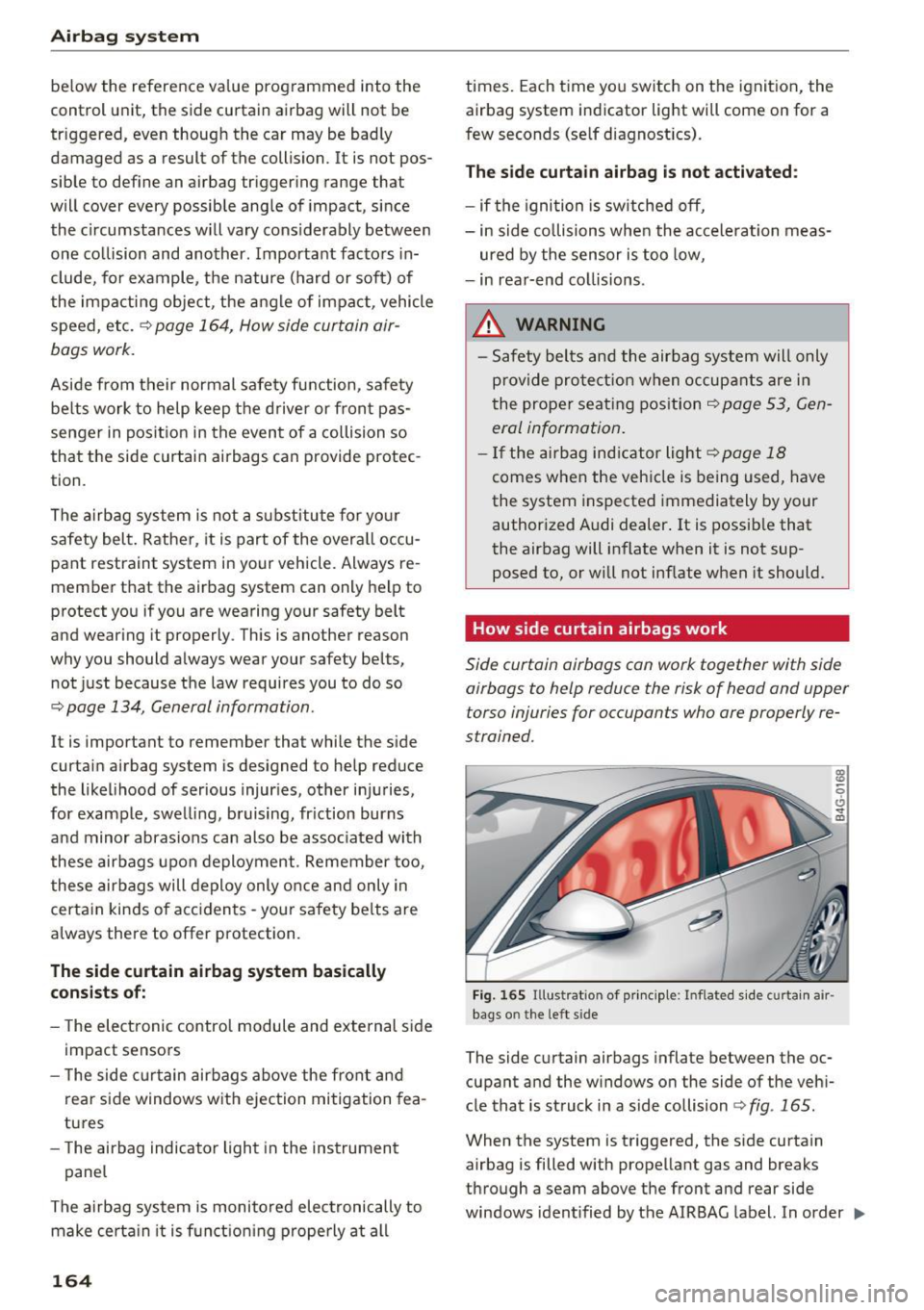
Fig. 165 Illus trat ion of principle: Inflated side curtain a ir
bags o n the left s ide
The side curtain airbags inflate between the oc
cupant and the windows on the side of the veh i-
cle that is struck i n a side collision ¢
fig. 165 .
When the system is triggered, the s ide curtain
airbag is filled with propellant gas and breaks
through a seam above the front and rear side
windows identified by the AIRBAG label. In order ..,.
Page 191 of 294
Intelligent Technology
ESC levels Sport mode on Sport mode off
Behavio r
The ESC and ASR stabilization functions The fu ll stabilization function of the ESC
are limited ¢ .&. . and ASR is avai lable again.
Operation Press the I .a OFF I button.
Press the I.a OFFI button again .
Indicator II turns on. II turns off.
lights
Driver mes- Stabilization control (ESC): sport. Warn- Stabilization control (ESC): on
sages ing! Restricted stability
A WARNING
Only switch sport mode on when your driving
abilities and the traffic s ituation permit, be
cause there is a r isk of slid ing .
- The stabilization function is limited when
sport mode is sw itched on. The driving
wheels could spin and the vehicle cou ld
swerve, espec ially on slick or slippery road
surfaces .
(D Tips
Sport mode cannot be sw itched on if the
cru ise control system* or adaptive cruise con
trol* is switched on.
Braking
What affects braking efficiency?
New brake pads
During the first 250 miles (400 km), new brake
pads do not possess the ir full braking effect, they
have to be "broken in" first¢.&. . You can com
pensate for this slightly reduced braking power
by push ing harder on the brake pedal. Avoid
h eavy braking loads during the break-in period .
Operating conditions and driving habits
The brakes on today's automobiles are still sub
ject to wear , depend ing largely on operating con
d itions and dr iving habits ¢.&. . On veh icles that
are e ither dr iven most ly in stop-and-go city traf
fic or are driven hard, the brake pads should be
checked by your authorized Audi deale r more of
ten than specified in the
Warranty & Mainte
nance booklet.
F ailure to have your brake pads inspected can result
in reduced brake perform
ance.
On steep slopes, you should use the braking ef
fect of the engine. This way, you prevent un nec
essa ry wea r on the brake system. If you must use
you r brakes, do not hold the brakes down contin
u ous ly. Pump the brakes at intervals.
Operating noise
Noises may occur when braking depending on the
speed, bra king fo rce and outside conditions such
as temperature and humidity.
Effect of water and road salt
In certain situations, for example after driving
through water, in heavy rain, after overn ight con
densation or afte r wash ing your car, the brak ing
effect can be reduced by moisture or ic e on the
brake rotors and brake pads. The brakes must be
dried f irst with a few careful brake applications .
At h igher speeds and w ith the windshield wipers
turned on, the brake pads press against the brak e
rotors for a short amount of time. This occurs at
regular intervals without the driver noticing and
provides for better brake response t ime under
wet conditions.
T he effectiveness of the brakes can be reduced
when the vehicle is driven on a sa lt-covered road
and the brakes are not used . Likewise, yo u clean
off accum ulated salt coating from brake discs
and pads with a few cautious applications of the
brake¢ .&..
Corrosion
There may be a tendency fo r dirt to build up on
the brake pads and corrosion to form on the discs .,..
189
Page 196 of 294
Driving and the environment
Driving and the
environment
Breaking in
New engine
The engine needs to be run-in during the first
1,000 miles (1,500 km).
For the first 600 miles (1,000 kilometers):
.,. Do not use full throttle .
.,. Do not drive at engine speeds that are more
than 2/3 of the maximum permitted RPM .
.,. Avo id high engine speeds.
From 600 to 1,000 miles (1,000 to 1,500
kilometers):
.,. Speeds can gradually be increased to the maxi
mum perm issib le road or engine speed.
During and after break-in period
.,. Do not rev the engine up to high speeds when it
is cold . This applies whether the transmission is
i n N (Neutral) or in gear .
After the break-in period
.,. Do not exceed maximum engine speed under
any circumstances.
.,. Upshift into the next higher gear
before reach
i ng the red area at the end of the tachometer
scale~
page 10 .
During the first few hours of driving, the engine's
internal friction is higher than later when all the
mov ing parts have been broken in. How well this
break- in process is done depends to a considera
b le extent on the way the vehicle is d riven during
the first 1,000 miles (1,500 kilometers).
(D Note
Extremely high engine speeds are automati
cally reduced. However, these rpm lim its are
programmed for an engine we ll run-in, not a
new engine .
194
® For the sake of the environment
Do not drive with unnecessarily high engine
speeds -upshifting early saves fuel, reduces
noise and protects the environment.
New tires
If your vehicle is running on new tires, drive par
ticularly careful for the first 350 m iles (500 kilo
meters) after f itting .
.8, WARNING
New tires tend to be slippe ry and must also
be "broken-in". Be sure to remember this dur
ing the first 350 mi les (500 kilometers).
Brake gent ly. Avoid following closely behind
other ve hicles or other situations that might
require sudden, hard braking.
Avoid damaging the
vehicle
When you are driving on poor roads, or over
curbs, steep ramps, etc., make certain that low
lying parts such as spo ilers and exhaust system
parts do not bottom out and get damaged .
-
This is especially true for vehicles with low-slung
chassis (sports chassis)* and fully loaded
vehicles.
Driving through water on
roads
Note the following to avoid vehicle damage when
driving through water, for examp le on flooded
roads:
- The water must not be any highe r than the bot
tom of the vehicle body.
- Do not drive faster than walk ing speed .
.8, WARNING
After driving through water or mud, the brak
ing effect can be red uced due to moisture on
the brake discs and brake pads . A few careful
brake applications should dry off the brakes.
Page 203 of 294
braking effect to slow the vehicle. Use of the
brakes alone can cause them to overheat and fail.
Air suspension*
When driving with a tra ile r, activate the trailer
mode of the air suspension. Switch the air sus
pension trailer mode on when you are towing a
trailer. This will limit the regulation by the air
suspension while driving. Select in the MMI :
ICARI function button > (Car)* systems control
button>
Vehicle settings> Air susp.: towing>
On.
Coolant temperature
The coolant temperature gauge¢ page 10 must
be observed carefully . The coolant temperature
can increase if you drive on long inclines in a low
gear at high engine speeds. Reduce your speed immediately if the LEDs in the top part of the dis
play turn on .
For more information about ind icator lights, re
fer to. ¢
page 15.
A WARNING
Anyone not properly restrained in a moving
vehicle is at a much greater risk in an acci
dent. Never let anyone ride in your car who is
not p roperly wearing the restraints p rovided
by Audi.
Trailer mode notes
Important to know -
Your vehicle handles differently when towing a
trailer because of the additional weight and dif
ferent weight distribution. Safety, performance
and
economy will greatly depend on how careful
ly you load your trailer and operate your rig .
Before you actually tow your trailer, practice
turning, stopping and backing up in an area away
from traff ic. Keep practicing until you have be
come comp letely fami liar with the way your vehi
cle-trailer comb inat ion behaves and responds.
Backing up is difficult and requires practice.
Backing up with a trailer generally requires steer-
Trailer mode
ing action opposite to that when backing up your
vehicle without a trailer .
Maintain a greater distance between your vehicle
and the one in front of you. You will need more
room to stop . To compensate for the trailer, you
will need a larger than normal turning radius .
When passing, remember that you cannot accel
erate as fast as you normally wo uld because of
the added load . Make sure you have enough room
to pass. After passing, allow p lenty of room for
your trailer before changing lanes again .
Avo id jerky starts, sharp turns or rapid lane
changes.
(D Tips
- Do not tow a trailer during the break-in peri
od of your veh icle.
-If you tow a trailer, your Audi may require
more frequent maintenance due to the ex
tra load ¢
page 2 73.
Parking on a slope
Do not pork on a slope with a trailer. If it cannot
be avoided, do so only ofter doing the following:
When parking:
"Apply the foot brake .
" Have someone place chocks under both the ve
hicle and the trailer wheels.
"W ith chocks in place, slowly release the brakes
until the wheel chocks absorb the load.
" Turn the whee ls towards the curb.
" App ly the parking brake.
" Select the P selector lever position.
When restarting after parking:
"App ly the foot brake.
" Start the engine .
"S elect the D/S se lector lever position.
" Release the parking brake and slowly pull out
and away from the wheel chocks.
" Stop and have someone retrieve the wheel
chocks.
201
Page 221 of 294
....
Audi oil quality standard
Gas oline
VW 502 00 or
engi ne vw 504 00
Die sel vw 507 00
en gin e
Using the prope r engine oil is important for the
functiona lity and service life of the eng ine. Your
engine was factory-filled with a high -quality oil
which can usually be used throughout the entire
year.
@ Note
Your Limited New Vehicle Warranty does not
cover damage or malfunctions due to failure
to follow recommended maintenance and use
requirements as set forth in the Audi Owner's Manual and Warranty
& Maintenance booklet.
- Use only a high quality eng ine oil that ex-
pressly complies with the Aud i oil quality
standard specified for your vehicle's engine.
Using any other oil can cause serious engine
damage .
- Do not mix any lubricants or other additives
into the engine oil. Doing so can cause en
gine damage.
(D Tips
If you need to add oil and there is none availa
ble that meets the Audi o il quality standard
your eng ine requ ires, you may add a total of
no more than 0.5 quart/liter of a h igh-quality
"synthet ic"oil that meets the followi ng speci
fications.
- Vehicles with gasoline eng ine: AC EA A3 o r
API SM wi th a viscosity g rade of SA E OW-30,
SAE SW-30 or SAE SW-40.
- Vehicles wit h diesel eng ine: ACEA C3 o r
API CF with a v iscosi ty grade of SA E OW-30
or SA E SW -30.
- Fo r more information abou t engine o il that
has been approved for your vehi cle, please
contact either you r a utho rized Audi dea ler
or A udi Customer Relations at
"' 1 (800) 822-2834 or visit our web site at
0
~ www.audiusa.com or www.aud icanada.ca.
....
Engine oil consumption
The engine in your vehicle depends on on ade
quate amount of oil to lubricate and cool oil of
its moving ports.
In order to provide effect ive lubrication and cool
i ng of internal engine components, all internal
combust ion eng ines consume a certa in amount
of oil. Oil consumption varies from eng ine to en
gine and may change s ign ificantly ove r the life of
the engine. Typ ica lly, engines w ith a specified
break-in period (see
¢ page 194) consume more
oi l during the break -in period than they consume
after oil consumption has stabilized.
Under normal cond itions, the rate of oil con
sumption depends on the q uality and viscosity o f
the oil, the RPM (revol utions per minute) at
which the engine is operated, the ambient tem
perature and road condit ions. Further factors are
the amount of oil dilution from water condensa
tion or fuel residue and the oxidation level of the o il. As any engine is subject to wear as mileage
builds up, the oil consumption may increase over
time unt il replacement of worn components may
become necessary.
With all these variables coming into play, no standard rate of o il consumption can be estab
li shed or spec ified . T he re is no alte rnative to reg
u la r and frequent checking of the oi l level , see
Note .
If the yellow engine o il leve l warning symbo l in
the instrument cluster
II lights up, yo u should
c h eck the o il level as soon as possible
¢ page 220. Top off the o il at your earlies t con
venience
¢ page 220.
A WARNING
--=-
Before you check anything in the engine com-
partment, always read and heed all WARN
INGS
¢ &. in Working in the engine comport
ment on page 216.
(D Note
Driving wit h an insufficient oil level is likely to
cause severe damage to the eng ine.
IJJ,,
219
Page 236 of 294
Wheels
Bead
means the part of the tire that is
made of steel wires, wrapped or
reinforced by ply cords and that is
shaped to fit the rim .
Bead separation
means a breakdown of the bond
between components in the bead.
Cord
means the strands forming the
plies in the tire.
Cold tire inflation pressure
means the tire pressure recom
mended by the vehic le manufac
turer for a tire of a des ignated
size that has not been driven for more than a couple of miles (kilo
meters) at low speeds in the
three hour period before the tire pressure is measured or adj usted.
Curb weight
means the weight of a motor ve
hicle w ith standard equipment in
cluding the maximum capacity of
fuel, oil, and coolant, air condi
tioning and additiona l weight of
op tional equipment.
E x tra load tire
means a tire des igned to operate
at higher loads and at h igher in -
234
flation pressures than t he corre
spond ing standa rd tire. Extra load
tires may be identified as "XL",
"xl" , "EXTRA LOAD" , or "RF" on
the sidewall.
Gross A xle Weight Rating
("GAWR ")
means the load-carrying capacity
of a single axle system , measured
at the ti re-gro und interfaces.
Gross Vehicle Weight Rating
("GVWR")
means the max imum total loaded
weight of the vehicle .
Groove
means the space between two ad
jacent tread ribs .
Load rating (code)
means the maximum load tha t a
tire is rated to carry for a given in
flation pressure. You may not find
this informat ion on all ti res be
cause it is not required by law .
Maximum load rating
means the load rating for a tire at
the maximum permissible infla
tion p ressure for that ti re .
Maximum loaded vehicle
weight
means the sum of: ...
Page 265 of 294
Bulbs
Replacing light bulbs
For your safety, we recommend that you have
your authorized Audi dealer replace burned out
bulbs for you.
It is becoming increasingly more and more diffi
cult to replace vehicle light bulbs since in many
cases, other parts of the car must first be re
moved before you are able to get to the bulb.
This applies especially to the light bulbs in the
front of your car wh ich you can only reach
through the eng ine compartment.
Sheet metal and bulb holders can have sharp
edges that can cause serious cuts, and parts must be correctly taken apart and then properly
put back together to help prevent breakage of
parts and long term damage from water that can
ente r hous ings that have not been properly re
sea led .
F or your safety, we recommend that you have
your author ized Audi dealer replace any bu lbs for
you, s ince your dealer has the p roper tools, the
correct bulbs and the expertise.
Gas di schar ge l amp s (X enon li ghts):
Due to the high electrical voltage, have the bulbs
replaced by a qual ified technician . Headlights
w ith Xenon light can be identified by the high
voltage sticker.
LED headlights* require no maintenance. Please
contact your authorized Audi dealer if a bulb needs to be replaced.
A WARNING
Contact w ith high-voltage components of the
elect rical system a nd improper rep lacement
of gas d ischarge (Xenon) headlight b ulbs can
cause serious personal injury and death .
- Xenon bulbs are press urized and can ex
plode when be ing changed.
- Chang ing Xenon lamps requires the spec ial
t rain ing, instructions and equipment.
- Only an autho rized Aud i dea le r o r other
qualified wo rkshop s hou ld change the bulbs
in gas disc harge lamps .
Bulbs
A WARNING
There are parts with sharp edges on the open
i ngs and on the bulb holders that can cause
serious cuts.
- If you are uncertain about what to do, have
the work performed by an authorized Audi dealer or other qualified workshop. Ser ious
pe rsonal injury may result from improperly
pe rformed work.
0) Tips
- If you st ill prefer to replace the light bulbs
yourself, be aware that the engine compart ment is a hazardous area to work in
~page 216~ .&
-It is best to ask your authorized Audi dealer
w henever you need to change a bu lb.
263
Page 280 of 294
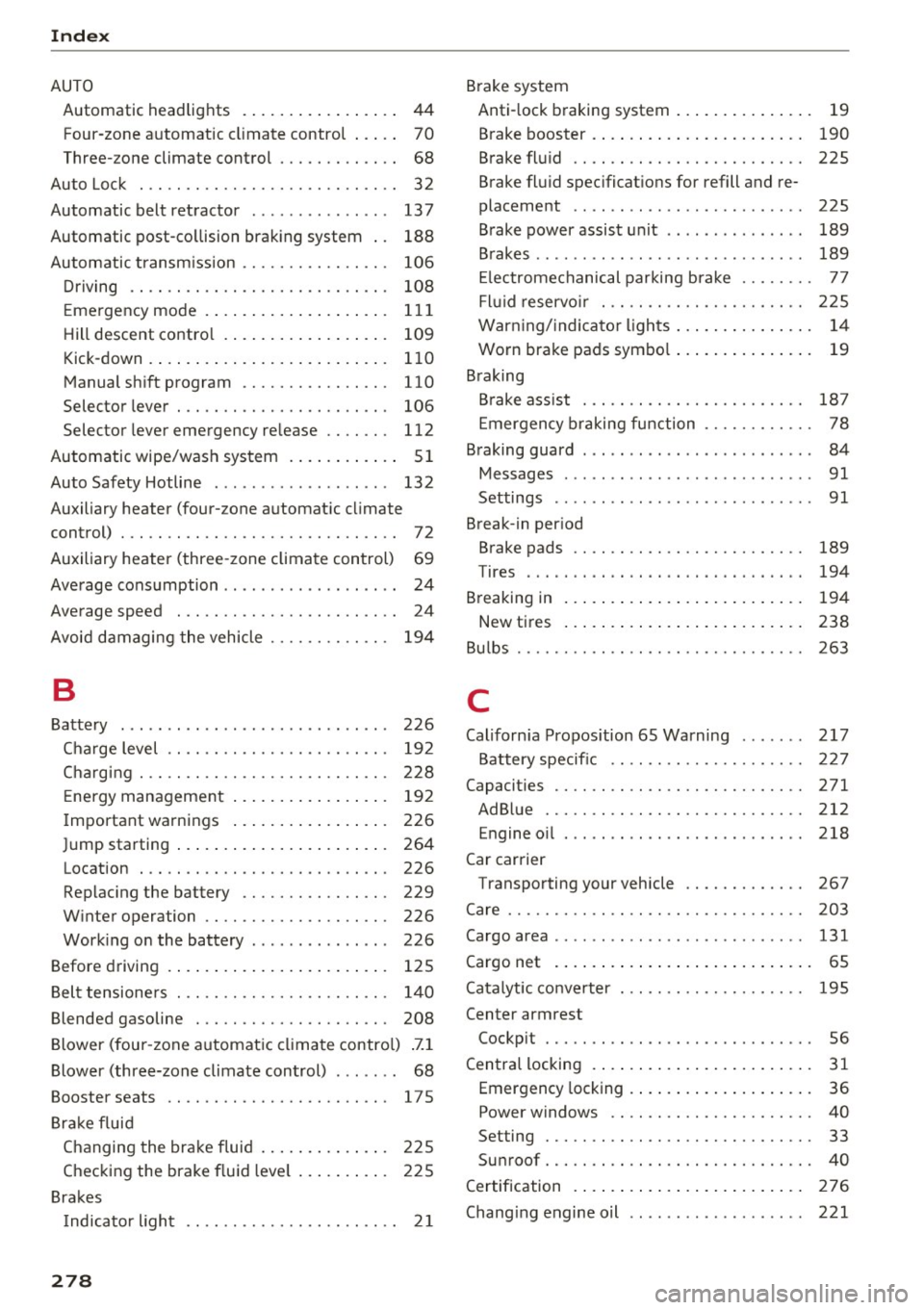
Index
AUTO Automatic headlights . . . . . . . . . . . . . . . . . 44
Four-zone automatic cl imate control . . . . . 70
Three- zone climate control . . . . . . . . . . . . . 68
Auto Lock . . . . . . . . . . . . . . . . . . . . . . . . . . . . 32
Automatic belt retractor . . . . . . . . . . . . . . . 13 7
Automatic post-collision braking system . . 188
Automatic transm ission . . . . . . . . . . . . . . . . 106
Driving . . . . . . . . . . . . . . . . . . . . . . . . . . . . 108
Emergency mode . . . . . . . . . . . . . . . . . . . . 111
Hill descent contro l . . . . . . . . . . . . . . . . . . 109
Kick-down.......................... 110
Manual shift program . . . . . . . . . . . . . . . . 1 10
Selector lever . . . . . . . . . . . . . . . . . . . . . . . 106
Selector lever emergency release . . . . . . . 112
Automatic wipe/wash system . . . . . . . . . . . . 51
Auto Safety Hotline . . . . . . . . . . . . . . . . . . . 132
Auxiliary heater (four-zone automatic climate
control) . . . . . . . . . . . . . . . . . . . . . . . . . . . . . . 72
Auxiliary heater (three-zone climate control) 69
Average consumption . . . . . . . . . . . . . . . . . . . 24
Average speed . . . . . . . . . . . . . . . . . . . . . . . . 24
Avoid damaging the vehicle . . . . . . . . . . . . . 194
B
Battery ... .. .. ... .. .. .. ... .. ... .. .. .
Charge level .. .... ........... .... .. .
Charging . .. .. ............... .... .. .
Energy management ................ .
Important warnings .............. .. .
Jump starting ................... ... .
Location
. .. .. .. ............. .... .. .
Replacing the battery .. ... .... .. .. .. .
Win ter operation .... ............. .. .
Working on the battery .............. .
Before driving 226
192
228 192
226
264
226
229
226 226
12S
Belt tensioners . . . . . . . . . . . . . . . . . . . . . . . 140
Blended g asoline . . . . . . . . . . . . . . . . . . . . . 208
Blower (four-zone automatic climate control) .7.1
Blower (three-zone climate control) . . . . . . . 68
Booster seats . . . . . . . . . . . . . . . . . . . . . . . . 17 5
Brake fluid Changing the brake fluid . . . . . . . . . . . . . . 225
Checking the brake fluid level . . . . . . . . . . 225
Brakes Indicator light . . . . . . . . . . . . . . . . . . . . . . . 21
278
Brake system
Anti- lock braking syst em . . . . . . . . . . . . . . . 19
Brake booster . . . . . . . . . . . . . . . . . . . . . . . 190
Brake fluid . . . . . . . . . . . . . . . . . . . . . . . . . 22S
Brake fluid specific ations fo r refill and re
placement . . . . . . . . . . . . . . . . . . . . . . . . . 225
Brake power assist unit . . . . . . . . . . . . . . . 189
Brakes . . . . . . . . . . . . . . . . . . . . . . . . . . . . . 189
Electromechanical parking brake . . . . . . . . 77
Fluid reservoir . . . . . . . . . . . . . . . . . . . . . . 225
Warning/indicator lights . . . . . . . . . . . . . . . 14
Worn brake pads symbo l . . . . . . . . . . . . . . . 19
Braking Brake assist . . . . . . . . . . . . . . . . . . . . . . . . 187
Emergency braking function . . . . . . . . . . . . 78
Braking guard . . . . . . . . . . . . . . . . . . . . . . . . . 84
Messages . . . . . . . . . . . . . . . . . . . . . . . . . . . 91
Settings . . . . . . . . . . . . . . . . . . . . . . . . . . . . 91
Break-in period Brake pads . . . . . . . . . . . . . . . . . . . . . . . . . 189
Tires 194
Breaking in . . . . . . . . . . . . . . . . . . . . . . . . . . 194
New tires . . . . . . . . . . . . . . . . . . . . . . . . . . 238
Bulbs . . . . . . . . . . . . . . . . . . . . . . . . . . . . . . . 263
C
California Proposition 65 Warning ..... . .
Battery specific .. .. .. .. ........... . .
Capacities Ad Blue 217
227
271
212
E ngine oil ....... ... ............. .. . 218
Car carrier Tr ansporting your vehicle . . . . . . . . . . . . . 26 7
Care . . . . . . . . . . . . . . . . . . . . . . . . . . . . . . . . 203
Cargo area .. ... ... .. .. ... ..... ..... .. 131
Cargo net . . . . . . . . . . . . . . . . . . . . . . . . . . . . 65
Catalytic converter 195
Center armrest Cockpit . . . . . . . . . . . . . . . . . . . . . . . . . . . . . 56
Central locking . . . . . . . . . . . . . . . . . . . . . . . . 31
Emergency locking . . . . . . . . . . . . . . . . . . . . 36
Power windows . . . . . . . . . . . . . . . . . . . . . . 40
Setting . . . . . . . . . . . . . . . . . . . . . . . . . . . . . 33
Sunroof. . . . . . . . . . . . . . . . . . . . . . . . . . . . . 40
Certification . . . . . . . . . . . . . . . . . . . . . . . . . 276
Changing engine oil . . . . . . . . . . . . . . . . . . . 221