towing AUDI A6 2016 User Guide
[x] Cancel search | Manufacturer: AUDI, Model Year: 2016, Model line: A6, Model: AUDI A6 2016Pages: 294, PDF Size: 73.88 MB
Page 202 of 294
Trailer mod e
Tire pr essure
When tow ing a tra iler, inflate the tires of you r
veh icle to the cold tire pressure listed under "Fu ll
load" on the label located on the driver's side B
pillar (visib le when the door is open) . Inflate
trai ler tires to trailer and tire manufacturers'
specifications.
Light s
Check to make sure both vehicle and trailer lights
are working proper ly.
Safet y chains
Be sure t railer safety chains are properly connect
ed from the trailer to the h itch on the veh icle.
L eave enough slack in the chains to permit turn
ing corners . When yo u install safety chains, make
sure they wi ll not drag on the road when you are
driving.
The chains shou ld cross under the trailer tongue
to prevent it from dropping in case of separation
from the hitch .
Adjusting the Audi d rive select
Make sure the vehicle is on a level surface bef ore
hitching up the t railer and bef ore adjust ing the
tongue we ight . The vehicle must be in
auto or
comf ort driving mode and not raised
r::!> page 100, r::!> 0 .
Make sure that the vehicle is lowered. In Info
tainment, select:
ICARI function button > Lower
control button .
I f you m ust dr ive under poor road condit ions, you
can ra ise the vehicle
afte r coup ling the t rai ler or
after adjusting the tongue weight r:!> page 102.
(D Note
-Changes in tempe rature or load can affect
the he ight of the vehicle.
- Always se lect
auto or comfort mode. Othe r
wise, the tongue load spec ified for yo ur ve
hicle w ill no longer be applicable .
200
· Driving instructions
Driving with a trailer always requires extra care
and consideration .
To obtain the best possible hand ling of veh icle
and trailer, please note the following:
.,. Do not tow a loaded trailer when your car itself
is not loaded .
.,. Be especially careful when passing other
vehicles .
.,. Observe speed limits .
.,. Do not dr ive at the maximum permissible
speed.
.,. Always app ly brakes ea rly.
.,. Monitor the temperat ure gauge.
Weight distribution
Towing a loaded trai ler with an empty car results
i n a h ighly unstab le distribution of weight . If this
cannot be avoided, drive at very low speeds only
to avoid the risk of losing steer ing contro l.
A "balanced" rig is easier to operate and control.
This means that the tow vehicle shou ld be loaded
to the extent possible and permissib le, wh ile
k eeping the trailer as l ight as poss ible under the
c ircu mstances . Wheneve r possib le, transfer
some ca rgo to the luggage compartment of the
tow vehicle while observing tongue load require
ments and vehicle loading considerations.
Speed
The higher the speed, the mo re diff icu lt i t be
comes fo r the driver to con trol the r ig . Do not
drive at the maximum permissible speed. Reduce
your speed even more if load, weather or wind
cond itions are unfavorab le -particularly when
go ing downh ill.
Reduce vehicle speed
i mmed iatel y if the trailer
shows the slightest sign of swaying.
Do not tr y
to stop the swaying by accelerating.
Observe speed limits . In some areas, speeds for
vehicles towing trailers are lower than for regular
vehicles .
Always apply bra kes early. Whe n driving down -
hill, shift into a lower gear to use the engine .,..
Page 203 of 294
braking effect to slow the vehicle. Use of the
brakes alone can cause them to overheat and fail.
Air suspension*
When driving with a tra ile r, activate the trailer
mode of the air suspension. Switch the air sus
pension trailer mode on when you are towing a
trailer. This will limit the regulation by the air
suspension while driving. Select in the MMI :
ICARI function button > (Car)* systems control
button>
Vehicle settings> Air susp.: towing>
On.
Coolant temperature
The coolant temperature gauge¢ page 10 must
be observed carefully . The coolant temperature
can increase if you drive on long inclines in a low
gear at high engine speeds. Reduce your speed immediately if the LEDs in the top part of the dis
play turn on .
For more information about ind icator lights, re
fer to. ¢
page 15.
A WARNING
Anyone not properly restrained in a moving
vehicle is at a much greater risk in an acci
dent. Never let anyone ride in your car who is
not p roperly wearing the restraints p rovided
by Audi.
Trailer mode notes
Important to know -
Your vehicle handles differently when towing a
trailer because of the additional weight and dif
ferent weight distribution. Safety, performance
and
economy will greatly depend on how careful
ly you load your trailer and operate your rig .
Before you actually tow your trailer, practice
turning, stopping and backing up in an area away
from traff ic. Keep practicing until you have be
come comp letely fami liar with the way your vehi
cle-trailer comb inat ion behaves and responds.
Backing up is difficult and requires practice.
Backing up with a trailer generally requires steer-
Trailer mode
ing action opposite to that when backing up your
vehicle without a trailer .
Maintain a greater distance between your vehicle
and the one in front of you. You will need more
room to stop . To compensate for the trailer, you
will need a larger than normal turning radius .
When passing, remember that you cannot accel
erate as fast as you normally wo uld because of
the added load . Make sure you have enough room
to pass. After passing, allow p lenty of room for
your trailer before changing lanes again .
Avo id jerky starts, sharp turns or rapid lane
changes.
(D Tips
- Do not tow a trailer during the break-in peri
od of your veh icle.
-If you tow a trailer, your Audi may require
more frequent maintenance due to the ex
tra load ¢
page 2 73.
Parking on a slope
Do not pork on a slope with a trailer. If it cannot
be avoided, do so only ofter doing the following:
When parking:
"Apply the foot brake .
" Have someone place chocks under both the ve
hicle and the trailer wheels.
"W ith chocks in place, slowly release the brakes
until the wheel chocks absorb the load.
" Turn the whee ls towards the curb.
" App ly the parking brake.
" Select the P selector lever position.
When restarting after parking:
"App ly the foot brake.
" Start the engine .
"S elect the D/S se lector lever position.
" Release the parking brake and slowly pull out
and away from the wheel chocks.
" Stop and have someone retrieve the wheel
chocks.
201
Page 247 of 294
-Tires on a vehicle that has
been overloaded can fail sud
denly, including a blowout and
sudden deflation, causing loss
of control and a crash.
-Always make sure that the to tal load being transported -
including the weight of a trail
er hitch and the tongue
weight of a loaded trailer - does not make the vehicle
heavier than the vehicle's
Gross Vehicle Weight Rating.
Determining correct load
limit
Use the example below to calcu
late the total weight of the pas
sengers and luggage or other
things that you plan to transport so that you can make sure that
your vehicle will not be overload
ed.
Steps for Determining Correct Load Limit
1. Locate the statement "THE
COMBINED WEIGHT OF OCCU
PANTS AND CARGO SHOULD
NEVER EXCEED XXX KG OR XXX
LBS "on your vehicle's placard
(tire inflation pressure label)
¢ page 241, fig. 195.
Wheels
2. Determine the combined
weight of the driver and pas sengers that will be riding in
your vehicle.
3. Subtract the combined weight of the driver and passengers
from "XXX" kilograms or "XXX"
pounds shown on the sticker
¢ page 241, fig . 195 .
4. The resulting figure equals the
available amount of cargo and
luggage load capacity. For ex
ample, if the "XXX " amount
equals
1400 lbs. and there will
be five
150 lbs . passengers in
your vehicle, the amount of
available cargo and luggage
load capacity is 650 lbs.
(1400-750 (5 X 150) = 650
lbs .)
5. Determine the combined
weight of luggage and cargo
being loaded on the vehicle.
That weight may not safely ex ceed the available cargo and
luggage load capacity calculat
ed in Step 4.
6. If your vehicle will be towing a trailer, load from your trailer
will be transferred to your ve
hicle. Consult this manual to
determine how this reduces ..,
245
Page 254 of 294
Emergency assistance
-Hooks to remove the whee l covers*
- Plastic hook to remove wheel bolt covers*
- Whee l bolt wrench
- Al ignment pin for changing wheels
- Screwdriver with revers ible blade
- Towing eye
- Jack
Before storing the jack, make sure it is wound
back down as far as it wi ll go.
A WARNING
Improper use of the vehicle jack can cause se
rious persona l injuries.
- Never use the screw driver hex head to
tighten whee l bolts, since the bolts cannot
atta in the necessary tighten ing torque if you
use the hex head, potentially caus ing an ac
cident.
- The factory-supplied jack is intended on ly
for your vehicle model. Under no circum
stances should it be used to lift heavy
vehicles or other loads; you r isk injuring
yourself.
- Never start the eng ine when the vehicle is
raised, which could cause an accident.
- Support the veh icle securely with appropri
ate stands if work is to be performed under
neath the vehicle; otherwise, there is a po
tent ial r isk for injury .
- Never use the jack supplied with your Audi
on another vehicle, particularly on a heavier
one. The jack is only suitable for use on the
vehicle it came with.
(D Tips
- Some of the on board items listed above are
provided on certain models only or are op
tiona l extras.
- Before you can ra ise your veh icle using the
j ack, you must act ivate the jacking mode
c:::;,page255.
252
· Space-saving spare tire (compact spare
tire)
The spare tire/wheel is located in the luggage
compartment under the cargo floor cover. It is
intended for short -term use only.
Taking out the spare tire
" Lift the cargo floor by the plastic handle
c:::;,page 251, fig. 200 .
" Hook the handle into the luggage compartment
weather strip.
"Tur n the large sc rew
c:::;, page 251, fig. 200
counter-clockwise .
" Take out the spare tire.
" Always store the vehicle tool kit, the jack* and
the replaced tire in the luggage compartment
c:::;,page 131.
"Unhook the cargo floor before closing the rear
lid .
Using the spare tire (compact spare tire)
The compact spare tire is on ly intended for emer
gencies until you can reach a repair shop. Replace
it as quickly as poss ible with a standard wheel
and t ire.
There are some restrictions on the use of the compact spare tire. The compact spare tire has
been designed spec ifically for your type of vehi
cle . It must not be swapped with a compact
spare tire from another type of veh icle .
Snow chains
For technical reasons, the use of snow chains on
the compact spare tire is
not permitted .
If you do have to drive with snow chains and a
front tire fails, mount the spare whee l with tire
instead
of a rear tire. Install the snow chains on
the rear tire and use it to replace the defect ive
front tire .
A WARNING
-Never use the spare tire if it is damaged or if
it is worn down to the tread wear indicators .
- If the spare tire is more than 6 years old,
use it only in an emergency and with ex
treme caution and careful driving.
Page 255 of 294
-The spare tire is intended on ly for tempora
ry and short-term use. It shou ld be replaced
as soon as possible with the normal wheel
and t ire.
- After mounting the compact spare tire, the
tire pressure must be checked as soon as
poss ible. The t ire pressure of the compact
spare tire m ust be 4.2 bar; otherwise, you
risk having an accident.
- Do not drive faster than SO mph (80 km/h).
You risk hav ing an accident .
-Avoid full-throttle accelerat ion, heavy brak
ing, and fast cornering . You risk having an
acc ident.
- Never drive us ing more than one spare
wheel and tire . You risk having an acc ident.
- Normal summer or winter tires must not be
mounted on the compact spare wheel rim .
- For technical reasons, the use of tire chains
on the spare tire is not perm itted. If it is
necessary to drive with t ire chains, the spare
wheel m ust be mounted on the front axle i n
the even t of a flat in a rea r tire. The new ly
avail able front wheel m ust then be insta lled
in place of the rear wheel with the flat tire .
Installing the tire chain before mounting
the wheel and tire is recommended .
- Loose items in the passenger compartment
can cause ser ious personal injury during
hard braking or in an acc ident. Never store
the inflatable spare t ire or jack and too ls in
the passenger compartment.
Replacing wheels
Before changing a wheel
Observe the following precautions for your own
and your passenger's safety when changing a
wheel.
• After you experience a tire failure , pull the car
well away from moving t raff ic and try to reach
level ground before you stop¢ A-
• All passengers sho uld leave the car and move
to a safe location (fo r instance, be hind the
guardrail) ¢
A.
• Engage the parking b rake to prevent yo ur vehi
cle from roll ing unintentionally ¢
A-
Em ergenc y ass is tanc e
• Move selecto r lever t o po sit ion P ¢ A .
• If you are towing a trai ler, unhitch the trailer
from yo ur vehicle .
• Take the
jack and the spare tire out of the lug
gage compartment
¢page 251, ¢page 252.
A WARNING
You or your passengers could be injured while
changing a whee l if you do no t follow these
safety precaut ions:
- If you have a flat tire, move a safe distance
off the road. Turn off the eng ine, turn the
emergency f lashers on a nd use other wa rn
ing devices to alert other motorists.
- Make sure that passenge rs wait i n a safe
p la ce away from the vehicle and well away
fr om the road and t raff ic.
- To help preven t the veh icle from moving
suddenly and possib ly slipping off the ja ck,
always fu lly set the park ing brake and bloc k
the wheel diagonally opposite the wheel be ing changed. When one front whee l is lifted
off the ground, placing the Automatic
Transmission in P (Park) wi ll
not prevent the
veh icle from moving.
- Before you change a wheel, be sure the
ground is level and firm. If necessary, use a
sturdy board under the jack.
- Always store the vehicle tool kit, the jack
and the replaced tire in the luggage com
partment
¢ page 131.
(!) Tips
Before changing the wheel, you must activate
the jacking mode, so that the automat ic con
tro ls for the Adaptive Air Suspension* do not
make it more difficult to lift the vehicle with
the jack ¢
page 255.
Changing a wheel
When you change a wheel , follow the sequence
described below step -by -step and in exactly that
order .
l. Activate the vehicle jack mode*¢ page 255. .,.
253
Page 266 of 294
Emergency situations
Emergency situations
General
This chapter is intended for trained emergency crews and working personnel who have the nec
essary tools and equipment to perform these
operations.
Starting by pushing or
towing
CD Note
Vehicles with an automatic transmission can
not be started by pushing or towing.
Starting with jumper
cables
If necessary, the engine con be started by con
necting it to the battery of another vehicle .
If the engine should fail to start because of a dis
charged or weak battery, the battery can be con
nected to the battery of
another vehicle, using a
pair of jumper cables to start the engine.
Jumper cables
Use only jumper cables of sufficiently large cross
section
to carry the starter current safely. Refer
to the manufacturer's specifications.
Use only jumper cables with
insulated terminal
clamps which are distinctly marked :
plus(+) cable in most cases colored red
minus(-) cable
in most cases colored black .
A WARNING
Batteries contain electricity, acid, and gas.
Any of these can cause very serious or fatal in
jury. Follow the instructions below for safe hand Ling of your vehicle's battery .
-Always shield your eyes and avoid leaning
over the battery whenever possible.
-A discharged battery can freeze at tempera
tures just below 32 °F (0 °C). Before con
necting a jumper cable, you must thaw the
264
frozen battery completely, otherwise it could explode .
- Do not allow battery acid to contact eyes or
skin. Flush any contacted area with water immediately.
- Improper use of a booster battery to start a
vehicle may cause an explosion.
- Vehicle batteries generate explosive gases.
Keep sparks, flame and lighted cigarettes
away from batteries.
- Do not try to jump start any vehicle with a
low acid level in the battery .
- The voltage of the booster battery must also
have a 12-volt rating. The capacity (Ah) of
the booster battery should not be lower
than that of the discharged battery. Use of
batteries of different voltage or substantial
ly different "Ah" rating may cause an explo
sion and personal injury .
- Never charge a frozen battery. Gas trapped in the ice may cause an explosion .
- Never charge or use a battery that has been
frozen . The battery case may have be weak
ened .
- Use of batteries of different voltage or sub stantially different capacity (Ah) rating may
cause an explosion and injury. The capacity
(Ah) of the booster battery should not be
lower than that of the discharged battery.
- Before you check anything in the engine
compartment, always read and heed all
WARNINGS
~page 216.
CD Note
-Applying a higher voltage booster battery
will cause expensive damage to sensitive
electronic components, such as control
units, relays, radio, etc.
- There must be no electrical contact between
the vehicles as otherwise current could al
ready start to flow as soon as the positive
(+) terminals are connected.
@ Tips
The discharged battery must be properly con-
nected to the vehicle's electrical system. .,.
Page 268 of 294
Emergency situations
(D Note
Improper hook -up of ju mper cables can r uin
the generato r.
- Always con nect P OSITIVE( +) to POS ITI VE
( + ), and NEG ATI VE( -) to NEGATIVE( -)
ground post of t he battery manage r contro l
u nit .
- Check that a ll sc rew p lugs on the battery
cells are sc rewed in firmly . If not, t ighten
plugs p rior to connect ing clamp o n negat ive
b attery t erminal.
- Please note t hat the procedure fo r con nect
i ng a jumper cable as desc rib ed above ap
plies specifica lly to the case of yo ur vehicle
being jum p starte d. When you a re giv ing a
ju mp sta rt to anothe r vehicle, do
not con
n e ct t he neg ative( -) ca b le to the neg ative
(- ) termin al o n t he dis ch arged battery @
¢
fig . 215. Inste ad, securely connec t the
negative (-) cab le to either a so lid metal
compo nent that is f irm ly bolted to the e n
gine block o r to the engine bloc k itself. If
the battery that is bei ng cha rged does not
vent to the outside, escap ing battery gas
could ignite an d exp lode!
Towing with a tow truck
General hints
Your Audi requires special handling for towing.
The fo llow ing informa tion is to be used by com
mercial tow truck operators who know how to op
era te the ir equipmen t sa fe ly .
- Never tow your Audi. Towing will cause dam
age to the engine and transmi ssion.
- Never wrap the safety chains or winch cables
around the brake l ines .
- To prevent unnecessary damage, your Audi
must be transported with a flat bed truck.
- To load the vehicle on to the flat bed , use the
towing loop found in the vehicle tools and at
tach to the front or rear anchorage
¢ page 266 and ¢ page 267.
266
A WARNING
A veh icle being towed is not safe for passe n
ge rs . Neve r allow a nyone to ride in a vehicle
be ing towed, fo r any reason .
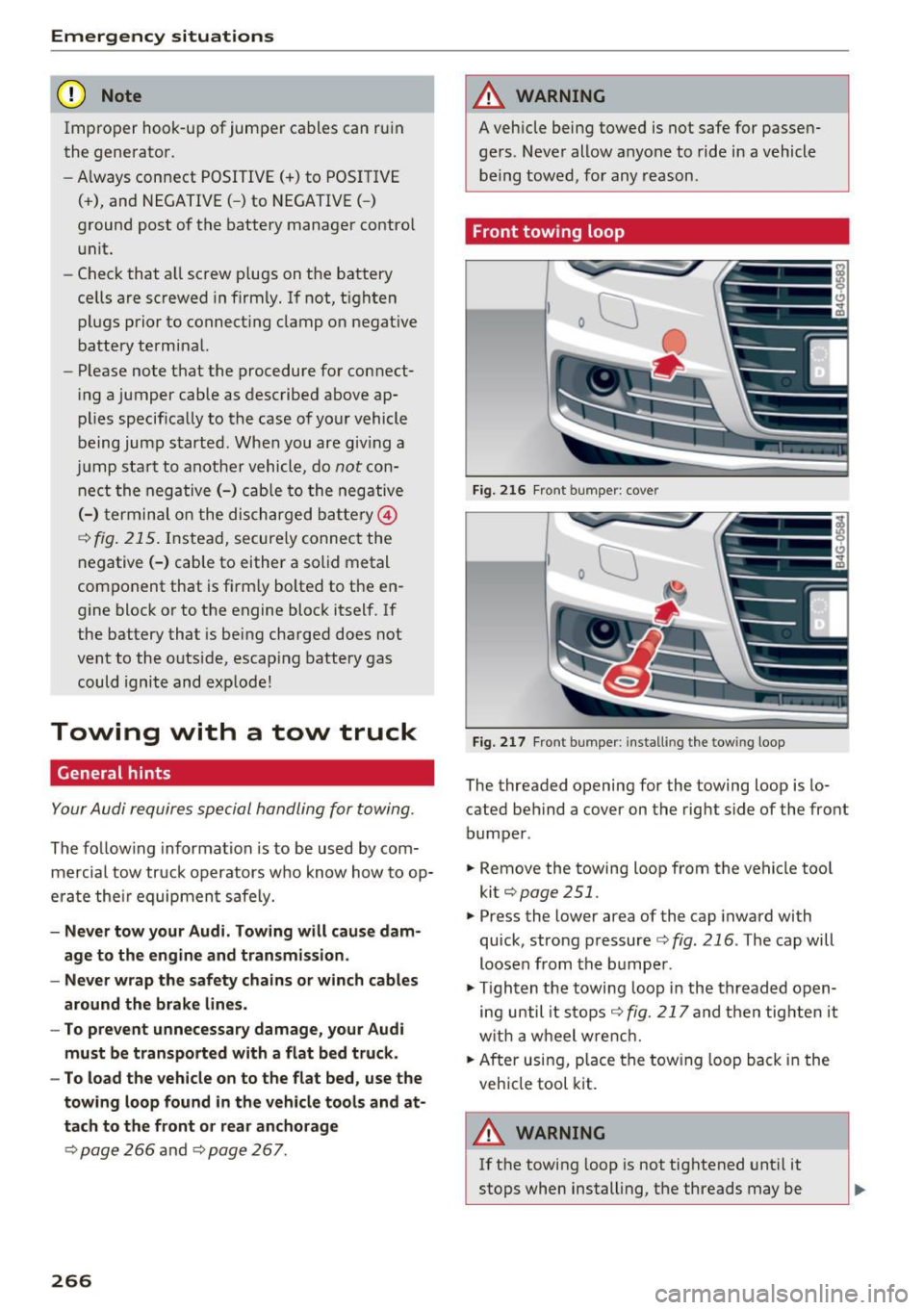
Front towing loop
Fig. 216 Fron t bumper : cover
Fi g. 21 7 Fron t bumper : install ing the tow ing loop
The threaded opening for the towing loop is lo
cated behind a cover on the rig ht side of the front
bumper .
.. Remove the towing loop f rom the vehicle too l
kit¢
page 251 .
.. Press the lower area of the cap inward with
quick, strong p ressure
¢ fig. 216 . The cap will
loosen from the b umpe r.
.. Tighten the towi ng loop in the threaded o pen
i n g until it stops ¢
fig. 21 7 and then tig hten it
w it h a wheel wre nc h .
.. After using, p lace the tow ing loop b ack in the
veh icle tool kit.
A WARNING
If t he t owi ng loop is not tightened unt il it
stops when installing, the threads may be
-
Page 269 of 294
.... N
0 CJ '
pulled out when towing the vehicle and that
could cause an accident.
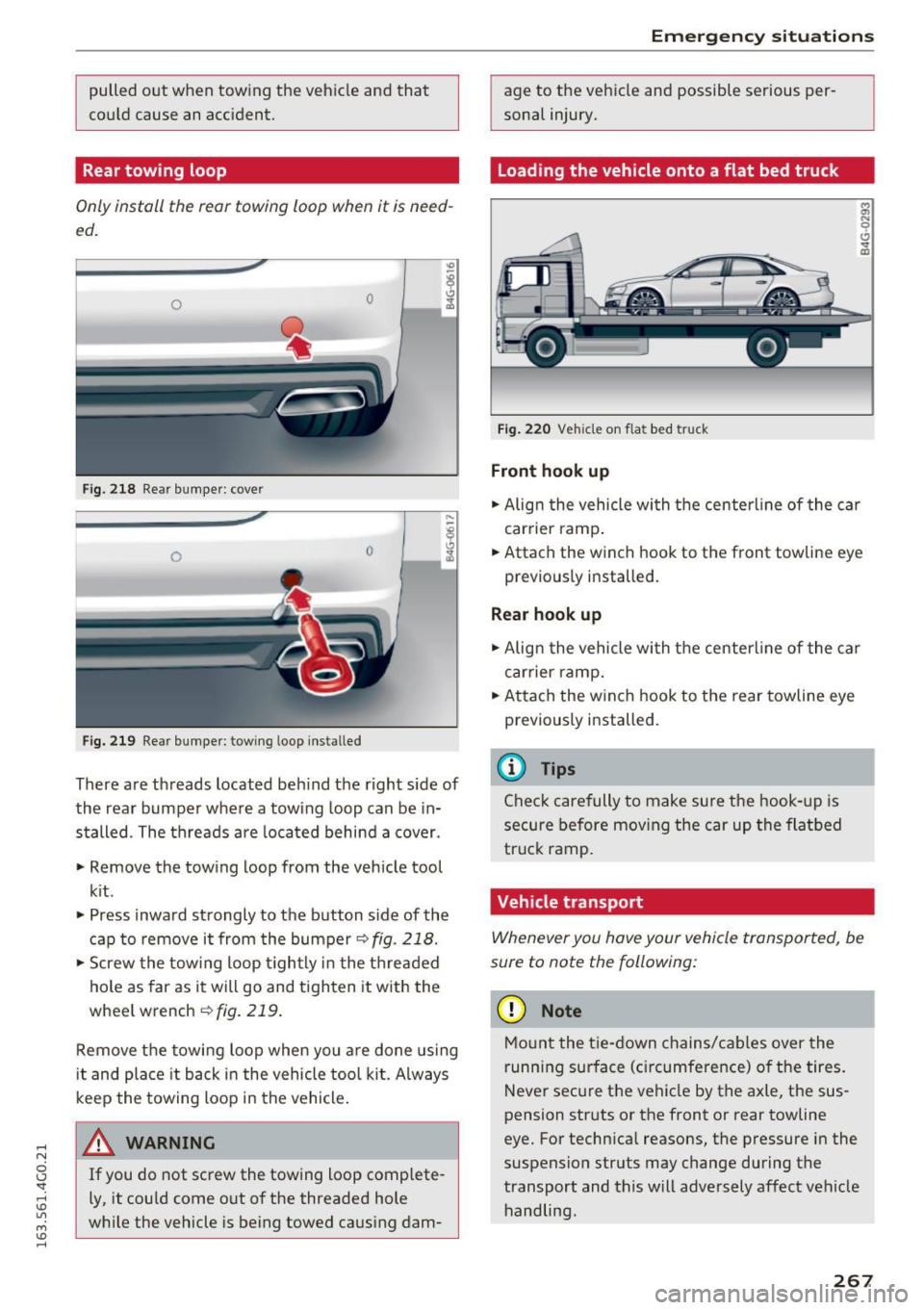
Rear towing loop
Only install the rear towing Loop when it is need
ed.
0 0
Fig. 218 Rea
r bumpe r: cover
0 0 I
--
Fig. 219 Rear bumpe r: towing loop installed
There are threads located beh ind the right side of
the rear bumper where a tow ing loop can be in
stalled . The threads are loca ted behind a cover.
.. Remove the towing loop from the vehicle tool
kit .
.. Press inward strongly to the button side of the
cap to remove it from the bumper
C? fig. 218.
.. Screw the towing loop tightly in the threaded
hole as far as it will go and tighten it with the
wheel wrench
¢ fig. 219.
Remove the towing loop when you a re done using
it and place it back in the vehicle tool kit. Always
keep the towing loop in the vehicle.
_& WARNING
If you do not screw the towing loop complete
ly, it cou ld come out of the threaded hole
while the vehicle is being towed caus ing dam-
Emergency situations
age to the vehicle and possible serious per
sonal injury.
Loading the vehicle onto a flat bed truck
Fig. 220 Veh icle on flat bed truck
Front hook up
.. Alig n the vehicle with the centerline of the car
carrier ramp.
.. Attach the winch hook to the front towline eye
previously installed.
Rear hook up
.. Align the vehicle with the centerl ine of the car
carrier ramp .
.. Attach the winch hook to the rear towline eye
previously installed.
(D Tips
Check carefully to make sure the hook-up is
secure before moving the car up the flatbed
truck ramp .
Vehicle transport
Whenever you have your vehicle transported, be
sure to note the following:
(D Note
Mount the tie-down chains/cables over the
running surface (c ircumference) of the tires.
Never secure the vehicle by the axle, the sus
pension struts or the front or rear towline
eye. For technica l reasons, the pressure in the
suspension struts may change during the
transport and this will adversely affect vehicle handling.
267
Page 275 of 294
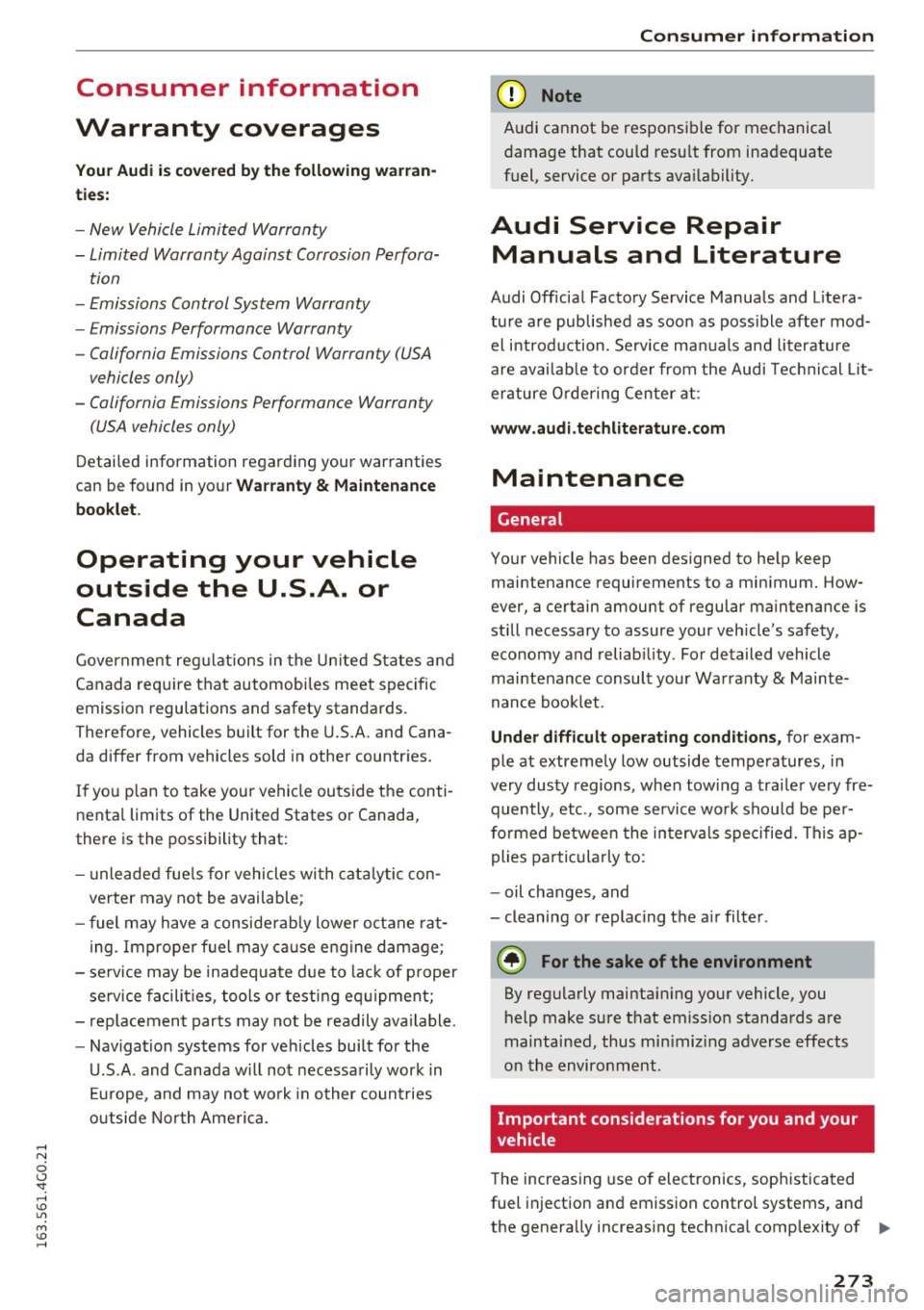
Consumer information
Warranty coverages
Y our Audi is co vered b y the foll owing war ran
tie s:
- New Vehicle Limited Warranty
- Limited Warranty Against Corrosion Perfora-
tion
- Emissions Control System Warranty
- Emissions Performance Warranty
- California Emissions Control Warranty (USA
vehicles only)
- California Emissions Performance Warranty
(USA vehicles only)
Detailed information regard ing your warranties
can be found in yo ur
W arranty & M ainten ance
bookl et.
Operating your vehicle
outside the U.S.A. or
Canada
Government reg ulations in the Un ited States and
Canada require that automobiles meet specific
emission regulations and safety standards.
Therefore, vehicles built for the U .S.A. and Cana
da differ from vehicles sold in other countries.
I f you p lan to take your vehicle outside the conti
nenta l limits of the United States or Canada,
there is the poss ibility that:
- u nleaded fue ls for vehicles with cata lytic con
verter may not be available;
- fuel may have a considerably lower octane rat
i ng . Imprope r fuel may ca use engine damage;
- service may be inadequate due to lack of p roper
service facilities, tools or testing eq uipment;
- r eplacement parts may not be readily ava ilable.
- Navigation systems for veh icles built for the
U .S .A . and Canada will not necessa rily work in
E urope, and may not wo rk in other countries
outside No rth Ame rica.
Con sumer inf ormation
(D Note
Audi cannot be respons ible for mechanical
damage that could resu lt from inadequate
fuel, service or parts ava ilability.
Audi Service Repair
Manuals and Literature
Audi Official Factory Service Manuals and L itera
ture are published as soon as poss ible after mod
el introduction. Service ma nuals and literature
are avai lab le to order from the Audi Tec hni cal Lit
erature Ordering Center at :
www.audi .t e chlit eratur e.com
Maintenance
General
Your vehicle has been designed to he lp keep
maintenance requirements to a min imum. How
ever, a certain amount of regular maintenance is
still necessary to assure your veh icle's safety,
economy and reliab ility . For detailed vehicle
maintenance consult your Wa rranty
& Mainte
nance book let .
Und er diff icult op erating condition s, for exam
ple at extremely low outside temperatures, in
very dusty regions, when towing a trai le r very fre
quently, etc., some service work shou ld be per
fo rmed between the in terv als specified. This ap
plies particularly to:
- oil changes , and
- cleaning or replacing the a ir filter .
(® For the sake of the environment
By regularly maintain ing your vehicle, you
help make sure that emiss ion standards are
maintai ned, thus min imizing adverse effects
on the environment .
Important considerations for you and your
vehicle
The increasing use of electronics, sophisticated
fuel injection and emission control systems, and
the generally increas ing technica l complexity of ..,_
273
Page 289 of 294
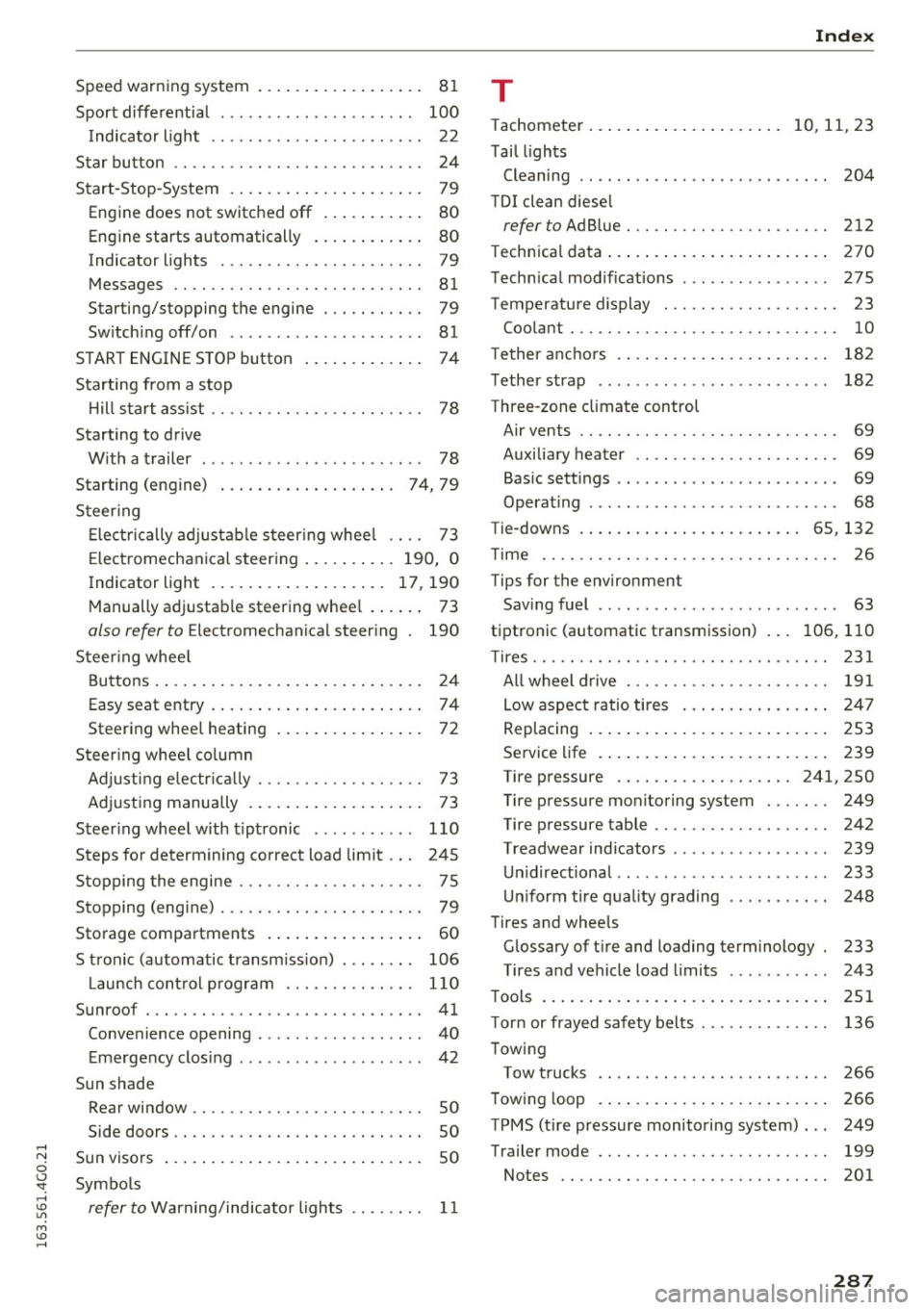
....
Speed warning system . . . . . . . . . . . . . . . . . . 81
Sport differential . . . . . . . . . . . . . . . . . . . . . 100
Indicator light . . . . . . . . . . . . . . . . . . . . . . . 22
Star button . . . . . . . . . . . . . . . . . . . . . . . . . . . 24
Start-Stop-System . . . . . . . . . . . . . . . . . . . . . 79
Engine does not switched off . . . . . . . . . . . 80
Engine starts automatically . . . . . . . . . . . . 80
Indicator lights . . . . . . . . . . . . . . . . . . . . . . 79
Messages . . . . . . . . . . . . . . . . . . . . . . . . . . . 81
Starting/stopping the engine . . . . . . . . . . . 79
Switching off/on . . . . . . . . . . . . . . . . . . . . . 81
START ENGINE STOP button . . . . . . . . . . . . . 74
Starting from a stop
H ill start assist . . . . . . . . . . . . . . . . . . . . . . . 78
Starting to drive W ith a trailer . . . . . . . . . . . . . . . . . . . . . . . . 78
Starting (engine) . . . . . . . . . . . . . . . . . . . 74, 79
Steering Electrically adjustable steering wheel . . . . 73
Electromechanical steering .......... 190, 0
Indicator light ................ ... 17, 190
Manually adjustable steering wheel . . . . . . 73
also refer to Electromechanical steering . 190
Steer ing wheel
Buttons....................... .... .. 24
Easy seat entry . . . . . . . . . . . . . . . . . . . . . . . 7 4
Steering wheel heating . . . . . . . . . . . . . . . . 72
Steering wheel column
Adj usting electr ically . . . . . . . . . . . . . . . . . . 73
Adjusting manually . . . . . . . . . . . . . . . . . . . 73
Steering wheel with tiptronic . . . . . . . . . . . 110
Steps for determining correct load limit . . . 245
Stopping the engine . . . . . . . . . . . . . . . . . . . . 75
Stopping (engine) . . . . . . . . . . . . . . . . . . . . . . 79
Storage compartments . . . . . . . . . . . . . . . . . 60
S tronic (automatic transmission) . . . . . . . . 106
L aunch control program . . . . . . . . . . . . . . 110
Sunroof . . . . . . . . . . . . . . . . . . . . . . . . . . . . . . 41
Convenience opening . . . . . . . . . . . . . . . . . . 40
Emergency closing . . . . . . . . . . . . . . . . . . . . 42
Sun shade Rear window . . . . . . . . . . . . . . . . . . . . . . . . . 50
Side doors . . . . . . . . . . . . . . . . . . . . . . . . . . . 50
~ Sun visors . . . . . . . . . . . . . . . . . . . . . . . . . . . . 50
~ Symbols ....
~ refer to Warning/indicator lights . . . . . . . . 11
M v:, ....
Index
T
Tachomete r . . . . . . . . . . . . . . . . . . . . . 10 , 11, 23
Tail lights Cleaning . . . . . . . . . . . . . . . . . . . . . . . . . . . 204
TOI clean diesel
refer to Ad Blue. .... ............... .. 212
Technical data . . . . . . . . . . . . . . . . . . . . . . . . 270
Technical modifications . . . . . . . . . . . . . . . . 275
T emperature display . . . . . . . . . . . . . . . . . . . 23
Coolant . . . . . . . . . . . . . . . . . . . . . . . . . . . . . 10
Tether anchors . . . . . . . . . . . . . . . . . . . . . . . 182
Tether strap . . . . . . . . . . . . . . . . . . . . . . . . . 182
Three-zone climate control Air vents . . . . . . . . . . . . . . . . . . . . . . . . . . . . 69
Auxiliary heater . . . . . . . . . . . . . . . . . . . . . . 69
Basic settings . . . . . . . . . . . . . . . . . . . . . . . . 69
Operating . . . . . . . . . . . . . . . . . . . . . . . . . . . 68
Tie-downs . . . . . . . . . . . . . . . . . . . . . . . . 65, 132
T ime ...... .... .. .. ............... .. . 26
Tips for the environmen t
Saving fuel . . . . . . . . . . . . . . . . . . . . . . . . . . 63
tiptronic (automatic transmission) ... 106, 110
T ires....... .. .. .. .. ............... .. 231
All wheel drive . . . . . . . . . . . . . . . . . . . . . . 191
Low aspect ratio tires . . . . . . . . . . . . . . . . 247
Replacing . . . . . . . . . . . . . . . . . . . . . . . . . . 253
Service life . . . . . . . . . . . . . . . . . . . . . . . . . 239
Tire pressure . . . . . . . . . . . . . . . . . . . 241, 250
Tire pressure monitoring system . . . . . . . 249
Tire pressure table . . . . . . . . . . . . . . . . . . . 242
T readwear indicators . . . . . . . . . . . . . . . . . 239
Unidirectional . . . . . . . . . . . . . . . . . . . . . . . 233
Uniform tire quality grading . . . . . . . . . . . 248
Tires and wheels Glossary of tire and loading terminology . 233
Tires and vehicle load limits . . . . . . . . . . . 243
Tools . . . . . . . . . . . . . . . . . . . . . . . . . . . . . . . 251
Torn or frayed safety belts . . . . . . . . . . . . . . 136
Towing Tow trucks . . . . . . . . . . . . . . . . . . . . . . . . . 266
Towing loop . . . . . . . . . . . . . . . . . . . . . . . . . 266
TPMS (tire pressure monitoring system) . . . 249
Trailer mode . . . . . . . . . . . . . . . . . . . . . . . . . 199
Notes . . . . . . . . . . . . . . . . . . . . . . . . . . . . . 201
287