door lock AUDI A6 2016 Owner's Manual
[x] Cancel search | Manufacturer: AUDI, Model Year: 2016, Model line: A6, Model: AUDI A6 2016Pages: 294, PDF Size: 73.88 MB
Page 77 of 294
Switching the ignition on/off
If you would like to switch the ignition on with
out starting the engine, follow these steps:
.,. Press the
I STAR T ENGINE STOPI button with·
out pressing the brake pedal.
.,. To switch the ignition off, press the button
again. The needle in the tachometer moves into
the
OFF position.
The prewarming runs automatically in diesel
vehicles when the ignition is switched on.
Equipment that uses a lot of electricity is switch
ed off temporarily when you start the engine.
If the engine should not start immediately, the
starting process is automatically stopped after a
short time. Repeat starting procedure .
Start-Stop-System*
Note the information in c> page 79, Start-Stop
System.
A WARNING
- Never allow the engine to run in confined
spaces, because this increases the risk of as
phyxiation.
- Never turn off the engine before the vehicle
has come to a complete stop.
- The brake booster and power steering no
longer function when you stop the engine.
You must use more force when braking or
steering. Because you cannot brake and
steer as you usually would, this could lead
to accidents and serious injuries. These
functions are still active if the Start-Stop
System* has stopped the engine.
(D Note
Avoid high engine speed, full throttle, and
heavy engine load as long as the engine has
not reached operating temperature yet. You
could damage the engine.
@ For the sake of the environment
Do not let the engine run while parked to
warm up. Begin driving immediately. This re
duces unnecessary emissions.
-
Driving
{!) Tips
- After starting a cold engine, there may be a
brief period of increased noise because the
oil pressure must first build up in the hy
draulic valve adjusters. This is normal and
not a cause for concern .
- If you leave the vehicle with the ignition
switched on, the ignition will switch off af
ter a certain amount of time. Make sure that electrical equipment such as the exterior
lights are switched off.
Stopping the engine
.,. Bring your vehicle to a complete stop.
.,. Move the selector lever to the P or N position.
.. Press the
!START ENGINE STOP ! button
r:!>poge 74, fig. 80.
Steering lock
The steering locks when you turn the engine off
using the
I START ENGINE STOPI button and
open the driver's door. The locked steering helps
prevent vehicle theft.
Emergency off
If necessary, the engine can be switched off with
the selector lever in the R or D/S position. The
engine stops if you press and hold the
!START ENGINE STOP ! button at speeds below
6 mph (10 km/h) and press the brake pedal.
A WARNING
-Never turn off the engine until the vehicle
has come to a complete stop.
- The brake booster and power steering only
work when the engine is running.
If the en
gine is off, you have to use more force when
steering or braking. Because you cannot
steer and brake as you usually would, this
could lead to crashes and serious injuries.
- For safety reasons, you should always park
your vehicle with the selector lever in P.
Otherwise, the vehicle could inadvertently
roll away.
-
75
Page 78 of 294
Driving
-After the engine has been sw itched off, the
rad iator fan can continue to run for up to 10
minutes - even with the ign ition switched
off . It ca n also switch on again after some
t ime if the coolant temperature rises as the
r esult of a heat buildup o r if the eng ine is
hot and the eng ine compartme nt is addi
ti onal ly he ated by the su n's rays.
@ Note
Do not stop the engine immed iate ly after
hard o r ex tended d riving. Keep the engine
running for app rox im ately two m inutes to
prevent exces sive hea t build-up.
Messages
Turn off ignition before leaving car
T his message appe ars and a warn ing tone so unds
if you o pen the d river's door when the ignition is
sw itche d on .
Press brake pedal to start engine
This message appea rs if you do not press the
brake pedal whe n starting the engine.
fll Is key in the vehicle?
T his indi cato r light turn s on and t his mess age ap
pea rs i f the ig nition key was removed from the
ve hicle when t he engine was ru nning. If the igni
tion key is no longer in the veh icle, yo u can not
switch on the ignition or start the engine once
you stop it. You also cannot lock the vehicle from
the outside.
Shift to P , otherwise vehicle can roll away .
Doors do not lock if le ver is n ot in P.
This message appears for safety reasons if the
transmission is not in the P pos it ion when you
sw itch the ignition off . Move the selector lever to
the P position. Otherwise the vehicle is not pro
tected from rolling and it ca nnot be locked.
DJ Key is not recognized. Hold back of key
against marked area . See owner's manual
If the i ndicator lig ht tu rns on and th is mess age
appears, there is a mal function
q page 76 .
76
Turn off ignition before leaving car. Battery is
discharg ing
This driver message appears if the drive r's door is
opened wh ile the ign ition is switche d on. Always
swi tch off the ignition i f yo u are leav ing the ve hi
cle. Refer to
~ page 80.
Shift to P and turn off ignition before leaving
car, otherwise vehicle can roll away
This message appears if the d river 's door is
opened wh ile the ignition is switc hed on and the
selector lever is not in the P po sition . Move the
selector lever i nto the P posi tion and sw itch the
igni tion off when you exit the veh icle. O therwise
the ve hicle co uld ro ll. Refer to~
page 80 .
'
Starting the engine when there is a
malfunction
It may not be possible to start the engine under
certain circumstances, for example if the battery
in the vehicle key is drained, if interference is af
fected the key or if there is a system malfunc
tion.
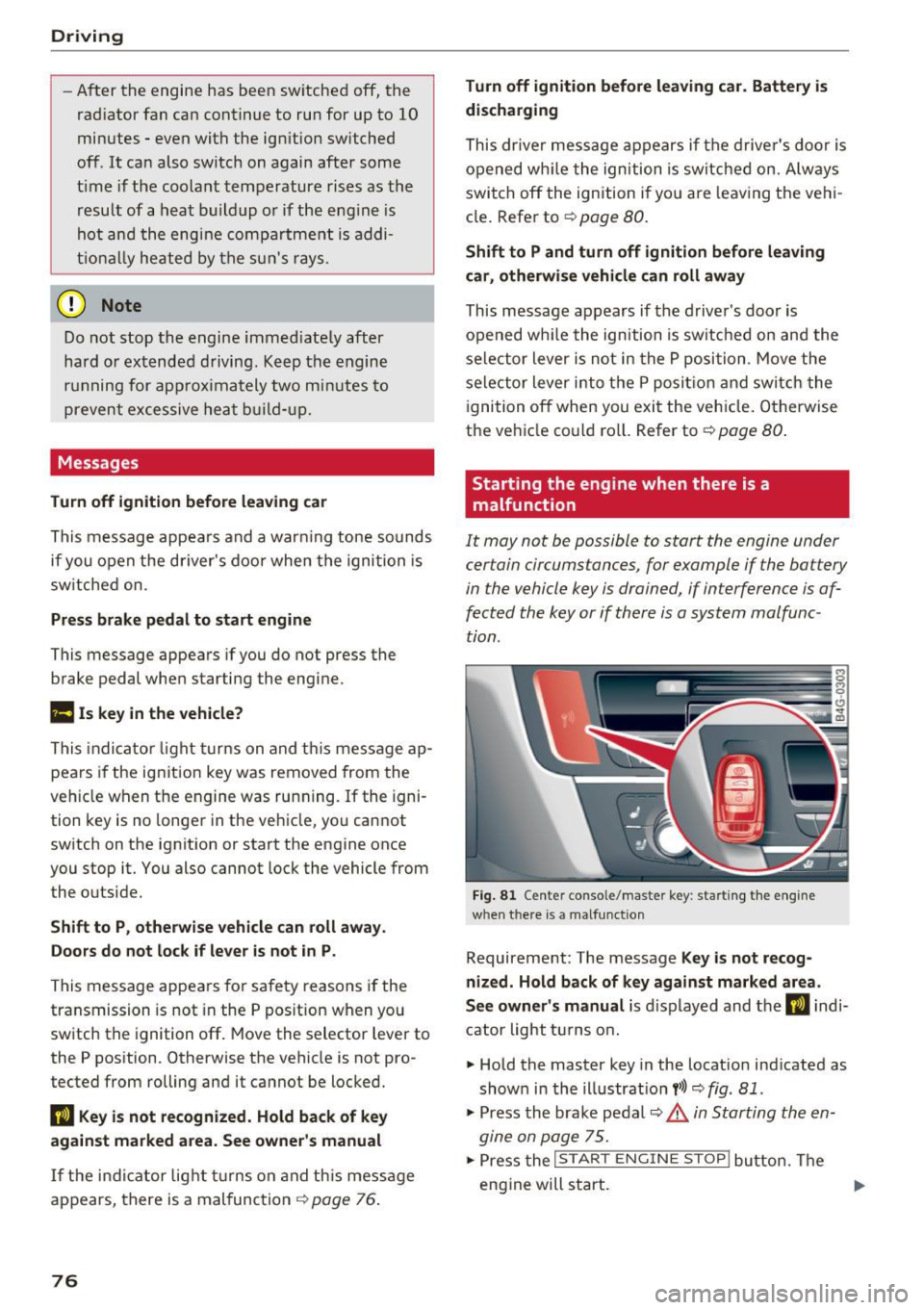
F ig. 81 Cente r conso le/mas te r key : sta rting the eng ine
w hen th ere is a malfunct io n
Requirement: The message Key is not recog
nized. Hold back of key against marked area .
See owner's manual
is d isplayed and t he DJ indi
c at or light t urns o n.
• Hold the master key in the locat io n ind icated as
show n in the ill ustrat io n
y>l) q fig . 81 .
• Press the bra ke pe dal q &_ in Starting the en
gine on page 75.
.,. Press the ~I S_ T_A_R_ T_E_ N_G_I_N_E_S_ T_O_P ~I bu tto n. Th e
eng ine will s tart.
Page 80 of 294
Driving
& WARNING
-Always take the vehicle key with you when
leaving the vehicle, even for a short period
of time. This a pplies particularly when chi l
dren rema in in the vehicle . Ot herwise ch il
dre n could star t the engi ne, release the
par kin g br ake o r o per ate ele ct rical e quip
ment su ch as power win dows, whi ch in
creases the risk of an acc ident .
- No one sho uld rem ain in t he vehicle when i t
is lo cked, es pec ially children. Locked doors
make it mo re diff icu lt fo r emergency work
ers to get into the vehicle, which puts lives
at risk.
Starting from a stop
The start assist function ensures that the park
ing brake is released automatically upon start
ing.
Stopping and setting the parking brake
.,. Pull t he swi tch ~ to set the p arki ng brak e.
Starting and automatically releasing the
parking brake
.,. When yo u press the accelerator pedal, the
par king b rake is autom atically rele ased and
yo ur vehicle begins to move.
T he parki ng b rake can be set if you must stop the
ve hicl e at a s to p lig ht or in t raff ic. Th e ve hicle
does not h ave to be he ld w ith the bra ke pedal.
T he parkin g brake e liminates the tendency to
creep when a selector lever position is engaged .
The parking b rake releases automatica lly and the
ve hicle beg ins to move as soon as you p ress the
accelerator pedal as usual.
Starting on slopes
W hen starting on inclines, the hill star t ass ist
p revents the ve hicle from unintentionally ro lli ng
back . The braking force of the park ing brake is
not released until sufficient d riving force has
been b uilt up at the w heels.
78
(D Tips
Fo r safety reasons, the par king brake is re
l eased a utomatically on ly when the d river's
safety be lt is engaged in the b uck le.
Starting to drive with a trailer
To prevent rolling back unintentionally on an in
cline, do the following:
.,. Keep the switch pull ed ~ and press t he accel
erator pedal. The parking brake stays app lied
and prevents the veh icle from roll ing backward .
.,. You can release the switch ~ once yo u are su re
that you are transferring enough driving force
to the whee ls by press ing the accelerator pedal.
Depend ing on the weight of t he rig (vehicle and
trailer) and the sever ity of the incline, you may
r oll backwards as you sta rt .
Emergency braking function
This is used if the conventional brake system
fails or lock s up.
.,. To brake your veh icle in an eme rge ncy, pull the
~ switch and hold it pu lled .
.,. As soon as you re lease the~ switch or acceler-
ate, the braking stops .
If you p ull the switch
«v> and hold it above a
speed of about 5 mph (8 km/h), the emergency braking function is init iated. The vehicle is braked
at all fou r whee ls by activati ng the hydraulic
brake system . The brake performance is s imilar
to making an emergency stop~.&. .
In order not to activate the emergency braking by
mistake, an aud ible warn ing to ne (buzzer)
sou nds when the~ switch is pulled . As soon as
the ~ switch is re leased, or the accele rator peda l
i s dep ressed, eme rge ncy braking stops.
& WARNING
Eme rgen cy b raking sho uld o nly be used in an
e m ergency, when the no rmal brake ped al has
failed or the brake pedal is obst ructed. Using
the park ing bra ke to pe rform emergency
b raking w ill slow your vehicle down as if yo u
Page 82 of 294
Driving
-The ignition will turn off if you press the
I STAR T ENGINE STOP! button during a stop
phase. The needle in the tachometer moves
into the
OFF position.
General information
Applies to veh icles: with Start-Stop-System
Th e standard Start-Stop mode con be canceled
for different system-related reasons.
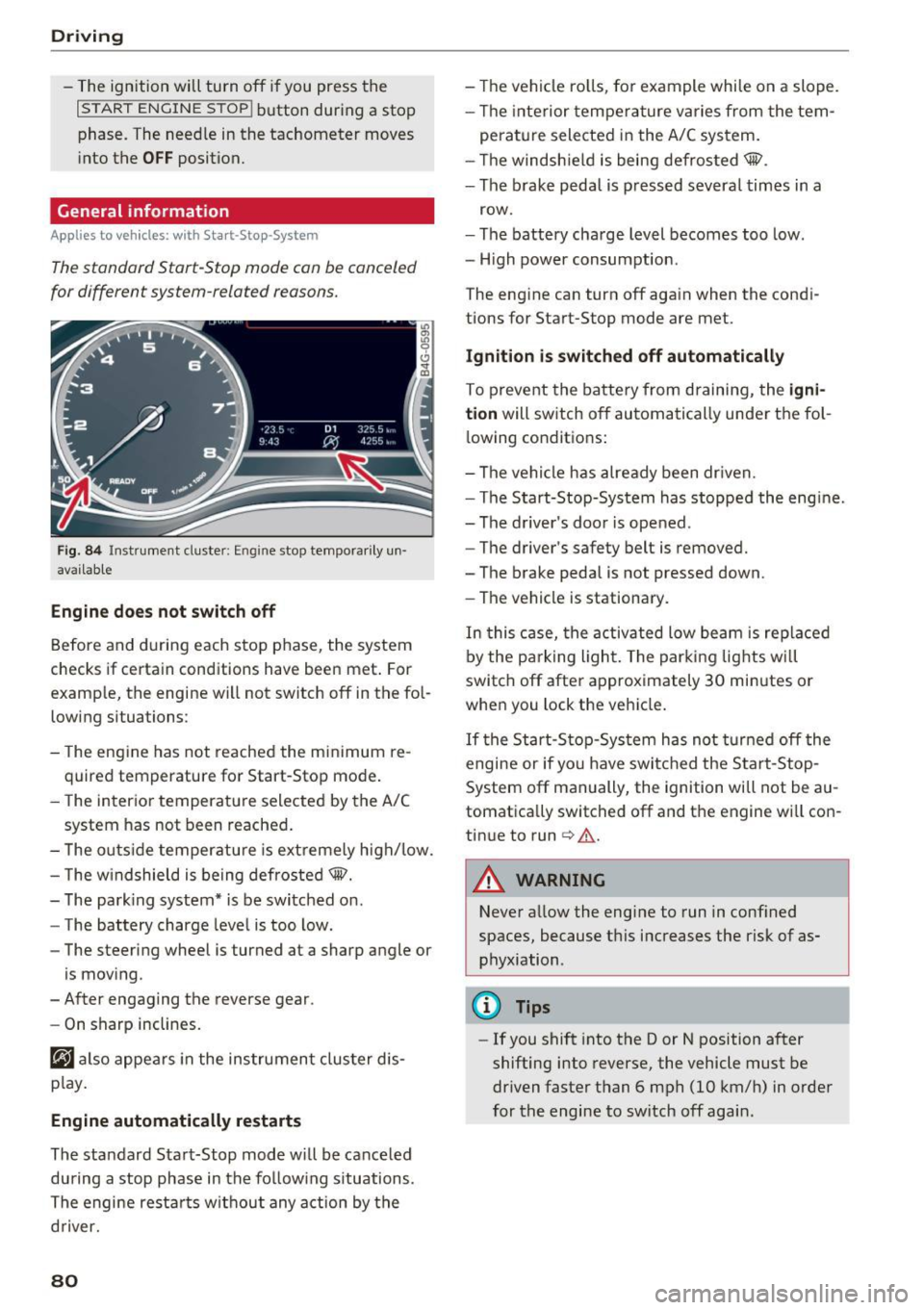
Fig. 84 Instrument cluste r: En gin e stop temporarily un·
available
Engine does not switch off
Before and during each stop phase, the system
checks if certain conditions have been met. For
example, the engine will not switch
off in the fol
lowing situations :
- The engine has not reached the minimum re
quired temperature for Start-Stop mode.
- The interior temperature selected by the A/C
system has not been reached.
- The outside temperature is extremely high/low.
- The windshield is being defrosted®.
- The parking system* is be switched on.
- The battery charge level is too low.
- The steering wheel is turned at a sharp angle or
is moving .
- After engaging the reverse gear .
- On sharp inclines.
@j also appears in the instrument cluster dis
play.
Engine automatically restarts
The standard Start-Stop mode will be canceled
during a stop phase in the following situations .
The engine restarts without any action by the
driver.
80
- The vehicle rolls, for example while on a slope.
- The interior temperature varies from the tem-
perature selected in the A/C system.
- The windshield is being defrosted®.
- The brake pedal is pressed several times in a
row.
- The battery charge level becomes too low.
- High power consumption.
The engine can turn
off again when the condi
tions for Start-Stop mode are met.
Ignition is switched off automatically
To prevent the battery from draining, the igni
tion
will switch off automatically under the fol·
lowing conditions:
- The vehicle has already been driven.
- The Start-Stop-System has stopped the engine.
- The driver's door is opened.
- The driver's safety belt is removed.
- The brake pedal is not pressed down .
- The vehicle is stationary.
In this case, the activated low beam is replaced
by the parking light. The parking lights will
switch
off after approximately 30 minutes or
when you lock the vehicle.
If the Start-Stop-System has not turned off the
engine or if you have switched the Start-Stop
System
off manually, the ignition will not be au
tomatically switched
off and the engine will con
tinue to run
cc> .&. .
A WARNING
Never allow the engine to run in confined
spaces, because this increases the risk of as
phyxiation .
(D Tips
-If you shift into the D or N position after
shifting into reverse, the vehicle must be
driven faster than 6 mph (10 km/h) in order
for the engine to switch off again .
Page 110 of 294
Automatic transmissio n
than 2 seconds when the brake pedal is not
pressed.
Lock button
The lock button in the selecto r lever hand le pre
ve nts yo u from moving the selector lever un in
tentionally while in some se lector lever positions .
The positions that require the lock button to be
pr essed are marked in co lor in the i llustration
¢ fig. 116 .
Driving the automatic transmission
Starting the engine
~ T he selector lever must be in P or N.
Starting off
~ Press and hold the brake pedal.
~ Press and hold the release button in the selec
tor lever handle, se lect the des ired selector lev
er position such as D/S and r ele ase the button.
~ Wait briefly until the transmission has shifted
(you w ill feel a slight movement).
~ Remove your foot from the brake pedal and ac
celerate .
Stopping t emporar ily
~ Keep the vehicle stationary using the braking
pedal , for example at traffic lights .
~ Do not press the accelerator pedal when doing
th is .
~ To prevent the vehicle from rolling when you
start driving, set the park ing brake when stop
ping on steep inclines¢,& .
~ The pa rk ing brake w ill release automatically
and the vehi cle will start moving once you press
the accelerator pedal.
Stopping /parking
If the se lector lever is not in the P posit ion when
you open the d river's door, the vehicle could roll.
The message
Tran smission : Car ma y roll! Shift
to park!
appears .
~ Press and hold the brake pedal unt il the vehicle
has come to a complete stop.
~ Apply the pa rking brake ¢ page 77, Parking .
~ Select the P selector leve r position ¢ ,& .
108
Stopping on an incline
~ Always press the brake pedal to ho ld the vehi
cle in p lace and prevent it from "rolling back"
¢
,& . Do not try to prevent the vehicle from
"rolling back" when a gear is engaged by in
creas ing the engine speed ¢(D .
Starting on an inclin e
~ Activate the pa rk ing br ake.
~ With the driving gear selected, press the accel
erator pedal carefully. The parking brake will
re lease a utomatically if your seat belt is fas
tened.
Under certain circumstances, such as driving in
the mountains, it may be useful to switch tempo rarily to the manual sh ift program in order to ad
j ust the gears to the dr iv ing cond it ions by hand
Q ,&. .
On s lopes, activate the parking brake first and
then move the selector lever to the P position.
This prevents too much stress from being placed
on the locking mechanism.
A WARNING
- The vehicle can also roll when the eng ine is
stopped .
- Unintended vehicle movement can cause se
rious injury .
- Never leave your veh icle with the engine
r u nning while in gear. If you must leave
your veh icle when the eng ine is r unning, ac
tivate t he pa rking bra ke a nd move the selec
to r lever to P.
- P owe r is still transmitted to the wheels
when the engine is runn ing a t idle . To p re
ve nt the vehicle from "creeping ", yo u m ust
keep your foot on the b rake when the en
gine is running and the se lector lever is in D/
5 or R or "tiptronic" mode is se lected .
- D o not press the acce le ra tor peda l when
changing the se lector lever posit ion while
the vehicle is stationary and the engine is
r u nning.
- Never sh ift into R or P whi le driving.
Page 133 of 294
-Never place or install floor mats or other
floor coverings on top of already installed
floor mats. Additional floor mats and other
coverings will reduce the size of the pedal
area and interfere with the pedals .
- Always properly reinstall and secure floor
mats that have been taken out for cleaning.
- Always make sure that objects cannot fall
into the driver footwell while the vehicle is
moving . Objects can become trapped under
the brake pedal and accelerator pedal caus ing a loss of veh icle control.
Storing cargo correctly
Loading the luggage compartment
All luggage and other objects must be properly
stowed and secured in the luggage compart
ment.
L oose items in the luggage compartment can
shift suddenly, changing vehicle handling charac
teristics. Loose items can also increase the risk of
serious personal injury in a sudden vehicle ma
neuver or in a collision.
.. Distribute the load evenly in the luggage com
partment.
.. Always place and properly secure heavy items in
the luggage compartment as far forward as
possible.
.,. Secure luggage using the tie-downs provided
¢ page 64, Luggage compartment .
.,. Make sure that the rear seatback is securely
latched in place.
A WARNING
Improperly stored luggage or other items can
fly through the vehicle causing serious per
sonal injury in the event of hard braking or an
accident. To help reduce the risk of serious
personal injury:
- Always put objects, for example, luggage or
other heavy items in the luggage compart
ment.
- Always secure objects in the luggage com
partment using the tie-down hooks and
suitable straps.
Driving safety
A WARNING
Heavy loads will influence the way your vehi
cle handles. To help reduce the risk of a loss
of control lead ing to serious personal injury:
- Always keep in mind when transporting
heavy objects, that a change in the center of
gravity can also cause changes in vehicle handling:
- Always distribute the load as evenly as
possible .
- Place heavy objects as far forward in the
luggage compartment as possible.
- Never exceed the Gross Axle Weight Rating
or the Gross Vehicle Weight Rating specified
on the safety compliance sticker on the left
door jamb. Exceeding permissible weight
standards can cause the vehicle to slide and handle differently.
- Please observe information on safe driving
¢page 125.
A WARNING
To help prevent poisonous exhaust gas from
being drawn into the vehicle, always keep the
rear lid closed while driving .
- Never transport objects larger than those
f itting completely into the luggage area be
cause the rear lid cannot be fully closed.
- If you absolutely must drive with the rear lid open, observe the following notes to reduce
the risk of poisoning:
- Close all windows,
- Close the power roof*,
- Open all air outlets in the instrument pan-
el,
- Switch off the air recirculation,
- Set the fresh air fan to the highest speed .
A WARNING
Always make sure that the doors, all win
dows , the power roof* and the rear lid are se
curely closed and locked to reduce the r isk of
in jury when the vehicle is not being used.
- After closing the rear lid, always make sure
-
that it is properly closed and locked. ~
131
Page 174 of 294
Child safety
_& WARNING
A child in a child safety seat installed with the LA TCH lower anchorages or w ith the standard
safety belt or a child in a booster seat on the
rear seat could play with unused rear seat
safety belts and become entangled. This
could cause the child serious personal injury
and even death.
- Always sec ure unused rear seat safety belts
out of reach of ch ildren in child seats such
as by properly routing them around the
head restraint of the seat where the child
restraint is insta lled .
- Never activate the convertible locking re
tractor when routing the safety belts around
the head restraints.
- Never let anyone sit at the cente r rear seat
ing position if the center rear safety belt has
been routed around a rear head restraint.
Child seats
Infant seats
Babies and infants up to about one year old and
20 lbs . or 9 kg need special rearward-facing
child restraints that support the back, neck and
head in a crash.
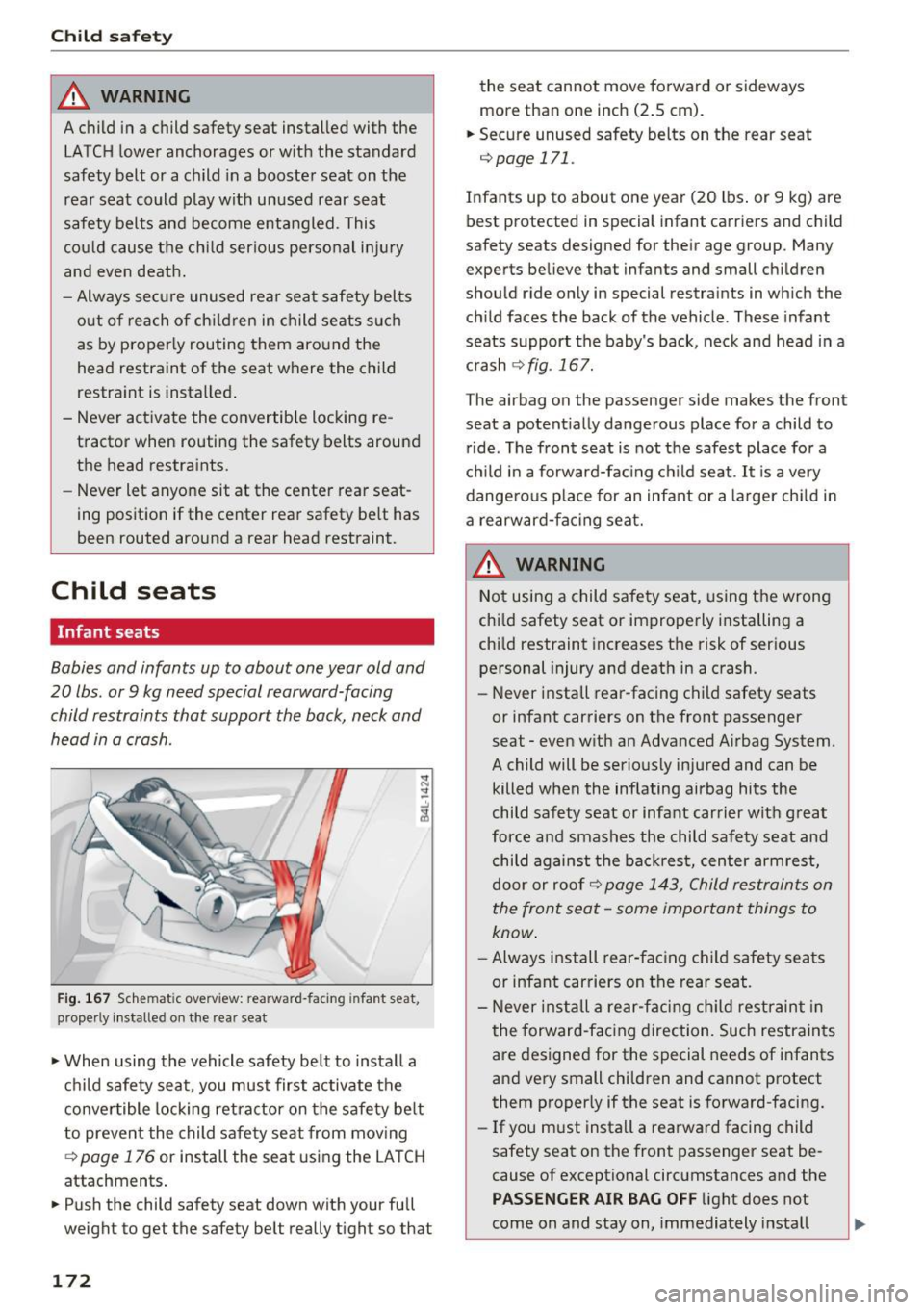
Fig . 167 Schemat ic overv iew: r earwa rd -fa cing in fant seat,
p roperly installe d on the rea r seat
.. When using the vehicle safety be lt to install a
child safety seat, you must first activate the
convertible locking retractor on the safety be lt
to prevent the child safety seat from mov ing
q page 176 or install the seat using the LATCH
attachments .
.. Push the child safety seat down with your full
weight to get the safety belt really tight so that
172
the seat cannot move forward or sideways
more than one inch (2 .5 cm) .
.. Secure unused safety belts on the rear seat
q page 171.
Infants up to about one year (20 lbs. or 9 kg) are
b est protected in special infant carriers and child
safety seats designed for their age group. Many
experts believe that infants and small children
should ride only in special restraints in wh ich the
child faces the back of the vehicle . These infant
seats support the baby's back, neck and head in a
crash
q fig . 167.
T he airbag on the passenger side makes the front
seat a potent ially dangerous place for a child to
ride . The front seat is not the safest place for a
child in a forward-facing ch ild seat .
It is a very
dangerous p lace for an infant or a larger child in
a rearward-facing seat.
_& WARNING
Not using a child safety seat, using the wrong
chi ld safety seat or improperly installing a
chi ld restraint increases the risk of serious
personal injury and death in a crash .
- Never install rear-facing child safety seats
or infant carriers on the front passenger
seat - even w ith an Advanced A irbag System .
A child will be serious ly injured and can be
killed when the inflating airbag hits the
child safety seat or infant carrier with great
force and smashes the child safety seat and
child against the backrest, center armrest,
door or roof
q page 143, Child restraints on
the front seat -some important things to
know .
-Always install rear-facing child safety seats
or infant carriers
on the rear seat .
- Never install a rear-facing child restraint in
the forward-facing direction. Such restraints
are designed for the special needs of infants
and very small children and cannot protect
them proper ly if the seat is forward-facing.
- If you must install a rearward facing child
safety seat on the front passenger seat be
cause of exceptional circumstances and the
PASSENGER AIR BAG OFF light does not
come on and stay on, immediately install
Page 179 of 294
children, especially those 12 years and younger,
should always ride in the back seat properly re
stra ined for their age and size.
A WARNING
-
Improperly installed child safety seats in
crease the risk of serious personal injury and
death in a collision.
- Always make sure that the safety belt re
tractor is locked when install ing a child
safety seat . An unlocked safety belt retrac
tor cannot hold the child safety seat in place dur ing normal driving or in a crash.
- Always buckle the child safety seat firmly in
place even if a child is not sitting in it . A
loose child safety seat can fly around during
a sudden stop or in a collision.
- Always make sure that the rear seat back
rest to wh ich the center rear safety be lt* is
attached is secure ly latched whenever the
rear center safety belt is being used to se
cure a child restraint.
- If the backrest is not securely latched, the
child and the child restraint will be thrown
forward together with the backrest and will strike parts of the vehicle interior. The chi ld
can be seriously injured or killed.
- Never install rear-facing chi ld safety seats
or infant carriers on the front passenger
seat. A child will be seriously injured and can be killed when the passenger airbag in
flates.
- The inflating a irbag w ill hit the child safety
seat or infant carrier with great force and
will smash the ch ild safety seat and child
against the backrest, center armrest, door
or roof.
- Always install rear-facing child safety seats
o r infant carriers on the rear seat.
- Forward-fac ing ch ild safety seats or infant
carriers installed on the front passenger's
seat may inte rfe re with the deployment of
the a irbag and cause serious injury to the
child.
- It is safer to install a forward-fac ing ch ild
safety seat on the rear seat.
- Always read and heed all WARN INGS when
ever using a child restrained in a veh icle is
Ch ild safety
being used ¢page 166. Special precautions
apply when instal ling a child safety seat on
the front passenger seat
¢ page 143, Child
restraints on the front seat -some impor
tant things to know .
A WARNING
-Always take special precautions if you must
i nstall a forward or rearward-facing child re
stra int on the front passenger 's seat in excep
tional s ituations:
- Whenever a forward or rearward-fac ing
child restraint is installed on the front pas
senger seat, the
PAS SENGER AIR BAG OFF
light must come on and stay on whenever
the ignition is switched on .
- I f the
PASSENGER AIR BAG OFF light does
not come on and stay on, perform the
checks described
¢ page 153, Monitoring
the Advanced Airbag System.
- Take the child restraint off the front passen
ger seat and install it properly at one of the
rear seat positions if the
PA SS ENGER AIR
BAG OFF light does not stay on whenever
the ignition is switched on.
- Improper installat ion of child restraints can
reduce the ir effectiveness or even prevent
them from providing any protect ion.
- An improperly installed child restra int can
interfere with the airbag as it deploys and
serious ly injure or even kill the child .
- Always carefully follow the manufacturer's
instructions provided with the child safety
seat or carr ier .
- After checking to make sure that the child
restraint is properly installed, make certain
that the child restraint is co rrectly recog
n ized by the capacitive passenge r detection
system in the fron t passenger seat and that
the
PASSENGER AIR BAG OFF light signals
the correct front passenger frontal a irbag
stat us.
A WARNING
Forward-facing child restra ints :
-
177
Page 180 of 294
Child safety
-Always make sure the forward-facing seat
has been designed and certified by its man
ufacturer for use on a front seat with a pas
senger front and side airbag.
- Never put the forward-facing child restraint
up, against or very near the instrument pan
el.
- Always move the passenger seat into its
rearmost position in the seat's fore and aft
adjustment range, as far away from the air
bag as possible before installing the for
ward-facing child restraint. The backrest
must be adjusted to an upright position.
- Make sure that the
PASSENGER AIR BAG
OFF
light comes on and stays on all the time
whenever the ignition is switched on.
_&. WARNING
Rearward-facing child restraints:
- A child in a rearward-facing child safety seat
installed on the front passenger seat will be
seriously injured and can be killed if the
front airbag inflates -even with an Ad
vanced Airbag System.
- The inflating airbag will hit the child safety
seat or infant carrier with great force and
will smash the child safety seat and child
against the backrest, center armrest, door
or roof.
- Always be especially careful if you must in
stall a rearward facing child safety seat on
the front passenger seat in exceptional cir
cumstances.
- Make sure that the
PASSENGER AIR BAG
OFF
light comes on and stays on all the time
whenever the ignition is switched on .
- If the
PASSENGER AIR BAG OFF light does
not come on and stay on, immediately in
stall the rear-facing child safety seat in a rear seating position and have the airbag
system inspected by your Audi dealer .
178
· Activating the convertible locking retractor
Use the convertible locking retractor to secure a
child restraint.
Always heed the child safety seat manufacturer 's
instructions when installing a child restrain t in
your vehicle . To activate the convertible locking
retractor:
.. Place the child restraint on a seat, preferably
on the rear seat.
.. Slowly pull the belt
all the way out .
.. Route it around or through the child restraint
belt path
~ ,&. .
.. Push the child safety seat down with your full
weight to get the safety belt really tight.
.. Insert the belt tongue into the buckle for that
seating position.
.. Guide the safety belt back into the retractor un
til the belt lies flat and snug on the child safety
seat.
.. You should hear a "clicking" noise as the belt
winds back into the inertia reel. Test the con
vertible locking retractor by pulling on the belt.
You should no longer be able to pull the belt
out of the retractor. The convertible locking re
tractor is now activated.
.. Make sure that the red release button is facing
away from the child restraint so that it can be
unbuckled quickly.
.. Pull on the belt to make sure the safety belt is
properly tight and fastened so that the seat
cannot move forward or sideways more than
one inch (2 .5 cm) .
_&. WARNING
Using the wrong child restraint or an improp
erly installed child restraint can cause serious
personal injury or death in a crash.
- Always make sure that the safety belt re
tractor is locked when installing a child
safety seat. An unlocked safety belt retrac
tor cannot hold the child safety seat in place
during normal driving or in a crash.
- Always buckle the child safety seat firmly in place even if a child is not sitting in it. A
loose child safety seat can fly around during
a sudden stop or in a crash.
Page 214 of 294
Fuel and Refueling
case, try turning the nozzle before inserting
it in the fuel fi ller neck, use a different fue l
pump or see your authorized Audi dea ler or
authorized repair facility for ass istance.
- The fuel filler flap of your vehicle is not
locked when you lock the vehicle from the
inside.
Fuel filler door emergency release
If the central locking system is faulty, the fuel
filler door can be unlocked manually.
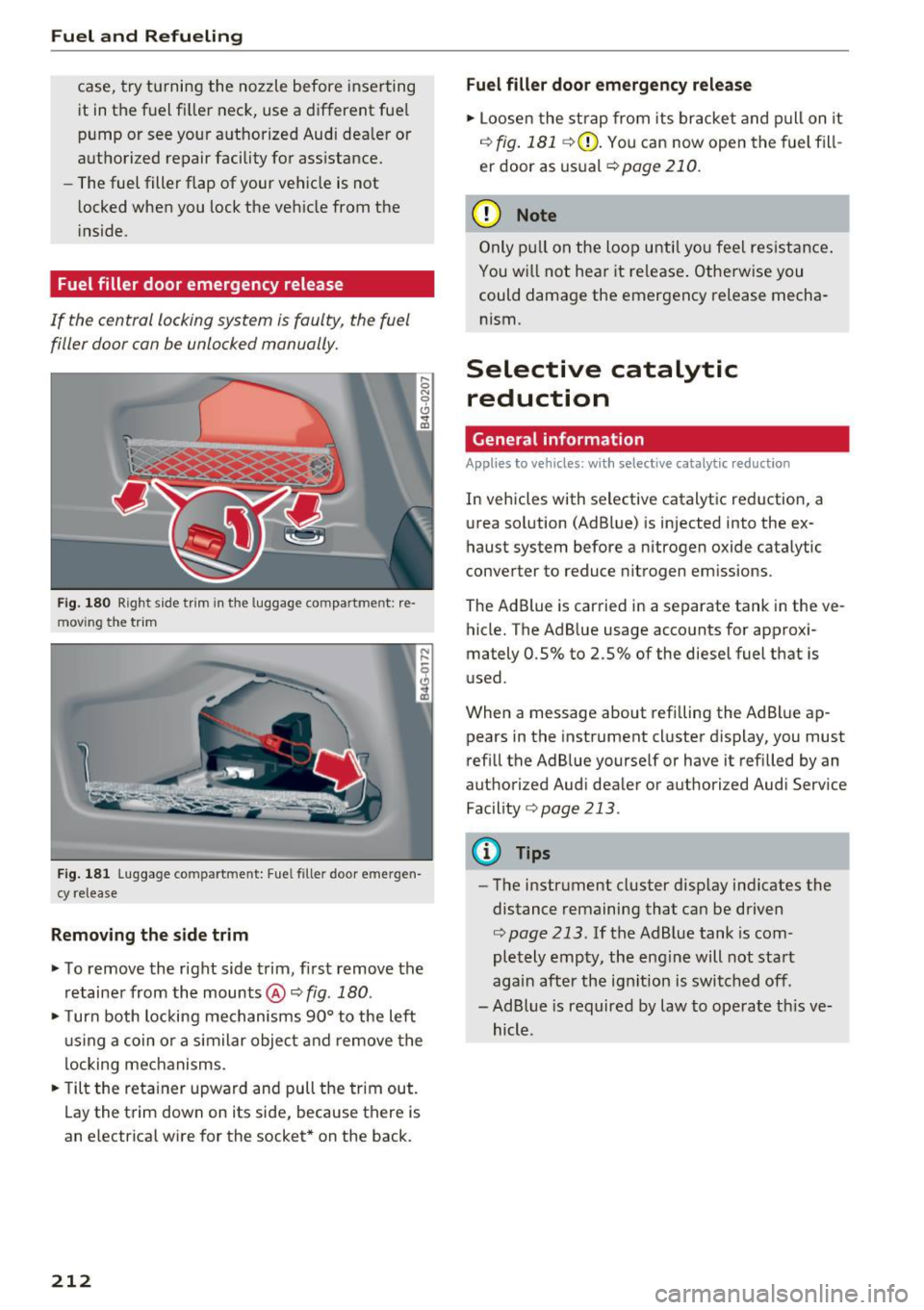
F ig. 180 Right side t rim in the luggage compartme nt: re ·
m ov ing the trim
Fig. 181 Luggage co mpa rtment: Fue l filler door emergen
cy release
Removing the side trim
• To remove the right side trim, first remove the
retainer from the mounts @¢
fig. 180.
• Turn both locking mechanisms 90° to the left
usi ng a coin or a similar object and remove the
locking mechanisms.
• Tilt the retainer upward and pull the trim out.
Lay the trim down on its side, because there is
an electrical wire for the socket * on the back.
212
Fuel filler door emergency release
• Loosen the strap from its bracket and pull on it
r:!.>fig. 181 ¢(2) . You can now open the fuel fill
er door as usual ¢
page 210.
(D Note
Only pull on the loop until you feel resistance .
You wi ll not hear it release . Otherwise you
could damage the emergency release mecha nism.
Selective catalytic reduction
General information
Applies to vehicles: with selective catalytic reduction
In vehicles with selective catalytic reduction, a
urea solution (AdBlue) is injected into the ex
haust system before a nitrogen oxide catalytic
converter to reduce nitrogen emissions.
The Ad Blue is carried in a separate tank in the ve
hicle. The AdBlue usage accounts for approxi
mately 0.5% to 2.5% of the diesel fuel that is
used.
When a message about refilling the AdBlue ap
pears in the instrument cluster display, you must
refill the Ad Blue yourself or have it refilled by an
authorized Audi dealer or authorized Audi Service
Facility
r:!.>page 213 .
{!) Tips
-The instrument cluster display ind icates the
distance remaining that can be driven
¢ page 213. If the AdBlue tank is com
pletely empty, the engine will not start
again after the ign ition is switched off.
- Ad Blue is required by law to operate th is ve
hicle.