child lock AUDI A6 2017 User Guide
[x] Cancel search | Manufacturer: AUDI, Model Year: 2017, Model line: A6, Model: AUDI A6 2017Pages: 280, PDF Size: 70.24 MB
Page 132 of 280
Driving safety
"' Always keep both feet in the footwell so that
you are in control of the vehicle at all times.
For detailed information on how to adjust the
driver's seat, see
c;, page SO.
A WARNING
Drivers who are unbelted, out of position or
too close to the airbag can be seriously in
jured by an airbag as it unfolds . To help re
duce the risk of serious personal injury:
- Always adjust the driver's seat and the
steering wheel so that there are at least
10 inches (25 cm) between your breastbone
and the steering wheel.
- Always adjust the driver's seat and the
steering wheel so that there are at least
4 inches (10 cm) between the knees and the
lower part of the instrument panel.
- Always hold the steering wheel on the out
side of the steering wheel rim with your
hands at the 9 o'clock and 3 o'clock posi
tions to help reduce the risk of personal in
jury if the driver's airbag inflates.
- Never hold the steering wheel at the
12 o'clock position or with your hands at
other positions inside the steering wheel
rim or on the steering wheel hub. Holding
the steering wheel the wrong way can cause
serious injuries to the hands, arms and head if the driver's airbag inflates.
- Pointing the steering wheel toward your
face decreases the ability of the su pplemen
tal driver's airbag to protect you in a colli
sion.
- Always sit in an upright position and never lean against or place any part of your body
too close to the area where the airbags are
located .
- Before driving, always adjust the front seats
properly and make sure that all passengers
are properly restrained .
- For adjustable head restraints: before driv
ing, always also adjust the head restraints
properly .
- Never adjust the seats while the vehicle is
moving. Your seat may move unexpectedly
and you could lose control of the vehicle.
130
-
-Never drive with the backrest reclined or
tilted far back! The farther the backrests are
tilted back, the greater the risk of injury due
to incorrect positioning of the safety belt
and improper seating position .
- Children must always ride in child seats
c;,page 171. Special precautions apply
when installing a child seat on the front
passenger seat
c:;, page 147.
Proper seating position for the front
passenger
The proper front passenger seating position is
important for safe, relaxed driving.
For your own safety and to reduce the risk of in
jury in the event of an accident , we recommend
that you adjust the seat for the front passenger
to the following position:
"'Adjust the angle of the seatback so that it is in
an upright position and your back comes in full
contact with it whenever the vehicle is moving.
"'For adjustable head restraints: adjust the head
restraint so the upper edge is as even as possi
ble with the top of your head. If that is not pos
sible, try to adjust the head restraint so that it
is as close to this position as possible
c:;, page 131 . Move the head restraint so that it
is as close to the back of the head as possible.
"' Keep both feet flat on the floor in front of the
front passenger seat .
"' Fasten and wear safety belts correctly
c;,page 142.
For detailed information on how to adjust the
front passenger's seat, see
c:;, page SO .
A WARNING
Front seat passengers who are unbelted, out
of position or too close to the airbag can be
seriously injured or killed by the airbag as it
unfolds. To help reduce the risk of serious
personal injury:
- Passengers must always sit in an upright po
sition and never lean against or place any part of their body too close to the area
where the airbags are located.
Ill-
Page 145 of 280
co
co
.... N
" N .... 0 0 <..:l 'SI'
Automatic safety belt r etractors
Every safety be lt is equ ipped wi th an automatic
be lt retractor on the shoulder belt. Th is feature
l ocks the belt when the belt is p ulled out fast,
during hard braking and in an accident. The belt may also lock when you drive up or down a steep
h ill or through a sharp curve. During normal driv
ing the belt lets you move freely .
Safety be lt pret en sioner s
The safety belts are equipped with a belt preten
sioner that helps to tighten the safety belt and
remove slack when the pretensioner is activated
c:;, page 145. The function of the pretensioner is
monitored by a warning light
c:;, page 17.
Con vertible loc king retractor
Every safety belt exc ept the one on the driver
seat is equipped with a convertible locking retrac
tor that
mu st be used when the safety belt is
used to attach a child seat. Be sure to read the
important information about this featu re
c;, page 182.
A WARNING
Improperly posit ioned safety be lts ca n cause
ser ious injury in an accide nt
c:;, page 143,
Safe ty belt position .
-Safety belts offer optimum protection only
when the seatback is upr ight and belts are
prope rly pos itioned on the bo dy.
- Always ma ke sure tha t the rear sea t bac k
rest to wh ic h t he cente r rea r safety be lt* is
a ttached is secure ly latched whenever the
rear center safety belt is being used. If the
backrest is not securely latched, the passen
ger will move forward with the backrest dur
ing sudden braking, in a sudden maneuver
and especially in a cras h.
- Never attach the safety belt to the buckle
for another seat. Attaching the belt to the
wrong buckle w ill red uce safety belt effec
t iveness and can cause serious personal in
jury.
- A passenger who is not p roperly restrained
can be seriously in ju red by the safety be lt it
self when it moves from the stronger par ts
Safet y bel ts
of the body into critical areas like the abdo
men .
- Always lock the convertible locking retractor
when yo u are securing a child seat in the ve
hicle
c;,page 184.
(I} Tips
For information on safety belt pretensioners,
refer to
c:;, page 145 .
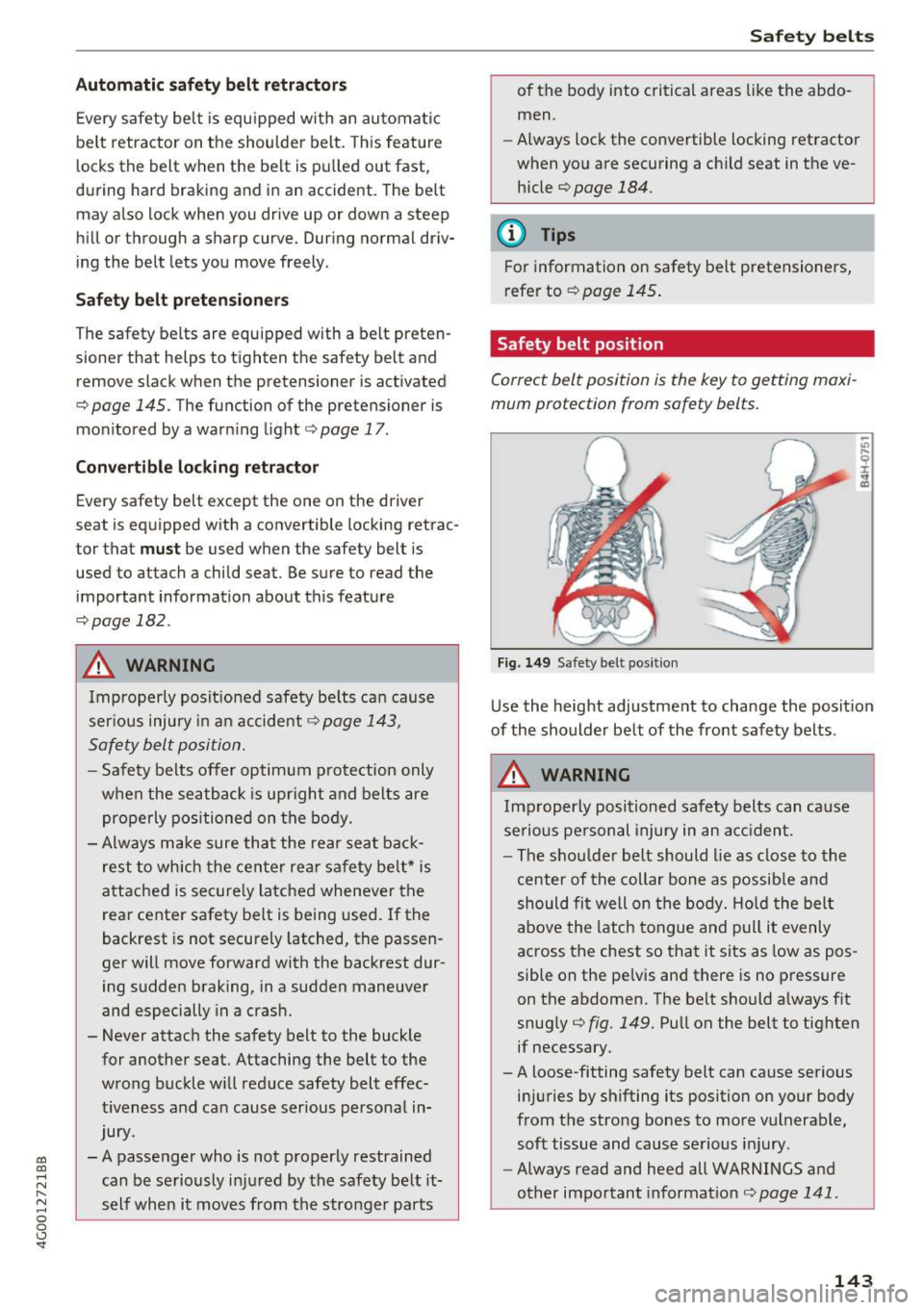
Safety belt position
Correct belt position is the key to getting ma xi
mum protection from safety belts.
Fig . 14 9 Safety belt pos it io n
Use the height adjustme nt to change the posit ion
of the shoulder belt of the front safety belts .
A WARNING ~
Imp roperly positioned safety belts can ca use
se rio us pe rsonal injury in an a cciden t.
- The s hou lde r belt should lie as close to the
center of the collar bone as possib le and
should fi t well on the body . Ho ld the bel t
above the latch tongue and pull it evenly
across the chest so tha t it sits as low as pos
sible on the pe lvis and there is no pressure
on the abdomen. The belt should a lways fit
snug ly
c:;, fig. 149. Pu ll on the belt to tighten
if necessary.
- A loose-fitting safety belt can cause serious
inju ries by shifting its position on your body
from the strong bones to more vulnerable, soft tissue and cause serious i nju ry .
- Always read and heed all WARNINGS and
other important informat io n
c:;, page 141 .
143
Page 154 of 280
Airbag system
-Therefore, always wear your safety belts and
make sure that everybody in your vehicle is
properly restrained.
- Always hold the steering wheel with both
hands on the outside of the steering wheel
rim at the 9:00 o 'clock and 3 :00 o'clock po
sitions to help reduce the risk of personal in
jury if the driver's airbag inflates .
- Never hold the steering wheel at the 12
o'clock position or with your hands any
where inside the steering wheel or on the steering wheel hub. Holding the steering
wheel the wrong way increases the risk of
severe injury to the arms, hands, and head if
the driver airbag deploys.
A WARNING
Objects between you and the airbag will in
crease the risk of injury in a crash by interfer
ing with the way the airbag unfolds and/or by
being pushed into you as the airbag inflates.
- Always make sure nothing is in the front air-
-
bag deployment zone that could be struck
by the airbag when it inflates.
- Objects in the zone of a deploying airbag
can become projectiles when the airbag de
ploys and cause serious personal injury.
- Never hold things in your hands or on your lap when the vehicle is in use .
- Never place accessories or other objects
(such as cup holders, telephone brackets,
note pads, navigation systems, or things
that are large, heavy, or bulky) on the doors;
never attach then to the doors or the wind
shield; never place them over or near or at
tach them to the area marked ,.AIRBAG" on
the steering wheel, instrument panel or the
seat backrests; never place them between
these areas and you or any other person in
the vehicle.
- Never attach objects to the windshield
above the passenger front airbag, such as
accessory GPS navigation units or music
players. Such objects could cause serious in
jury in a collision, especially when the air bags inflate .
152
-Never recline the front passenger seat to
transport objects. Items can also move into
the deployment area of the side airbags or
the front airbag during breaking or in a sud
den maneuver . Objects near the airbags can
fly dangerously through the passenger com
partment and cause injury, particularly
when the seat is reclined and the airbags in
flate.
A WARNING
A person on the front passenger seat, espe
cially infants and small children, will receive
serious injuries and can even be killed by be ing too close to the airbag when it inflates .
- Although the Advanced Airbag System in
-
your vehicle is designed to turn off the front
passenger airbag if an infant or a small child
is on the front passenger seat, nobody can
absolutely guarantee that deployment un
der these special conditions is impossible in
all conceivable situations that may happen
during the useful life of your vehicle.
- The Advanced Airbag System can deploy in
accordance with the .,low risk" option for 3-
and 6-year-old children under the U.S . Fed
eral Standard if a child with electrical capac
itance greater than the combined capaci
tance of a typical one-year old infant re
strained in one of the forward facing or rear
ward-facing child seats with which your ve
hicle was certified is on the front passenger
seat and the other conditions for airbag de
ployment are met.
- Accident statistics have shown that children
are generally safer in the rear seat area than
in the front seating position.
- For their own safety, all children, especially
12 years and younger, should always ride in
the back properly restrained for their age and size.
Advanced front airbag system
Your vehicle is equipped with a front Advanced
Airbag System in compliance with United States
Federal Motor Vehicle Safety Standard 208, as
well as Canada Motor Vehicle Safety Standard ..,.
Page 162 of 280
Airbag system
the front passenger seat . Always make sure that
the safety belt for the front passenger seat is
proper ly fastened .
The PASSENGER AIR BAG OFF light will show
the status of the front seat passenger's frontal
Advanced Airbag a few seconds after the igni
tion is switched on and the airbag indicator
light goes off . The PASSENGER AIR BAG OFF
light:
- will stay on if the front passenger seat is not
occupied;
- will stay on if the electrical capacitance meas
ured by the capacitive passenger detection sys
tem for the front passenger seat equals the
combined capacitance of an infant up to about
one year of age and one of the rearward-facing
or forward-facing child restraints listed in Fed
eral Motor Vehicle Safety Standard 208 w ith
which the Advanced Airbag System in your veh i
cle was certified; For a list ing of the child re
straints that were used to certif y you r vehicle's
compliance with the U.S. Safety Standard
¢page 173.
-will go out if the front passenger seat is occu
pied by an adult as registered by the capacitive
passenger detection system.
- The
PASSENGER AIR BAG OFF light must come
on and stay on if the ignition is on and . ..
- a car bed has been insta lled on the front pas
senger seat, o r
- a rearward-facing child res traint has been in
stalled on the front passenger seat, or
- a fo rw ar d-fa cing child restraint has bee n ins tal
led on the front passenge r seat,
- and if the electrica l capacitance registered on
the front passenger seat is equa l to or less than
the combined capacitance of a typica l 1 year
o ld infant and one of the rearward-facing or
forward-facing child restraints listed in Federal
Motor Vehicle Safety Standard 208 with which
the Advanced Airbag System in your vehicle was certified.
If the front passenger seat is not occupied, the
front airbag will not deploy, and the
PASSENGER
AIR BAG OFF
light will stay on. Never install a
rearward-fac ing ch ild restraint on the front pas
senger seat, the safest place for a child in any
160
kind of child restraint is at one o f th e seating po
sitions on the rear seat¢
page 148, Child re
straints on the front seat -some important
things to know
and ¢ page 171, Child safety.
If the PASSENGER AIR BAG light comes
on ...
If the PASSENGER AIR BAG OFF light comes on
when one of the conditions listed above is met,
be sure to check the light regularly to make cer
ta in that the
PASSENGER AIR BAG OFF light
stays on continuously whenever the ignition is
on. If the
PASSENGER AIR BAG OFF light does
not appear on and does not stay on a ll the time,
stop as soon as it is safe to do so and
- reactivate the system by tur ning the ignition
off for more than 4 seconds and then turning it
on again;
- remove and re install the child restraint. Make
sure that the child restraint is properly insta l
led and that the safety belt for the front pas
senge r seat has been corre ctly routed through
the child restraint as described in the child re
straint manufacturer's instructions;
- make sure that the convertible lock ing retrac
tor on the safety belt for the front passenger
seat has been activated and that the safety belt
has been pulled tight.
- make sure that no e lectrica l device (suc h as a
laptop, CD player, e lectronic games device,
power inverter or seat heater for child seats) is
placed or used on the front passenger seat if
the device is connected to the 12-volt socket or
the cigarette lighter socket;
- make sure that no seat heater has been retro
fitted or otherw ise added to the front passen
ger seat;
- make sure that noth ing can interfere with the
safety belt buckles and that they are not ob
structed;
- make sure that there are no wet objects (such
as a wet towel) and no water or other liquids on
the front passenger seat cushion. .,.
Page 177 of 280
co
co
.... N
" N .... 0 0 <..:l '
ger seat and install it properly at one of the
rear seat positions if the
P ASS ENGER A IR
BA G O FF
light does not stay on.
- Have the airbag system inspected by your
authorized Audi dealer immediately.
The child seats listed in categories A to C have been statically tested by Audi only for the Ad
vanced Airbag function.
Important safety instructions for using
child safety seats
Correct use of child safety seats substantially re
duces the risk of injury in an accident!
As the driver, you are responsible for the safety
of everybody in the vehicle, especially children:
~ Always use the right child safety seat for each child and a lways use it properly~
page 177.
~ Always carefully follow the child safety seat
manufacturer's instructions on how to route
the safety belt properly through the child safe
ty seat .
~ When using the vehicle safety be lt to install a
child safety seat, you must first activate the
convertible locking retractor on the safety be lt
to prevent the child safety seat from moving
¢page 182.
~ Push the child safety seat down with your fu ll
weight to get the safety be lt really tight so that
the seat cannot move forward or sideways
more than one inch (2.5 cm).
~ Secure unused safety belts on the rear seat
¢ page 177.
Always remember: Even though your vehicle is
equipped with an Advanced Airbag system, all
children, especially those 12 years and younger,
should always ride in the back seat properly re
stra ined fo r their age and size.
_& WARNING
Not using a ch ild safety seat, using the wrong
child safety seat or improper ly installing a
Ch ild safety
child restraint increases the risk of serious
personal injury and death.
- All vehicle occupants and especially children
must be restrained properly whenever riding
in a vehicle. An unrestra ined or improperly
restrained child could be injured by striking
the inter ior or by being ejected from the ve
hicle dur ing a sudden maneuve r or impact.
An unrest rained or improperly restrained
child is a lso at greater r is k of injury or death
through contact w ith an inflating a irbag.
- Commerc ially availab le child safe ty seats
are requi red to comply with U.S. Federal
Motor Vehicle Safety Standard (FMVSS) 213
(in Canada CMVSS 213).
- When buying a child restra int, select one
that fits your ch ild and the vehicle .
- Only use child restraint systems that fully
contact the flat portion of the seat cush
ion. The ch ild restraint must not t ip or
lean to either side. Audi does not recom
mend using child safety seats that rest on
legs or tube-like frames. They do not pro
vide adequate contact with the seat.
- Always heed all lega l requirements per
ta ining to the insta llation and use of child
safety seats and carefu lly follow the in
structions provided by the manufacturer
of the seat you are using .
- Never a llow children under 57 inches
(1.45 mete rs) to wear a normal safety be lt.
They must a lways be restrained by a proper
child restraint system. Otherwise, they
could sustain injuries to the abdomen and
neck areas during sudden braking maneu
vers or accidents .
- Never let more than one child occupy a child
safety seat.
- Never let babies or o lder children ride in a
vehicle while sitting on the lap of another
passenger .
- Holding a child in your arms is never a sub
stitute for a chi ld restrain t system .
- The strongest person cou ld not ho ld the
ch ild with the forces that exist in an acci
dent. The child will strike the interior of
the vehicle and can also be struck by the passenger.
175
Page 179 of 280
co
co
.... N
" N .... 0 0 <.,;) 'SI"
-Take the child restraint off the front passen
ger seat and install it properly at one of the
rear seat positions if the
PASSENGER AIR
BAG OFF
light does not stay on.
- Have the airbag system inspected by your
authorized Audi dealer immediately.
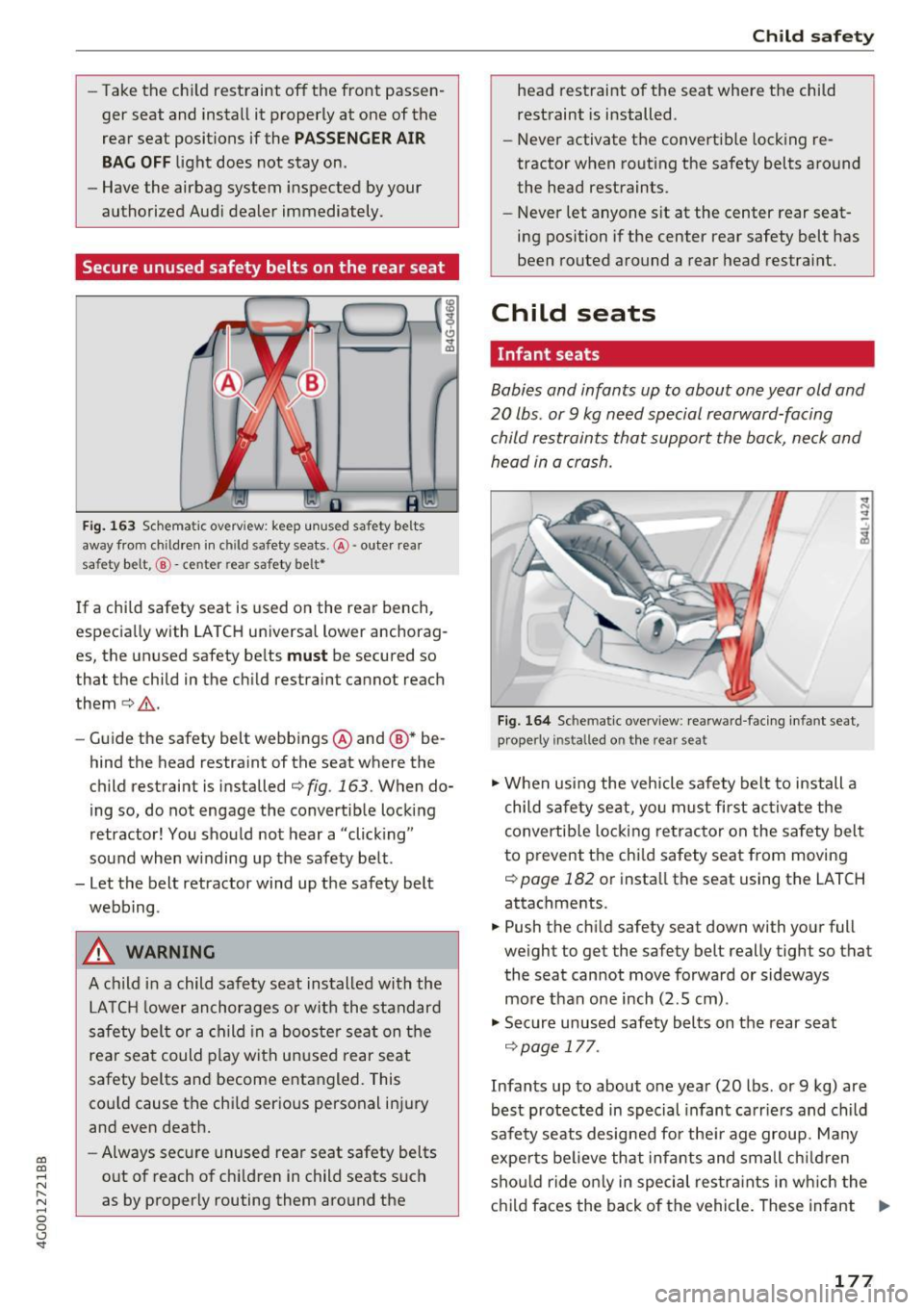
Secure unused safety belts on the rear seat
Fig . 163 Schemat ic overv iew: keep unused s-afety belts
away from children in chil d safety seats. @· oute r rear
sa fety belt,
@ -center rear safety belt*
If a chi ld safety seat is used on the rear bench,
especia lly with LA TCH universal lower anchorag
es, the unused safety belts
must be secured so
that the child in the child restraint cannot reach
them
c::> ,& .
-Gui de the safety belt webbings @ and ®* be
hind the head restra int of the seat where the
child restraint is installed
c::>fig. 163. When do
ing so, do not engage the convertible lock ing
retractor! You should not hear a "click ing"
sound when w inding up the safety belt.
- Let the belt retractor wind up the safety belt
webbing .
A WARNING
A child in a child safety seat installed with the
LATCH lower anchorages or with the standard
safety belt or a child in a booste r seat on the
rear seat could play with unused rear seat
safety belts and become entangled. This
cou ld cause the chi ld serious personal injury
and even death.
- Always secure unused rear seat safety belts
out of reach of children in child seats such
as by proper ly routing them aro und the
Child safety
head restraint of the seat where the child
restraint is installed .
- Never activate the convertible locking re
tractor when routing the safety belts around
the head restraints.
- Never let anyone sit at the center rear seat
ing position if the center rear safety belt has
been routed around a rear head restraint.
Child seats
Infant seats
Babies and infants up to about one year old and
20 lbs. or
9 kg need special rearward-facing
child restraints that support the back, neck and
head in a crash.
Fig. 164 Sc hem atic overv iew: rearward -fac ing infa nt seat ,
properly installed o n the rear seat
., When using the vehicle safety belt to install a
child safety seat, you must first activate the
convertib le locking retractor on the safety belt
to prevent the chi ld safety seat from moving
c::> poge 182 or install the seat using the LATCH
attachments .
.. Push the child safety seat down with your full
weight to get the safety belt really tight so that
the seat cannot move forward or sideways
more than one inch (2 .5 cm) .
., Sec ure unused safety belts on the rear seat
c::>page 177.
Infants up to about one year (20 lbs . or 9 kg) are
best protected in special infant carriers and child
safety seats designed for the ir age group. Many
expe rts be lieve that infants and small children
shou ld ride only in special res tra ints in wh ich the
child faces the back of the vehicle. These infant ..,
177
Page 181 of 280
Convertible child safety seats
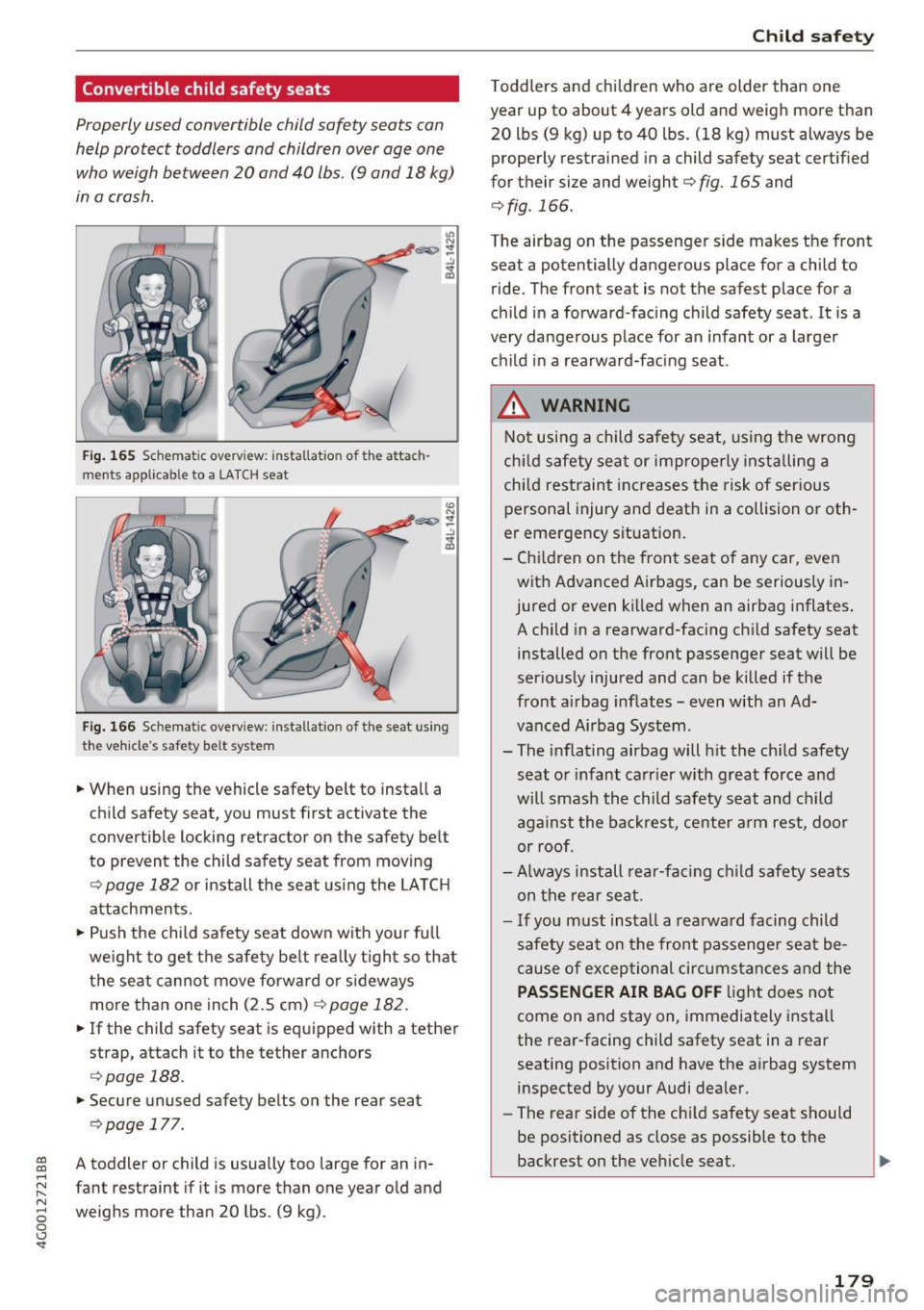
Properly used convertible child safety seats can
help protect toddlers and children over age one
who weigh between
20 and 40 lbs. (9 and 18 kg)
in a crash.
Fig. 165 Schemat ic overv iew: installatio n of the attac h
ments app lica ble to a LA TCH seat
Fig. 166 Schematic overv iew : installat io n of the seat using
the vehicle 's safe ty be lt syste m
.. When using the vehicle safety belt to install a
child safety seat, you must first activate the
convertible locking retractor on the safety belt
to prevent the child safety seat from moving
Q page 182 or install the seat us ing the LATC H
attachments .
.. Push the child safety seat down with your fu ll
weight to get the safety belt really tight so that
the seat cannot move forward o r sideways
more than one inch (2.5 cm)
Qpage 182.
.. If the child safety seat is equipped with a tether
strap, attach it to the tether anchors
Q page 188.
.. Secure unused safety belts on the rear seat
Q page 177.
~ A toddler or child is usually too large for an in-
;::j fant restraint if it is more than one year old and
" 8 weighs more than 20 lbs . (9 kg) .
0 <..:l 'SI"
Child safety
Toddlers and children who are older than one
year up to about 4 years old and weigh more than
20 lbs (9 kg) up to 40 lbs. (18 kg) must always be
properly restrained in a child safety seat certified
for their size and weight
Q fig. 165 and
q fig . 166.
The airbag on the passenger side makes the front
seat a potentially dangerous place for a child to
ride. The front seat is not the safest place for a
child in a forward -facing child safety seat. It is a
very dangerous place for an infant or a larger
child in a rearward-facing seat .
_&. WARNING
Not using a child safety seat, us ing the wrong
child safety seat or improperly instal ling a
chi ld restraint increases the risk of serious
personal injury and death in a collision or oth
er emergency situation.
- Children on the front seat of any car, even
with Advanced Airbags, can be seriously in
jured or even killed when an airbag inflates.
A child in a rearward-facing ch ild safety seat
installed on the front passenger seat will be
seriously injured and can be killed if the
front airbag inflates -even with an Ad
vanced Airbag System .
- The inflating airbag will hit the child safety
seat or infant carr ier with great force and
will smash the child safety seat and child
against the backrest, center arm rest, door
or roof.
-Al ways install rear-fa cing child safety seats
on the rear seat .
- If you must insta ll a rearward facing child
safety seat on the front passenger seat be
cause of exceptional circumstances and the
PASSENGER AIR BAG OFF light does not
come on and stay on, immediately install
the rea r-facing child safety seat in a rear
seating position and have the a irbag system
inspected by your Audi dealer .
- The rear side of the ch ild safety seat shou ld
be positioned as close as possible to the
backrest on the veh icle seat.
II>-
179
Page 183 of 280
Booster seats and safety belts
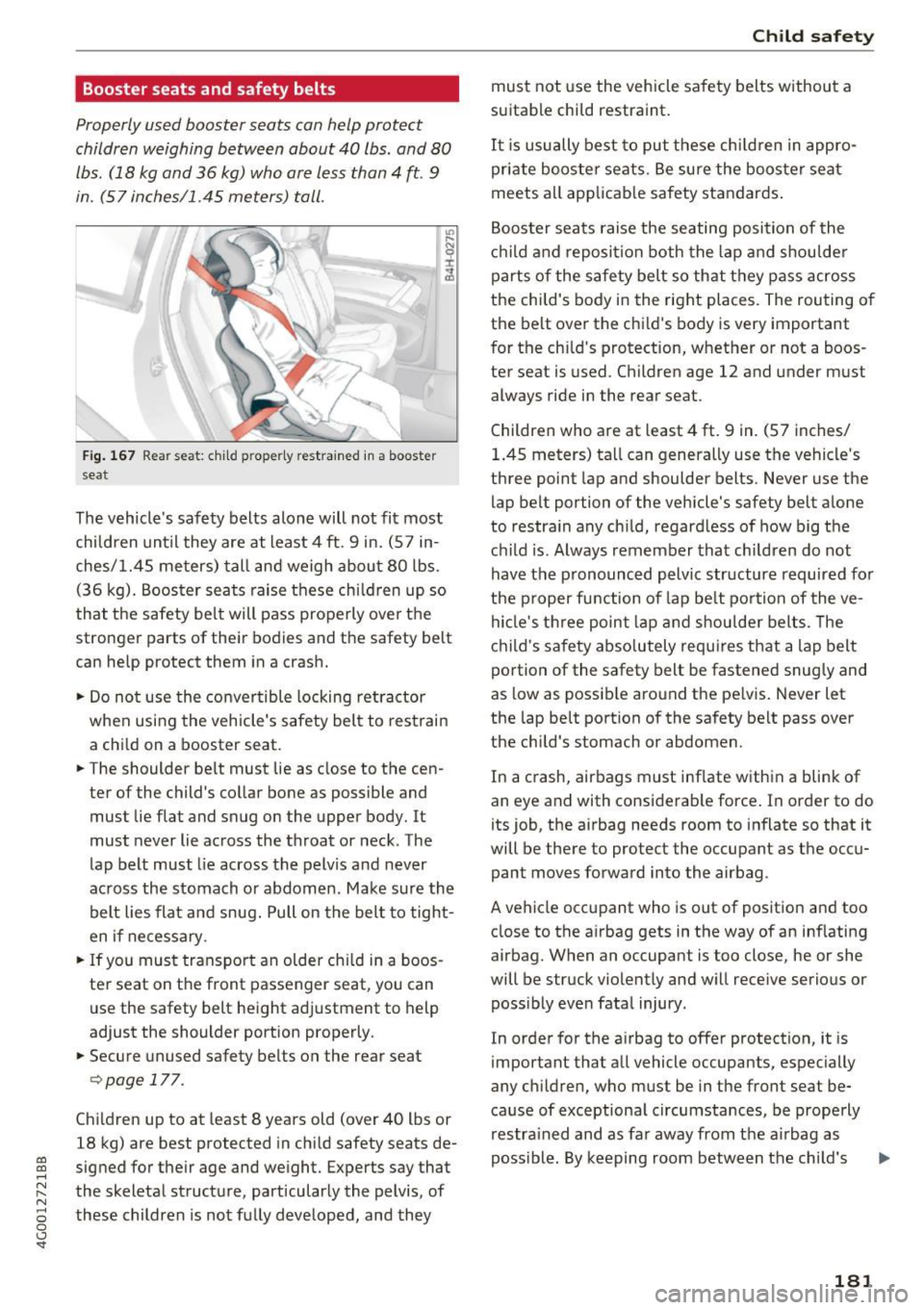
Properly used booster seats can help protect
children weighing between about 40 lbs. and 80
lbs. (18 kg and 36 kg) who are less than 4
ft. 9
in. (57 inches/1.45 meters) tall.
Fig. 167 Rear seat: child p roper ly restrained in a booster
seat
The vehicle's safety belts alone will not fit most
children until they are at least 4
ft. 9 in. (57 in
ches/1.45 meters) tall and weigh about 80 lbs.
(36 kg). Booster seats raise these ch ildren up so
that the safety belt will pass properly over the
stronger parts of their bodies and the safety belt
can help protect them in a crash.
.,. Do not use the convertible locking retractor
when using the vehicle's safety belt to restrain
a chi ld on a booster seat .
.. The shoulder belt must lie as close to the cen
ter of the child's collar bone as possible and must lie flat and snug on the upper body. It
must never lie across the throat or neck. The
lap belt must lie across the pelvis and never
across the stomach or abdomen. Make sure the
belt lies flat and snug. Pull on the belt to tight
en if necessary .
.,. If you must transport an older chi ld in a boos
ter seat on the front passenger seat, you can
use the safety belt height adjustment to help
adjust the shoulder portion properly .
.. Secure unused safety belts on the rear seat
r:=>page 177.
Children up to at least 8 years old (over 40 lbs or
18 kg) are best protected in chi ld safety seats de-
~ signed for their age and we ight. Experts say that ....
~ the skeletal structure, part icularly the pelvis, of N
8 these children is not fully developed, and they 0 <.,;) 'SI'
Child safety
must not use the vehicle safety belts without a
suitable child restraint.
It is usually best to put these children in appro
priate booster seats. Be sure the booster seat
meets all applicab le safety standards .
Booster seats raise the seating position of the
child and reposition both the lap and shoulder
parts of the safety belt so that they pass across
the child's body in the right places. The routing of
the be lt over the chi ld's body is very important
for the ch ild's protection, whether or not a boos
ter seat is used. Children age 12 and under must
always ride in the rear seat.
Children who are at least 4
ft. 9 in. (57 inches/
1.45 meters) tall can generally use the vehicle's
three point lap and shoulder belts . Never use the
lap belt portion of the vehicle's safety belt a lone
to restrain any ch ild, regard less of how big the
ch ild is. Always remember that child ren do not
have the pronounced pelvic structure required for
the proper function of lap be lt portion of the ve
hicle's three point lap and shoulder belts. The
child's safety absolutely requires that a lap belt
portion of the safety belt be fastened snug ly and
as low as possible around the pe lvis. Never let
the lap belt portion of the safety belt pass over
the child's stomach or abdomen .
In a crash, airbags must inflate within a blink of
an eye and with considerab le force. In order to do
its job, the airbag needs room to inflate so that it
will be there to protect the occupant as the occu
pant moves forward into the airbag .
A vehicle occ upant who is out of position and too
close to the a irbag gets in the way of an inflating
airbag. When an occupant is too close , he or she
will be struck violently and w ill receive serious or
possibly even fata l injury .
In order for the airbag to offer protect ion, it is
important that all vehicle occupants, especially
any children , who must be in the front seat be
cause of exceptiona l circumstances, be properly
restrained and as far away from t he airbag as
poss ible. By keeping room between the child's ..,_
181
Page 184 of 280
Child safety
body and the front of the passenger compart
ment, the airbag can inflate completely and pro
vide supplemental protection in certain frontal
collisions.
.,&. WARNING
Not using a booster seat, using the booster
seat improperly, incorrectly installing a boos
ter seat or using the vehicle safety belt im
properly increases the risk of serious personal
injury and death in a collision or other emer
gency situation. To help reduce the risk of se
rious personal injury and/or death:
- The shoulder belt must lie as close to the
center of the child's collar bone as possible
and must lie flat and snug on the upper
body.
It must never lie across the throat or
neck. The lap belt must lie across the pelvis
and never across the stomach or abdomen .
Make sure that the belt lies flat and snug.
Pull on the belt to tighten if necessary.
- Failure to properly route safety belts over a
child's body will cause severe injuries in an
accident or other emergency situation
¢ page 139.
-The rear side of the child safety seat should
be positioned as close as possible to the
backrest on the vehicle seat .
- For adjustable head restraints: adjust or re
move the rear seat head restraint if it is dif
ficult to install the child seat with the head
restraint in place
¢ page 52. Install the
head restraint again immediately once the
child seat is removed. Driving without head
restraints or with head restraints that are
not properly adjusted increases the risk of
serious or fatal neck injury dramatically.
- Never let a child put the shoulder belt under
the arm or behind the back, because it could
cause severe injuries in a crash.
- Children on the front seat of any car, even
with Advanced Airbags, can be seriously in
jured or even killed when an airbag inflates .
- Never let a child stand or kneel on any seat,
for example the front seat.
- Never let a child ride in the cargo area of
your vehicle.
182
- Always remember that a child leaning for
ward, sitting sideways or out of position in
any way during an accident can be struck by
a deploying airbag . This will result in serious
personal injury or death .
- If you must install a booster seat on the
front passenger seat because of exceptional
circumstances the
PASSENGER AIR BAG
OFF
light must come on and stay on, when
ever the ignition is switched on.
- If the
PASSENGER AIR BAG OFF light does
not come on and stay on, perform the
checks described ¢
page 159, Monitoring
the Advanced Airbag System .
-Take the child restraint off the front passen
ger seat and install it properly at one of the
rear seat positions if the
PASSENGER AIR
BAG OFF
light does not stay on whenever
the ignition is switched on.
- Always read and heed all WARNINGS when
ever using a child restrained in a vehicle is
being used¢
page 139, Safety belts,
¢ page 147, Airbag system and
¢ page 171, Important information.
Securing child seats
Securing a child safety seat using a safety
belt
Safety belts for the rear seats and the front pas
senger con be locked with the convertible locking
retractor to properly secure child safety seats.
The safety belts emergency locking retractors for
the rear seats safety belts and for the front pas
senger's seat safety belt have a convertible lock
ing retractor for child restraints. The safety belt
must be locked so that belt webbing cannot un
reel. The retractor can be activated to lock the
safety belt and prevent the safety belt webbing
from loosening up during normal driving . A child
safety seat can only be properly installed when
the safety belt is locked so that the child and
child safety seat will stay in place.
Always remember : Even though your vehicle is
equipped with an Advanced Airbag system, all
children, especially those 12 years and younger, .,.
Page 185 of 280
co
co
.... N
" N .... 0 0 <..:l '
A WARNING
Improperly installed child safety seats in
crease the risk of serious personal injury and
death in a collision.
-Always make sure that the safety belt re tractor is locked when installing a child safety seat. An unlocked safety belt retrac
tor cannot hold the child safety seat in place
dur ing normal driving or in a crash .
- Always buckle the child safety seat firmly in
place even if a child is not sitting in it . A
loose child safety seat can fly around during
a sudden stop or in a collision.
- Always make sure that the rear seat back
rest to wh ich the center rea r safety be lt* is
attached is secure ly latched whenever the
rear cente r safety belt is being used to se
cure a chi ld restraint.
- If the backrest is not securely latched, the
child and the child restraint will be thrown
forward together with the backrest and will
strike parts of the vehicle interior . The chi ld
can be seriously injured or killed.
- Never install rear-facing chi ld safety seats
or infant carriers on the front passenger
seat. A child will be serious ly injured and
can be killed when the passenger airbag in
flates.
- The inflating a irbag w ill hit the child safety
seat or infant carrier with great force and
will smash the ch ild safety seat and child
against the backrest, center armrest, door
or roof.
- Always install rear -facing child safety seats
or infant carriers on the rear seat.
- Forward -facing ch ild safety seats or infant
carriers installed on the front passenger 's
seat may inte rfere with the deployment of
the a irbag and cause serious injury to the
child.
- It is safer to install a forward-fac ing ch ild
safety seat on the rear seat.
- Always read and heed all WARNINGS when
ever using a child restrained in a veh icle is
being used
r:::> page 171 . Specia l precaut ions
Ch ild safety
apply when install ing a child safety seat on
the front passenger seat
r:::> page 148, Child
restraints on the front seat -some impor
tant things to know .
A WARNING
Always take special precautions if you must
i nstall a forward or rearward-facing child re
stra int on the front passenger's seat in excep
tional s ituations:
- Whenever a forward or rearward-fac ing
child restraint is installed on the front pas
senger seat, the
PASSENGER AIR BAG OFF
light must come on and stay on whenever
the ignition is switched on .
- I f the
PASSENGER AIR BAG OFF light does
not come on and stay on, perform the
checks described
r:::> poge 159, Monitoring
the Advanced Airbag System.
- Take the child restraint off the front passen
ger seat and install it properly at one of the rear seat positions if the
PAS SENGER AIR
BAG O FF
light does not stay on whenever
the ignition is switched on.
-Improper installat ion of child restraints can
reduce the ir effectiveness or even prevent
them from providing any protect ion.
- An improperly installed child restra int can
interfere with the airbag as it deploys and
serious ly injure or even kill the child.
- Always carefully follow the manufacturer's
instructions provided with the child safety
seat or carr ier.
- After checking to make sure that the child
restraint is properly installed, make certain
that the child restraint is correctly recog
n ized by the capacitive passenge r detection
system in the front passenger seat and that
the
PASSENGER AIR BAG OFF light signals
the correct front passenger frontal airbag
stat us.
A WARNING
Forwa rd -facing child restraints :
-
183