warning AUDI A6 2017 Manual Online
[x] Cancel search | Manufacturer: AUDI, Model Year: 2017, Model line: A6, Model: AUDI A6 2017Pages: 280, PDF Size: 70.24 MB
Page 121 of 280
co
co
.... N
" N .... 0 0 <..:l -
There is no distance warning fo r the rear. The
fron t sensors remain activa ted . The visual display
switches to trai ler mode. The rearview camera
image will not show the orientation lines and the
b lue surfaces.
Trailer hitches that are not installed at the
factory may cause the parking system to ma l
function or they may restrict its function.
Parking systems
119
Page 122 of 280
Intelligent Technology
Intelligent Technology
Electronic Stabilization
Control (ESC)
Description
Elect ronic Stabilization Control (ESC) suppo rts
driver safety.
It red uces the risk of slipping and
improves dr iving stability. ESC detects crit ica l sit
uations such as the veh icle oversteering and un
dersteering or the wheels are sp inning. The vehi
cle is stabilized by app lying the brakes or reduc
ing engine torque. As soon as the ESC is active ly
regulat ing, the
D.1 indicato r light blin ks in the in
s trumen t clus ter.
The fo llow ing systems are integrated in the ESC :
Ant i-lock braking system (ABS)
ABS p revents the whee ls from locking whe n brak
ing. The vehicle can sti ll be steered even during
hard brak ing. Apply steady press ure to the brake
pedal. Do not pump the pedal. A puls ing in t he
b rake pedal indicates that the system is acting to
s tabilize the vehicle .
Br ake assist system
The brake assist system can decrease brak ing dis
tance . It increases brak ing power when the driver
presses the brake pedal q uick ly in emergency sit
uations . You must press and hold t he b rake pedal
until the dangerous sit uat io n is over . In veh icles
with adapt ive c ruise control*, the bra ke as sist
sy stem is more sensitive if t he di sta nce detec ted
t o the vehicle dr iv ing ahead is too small. On
ve hicl es with act ivated and f unct io ni ng night vi
sion assist*, the brake assist system can respond mo re sensit ively if there is a warning .
Anti-slip regulation (ASR)
ASR red uces eng ine power when the drive w heels
be gin sp inning an d adapts the force to the road
conditions. This makes it easie r to sta rt, acceler
ate and dr ive up h ills.
Electronic differential lock (EDL)
T he EDL applies the b rakes to a whee l t h at s tarts
sp inning and tra nsfe rs t he dr ive powe r to t he
o ther driving wheel or wheels (if the veh icle is
120
equipped with a ll w hee l drive*) . T h is f unction is
not avai lab le at higher speeds .
I n extreme cases , EDL automat ic al ly swi tches off
to keep t he b rake o n the br aked wheel from ove r
heating. The ve hicle is still working correct ly. ED L
will switc h on again automatically when condi
tions have returned to normal.
Steering recommendation
The ESC he lps to s tabili ze th e vehicle by ch ang ing
t h e s teer ing torque.
I n veh icles with dynamic s teer ing*, ESC a lso
helps to stab ilize the s teeri ng in cr it ic al situ a
tions.
Selective wheel torque control
Se lective wheel to rque control is used when d riv
i ng on curves . The front whee l on the ins ide of
t h e curve or both whe els on the i nside of th e
cu rve are braked se lectively as needed. This al
l ows mo re pre cise driving in curves .
Automatic post -collision braking system
The "a utomat ic post -coll is io n braking system"
can help to reduce the risk of sl iding and of addi
tiona l co llisions after an acc iden t. If the a irbag
c on tro l modu le dete cts a collision above a cer tain
vehicle speed, the veh icle is braked by t he ESC.
The veh icle does not brake automatically if:
- the drive r presses the accelerator pedal, or
- the bra king force generate d by the pressed
brake pedal is greater than the b raking force
that would be in itiated by the system, or
- the ESC, the bra ke system or the vehicle elect ri
cal system are not functioning.
A WARNING
- The ESC and its integ rated systems can not
overcome the lim its imposed by natura l
p hys ica l laws. Th is is es pec ially i mpo rtan t
on s lippery or we t roads. If the system s be
g in a cting to s tabili ze yo ur vehicle, you
should immedi ately alte r your speed to
match the road and tra ffi c conditions. Do
not let the inc reased safety provided tempt
Page 123 of 280
co
co
.... N
" N .... 0 0 <..:l 'SI"
you into taking risks. This could increase
your risk of a collision.
- Please note the risk of a co llision increases
when driving fast, especially through curves
and on slippery or wet roads, and when driv
ing too close to objects ahead. The ESC and
its integrated systems cannot always pre
vent collisions -there is still a r isk of acci
dents!
- Press the accelerator pedal carefully when
accelerating on even, slippery surfaces such
as ice and snow. The drive wheels can spin
Switching on /off
Intelligent Technology
even when these control systems are instal
led and this can affect driving stability and
increase the risk of a collision.
(D Tips
- ABS and ASR only function correctly when
all four wheels are equipped with identical
tires. Different tire s izes can lead to a reduc
tion in engine power.
- You may hear noises when the systems de
scribed are working.
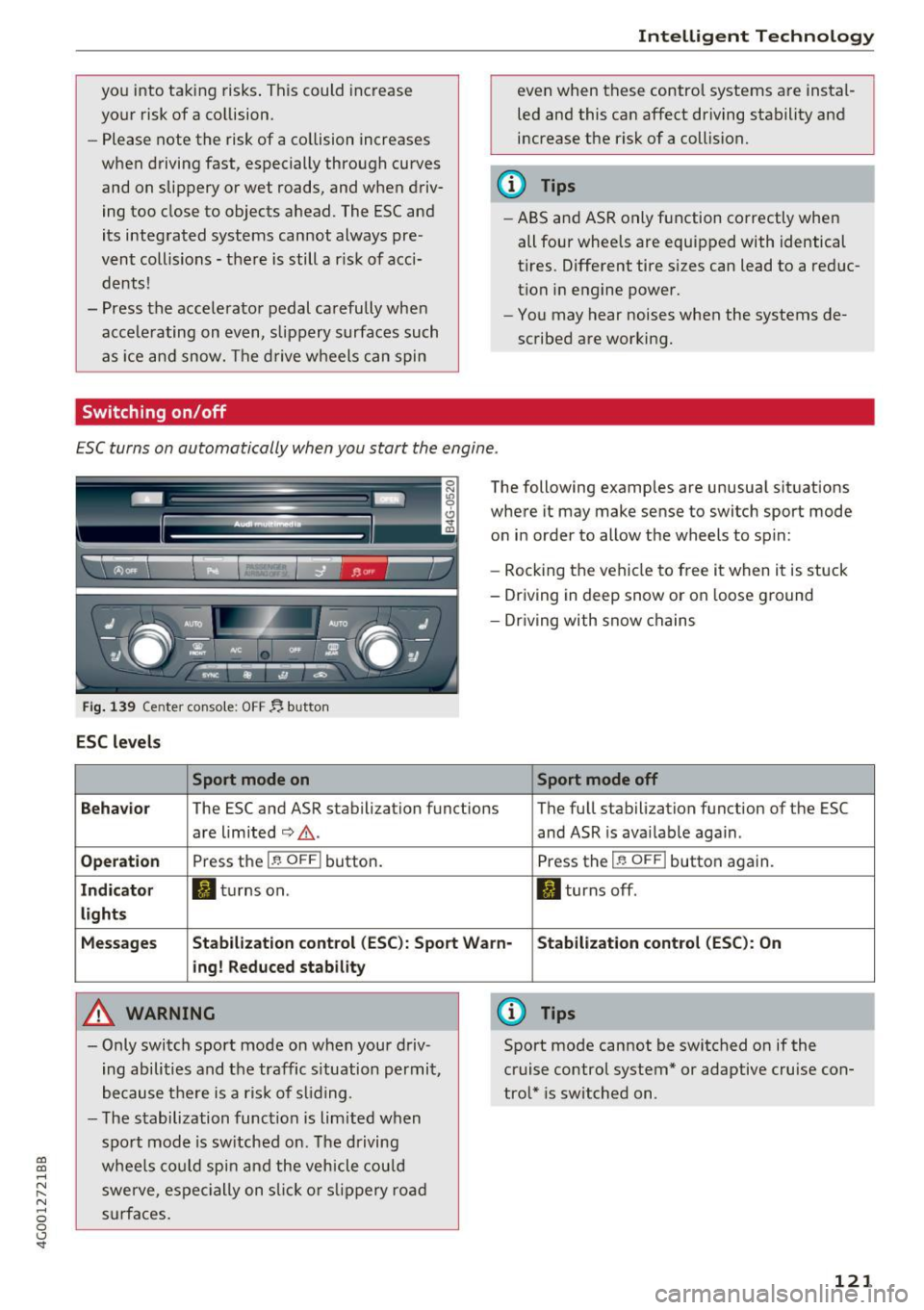
ESC turns on automatically when you start the engine .
Fig. 139 Center console: OFF ~ button
ESC levels
Sport mode on
The following examples are unusual situations
where it may make sense to switch sport mode
on in order to allow the wheels to spin:
- Rocking the vehicle to free it when it is stuck
- Driving in deep snow or on loose ground
- Dr iving with snow chains
Sport mode off
Behavior
The ESC and ASR stabilization functions The full stabilization function of the ESC
are limited
c:> .&. . and ASR is available again .
Operation Press the I~ OFF I button. Press the I~ OFFI button again.
Indicator ltltur nson. II turns off .
lights
Messages Stabilization control (ESC): Sport Warn· Stabilization control (ESC): On
i ng! Reduced stability
A WARNING
- Only switch sport mode on when your driv
ing abilities and the traffic s ituation permit,
because there is a risk of sliding .
- The stabilization function is limited when
sport mode is switched on. The driving
wheels could spin and the vehicle could
swerve, espec ially on slick or slipp ery road
surfaces .
(D Tips
Sport mode cannot be switched on if the
cruise control system* or adaptive cruise con
trol* is switched on .
121
Page 124 of 280
Intelligent Technology
Braking
New brake p ads
New b rake pads do no t achieve the ir full b raking
effect during the firs t 250 mi (400 km) . They
m ust be "broken in" first .
Wear
Brake pad wear depends largely o n the way the
ve hicl e is driven and on operat ing cond it ions.
This is especi ally true if you are d riving frequently
in the c ity and on c urves or with a sporty driving
style.
Operating noise
Noises may occur when bra king depend ing on the
speed, b raking force and outs ide cond it ions s uch
as temperature and humidity.
Effect of water and road salt
In ce rtain s ituations, for example after driving
through water, in heavy ra in, afte r ove rnight con
densat ion or after washing your car, the b raking
effect can be red uce d by mo isture or ice on the
b rake rotors and brake pads. The brakes must be
"dried" first with a few careful brake applica
tions.
At highe r speeds and with t he windshie ld wipers
turned on, the brake pads press against the bra ke
rotors for a short amount of time . This action,
which is not felt by the driver, happens at regular
intervals and ens ures a better reaction time for
the brakes in wet weathe r.
The braking effect can also be reduced if you are
driving on sa lted roads and you do not apply t he
brakes for long periods of time. The layer of salt
on the brake rotors and pads must be worn off
first when the brakes are applied.
Corrosi on
Leaving the vehicle parked for long periods of
time, low mi leage and avo iding heavy brak ing
can contribute to corrosion on the brake rotors
and to d irty brake pads.
If you usually avoid heavy b raking or if there is
corros ion present, occasional heavy braking at
122
high speeds is recommended to clean the brake
rotors and pads¢.&. .
Brake system malfunction
if you not ice that the b rake peda l t ravel has sud
denly increased, then a br ake circuit in the du al
c irc uit b rake system may have malfunctioned.
Drive to an authorized A udi dealer or authorized
A udi Se rvice Facility immediate ly to have the
problem corrected. On the way there, drive w ith
reduced speed and keep in m ind t hat you will
need a longer distance to stop and you will need
to press the brake peda l harder .
lo w b rake fluid level
When the brake fluid level is low, malfunctions in
the brake system may occur. The brake fluid level
i s electronically monitored.
Brake booster
The brake boos ter amp lifies the pressure you ap
ply to the brake pedal. It only works when the en
gine is running .
A WARNING
- Only app ly the brakes for the purpose o f
cleaning the brake system when road and
traffic conditions permit. You must not en
danger other road users. This i ncreases the
r is k of an accident .
-
- Never let the ve hicle roll while the engine is
s topped because this i ncreases the ris k of an
accident .
- New brake pads do no t ach ieve the ir full
braking effect dur ing the first 250 m i
( 4 00 km). They m ust be "b roken in" fi rst.
However, you can compensa te fo r the
slightly reduced brak ing force by pressing
firm ly on the brake pedal. Avo id heavy brak
ing during the break-in period.
- Ce rtain weather and operating condi tions
such as d riving through water, dr iv ing in
heavy rain o r driv ing after washi ng your ve
hicle can impai r the effectiveness of the
brakes. In the winter, ice may build up on
the brake pads, rotors and dr ums. Check
Page 126 of 280
Intelligent Technology
- For addi tional in format ion on dynamic
steering, refer to
c:> page 104.
ALL wheel drive (quattro)
Applies to: vehicles with all wheel drive
In oil wheel drive, all four wheels ore powered.
General information
In a ll wheel d rive, the d rivi ng power is divided be
t ween a ll four wheels. Th is happens au tomatical
ly depending on your driving behavior as well as
the current road cond itions. Also see
c::> page 120, Electronic Stabilization Control
(ESC) .
A center differentia l distrib utes the driv ing power
variably to the front and rear axle. It works to
gethe r with selective wheel torq ue control, which
activates when driving through curves
c::> page 120. With the sport differentia l", power
d istr ibut ion to the rear wheels is variable and can
be ad justed w ith drive select
c::> page 104.
The a ll wheel drive concept is designed for h igh
engine power. Your ve hicle is exceptionally pow
erful and has excellent driving characterist ics
both under normal dr iv ing condit ions and on
snow a nd ice . Always read and fo llow safety pre
cautions
c::> ,& .
Winter tires
By us ing a ll wheel drive, your vehicle has good
forward mot io n with standard t ires in winter con
d itions . However, in winter we recommend using
w inter or all season t ires on all fo ur wheels, be
cause th is w ill improve the b raking effe ct.
Snow chains
If there are snow chain laws, snow chains must
also be used on vehicles with all wheel drive
c::> page 226, Snow chains .
Replacing tires
For vehicles w ith all wheel dr ive, only whee ls with
the same rolling circumference should be used .
Avoid using t ires with different tread depths
c::> page 217, New tires or wheels .
124 Offroad vehicle?
You
r A udi is no t an off road vehicle -there is not
eno ugh ground clearan ce . F or this reason, avoid
difficult terra in .
_&. WARNING
- Also, in veh icles with all wheel drive, adapt
your driving sty le to the current road and
traffic conditions. Do not let the increased
safety provided tempt you into taking r isks,
because this inc reases the risk of an acc i
dent .
- The b raking ab ility of your vehicle is limited
to the t raction of the whee ls . In this way, i t
is not different from a two wheel d rive vehi
cle. Do not be tempte d to accelerate to a
hig h speed when the ro ad i s slip pery, be
cause th is increases the r is k of an accident .
- Note that on wet s treets, the front wheels
c a n " hyd ropla ne" if driv ing a t spee ds tha t
are too h igh. Unlike front wheel drive
veh icles, t he engine does not rev higher sud
de nly when t he vehicle begins hydroplan ing.
For this reason, adapt yo ur speed to the
road conditions to reduce the risk of an acci
de nt.
Energy management
The starting ability is optimized
The energy management system manages the
elec trical energy distribution and optimi zes the
availability of electri cal energy for starting the
engine .
When a vehicle wi th a conventiona l energy sys
tem is no t driven for a l ong time , the veh icle ba t
te ry is d raine d by equ ipment ( fo r example, the
immo biliz er). In certa in circ umstances, there
could may not be enough energy to start the en
gine.
Yo ur vehicle is equipped with an inte lligen t ener
gy management system fo r dist ributing elec trici
ty. This significantly improves the starting ability
and increases the vehicle battery life . .,.
Page 130 of 280
Driving sa fe ty
Driving safety
Basics
Safe driving habits
Please remember -safety first!
This chapter contains important information,
tips, instruct ions and warn ings that you need to
read and observe for your own safety, the safety
of your passengers and others. We have summar ized here what you need to know about safety
be lts, a irbags, child restra ints as well as child
safety. Your safety is for us
priority number 1 . Al
ways observe the i nfo rmation and wa rn ings in
this section - for your own safety as well as that
of your passengers.
The information i n this section applies to all
model versions of yo ur vehicle . Some of the fea
tures descr ibed in t his sections may be s tanda rd
equipment on some models, or may be optional
equipment on others . If you are not sure, ask
your authorized Audi dealer.
A WARNING
- Always make sure that you follow the in
structions and heed the WARNINGS in th is
Manual.
It is in your interest and in the in
te rest of your passengers.
- Always keep the comp lete Owner's Litera
ture in your A udi when you lend or sell your
vehicle so that this important information
will always be available to the d river and
passenge rs.
- Always keep the Owner 's literature handy so
that you can find it easily if you have ques
t ions.
Safety equipment
The safety features are part of the occupant re
straint system and work together to help reduce
the risk of injury in a wide variety of occident si t
uations.
Your safety and the safety of your passenge rs
should not be left to chance. Advan ces i n tech
nology have made a var iety of features avai lab le
to help reduce t he risk of injury in an accident .
128
The following is a list of just a few of the sa fety
features in your Audi :
- sophis tica ted safety be lts fo r dr ive r and all pas-
senge r seat ing pos itions,
- safety belt p retensioners,
- safety belt force lim ite rs fo r th e front seats,
- safety belt he ight adjustment systems for the
front seats,
- front airbags,
- knee airbags for the front seats*
- side airbags in the front seats and outer rear
seats*,
- side curtain airbags with ejection mitigation
features,
- special LATCH anchorages for child restraints,
- head rest raints fo r ea ch seating position,
- adj ustab le steering col umn.
These ind iv idual safety features, can work to
ge ther as a system to help protect you and your
passengers in a wide range of acc idents. These
features canno t wo rk as a sys tem if they are not
alw ays cor rec tly adj usted and cor rect ly used.
Safety is everybody' s re sponsibility!
Important things to do before driving
Safety is everybody's job! Vehicle and occupant
safety always depends on the informed and care
ful driver .
For your safety and the safety of your passen
gers,
before driving alway s:
.. Make sure that a ll lights and signals are operat
ing correctly.
.. Make sure that the tire pressure is correct.
.,. Make sure that all windows are clean and afford
good visibility to the outs ide .
.. Sec ure all luggage and othe r items carefully
~page 57, ~page 56 .
.. Ma ke sure that noth ing ca n interfere wi th the
peda ls .
.. Adjust front seat, head restraint and mirrors
correctly for yo ur height .
.. Instruct passengers to adjust the head re
straints according to their he ight.
Page 131 of 280
co
co
.... N
" N .... 0 0 <.,;) 'SI"
.. Make sure to use the right chi ld restraint cor
rectly to protect children
~ page 171 , Child
safety .
.. Sit properly in your seat and make sure that
your passengers do the same¢
page SO, Seats
and storage .
.. Fasten your safety belt and wear it properly . Al
so instruct your passengers to fasten their safe
ty be lts properly ¢
page 139 .
What impairs driving safety?
Safe driving is directly related to the condition of
the vehicle, the driver as well as the driver's abili
ty to concentrate on the road without being dis
tracted.
The driver is responsible for the safety of the ve
h icle and all of its occupants. If you r ability to
d rive is impaired, safety risks for eve rybody in the
veh icle increase and you also become a hazard to
everyone else on the road ¢A -Therefore :
.. Do not let you rself be dist racted by passengers
or by us ing a cellular te lephone .
.. NEVER dr ive when your dr iv ing ability is im
paired (by medications, alcohol, drugs, etc.).
.. Observe all traff ic laws, rules of the road and
speed limits and plain common sense.
.. ALWAYS adjust your speed to road, traffic and
weather cond itions.
.. Take frequent breaks on long trips. Do not drive
for more than two ho urs at a stretch .
.. Do NOT drive when you are tired, under pres
s ur e o r when you are st ressed.
_& WARNING
Impaired dr iv ing safe ty inc reases the risk of
ser ious personal inju ry and death whenever a
vehicle is being used.
.
Dr iving safety
Correct passenger
seating positions
Proper seating position for the driver
The proper driver seating position is important
for safe, relaxed driving .
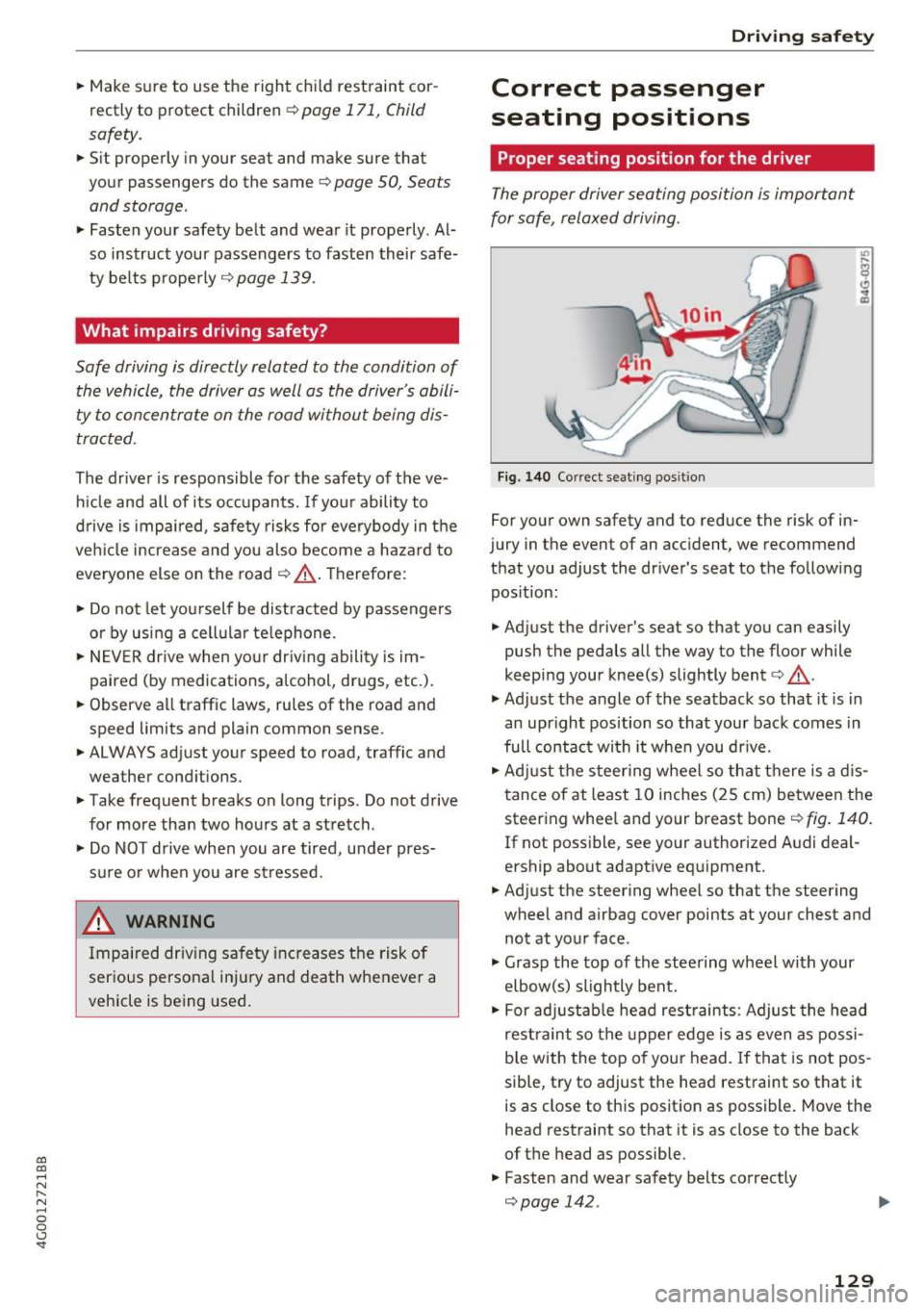
F ig. 140 Correct seat ing pos it io n
For your own safety and to reduce the risk of in
jury in the event of an accident, we recommend
that you adjust the dr iver 's seat to the fo llowing
pos ition:
.. Adjust the driver's seat so that you can easily
push the pedals all the way to the floor while
keep ing your knee(s) slightly bent¢&. -
.,. Adjust the angle of the seatback so that it is in
an upright position so that your back comes in
full contac t wi th it when you dr ive .
.. Adj ust the steer ing wheel so that there is a d is
tance of at least 10 inches (25 cm) between the steering whee l and your breast bone¢
fig. 140.
If not poss ible, see your author ized A udi deal
ership about adapt ive equipment.
.. Adjust the steering wheel so that the steering
wheel and airbag cover points at your chest and
not at your face .
.,. Grasp the top of the steering wheel with your
elbow(s) slightly bent.
.. For adjustab le head rest raints: Adjust the head
rest raint so the upper edge is as even as possi
b le with the top of your head. If that is not pos
sible, t ry to adjust the head restraint so that it
is as close to this posit ion as possible. Move the
head restraint so that it is as close to the back
of t he head as possible.
.. Fasten and wear safety belts correctly
Qpage 142. ..,.
129
Page 132 of 280
Driving safety
"' Always keep both feet in the footwell so that
you are in control of the vehicle at all times.
For detailed information on how to adjust the
driver's seat, see
c;, page SO.
A WARNING
Drivers who are unbelted, out of position or
too close to the airbag can be seriously in
jured by an airbag as it unfolds . To help re
duce the risk of serious personal injury:
- Always adjust the driver's seat and the
steering wheel so that there are at least
10 inches (25 cm) between your breastbone
and the steering wheel.
- Always adjust the driver's seat and the
steering wheel so that there are at least
4 inches (10 cm) between the knees and the
lower part of the instrument panel.
- Always hold the steering wheel on the out
side of the steering wheel rim with your
hands at the 9 o'clock and 3 o'clock posi
tions to help reduce the risk of personal in
jury if the driver's airbag inflates.
- Never hold the steering wheel at the
12 o'clock position or with your hands at
other positions inside the steering wheel
rim or on the steering wheel hub. Holding
the steering wheel the wrong way can cause
serious injuries to the hands, arms and head if the driver's airbag inflates.
- Pointing the steering wheel toward your
face decreases the ability of the su pplemen
tal driver's airbag to protect you in a colli
sion.
- Always sit in an upright position and never lean against or place any part of your body
too close to the area where the airbags are
located .
- Before driving, always adjust the front seats
properly and make sure that all passengers
are properly restrained .
- For adjustable head restraints: before driv
ing, always also adjust the head restraints
properly .
- Never adjust the seats while the vehicle is
moving. Your seat may move unexpectedly
and you could lose control of the vehicle.
130
-
-Never drive with the backrest reclined or
tilted far back! The farther the backrests are
tilted back, the greater the risk of injury due
to incorrect positioning of the safety belt
and improper seating position .
- Children must always ride in child seats
c;,page 171. Special precautions apply
when installing a child seat on the front
passenger seat
c:;, page 147.
Proper seating position for the front
passenger
The proper front passenger seating position is
important for safe, relaxed driving.
For your own safety and to reduce the risk of in
jury in the event of an accident , we recommend
that you adjust the seat for the front passenger
to the following position:
"'Adjust the angle of the seatback so that it is in
an upright position and your back comes in full
contact with it whenever the vehicle is moving.
"'For adjustable head restraints: adjust the head
restraint so the upper edge is as even as possi
ble with the top of your head. If that is not pos
sible, try to adjust the head restraint so that it
is as close to this position as possible
c:;, page 131 . Move the head restraint so that it
is as close to the back of the head as possible.
"' Keep both feet flat on the floor in front of the
front passenger seat .
"' Fasten and wear safety belts correctly
c;,page 142.
For detailed information on how to adjust the
front passenger's seat, see
c:;, page SO .
A WARNING
Front seat passengers who are unbelted, out
of position or too close to the airbag can be
seriously injured or killed by the airbag as it
unfolds. To help reduce the risk of serious
personal injury:
- Passengers must always sit in an upright po
sition and never lean against or place any part of their body too close to the area
where the airbags are located.
Ill-
Page 133 of 280
co
co
.... N
" N .... 0 0 <..:l 'SI"
-Passengers who are unbelted, out of posi
tion or too close to the airbag can be seri
ously injured by an airbag as it unfolds with
great force in the blink of an eye.
- Always make sure that there are at least
10 inches (25 cm) between the front pas
senger's breastbone and the instrument
panel.
- Always make sure that there are at least
4 inches (10 cm) between the front passen ger's knees and the lower part of the instru
ment panel.
- Each passenger must always sit on a seat of
their own and properly fasten and wear the safety belt belonging to that seat.
- Before driving, always adjust the front pas
senger seat properly.
- For adjustable head restraints: before driv
ing, always also adjust the head restraints
properly.
-Always keep your feet on the floor in front
of the seat. Never rest them on the seat, in
strument panel, out of the window, etc. The
airbag system and safety belt will not be
able to protect you properly and can even in
crease the risk of injury in a crash .
- Never drive with the backrest reclined or
tilted far back! The farther the backrests are
tilted back, the greater the risk of injury due
to incorrect positioning of the safety belt and improper seating position.
- Children must always ride in child seats
c> page 171. Special precautions apply
when installing a child seat on the front
passenger seat
c> page 147.
Proper seating positions for passengers in
rear seats
Rear seat passengers must sit upright with both
feet on the floor consistent with their physical
size and be properly restrained whenever the ve
hicle is in use.
To reduce the risk of injury caused by an incorrect
seating position in the event of a sudden braking
maneuver or an accident, your passengers on the
rear bench seat must always observe the follow
ing:
Driving safety
.,. For adjustable head restraints: adjust the head
restraint so the upper edge is as even as possi
ble with the top of your head. If that is not pos
sible, try to adjust the head restraint so that it
is as close to this position as possible
c>page 131.
.,. Keep both feet flat in the footwell in front of
the rear seat.
.,. Fasten and wear safety belts properly
c> page 142.
.,. Make sure that children are always properly re
strained in a child restraint that is appropriate
for their size and ager:!;>
page 171.
A WARNING
-
Passengers who are improperly seated on the
rear seat can be seriously injured in a crash.
- Each passenger must always sit on a seat of
their own and properly fasten and wear the
safety belt belonging to that seat.
- Safety belts only offer maximum protection
when the safety belts are properly posi
tioned on the body and securely latched. By not sitting upright, a rear seat passenger in
creases the risk of personal injury from im
properly positioned safety belts!
- For adjustable head restraints: always ad
just the head restraint properly so that it
can give maximum protection.
Proper adjustment of head restraints
App lies to: vehicles with adjusta ble head restraints
Correctly adjusted head restraints are an impor
tant part of your vehicle's occupant restraint sys
tem and can help to reduce the risk of injuries in
accident situations.
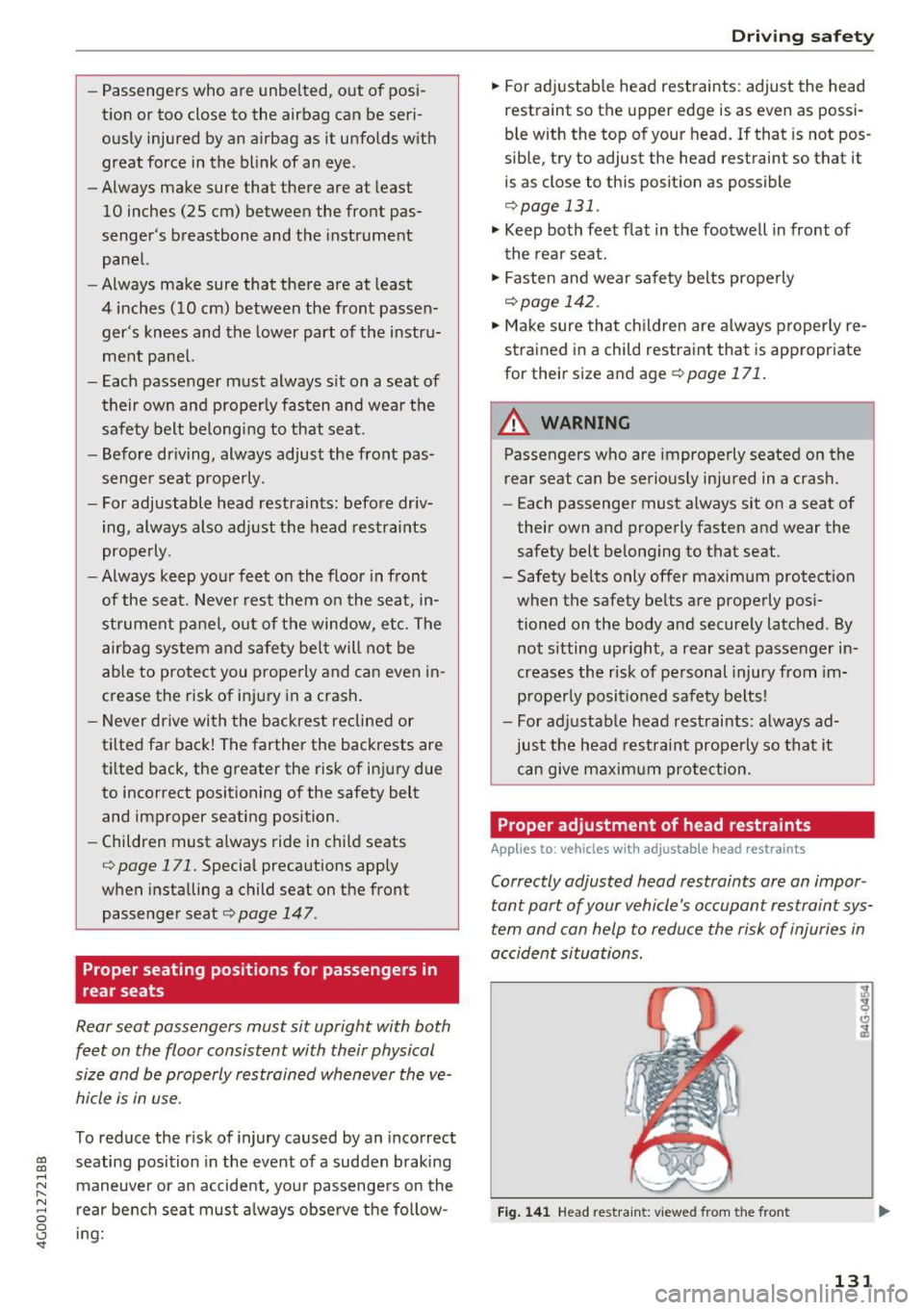
Fig. 141 Head restraint: viewed from the front
131
Page 134 of 280
Driving sa fe ty
The head restraints must be correc tly adjusted to
achieve the best protection .
.,. Adjust the head restraint so the upper edge is
as even as poss ible with the top of your head.
If
that is not possible, try to adjust the head re
straint so that it is as close to this position as
poss ib le ~
fig . 141. Move the head restraint so
that it is as close to the back of the head as
poss ible.
.,. If there is a passenger on the rear center seat
ing pos it ion, slide the center head restra int up
ward at least to the next notch.
Adjusti ng head restraints
¢ page 51.
A WARNING
All seats are equipped with head restraints.
Dr iv ing without head restraints or with head
restraints that are not p roperly adjusted in
cre ases the risk of serious or fatal ne ck inju ry
dramatically. To help reduce the r is k of injury:
- Always dr ive with the head rest raints in
place and properly ad justed.
- E very person in the vehicle must have a
prope rly adjusted head restra int.
- Always make sure each person i n the vehicle
prope rly adjusts their head res traint. Adjust
the head res tra int so the uppe r edge is as
even as possib le w ith the top of your head.
If that is no t possib le, try to adjust the head
restraint so that it is as close to this position
as possib le. Move the head restra int so that
it is as close to the back of the head as pos
sible.
- Never attempt to adjust head restraint wh ile driving. If you have dr iven off and
must adjust the driver headrest for any rea
son, fi rst s top the vehicle safely before at
tempting to ad just the head restra int.
- Children must always be properly restrained in a chi ld restraint that is appropriate fo r
their age and size
¢page 171.
132
Examples of improper seating positions
The occupant restraint system can only reduce
the risk of injury if vehicle occupants are properly
seated .
Improper seating positions can cause ser ious in
jury or death . Safety be lts ca n only work when
they are properly positioned on t he body . Im
prope r seat ing pos itions red uce the effectiveness
of safety bel ts a nd will even increase t he risk of
i njury and deat h by mov ing the safety bel t to cr it
ic al areas of the body. Improper seating positions
a lso increase the risk of se rio us in jury and death
when an airbag deploys and strikes an occ upant
who is not in the proper seating posit ion. A dr iver
i s responsible for the safety of all vehicle occu
pants and espec ially for children. Therefore :
.,. Never allow anyone to assume an incor rect
seating position when the vehicle is being used
¢ .&_ .
The following bulletins list on ly some samp le po
s itions that will increase the r isk of serious injury
and death . Our hope is that these examples will
make you more aware of seating positions that
are dangerous .
Therefore, whene ver the vehicl e is m oving:
-never stand up in the vehicle
- neve r stand on the seats
- neve r kneel on the seats
- neve r ride w it h the seatback recl ined
- never l ie down on the rear seat
- never lean up against the instrument panel
- never s it on the edge of the seat
- never sit sideways
- never lean out the window
- neve r put your feet o ut the window
- neve r put your feet on the instr ument panel
- neve r res t your feet on the seat c ushion or back
of the seat
- never ride in the footwell
- never ride in the cargo area