warning light AUDI A6 2018 Owners Manual
[x] Cancel search | Manufacturer: AUDI, Model Year: 2018, Model line: A6, Model: AUDI A6 2018Pages: 266, PDF Size: 41.38 MB
Page 197 of 266
a co .... N
" N .... 0 0 \,;J '
cle where temperatures remain below freezing
for extended periods.
Detergent additives in the oil will make fresh oil
l ook dark after the engine has been running for a
short time. This is norma l and is not a reason to
change the oil more often than recommended.
Because of the problem of proper disposa l, along
with the special tools and necessary expertise re
quired, we strong ly recommend that you have
your oil changed by an authorized
Audi dealer or
a qualified service station .
If you choose to change your oil yourself, please
note the following important information:
A WARNING
To reduce the risk of personal injury if you
must change the engine oil in your veh icle
yourself:
- Wear eye protection.
- To reduce the risk of burns from hot engine
o il, let the eng ine cool down to the touch.
-
-When removing the oil drain plug with your
fingers, stay as far away as possible. Always
keep your forearm parallel to the ground to
help prevent hot oil from running down your
arm.
- Drain the oil into a container designed for
this purpose, one large enough to hold at
least the total amount of oil in your engine .
- Engine oil is poisonous. Keep it well out of
the reach of children.
- Cont inuous contact w ith used engine oil is
harmful to your sk in. Always protect your
sk in by washing oil off thoroughly w ith soap
and water.
@ Note
Never mix oil addit ives with your engine o il.
These additives can damage your eng ine and
adversely affect your Audi Limited New Vehi
cle Warranty.
Checking and Filling
@) For the sake of the environment
-Before changing your oi l, first make sure
you know where you can properly dispose of
the used oil.
- Always dispose of used engine oi l properly.
Do not dump it on garden soil, wooded
areas, into open streams or down sewage
drains.
- Recycle used engine o il by tak ing it to a used
eng ine oil collection fac ility in your area, or
contact a service station .
Cooling system
Coolant
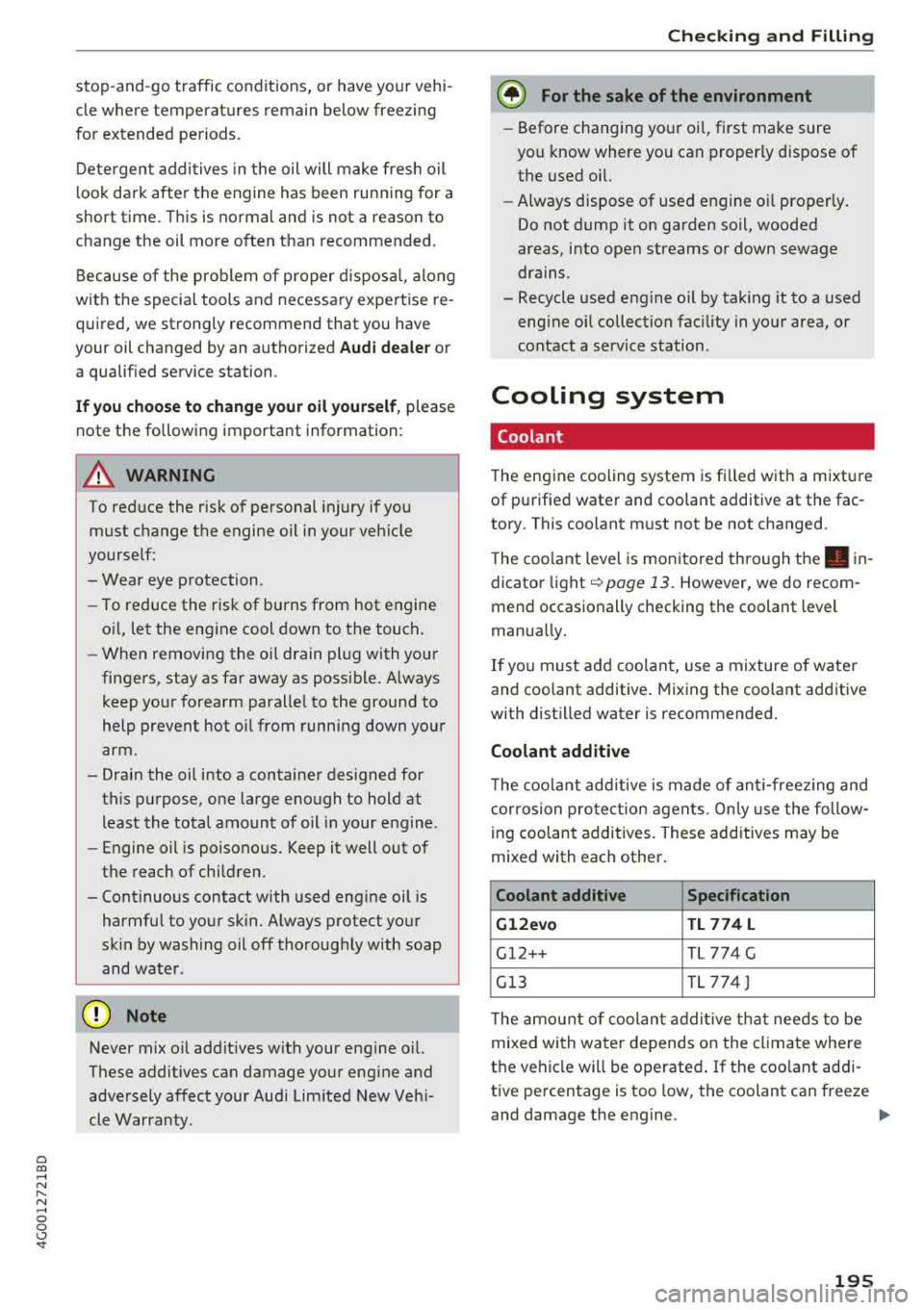
The engine cooling system is filled wit h a mixture
of purified water and coolant additive at the fac
tory. This coolant must not be not changed.
T he coolant level is monitored through
the . in
dicator light
r=:>poge 13. However, we do recom
mend occasionally checking the coolant leve l
manua lly.
If you must add coolant, use a mixture of water
and coolant additive. Mixing the coo lant additive
with distilled water is recommended.
Coolant additive
The coolant additive is made of anti-freezing and
corrosion protection agents. Only use the follow
ing coolant additives. These additives may be
mixed with each other .
Coolant additive Specification
Gl2evo
TL 774 L
Gl2++ TL 774 G
Gl3 TL 774
J
The amount of coolant additive that needs to be
mixed with water depends on the climate where
the vehicle wi ll be operated .
If the coolant addi
tive percentage is too low, the coolant can freeze
and damage the engine.
.,.
195
Page 198 of 266
Checking and Filling
Coolant Freeze protec-
additi ve tion
Warm min. 40% min. -13 °F
regions max. 45% (-25 °C)
Cold min. 50% max. -40
°F
regions max. 55% (-40 °C)
([) Note
- Before the start of winter, have an author
ized Audi dealer or authorized Audi Service
Facility check if the coolant additive in your
vehicle matches the percentage appropriate
for the climate. This is especially important
when driving in colder climates.
- If the appropriate coolant additive is not
available in an emergency, do not add any
other additive. You could damage the en
gine. If this happens, only use water and re store the correct mixture ratio with the
spec ified coolant additive as soon as possi
ble.
- Only refill with new coo lant.
- Radiator sealant must not be mixed w ith
the coo lant .
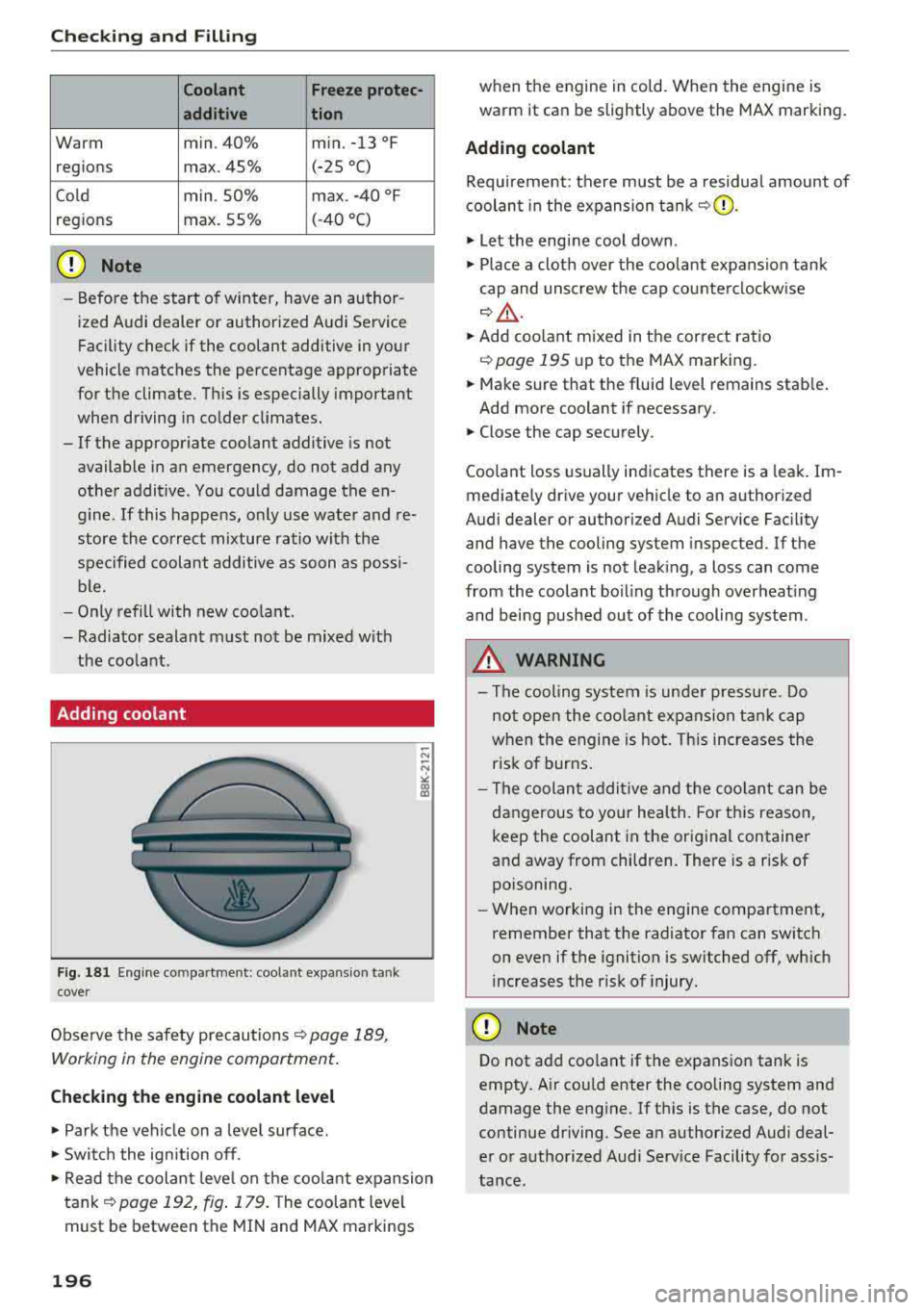
Adding coolant
F ig. 181 Engine compartment: coolant expans ion tank
cover
Observe the safety precautions~ page 189,
Working in the engine compartment .
Checking the engine coolant level
• Park the vehicle on a leve l surface .
• Switch the ignition off.
• Read the coolan t leve l on the coo la nt expansion
tank~ page 192, fig . 179. The coolant level
must be between the MIN and MAX markings
196
when the engine in cold. When the engine is
warm it can be slightly above the MAX marking .
Adding coolant Requirement: there must be a residual amount of
coolan t in the expansion tan k
~CD -
• Let the engine cool down .
• Place a cloth over the coolant expansion tank
cap and unscrew the cap counterclockw ise
~ & -
... Add coo lant m ixed in the cor rect ratio
~ page 195 up to the MAX marking.
• Make sure that the fluid level remains stab le .
Add more coolant if necessary .
• Close the cap securely.
Coolant loss usually ind icates there is a leak . Im
mediate ly drive your vehicle to an authorized
Audi dealer or authorized Audi Service Fac ility
and have the cooling system inspected. If the
cooling system is not leaking, a loss can come
from the coolant boiling through overheat ing
and being pushed out of the cooling system .
A WARNING
- The cooling system is under pressure. Do
not open the coo lant expansion ta nk cap
when the engine is hot. This increases the
risk o f bur ns.
- The coolan t addi tive and the coolant can be
dangerous to your health. For t his reason,
keep the coolant in the original container
and away from children. There is a risk of
poisoning.
- When working in the engine compartment,
remember that the radiator fan can switch
on even if the ignition is switched off, which
increases the risk of injury.
(D Note
Do not add coolant if the expansion tank is
empty. A ir cou ld enter the cooling system and
damage the engine. If this is the case, do not
continue driving. See an authorized Audi deal
er or authorized Audi Serv ice Facility for assis
tance.
Page 200 of 266
Checking and Filling
(D Note
If the vehicle will be parked for long periods
of t ime , protect it against the co ld so that it
will not be destroyed by "freezing"
c;,page 198 .
Vehicle battery
The term "vehicle battery " refers to the 12 Volt
bat tery in your vehicle.
Not running the vehicle for long pe riods of
t ime
If you do not drive your vehicle for several days o r
weeks , electri cal equipment is gr adually scaled
back or switched off . This reduces energy use and
ensures the veh icle w ill be able to start after long
periods of
time r:::;, page 123 . Some conve nience
functions, s uch as interior lighting or power seat
adj ustment, may not be available under certa in
circumstances. These convenience f unct ions w ill
be ava ilab le aga in once you switch the ignition on
and start the engine .
E ven w hen electrica l equ ipme nt is swi tched off,
the equipment can still d rain the vehicle battery
if the vehicle is not driven for long periods of
time . Deep draining results in a chemical reaction
that destroys the inside of the vehicle battery .
The vehicle battery must be charged every month
t o reduce the risk of this happening
r:::;, page 198.
Contact an author ized Audi dealer or authorized
Aud i Serv ice Facility for more information .
Winter operati on
Cold weather places higher demands on the vehi
cle battery. This results in reduced start ing abili
ty . Have the vehicle battery checked by an au
thor ized Audi dealer or authorized Audi Service
Facility before the co ld time of year .
198
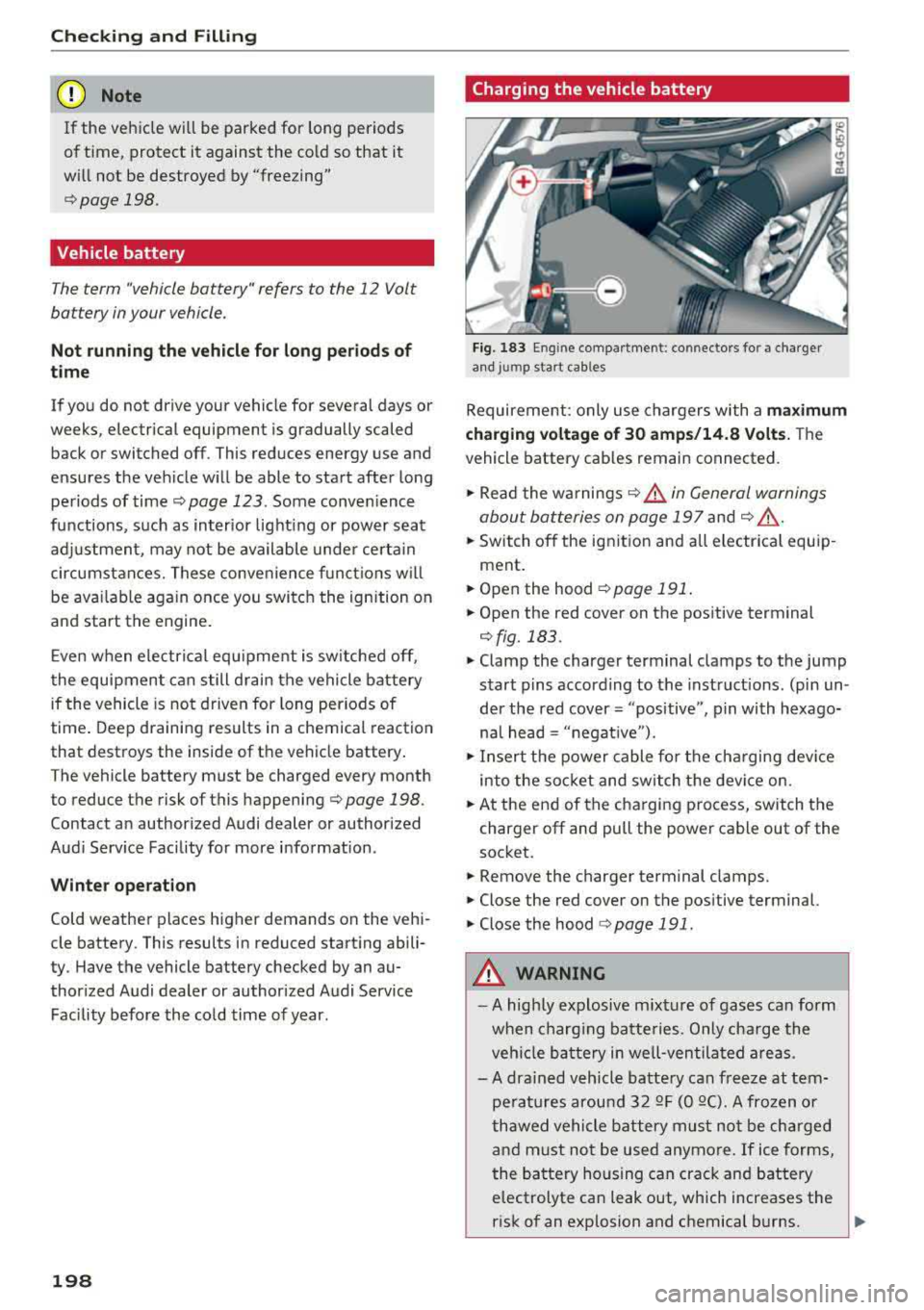
Charging the vehicle battery
Fig. 183 En g in e compartment : co nn ectors fo r a cha rger
a n d jum p start cab les
Requireme nt: only use chargers with a maximum
charging voltage of 30 amp s/14.8 Volts.
The
vehicle battery cab les remain connected.
... Read the wa rnings r:::;, _& in General warnings
about batteries on page 197
and r:::;, ,& .
... Switch off the ign it ion and all electrica l equip
ment .
... Open the hood c;,page 191 .
... Open the red cover on the pos itive terminal
¢fig. 183.
... Clamp the charger terminal clamps to the jump
start p ins accord ing to the instruct ions. (pin un
der the red cover
= " positive ", pin with hexago
nal head= "negat ive ").
... In sert t he power cable fo r th e cha rging dev ice
into the soc ket and switch t he devi ce on.
... At the end of the cha rging process, switch the
charger off and pull the power cable out of the
soc ket .
... Remove the charger terminal clamps.
... Close the red cover on the pos itive terminal.
... Close the hood c:;, page 191 .
A WARNING
-A highly explosive m ix ture of gases can form
when charg ing batte ries . Only cha rge the
veh icle b attery in well -ventila ted areas.
- A drained vehicle batte ry can freeze at tem
pe ra tu res around 32
QF (0 QC). A fro zen o r
thawed vehicle battery must no t be charged
a nd must not be used anymore. If ice forms,
the battery housing can crack and battery
electrolyte can leak out, which increases the
risk of an explosion and chemical burns.
..,.
Page 203 of 266
0 0)
-N ,.... N
-0
s ..
Wheels
Wheels and Tires
General information
.,,.Check your tires regularly for
damage (punctures, cuts, cracks
and bulges). Remove foreign ob
jects from the tire tread.
.,,. If driving over curbs or similar
obstacles, drive slowly and ap
proach the curb at an angle.
.,,.Have faulty tires or rims re
placed immediately.
.,,.Protect your tires from oil,
grease and fuel.
.,,.Mark tires before removing
them so that the same running
direction can be maintained if
they are reinstalled.
.,,.Lay tires flat when storing and
store them in a cool, dry location
with as little exposure to light as
possible.
&_ WARNING -
-Never drive faster than the
maximum permitted speed
for your tires. This could cause the tires to heat up too much.
This increases the risk of an
accident because it can cause
the tire to burst.
-Always adapt your driving to the road and traffic condi-
Wheels
tions. Drive carefully and re
duce your speed on icy or slip
pery roads. Even winter tires
can lose traction on black ice .
@ Note
-Please note that summer and
winter tires are designed for
the conditions that are typical
in those seasons. Audi recom
mends using winter tires dur
ing the winter months. Low
temperatures significantly de crease the elasticity of summ
er tires , which affects traction
and braking ability. If summer
tires are used in very cold
temperatures, cracks can form on the tread bars, resulting in
permanent tire damage that
can cause loud driving noise
and unbalanced tires.
-Burnished, polished or chromed rims must not be
used in winter driving condi
tions. The surface of the rims does not have sufficient corro
sion protection for this and
could be permanently dam
aged by road salt or similar
substances.
201
Page 223 of 266
a co .... N
" N .... 0 0 \,;J '
General information
Regu lar, proper ca re helps to maintain your ve hi
cle's value. It can a lso be a requirement when
submitting warranty claims fo r cor rosion damage
and pa int defects on the body.
The necessary care prod ucts can be obtained
from an authorized Audi dea le r or authorized
Aud i Service Facility . R ead and follow the instruc
tions fo r use on the packaging.
A WARNING
-Us ing clea ning and ca re products inco rrectly
can be dangero us to your hea lth .
- Always store clean ing and ca re prod ucts out
of reach of chi ldren to reduce the r isk of po i
son ing .
@ For the sake of the environment
- P refe rab ly purchase env ironmenta lly-friend
l y cleaning prod ucts.
- Do not d ispose o f leftove r clea ning and ca re
p roducts with house hold t rash.
Car washes
T he longer that deposits remain on the vehicle,
the more the surface may be damaged. High
temperatures such as those caused by sun light
increase t he damag ing effect .
Before washing, rinse
off heavy deposits with
p lenty o f water.
S tu bbor n depos its s uch as bird droppi ngs or tree
sap are best removed with plenty of wate r and a
mic rofibe r cloth.
A lso , wash t he u nderside of yo ur vehicle once
road sa lt stops being used for the season .
Pressure washers
When washi ng your ve hicle w it h a pressu re wash
e r, a lways fo llow the operating instr uctions pro
v id ed wi th t he p ress ure washer. This is espe cially
i mportant in rega rd to the pressure and sp raying
d ista nce . Do not a im the spray directly at the
sea ls on the side w indows , doors, lids o r the sun -
Care and cleaning
roo f* or at tires, r ubber hoses, insulat ing mater i
al, sensors* or camera lenses* . Keep a distance of
at least 16 in (40 cm) .
D o no t remove snow and ice wi th a pressure
washe r.
Never use cone noz zles o r high press ure no zzles .
The water temperature must not be above 140 °F
(60 °() .
Automatic car washes
Spray of f th e vehicle befo re wash ing .
Make s ure that the w in d ows and roo f* are closed
and the windsh ie ld wipers are
off . Follow instruc
t ions from the car wash ope rato r, es pecially if
t h ere are accesso ries attac hed to you r vehicle .
If possible, use car washes th at do not have
brushes .
Washing by hand
Clean the ve hicle starting from t he top and wor k
i ng down using a soft sponge o r clea ning br ush .
U se solven t-free cleani ng p rod ucts.
Washing vehicles with matte finish paint by
hand
To avo id d amag ing the pa int w hen washi ng, fi rst
r emove dust and large p articl es from you r vehi
cl e. Insects, gre ase spo ts and fingerpr ints are
best removed w it h a s pecial cleaner for mat te
finish paint.
Apply t he p rodu ct using a microfiber cloth. To
avo id dam ag ing t he pa int surfa ce, do no t use too
much pressure.
Rinse t he ve hicle thoroug hly w ith wate r. T hen
cl ea n usi ng a neutra l shampoo an d a soft m icro
f iber clo th .
Rinse the ve hicle thoroug hly aga in and let it air
dry. Remove a ny wate r residue using a chamois .
A WARNING
- Only wash the veh icle w hen the ig nition is
off an d follow t he in str uctions from the car
wash ope rato r to re duce the ris k of acci
dents .
-
221
Page 226 of 266
Care and cl eaning
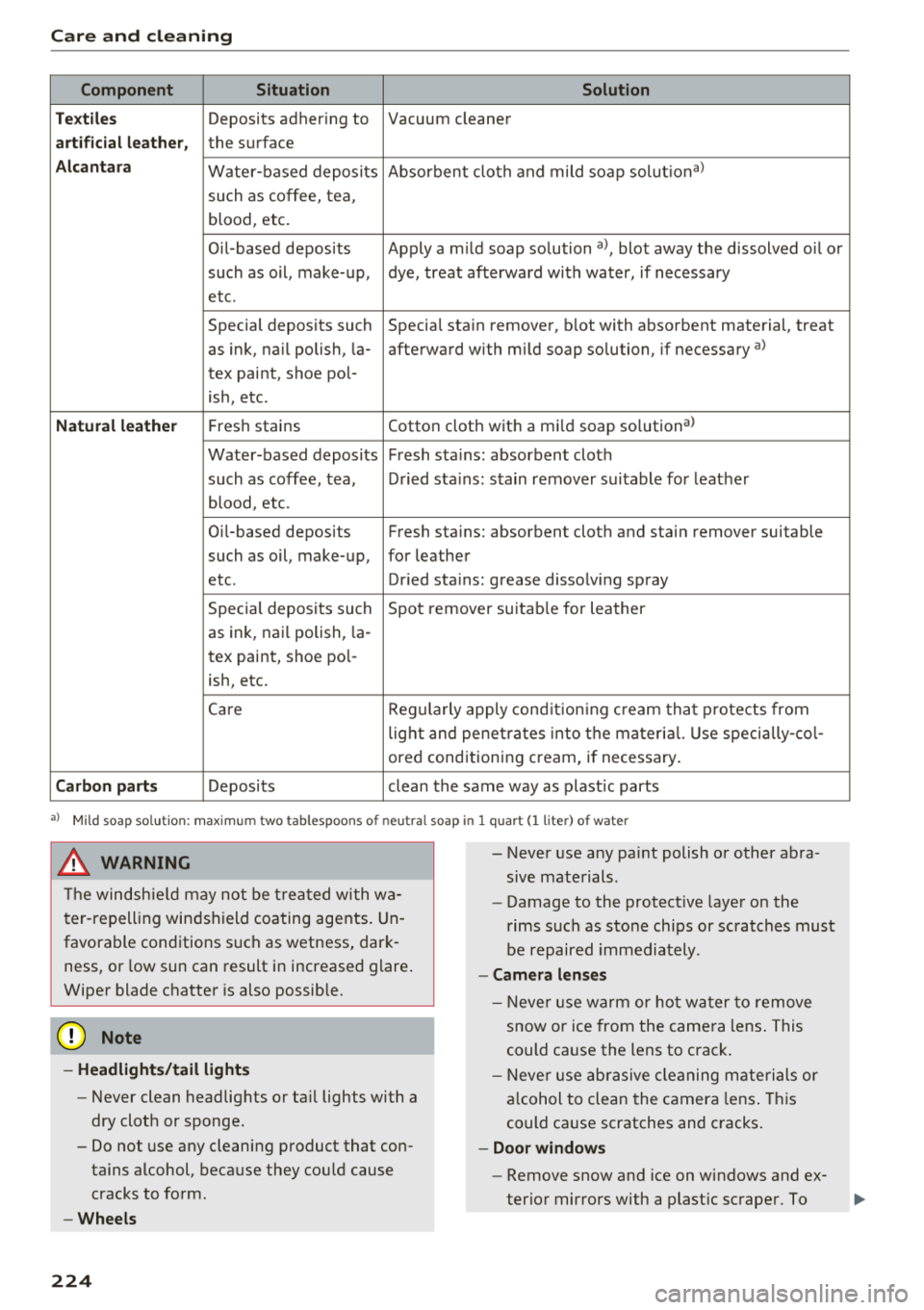
Component Situation Solution
Tex tile s
Deposits adhering to Vacuum cleaner
art ifici al l eat her, the surface
A lca ntara Water -based deposits Absorbent cloth and mild soap solut
iona>
such as coffee, tea,
blood, etc.
O il-based deposits Apply a m ild soap solution
a), blot away the dissolved oil or
such as oil , make-up, dye, treat afterward with water, if necessary
etc.
Special deposits such Special stain remover, blot with absorbent material, treat
as ink, na il polish, la- afterward with mild soap solution, if necessary a)
tex paint, shoe pol-
ish, etc.
Natural leathe r Fresh stains Cotton cloth
with a mild soap so lutiona >
Water-based deposits Fresh stairns : absorbent cloth
such as coffee, tea, Dried sta ins : stain remover suitable for leather
blood, etc.
Oil -based deposits Fresh stairns : absorbent cloth and stain remover suitable
such as oil, make-up, for leather
etc. Dried stains : grease dissolving spray
Special deposits such Spot remover suitab le for leather
as ink, nai l polish, la -
tex paint, shoe pol-
ish, etc.
Care Regula rly apply cond it ion ing cream that p rotects from
lig ht and penetrates into the material. Use specia lly-co l-
ored conditioning cream, if necessary .
Carbon part s Deposits clean the same way as plastic parts
al Mild soap solution: maximum two tablespoons of neutral soap in 1 quart (1 liter) of water
_& WARNING
The windsh ie ld may not be treated wi th wa
ter-repelling windshield coating agents. Un
favorable conditions such as wetness, dark
ness, or low sun can result in increased glare.
Wiper blade chatter is also possible.
@ Note
-Headlight s/tail light s
-Never clean headlights or tail lights with a
dry cloth or sponge.
- Do not use any cleaning product that con
tains alcohol, because they could cause
cracks to form .
-Wheel s
224
- - Never use any paint polish or other abra
sive materials.
- Damage to the protect ive layer on the
rims such as stone chips or scratches must
be repaired immediately.
- Cam era lens es
- Neve r use wa rm or hot water to remove
snow or ice from the came ra lens . This
could cause the lens to crack .
- Neve r use ab rasive cleaning m aterials or
a lcohol to clean the camera lens . This
could cause scratches and cracks .
-Door wind ow s
- Remove snow and ice on windows and ex-
terior mirrors with a plast ic scraper. To
Page 229 of 266
a co .... N
" N .... 0 0 \.J '
The vehicle jack* in your vehicle is mainte
na nee-free.
Replacing wheels
Before changing a wheel
Observe the following precautions for your own
and your passenger's safety when changing a
wheel .
'"After you experience a tire failure, pull the car
well away from moving traff ic and try to reach
le ve l ground before you stop ¢,&. .
'"All passe ngers should le ave the car and move
to a safe location (for instance, be hind the
guardra il) ¢ ,&. .
.. Engage the parkin g brake to p revent your vehi
cle from rolling
unintentionally ¢,&. .
'"Move selecto r lev er to p osition P ¢ ,&. .
'"If you are towing a trailer, unh itch the trailer
from your veh icle.
'" Take the jac k and the sp are tir e* out of the lug
gage compartment
i::> page 226 .
A WARNING
You or your passengers cou ld be inju red w hile
chang ing a wheel if you do not follow these
safety precautions :
- If you have a flat t ire, move a safe distance
off t he road. Tur n off the engine, t urn the
emergency flashers on and use other warn
ing devices to alert other motorists .
- Make s ure tha t pa ssengers w ait in a sa fe
place away from the vehicle and we ll away
from the road and traffic.
- T o help prevent the vehicle from moving
sudden ly and possibly slipping o ff th e jack,
always fully set the parking brake and b lock
the front and back of the wheel diagonally opposite the wheel be ing changed. When
one front whee l is lifted off the ground,
placing the Automatic Transm ission in P
(Park) w ill
not prevent the veh icle from
moving.
Em ergenc y ass is tanc e
-Before you change a whee l, be sure the
ground is level and firm . If necessary, use a
sturdy board under the jack.
- Always store the vehicle too l kit, the jack
and the replaced tire in the luggage com
partment
¢ page 130.
(D Tips
Before changing the wheel, you must activate
the jacking mode, so that the automatic con
tro ls for the Adaptive Air Suspension* do not
make it more difficult to lift the vehicle with
the
jack ¢ page 229 .
Changing a wheel
When you change a wheel , follow the sequence
described below step-by-step and in exactly that
order .
l. Activate the vehicle jack mode* ¢ page 229.
2. Remove the deco rati ve wheel co ver* or the
wheel bolt c aps *. For more details see also
¢ page 228, Decorative wheel covers or
¢ page 228, Wheels with wheel bolt caps .
3. Loosen the wheel bolt s ¢page 229.
4. Locate t he p roper mount ing point for the
jack and align the jack be low that poin t
¢page 229 .
S. R ais e the car with the jack ¢ page 229 .
6. Remove the wheel with the fl at tir e and then
install
the spare ¢ page 231.
7. Tig hte n all wheel bolts lightly .
8 .
Lower the vehicle with the jack .
9 . Use the wheel bolt wrench and
firml y tighten
all wheel
bo lts ¢ page 229.
10. Replace t he decorat ive wh eel cover * or the
wheel bolt cap s*.
11. Deactivate the vehicle jack mode* in t he
MMI :
ICAR I function button > (Car )* sys tem s
contro l button > Ser vicing & che cks > Air
s usp.: jack mod e> Off.
The vehicle jack mode * switches off automatica l-
ly at speeds abov e 6 mph (10 km/h).
.,.
227
Page 240 of 266
Bulbs
Bulbs
Replacing light bulbs
For your safety, we recommend that you have
your authori zed Audi dealer replace burned out
bulbs for you.
It is becoming increasingly more and more diffi
cult to replace vehicle light bulbs since in many
cases, other parts of the car must first be re moved before you are able to get to the bulb.
This applies espec ially to the light bulbs in the
front of your car wh ich you can only reach
through the eng ine compartment.
Sheet metal and bulb holders can have sharp
edges that can cause ser ious cuts, and parts
must be correctly taken apart and then properly
put back together to help prevent breakage of
parts and long term damage from water that ca n
ente r housings that have not been properly re
sealed.
For your safety, we recommend that you have
your author ized Audi dealer replace any bulbs for
you, s ince your dealer has the proper tools, th e
correct bulbs and the expertise .
Gas discharge lamps (Xenon lights):
Due to the high electrical voltage, have the bulbs
replaced by a qualified technic ian . Headlights
with Xenon light can be identified by the high
voltage sticker.
LED headlights*
LED headlights require no maintenance. Please
contact your authorized Audi dealer if a bulb needs to be replaced.
A WARNING
Contact w ith high-voltage components of the
electrical system and improper replacement
of gas d ischarge (Xenon) headl ight bulbs can
cause se rious personal injury and death.
- Xenon bulbs are pressurized and can ex
plode when be ing changed .
- Chang ing Xenon lamps requires the spec ial
train ing, instructions and equipment .
238
-On ly an authorized Audi dealer or other
qualif ied workshop should change the bu lbs
in gas discharge lamps.
A WARNING
There are parts with sharp edges on the open
ings and on the bulb holders that can cause
serious cuts .
- If you are uncertain about what to do, have
the work performed by an author ized Audi
dealer or other qualified workshop . Ser ious
pe rsonal injury may res ult from improperly
pe rformed wor k.
(D Tips
- If you still prefer to replace the light bulbs
yourself, be aware that the engine compart
ment is a hazardous area to wo rk in
~page 189 ~.&.
-It is best to ask your authorized Audi dea ler
w henever you need to change a bulb.
Page 241 of 266

a co .... N
" N .... 0 0 \.J '
General
This chapter is intended for trained emergency
crews and working personnel who have the nec
essary tools and equipment to perform these
operations.
Starting by pushing or
towing
~ Note
Vehicles with an automatic transmission can
not be started by pushing or towing.
Starting with jumper
cables
If necessary, the engine can be started by con
necting it to the battery of another vehicle .
If the engine should fail to start because of a dis
charged or weak battery, the battery can be con
nected to the battery of
another vehicle, using a
pair of jumper cables to start the engine.
Jumper cables
Use only jumper cables of sufficiently large cross
section
to carry the starter current safely. Refer
to the manufacturer's specifications.
Use only jumper cables with
insulated terminal
clamps which are distinctly marked :
plus(+) cable in most cases colored red
minus(-) cable
in most cases colored black.
A WARNING -
Batteries contain electricity, acid, and gas.
Any of these can cause very serious or fatal in
jury. Follow the instructions below for safe
handling of your vehicle's battery .
-Always shield your eyes and avoid leaning
over the battery whenever possible.
-A dead battery can freeze at temperatures
around 32 °F (0 °C) . If the vehicle battery is
frozen, you must thaw it before connecting
the jump start cables. If you do not, this in-
Emergency situations
creases the risk of an explosion and chemi
cal burns. After jump starting the vehicle,
drive to an authorized Audi dealer or author ized Audi Service Facility immediately to
have the vehicle battery checked.
- Do not allow battery acid to contact eyes or
skin . Flush any contacted area with water
immediately.
- Improper use of a booster battery to start a
vehicle may cause an explosion .
- Vehicle batteries generate explosive gases .
Keep sparks, flame and lighted cigarettes
away from batteries.
- Do not try to jump start any vehicle with a
low acid level in the battery .
- The voltage of the booster battery must also
have a 12-volt rating . The capacity (Ah) of
the booster battery should not be lower
than that of the discharged battery. Use of
batteries of different voltage or substantial
ly different "Ah " rating may cause an explo
sion and personal injury.
- Never charge a frozen battery. Gas trapped
in the ice may cause an explosion.
- Never charge or use a battery that has been
frozen. The battery case may have be weak
ened.
- Use of batteries of different voltage or sub
stantially different capacity (Ah) rating may
cause an explosion and injury. The capacity
(Ah) of the booster battery should not be
lower than that of the discharged battery.
- Before you check anything in the engine
compartment, always read and heed all
WARNINGS
c>page 189.
@ Note
- Applying a higher voltage booster battery
will cause expensive damage to sensitive
electronic components, such as control
units, relays, radio, etc.
- There must be no electrical contact between
the vehicles as otherwise current could al
ready start to flow as soon as the positive
( + ) terminals are connected.
239
Page 242 of 266
Emergency situations
@ Tips
The discharged battery must be properly con
nected to the vehicle's electrical system .
When jump starting or charging the battery,
never connect the negative ground cable to
the battery negative post because the battery
manager system must be able to detect the
battery's state of charge. Always connect the
negat ive g round cable to the negative ground
post of the battery manager control unit.
Use of jumper cables
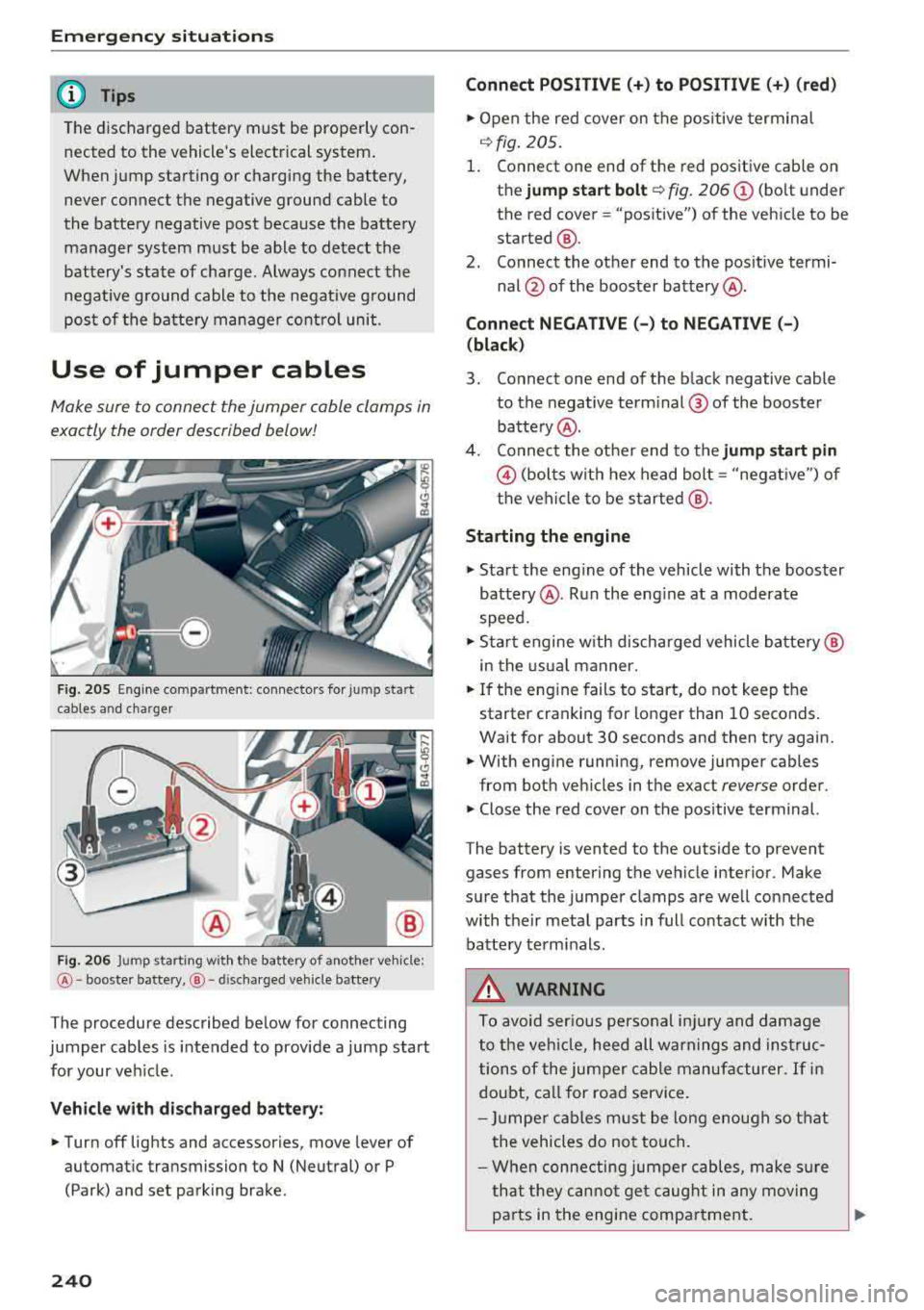
Make sure to connect the jumper cable clamps in
exactly the order described below!
Fig . 205 Engine compartmen t: connecto rs for jump start
cables and charger
@
F ig . 206 Jump starting w it h the battery of anot her vehicle :
@-booster battery, @- discha rged vehicle battery
The procedure described below for connecting
jumper cables is intended to provide a jump start
for your veh icle.
Vehicle with discharged battery:
• Turn off lights and accessories, move lever of
automatic transmission to N (Neutral) or P (Park) and set park ing brake.
240
Connect POSITIVE(+) to POSITIVE(+) (red)
• Open the red cover on the positive terminal
i:!.> fig. 205.
1. Connect one end of the red positive cable on
the
jump start bolt ~ fig. 206@ (bolt under
the red cover= "positive") of the vehicle to be
started @.
2. Connect the other end to the positive termi-
nal @of the booster battery @.
Connect NEGATIVE(-) to NEGATIVE(-)
(black)
3. Connect one end of the black negative cable
to the negative terminal @ of the booster
battery @.
4. Connec t the other end to the
jump start pin
@ (bolts with hex head bolt= "negative") of
the vehicle to be started @.
Starting the engine
• Start the eng ine of the vehicle with the booster
battery @. Run the eng ine at a moderate
speed.
• Sta rt engine w ith discharged vehicle battery@
in the usual manner.
• If the engine fails to start, do not keep the
starter cranking for longer than 10 seconds.
Wait for about 30 seconds and then try again.
• With engine running, remove jumper cables
from both veh icles in the exact
reverse order.
• Close the red cover on the pos itive terminal.
The battery is vented to the outside to prevent
gases from entering the vehicle interior . Make
sure that the jumper clamps are well connected
with their metal parts in full contact w ith the
battery terminals.
A WARNING
To avoid serious personal injury and damage
to the vehicle, heed all warnings and instruc
tions of the jumper cable manufacturer. If in
doubt, call for road service .
- Jumper cables must be long enough so that
the vehicles do not touch.
- When connecting jumper cables, make sur e
that they cannot get caug ht in any moving
pa rts in the engine compartment.
.,.