ABS AUDI A6 2018 User Guide
[x] Cancel search | Manufacturer: AUDI, Model Year: 2018, Model line: A6, Model: AUDI A6 2018Pages: 266, PDF Size: 41.38 MB
Page 137 of 266
a co ,...,
N
" N ,...,
0 0 \,;J '
Frontal collisions and the law of physics
Frontal crashes create very strong forces for peo
ple riding in vehicles .
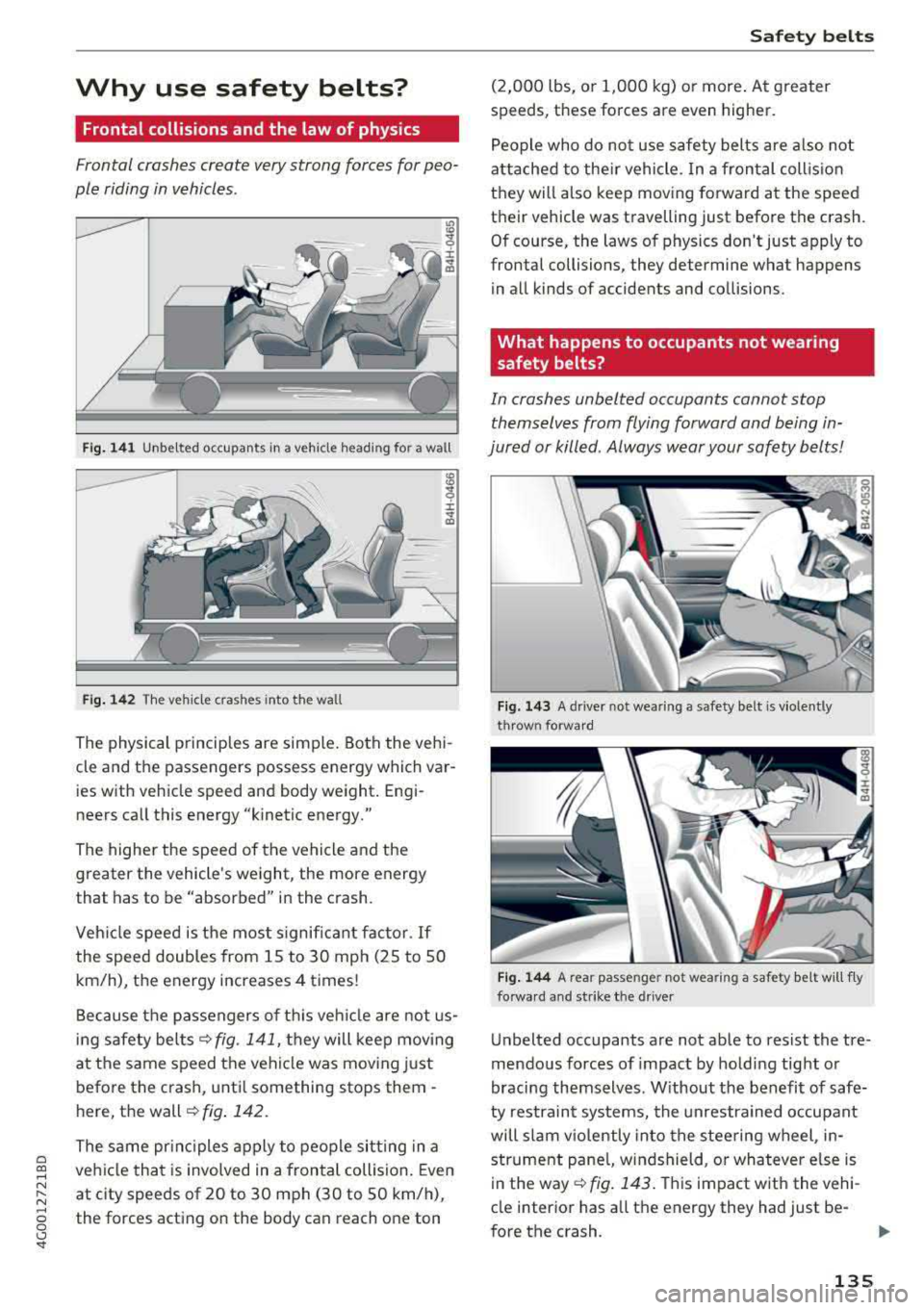
Fig. 141 Unbe lted occupants in a vehicle heading for a wall
Fig. 14 2 The vehicle crashes into the wall
The physical principles are simple. Both the vehi
cle and the passengers possess energy which var
ies with vehicle speed and body weight. Engi
neers call this energy "kinetic energy."
The higher the speed of the vehicle and the greater the vehicle's weight, the more energy
that has to be "absorbed" in the crash.
Veh icle speed is the most significant facto r.
If
the speed doubles from 15 to 30 mph (25 to 50
km/h), the energy increases 4 times!
Because the passengers of t his veh icle are not us
ing safety belts
r::!.> fig. 141, they will keep mov ing
at the same speed the vehicle was moving j ust
before the crash, unt il something stops them -
here, the wall
r::!.> fig . 142.
The same pr inc iples apply to people sitting in a
vehicle that is involved in a frontal collision. Even
at city speeds of 20 to 30 mph (30 to SO km/h),
the forces acting on the body can reach one ton
Safety bel ts
(2,000 lbs, o r 1,000 kg) or more . At greater
speeds, these forces are even higher.
People who do not use safety belts are a lso not
attached to the ir vehicle. In a fron tal coll is ion
they will also keep moving forward at the speed
their vehicle was travelling just before the crash.
Of course, the laws of physics don't just apply to
frontal collisions, they determine what happens
in all kinds of accidents and collisions.
What happens to occupants not wearing
safety belts?
In crashes unbelted occupants cannot stop
themselves from flying forward and being in
jured or killed . Always wear your safety belts!
F ig. 143 A driver not wearing a safety belt is violently
thrown forward
Fig . 144 A rear passenger not wearing a safety belt will f ly
forwa rd and strike the driver
Unbelted occupants are not able to resist the tre
mendous forces of impact by holding tight or
bracing themselves. W ithout the benefit of safe
ty restraint systems, the unrestrained occupant
will slam v io lently into the stee ring wheel, in
strument pane l, windshield, o r whatever e lse is
in the way
r::!.>fig . 143. T his impact with the vehi
cle inter ior has a ll the energy they had just be-
fore the crash.
IJI,,-
1 35
Page 138 of 266
Safe ty belts
Never rely on airbags alone for protection . Even
when they deploy, airbags provide only additiona l
protection. Airbags are not supposed to dep loy in
all kinds of accidents. A lthough your Audi is
equipped w ith airbags, all vehicle occupants, in
cluding the dr iver, must wear safety belts cor
rectly in order to minimize the risk of severe in
jury or death in a crash .
Remember too, that airbags will deploy only
once and that your safety belts are always there
to offer protect ion in those accidents in w hich
airbags are not supposed to deploy or when they
have a lready deployed. Unbel ted occupants can
a lso be thrown o ut of the ve hicle where eve n
mo re severe or fatal injur ies can occur .
It is also important for the rear passenge rs to
wear safety belts co rrectly. Unbel ted passengers
i n t he re ar seats endanger no t on ly themse lves
but also the drive r and other passengers
c::> fig . 144 . In a frontal collision they will be
thrown forward violently, where they can hit and
in jure the driver and/or front seat passenger .
Safety belts protect
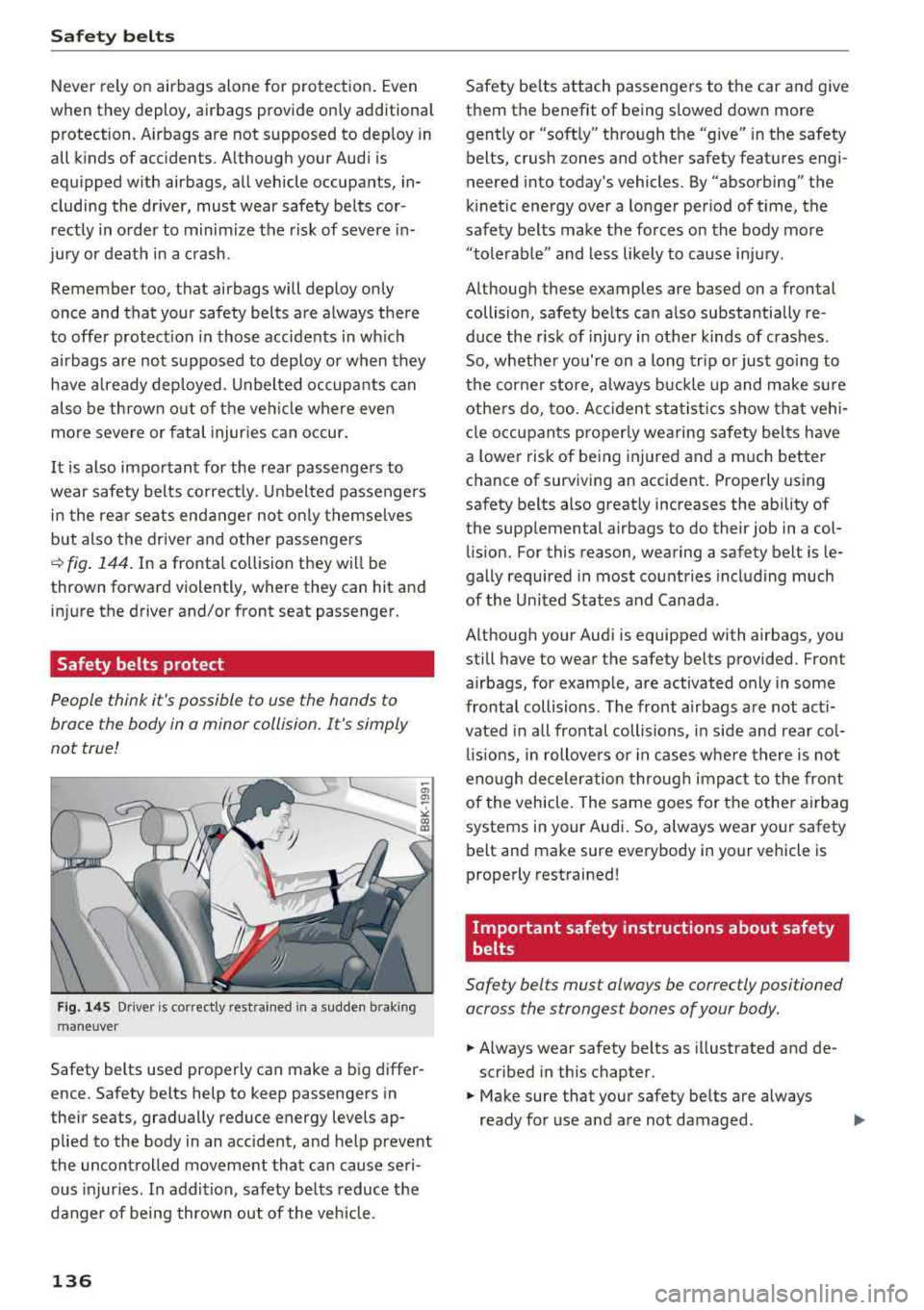
People think it's possible to use the hands to
brace the body in a minor collision . It's simply
not true!
F ig . 14 5 Driver is co rrectly restrai ned in a sudde n brak ing
m aneuver
Safety belts used properly can make a b ig d iffer
ence. Safety belts help to keep passengers in
their seats, gradually reduce energy levels ap
plied to the body in an accident, and he lp prevent
the uncont rolled moveme nt that can cause seri
ous injur ies. In addition, safety be lts reduce the
danger of being thrown out of the vehicle .
136
Safety belts attach passengers to the car and g ive
them the benefit of being s lowed down more
gently or "soft ly" thro ugh the "give" in the safety
belts, crush zones and other safety feat ures engi
neered into today 's vehicles. By "absorbing" the
k inet ic energy over a longe r per iod of t ime, the
safety belts make the forces on the body more "tole rab le" and less likely to cause inju ry .
Although these examples are based on a frontal
collision, safety be lts ca n also substantially re
duce the r isk o f injury in ot her kinds of crashes.
So, whethe r you're on a long trip or just going to
the cor ne r store, a lways b uckle up and make s ure
othe rs do, too. Ac ciden t st at ist ics show that veh i
cl e occupants prope rly wearing safety bel ts have
a lowe r risk of be ing injured and a m uch better
chance of surviving an acc ident . Properly using
safety be lts also great ly increases the ability of
the supp lemental airbags to do their job in a col
li sion. For this reason, wearing a safety belt is le
gally required in most countries including much
of the United States and Canada.
Although your Aud i is equipped with airbags, you
still have to wear the safety belts provided. Front
airbags, for examp le, are activated only in some
frontal collisions. The front airbags are not act i
vated in all frontal collisions, in side and rear co l
li sio ns, in rollovers or in cases whe re there is not
eno ugh deceler ation throug h impa ct to the front
of the vehicle . The same goes for the other a irbag
systems in your Audi. So, always wear your safety belt and make sure everybody in your vehicle is
properly rest rained!
Important safety instructions about safety
belts
Safety belts must always be correctly positioned
across the strongest bones of your body.
.,. Always wear safety belts as illustrated and de
scribed in this chapter.
.,. Make sure that your safety be lts are always
ready fo r use a nd a re not damaged .
Page 149 of 266
a co .... N
" N .... 0 0 \,;J '
o'clock position or with your hands any
where inside the steering wheel or on the steering wheel hub . Holding the steering
wheel the wrong way increases the risk of severe injury to the arms, hands, and head if
the driver airbag deploys.
A WARNING
Objects between you and the airbag will in
crease the risk of injury in a crash by interfer
ing with the way the airbag unfolds and/or by
being pushed into you as the airbag inflates.
- Always make sure nothing is in the front air-
bag deployment zone that could be struck
by the airbag when it inflates.
-
- Objects in the zone of a deploying airbag
can become projectiles when the airbag de
ploys and cause serious personal injury.
- Never hold things in your hands or on your
lap when the vehicle is in use.
- Never place accessories or other objects
(such as cup holders, telephone brackets,
note pads, navigation systems, or things
that are large, heavy, or bulky) on the doors;
never attach then to the doors or the wind
shield; never place them over or near or at
tach them to the area marked
,,AIRBAG" on
the steering wheel, instrument panel or the seat backrests; never place them between
these areas and you or any other person in
the vehicle.
- Never attach objects to the windshield
above the passenger front airbag, such as
accessory GPS navigation units or music
players. Such objects could cause serious in
jury in a collision, especially when the air bags inflate.
- Never recline the front passenger seat to
transport objects. Items can also move into
the deployment area of the side airbags or
the front airbag during breaking or in a sud den maneuver. Objects near the airbags can
fly dangerously through the passenger com partment and cause injury, particularly
when the seat is reclined and the airbags in
flate.
Airbag system
A WARNING
r--
A person on the front passenger seat, espe-
cially infants and small children, will receive
serious injuries and can even be killed by be ing too close to the airbag when it inflates .
- Although the Advanced Airbag System in your vehicle is designed to turn off the front
passenger airbag if an infant or a small child
is on the front passenger seat, nobody can
absolutely guarantee that deployment un
der these special conditions is impossible in
all conceivable situations that may happen
during the useful life of your vehicle.
- The Advanced Airbag System can deploy in accordance with the
.,low risk" option for 3-
and 6-year-old children under the U.S. Fed
eral Standard if a child with electrical capac itance greater than the combined capaci
tance of a typical one-year old infant re
strained in one of the forward facing or rear
ward-facing child seats with which your ve hicle was certified is on the front passenger
seat and the other conditions for airbag de-
ployment are met.
- Accident statistics have shown that children
are generally safer in the rear seat area than
in the front seating position.
- For their own safety, all children, especially
12 years and younger, should always ride in
the back properly restrained for their age
and size.
Advanced front airbag system
Your vehicle is equipped with a front Advanced
Airbag System in compliance with United States Federal Motor Vehicle Safety Standard 208, as
well as Canada Motor Vehicle Safety Standard (CMVSS) 208 as applicable at the time your vehi
cle was manufactured.
The front Advanced Airbag System supplements
the safety belts to provide additional protection
for the driver's and front passenger's heads and
upper bodies in frontal crashes . The airbags in
flate only in frontal impacts when the vehicle de-
celeration is high enough.
.,.
147
Page 151 of 266
a co .... N
" N .... 0 0 \,;J '
t ing s ideways or out of pos ition in any way,
your risk of injury is much higher.
- You will also receive serious injur ies and
cou ld even be killed if you are up aga inst the
airbag or too close to it when it inflates -
even with an Advanced Airbag
¢page 142 .
A WARNING
A ch ild in a rearward-facing ch ild seat instal
led on the front passenger seat w ill be ser i
ously in jured and can be k illed if the front air
bag inflates - even with an Advanced A irbag
System.
- Alt hough the Advanced A irbag System in
yo ur vehicle is des igned to t urn off t he front
airbag when a re arwa rd-faci ng ch ild re
straint has been insta lled on the front pas
senger seat, nobody can abso lutely guaran
tee that deployment is impossible in a ll con
ceivable s ituations that may happen during
the useful life of your vehicle.
- The inflating a irbag w ill hit the child seat or
infant carrier w ith great force and will
smash the c hild seat and child against the
backrest, ce nter armrest, door, or roof .
- Always install rearward-fac ing ch ild re
straints on the rear seat.
- If you must install a rearward fac ing c hild
seat on the front passenger seat because of
exceptiona l circumstances and the
PA SSEN
GER AIR BAG OFF
light does not come o n
and stay on, immediately insta ll the rear
facing child seat in a re ar seat ing pos ition
and have the a irbag sys tem inspected by
yo ur Audi dealer .
A WARNING
If , in except ional circumstances, you mus t in
sta ll a forward-facing chi ld restraint on the
front passenger's seat:
- Always make sure the forward -facing seat
has been designed and certified by its man
ufact urer for use on a front seat with a pas
senger front and s ide a irbag.
Airbag syste m
- Never p ut the fo rward-facing child restraint
up aga inst or very near the instr ument pan
el.
-Always move the front passenger seat to
the highest posit ion in the up and down ad
justment range and move it back to the rearmost posit ion in the seat's fore and aft
ad justment range, as far away from the a ir
bag as poss ible, before installing the for
ward-fac ing ch ild rest raint.
- Always make sure that the safety be lt upper
a nchorage is behind the c hild rest raint and
not next to o r in front of the ch ild res trai nt
so th at the s afety be lt will be p roper ly posi
tioned.
- Always make su re th at there is not hing o n
the front passenger seat that will cause the
capacitive passenger detection system in
the seat to signal to the Airbag System that
the seat is occup ied by a person when it is
not, or to signal that it is occupied by some
one w ho is heavier than the person actually
sitt ing on the seat. The presence of add i
tional objects cou ld cause the passe nger
front a irbag to be t urned on when it should
be off, o r cou ld cause t he air bag to work in a
way th at is d ifferen t from the way it wo uld
have worked withou t the object on the seat .
- Mak e sure that t he
PASSENGER AIR BAG
OFF
li ght comes on and stays on all the time
whenever t he ignition is switched on .
Advanced Airbag System components
The front passenger seat in your ve hicle has a lot
of very important parts of t he Advanced Airbag
System in it. These parts include the capacitive passenger detection system, wir ing, brackets,
and more . The control unit monitors the system
on the fro nt passenger seat when the ignition is
switched on and turns the airbag indicator l igh t
o n when a malfunction in the one of the system
components is
detec ted ¢ page 154. Because
the fron t passenger sea t contains impo rtan t
parts of the Advanced Ai rbag System, you m ust
take care to prevent it from being damaged .
Damage to the seat may prevent the Advanced
..,_
149
Page 160 of 266
Airbag system
must be performed by qualified workshops
only. Make sure that any airbag service ac
tion is entered in your Audi Warranty
&
Maintenance booklet under AIRBAG RE·
PLACEMENT RECORD .
-For safety reasons in severe accidents, the
alternator and starter are separated from
the vehicle battery with a pyrotechn ic circuit
interrupter.
- Work on the pyrotechnic circuit interrupt
er must only be performed by a qualified
technicians who have the experience, in
formation and special tools necessary to
perform the work safely.
- If the vehicle or the circuit interrupter is
scrapped, all applicable safety precautions
must be followed .
@ For the sake of the environment
Undeployed airbag modules and pretension
ers might be classified as Perchlorate Materi
al
-special handling may apply , see
www .dtsc.ca.gov/hazardouswaste/perchlo
rate . When the vehicle or parts of the re
straint system including airbag modules and
safety belts w ith pretensioners are scrapped,
all applicable laws and regulations must be
observed . Your authorized Audi dealer is fa
miliar with these requirements and we recom
mend that you have your dealer perform this
service for you.
Other things that can affect Advanced
Airbag performance
Changing the vehicle's suspension system can
change the way that the Advanced Airbag System
performs in a crash. For example, using tire-rim
comb inations not approved by Audi, lower ing the
vehicle, chang ing the stiffness of the suspension,
including the springs, suspension struts , shock
absorb ers etc . can change the forces that are
measured by the airbag sensors and sent to the
electronic control unit . Some suspension changes
can, for example, increase the force levels meas
ured by the sensors and make the airbag system
deploy in crashes in which it would not deploy if
the changes had not been made. Other kinds of
158
changes may reduce the force levels measured by
the sensors and prevent the airbag from deploy
i ng when it should .
& WARNING
Changing the vehicle's suspension including
use of unapproved tire-rim combinations can
change Advanced Airbag performance and in
crease the risk of serious personal injury in a
crash .
- Never install suspension components that do not have the same performance charac
teristics as the components origina lly instal
led on your vehicle.
- Never use tire-rim combinations that have
not been approved by Aud i.
Knee airbags
Description of knee airbags
Applies to: vehicles with knee airbags
The knee airbag system can provide supplemen
tal protection to properly restrained front seat
occupants.
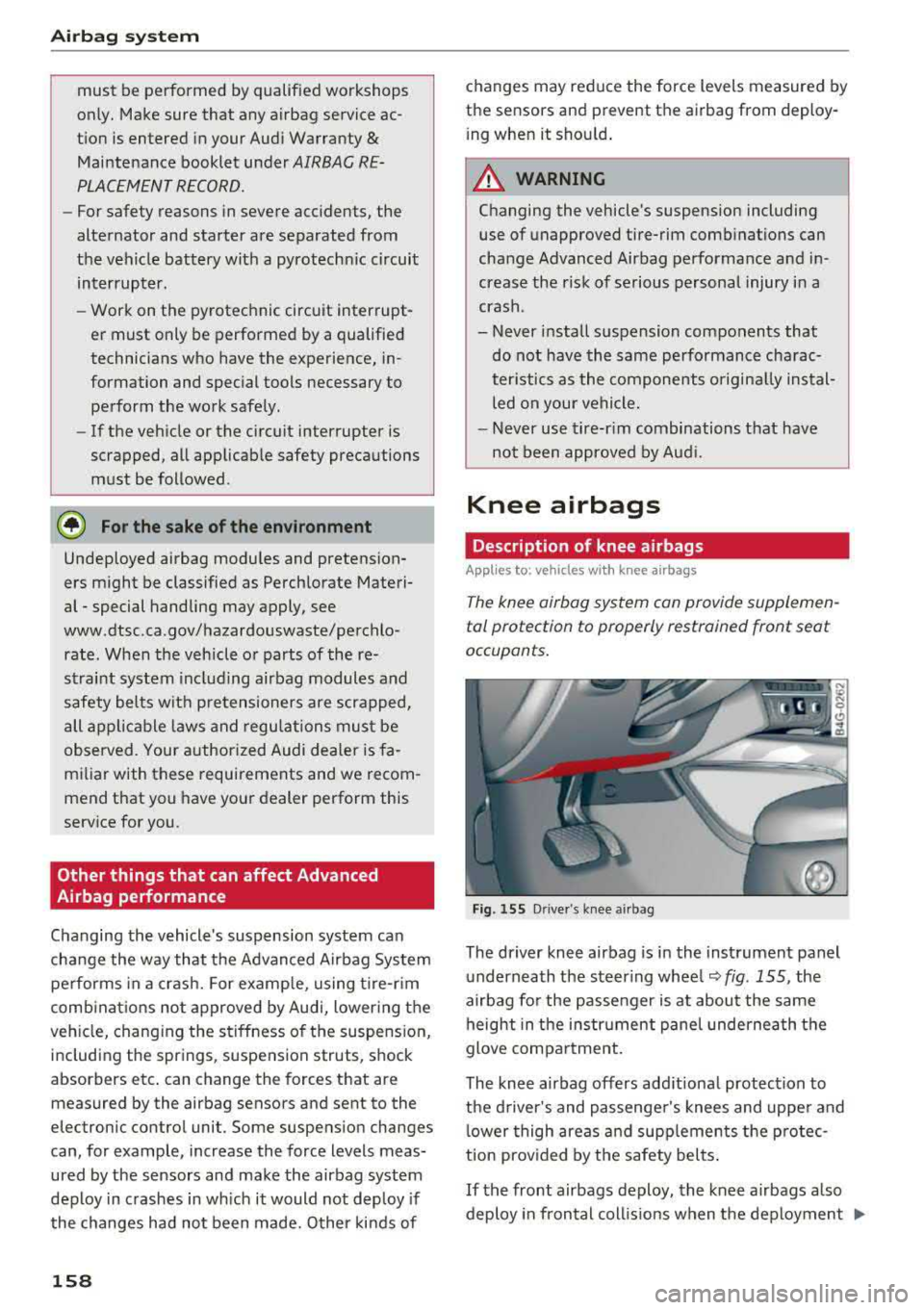
Fig . 155 Driver 's knee airbag
The driver knee airbag is in the instrument panel
underneath the steering wheel ¢
fig. 155, the
airbag for the passenger is at about the same height in the instrument panel underneath the
glove compartment.
The knee airbag offers add itional protect ion to
the driver's and passenger's knees and upper and lower thigh areas and supplements the protec
tion prov ided by the safety belts .
If the front airbags deploy, the knee airbags also
deploy in frontal coll is ions when the deployment
..,.
Page 178 of 266
Child safety
Booster seats and safety belts
Properly used booster seats can help protect
children weighing between about 40 lbs . and 80
lbs. (18 kg and 36 kg) who are less than 4
ft. 9
in. (57 inches/1.45 meters) tall .
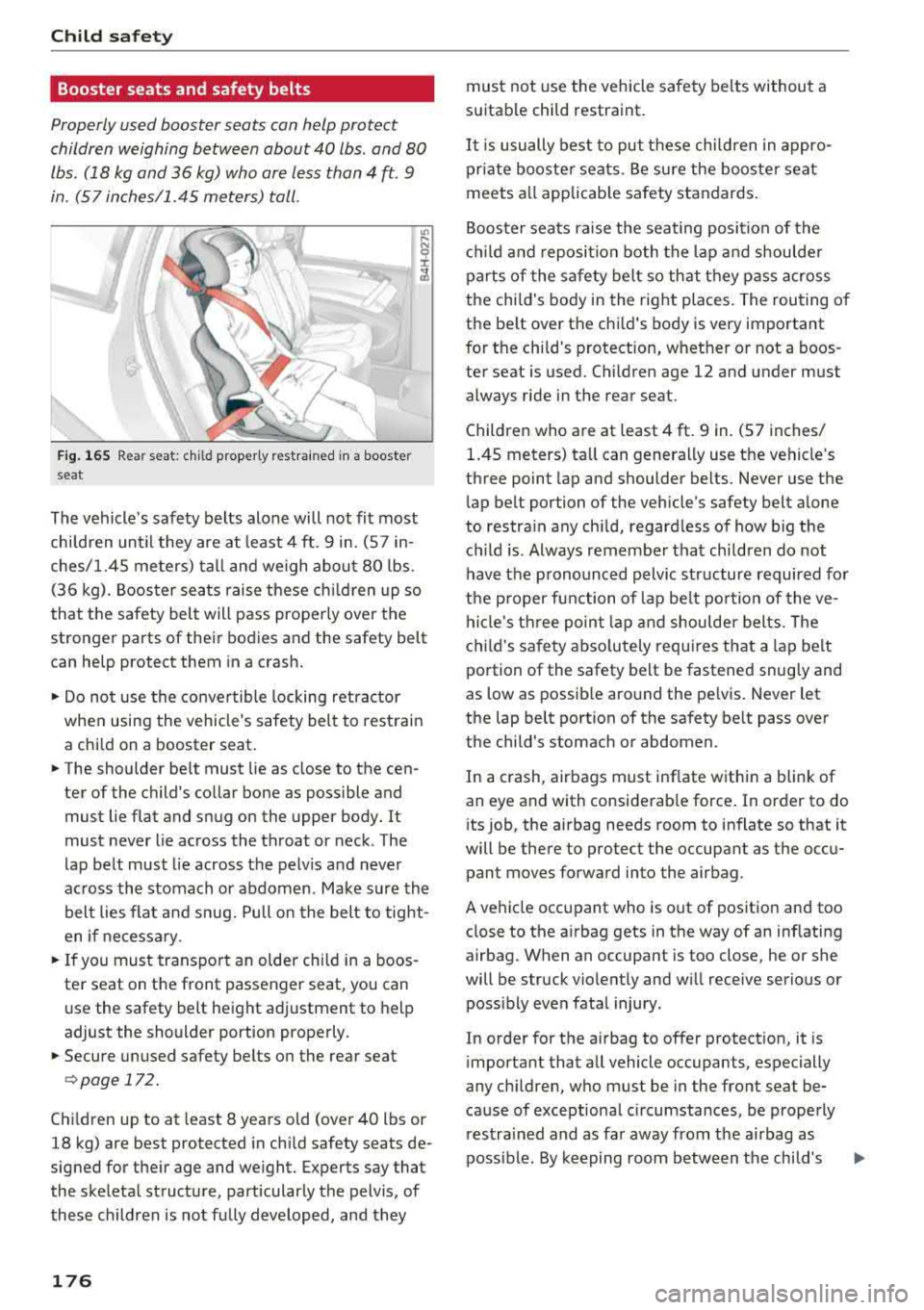
Fig. 165 Rear seat: child properly restrained in a booster
seat
The vehicle's safety belts alone will not fit most
children until they are at least 4
ft. 9 in. (57 in
ches/1.45 meters) tall and weigh about 80 lbs.
(36 kg). Booster seats raise these chi ldren up so
that the safety belt will pass properly
over the
stronger parts of their bodies and the safety belt
can help protect them in a crash.
.. Do not use the convertible locking retractor
when using the vehicle's safety belt to restrain
a child on a booster seat .
.. The shoulder belt must lie as close to the cen
ter of the child's collar bone as possible and must lie flat and snug on the upper body. It
must never lie across the throat or neck . The
lap belt must lie across the pelvis and never
across the stomach or abdomen . Make sure the
belt lies flat and snug. Pull on the belt to tight
en if necessary .
.. If you must transport an older child in a boos
ter seat on the front passenger seat, you can use the safety belt height adjustment to help
adjust the shoulder portion properly .
.. Secure unused safety belts on the rear seat
c>page 172.
Children up to at least 8 years old (over 40 lbs or
18 kg) are best protected in child safety seats de
signed for their age and weight. Experts say that
the skeletal structure, particularly the pelvis, of
these children is not fully developed, and they
176
must not use the vehicle safety belts without a
suitable child restraint .
It is usually best to put these children in appro
priate booster seats. Be sure the booster seat
meets all applicable safety standards.
Booster seats raise the seating position of the
child and reposition both the lap and shoulder
parts of the safety belt so that they pass across
the child's body in the right places. The routing of
the be lt over the child's body is
very important
for the child's protection, whether or not a boos
ter seat is used. Children age 12 and under must
always ride in the rear seat.
Children who are at least 4
ft. 9 in. (57 inches/
1.45 meters) tall can generally use the vehicle 's
three point lap and shoulder belts. Never use the
lap belt portion of the vehicle's safety belt alone
to restrain any child, regardless of how big the
c hi ld is. Always remember that children do not
have the pronounced pelvic structure required for
the proper function of lap belt portion of the
ve
hicle's three point lap and shoulder belts. The
child's safety absolutely requires that a lap belt
portion of the safety belt be fastened snugly and
as low as possible around the pelvis. Never let
the lap belt portion of the safety belt pass over
the child's stomach or abdomen.
In a crash, airbags must inflate within a blink of
an eye and with considerable force. In order to do its job, the airbag needs room to inflate so that it
will be there to protect the occupant as the occu pant
moves forward into the airbag .
A vehicle occupant who is out of position and too close to the airbag gets in the way of an inflating
airbag. When an occupant is too close, he or she
will be struck violently and will receive serious or possibly even fatal injury .
In order for the airbag to offer protection, it is
important that all vehicle occupants, especially
any children, who must be in the front seat be
cause of exceptional circumstances, be properly
restrained and as far away from the a irbag as
possible. By keeping room between the child's
.,..
Page 212 of 266
Wheels
-Only use tires that are more than six years old when absolutely necessary and drive
carefully when doing so.
-Do not use run-flat tires on your vehicle. Using them when not permitted can lead to
ve
hicle damage or accidents.
-If you install wheel covers on the vehicle, make sure they allow enough a ir circulation to
cool the brake system. If they
do not, this could increase the risk of an accident.
Tire wear/damage
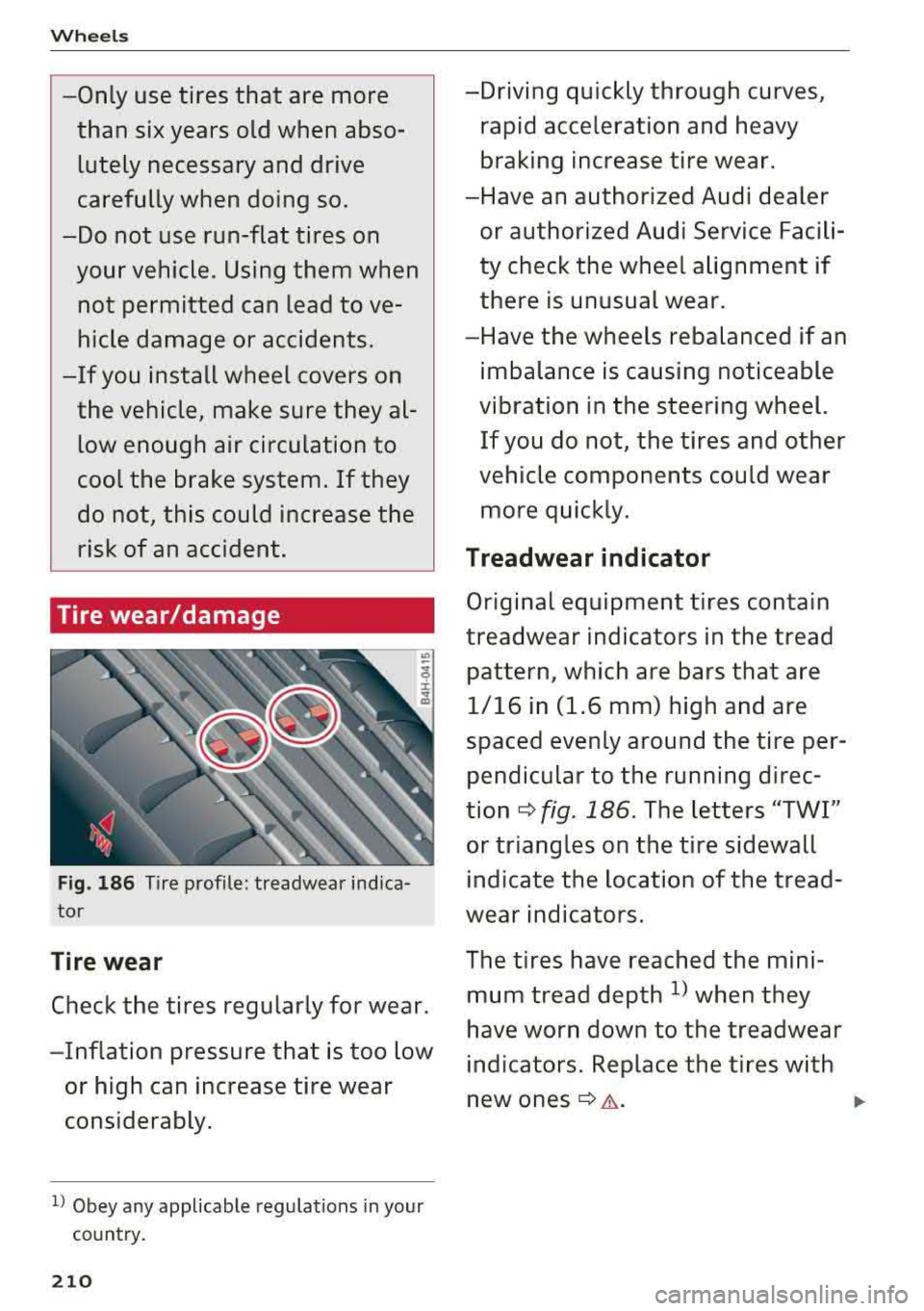
Fig. 186 Tire profile: trea dwear indica
tor
Tire wear
Check the tires regularly for wear.
-Inflation pressure that is too low
or high can increase tire wear
considerably.
l) Obey any applicable regulations in your
country.
210
-Driving qu ickly through curves,
rapid acceleration and heavy
braking increase tire wear.
-Have an authorized Audi dealer or authorized Audi Service Facili
ty check the wheel alignment if
there is unusual wear.
-Have the wheels rebalanced if an imbalance is causing noticeable
vibration in the steering wheel. If you do not, the tires and other
vehicle components could wear more quick ly.
Treadwear indicator
Original equipment tires contain
treadwear indicators in the tread pattern, which are bars that are 1/16 in (1.6 mm) high and are
spaced evenly around the tire per pendicular to the running direc
tion
c> fig . 186. The letters "TWI"
or triangles on the tire sidewall indicate the location of the tread
wear indicators.
The t ires have reached the mini
mum tread depth
l) when they
have worn down to the treadwear
indicators. Replace the tires with
new ones
c> A . "'
Page 221 of 266
a co ,...,
N
" N ,...,
0 0 \,;J '
proper tire maintenance, and it is the driver's re
sponsib ility to ma intain correct tire pressure,
even if under-inf lation has not reached the level
to trigger illum ination of the TPMS low tire pres
sure telltale .
Your veh icle has also been equ ipped w ith a TPMS
malfunct ion indicator to indicate when the sys
tem is not operating properly. The TPMS mal
function indicator is combined w ith the low tire
pressure telltale. Whe n the system detects a
malfunct ion, the telltale will flash for approxi
mately one minu te and then remain cont inuous ly
i llum inated. This sequence wi ll continue upon
subseq uen t veh icle start -ups as long as the ma l
function exists.
When the malfunct ion i ndicator is ill uminated,
the system m ay not be ab le to detec t or sig nal
l ow tire press ure as intended. TPMS ma lfunctions
may occur for a var iety of reasons, incl uding the
installation of replacement or alternate tires or
wheels on the vehicle that prevent the TPMS
from functioning properly. Always check the TPMS malfunction telltale after rep lacing one or
more t ires or whee ls on your vehicle to ensu re
that t he replacement or alternate ti res and
wheels allow the TPMS to cont inue to func tion
p roperly.
If the tire pressure monitoring system
indicator appears
A ppl ies to: ve hicles with Tire Pressure Moni toring System in
di cato r
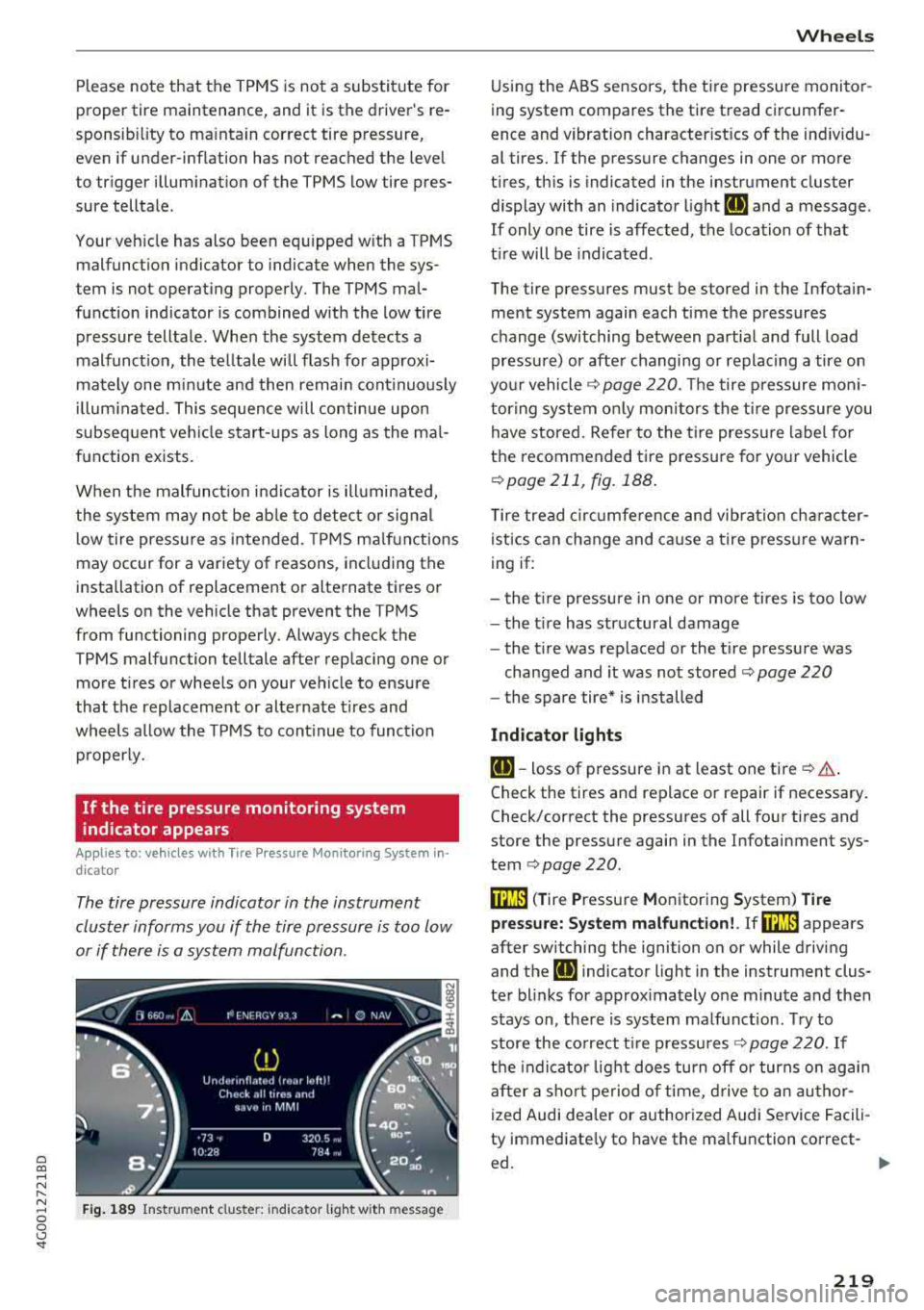
The tire pressure indicator in the instrument
cluster informs you if the tire pressure is too low
or if there is a system malfunction .
Fig. 1 89 Instrument cl uste r: in dicator l ight w it h m essage
Wheels
Using the ABS sensors, the tire pressure monito r
ing system compares the tire tread circumfer
ence and vibration characterist ics of the ind ividu
al tires. If the pressure changes in one or more
t ires, th is is indicated in the instrument cluster
display with an indicator l ight
IE and a message .
If only o ne tire is affected, the location of tha t
t ir e will be indicated .
The tire pressures must be stored in the Infotain ment system again each time the pressures
change (switching between partial and full load
pressure) or afte r changing or replac ing a tire on
yo ur vehicle
Q page 220. The tire p ressure mon i
tor ing system on ly mon itors the t ire pressure you
have stored. Refer to the t ire press ure label fo r
the recommended ti re pressure for yo ur vehicle
Q page 211, fig. 188 .
Tire tread c ircu mfe rence and vibr ation cha racter
istics can change and ca use a tire press ure warn
ing if:
- the t ire pressure in one or more tires is too low
- the t ire has str uctural damage
- the t ire was replaced or the t ire pressure was
changed and it was not stored
Q page 220
- the spare tire* is i nstalled
Indicator light s
IE-toss of pressure in at least one tire Q & .
Check the tires and replace or repair if necessary .
Check/correct the pressures of all four tires and
store the pressu re again in the Infotainment sys
tem
Q page 220.
m ( T ire Pressure Monitoring System) Ti re
pressure: System malfunction!.
If rn:m appears
after switching the ignition on or while driving
and the
IE indicator light in the instrument clus
te r blinks for approx imately one minute and then
stays on, the re is system malf unct ion . Try to
store the co rrect t ire pressu res
Q page 220. If
t h e indicat or light does turn off or turns on agai n
af ter a sho rt pe riod o f time, d rive to an au thor
ized Audi dea ler or authorized Audi Service Facili
ty immediate ly to have the ma lfunction correct-
ed.
~
219
Page 226 of 266
Care and cl eaning
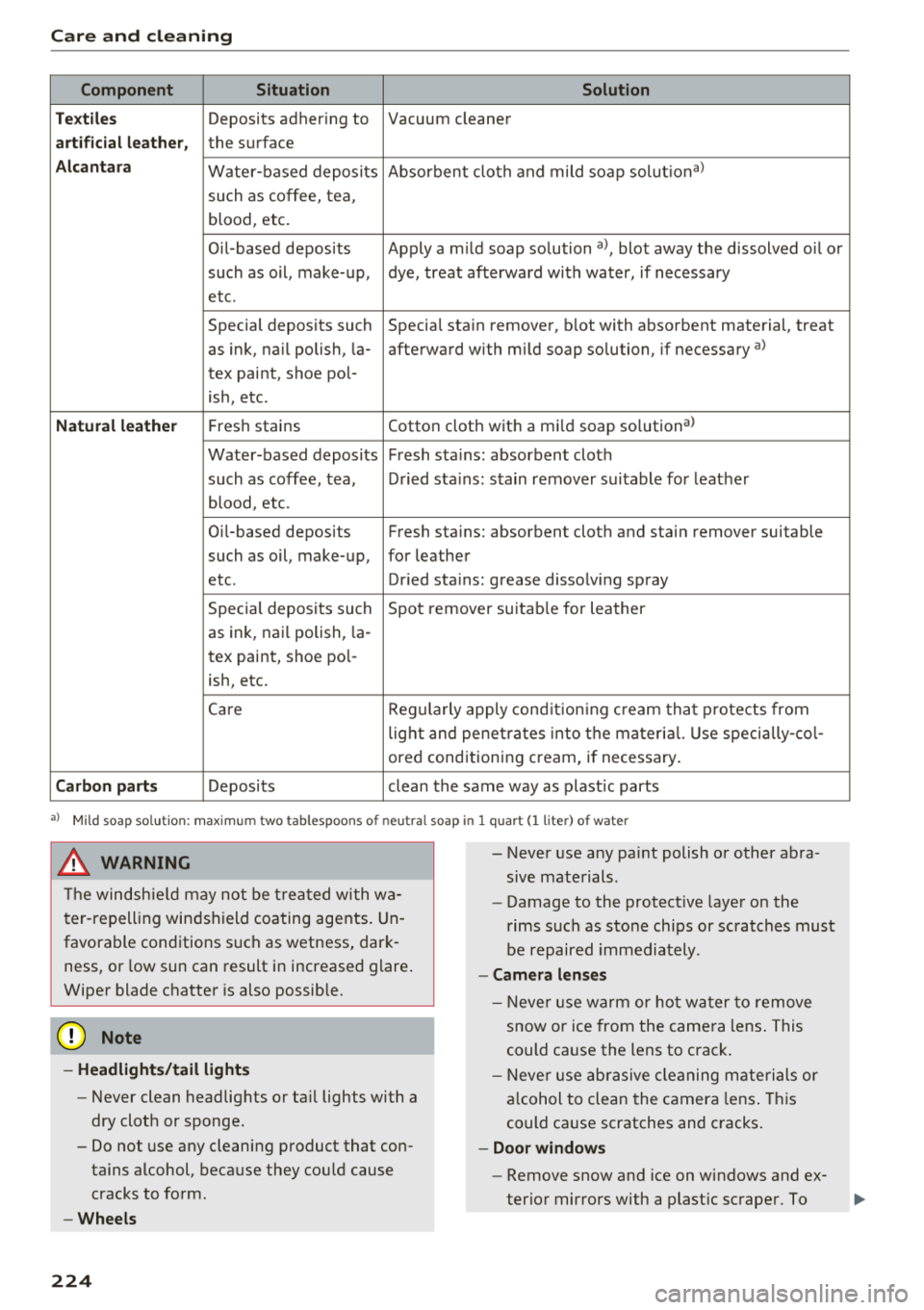
Component Situation Solution
Tex tile s
Deposits adhering to Vacuum cleaner
art ifici al l eat her, the surface
A lca ntara Water -based deposits Absorbent cloth and mild soap solut
iona>
such as coffee, tea,
blood, etc.
O il-based deposits Apply a m ild soap solution
a), blot away the dissolved oil or
such as oil , make-up, dye, treat afterward with water, if necessary
etc.
Special deposits such Special stain remover, blot with absorbent material, treat
as ink, na il polish, la- afterward with mild soap solution, if necessary a)
tex paint, shoe pol-
ish, etc.
Natural leathe r Fresh stains Cotton cloth
with a mild soap so lutiona >
Water-based deposits Fresh stairns : absorbent cloth
such as coffee, tea, Dried sta ins : stain remover suitable for leather
blood, etc.
Oil -based deposits Fresh stairns : absorbent cloth and stain remover suitable
such as oil, make-up, for leather
etc. Dried stains : grease dissolving spray
Special deposits such Spot remover suitab le for leather
as ink, nai l polish, la -
tex paint, shoe pol-
ish, etc.
Care Regula rly apply cond it ion ing cream that p rotects from
lig ht and penetrates into the material. Use specia lly-co l-
ored conditioning cream, if necessary .
Carbon part s Deposits clean the same way as plastic parts
al Mild soap solution: maximum two tablespoons of neutral soap in 1 quart (1 liter) of water
_& WARNING
The windsh ie ld may not be treated wi th wa
ter-repelling windshield coating agents. Un
favorable conditions such as wetness, dark
ness, or low sun can result in increased glare.
Wiper blade chatter is also possible.
@ Note
-Headlight s/tail light s
-Never clean headlights or tail lights with a
dry cloth or sponge.
- Do not use any cleaning product that con
tains alcohol, because they could cause
cracks to form .
-Wheel s
224
- - Never use any paint polish or other abra
sive materials.
- Damage to the protect ive layer on the
rims such as stone chips or scratches must
be repaired immediately.
- Cam era lens es
- Neve r use wa rm or hot water to remove
snow or ice from the came ra lens . This
could cause the lens to crack .
- Neve r use ab rasive cleaning m aterials or
a lcohol to clean the camera lens . This
could cause scratches and cracks .
-Door wind ow s
- Remove snow and ice on windows and ex-
terior mirrors with a plast ic scraper. To
Page 253 of 266
a co .... N
" N .... 0 0 \.J '
Symbols
4-zone deluxe automatic climate control 58
Air vents . . . . . . . . . . . . . . . . . . . . . . . . . . . . 62
Key recognition . . . . . . . . . . . . . . . . . . . . . . 58
Operation . . . . . . . . . . . . . . . . . . . . . . . . . . . 60
Residual heat . . . . . . . . . . . . . . . . . . . . . . . . 62
Synchronizing . . . . . . . . . . . . . . . . . . . . . . . . 62
A
A/C (4-zone de luxe automatic climate
control) . . . . . . . . . . . . . . . . . . . . . . . . . . . . . . 61
A/C (deluxe automatic climate control) 59
ABS
refer to Anti-lock braking system . . . . . . . 119
Accessories . . . . . . . . . . . . . . . . . . . . . . . 52, 249
Active lane assist . . . . . . . . . . . . . . . . . . . . . . 95
Adjusting the vibration warning . . . . . . . . . 97
Clean ing the camera area . . . . . . . . . . . . . 222
Indicator light . . . . . . . . . . . . . . . . . . . . . . . 96
Messages . . . . . . . . . . . . . . . . . . . . . . . . . . . 96
Switching on/off . . . . . . . . . . . . . . . . . . . . . 96
Adapt ive a ir suspension . . . . . . . . . . . . . . . . 104
Adaptive cruise control . . . . . . . . . . . . . . . . . . 86
Braking guard ................. ..... .. 91
Cleaning the sensor . . . . . . . . . . . . . . . . . . 222
Messages . . . . . . . . . . . . . . . . . . . . . . . . . . . 93
Request for driver intervention . . . . . . . . . . 91
Stop -and-go traffic . . . . . . . . . . . . . . . . . . . 89
Adjusting air distribution (4-zone de luxe auto
matic climate control) . . . . . . . . . . . . . . . . . . 61
Adjusting air distribution (deluxe automatic
climate control) . . . . . . . . . . . . . . . . . . . . . . . 59
Adjust ing the temperature (4-zone deluxe au
tomatic climate control) . . . . . . . . . . . . . . . . 61
Adjusting the temperature (deluxe automat ic
climate control) . . . . . . . . . . . . . . . . . . . . . . . 59
Advanced key
refer to Convenience key . . . . . . . . . . . . . . . 68
Airbag . . . . . . . . . . . . . . . . . . . . . . . . . . . . . . 142
Airbag system . . . . . . . . . . . . . . . . . . . . . . . . 162
Advanced Airbag System . . . . . . . . . . . . . . 146
Advanced Airbag System components . . . 149
Care . . . . . . . . . . . . . . . . . . . . . . . . . . . . . . 157
Ch ild ren . . . . . . . . . . . . . . . . . . . . . . . . . . . 168
Index
Child r estraints . . . . . . . . . . . . . . . . . . . . . 168
Components (front airbags) . . . . . . . . . . . 149
Danger of fitting a child seat on the front
passenger seat . . . . . . . . . . . . . . . . . . . . . . 143
Disposal . . . . . . . . . . . . . . . . . . . . . . . . . . . 157
Front airbags . . . . . . . . . . . . . . . . . . . 146, 14 7
How do the front a irbags work? . . . . . . . . 152
How many a irbags does my vehicle have? 149
How the Advanced Airbag System compo-
nents work togethe r . . . . . . . . . . . . . . . . . 151
Important information . . . . . . . . . . . . . . . 142
Important safety instructions on the knee
airbag system . . . . . . . . . . . . . . . . . . . . . . . 160
Knee airbags . . . . . . . . . . . . . . . . . . . . . . . . 158
Monitoring . . . . . . . . . . . . . . . . . . . . . . . . . 154
PASSENGER AIR BAG OFF light . . . . . . . . . 154
Repairs . . . . . . . . . . . . . . . . . . . . . . . . . . . . 157
Safety instructions . . . . . . . . . . . . . . . . . . . 156
S ide a irbags . . . . . . . . . . . . . . . . . . . . . . . . 160
S ide curta in a irbags . . . . . . . . . . . . . . . . . . 163
Warning/Ind icator lights . . . . . . . . . . . . . 154
When must the system be inspected? . . . 154
Air suspension . . . . . . . . . . . . . . . . . . . . . . . 104
Alarm system
refer to Anti-theft alarm system . . . . . . . . . 30
Alignment pin (tire changing) . . . . . . . . . . . 226
All -weather lights . . . . . . . . . . . . . . . . . . . . . . 38
All season ti res . . . . . . . . . . . . . . . . . . . . . . . 216
All wheel drive . . . . . . . . . . . . . . . . . . . . . . . 123
Alternator
refer to Alternator (indicator light) . . . . . . 14
Alternator (indicator light) . . . . . . . . . . . . . . 14
Amb ient lighting . . . . . . . . . . . . . . . . . . . . . . 41
Anti-freeze Windshield washer system . . . . . . . . . . . . 199
Anti- lock braking system . . . . . . . . . . . . . . . 119
Indicator light . . . . . . . . . . . . . . . . . . . . . . . 16
Anti-Slip Regu lation . . . . . . . . . . . . . . . . . . . 119
Indicator light . . . . . . . . . . . . . . . . . . . . . . . 16
Anti -theft alarm system . . . . . . . . . . . . . . . . . 30
Ashtray . . . . . . . . . . . . . . . . . . . . . . . . . . . . . . 51
ASR
refer to Anti-Slip Regulation . . . . . . . . . . . 119
Audi braking guard
refer to Braking guard . . . . . . . . . . . . . . . . . 91
Audi drive select
refer to Drive se lect . . . . . . . . . . . . . . . . . . 104
251