check engine AUDI A6 2018 User Guide
[x] Cancel search | Manufacturer: AUDI, Model Year: 2018, Model line: A6, Model: AUDI A6 2018Pages: 266, PDF Size: 41.38 MB
Page 73 of 266
a co .... N
" N .... 0 0 \.J '
tachometer also moves into the
READ Y posi
t ion
ll .
~ The eng ine starts aga in when you take your
foot off the brake pedal. The ind icator light
turns off.
Additional inf ormation
The engine stops in the P, N and D se lector lever
positions.
I f you select the R pos ition dur ing a stop phase,
the engine will start again .
Shift to P q uickl y to p revent t he engine from
starti ng u ninten tiona lly w hen s hift ing t hrough R .
You can determ ine for yourself if the eng ine will
stop or not by reducing or increas ing the amount
of force you use to press the bra ke pedal. For ex
ample, if you only lig htly press on t he b rake ped
a l in stop-and -go traff ic or w hen tu rning, the en
gine will not switch
off when the vehicle is sta
tionary . As soon as yo u press the brake down
harder, the eng ine will switch off.
(D Tips
-Press the b rake pedal during a Stop p hase
to keep the ve hicle from rolling.
-The ignition wi ll tu rn off if you press the
I START E NGINE STOP ! button during a stop
phase . The need le in the tachomete r moves
i nto the
OFF position.
General information
App lies to: ve hicles with Start/Stop system
The standard Start/Stop mode can be canceled
for various system-related reasons.
Engine does not switch off
B efore and d urin g e ach stop phase , the system
checks if certa in con ditions have been me t. If the
@j indicator light appears in the instrument cl us
ter disp lay, the engine will not be stopped, for
examp le in the fo llow ing s ituations:
ll Ma rket -specific
Driving
-The engine has not reached the minim um re
quired temperature for Sta rt/Stop mode.
-The interior temperature selec ted by the cli -
mate control system has not been reached .
-The outside tempe ra ture is ex tremely high/low.
-The winds hield is bei ng defros ted® .
-The parking system * is sw itched on .
-The vehicle battery charge level is too low .
-The steering wheel is tu rned at a sharp angle o r
is moving.
-After engaging the reverse gear.
-On sharp inclines .
Engine automatically restarts
The standard Start/S top mode w ill be can celed
dur ing a stop phase in the followi ng si tuatio ns.
T he eng ine restarts wi thout any action by the
driver .
-The vehi cle ro lls, fo r example whi le on a slope .
-The inte rior tempe rature d iffers from t he tem-
pe ra ture selected in the A/C system.
-The winds hield is bei ng defrosted® .
-The brake peda l is pressed severa l times in a
row .
-The vehicle battery charge level is too low.
-Power consumption is high.
T he eng ine can turn off aga in when the cond i
tions for Start/Stop mode are met.
Ignition is switched off automatically
T o p reve nt the vehicle battery from dra ining, the
i gni tion will switc h off
automaticall y under the
f o llow ing co nditions:
-The vehicle has already been dr iven .
-The Start/Stop system has stopped the engine .
-The driver's door is opened .
-The driver's safety belt is unbuckled.
-The brake peda l is not pressed .
-The vehicle is stat ion ary.
In this case, the activated low beam is replaced
by the pa rk ing light. The par kin g lights wi ll
swi tch off afte r approx imately 30 m inutes o r
whe n you lock t he ve hicle.
71
Page 83 of 266
a co .... N
" N .... 0 0 \.J -
General information
Your veh icle is primar ily intended for transport
ing people and luggage. However, if you dr ive
with a trailer, follow the technical requirements,
the operation and driving tips, and the legal reg
u lations.
Driving with a trailer affects the vehicle 's fuel
consumption, performance and wear. It also re
quires highe r concentration from the driver.
A WARNING
Do not transport any people in a trailer due to
the risk of fatal injury.
Technical requirements
Certain requirements must be met when towing
a trailer.
Trailer hitch
Only use a trailer hitch with a removab le ball
hitch mount and ball hitch. The trailer hitch must
be perm itted for the vehicle, the trailer and the
permitted total weight of the trailer being
pu lled. Above all, it must be secure ly and safe ly
attached to the vehicle trailer.
Never mount a trailer hitch on the bumper. The
trailer hitch must be mounted in a way that does
not impair the function of the bumper. Do not
make any changes to the exhaust system and the
brake system.
Check regularly if the trailer hitch is securely
mounted. A lways follow the instructions given by
the trai ler hitch manufacturer .
Trailer brakes
If the tra iler has its own brake system, then fol
l ow the manufacturer specifications. However,
the brake system on the trailer must never be
connected to the vehicle brake system.
Trailer towing
Engine cooling system
Driving with a trailer means a higher load on the
engine and the cooling system. The coo ling sys
tem must be designed for additiona l load and
contain enough coo lant
i::> @ .
@ Note
Longer inclines cannot be driven without a
suitab le cooling system, especia lly if t he out
side temperatures are high . otherwise, this
increases the risk of engine damage.
Operating instructions
Several things must be noted when towing a
trailer.
Towing capacity
Your vehicle can only be operated with class 1 or
class 2 trailers.
Load distribution
Poor cargo load and distribut ion can negatively
impact vehicle handling.
- Store objects preferably in the vehicle luggage
compartment . The vehicle should always carry
the heaviest poss ible load and the trailer
should have the lightest possible load.
- Distribute the load in the trailer so that the
heavy objects are as close to the axle as poss i
b le.
- Secure objects from sl iding out of place .
- Ut ilize the maximum permitted tongue weight
if possible .
Tires
Set the tire pressure on your vehicle for a "full
load"; see the tire pressure sticker
c::>page 211.
If necessary, also adjust the tire pressure on the
trailer according to the manufacturer's recom mendat ion .
Winter tires should be mounted on the vehicle and on the trailer during winter temperatures.
Outside mirrors
If you cannot see the tra ffic behind the trailer
with the standard exterior mirrors, then you
81
Page 84 of 266
Trail er to wing
must attach additiona l exterior mirrors . Adjust
them so you have a sufficient visibility behind
you .
Exterior lighting
Follow the lega l regulat ions regard ing the light
ing eq uipment on your trailer . Conta ct an author
ized Audi dealer or authorized Audi Service Facili
ty for more information.
Before start ing to drive, check a ll l ight ing equip
men t on the hitc hed trailer.
The headlig ht range contro l adjusts automatical
ly to the light range of the headl ights.
Safe ty chain s
Make su re the safety chains are correctly applied
when pulling a trailer . The chains should hang
enough so t hat the trailer can dr ive around
curves. However, they must not touch the
g round .
Air su spension
Applies to: vehicles with air suspension
The air suspension must be at the standard vehi
cle height before you set the tongue weight on
the trailer a nd h itch the trailer ¢@ ,
¢page 106,
Raising/lowering the vehicle .
For ve hicles w ith a factory-installed tra iler hitch,
the air suspension trailer mode will automat ically
sw itch on if you connect the trailer cable to the
socket.
F or ve hicles w ith a retro fitted trailer hitch, you
must switch on the air suspension trailer mode
manually . Select in the Infota inment system:
ICARI function button > ( Car )* s yste m s contro l
button
> V ehicle setting s > Air su spen sion : trail
e r > On .
Switch it off again after tow ing a tra ile r.
You can also switch off tra iler mode ma nually
while driving , for example, when using a bicycle
rac k system .
If you have to drive through difficult road condi
tions , you can raise the vehicle aga in after hitch
ing the t rai ler or after adjust ing the tongue
weight .
82
@ Note
Applies to: vehicles with air suspension
-Changes i n temperature or load can affect
the height of the vehicle .
- Set the air suspension to the standard veh i
cle he ight, otherwise the applicable tongue
we ight no longer appl ies to your veh icle .
(D Tips
-Use chocks when park ing on inclines if the
trai ler is loaded.
- We recommend also hav ing the vehicle in
spected between the inspection intervals if
you are towing a trailer frequently .
- Avoid driv ing with a trai ler dur ing the veh i
cle break-in per iod.
Driving with a trailer
Driving with a trailer requires extra caution.
Sp eed
Adhere to t he lega l speed lim its . Fo llow the legal
regu lat ions
sp ecific to the country.
As the speed increases, the dr iv ing stab il ity of
t h e tra ile r decreases. Therefore you should not
exceed the max imum lega l speed lim it w hen
t h ere are unfavorab le road, weather and/or wind
conditions. This especia lly applies when driving
downh ill.
Yo u m ust always red uce your speed as soon as
you notice even the slightest swinging motion o f
the trai ler . Never try to "straight en out" the trai l
er by acce lerating.
The we ight d istr ibution is very poor if the vehicle
is empty and the trai ler is loaded. However if you
must drive under these circumstances, then drive
especially slowly .
Brakes
B rake in a time ly manner. Downs hift befo re dr iv
i ng down hill so that the engine can assist with
braking ¢&. .
When using a trailer w it h over run bra kes, fi rst
bra ke gently t hen q uick ly. This red uces the r isk of
j erking while braking if the trailer wheels lock up .
IIJJ,,
Page 123 of 266
a co .... N
" N .... 0 0 \,;J '
wear depends largely on the way the
vehicle is driven and on operating conditions.
This is especially true if you are driving frequently
in the city and on curves or with a sporty driving
style.
Operating noise
Noises may occur when braking depending on the
speed, braking force and outside conditions such
as temperature and humidity.
Effect of water and road salt
In certain situations, for example after driving
through water, in heavy ra in, after overnight con
densat ion or after washing your car, the braking
effect can be reduced by moisture or ice on the
brake rotors and brake pads. The brakes must be
"dried" first with a few careful brake applica
tions.
At higher speeds and with the windshie ld wipers
turned on, the brake pads press against the brake rotors for a short amount of time. This action,
which is not felt by the driver, happens at regular
intervals and ensures a better reaction time for
the brakes in wet weather .
The braking effect can also be reduced if you are
driving on salted roads and you do not apply the brakes for long periods of time. The layer of salt
on the brake rotors and pads must be worn off
f ir st when the brakes are applied.
Corrosion
Leaving the vehicle parked for long periods of
time, low mileage and avo iding heavy brak ing
can contribute to corrosion on the brake rotors
and to d irty brake pads .
If you usually avoid heavy braking or if there is
corros ion present, occasional heavy braking at
high speeds is recommended to clean the brake
rotors and
pads¢ &..
Brake system malfunction
If you notice that the brake pedal travel has sud
denly
increased, then a brake circuit in the dual
circu it brake system may have malfunct ioned.
Drive to an authorized Aud i dealer or authorized
Intelligent Technology
Audi Service Facility immediately to have the
problem corrected. On the way there, drive with
reduced speed and keep in mind that you will
need a longer distance to stop and you will need
to press the brake peda l harder.
Low brake fluid level
When the brake fluid level is low, malfunctions in
the brake system may occur . The brake fluid level
is e lectronically monitored.
Brake booster
T he brake booster amplifies the press ure you ap
ply to the brake pedal. It on ly works w hen the en
gine is running.
A WARNING
-
-Only apply the brakes for the purpose of
cleaning the brake system when road and
traffic cond itions permit. You must not en
danger other road users. This increases the
risk of an accident .
- Never let the vehicle roll while the engine is
stopped because this increases the risk of an
accident .
- New brake pads do not ach ieve the ir full
braking effect dur ing the first 250 m i
(400 km). They must be "broken in" first .
However, you can compensate fo r the
slightly reduced braking force by pressing
firmly on the brake pedal. Avoid heavy b rak
ing during the break -in period.
- Ce rtain weather and operating conditions
such as driving through water, dr iv ing in
heavy rain or driving after washing your ve
hicle can impair the effectiveness of the
brakes. In the winter, ice may build up on
the brake pads, rotors and drums. Check
these components by braking carefully. Ap
plying the brakes carefully several times
dries the brakes and removes ice build-up .
- The efficiency of the brakes can also be im
pa ired by dr iv ing for long stretches on roads
covered with salt without using the brakes.
You can remove salt deposits from the
brake rotors and pads by carefully applying
the brakes several times.
121
Page 187 of 266
a co .... N
" N .... 0 0 \,;J '
Gasoline grade
A pplies to: ve hicles with gasoline engines
The correct gasoline grade is stated on the inside
of the fuel filler door .
The vehicle is equipped with a catalytic converter
and must only be driven with
unleaded gasoline .
Audi recommends using TOP TIER Detergent Gas
oline. Additiona l information on TOP TIER Deter
gent Gasoline can be found on the official web
site (www .topt iergas.com).
The individual gasoline grades are differentiated
by
octane ratings. T his value is given with (R +M)/
2 equating to AKI or in RON.
The following headings match the corresponding
sticker in the fuel fi ller door.
UNLEADED FUEL ONLY MIN. (R+M)/2 87
Regular/ MIN. RON 91 Regular
Use regu lar gasoline with minimum 87 AKI/
91 RON
i::> (@ .
The maximum engine power is only reached if
premium gasoline 91 AKI/ 95 RON is used.
UNLEADED FUEL ONLY PREMIUM MIN . (R
+M)/2 91 / SUPER MIN. RON 95
Using premium gasoline with minimum 91 AKI/
95 RON is recommended.
If premium gasoline is not available, you can also
use regular gasoline 87 AKI/ 91 RON . However
this does reduce the engine power slightly.
({D) Note
-Fill in g the tank just one time with leaded
fuel or other metallic additives will cause
permanent deterioration to the catalytic
converter function.
- When gasoline with an octane rating that is
too low is used, high speeds or heavy engine
load can lead to eng ine damage.
Checking and Filling
(D Tips
The vehicle may be filled with fuel that has a
higher octane rating than what is required by
the engine .
Blended gasoline
Applies to : vehicles wi th gasoli ne e ngi ne
Use of gasoline containing alcohol or MTBE
(methyl tertiary butyl ether)
You may use unleaded gasoline blended with al
coho l or MTBE (commonly referred to as oxygen
ates) if the blended mixture meets the following
criteria:
Blend of gasoline methanol (wood alcohol or
methyl alcohol)
-Anti-knock index must be 87 AKI or higher.
- Blend must contain no more than
3% metha-
nol.
- Blend must contain more than
2% co-solvents.
Blend of gasoline and ethanol (grain alcohol or
ethyl alcohol)
-Anti-knock index must be 87 AKI or higher.
- Blend must not conta in more than
15% etha-
nol.
Blend of gasoline and MTBE
- Anti -knock index must be 87 AKI or higher.
- Blend must not contain more than
15% MTBE.
Seasonally adjusted gasoline
Many gasoline grades are blended to perform es
pecially well for winter or summer dr iving . Dur
ing seasonal change-over, we suggest that you
fill up at busy gas stat ions where the seasonal
adjustment is more likely to be made in time .
@ Note
-Methanol fuels which do not meet these re
quirements may cause corrosion and dam
age to plast ic and rubbe r components in the
fuel system.
- Do not u se fuels that fail to meet the speci-
fied criteria in this chapter.
.,.
185
Page 188 of 266
Checking and Filling
-If you a re unable to determine whether or
not a particular fuel blend meets the speci
fications, ask your service station or its fuel
supplier.
- Do not use fuel for which the contents can
not be identified.
- Fuel system damage and performance prob
lems resulting from the use of fuels differ
ent from those specified a re not the respon
sibility of Audi and are not covered under
the New Vehicle or the Emission Control System Warranties.
- If you experience a loss of fuel economy or
driveability and performance problems due
to the use of one of these fuel blends , we
recommend that you switch to unblended
fuel.
Gasoline additives
A major concern among many auto manufactur
ers is carbon deposit build-up caused by the type
of gasoline you use.
Although gasoline grades differ from one manu
facturer to another, they have certain things in
common. All gasoline grades contain substances
that can cause deposits to collect on vital engin e
parts, such as fuel injectors and intake valves. Al
though most gasoline brands include additives to keep engine and fuel systems clean, they are not
equally effective .
Audi recommends using TOP TI ER Dete rgent Gas
oline. For more information on TOP TIER Deter
gent Gasoline , please go to the official website
(www .toptiergas .com) .
After an extended per iod of us ing inadequate
fuels, carbon deposit build-ups can rob your
en
gine of peak performance.
(D Note
Damage or malfunction due to poor fuel qual
ity is not covered by the Audi New Vehicle Limited Warranty.
186
Refueling
Fueling procedure
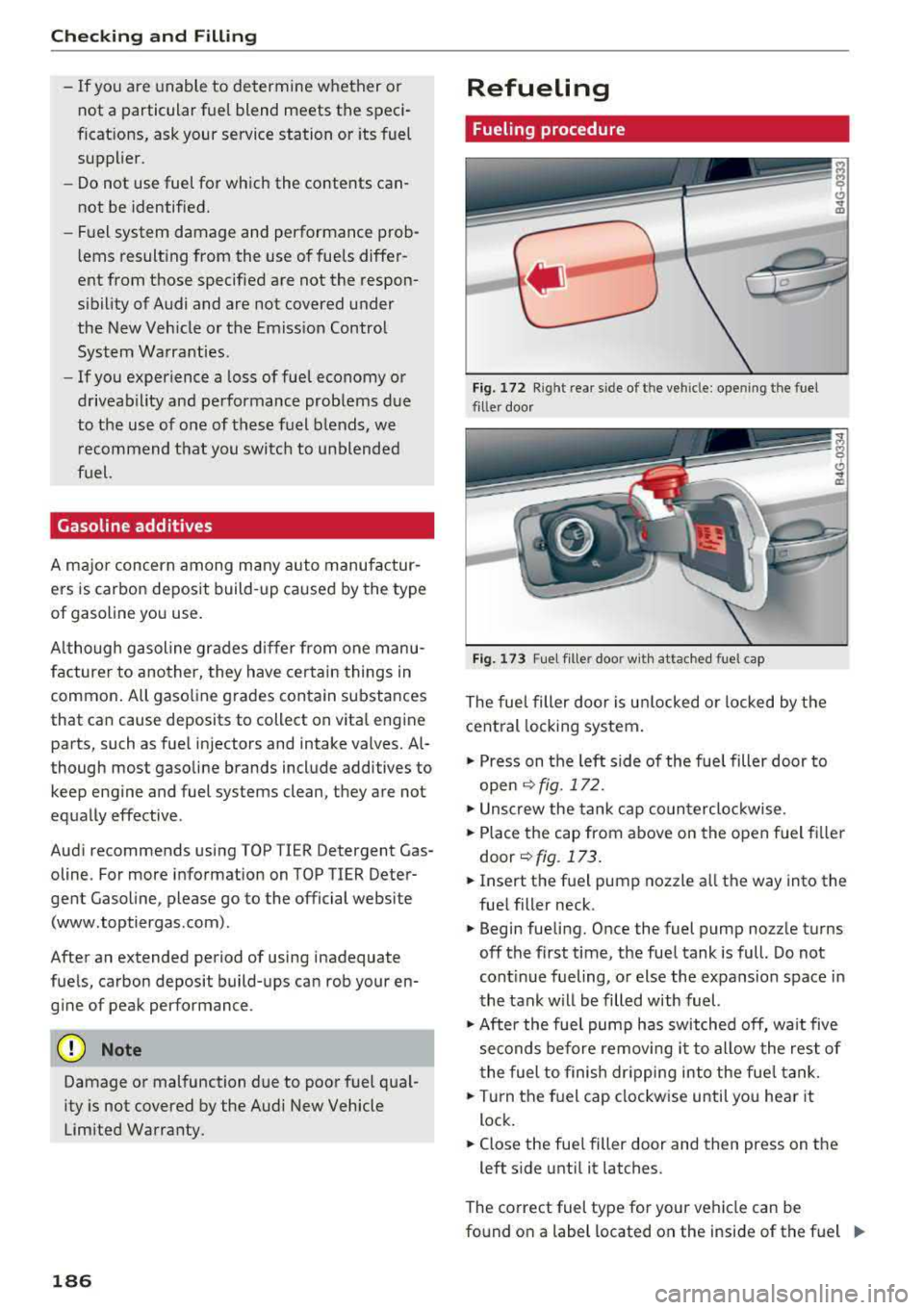
Fig. 172 R ig ht re ar sid e o f th e ve hicle: o penin g th e fu el
filler door
Fig. 173 F uel fille r doo r with at tached fuel cap
The fuel filler door is unlocked or locked by the
central locking system.
.,. Press on the left side of the fuel filler door to
open
~ fig. 172.
.,. Unscrew the tank cap counterclockwise .
.,. Place the cap from above on the open fuel filler
door
~ fig.173.
.,. Insert the fuel pump nozzle all the way into the
fuel filler neck .
.,. Begin fueling. Once the fuel pump nozzle turns
off the first time, the fuel tank is full. Do not
continue fueling, or else the expansion space in
the tank will be filled with fuel.
.,. After the fuel pump has switched off, wait five
seconds before removing it to allow the rest of
the fuel to finish dripping into the fue l tank.
.,. Turn the fuel cap clockwise until you hear it
lock.
.,. Close the fuel filler door and then press on the
left side until it latches.
The correct fuel type for your vehicle can be
found on a label located on the inside of the fuel
.,.
Page 190 of 266
Checking and Filling
Fuel filler door emergency release
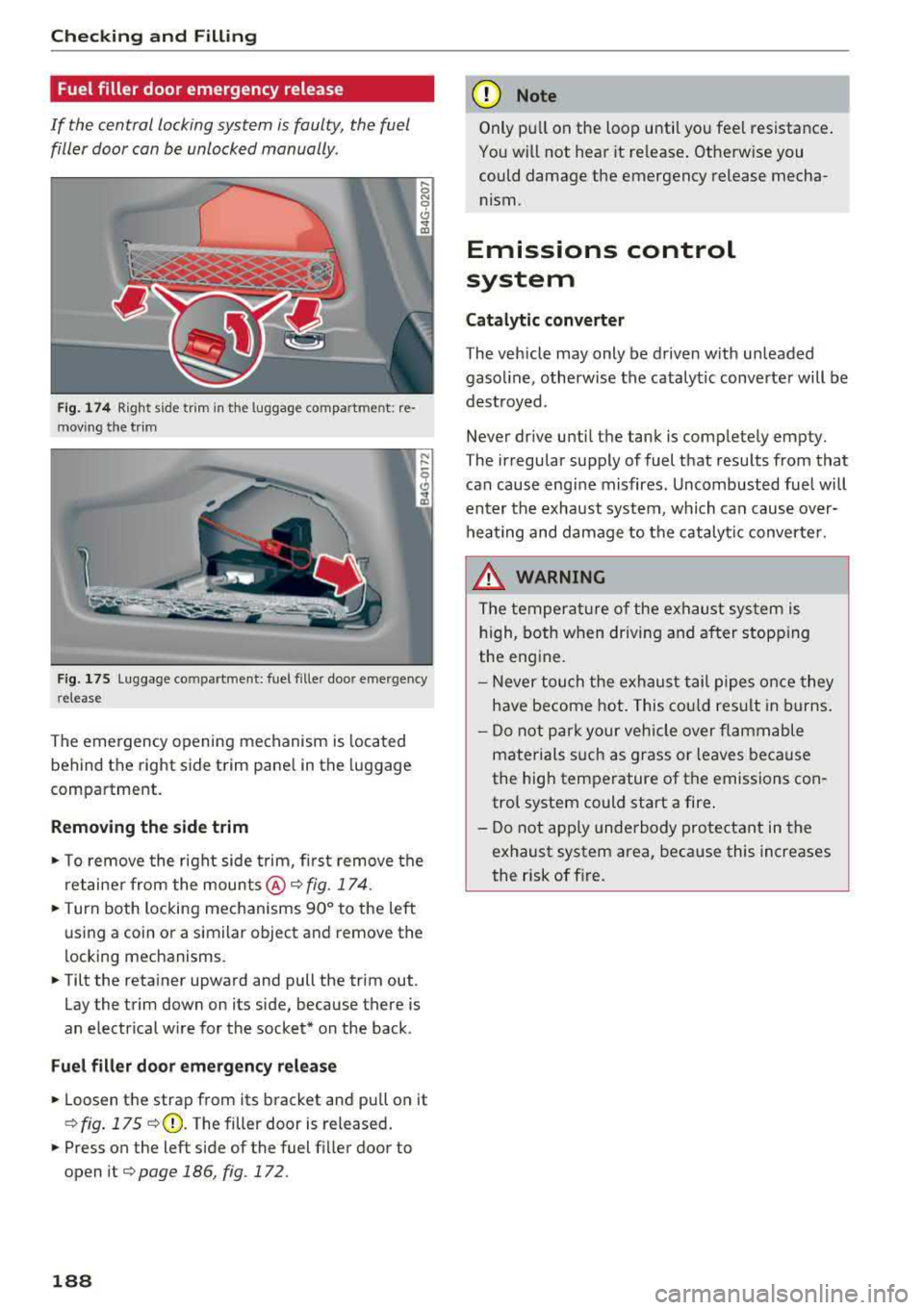
If the central locking system is faulty, the fuel
filler door can be unlocked manually.
Fig . 17 4 Right side trim in the luggage co mpartme nt: re
mov ing the tr im
F ig. 175 Luggage compa rtment: fuel fille r doo r eme rgency
r elease
The emergency opening mechanism is located
behind the right side trim pane l in the luggage
compartment.
Removing th e side trim
• To remove the right side trim, first remove the
retaine r from the mounts @¢
fig. 174.
• Turn both locking mechanisms 90° to the left
us ing a coin or a similar object and remove the
locking mechanisms.
• Tilt the reta iner upward and pull the trim out .
Lay the trim down on its side, because there is
an electrical w ire for the socket* on the back .
Fuel filler d oor em ergenc y relea se
• Loosen the strap from its bracket and pu ll on it
¢ fig. 175 ¢(D. The filler door is released.
• Presson the left side of the fuel f iller door to
open it
¢page 186, fig. 172.
188
(D Note
Only pu ll on the loop until you feel resistance .
You will not hear it re lease . Otherwise you
could damage the emergency release mecha nism.
Emissions control
system
Cat alytic converter
The vehicle may only be driven w ith unleaded
gaso line , otherwise the catalytic converte r will be
dest royed .
Never dr ive until the tank is completely empty.
The irregular supply of fuel that results from that can cause engine misfires. Uncombusted fuel will
enter the exhaust system, which can cause over
heating and damage to the catalytic converter .
&_ WARNING
The temperature of the exhaust system is
h igh, both when driving and a fter stopp ing
the engine.
-
- Never tou ch the exhaust tail pipes once they
have become hot. This cou ld resu lt in burns.
- Do not park your vehicle over flammable
materials s uch as grass or leaves because
the high temperature of the emissions con
trol system could start a fire .
- Do not apply unde rbody protectant in the
exhaust system area, beca use this increases
the risk of fire.
Page 192 of 266
Checking and Filling
belt, alternator and radiator fan) and from
the high-voltage ignition system.
- Do not under any circumstances give gas in
advertently (for example, by hand from the
engine compartment) if the vehicle is sta
tionary but the engine is running and a gear
is engaged. Otherwise, the vehicle will start
to move immediately and this could result
in an accident.
- Pay attention to the following warnings list
ed when work on the fuel system or on the
electrical equipment is required.
- Do not smoke.
- Never work near open flames.
- Always have a working fire extinguisher
nearby.
- All work on the battery or electrical system
in your vehicle can result in injuries, chemi
cal burns, accidents or burns. Because of
this, all work must be performed
only by an
authorized Audi dealer or authorized Audi
Service Facility.
- To reduce the risk of electric shock and in
jury, never touch the following components when the engine is running or is being start
ed:
- Ignition cable
- Other components in the electronic high-
voltage ignition system
- If you must check or perform work on the
engine while it is running:
- Set the parking brake and place the selec tor lever in the P (park) position first.
- Always proceed with extreme caution so that clothing, jewelry or long hair do not
become caught in the radiator fan, fan
belt or other moving components or do
not come into contact with hot compo
nents. Tie back long hair before beginning
work and do not wear clothing that can
hang down into the engine.
- Limit your exposure to exhaust and chemi
cals to as short a time as
possible~ &..
A WARNING
California Proposition 6S Warning:
190
-Engine exhaust, some of its constituents,
and certain vehicle components contain or
emit chemicals known to the State of Cali
fornia to cause cancer and birth defects and
reproductive harm . In addition, certain flu
ids contained in vehicles and certain prod
ucts of component wear contain or emit
chemicals known to the State of California
to cause cancer and birth defects or other
reproductive harm.
- Battery posts, terminals and related acces
sories contain lead and lead compounds,
chemicals known to the State of California
to cause cancer and reproductive harms.
Wash hands after handling.
@ Note
When filling fluids, be sure not to mix the flu
ids up. Otherwise severe malfunctions and en
gine damage will occur.
@ For the sake of the environment
You should regularly check the ground under
your vehicle in order to detect leaks quickly. If there are visible spots from oil or other fluids, bring your vehicle to an authorized Audi deal
er or authorized Audi Service Facility to be
checked.
Page 193 of 266
a co ,...,
N
" N ,...,
0 0 <..:l '
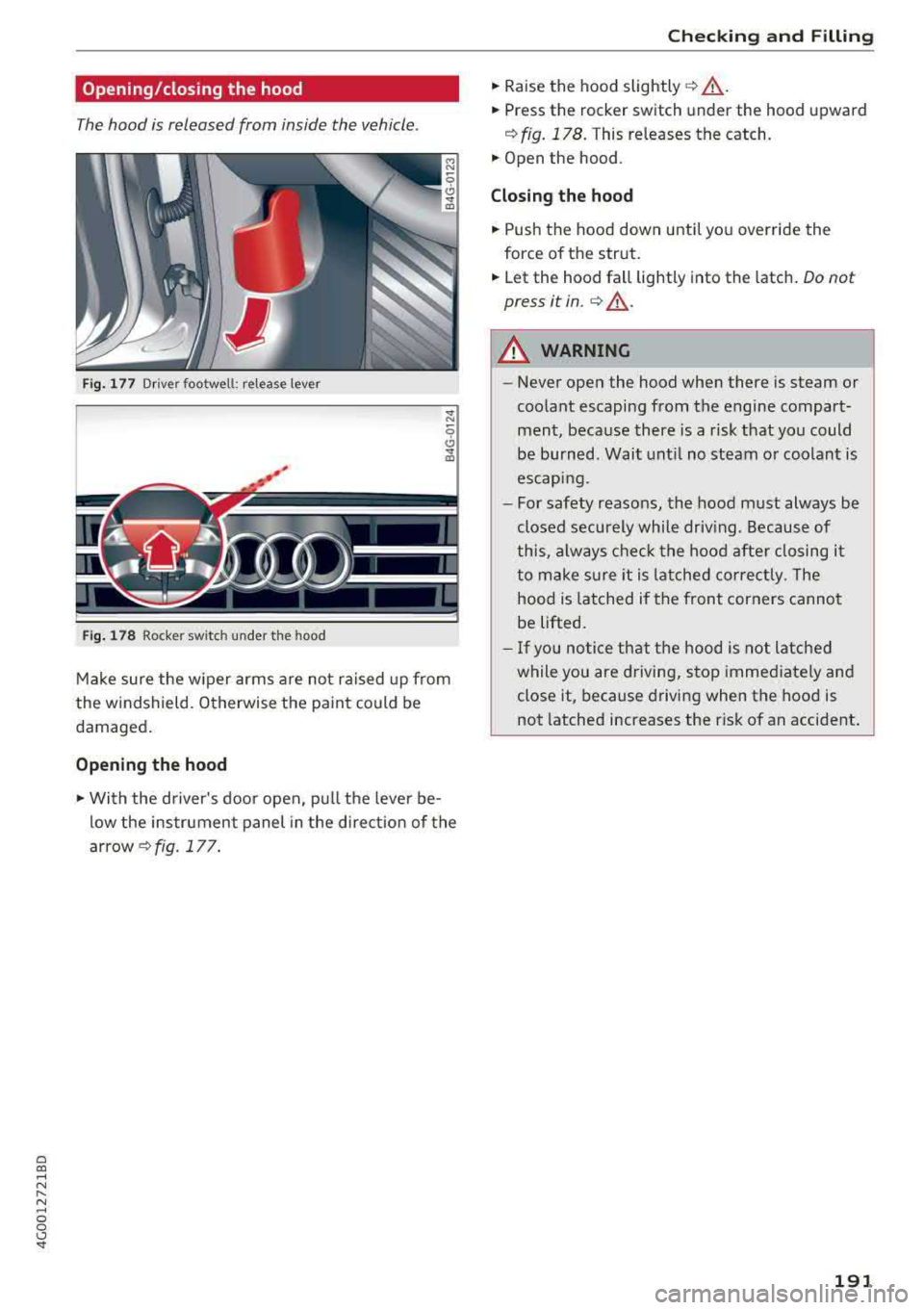
The hood is released from inside the vehicle.
Fig. 177 Dr ive r footwell: release leve r
Fi g. 178 Rocker sw itc h under the hood
Make sure the w iper arms are not raised up from
the windshield . Otherwise the pa int could be
damaged .
Opening the hood
.. With the driver's door open, pu ll the leve r be
low the instrument panel in the direct ion of the
arrow ¢ fig. 177 .
Checking and Filling
.. Raise the hood slightly ¢.&_ .
.. Press the rocker switch under the hood upward
¢
fig. 178. T his releases the catch .
.. Open the hood.
Closing the hood
.. Push the hood down until yo u over ride the
force of the strut .
.. Let the hood fall lightly into the latch. Do not
press it in.
¢ .&_ .
A WARNING
-
-Never open the hood when there is steam or
coolant escaping from the engine compart ment, because there is a risk that you could
be burned . Wait unti l no steam or coolan t is
escaping.
- For safety reasons, the hood m ust always be
closed securely while driv ing . Because of
this, always check t he hood afte r closing i t
t o make sure it is latched correct ly . T he
hood is latched if the front corners cannot
be lifted.
- If you no tice that the hood is not latched
while you are d riving, stop immed iately and
close it, because drivi ng when the hood is
not latched increases the r isk of an accident .
191
Page 194 of 266
Checking and Filling
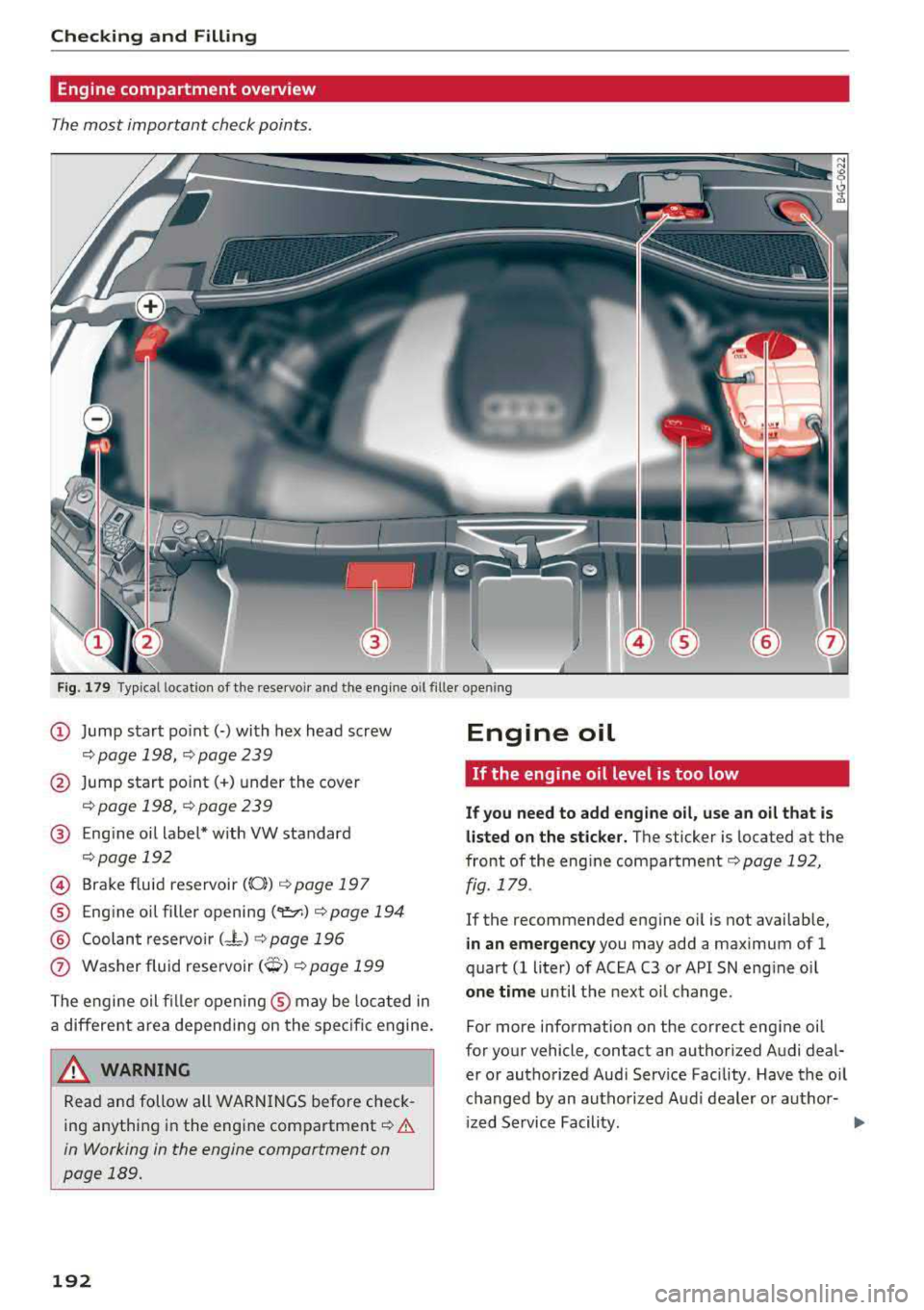
Engine compartment overview
The most important check points.
Fig. 179 Typical location of the rese rvoir and the engine o il filler open ing
(D Jump start point(-) with hex head screw
~page 198, ¢page 239
@ Jump start point(+) under the cover
~ page 198, ¢ page 239
® Engine oil label* with VW standard
¢page 192
@ Brake fluid reservoir ((0)) ¢page 197
® Eng ine oil filler opening(~)¢ page 194
@ Coolant reservoir ( - L) ~ page 196
(j) Washer fluid reservoir (0) ¢ page 199
The engine oil filler opening ® may be located in
a different area depending on the specific engine.
& WARNING
Read and follow all WARNINGS before check
ing anything in the engine
compartment¢ &
in Working in the engine compartment on
page 189.
192
Engine oil
If the engine oil level is too low
If you need to add engine oil, use an oil that is
listed on the sticker.
The sticker is located at the
front of the eng ine
compartment¢ page 192,
fig . 179 .
If the recommended engine oil is not availab le,
in an emergency you may add a maximum of 1
quart(! liter) of ACEA C3 or API SN eng ine oi l
one time until the next oil change .
For more information on the correct eng ine oil
for your vehicle, contact an authorized Audi deal
er or authorized Aud i Serv ice Facility . Have the oil
c h anged by an authorized Audi dealer or author
ized Service Facility.