heating AUDI A6 2018 User Guide
[x] Cancel search | Manufacturer: AUDI, Model Year: 2018, Model line: A6, Model: AUDI A6 2018Pages: 266, PDF Size: 41.38 MB
Page 65 of 266
a co ,...,
N
" N ,...,
0 0 \,;J '
Applies to: veh icles with steering wheel heating
The steering wheel rim can be heated.
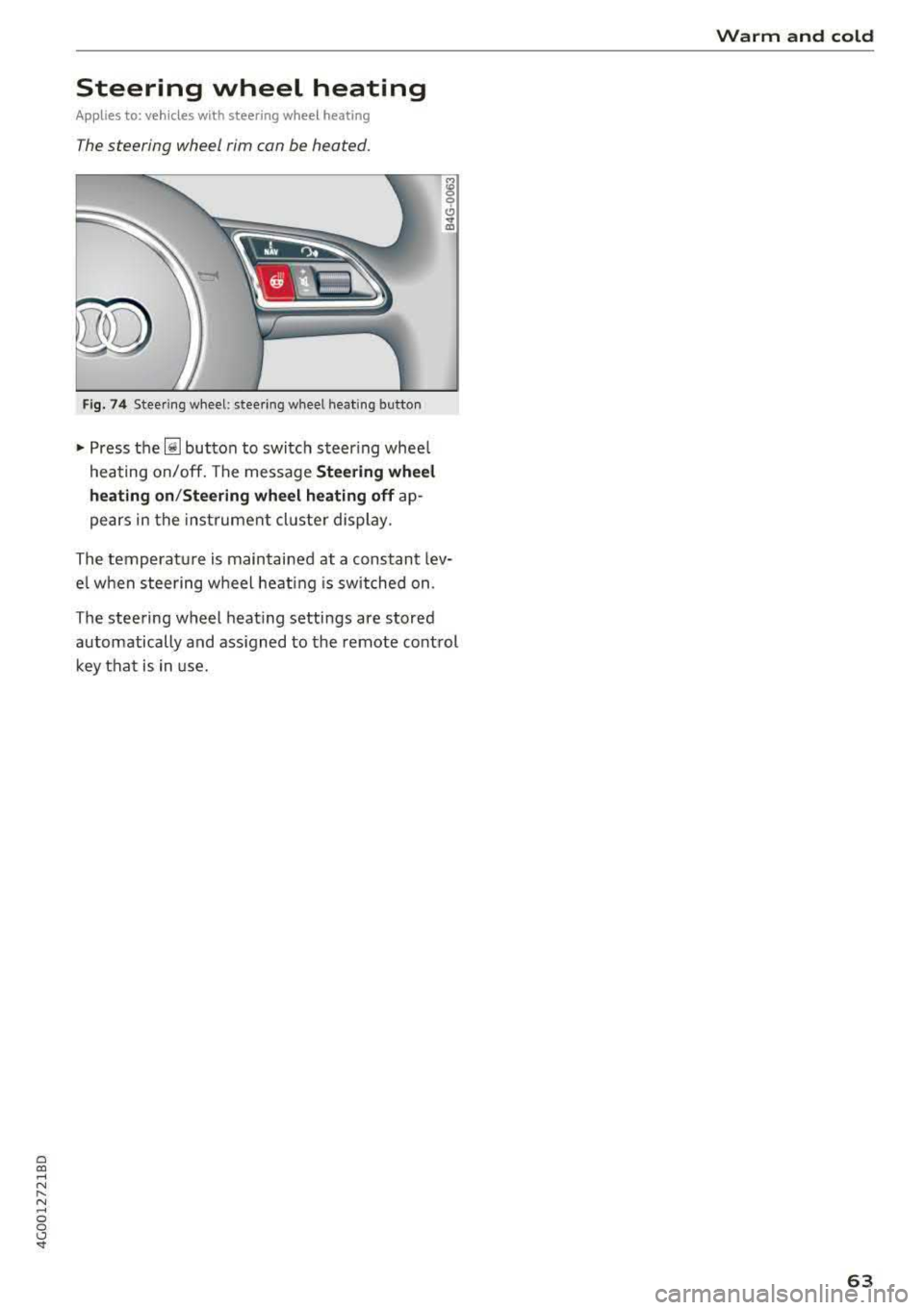
Fig . 74 Steering wheel: steering wheel heating button
~ Press the~ button to switch steer ing whee l
heating on/off. The message
Steering wheel
heating on /Steering wheel heating off
ap
pears in the instrument cluster display.
The temperature is maintained at a constant lev
e l when steering wheel heat ing is switched on.
The steering wheel heating settings are stored
automatically and ass igned to the remote control
key that is in use.
Warm and cold
63
Page 68 of 266
Driving
When not being used, a roof rack should be removed to decrease the wind resistance of the ve
hicle. You will save approximately 12% of your
fuel when at speeds from 62- 7 5 mph
(100-120 km/h) .
Save energy
The engine drives the generator, which generates
electricity ; the fuel consumption also increases
with the demand for electricity. Therefore, switch electrical equipment off when you no longer
need it. Examples of equipment that uses a lot of
energy are air blowers at a high setting, the rear
window defogger and seat heating* .
@ Note
Do not leave engine idling unattended after
starting. If warning lights should come on to
ind icate improper operation, they would go
unheeded. Extended idling also produces
heat, which could result in overheating or
other damage to the vehicle or other proper-
ty.
@ Note
- Have your vehicle maintained properly and
in accordance with the service recommenda
tions in your Warranty
& Maintenance book
let. Lack of proper maintenance as well as
improper use of the vehicle will impair the
function of the emission control system and
could lead to damage.
- Do not alter or remove any component of
the Emission Control System unless ap proved by the manufacturer .
- Do not alter or remove any device , such as
heat shields, switches, ignition wires,
valves, which are designed to protect your
vehicle's Emission Control System and other important vehicle components .
@ Tips
The consumption estimates as published by
ENVIRONMENTAL PROTECTION AGENCY (EPA) and Transport Canada may not corre
spond to your actual consumption on the
road, which will vary depending upon vehicle
66
load and speed, road and weather conditions ,
trip length, etc.
Steering
Manual steering wheel position adjustment
Applies to: vehicles with manual steering wheel adjustment
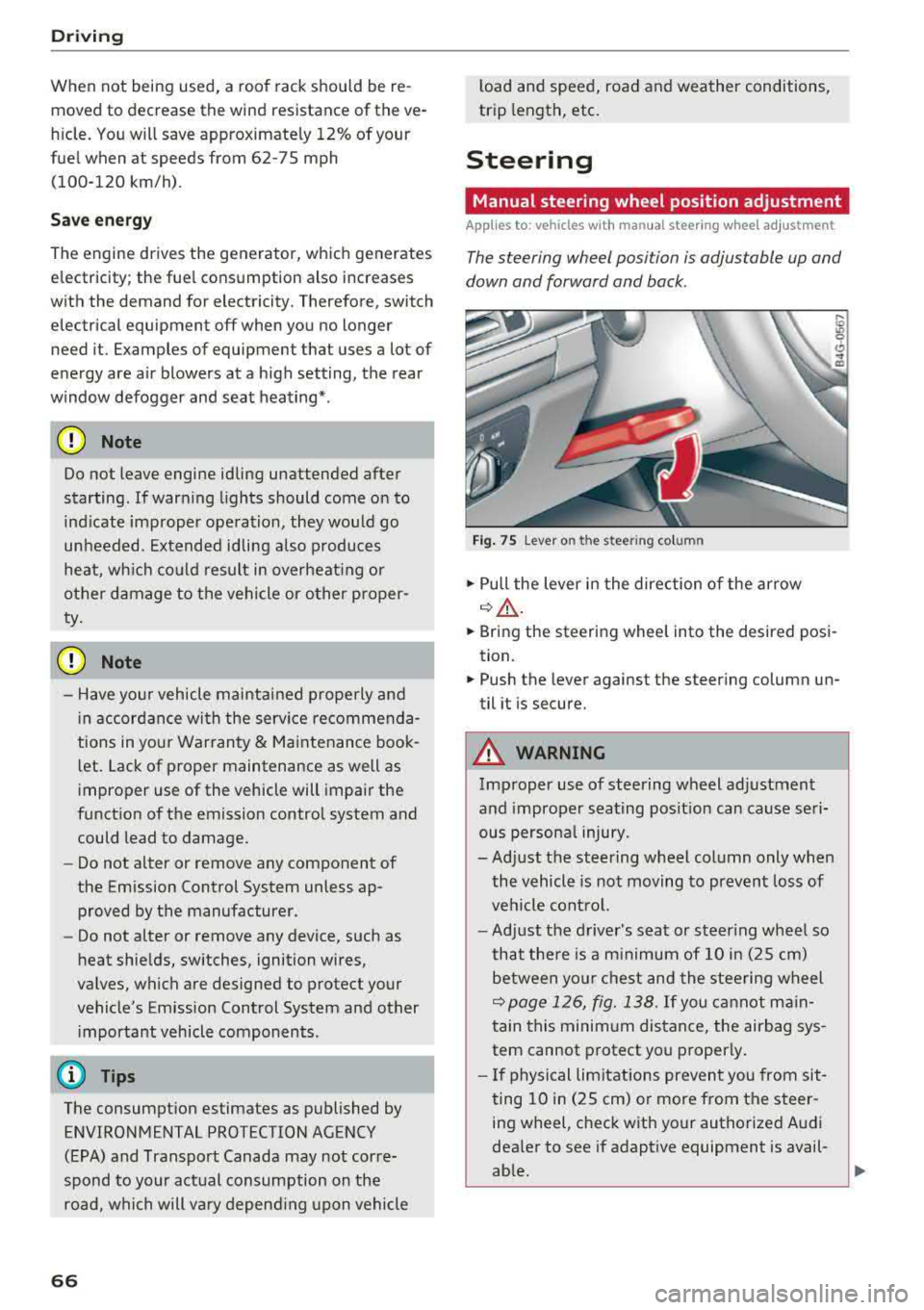
The steering wheel posi tion is adjustable up and
down and forward and back .
Fig. 75 Lever on th e stee ring column
.,. Pull the lever in the direction of the arrow
~A -
... Bring the steering wheel into the desired posi
tion .
.,. Push the lever against the steering column un
til it is secure.
A WARNING
Improper use of steering wheel adjustment
and improper seating position can cause seri
ous personal injury.
-Adjust the steering wheel column only when
the vehicle is not moving to prevent loss of
vehicle control.
-Adjust the driver's seat or steering wheel so
that there is a minimum of 10 in (25 cm)
between your chest and the steering wheel
~page 126, fig. 138. If you cannot main
tain this minimum distance, the airbag sys
tem cannot protect you properly .
- If physical limitations prevent you from sit
ting 10 in (25 cm) or more from the steer
ing wheel, check with your authorized Audi
dealer to see if adaptive equipment is avail-
able.
.,.
Page 81 of 266
a co .... N
" N .... 0 0 \.J '
~ page 105 .
~ Press t he b rake peda l firmly with you r left foot
and hold it all the way down for at least one
second.
~ At the same t ime, press the gas pedal all the
way dow n wit h your right foot unt il the engi ne
r eaches and stays at a h igh RPM level.
~ Remove yo ur foot from t he b rake pedal within
five
seconds ~& ..
& WARNING
-Always adapt yo ur driv ing to t he tra ffic flow.
-O nly use the La u nch control prog ram when
road and traffic cond itions allow it and ot h
er drivers w ill not be endangered or both
ere d by your driving and the vehicle's accel
eration.
-Please note that the drive whee ls can sp in
and the vehicle can break away when sport
mode is switched o n, especia lly when the
road is s lippery.
-Once the vehicle has sta rted moving, press
the
I ~ OF FI button br iefly to tu rn the sport
mode off.
(D Tips
-The transmiss ion tem perature may increase
s ignificantly a fte r us ing the launc h cont rol
p rogram. If that happens, the program may
not be available for a few m in utes .
It will be
available again after a cool-down pe riod .
-When accelerating using the la unch control
p rogram, all ve hicle parts are subject to
heavy loads. This can lead to increased
wea r.
Transmission malfunction
ID Transmi ssion : Press brake pedal and select
gear again .
Press the brake pedal and se lect t he des ired se
l ec to r l ever pos it io n aga in . You can t hen continue
d riving.
ID Transmission overheating : Please drive con
s e rvatively.
Driving
T he transmission tem peratu re has inc reased sig
nificantly due to the sporty driving manner . Drive
i n a less spo rty manne r until the temperatu re re
turns to the norma l range and the indicator light
switches of.
[O] Transmission malfunction : You can continue
driving
T he re is a system malfu nction in t he tra nsmis
s ion . You may contin ue driving . Dr ive to an a u
t h orized Audi dea le r or a uthorized Audi Service
Fac ility soon to have t he malfunct io n corrected .
[O] Transmission malfunction: You can continue
driving with limited functionality
T he re is a system malfu nction in t he transmis
s io n. The transm ission is swi tc hi ng to eme rge ncy
mode. This mode only sh ifts into ce rtain gears or
will no longer shift a t all. T he eng ine may sta ll.
D rive to an authorized A udi dealer or autho rized
Audi Se rvice Facility immed iate ly to have the
malfunction corrected.
Applies to: vehicles with S tronic transmission
[O] lij Transmis sion malfunction: No rever se
gear. You can continue driving
T he re is a system m alfu nction in t he tra nsmis
s io n. The transm ission is swi tc hi ng to emergency
mode. This mode only shifts into certain gears or
will no longer shift at a ll. The eng ine may sta ll.
Yo u cannot engage the reve rse gear. Dr ive to an
authori zed Aud i dea le r or a uthori zed Audi Serv ice
Facility immed iate ly to have the ma lfunction cor
rected .
[O] Transmission malfunction: Stop vehicle and
shift to park.
Do not continue dr iv ing . Se lect t he P sele ctor lev
er posit io n an d see an au thor ized A udi dealer or
a ut ho riz ed Au di Serv ice Facili ty fo r ass ista nce .
@ Note
If t he t ransm iss ion has swi tched to em erge n
cy mo de, dr ive t o an a uth o riz e d Aud i de aler o r
auth oriz e d Aud i Serv ice F acili ty imme diat ely
to have t he mal func tion cor rected .
79
Page 87 of 266
a co .... N
" N .... 0 0 \.J '
yo ur foot on the accelerator pedal prevents
the cruise control from braking. Th is is be
cause pressing the acce lerator pedal over
rides the cruise control system .
- If a brake system ma lf u nction such as over
heating occu rs when the c ruise contro l sys
tem is switched on, the braking function in
the system may be switched off . The rest of
t h e cruise control system f unction s remain
ac tive as long as
the @;(IM~ (USA model s) /
l'I (C anada models) indi cator light is on .
(D Tips
The brake ligh ts turn on when the brakes a re
ap plied a utomat ica lly .
Changing speed
Applies to: vehicles with cruise control system
.. To inc rease o r decrease the speed in incre
ments, tap the lever toward
0 10 <=> page 84 ,
fig . 87 .
.. To inc rease o r decrease the speed qu ickly, ho ld
the leve r in the
010 direction until the de
s ir ed speed is displayed.
You can a lso press the acce lerator pedal down to
increase yo ur speed, for example i f you want to
pass someone. The speed you set earlier w ill re
sume as soo n as you release t he accelerator ped
al.
However, if you exceed your saved speed by 5
mph (10 km/h) for longe r th an 6 mi nutes, the
cru ise control system tur ns off temporar ily .
The
green @;(i)~i~ (USA models) !l'I (Canada mod
e ls) indicator light in the speedometer tu rns off
and the stored speed is maintained.
Preselecting the speed
Applies to: vehicles with cruise control system
You can pre-select your desired speed when the
vehicle is stationary.
.. Switch the ign ition on.
.. Pull the lever into position @<=> page 84,
fig. 87 .
A ss istance systems
.. To increase or decrease the speed, tap the lever
toward
0 10 .
.. To store t he speed d isp layed, release the leve r.
T his func tion makes it possible , fo r example, to
save the spee d you want before driving on the
highway. Once on the highway, activate the
c ruise contro l by pull ing the leve r
towa rd @ .
Switching off
Applies to : vehicles with cruise control system
Deact ivating temporarily
.. Press the brake pedal, or
.. Press the lever into position @(not clicked into
p lace) <=>
page 84, fig . 87, or
.. Dr ive fo r longer t han 5 m inutes faster than 5
mph (10 km/h) above the stored speed .
Switching off completely
.. Press the lever into position @(clicked into
p lace), or
.. Switch the ignit ion off .
The speed you stored will be ma intained if the
cruise contro l has been switched off temporari ly .
To resume the stored speed, re lease the brake
peda l and pull the lever to
position @.
Switching the ignition off wi ll erase the stored
speed.
A WARNING "---
You should only resume the sto red speed if it
i s no t too high fo r existing t raff ic conditions .
Otherw ise you can inc rease the risk of an acci
d ent .
85
Page 121 of 266

a co .... N
" N .... 0 0 \,;J '
control (ESC)
Description
Electronic stabilization control (ESC) supports
driver safety. It reduces the risk of slipping and
improves driving stability. ESC detects critica l sit
uations such as the vehicle oversteering and un
dersteering or the wheels are spinning. The vehi
cle is stabilized by applying the brakes or reduc ing engine torque. As soon as the ESC is actively
regulating, the
If] indicator light b links in the in
strument cluster.
The following systems are integrated in the ESC:
Anti-lock braking system (ABS)
ABS prevents the wheels from locking when brak
ing. The vehicle can still be steered even during
hard braking. Apply steady pressure to the brake
pedal. Do not pump the pedal. A pulsing in the
brake pedal indicates that the system is act ing to
stabilize the vehicle .
Brake assist system
The brake assist system can decrease braking dis
tance. It increases braking power when the driver
presses the brake pedal quickly in emergency sit
uations . You must press and hold the brake pedal
until the dangerous situat ion is over . In veh icles
with adaptive cruise contro l*, the brake assist
system is more sensitive if the distance detected
to the vehicle dr iv ing ahead is too small. On
vehicles with activated and functioning night vi
sion assist*, the brake assist system can respond more sensitively if there is a warning .
Anti-Slip Regulation (ASR)
ASR reduces eng ine power when the drive wheels
begin spinning and adapts the force to the road
conditions. This makes it easier to start, acceler
ate and drive up hills.
Electronic differential lock (EDL)
The EDL applies the brakes to a whee l that starts
spinning and transfers the drive power to the
other driving wheel or wheels (if the vehicle is
Intelligent Technology
equipped with a ll wheel drive*). This function is
not avai lab le at higher speeds.
In extreme cases , EDL automatically switches off
to keep t he brake on the braked whee l from over
heating. The vehicle is still working correctly. EDL
will switch on again automatically when condi
tions have returned to normal.
Power steering
The ESC can also support veh icle stability
through steering .
Selective wheel torque control
Selective wheel torque control is used when driv
i ng on curves. The front whee l on the ins ide of
the curve or both wheels on the ins ide of the
curve are braked selectively as needed. This al
lows more precise driving in curves.
Automatic post-collision braking system
The "automat ic post-collis ion braking system"
can help to reduce the risk of sliding and of addi
tional collisions after an accident. If the airbag
contro l module
detects a co llision above a certa in
vehicle speed, the vehicle is braked by the ESC.
T he vehicle does not brake automatically if:
- the driver presses the accelerator pedal, or
- the braking force generated by the pressed brake pedal is greater than the braking force
that would be initiated by the system, or
- the ESC, the brake system or the vehicle electri
cal system are not functioning.
A WARNING
-
- The ESC and its integrated systems cannot
overcome the lim its imposed by natura l
p hys ica l laws. This is especially impo rtant
on slippery or wet roads. If the systems be
g in acting to stabilize yo ur vehicle, you
should immediately alter your speed to
match the road and traffic conditions. Do
not let the increased safety provided tempt
you into taking risks. This could increase
your r isk of a coll is ion.
- Please note the risk of a coll ision increases
when dr iv ing fast, especially through curves
and on slippery or wet roads, and when
IIJ,,
119
Page 190 of 266
Checking and Filling
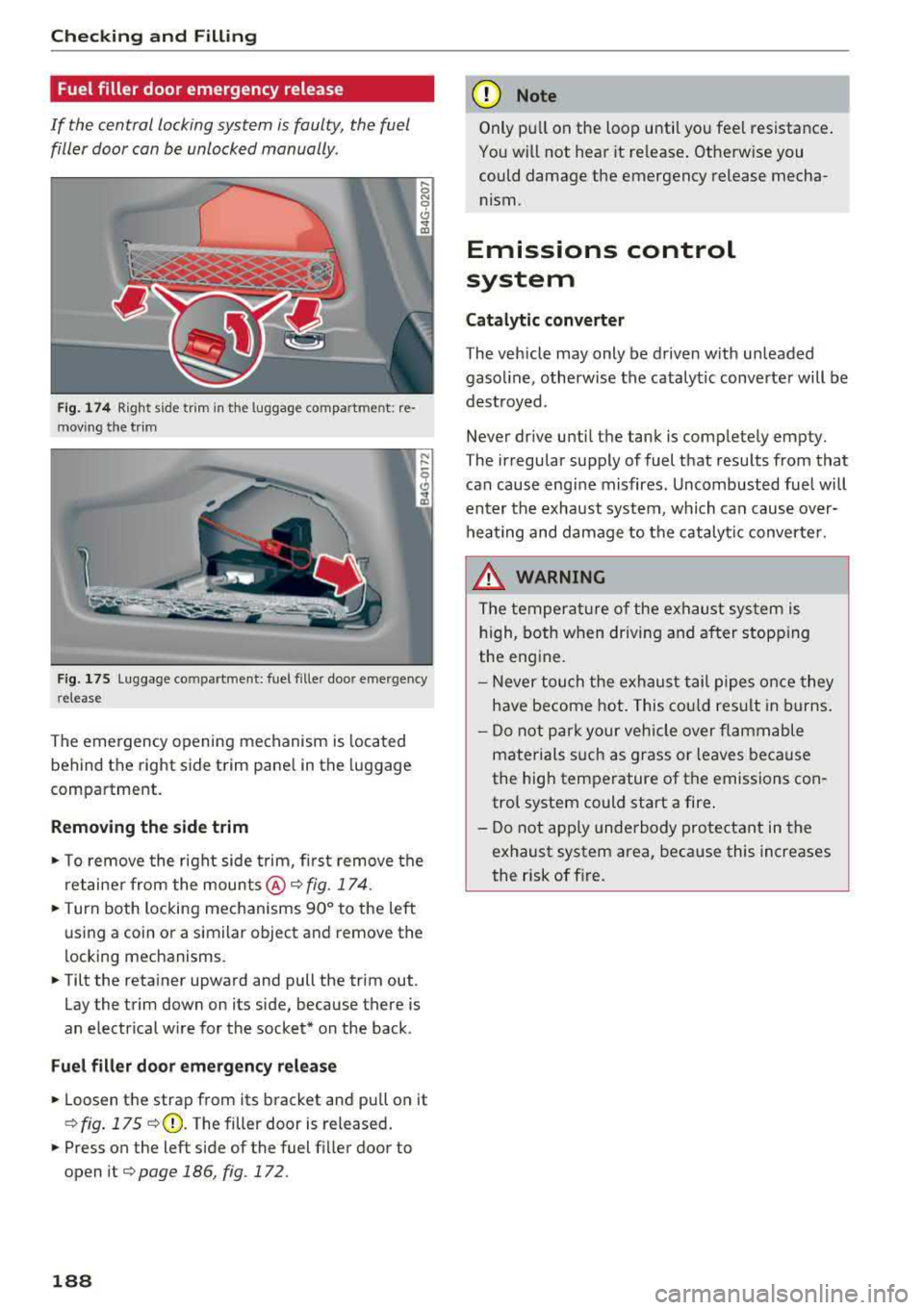
Fuel filler door emergency release
If the central locking system is faulty, the fuel
filler door can be unlocked manually.
Fig . 17 4 Right side trim in the luggage co mpartme nt: re
mov ing the tr im
F ig. 175 Luggage compa rtment: fuel fille r doo r eme rgency
r elease
The emergency opening mechanism is located
behind the right side trim pane l in the luggage
compartment.
Removing th e side trim
• To remove the right side trim, first remove the
retaine r from the mounts @¢
fig. 174.
• Turn both locking mechanisms 90° to the left
us ing a coin or a similar object and remove the
locking mechanisms.
• Tilt the reta iner upward and pull the trim out .
Lay the trim down on its side, because there is
an electrical w ire for the socket* on the back .
Fuel filler d oor em ergenc y relea se
• Loosen the strap from its bracket and pu ll on it
¢ fig. 175 ¢(D. The filler door is released.
• Presson the left side of the fuel f iller door to
open it
¢page 186, fig. 172.
188
(D Note
Only pu ll on the loop until you feel resistance .
You will not hear it re lease . Otherwise you
could damage the emergency release mecha nism.
Emissions control
system
Cat alytic converter
The vehicle may only be driven w ith unleaded
gaso line , otherwise the catalytic converte r will be
dest royed .
Never dr ive until the tank is completely empty.
The irregular supply of fuel that results from that can cause engine misfires. Uncombusted fuel will
enter the exhaust system, which can cause over
heating and damage to the catalytic converter .
&_ WARNING
The temperature of the exhaust system is
h igh, both when driving and a fter stopp ing
the engine.
-
- Never tou ch the exhaust tail pipes once they
have become hot. This cou ld resu lt in burns.
- Do not park your vehicle over flammable
materials s uch as grass or leaves because
the high temperature of the emissions con
trol system could start a fire .
- Do not apply unde rbody protectant in the
exhaust system area, beca use this increases
the risk of fire.
Page 227 of 266
a co .... N
" N .... 0 0 \,;J '
one direction and not back and forth.
- N ever remove snow or ice from door win
dows and mirrors using warm or hot water
because this could cause cracks to form .
- To avoid damage to the rear w indow de
fogger, do not apply any stickers on the heating wires on the inside of the window .
-Deco rati ve parts /trim
- Never use chrome care or cleaning prod-
ucts.
- Paint
-To red uce the risk of scratches, the vehicle
must be free of dirt and dus t before pol
ishing or waxing .
- To preven t pa int damage, do not pol ish or
wax the ve hicle in direct sunlight.
- To red uce the risk of pa int damage, do not
polish away rust spots.
- Remove cosmetics and sunscreen immedi
a tely- these could damage the pa int.
- Displa ys
- To avoid scratches, do not use dry cleaning
methods on displays .
-Controls
- Make sure that no fluids enter the con-
trols, because this could cause damage.
- Safet y belts
- Do not remove the safety belts to clean
t hem.
- Never clean safety belts or their compo
nents chemically or with cor rosive fl uids
or so lvents and neve r allow sh arp obje cts
t o come into con ta ct w ith the sa fe ty belts.
Th is could cause damage to the belt web
bing .
- If the re is damage to the webbing, the
connections, the retractors or the b uckles,
have them replaced by an authorized Audi
dea ler or authorized Audi Service Facility.
- Te xtiles/artificial leather / Alcantara
- Never treat artific ial leather/ Alcantara
w ith leather care products, solvents, floor
polish, shoe polish, spot remove or similar
prod ucts .
- Have a specialist remove st ubborn stains
to prevent damage.
Care and cleaning
- Neve r use steam cleaners, brushes, hard
sponges, etc. when cleaning .
- Do not turn on the seat heating* to dry the
seat.
- Obje cts w ith sharp edges, such as zippe rs
or rivets on clothing or be lts, can cause
damage to the surface .
- Open hoo k and loop fasteners, for exam
p le on clothing, can damage seat covers.
M ake sure hook and loop fasteners are
closed.
- Natural leather
- Never treat leather with solvents, floor
polish, shoe po lish, spot remover or sim i
lar p roducts.
- Objects w ith sharp edges, such as zippers
or rivets on clothing or belts, can cause
damage to the surface.
- Never use steam cleaners, brushes, hard
sponges, etc. when cleaning.
- Do not turn on the seat heating* to dry the seat.
- To he lp prevent the leather from fad ing,
do not leave the vehicle in direct sun light
fo r long pe riods of time. If leav ing the ve
h icle parked fo r long pe riods of time, you
should cover the le athe r to prote ct it from
d irec t sun light.
(D Tips
- Insects are easie r to remove from paint that
has been freshly waxed.
- Regular wax ing can prevent rust spots from
forming.
Placing your vehicle out
of service
If you would like to take your vehicle out of serv
ice for a longer period of time, contact an author
ized Audi dea ler or authorized Audi Service Facili
ty. They will adv ise you of important measures,
such as corrosion protection, service and storage
procedures. Also follow the information about
the veh icle battery
r=;,page 197 .
225
Page 237 of 266
a co ,...,
N
" N ,...,
0 0 \,;J '
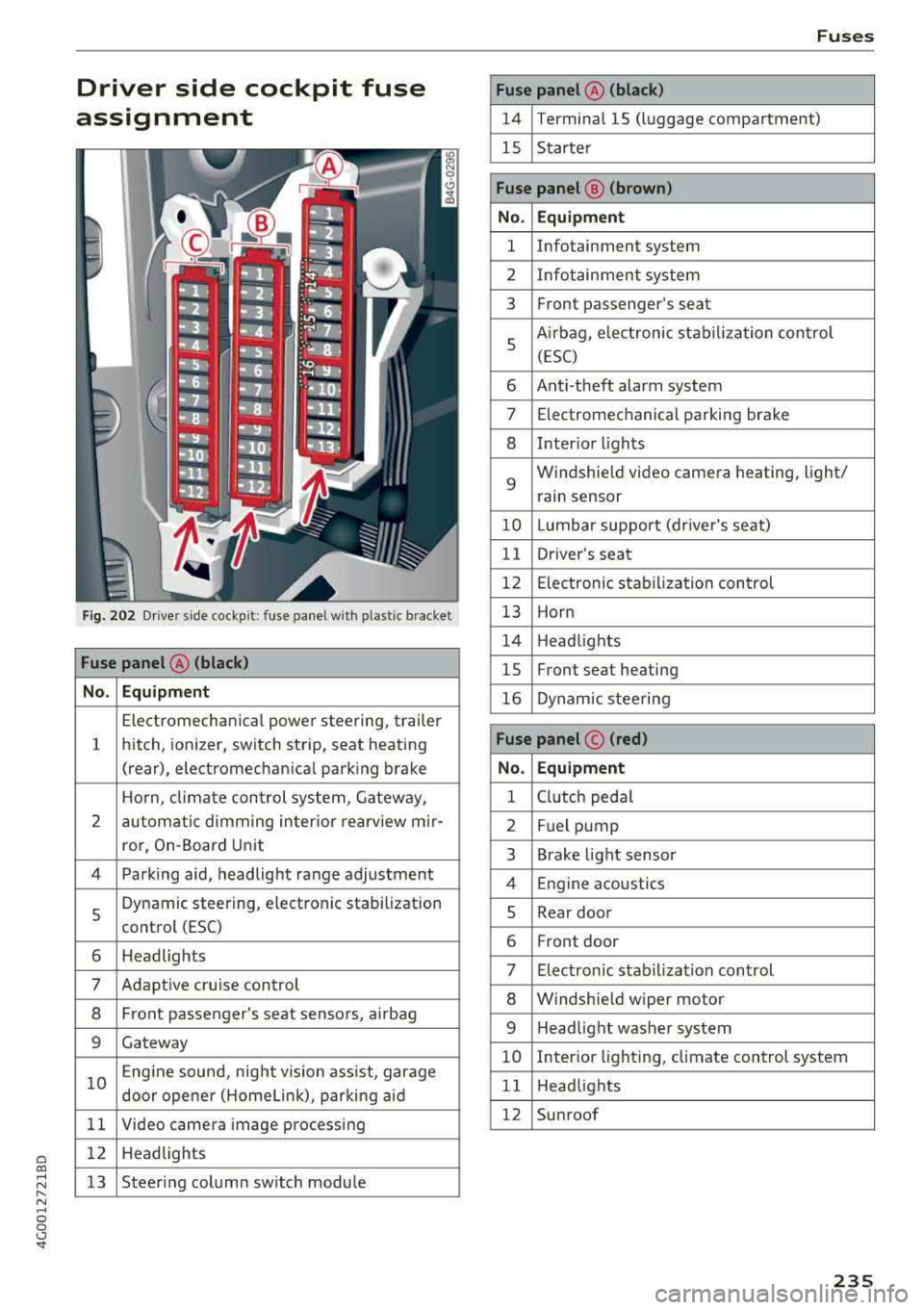
assignment
F ig. 202 Drive r side cockp it : fuse panel w it h plastic bracket
Fuse panel @ ( black)
No . Equipment
Electromechan ica l powe r stee ring, trailer
1 hitch, ionizer, switch st
rip, seat heating
(rear), electromechan ica l park ing brake
Ho rn, climate con trol system, Gateway,
2 au
tomati c dimm ing in ter ior rearv iew m ir-
ro r, On -Board Unit
4 Park ing aid, headlight range adjustment
5
Dynamic steering, electronic stabilization
control (ESC)
6 Headlights
7 Adapt ive cru ise control
8 Front passenger's seat senso rs, a irbag
9 Gateway
10 Engine sound, nig
ht vision ass ist, garage
door opene r (H ome link), parki ng aid
11 Video camera
image processi ng
12 Headlights
13 Steering column sw
itch module
Fuses
Fuse panel @ (black)
14 Termina l 15 (luggage compartment)
1 5 Starte r
Fuse panel @ (brown)
No . Equipment
1 Infotainment system
2 Infot ainment system
3 Front passenger's seat
5
A
ir bag, e lec tronic sta bi liz ation con trol
( E SC)
6 Ant
i- theft alarm system
7 E lectromec ha nical pa rking brake
8 Inter io r li ghts
9
Windshie ld video came ra heating, light/
r ain sensor
10 Lumbar support (dr iver's se at)
11 Driver
's seat
12 Electronic stab ilizati on con trol
13 Horn
1 4 Head lights
lS Front seat heating
16 Dynamic s tee ring
Fuse panel © (red)
No . Equipment
1 Clutch peda l
2 Fuel p ump
3 Brake
light sensor
4 Engine acoustics
5 Rear door
6 Fr
ont door
7 Elec tronic stab iliza tion control
8 Windshie ld wiper motor
9 H ead light washer system
10 Interio
r light ing, climate control system
1 1 Head lights
12 Sunroof
235
Page 238 of 266
Fuses
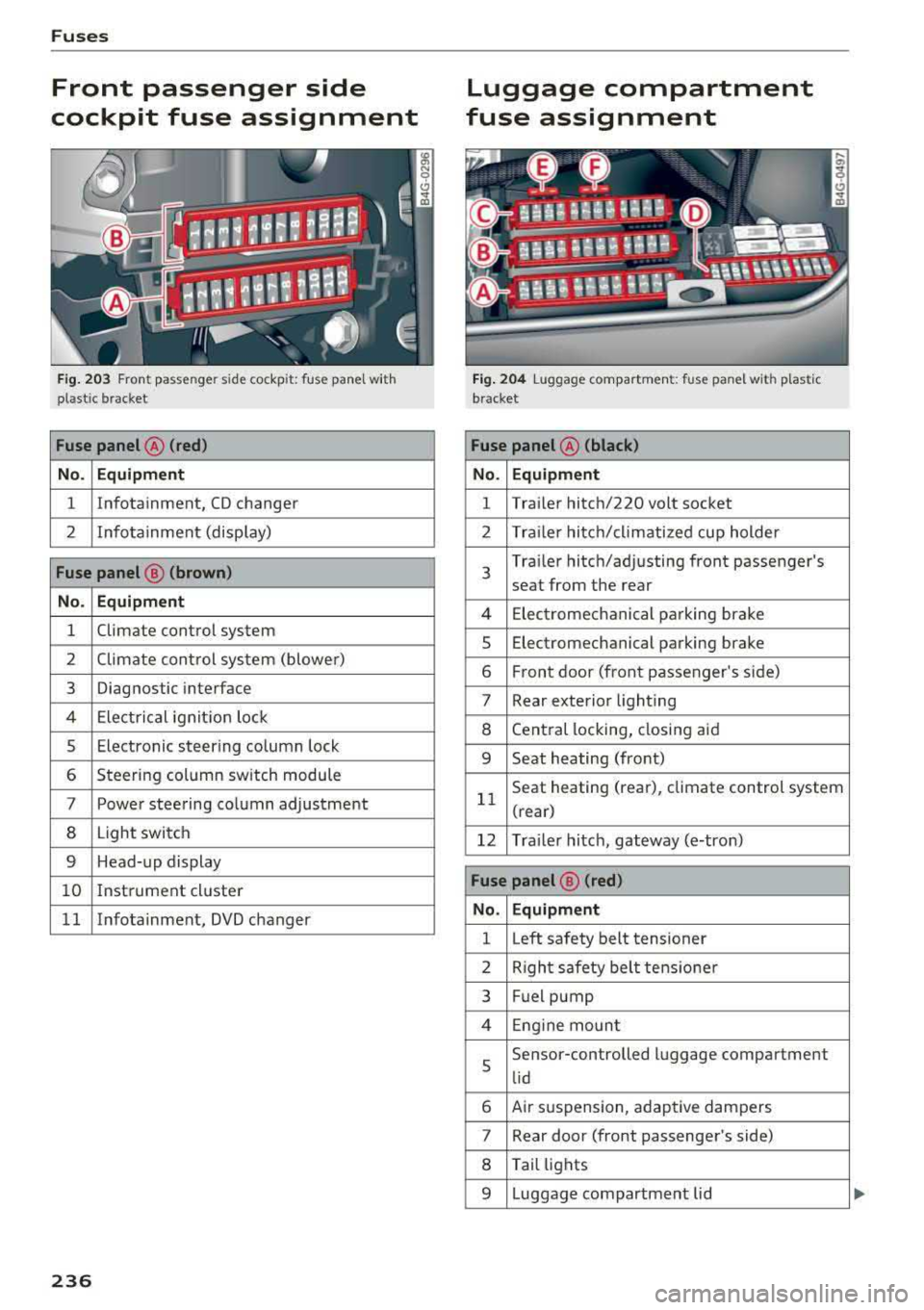
Front passenger side
cockpit fuse assignment
F ig . 203 Front passenger side cockpit: fuse pane l with
plastic bracket
Fuse panel @ (red )
No. Equipm ent
1 Infotainment, CD changer
2 I
nfotainment (display)
Fuse panel@ (brown)
No . Equipm ent
1 Climate control system
2 Climate
control sys tem (blowe r)
3 Diagnostic interface
4 Ele ct ric al ignit ion lock
5 Electronic steer ing column lock
6 Steering column sw itch module
7 Power stee ring co lumn adjustment
8 Light switch
9 Head-up display
10 I
nstrument cl uste r
11 Infota inment, DVD changer
236
Luggage compartment
fuse assignment
F ig . 2 04 L uggage compartment: fuse panel with plast ic
b racket
Fuse panel @ (black)
No . Equipment
1 Tra
iler hitch/220 volt socket
2 Tra ile r hitc h/climatized cup holder
3
Trailer hitch/adjusting front passenger's
seat from the rear
4 E lec tromechani cal pa rking brake
5 Electromechanical parking brake
6 Fr on t door (front passenger's side)
7 Rear exterior lighting
8 Central locking, closing aid
9 Seat heating (fro nt)
11 Seat
heating (rear), climate control system
(rear)
12 Tra ile r hitch, gateway (e-tron)
Fuse panel @ (red)
No . Equipment
1 Left safety
belt tensioner
2 R ight safety be lt tens ioner
3 Fuel pump
4 Eng ine moun t
5
Sensor-controlled luggage compartment
l id
6 Air s uspension, adaptive dampers
7 Rear door (front passenger's side)
8 Tail lights
9 Luggage compartmen t lid
Page 257 of 266
a co .... N
" N .... 0 0 \.J '
14
Eng ine sound . . . . . . . . . . . . . . . . . . . . . . . . 104
Engine speed limitation (indicator light) 17
Engine Start/Stop mode
refer to Start/Stop system . . . . . . . . . . . . . 72
Engine warm-up request
I ndicator light . . . . . . . . . . . . . . . . . . . . . . .
1 7
Environment
Proper disposal of drained engine oil . . . .
194
Unleaded gasoline . . . . . . . . . . . . . . . . . . . 185
EPC (engine control) . . . . . . . . . . . . . . . . . . . . 16
ESC
Automatic post-collision brak ing system .
119
also refer to Electronic stabilization con-
tro l . . . . . . . . . . . . . . . . . . . . . . . . . . . . . . .
119
ESP
refertoElectron icstabilizationcontrol . .
119
Event Data Recorder (EDR) . . . . . . . . . . . . . 124
Exterior lighting . . . . . . . . . . . . . . . . . . . . . . . 38
Exterior mirrors
Adjusting . . . . . . . . . . . . . . . . . . . . . . . . . . .
42
o· . 1mmmg . .. .. ............. .. .. .. .. . . 42
Heating............................. 42
Exterior temperature display . . . . . . . . . . . . . 19
F
Fastening
Booster seats . . . . . . . . . . . . . . . . . . . . . . .
176
Convertible child safety seats . . . . . . . . . . 174
Infant seats . . . . . . . . . . . . . . . . . . . . . . . . 172
Federal Communications Commission (FCC) 250
Fl oor mats . . . . . . . . . . . . . . . . . . . . . . . . . . . 130
Folding the rear seats . . . . . . . . . . . . . . . . . . . 55
Foot pedals . . . . . . . . . . . . . . . . . . . . . . . . . . 130
For the sake of the environment
Environmentally-friendly driving . . . . . . . .
65
Fu eling . . . . . . . . . . . . . . . . . . . . . . . . . . . . 186
Leaks . . . . . . . . . . . . . . . . . . . . . . . . . . . . . . 190
Roof rack . . . . . . . . . . . . . . . . . . . . . . . . . . . 54
Warming up the engine . . . . . . . . . . . . . . . . 68
Fr eeze protection
Coolant
. ... .. ................ ......
Front airbags
D . t' escnp 10n ... ................ ... .. .
How they work ............... .. .. .. .
195
146
152
Index
Frontal collisions and the laws of physics . . 135
Front center armrest . . . . . . . . . . . . . . . . . . . 48
Front seats
Adjusting . . . . . . . . . . . . . . . . . . . . . . . . . .
127
Child restraints in the front seat . . . . . . . . 143
also refer to Seats . . . . . . . . . . . . . . . . . . . . 4 7
Fuel . . . . . . . . . . . . . . . . . . . . . . . . . . . . . . . .
185
Additives. . . . . . . . . . . . . . . . . . . . . . . . . . . 185
Blended gasoline . . . . . . . . . . . . . . . . . . . . 185
Current consumption . . . . . . . . . . . . . . . . . . 20
Fuel gauge . . . . . . . . . . . . . . . . . . . . . . . . 9, 10
Fuel tank capacity . . . . . . . . . . . . . . . . . . . 245
Gasoline . . . . . . . . . . . . . . . . . . . . . . . . . . . 185
Gasoline addit ives . . . . . . . . . . . . . . . . . . . 186
Indicator light . . . . . . . . . . . . . . . . . . . . . . . 17
Saving fuel . . . . . . . . . . . . . . . . . . . . . . 65, 104
Fueling
Fuel gauge . . . . . . . . . . . . . . . . . . . . . . . . . .
10
Fuel tank capacity . . . . . . . . . . . . . . . . . . . 245
Open ing the fuel filler door . . . . . . . . . . . . 186
Fuses
Assignment . . . . . . . . . . . . . . . . . . . . . . . .
235
Replacing . . . . . . . . . . . . . . . . . . . . . . . . . . 234
G
Garage door opener (Homelink) . . . . . . . . . . 36
Garment hook . . . . . . . . . . . . . . . . . . . . . . . . . 53
Gas discharge lamps . . . . . . . . . . . . . . . . . . . 238
G asoline . . . . . . . . . . . . . . . . . . . . . . . . . . . . 185
Octane rating . . . . . . . . . . . . . . . . . . . . . . . 185
Recommendation . . . . . . . . . . . . . . . . . . . . 185
GAWR
refer to Gross Axle Weight Rating (GAWR) 246
Glasses holder . . . . . . . . . . . . . . . . . . . . . . . .
53
Glossary of tire and loading terminology . . 204
Glove compartment . . . . . . . . . . . . . . . . . . . . 53
cooled . . . . . . . . . . . . . . . . . . . . . . . . . . . . . . 53
Valet parking function . . . . . . . . . . . . . . . . . 36
Gross Axle Weight Rating (GAWR) . . . . . . . 246
Gross Vehicle Weight Rating (GVWR) . . . . . 246
GVWR
refer to Gross Vehicle Weight
Rating (GVWR) . . . . . . . . . . . . . . . . . . . . . .
246
H
Head-up disp lay . . . . . . . . . . . . . . . . . . . . . . . 22
255