oil AUDI A6 2018 User Guide
[x] Cancel search | Manufacturer: AUDI, Model Year: 2018, Model line: A6, Model: AUDI A6 2018Pages: 266, PDF Size: 41.38 MB
Page 195 of 266
a co .... N
" N .... 0 0 \,;J '
~ Castrot /lftlg;'f.E@t Frtrrr.::--.~lri,'lAl.
A ud i recomm ends using the Lo ng Life h igh
perfo rm ance eng ine oil from Aud i Genu ine
Parts .
Checking the engine oil level
The engine oil level can be checked in the Info
tainment system
Observe the safety precautions ¢ A in Working
in the engine compartment on page 189.
~ Park your vehicle on a level surface.
~ Shut the engine off when it is warm .
~ Switch only the ignition back on.
~ Wait approx imately two minutes.
~ Select : the ICARI function button > (C ar)* Sys
tem s
control button > Service & control > O il
l e v el.
~ Read the o il level in the display. Add eng ine oil
i f t he ba r in the oil leve l ind icator is just before
"min" ¢ page 194.
(UJ) Note
The engine oil leve l mus t not be unde r the
"min" mark ing, as this will increase the risk of
engine damage.
(D Tips
The o il level indica tor in the disp lay is on ly an
informationa l display. If the o il level is too
low, a minimum oi l warning appears in the in
strument cluster. Add oil and close the hood.
The current oil level is d isplayed in the Info
tainment system the next t ime the ignition is
sw itched on.
(D Tips
The engine oil consumption may be up to
0.5 quart/600 m iles (0.S liter/1,000 km), de
pending on driving style and operating condi
tions. Consumpt ion may be h igher during the
first 3,000 miles (5,000 km). Because of this,
the eng ine oil level m ust be checked regu lar
ly. I t is best to chec k each t ime yo u refuel
your veh icle and befo re long d rives .
Ch eck ing and F illing
-In order to prov ide effective lubrication and
cooling of interna l engine components, a ll
internal comb ustion engines consume acer
tain amount of oil. Oi l consumption var ies
from engine to engine and may change sig
nificantly over the life of the engine . Typi
cally, eng ines with a specified break-in peri
od consume mo re o il du ring the break-in pe
r iod than they consume afte r oil cons ump
t ion has s tabilized.
-Under norma l co ndit io ns, the rate of oil
cons umption depe nds on the q ual ity and
vis cos ity of the oil , the R PM (revo lutions per
m inute) a t which the engine is operated, the
ambient temperature and road conditions .
Further factors are the amount of oi l di lu
tion from water condensat ion or fue l resi
due and the oxidation level of the oil. As any
eng ine is subject to wear as m ileage builds
up, the oil consumption may increase over
t ime until replacement of worn components
may become necessa ry.
-With all these var iables com ing into play,
no sta ndard rate of o il consumption can be
established o r specified. There is no a lter na
ti ve to c hec king the oil leve l reg ularly and
frequently.
-If you have the impress ion your e ngine co n
sumes excessive amo unts o f oil, we recom
mend that you consult an author ized Audi
dea ler to have the cause of your concern
properly diagnosed . Keep in mind that t he
acc urate measurement of o il cons umption
requires great care and may take some
time . An authorized Aud i dealer has instruc
tions about how to measu re o il consump
tion accurate ly.
-You can find informat ion on engine oil and
eng ine o il capacit ies for the USA at
www.aud iusa.com/he lp/ma intenance, o r
for Ca nada at www.aud i.ca/ ca/web/en/
cu stomer -area/ ca re -and -m a i ntena nee/ a u di
serv i ce -sched u les. htm l, or ca ll
800 -822-2834 .
193
Page 196 of 266
Check ing and F illing
Adding engine oil
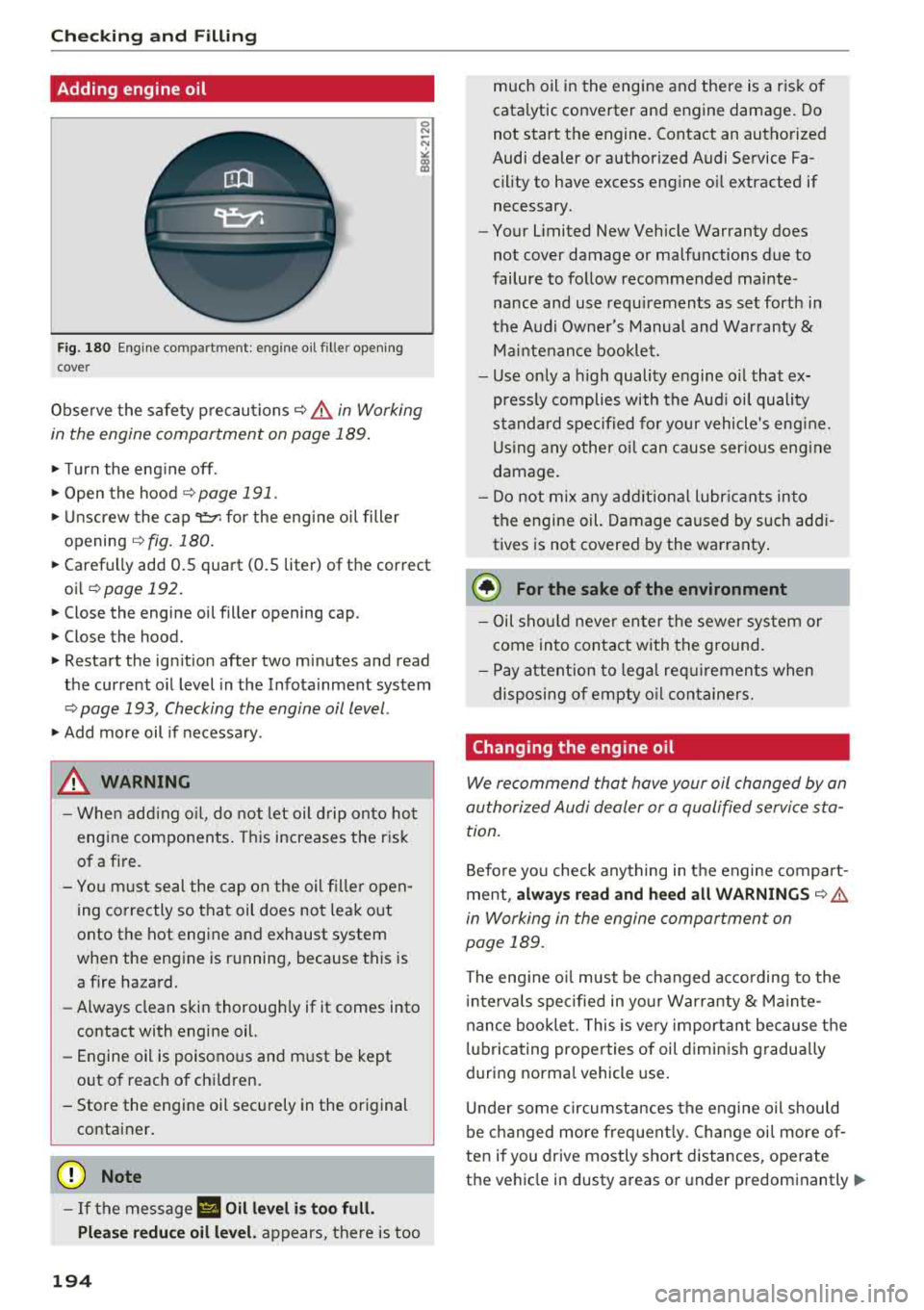
F ig. 180 Engine co mpartment : en gin e oil fille r opening
cove r
Observe the safety precaut ions ¢&. in Working
in the engine comportment on page 189 .
"'Turn the eng ine off.
"' Open the hood ¢ page 191.
"'Unscrew the cap~ for the eng ine oi l filler
opening ¢
fig. 180.
"'Carefu lly add 0.5 quart (0 .5 liter) of the correct
oi l
¢pag e 192.
"'Close the engine oil filler opening cap .
"'Close the hood.
"'Restart the ign ition after two mi nutes and read
the current o il level in the Infotainment system
¢ page 193 , Checking the engine oil level .
"'Add more oil if necessa ry .
,& WARNING
- Whe n add ing o il, do not let oil d rip onto hot
engine components . This increases the r is k
of a fire.
- Yo u m ust seal the cap on the oil fi lle r open
ing correctly so that oil does not leak o ut
onto the hot engine and exhaust system
when the eng ine is r unning, because this is
a fire hazard.
- Always clean skin thorough ly if it comes into
contact with engine oil.
- Engine oil is poisono us and must be kept
o ut o f reach of chi ld ren.
- Store the engine oi l sec urely in the original
container.
(LlJ) Note
- If the message Ill Oil l evel i s too full.
Plea se redu ce oil le vel.
appears, there is too
194
much oil in the engine and the re is a r isk o f
cata lytic converter and engine damage. Do
not start t he engine. Contact an autho rized
Audi dealer or author ized Audi Service Fa
cility to have excess eng ine o il extracted if
necessary .
- Your L imited New Vehicle Warranty does
not cover damage or ma lfunctions due to
failure to follow recommended mai nte
nance and use requ irements as set fort h in
the A udi Owne r's Manual and War ranty
&
Ma inte nan ce bookle t.
- Use on ly a high quality engine o il that ex
press ly complies with the A ud i oi l quality
s ta ndard spec ified fo r yo ur vehicle 's eng ine.
Us ing any othe r oi l c an cause ser io us eng ine
damage .
- Do not mix any add it io na l lubr ic a nts in to
t he engine oil. Damage ca used by such add i
tives is not covered by the warranty .
@ For the sake of the environment
- Oil sho uld neve r en ter the sewer sys tem or
come in to contact with the g round .
- Pay attent ion to lega l re quir emen ts when
disposing o f emp ty o il conta iners.
Changing the engine oil
We recommend that hove your oil changed by on
authorized Audi dealer or a qualified servi ce sta
tion.
Befo re yo u check anything in t he engine compart
ment,
alway s read and h eed all WARNINGS ¢ &
in Working in the engine comportment on
page 189.
The eng ine o il must be changed according to the
i nte rvals spec ified in yo ur War ranty
& Ma inte
nance boo klet. This is ve ry important because the
l ubricating prope rties of oil diminish gradua lly
during norma l vehicle us e.
Un der some circumstances the engine oil should
be c hanged more freq uent ly. Change oi l more of
ten if you drive mostly s hort distances, operate
the ve hicle in dusty areas or under
predominantly ..,.
Page 197 of 266
a co .... N
" N .... 0 0 \,;J '
cle where temperatures remain below freezing
for extended periods.
Detergent additives in the oil will make fresh oil
l ook dark after the engine has been running for a
short time. This is norma l and is not a reason to
change the oil more often than recommended.
Because of the problem of proper disposa l, along
with the special tools and necessary expertise re
quired, we strong ly recommend that you have
your oil changed by an authorized
Audi dealer or
a qualified service station .
If you choose to change your oil yourself, please
note the following important information:
A WARNING
To reduce the risk of personal injury if you
must change the engine oil in your veh icle
yourself:
- Wear eye protection.
- To reduce the risk of burns from hot engine
o il, let the eng ine cool down to the touch.
-
-When removing the oil drain plug with your
fingers, stay as far away as possible. Always
keep your forearm parallel to the ground to
help prevent hot oil from running down your
arm.
- Drain the oil into a container designed for
this purpose, one large enough to hold at
least the total amount of oil in your engine .
- Engine oil is poisonous. Keep it well out of
the reach of children.
- Cont inuous contact w ith used engine oil is
harmful to your sk in. Always protect your
sk in by washing oil off thoroughly w ith soap
and water.
@ Note
Never mix oil addit ives with your engine o il.
These additives can damage your eng ine and
adversely affect your Audi Limited New Vehi
cle Warranty.
Checking and Filling
@) For the sake of the environment
-Before changing your oi l, first make sure
you know where you can properly dispose of
the used oil.
- Always dispose of used engine oi l properly.
Do not dump it on garden soil, wooded
areas, into open streams or down sewage
drains.
- Recycle used engine o il by tak ing it to a used
eng ine oil collection fac ility in your area, or
contact a service station .
Cooling system
Coolant
The engine cooling system is filled wit h a mixture
of purified water and coolant additive at the fac
tory. This coolant must not be not changed.
T he coolant level is monitored through
the . in
dicator light
r=:>poge 13. However, we do recom
mend occasionally checking the coolant leve l
manua lly.
If you must add coolant, use a mixture of water
and coolant additive. Mixing the coo lant additive
with distilled water is recommended.
Coolant additive
The coolant additive is made of anti-freezing and
corrosion protection agents. Only use the follow
ing coolant additives. These additives may be
mixed with each other .
Coolant additive Specification
Gl2evo
TL 774 L
Gl2++ TL 774 G
Gl3 TL 774
J
The amount of coolant additive that needs to be
mixed with water depends on the climate where
the vehicle wi ll be operated .
If the coolant addi
tive percentage is too low, the coolant can freeze
and damage the engine.
.,.
195
Page 198 of 266
Checking and Filling
Coolant Freeze protec-
additi ve tion
Warm min. 40% min. -13 °F
regions max. 45% (-25 °C)
Cold min. 50% max. -40
°F
regions max. 55% (-40 °C)
([) Note
- Before the start of winter, have an author
ized Audi dealer or authorized Audi Service
Facility check if the coolant additive in your
vehicle matches the percentage appropriate
for the climate. This is especially important
when driving in colder climates.
- If the appropriate coolant additive is not
available in an emergency, do not add any
other additive. You could damage the en
gine. If this happens, only use water and re store the correct mixture ratio with the
spec ified coolant additive as soon as possi
ble.
- Only refill with new coo lant.
- Radiator sealant must not be mixed w ith
the coo lant .
Adding coolant
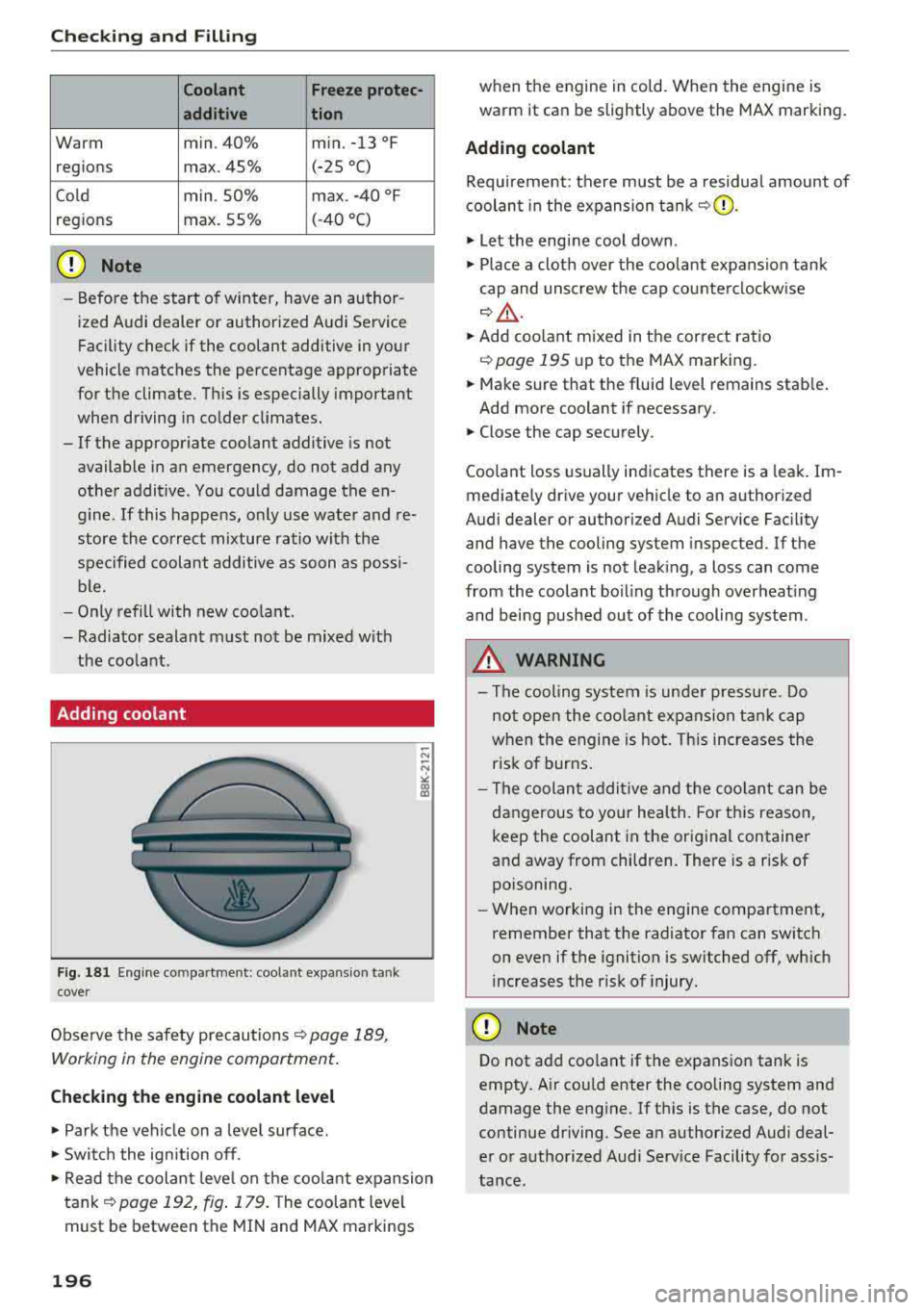
F ig. 181 Engine compartment: coolant expans ion tank
cover
Observe the safety precautions~ page 189,
Working in the engine compartment .
Checking the engine coolant level
• Park the vehicle on a leve l surface .
• Switch the ignition off.
• Read the coolan t leve l on the coo la nt expansion
tank~ page 192, fig . 179. The coolant level
must be between the MIN and MAX markings
196
when the engine in cold. When the engine is
warm it can be slightly above the MAX marking .
Adding coolant Requirement: there must be a residual amount of
coolan t in the expansion tan k
~CD -
• Let the engine cool down .
• Place a cloth over the coolant expansion tank
cap and unscrew the cap counterclockw ise
~ & -
... Add coo lant m ixed in the cor rect ratio
~ page 195 up to the MAX marking.
• Make sure that the fluid level remains stab le .
Add more coolant if necessary .
• Close the cap securely.
Coolant loss usually ind icates there is a leak . Im
mediate ly drive your vehicle to an authorized
Audi dealer or authorized Audi Service Fac ility
and have the cooling system inspected. If the
cooling system is not leaking, a loss can come
from the coolant boiling through overheat ing
and being pushed out of the cooling system .
A WARNING
- The cooling system is under pressure. Do
not open the coo lant expansion ta nk cap
when the engine is hot. This increases the
risk o f bur ns.
- The coolan t addi tive and the coolant can be
dangerous to your health. For t his reason,
keep the coolant in the original container
and away from children. There is a risk of
poisoning.
- When working in the engine compartment,
remember that the radiator fan can switch
on even if the ignition is switched off, which
increases the risk of injury.
(D Note
Do not add coolant if the expansion tank is
empty. A ir cou ld enter the cooling system and
damage the engine. If this is the case, do not
continue driving. See an authorized Audi deal
er or authorized Audi Serv ice Facility for assis
tance.
Page 201 of 266
a co .... N
" N .... 0 0 \,;J '
thorized Aud i Serv ice Facility for more infor
mation.
- Do not connect or disconnect the charging
cable while charg ing because this increases
the risk of an explosion.
(D Tips
-Only charge the vehicle battery through the
connections in the engine compartment.
- Read all of the manufacturer's instructions
for the charger before charging the ve hicle
battery.
Windshield washer system
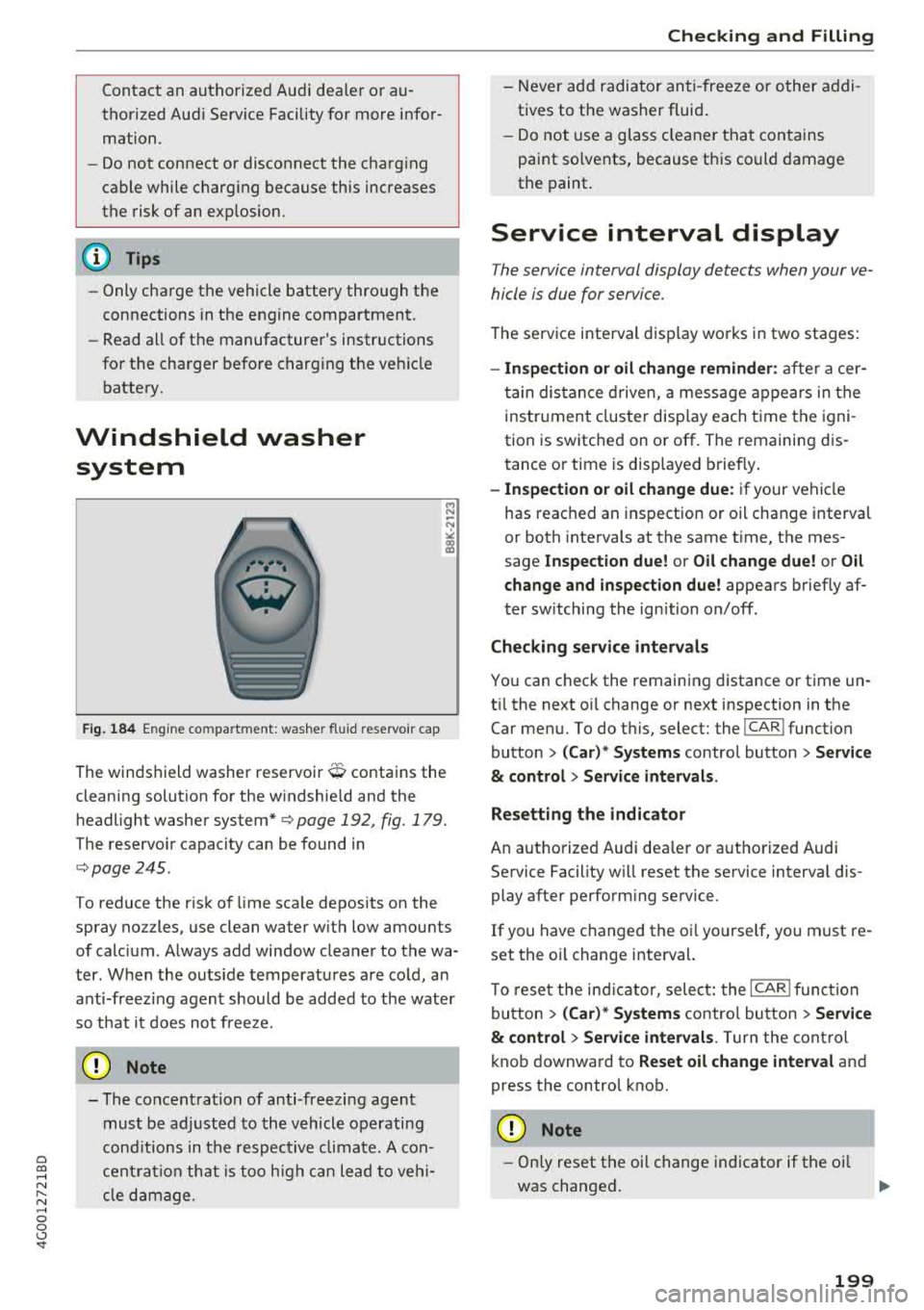
F ig. 184 Eng ine co mpartment: washer flu id reservoir cap
M N ~ N
"' a, a,
The winds hield washer reservoir O contains the
cleaning solution for the windshield and the
headlight washer system*
c::;,page 192 , fig . 179.
The reservoir capacity can be found in
c::;, page 245 .
To reduce the risk of lime sca le deposits on the
spray nozzles, use clean water w ith low amounts
of calc ium . Always add window cleaner to the wa
ter . When the outs ide temperatures are cold, an
anti-freez ing agent should be added to the water
so that it does not freeze.
0 Note
- The concentration of anti-freezing agent
must be adjusted to the vehicle operating
cond itions in the respect ive climate. A con
centration that is too high can lead to vehi
cl e damage.
Checking and Filling
- Never add radiato r anti -freeze or other addi
tives to the washer fluid .
- Do not use a glass cleaner that contains
paint solvents, because this could damage
the paint.
Service interval display
The service interval display detects when your ve
hicle is due for service .
The service interval display works in two stages:
-Inspection or oil change reminder : after a cer-
tain distance driven, a message appears in the
instrument cluster display each time the igni
tion is switched on or off. The remaining dis
tance or time is disp layed briefly.
-Inspection or oil change due: if your vehicle
has reached an inspection or oil change interval
or both intervals at the same time, the mes
sage
Inspection due! or Oil change due! or Oil
change and inspection due!
appears briefly af
ter switching the ignition on/off .
Checking service intervals
You can check the remaining distance or time un
til the next oi l change or next inspection in the
Car menu. To do this, select: the
I CAR I function
button
> (Car)* Systems control button > Service
& control > Service intervals .
Resetting the indicator
An authorized Audi dea ler or authorized Audi
Service Facility w ill reset the service interval dis
play after perform ing service .
If you have changed the oi l yourse lf, you must re
set the oil change interval.
To r eset the indicat or, select: the
I CARI function
button
> (Car)* Systems control button > Service
& control > Service intervals . Turn the control
knob downward to
Reset oil change interval and
press the control knob.
@ Note
- Only reset the oi l change indicator if the oi l
was changed.
199
Page 203 of 266
0 0)
-N ,.... N
-0
s ..
Wheels
Wheels and Tires
General information
.,,.Check your tires regularly for
damage (punctures, cuts, cracks
and bulges). Remove foreign ob
jects from the tire tread.
.,,. If driving over curbs or similar
obstacles, drive slowly and ap
proach the curb at an angle.
.,,.Have faulty tires or rims re
placed immediately.
.,,.Protect your tires from oil,
grease and fuel.
.,,.Mark tires before removing
them so that the same running
direction can be maintained if
they are reinstalled.
.,,.Lay tires flat when storing and
store them in a cool, dry location
with as little exposure to light as
possible.
&_ WARNING -
-Never drive faster than the
maximum permitted speed
for your tires. This could cause the tires to heat up too much.
This increases the risk of an
accident because it can cause
the tire to burst.
-Always adapt your driving to the road and traffic condi-
Wheels
tions. Drive carefully and re
duce your speed on icy or slip
pery roads. Even winter tires
can lose traction on black ice .
@ Note
-Please note that summer and
winter tires are designed for
the conditions that are typical
in those seasons. Audi recom
mends using winter tires dur
ing the winter months. Low
temperatures significantly de crease the elasticity of summ
er tires , which affects traction
and braking ability. If summer
tires are used in very cold
temperatures, cracks can form on the tread bars, resulting in
permanent tire damage that
can cause loud driving noise
and unbalanced tires.
-Burnished, polished or chromed rims must not be
used in winter driving condi
tions. The surface of the rims does not have sufficient corro
sion protection for this and
could be permanently dam
aged by road salt or similar
substances.
201
Page 206 of 266
Wheel s
Glossary of tire and loading
terminology
Accessory weight
means the combined weight (in
excess of those standard items
which may be replaced) of auto matic transmission, power steer
ing , power brakes , power win
dows , power seats, radio, and
heater, to the extent that these
items are available as factory-in
stalled equipment (whether in
stalled or not).
Aspect ratio
means the ratio of the height to
the width of the tire in percent. Numbers of 55 or lower indicate a
low sidewall for improved steer
ing response and better overall
handling on dry pavement .
Bead
means the part of the tire that is
made of steel wires, wrapped or
reinforced by ply cords and that is
shaped to fit the rim.
Bead separation
means a breakdown of the bond
between components in the bead.
20 4
Cord
means the strands forming the
plies in the tire.
Cold tire inflation pressure
means the t ire pressure recom
mended by the vehicle manufac
turer for a tire of a designated
size that has not been driven for
more than a couple of miles (kilo
meters) at low speeds in the
three hour period before the tire pressure is measured or adjusted.
Curb weight
means the weight of a motor ve
hicle w ith standard equipment in
cluding the maximum capacity of
fuel, oil, and coolant, ai r condi
tioning and additional weight of
optional equipment.
E x tra load ti re
means a tire designed to operate
at higher loads and at higher in
flation pressures than the corre
sponding standard tire. Extra load
tires may be identified as "X L",
"
l" "EXTRA LOAD" or "RF" on X I I
the sidewall. .,.
Page 216 of 266
Wheels
Tires and vehicle load limits
There are limits to the amount of
load or weight that any vehicle
and any tire can carry. A vehicle
that is overloaded will not handle
well and is more difficult to stop. Overloading can not only lead to loss of vehicle control, but can al
so damage important parts of the
vehicle and can lead to sudden tire failure, including a blowout
and sudden deflation that can
cause the vehicle to crash.
Your safety and that of your pas sengers also depends on making
sure that load limits are not ex
ceeded. Vehicle load includes ev
erybody and everything in and on
the vehicle. These load limits are
technically referred to as the vehi
cle's
Gross Vehicle Weight Rat
ing
("GVWR").
The "GVWR" includes the weight
of the basic vehicle, all factory in
stalled accessories, a full tank of
fuel, oil, coolant and other fluids plus maximum load. The maxi
mum load includes the number of
passengers that the vehicle is in
tended to carry ("seating capaci
ty") with an assumed weight of 150 lbs. (68 kg) for each passen-
214
ger at a designated seating posi
tion and the total weight of any luggage in the vehicle. If you tow
a trailer, the weight of the trailer
hitch and the tongue weight of
the loaded trailer must be includ
ed as part of the vehicle load.
The
Gross Axle Weight Rating
("GAWR") is the maximum load
that can be applied at each of the
vehicle's two axles.
The fact that there is an upper limit to your vehicle's Gross Vehi
cle Weight Rating means that the
total weight of whatever is being
carried in the vehicle (including
the weight of a trailer hitch and
the tongue weight of the loaded
trailer) is limited. The more pas
sengers in the vehicle or passen
gers who are heavier than the
standard weights assumed mean
that less weight can be carried as
luggage.
The Gross Vehicle Weight Rating
and the Gross Axle Weight Rating
are listed on the safety compli
ance sticker label located on the
driver's side B-pillar.
Page 226 of 266
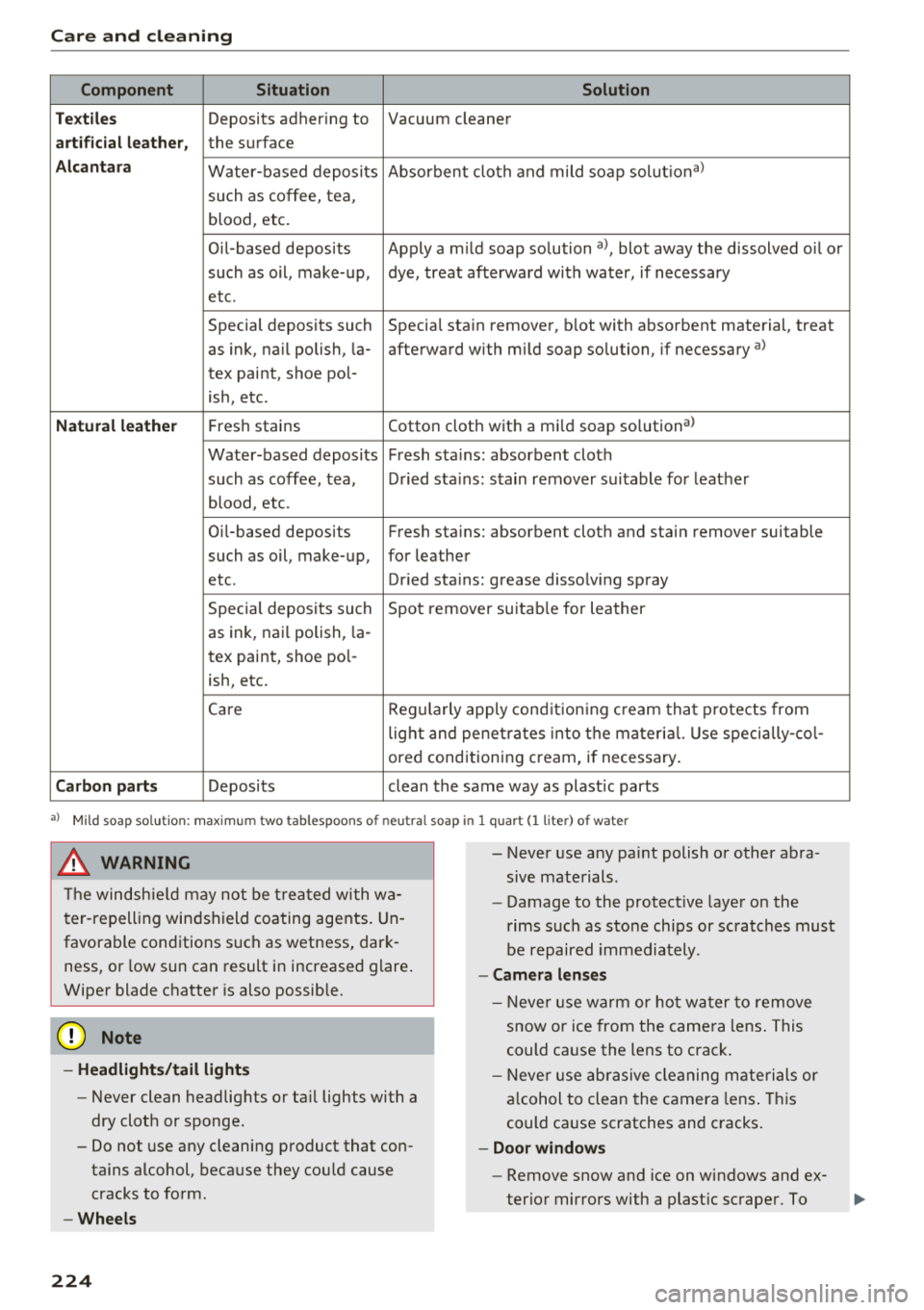
Care and cl eaning
Component Situation Solution
Tex tile s
Deposits adhering to Vacuum cleaner
art ifici al l eat her, the surface
A lca ntara Water -based deposits Absorbent cloth and mild soap solut
iona>
such as coffee, tea,
blood, etc.
O il-based deposits Apply a m ild soap solution
a), blot away the dissolved oil or
such as oil , make-up, dye, treat afterward with water, if necessary
etc.
Special deposits such Special stain remover, blot with absorbent material, treat
as ink, na il polish, la- afterward with mild soap solution, if necessary a)
tex paint, shoe pol-
ish, etc.
Natural leathe r Fresh stains Cotton cloth
with a mild soap so lutiona >
Water-based deposits Fresh stairns : absorbent cloth
such as coffee, tea, Dried sta ins : stain remover suitable for leather
blood, etc.
Oil -based deposits Fresh stairns : absorbent cloth and stain remover suitable
such as oil, make-up, for leather
etc. Dried stains : grease dissolving spray
Special deposits such Spot remover suitab le for leather
as ink, nai l polish, la -
tex paint, shoe pol-
ish, etc.
Care Regula rly apply cond it ion ing cream that p rotects from
lig ht and penetrates into the material. Use specia lly-co l-
ored conditioning cream, if necessary .
Carbon part s Deposits clean the same way as plastic parts
al Mild soap solution: maximum two tablespoons of neutral soap in 1 quart (1 liter) of water
_& WARNING
The windsh ie ld may not be treated wi th wa
ter-repelling windshield coating agents. Un
favorable conditions such as wetness, dark
ness, or low sun can result in increased glare.
Wiper blade chatter is also possible.
@ Note
-Headlight s/tail light s
-Never clean headlights or tail lights with a
dry cloth or sponge.
- Do not use any cleaning product that con
tains alcohol, because they could cause
cracks to form .
-Wheel s
224
- - Never use any paint polish or other abra
sive materials.
- Damage to the protect ive layer on the
rims such as stone chips or scratches must
be repaired immediately.
- Cam era lens es
- Neve r use wa rm or hot water to remove
snow or ice from the came ra lens . This
could cause the lens to crack .
- Neve r use ab rasive cleaning m aterials or
a lcohol to clean the camera lens . This
could cause scratches and cracks .
-Door wind ow s
- Remove snow and ice on windows and ex-
terior mirrors with a plast ic scraper. To
Page 245 of 266
a co ,...,
N
" N ,...,
0 0 \,;J '
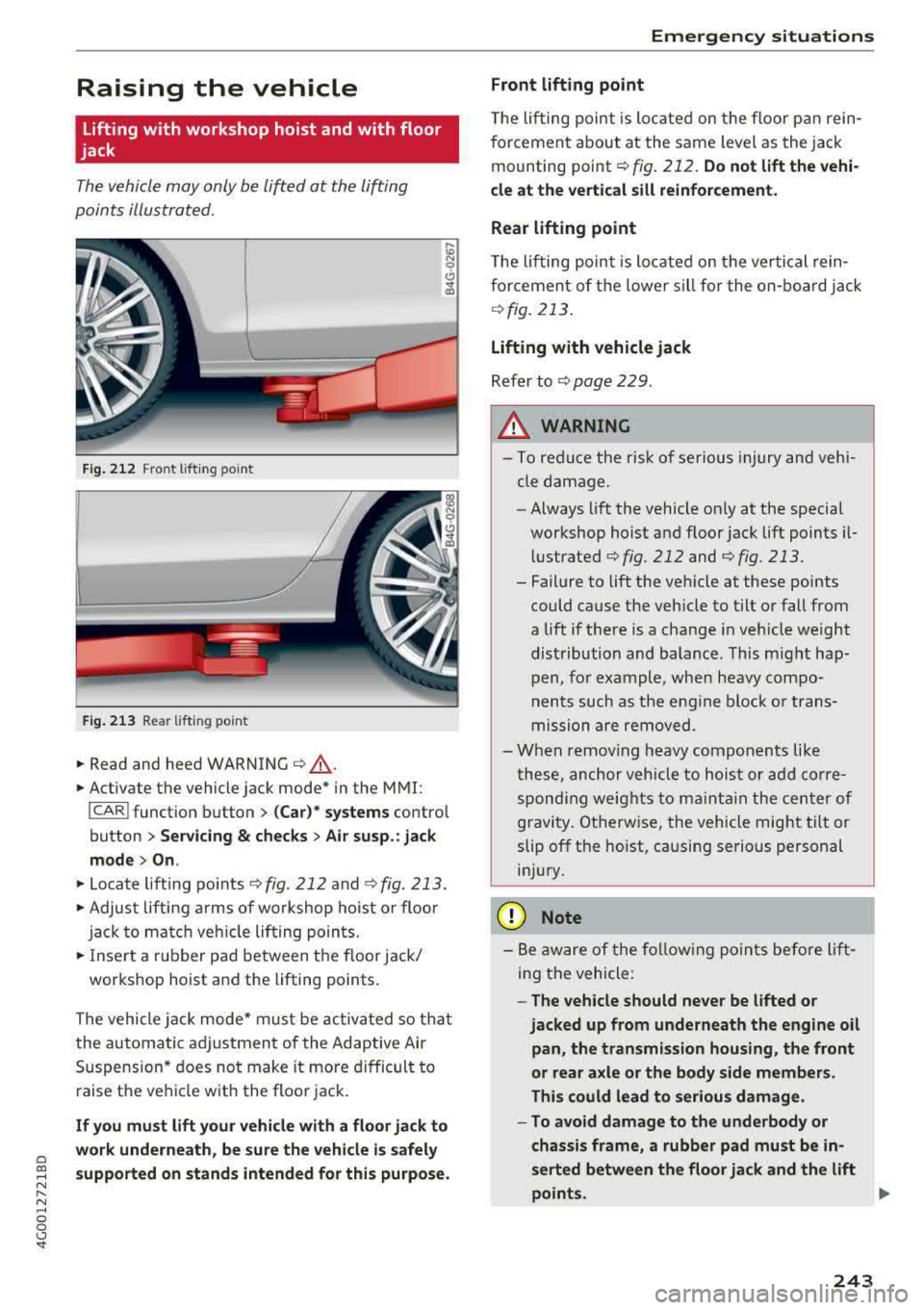
Lifting with workshop hoist and with floor
jack
The vehicle may only be lift ed at the lifting
points illus tr at ed.
Fig. 212 Fro nt lift in g poin t
Fig. 213 Re ar lift ing poin t
.,. Read and heed WARNING c::> &, .
.. Activate the veh icle ja ck mode* in the M MI:
I CAR I funct ion button> (Car) * systems contro l
bu tton >
Servicing & checks > Air susp.: jack
mode > On .
.. Loca te lift ing po ints c::> fig . 212 and c::>fig . 213 .
.. Adju st lifting arms of wo rkshop hoist o r floo r
jack t o match vehicle li fting poin ts.
.. In se rt a rubb er pa d between the floor jack/
wor kshop ho ist a nd the lifting points .
T he vehicle ja ck m ode* mus t be activa ted so that
the au tomatic a djustment of the Ad aptive Air
Suspension * does no t make it more difficult to
raise the ve hicle wit h the floor jac k.
If you must lift your vehicle with a floor jack to
work underneath, be sure the vehicle is safely
supported on stands intended for this purpose . Emergency situations
Front lifting point
T he lifting poin t is locate d on the floor p an rein
f o rcement about at the same level as the ja ck
mounting point
c::> fig . 212 . Do not lift the vehi
cle at the vertical sill reinforcement .
Rear lifting point
T he lifting p oin t i s lo cate d on the ve rtic al rei n
f o rceme nt o f th e lower s ill for the on- bo ar d jac k
c::>fig. 213.
Lifting with vehicle jack
Refer to c::> pag e 229 .
A WARNING
- To reduce the r is k of se rious inju ry and veh i
cle dama ge.
-Always lift the vehicle o nly at the specia l
wor kshop h oist a nd f loor jack lift points
il
l ustrated c::>fig. 212 and c::> fig. 213.
-Failure to lift t he ve hicle at these points
could ca use t he veh icle to tilt o r fall from
a lift i f th ere is a change in vehicle weight
dist ribution and balance . This might hap
pen, fo r example, when heavy compo
n en ts such as the eng ine block o r trans
missi on a re removed .
- Whe n re mov ing heavy comp onents like
these, an ch or veh icle t o hois t or ad d co rre
spon ding weig hts t o m aintai n the cen ter of
g ravi ty . Ot herw ise, the vehicle mig ht tilt or
slip off t he hoist, caus ing se rio us pe rsonal
i njur y .
(D Note
-Be aw are of the fo llow ing po ints b efor e lift
ing the vehicle:
-The vehicle should never be lifted or
jacked up from underneath the engine oil
pan, the transmission housing, the front
or rear axle or the body side members.
This could lead to serious damage .
-To avoid damage to the underbody or
chassis frame, a rubber pad must be in
serted between the floor jack and the lift
points .
.,.
243