belt AUDI A6 2018 Owners Manual
[x] Cancel search | Manufacturer: AUDI, Model Year: 2018, Model line: A6, Model: AUDI A6 2018Pages: 266, PDF Size: 41.38 MB
Page 5 of 266
a co .... N
" N .... 0 0 \,;J '
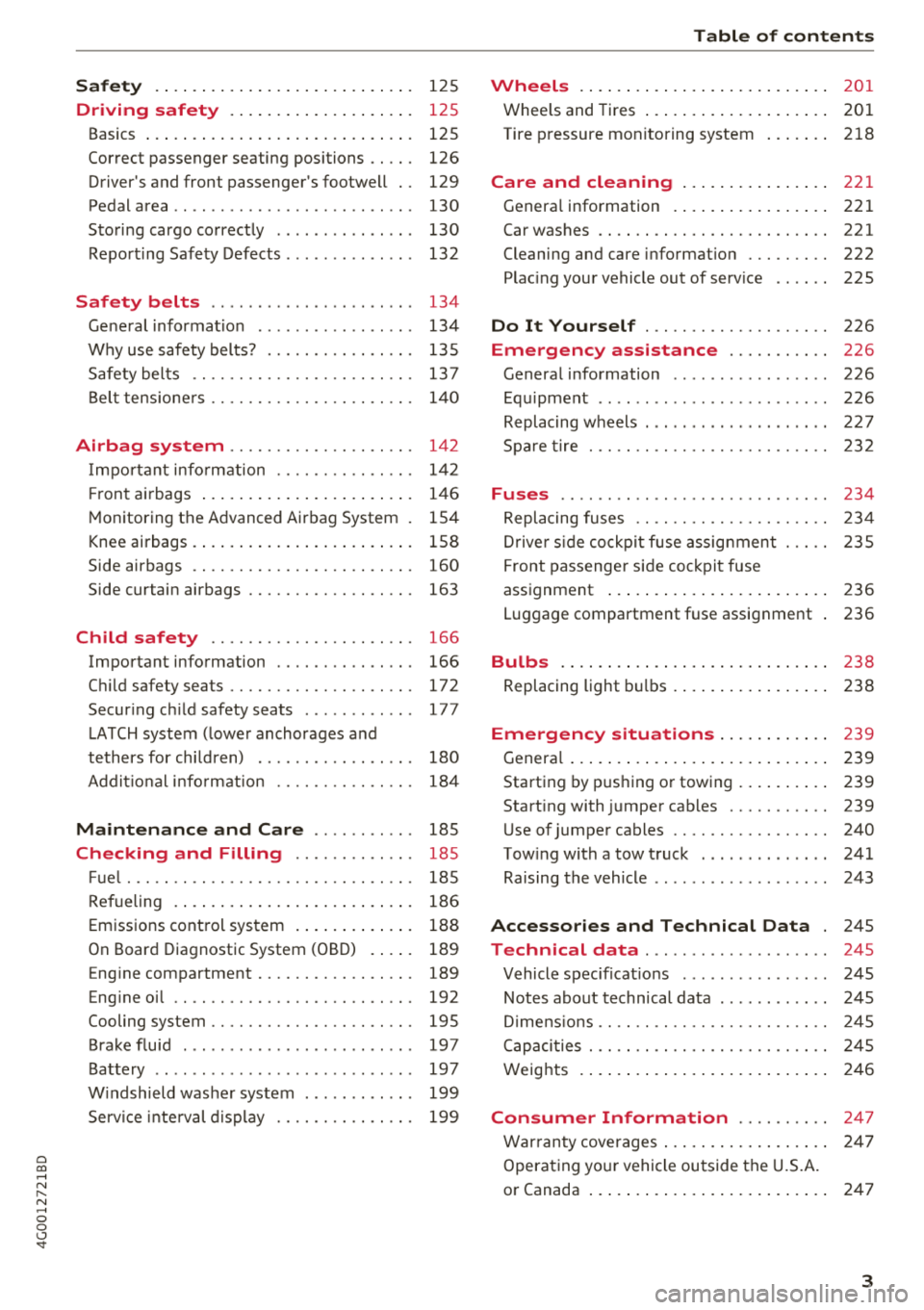
Driving safety . . . . . . . . . . . . . . . . . . . . 125
Basics . . . . . . . . . . . . . . . . . . . . . . . . . . . . . 125
Correct passenger seating positions . . . . . 126
Driver 's and front passenger's footwell . . 129
Pedal area . . . . . . . . . . . . . . . . . . . . . . . . . . 130
Storing cargo correctly . . . . . . . . . . . . . . . 130
Repo rt ing Safety Defects . . . . . . . . . . . . . . 132
Safety belts . . . . . . . . . . . . . . . . . . . . . . 134
Gene ral informat ion . . . . . . . . . . . . . . . . . 134
Why use safety belts? . . . . . . . . . . . . . . . . 135
Safety bel ts . . . . . . . . . . . . . . . . . . . . . . . . 13 7
Belt tens ione rs . . . . . . . . . . . . . . . . . . . . . . 140
Airbag system . . . . . . . . . . . . . . . . . . . . 142
I mportant info rm ation . . . . . . . . . . . . . . . 142
Fr on t ai rbags . . . . . . . . . . . . . . . . . . . . . . . 146
M onitoring the Advanced Airbag System . 154
Knee airbags. . . . . . . . . . . . . . . . . . . . . . . . 158
Side airbags . . . . . . . . . . . . . . . . . . . . . . . . 160
Side curtain airbags . . . . . . . . . . . . . . . . . . 163
Child safety . . . . . . . . . . . . . . . . . . . . . . 166
Important information . . . . . . . . . . . . . . . 166
C hi ld safety seats............. .. .. .. . 172
Secur ing ch ild safety seats . . . . . . . . . . . . 177
L ATCH system (lowe r anchorages a nd
tethers for children) . . . . . . . . . . . . . . . . . 180
Addit io n al i nfo rmat ion . . . . . . . . . . . . . . . 184
Maint enance and Care . . . . . . . . . . . 185
Checking and Filling . . . . . . . . . . . . . 185
Fu el . . . . . . . . . . . . . . . . . . . . . . . . . . . . . . . 185
Refueling . . . . . . . . . . . . . . . . . . . . . . . . . . 186
Emissions control system . . . . . . . . . . . . . 188
On Board Diagnostic System (OBD) . . . . . 189
E ng ine compartment . . . . . . . . . . . . . . . . . 189
Eng ine oil . . . . . . . . . . . . . . . . . . . . . . . . . . 192
Cooling system . . . . . . . . . . . . . . . . . . . . . . 195
Brake fluid . . . . . . . . . . . . . . . . . . . . . . . . . 197
Battery . . . . . . . . . . . . . . . . . . . . . . . . . . . . 197
W indshield was her system . . . . . . . . . . . . 199
Serv ice inte rval d isplay . . . . . . . . . . . . . . . 199
Table of content s
Wheels .. .. .... .. ... .. ..... ... .. ..
20 1
Whee ls and Tires . . . . . . . . . . . . . . . . . . . . 201
Tire pressure monitoring system . . . . . . . 218
Care and cleaning . . . . . . . . . . . . . . . . 2 21
Genera l information . . . . . . . . . . . . . . . . . 221
Car washes . . . . . . . . . . . . . . . . . . . . . . . . . 221
Cleaning and care informat ion . . . . . . . . . 222
Plac ing your vehicle out of serv ice . . . . . . 225
Do It Yourself . . . . . . . . . . . . . . . . . . . . 226
Emergency assistance . . . . . . . . . . . 226
General information . . . . . . . . . . . . . . . . . 226
Eq uipment . . . . . . . . . . . . . . . . . . . . . . . . . 226
Replacing w heels . . . . . . . . . . . . . . . . . . . . 227
Spa re t ire 232
Fuses ........ .. .. ................ . 234
Replacing fuses . . . . . . . . . . . . . . . . . . . . . 234
Dr ive r side cockpit f use assignmen t
F ront passenge r side co ckpit fuse 2
35
assignment . . . . . . . . . . . . . . . . . . . . . . . . 2 36
Luggage compartment fuse assignment 236
Bulbs .. .. .. .... .. ... .. ..... ... .. .. 23 8
Replacing light bu lbs . . . . . . . . . . . . . . . . . 238
Emergency situations . . . . . . . . . . . . 239
Genera l . . . . . . . . . . . . . . . . . . . . . . . . . . . . 239
Starting by p ush ing or towing . . . . . . . . . . 239
Start ing with jumper cab les . . . . . . . . . . . 239
Use of jumper cables . . . . . . . . . . . . . . . . . 240
Tow ing with a tow truck . . . . . . . . . . . . . . 241
Raising the vehicle . . . . . . . . . . . . . . . . . . . 243
Accessories and Technical Data . 245
Technical data . . . . . . . . . . . . . . . . . . . . 245
Vehicle spec if icat io ns . . . . . . . . . . . . . . . . 245
Notes about technical data . . . . . . . . . . . . 245
D imens ions . . . . . . . . . . . . . . . . . . . . . . . . . 245
Capaci ties . . . . . . . . . . . . . . . . . . . . . . . . . . 245
Weig hts . . . . . . . . . . . . . . . . . . . . . . . . . . . 246
Consumer Information . . . . . . . . . . 247
Warranty cove rages . . . . . . . . . . . . . . . . . . 24 7
Operating your vehicle outside the U.S.A.
or Canada . . . . . . . . . . . . . . . . . . . . . . . . . . 247
3
Page 13 of 266
a co .... N
" N .... 0 0 \.J '
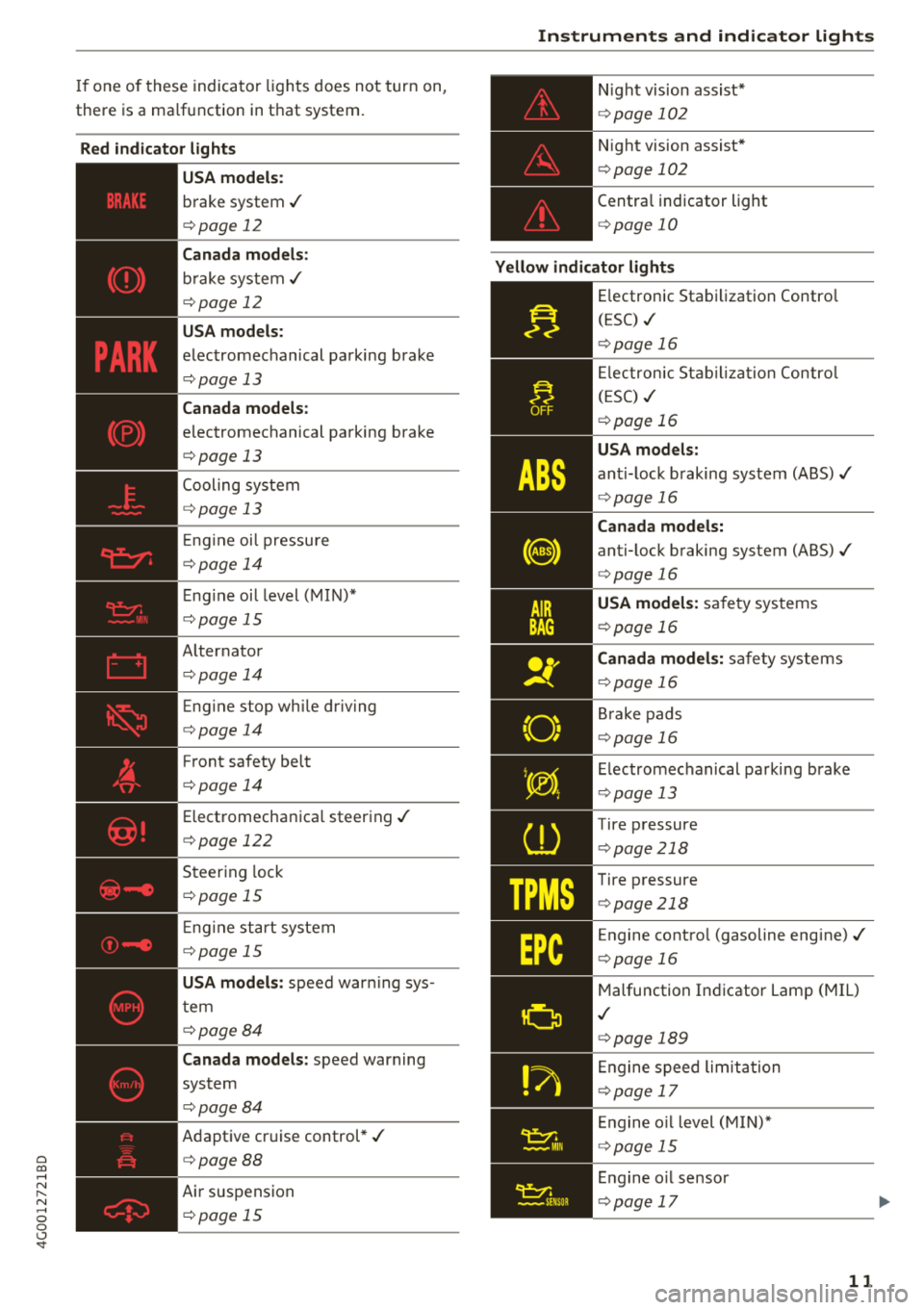
there is a ma lfu nction in t hat system.
Red indicator lights ~..::.._ __________ _
USA models:
b rake system .I
c::> page 12
Canada models:
bra ke sys te m .I
c::> page 12
USA models :
elec tromechanical parking brake
c::> page 13
Canada models:
e lectromechanical pa rking brake
c::> page 13
Cooling sys tem
c::> page 13
E ng ine oi l pressu re
c::> page 1 4
Eng ine oi l level ( MIN )*
c::> pag e 15
A lternator
Eng ine stop wh ile dr iv ing
c::> page 14
F ront safety belt
c::> page 14
Elect romecha nica l steer ing ./
c::> page 122
Steer ing lock
c::> page 1 5
En gine sta rt system
c::> page 15
USA models:
spee d war ning sys
t em
c::> page 8 4
Canada models :
speed warning
system
c::> page 84
Adapt ive cr uise control* ./
c::> page 88
Air suspension
c::> page 15
Instruments and indicator lights
N ight vision assist*
c::> page 10 2
Night vision assist *
c::>page 102
Centra l indicator light
c::> page 10
Yellow indicator lights
~--==-------------:--
E lectronic Sta bilizat ion Contro l
TPMS
(ESC) .I
Elec tron ic St abiliz ati on Contro l
( E SC)
.I
USA models:
an ti-lock b raking system (ABS) ./
Canada models:
anti-lock b raking system (ABS) ./
c::> page 16
USA models:
sa fe ty sys tems
c::> page 16
Canada models:
safe ty sy stems
c::> page 1 6
Br ake pads
c::> page 16
Electromechanical parking brake
c::> pag e 13
Tire p ressure
c::> page 218
Tire p ressure
c::> page 218
Engine co ntro l (gasoline engine) ./
c::> page 16
Malfunction Ind icator Lamp (MIL)
.I
c::> page 189
En gine s peed li mita tio n
c::> page 1 7
En gine o il level (MI N)*
c::> page 15
En gine o il sensor
c::> page 17
11
Page 16 of 266
Instruments and indicator lights
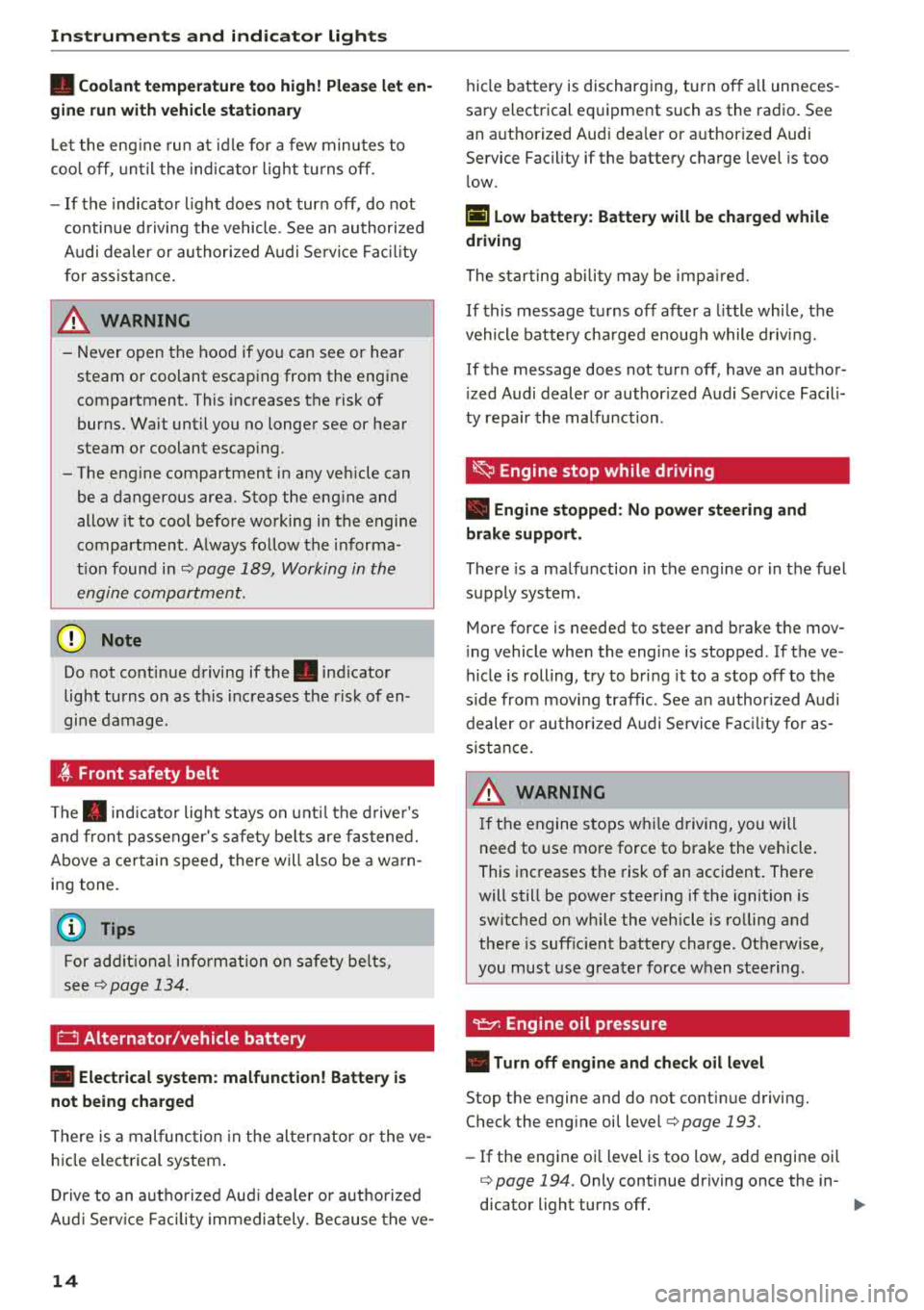
• Coolant temperature too high! Please let en
gine run with vehicle stationary
Let the engine run at idle for a few minutes to
cool off, until the indicator light turns off.
- If the indicator light does not turn off, do not
continue driving the vehicle. See an authorized
Audi dealer or authorized Audi Service Facility
for assistance.
A WARNING
- Never open the hood if you can see or hear
steam or coolant escaping from the engine
compartment. This increases the risk of
burns. Wait until you no longer see or hear
steam or coolant escaping.
- The engine compartment in any vehicle can be a dangerous area. Stop the engine and
allow it to cool before working in the engine
compartment. Always follow the informa
tion found
in¢ page 189, Working in the
engine compartment.
@ Note
Do not continue driving if the. indicator
light turns on as this increases the risk of en
gine damage.
~ Front safety belt
The. indicator light stays on until the driver's
and front passenger's safety belts are fastened.
Above a certain speed, there will also be a warn
ing tone.
(D Tips
For additional information on safety belts,
see
¢page 134.
0 Alternator/vehicle battery
• Electrical system: malfunction! Battery is
not being charged
There is a malfunction in the alternator or the ve
hicle electrical system.
Drive to an authorized Audi dealer or authorized
Audi Service Facility immediately. Because the ve-
14
hicle battery is discharging, turn off all unneces
sary electrical equipment such as the radio. See
an authorized Audi dealer or authorized Audi
Service Facility if the battery charge level is too
low.
(•) low battery: Battery will be charged while
driving
The starting ability may be impaired.
If this message turns off after a little while, the
vehicle battery charged enough while driving.
If the message does not turn off, have an author
ized Audi dealer or authorized Audi Service Facili
ty repair the malfunction .
~ Engine stop while driving
• Engine stopped: No power steering and
brake support.
There is a malfunction in the engine or in the fuel
supply system.
More force is needed to steer and brake the mov
ing vehicle when the engine is stopped . If the
ve·
hicle is rolling, try to bring it to a stop off to the
side from moving traffic. See an authorized Audi
dealer or authorized Audi Service Facility for as
sistance.
A WARNING
If the engine stops while driving, you will
need to use more force to brake the vehicle.
This increases the risk of an accident. There
will still be power steering if the ignition is
switched on while the vehicle is rolling and
there is sufficient battery charge . Otherwise,
you must use greater force when steering.
~ Engine oil pressure
• Turn off engine and check oil level
Stop the engine and do not continue driving.
Check the engine oil
level¢ page 193.
-
- If the engine oil level is too low, add engine oil
¢ page 194 . Only continue driving once the in-
dicator light turns off.
1111-
Page 18 of 266
Instruments and indicator lights
& Brake booster
U Brake servo: limited functionality. You can
continue driving. Contact workshop
There is a ma lfunction in the brake booster . The
brake booster is available, but its effectiveness is
reduced . Braking behavior may be different from
how it normally functions and the brake pedal
may vibrate.
Drive to an authorized Audi dealer or authorized
Audi Service Facility immediately to have the
malfunction corrected.
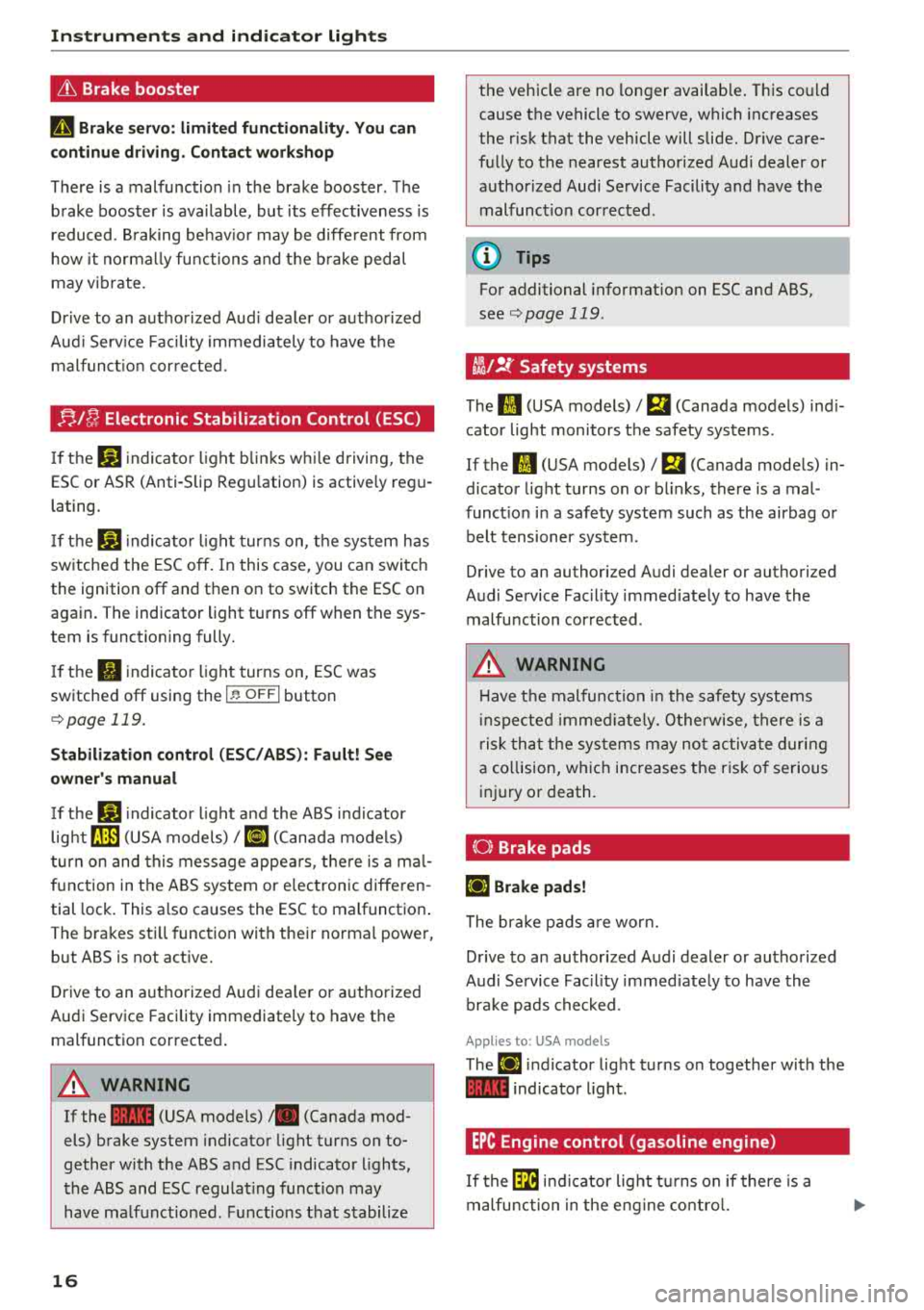
Y!., /~ Electronic Stabilization Control (ESC)
If the bJ indicator light blinks while driving, the
ESC or ASR (Anti-Slip Regulation) is actively regu
lating.
If the
bJ indicator light turns on, the system has
switched the ESC
off. In this case, you can switch
the ignition
off and then on to sw itch the ESC on
again. The indicator light turns
off wh en th e sys
tem is functioning fully.
If the
II indicator light turns on, ESC was
switched
off using the i.i, O FF I button
¢page 119.
Stabilization control (ESC/ABS): Fault! See
owner's manual
If the G) indicator light and the ABS indicator
light~ (USA models) I II] (Canada models)
turn on and this message appears, there is a mal
function in the ABS system or electronic differen
tial lock. This also causes the ESC to malfunction.
Th e brakes still function with their normal pow er,
but ABS is not active.
Drive to an authorized Audi dealer or authorized
Audi Service Facility immediately to have the
malfunction corr ect ed.
&_ WARNING
If the 1111 (USA models) /. (Canada mod
els) brake system indicator light turns on to
gether with the ABS and ESC indicator lights,
the ABS and ESC regulating function may
have malfunctioned . Functions that stabilize
16
the vehicle are no longer available. This could
cause the vehicle to swerve, which increases
the risk that the vehicle will slide. Drive care
fully to the nearest authorized Audi dealer or
authorized Audi Service Facility and have the
malfunction corrected.
{D Tips
For additional information on ESC and ABS,
see
¢ page 119 .
tlit !J: Safety systems
The II (USA models) Im (Canada models) indi
cator light monitors the safety systems .
I f the
II (USA models) Im (Canada models) in
dicator light turns on or blinks, there is a mal
function in a safety system such as the airbag or
belt tensioner system.
Drive to an authorized Audi dealer or authorized
Audi Service Facility immediately to have the
malfunction corrected .
&_ WARNING
Have the malfunction in the safety systems
inspected immediately. Otherwise, there is a
risk that the systems may not activate during
a collision, which increases the risk of serious
injury or death.
(0} Brake pads
Ill Brake pads!
The brake pads are worn.
Drive to an authorized Audi dealer or authorized
Audi Service Facility immediately to have the
brake pads checked.
Applies to: USA models
-
The Ill indicator light turns on together with the
1111 indicator light.
EPC Engine control (gasoline engine)
If the~ indicator light turns on if there is a
malfunction in the engine control.
Page 57 of 266
a co ,...,
N
" N ,...,
0 0 \,;J '
compartment
Applies to: vehicles with folding backrests
The rear seat backrests can be folded forward ei
ther separately or together.
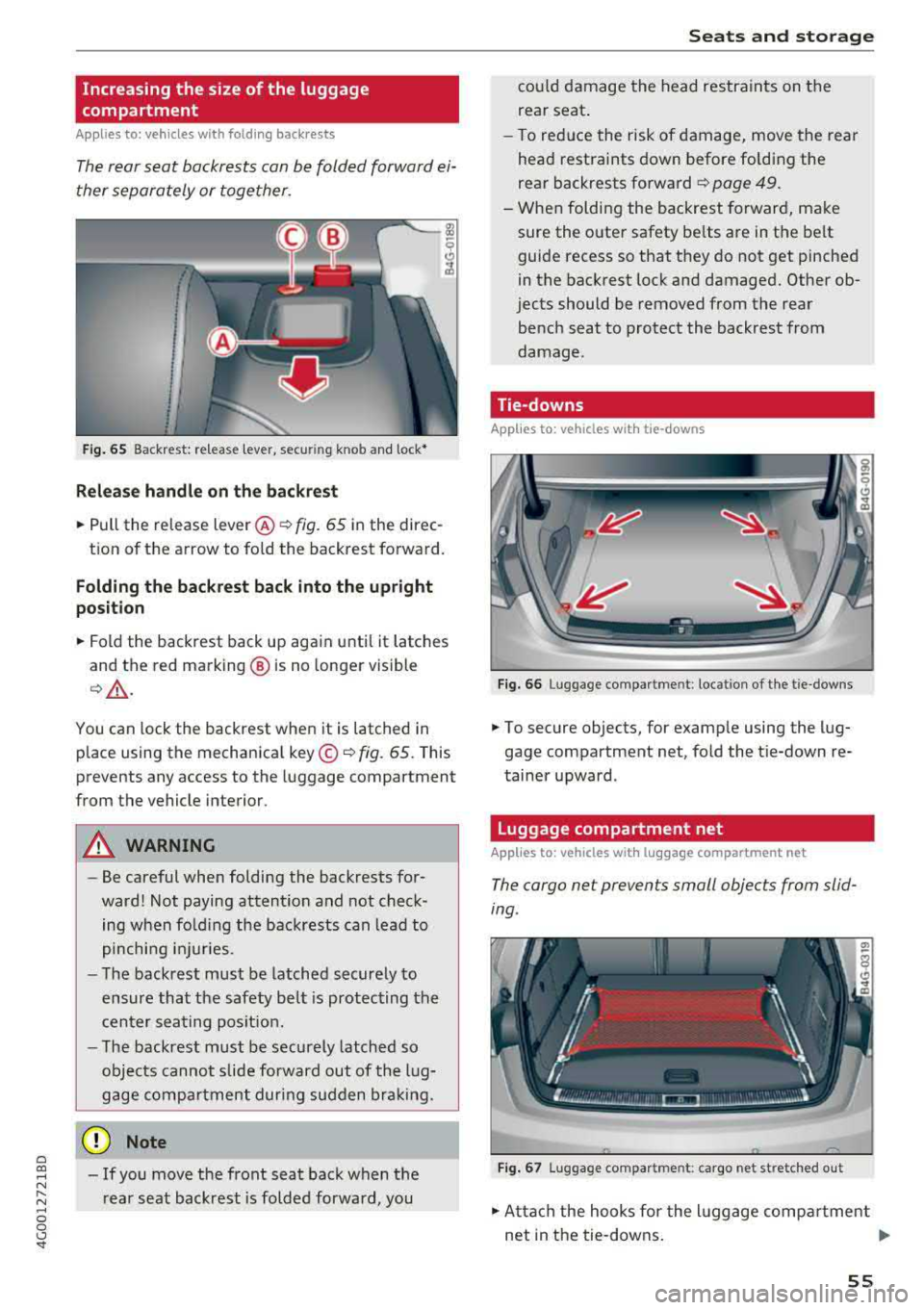
F ig . 65 Backrest: re lease lever, secur ing knob and lock•
Relea se handle on the back re st
~ Pull the release lever @¢ fig. 65 in the direc-
tion of the arrow to fo ld the backrest forward.
Folding the ba ckrest back into the upright
po sition
~ Fold the backrest back up again until it latches
and the red marking @ is no longer visible
¢& .
You can lock the backrest when it is latched in
place using the mechanical key ©¢
fig. 65 . This
prevents any access to the luggage compartment
from the vehicle interior.
A WARNING
- Be careful when folding the backrests for
ward! Not paying attention and not check ing when fo ld ing the backrests can lead to
pinching i njuries.
- The backrest must be latched securely to
ensure that the safety be lt is protecting the
cen ter seating posit ion.
- The backrest must be securely latched so
objects cannot slide forward out of the l ug
gage compartment during sudden bra king.
(D Note
- If you move the front seat back when t he
r ear seat backrest is folded forward, you
S eats and storag e
could damage the head restraints on the
rear seat .
- To red uce the risk of damage, move the rear
head restraints down before folding the
rear backrests forward¢
page 49.
- When fold ing the backrest forward, make
sure the outer safety be lts are in the belt
guide recess so that they do not get pinched
in the backrest lock and damaged. Other ob
jects should be removed from the rear
bench seat to protect the backrest from
damage.
Tie-downs
Applies to: vehicles with tie-downs
F ig. 66 Luggage compartment: location of the tie-downs
~ To secure objects, for examp le using the lug
gage compartment net, fold the t ie-down re
tainer upward.
Luggage compartment net
Applies to: vehicles with luggage compartment net
The cargo net prevents small objects from slid
ing.
F ig . 67 Luggage compartment: cargo net stretched o ut
~ Atta ch the hooks for the l uggage compa rtment
net in the tie-downs .
..,..
55
Page 58 of 266
Seats and stor age
A WARNING
For strength reasons, only objects with a max
imum weight of 10 lbs (5 kg) should be se
cured in the luggage compartment net. Heavi
er objects are not adequate ly secured . There
is risk of personal i njur y.
Storage hooks
App lies to: vehicles with bag hooks
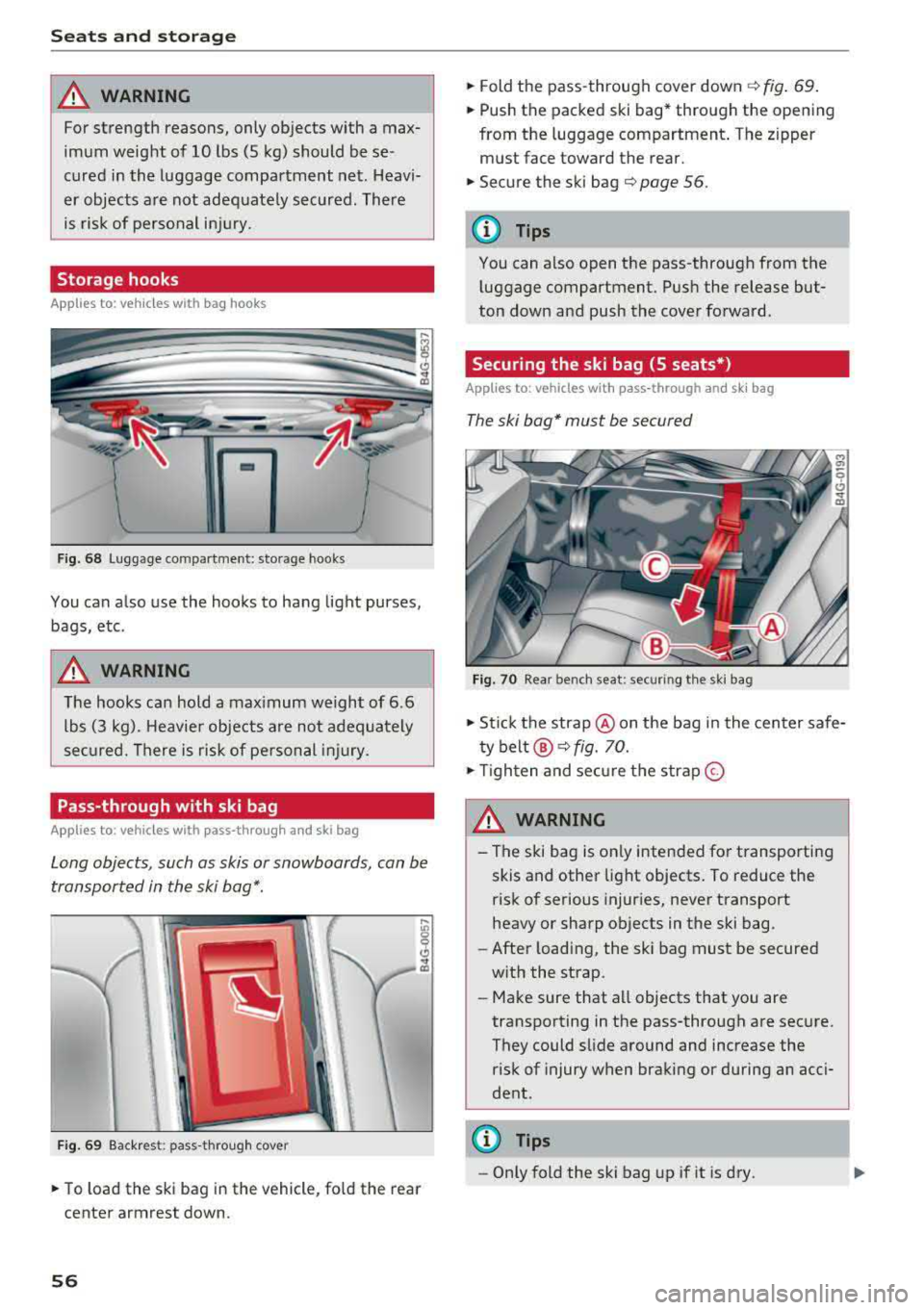
F ig. 68 Lugg age compartme nt: storage hooks
You can a lso use the hooks to hang light purses,
bags, etc .
A WARNING
The hooks can hold a max imum weight of 6 .6
lbs (3 kg). Heavier objects are not adequa tely
secured. There is risk of personal injury.
Pass-through with ski bag
Applies to: vehicles with pass -through and ski bag
Long objects, such as skis or snowboards, can be
transported in the ski
bag*.
F ig . 6 9 Backres t: pass-through cover
.,. To load the ski bag in the vehicle , fo ld the rear
center armrest down.
56
.,. Fold the pass-through cover down¢ fig. 69.
.,. Push the packed ski bag* through the opening
from the luggage compartment. The zipper
must face toward the rear.
.,. Secure the ski bag ¢ page 56.
(D Tips
You can also open the pass-through from the
l uggage compartment. Push the release but
ton down and push the cover forward.
Securing the ski bag (5 seats*)
Applies to: vehicles with pass-through and sk i bag
The ski bag* must be secured
Fig. 70 Rea r bench seat: securing t he ski bag
.,. St ic k the strap @on the bag in the center safe
t y
belt @¢ fig. 70.
.,. Tigh ten and se cure the s trap @
A WARNING
-The ski bag is on ly intended for transporting
skis and other light objects . To reduce the
risk of serious injur ies, never transport
heavy or sharp ob jects in the ski bag .
- After loading, the ski bag must be secured
w ith the strap.
-Make sure that all objects that you are
transporting in the pass-through are secure.
They could slide around and increase the
risk of injury when braking or during an acci
dent.
(D Tips
-Only fold the ski bag up if it is dry .
Page 73 of 266
a co .... N
" N .... 0 0 \.J '
tachometer also moves into the
READ Y posi
t ion
ll .
~ The eng ine starts aga in when you take your
foot off the brake pedal. The ind icator light
turns off.
Additional inf ormation
The engine stops in the P, N and D se lector lever
positions.
I f you select the R pos ition dur ing a stop phase,
the engine will start again .
Shift to P q uickl y to p revent t he engine from
starti ng u ninten tiona lly w hen s hift ing t hrough R .
You can determ ine for yourself if the eng ine will
stop or not by reducing or increas ing the amount
of force you use to press the bra ke pedal. For ex
ample, if you only lig htly press on t he b rake ped
a l in stop-and -go traff ic or w hen tu rning, the en
gine will not switch
off when the vehicle is sta
tionary . As soon as yo u press the brake down
harder, the eng ine will switch off.
(D Tips
-Press the b rake pedal during a Stop p hase
to keep the ve hicle from rolling.
-The ignition wi ll tu rn off if you press the
I START E NGINE STOP ! button during a stop
phase . The need le in the tachomete r moves
i nto the
OFF position.
General information
App lies to: ve hicles with Start/Stop system
The standard Start/Stop mode can be canceled
for various system-related reasons.
Engine does not switch off
B efore and d urin g e ach stop phase , the system
checks if certa in con ditions have been me t. If the
@j indicator light appears in the instrument cl us
ter disp lay, the engine will not be stopped, for
examp le in the fo llow ing s ituations:
ll Ma rket -specific
Driving
-The engine has not reached the minim um re
quired temperature for Sta rt/Stop mode.
-The interior temperature selec ted by the cli -
mate control system has not been reached .
-The outside tempe ra ture is ex tremely high/low.
-The winds hield is bei ng defros ted® .
-The parking system * is sw itched on .
-The vehicle battery charge level is too low .
-The steering wheel is tu rned at a sharp angle o r
is moving.
-After engaging the reverse gear.
-On sharp inclines .
Engine automatically restarts
The standard Start/S top mode w ill be can celed
dur ing a stop phase in the followi ng si tuatio ns.
T he eng ine restarts wi thout any action by the
driver .
-The vehi cle ro lls, fo r example whi le on a slope .
-The inte rior tempe rature d iffers from t he tem-
pe ra ture selected in the A/C system.
-The winds hield is bei ng defrosted® .
-The brake peda l is pressed severa l times in a
row .
-The vehicle battery charge level is too low.
-Power consumption is high.
T he eng ine can turn off aga in when the cond i
tions for Start/Stop mode are met.
Ignition is switched off automatically
T o p reve nt the vehicle battery from dra ining, the
i gni tion will switc h off
automaticall y under the
f o llow ing co nditions:
-The vehicle has already been dr iven .
-The Start/Stop system has stopped the engine .
-The driver's door is opened .
-The driver's safety belt is unbuckled.
-The brake peda l is not pressed .
-The vehicle is stat ion ary.
In this case, the activated low beam is replaced
by the pa rk ing light. The par kin g lights wi ll
swi tch off afte r approx imately 30 m inutes o r
whe n you lock t he ve hicle.
71
Page 75 of 266
a co .... N
" N .... 0 0 \,;J '
Requirement: the driver's door must be closed,
the driver's safety belt must be latched and the
parking brake must be set.
.,. To start driving and release the parking brake
automatically, press the accelerator pedal as
usual.
In addition to releasing the parking brake auto
matically, other convenience and safety functions
are available when you start driving
¢page 74,
Starting to drive.
Preventing the automatic parking brake
release
The vehicle could begin rolling unintentionally,
depending on the hill or if towing a trailer.
.,. To prevent the parking brake from releasing au
tomatically, pull and hold
the(®) switch and
press the accelerator pedal. The parking brake
remains set and prevents the vehicle from roll
ing backward.
.,. You can release the C®l switch again once you
are sure that you are giving enough driving
force to the wheels by pressing the accelerator pedal.
Emergency braking function
You can use the emergency braking function in an
emergency situation, or if the standard brake op
eration malfunctions or is disabled.
.,. Pull and hold the®) switch.
.,. As soon as you release the (®) switch or acceler-
ate, the braking stops.
Pulling and holding the
C®) switch while driving
the vehicle activates the emergency braking func
tion. The vehicle is braked at all four wheels by
activating the hydraulic brake system. The brak ing effect is similar to heavy
braking¢&_ .
To reduce the risk of activating the emergency
braking by mistake, a warning tone (buzzer)
sounds when
the®> switch is pulled. Emergency
braking stops as soon as
the®) switch is released
or the accelerator pedal is pressed.
Parking
.,. Press the brake pedal to stop the vehicle.
Driving
.,. Pull the®> switch to set the parking brake .
.,. Place the selector lever in the P position.
.,. Turn the engine off¢&_ .
.,. Turn the steering wheel when parking on in
clines so that the wheels will roll into the curb
if the vehicle starts moving.
A WARNING
-
- Do not press the accelerator pedal inadver
tently if a gear is selected when the vehicle
is stationary and the engine is running. Oth
erwise, the vehicle will start to move imme
diately and this could result in an accident.
- Emergency braking should only be used in
an emergency, when the normal brake pedal
has failed or the brake pedal is obstructed.
During emergency braking, your vehicle will
brake similar to heavy braking. ESC and the
associated components (ABS, ASR, EDL)
cannot overcome the laws of physics . In cor
ners and when road or weather conditions
are bad, a full brake application can cause
the vehicle to skid or the rear end to swerve,
which
increases the risk of an accident.
- If the power supply fails , you cannot set the
parking brake if it is released . In this case,
park the vehicle on level ground and secure
it by placing the selector lever in the P posi
tion. See an authorized Audi dealer or au
thorized Audi Service Facility for assistance.
- If you leave the vehicle, switch the ignition
off and take the vehicle key with you. This
applies particularly when children remain in
the vehicle. Otherwise children could start
the engine, release the parking brake or op
erate electrical equipment such as power
windows, which increases the risk of an acci
dent.
- No one should remain in the vehicle when it
is locked - especially children . Locked doors
make it more difficult for emergency work
ers to get into the vehicle, which puts lives
at risk.
(D Tips
When stopping at a traffic signal or stopping
in city traffic, you can set the parking brake
manually . The vehicle does not have to be
73
Page 96 of 266

Ass is tanc e system s
because the driver has not fastened their safety
be lt .
D oo r open
The adaptive cruise control system cannot sw itch
on when a door is open .
Sta tion ary obj ect ahead
This message appears if you would like to switch
adaptiv e cruis e control on and there is a station
ary object or obstacle directly ahead of your vehi
cle.
Audi pre sense
Preventative passenger protection
Applies to: vehicles with Audi pre sense
P re sense can initiate steps to p rotect vehicle oc
cupants in certain dangerous situations. The
functions described are available depending on
vehicle equipment :
Pre sense basic *
The fo llow ing f unc tions can be t rigge red in ce r
tain driving s it u ations:
- T ens ion ing of the safety belts (for example,
dur ing heavy b raking): the front safety belts
have reve rsible belt tensioners. If a coll is io n
does not occur, the safe ty belts loosen slightly
and are ready to trigger again.
- Clos ing the w indows and the sun roof* (for ex
amp le, when ove r-or unde rsteer ing) : the w in
dows and the sunroof * close until there is only
a small gap open .
The function of the pre sense basi c is act ivated at
a speed o f 20 mph (30 km/h) o r higher.
Dr ive se lect : th e deployment time is adapted in
Dynam ic mode.
Pre sense front (vehicles with adapti ve cru ise
control *}
Pre sense front contains t he f unct ions of p re
sense basic. In add it ion, the like lih ood of a rear
e n d coll is io n with the veh icle ahead is also calcu
lated, withi n the limits of the system .
If the risk
of a collision is detected, t he following functions
can trigger :
94
-Braking guard r::!> poge 91
-Tensioning of the safety bel ts
- Clos ing the windows and the sunroof*
Pre sense rear (vehicles with side a ssi st * }
Pre sense rear contains the funct ions of pre sense
basic . In addition, the likelihood of a rear-end
collision from the vehicle behind is also calculat
ed, within the limits of the system . If the r isk of a
collision is detected, the following functions can
t rigge r:
- Tensioning of the safety belts
- Closing the windows and the sunroof*
Pre sen se plu s*
Pre sense plus contains t he functions of pre
sense front and pre sense rear.
Error messag e
Audi pre sen se : Unavailable
Preventative passenger protect ion is not ava ila
ble . Drive to an autho rized Aud i deale r or author
i zed Audi Se rvice Facility immed iate ly to have the
malfunction cor rected .
_&. WARNING
Pre sense cannot overcome natural phys ic al
laws .
It is a system designed to assist and it
cannot prevent a co llision. Do not let the in
creased safety p rovided tempt you into tak ing
risks. This could increase your risk of a colli-
sion.
- The system can dep loy incorrectly .
- Please note that the sensors do not always
detect all objects . Th is increases the r isk of
a co llision.
- Pre sense does not react to peop le or ani
mals or objects that are crossing the vehi
cle 's path o r are difficu lt to detect
r::!>poge86.
- Reflective objects such as guard ra ils or the
entrance to a tunne l, heavy rain and ice can
affect the funct ion of the radar sensors and
-
the system's ability to detect a collision risk . ~
Page 126 of 266

Intelligent Technology
Notice about data
recorded by the Event
Data Recorder and
vehicle control modules
Event Data Recorder
This vehicle is equipped with an Event Data Re
corder (EDR). The main purpose of an EDR is to
record, in certain crash or near crash-like situa
tions, such as an airbag deployment or hitting a road obstacle, data that will assist in understand
ing how a vehicle's systems performed. The EDR
is designed to record data related to vehicle dy
namics and safety systems for a short period of
time, typically 30 seconds or less . The EDR in this
veh icle is designed to record such data as :
-How various systems in your vehicle were oper
at ing;
-Whether or not the driver and passenger safety
belts were buckled/fastened;
-How far (if at all) the driver was depressing the
accelerator and/or brake pedal; and,
-How fast the vehicle was traveling.
These data can help provide a better understand ing of the circumstances in which crashes and in
juries occur. NOTE : EDR data are recorded by your
vehicle only if a non-trivial crash situation occurs;
no data are recorded by the EDR under normal
driving conditions and no personal data (e .g .,
name, gender, age, and crash location) are re
corded. However, other pa rties , such as law en
forcement, could combine the EDR data wit h the
type of persona lly identifying data routine ly ac
quired during a crash investigation.
To read data recorded by an EDR, specia l equip
ment is required, and access to the veh icle or the
EDR is needed. In add it ion to the vehicle manu
facturer, other parties, such as law enforcement,
that have the specia l equipment, can read the in
formation if they have access to the vehicle or the
E DR .
Some state laws restrict the retrieval or down
loading of data stored by ED Rs installed in a vehi
cle for the express purpose of retrieving data af
ter an accident or crash event without the own
er's consent.
124
Audi will not access the EDR and/or simi lar data
or give it to others
-
-un less t he ve hicle owne r (or lessee if the vehi
cle has been leased) agrees; or
-upon the offic ial request by the police; or
-upon the order of a court of law or a govern-
ment agency; or
-for the defense of a lawsuit through the jud icial
discovery process .
-Audi may also use the data for research about
veh icle operat ion and safety performance or
prov ide t he data to a third party for research
purposes without identify ing t he specific vehi
cle or information about the identity of its own
er or lessee and only after the recorded vehicle
data has been accessed.
Vehicle control modules
Your vehicle is also equ ipped with a numbe r of
electronic cont rol modules for various vehicle
systems, such as engine management, em iss ion
contro l, airbags, and safety be lts.
These elect ronic control modules record data
during normal vehicle operation t hat may be
needed by trained technic ia ns for diagnostic and
repair purposes. The recording capability of these
modules is limited to data (no sound is record
ed). Only a sma ll amount of data is actually re
corded over a very limited period of time, or stor
ed when a system fault is detected by a control
module . Some of the data stored may relate to
vehicle speed, d irection, or braking, as well as re
straint system use and performance in the event
of a crash. Stored data can also only be read a nd
down loaded w ith specia l equipment that is di
rectly connected to the vehicle.
(D Tips
Your vehicle may be equipped w ith Aud i con
nect. Your use of certain Audi connect fea
tures requires wire less services that are pro
vided by a third party wireless telecommuni
cations provider. For details regarding how in
formation obtained through Audi connect is
collected, processed, transmitted, used, and
shared, please see your contract with the
wireless telecommun ications provider .