child lock AUDI A6 2020 User Guide
[x] Cancel search | Manufacturer: AUDI, Model Year: 2020, Model line: A6, Model: AUDI A6 2020Pages: 316, PDF Size: 86.41 MB
Page 67 of 316

4K0012721BD
Sitting correctly and safely
Adjusting the head restraints
Applies to: vehicles with manually adjustable head restraints
> To adjust the head restraint upward, slide it un-
til it locks into place.
> To adjust the head restraint downward, press
the button @) and slide the head restraint. Re-
lease the button and slide the head restraint
farther until it locks into place.
Removing the headrests
Applies to: vehicles with removable head restraints
> Applies to: vehicles with folding backrests: Fold
the backrest forward slightly. See > page 83.
> Move the head restraint upward all the way.
> Insert a suitable object, such as the the extend-
ed vehicle key or mechanical key, into the re-
lease point @ on the inside or outside of the
base.
> Press the button ) and pull the head restraint
out of the backrest > A\ in General informa-
tion on page 64.
Installing the headrests
Applies to: vehicles with removable head restraints
> Fold the backrest forward slightly > page 83.
> Slide the posts on the head restraint down into
the guides until the posts click into place.
> Press the button (2) and slide the head restraint
all the way down. It should not be possible to
remove the head restraint from the backrest
without pressing the button.
Safety belts
Each seat is equipped with a three-point safety
belt. Safety belts that are worn correctly are the
most effective way to reduce the risk of serious or
fatal injuries in a collision. Therefore, wear your
safety belt correctly and make sure that all vehi-
cle passengers are also wearing their safety belts
correctly when the vehicle is moving.
Even though your vehicle is equipped with an air-
bag system, every vehicle passenger must still al-
ways wear the appropriate safety belt. In addi-
tion to their normal protective function, safety
belts also hold vehicle occupants in the correct
seating position in the event of a collision so that
the airbags can deploy correctly and provide addi-
tional protection. Safety belts provide protection
during collisions when the airbags do not deploy
or if they have already deployed.
A WARNING
The risk of serious or fatal injury increases if
the safety belt is not fastened, if it is worn in-
correctly, or if it is damaged.
— All vehicle occupants, including the driver,
must fasten their safety belts correctly be-
fore every trip and must always keep their
safety belts fastened during the trip, regard-
less of whether the seat is equipped with an
airbag or not. This also applies to children
that are seated in a child safety seat that is
appropriate for their weight and age and
that is secured with a safety belt.
— In the event of a collision, vehicle occupants
that are not wearing safety belts could be
propelled through the vehicle interior and
collide with vehicle components, such as the
steering wheel, instrument panel, wind-
shield, or doors. In some situations, vehicle
occupants could also be ejected from the ve-
hicle. Vehicle occupants in the rear seats
who do not wear safety belts not only en-
danger themselves, but also other people in
the vehicle.
— Only one person may be fastened with a
safety belt at a time. Never secure more
than one person, including children, with a
single safety belt.
— Never allow children or infants to ride on an-
other person's lap and be belted into the
safety belt with them.
— Insert the belt buckle only in the belt latch
belonging to the corresponding seat, so that
the protective function is not impaired.
—To ensure the maximum protective function
of the safety belts, all vehicle passengers
must sit in the correct seating position
=> page 60.
— Check the condition of your vehicle’s safety
belts regularly > page 267. If you find dam-
age to the belt webbing, the belt connec-
tions, the retractor, or the buckle, have the
damaged safety belt replaced by an
65
Page 70 of 316

Sitting correctly and safely
> To check if the safety belt relay is securely
locked in place, pull firmly on the belt.
@ Tips
You can also adjust the height of the front
seats to change the position of the safety
belts.
PXe ert eam imately
Belt retractor lock
The safety belts on the rear seats and on the
front passenger seat are equipped with a belt re-
tractor lock.
> If you secure a child safety seat with a safety
belt, the belt retractor lock on the safety belt
may need to be activated. Follow the instruc-
tions from the child safety seat manufacturer.
» When a vehicle passenger has fastened a safety
belt, the belt retractor lock should not be acti-
vated. If the belt retractor lock has been acti-
vated unexpectedly, deactivate it.
Deactivating or activating the belt retractor lock
=> page 76.
Safety belt retractor
The safety belts are equipped with an automatic
belt retractor. This automatic retractor allows the
safety belt to be pulled all the way out when the
belt is pulled slowly. However, the automatic re-
tractor locks during sudden braking maneuvers.
It also locks the belts when accelerating, driving
uphill, and driving around curves.
Belt force limiter
Safety belts with belt force limiters reduce the
force placed on the body by the safety belts dur-
ing a collision.
Safety belt pretensioners
Safety belts may be tightened with reversible
belt tensioners when you start driving and in cer-
tain driving situations. If the safety belt is too
loose, it will be tightened so that the belt will
rest closer to the body.
In some collisions, pyrotechnic belt tensioners
may secure the safety belts so that they cannot
68
loosen. This reduces forward movement by the
vehicle passengers.
ZA\ WARNING
The pyrotechnic system can only provide pro-
tection during one collision. If the pyrotechnic
belt tensioners deploy, the pretensioning sys-
tem must be replaced by an authorized Audi
dealer or authorized Audi Service Facility.
G) Tips
Smoke may be released when pyrotechnic belt
tensioners deploy. This is not a sign of a vehi-
cle fire.
Memory function
General information
Applies to: vehicles with memory function
With the memory function, you can save and call
up seat profiles using the memory buttons in the
door trim panel.
Depending on the equipment, it may be possible
to store the following settings:
— Driver's seat: seat, steering wheel*, exterior
mirrors
— Front passenger's seat: seat
Storing and recalling a seat profile
Applies to: vehicles with memory function
The memory function buttons are located in the
door trim panel.
Storing a seat profile
> Press the [SET] button. If the LED in the button
turns on, a seat profile can be stored.
> Push one of the numbered memory buttons. A
tone confirms that the settings were stored.
Accessing a seat profile
> While the driver’s or front passenger's door is
open and the ignition is switched off, press the
memory button once briefly. The seat will be
fully adjusted to the settings in the seat profile.
> If the driver's/front passenger's door is closed
or the ignition is switched on, press and hold >
Page 76 of 316

Sitting correctly and safely
Transport Canada Information Centre
http://www.tc.gc.ca/roadsafety
Audi Customer Experience Center
https://www.audiusa.com/help/contact-us
https://www.audi.ca/ca/web/en/models/layer/
contact.html
ZA WARNING
To reduce the risk of serious or fatal injuries,
children must always be secured in the vehicle
with a child safety seat that is appropriate for
their body size, weight, and age.
— Children ages 12 and under must be trans-
ported using the appropriate child safety
seat. Note differences in regulations be-
tween states and countries.
— Child safety seats secured incorrectly in the
vehicle may cause serious or fatal injuries in
the event of an accident. Always secure the
child safety seat according to the manufac-
turer instructions.
— Children or babies must not under any cir-
cumstances be held on the lap of the driver
or other passengers while driving.
— Do not secure more than one child in a child
safety seat.
— Never allow a child to sit in a child safety
seat unsupervised.
— Never allow children to ride unsecured in the
vehicle or to stand or kneel on the seats
while driving. In the event of an accident, a
child could be propelled through the vehicle.
This can cause serious or fatal injuries for
the child and passengers.
— If children use an incorrect seating position
while driving, they have a higher risk of in-
jury during a sudden braking maneuver or
accident. This especially applies to children
in the front passenger's seat or children who
have their head near the side airbag deploy-
ment area, if the airbag system is deployed
during an accident. This incorrect seating
position can cause severe or even fatal inju-
ries.
— Make sure there is enough space in front of
the child in the child safety seat. If necessa-
ry, adjust the angle and position of the seat
in front of the child safety seat.
— The rear side of a forward-facing child safety
seat should be positioned as close as possi-
ble to the backrest on the vehicle seat. If the
head restraints make it difficult to install a
child safety seat, adjust or remove them if
necessary > page 64. Reinstall the head re-
straints immediately once the child safety
seat has been removed.
— Always make sure that the backrest on the
seat where the child safety seat is installed
is securely locked in place and cannot move
forward. Otherwise, the backrest where the
child safety seat is secured could move for-
ward in the event of an accident or other
emergency situation.
— NEVER use a rear-facing child safety seat on
a seat with an ACTIVATED FRONT AIRBAG;
this could cause DEATH or SERIOUS INJU-
RIES to a CHILD.
— Always secure child safety seats on the
rear seats. If exceptional circumstances re-
quire the child safety seat to be placed on
the front passenger's seat, then the front
passenger's airbag must be deactivated.
Always make sure that
PASSENGER AIR BAG OFF %; remains
on while driving. If
PASSENGER AIR BAG OFF %; does not
turn on, remove the child safety seat and
install it again according to the child safe-
ty seat manufacturer instructions. If
PASSENGER AIR BAG OFF 2; still
does not turn on, the front passenger's
seat must not be used. Drive to an author-
ized Audi dealer or authorized Audi Service
Facility and have the airbag system in-
spected.
— If you must use a forward-facing child safety
seat on the front passenger's seat, move the
seat as far back as possible so that it is as
far as possible from the front passenger's
airbag. While doing this, make sure the seat
can be adjusted all the way. A child in a child
safety seat on the front passenger's seat can
74
Page 78 of 316
Sitting correctly and safely
Secu OR CRT aa Te eR amg
LATCH anchors
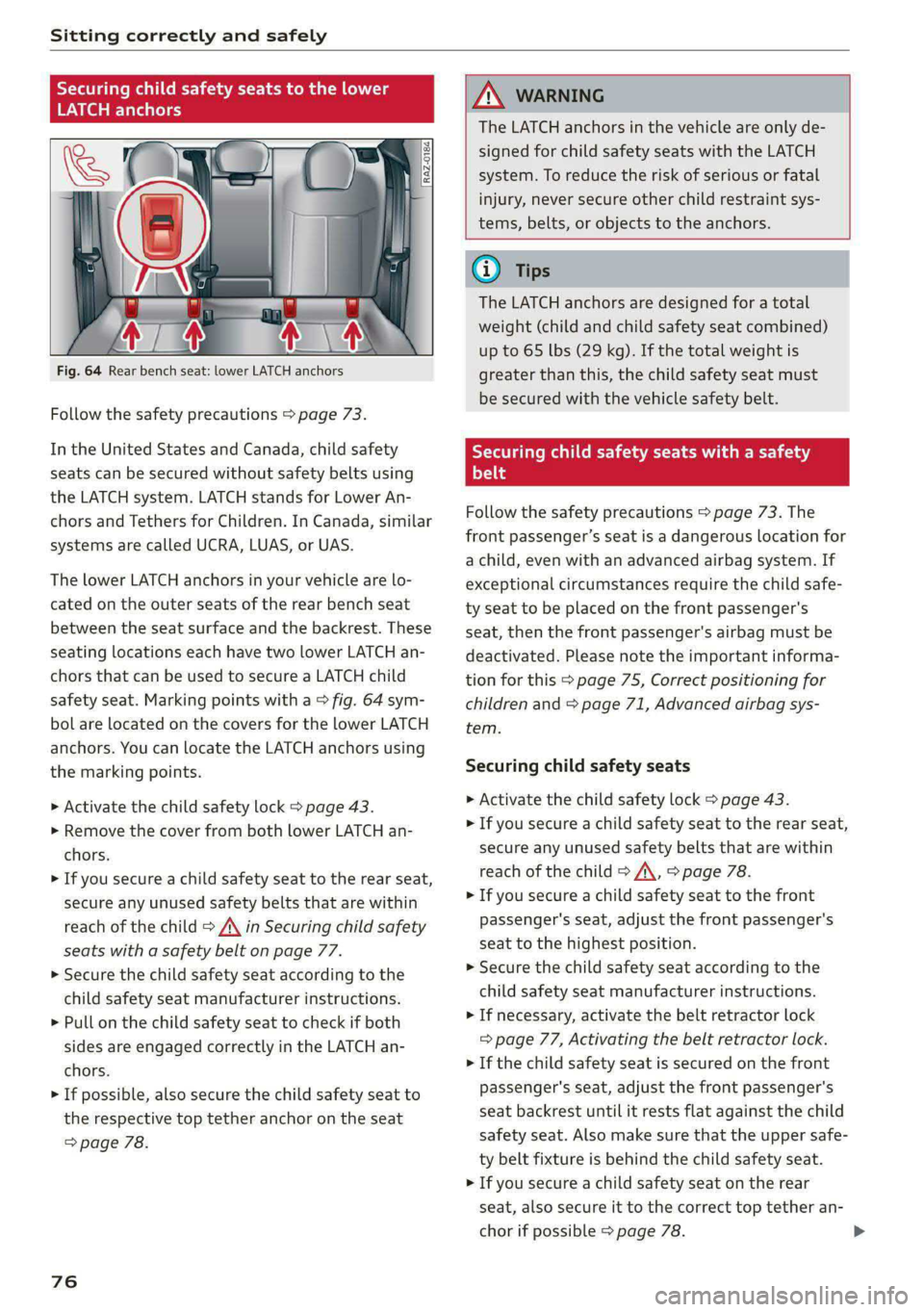
Fig. 64 Rear bench seat: lower LATCH anchors
Follow the safety precautions > page 73.
In the United States and Canada, child safety
seats can be secured without safety belts using
the LATCH system. LATCH stands for Lower An-
chors and Tethers for Children. In Canada, similar
systems are called UCRA, LUAS, or UAS.
The lower LATCH anchors in your vehicle are lo-
cated on the outer seats of the rear bench seat
between the seat surface and the backrest. These
seating locations each have two lower LATCH an-
chors that can be used to secure a LATCH child
safety seat. Marking points with a > fig. 64 sym-
bol are located on the covers for the lower LATCH
anchors. You can locate the LATCH anchors using
the marking points.
> Activate the child safety lock > page 43.
> Remove the cover from both lower LATCH an-
chors.
> If you secure a child safety seat to the rear seat,
secure any unused safety belts that are within
reach of the child > A\ in Securing child safety
seats with a safety belt on page 77.
> Secure the child safety seat according to the
child safety seat manufacturer instructions.
> Pull on the child safety seat to check if both
sides are engaged correctly in the LATCH an-
chors.
> If possible, also secure the child safety seat to
the respective top tether anchor on the seat
=> page 78.
76
ZA WARNING
The LATCH anchors in the vehicle are only de-
signed for child safety seats with the LATCH
system. To reduce the risk of serious or fatal
injury, never secure other child restraint sys-
tems, belts, or objects to the anchors.
@® Tips
The LATCH anchors are designed for a total
weight (child and child safety seat combined)
up to 65 lbs (29 kg). If the total weight is
greater than this, the child safety seat must
be secured with the vehicle safety belt.
Secu OMe aa RT La
Prat
Follow the safety precautions > page 73. The
front passenger’s seat is a dangerous location for
a child, even with an advanced airbag system. If
exceptional circumstances require the child safe-
ty seat to be placed on the front passenger's
seat, then the front passenger's airbag must be
deactivated. Please note the important informa-
tion for this > page 75, Correct positioning for
children and > page 71, Advanced airbag sys-
tem.
Securing child safety seats
> Activate the child safety lock > page 43.
> If you secure a child safety seat to the rear seat,
secure any unused safety belts that are within
reach of the child > /\, > page 78.
> If you secure a child safety seat to the front
passenger's seat, adjust the front passenger's
seat to the highest position.
> Secure the child safety seat according to the
child safety seat manufacturer instructions.
> If necessary, activate the belt retractor lock
=> page 77, Activating the belt retractor lock.
> If the child safety seat is secured on the front
passenger's seat, adjust the front passenger's
seat backrest until it rests flat against the child
safety seat. Also make sure that the upper safe-
ty belt fixture is behind the child safety seat.
> If you secure a child safety seat on the rear
seat, also secure it to the correct top tether an-
chor if possible > page 78.
Page 79 of 316
4K0012721BD
Sitting correctly and safely
Activating the belt retractor lock
If you secure a child safety seat using the vehicle
safety belt, you must activate the belt retractor
lock. Follow the child safety seat manufacturer
instructions.
The belt retractor lock prevents the safety belt
from becoming loose while driving, which could
result in the child safety seat no longer being ad-
equately secured.
> Secure the child safety seat according to the
child safety seat manufacturer instructions.
While doing so, pull out the safety belt. Insert
the safety belt into the belt latch that belongs
to that seat until it audibly locks.
> Pull the upper belt out completely and then al-
low it to retract. You will hear a clicking sound
while the belt is retracting. It will not be possi-
ble to pull the safety belt out any farther.
» Push the child safety seat into the seat and al-
low the belt to retract more.
> Make sure that the child safety seat cannot
move more than 1 inch (2.5 cm).
Deactivating the belt retractor lock
> Unbuckle the safety belt from the belt latch.
> Remove the child safety seat according to the
manufacturer instructions.
> Allow the safety belt to retract completely. The
belt retractor lock is deactivated.
safety seat manufacturer for routing the
safety belt correctly. Incorrectly fastened
safety belts can cause injuries, even during
minor accidents.
ZA\ WARNING
— A safety belt that is not locked by the belt
retractor lock or a Locking device cannot se-
cure a child safety seat while driving or in
the event of an accident, which increases the
risk of fatal injury. Always make sure the
belt retractor lock on the safety belt is acti-
vated if the child safety seat manufacturer
instructions require it.
— Due to the risk of fatal injury, never place a
rear-facing child safety seat on the front
passenger's seat when the front passenger's
airbag is switched on.
— For the child safety seat to offer the maxi-
mum protection, it is especially important
to route the vehicle safety belt correctly. Al-
ways follow the instructions from the child
77
Page 81 of 316
4K0012721BD
Sitting correctly and safely
> If you secure a child safety seat to the LATCH
anchors, fasten the safety belt on the seat
where the child safety seat is installed using
the seat's safety belt latch.
> If you secure a child safety seat to one of the
outer seats, fasten the safety belt for the cen-
ter seat in its latch.
> Activate the belt retractor lock on the fastened
safety belts. To do this, pull the upper belt out
completely and then allow it to retract. You will
hear a clicking sound while the belt is retract-
ing. It will not be possible to pull the safety
belt out any farther.
> Make sure the fastened safety belt does not
block access to the LATCH anchors. Otherwise,
it may not be possible to secure the child safety
seat to the LATCH anchors correctly.
Z\ WARNING
A child in a child safety seat could play with
the unused safety belts and then become en-
tangled in them, which increases the risk of
fatal injury. Always secure unused safety belts
so that they are not within reach of children in
child safety seats.
79
Page 84 of 316
Stowing and using
> Use non-elastic cords attached to the tie-downs
to secure objects.
ZA WARNING
— Applies to: vehicles with luggage compart-
ment cover: The luggage compartment cov-
er is not a surface for storing objects. Ob-
jects placed on the cover increase the risk of
injury to all vehicle occupants during sudden
driving or braking maneuvers or in the event
of an accident.
— Loose objects can be thrown around the ve-
hicle interior during sudden driving or brak-
ing maneuvers, which increases the risk of
an accident. Always stow objects securely in
the luggage compartment and secure them
at the tie-downs. Use straps suitable for
heavy objects.
— If pieces of luggage or objects are secured
to the tie-downs with unsuitable or dam-
aged straps, this can increase the risk of in-
jury during braking maneuvers or accidents.
— When transporting heavy objects, the vehi-
cle characteristics will change due to the
shift in the center of gravity, which increases
the risk of an accident. You may need to
adapt your driving style and speed to the
current conditions.
— The cargo net is only strong enough to se-
cure light objects. Heavy objects are not ade-
quately secured. Attempting to secure heavy
objects increases the risk of injury.
— Never exceed the permitted axle and load
and vehicle weight > page 299.
— Never secure a child safety seat to the tie-
downs.
— Never leave your vehicle unattended, espe-
cially if the luggage compartment lid is
open. Children could enter the luggage com-
partment and close the luggage compart-
ment lid from the inside. This creates the
risk of fatal injury, since the children would
be locked in and may not be able to escape
by themselves.
— Do not allow children to play in or on the ve-
hicle. Close and lock the luggage compart-
ment lid as well as all other doors when you
leave the vehicle.
— Never transport passengers in the luggage
compartment. Every passenger must be cor-
rectly secured with the safety belts in the
vehicle > page 65.
— Be careful when releasing the backrest and
folding
it forward. To reduce the risk of be-
ing pinched, pay attention and check when
folding backrests forward.
— The backrest must be securely latched so
objects cannot slide forward out of the lug-
gage compartment during sudden braking.
— The backrest must be latched securely to en-
sure that the safety belt is protecting the
center seating position.
— Always pull forward on the backrest to make
sure it is check if it is correctly locked in
place.
82
@) Note
—To reduce the risk of damage, move the rear
head restraints down > page 64 before fold-
ing the rear backrests forward.
— When folding the backrest forward, make
sure the outer safety belts are in the belt
guide recess so that they do not get pinched
in the backrest lock and damaged. Other ob-
jects should be removed from the rear
bench seat to protect the backrest from
damage.
— If you move the front seat back when the
rear seat backrest is folded forward, you
could damage the head restraints on the
rear seat.
— Make sure that the heating grid strips for
the rear window defogger are not damaged
by abrasive objects.
— Let the luggage compartment cover roll up
slowly to reduce the risk of damage.
— Let the partition net roll up slowly to pre-
vent damage.
@ Tips
— The tire pressure must be adapted to the
load > page 255.
— You can purchase straps at specialty stores.
Page 92 of 316

Warm and cold
Applies to: vehicles with 4-zone automatic cli-
mate control: In the rear control panel, you can
press J multiple times to adjust the air distribu-
tion based on the direction of the arrow.
® Defrosting
The windshield and side windows are defrosted
or cleared of condensation as quickly as possible.
Align the outer air vents with the side windows.
The maximum amount of air flows mainly from
the vents below the windshield. The windshield
defogger* is also switched on at low outside tem-
peratures. The {% button will flash. Recirculation
mode switches off. The temperature should be
set at +72°F (22°C) or higher. Depending on the
outside temperature, the A/C cooling mode may
automatically switch on.
& Rear window defogger
The rear window defogger only operates when
the engine is running. It switches off automati-
cally after 10 to 20 minutes, depending on the
outside temperature.
To prevent the rear window defogger from
switching off automatically, press and hold the
& button for more than three seconds. This is
stored until the ignition is switched off.
AUTO
<>/&S Recirculation mode
In recirculation mode, the air inside the vehicle is
circulated and filtered. This prevents the unfil-
tered air outside the vehicle from entering the
vehicle interior > A\.
Pressing the <> button switches recirculation
mode on or off manually.
AUTOX
When switched on, automatic recirculation
controls the recirculation mode automatically.
You must press the ¥ button if fog forms on the
windows.
«) Seat heating
Applies to: vehicles with heated seats
The seat heating temperature can be set at mul-
tiple levels. Press «/ once to switch on the highest
level. Press w) again to decrease the temperature
one level at a time. The seat heating is switched
off if the button is not illuminated.
90
®) Seat ventilation
Applies to: vehicles with seat ventilation
The seat ventilation intensity can be set to multi-
ple levels. Press 2) once to switch on the highest
level. Press 2) again to decrease the intensity one
level at a time. The seat ventilation is switched
off if the button is not illuminated.
& Child safety lock*
If 8 turns on in the control panel in the rear*, the
child safety lock is active and operation is blocked
=> page 43.
Ionizer
Applies to: vehicles with ionizer
Hazardous particles and germs in the air may be
reduced through ionization. This helps to im-
prove the air quality for individuals in the passen-
ger compartment.
&" Fragrance
Applies to: vehicles with fragrance function
The fragrance function will dispense a scent in
the vehicle interior. It is dispensed through the
front outer vents. This will produce a pleasant
scent. The fragrance is time-delayed, especially
at low or high temperatures. You can adjust the
fragrance function > page 91.
Residual heat
The residual heat from the coolant is used to
heat the vehicle interior. To use this function,
press and hold the button for more than two
seconds while the ignition is switched off. The
function switches off automatically after about
15 minutes.
Z\ WARNING
— You should not use the recirculation mode
for an extended period of time, because no
fresh air is drawn in and the windows can
fog when cooling mode is switched off. This
increases the risk of an accident.
— Individuals with reduced sensitivity to pain
or temperature could develop burns when
using the seat heating* function. To reduce
the risk of injury, these individuals should
not use seat heating*.
Page 303 of 316
4K0012721BD
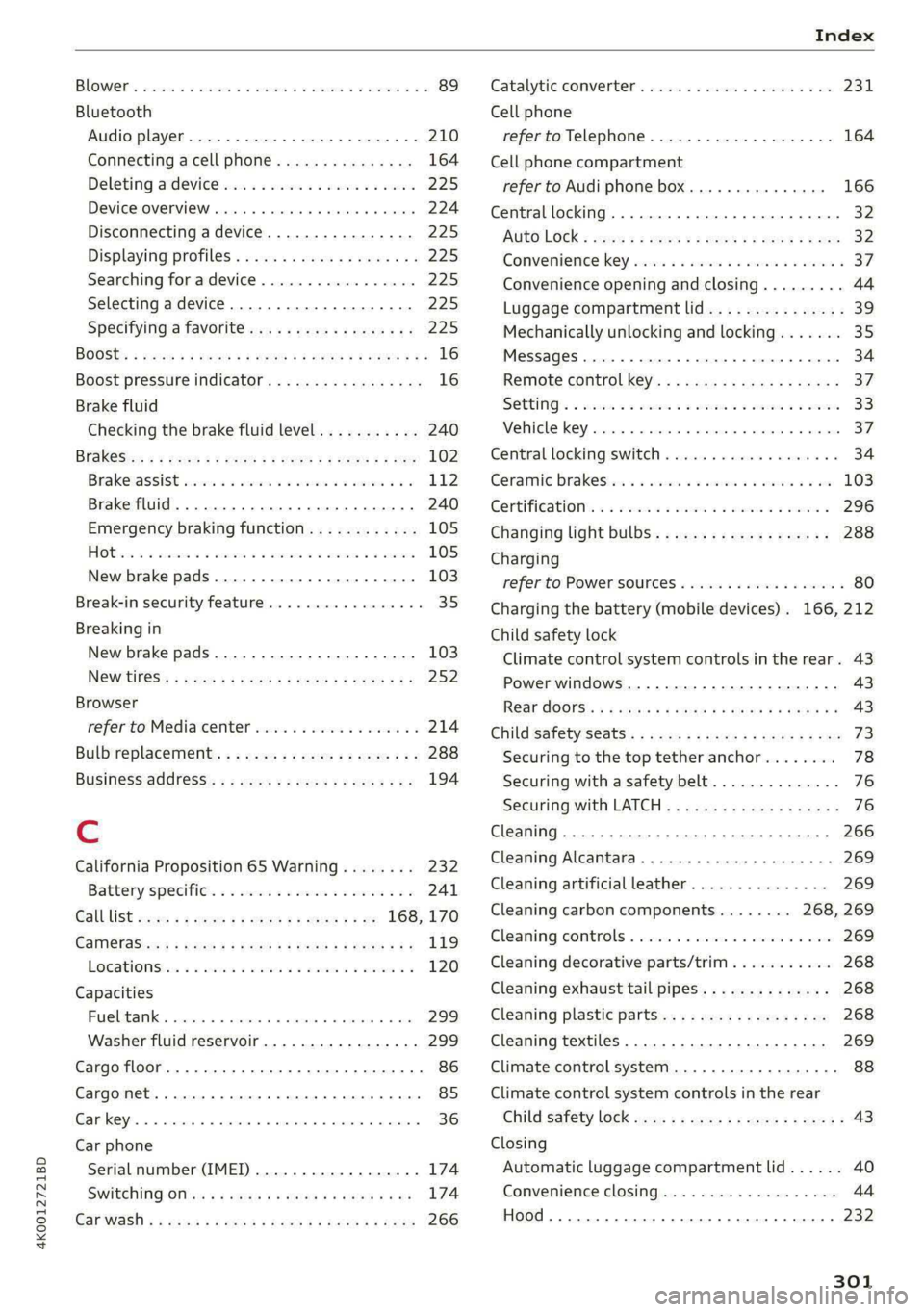
BlOWe rs scicies wo cures oo ceevte a x sousnne ow cumaee oo 3 89
Bluetooth
Audio player...........-.0 00.20 e ee eee 210
Connecting acell phone............... 164
Deleting adevice................0000- 225
Deviceoverview wi... enn eenie ee eee 224
Disconnecting a device................ 225
Displayitig( Profiles « sass 2 2 ews s x eenos ¢ os 225
Searching foradevice...............-. 225
Selecting adevice.............0.-000. 225
Specifying a favorite..............000. 225
BOOStiy + sewn 3 = wom 2 2 woe & E lomme + d ewe ge 16
Boost pressure indicator................. 16
Brake fluid
Checking the brake fluid level........... 240
BrakeSicx « sawy « 5 see: & 2 Semis = fates 6 2 ee 102
Braketassist wes so saws os ence vv ome as L112
Brake fluid... 2... 66... eee eee eee eee 240
Emergency braking function............ 105
HOtiin oe asco a x masa a & asses aw aamunes 4 & amerens 105
New brake pads..............2-000004 103
Break-in security feature..............0.- 35
Breaking in
New brake pads.........- 0.0 eee eee 103
N@WtIRGS:: « ean ss nee oo RomH ob eR a ge 252
Browser
refer to Media center.................. 214
Bulb replacement............--0000-00- 288
Business address........... 0000 cee eene 194
Cc
California Proposition 65 Warning........ 232
Battery ’specific:. = 2 cssvs se sewn eo wewe 2 os 241
GalLLUSt cess. = » season 2 & cease © 3 ewe © oe 168, 170
CamenaSiccg + een a + eeu ok RONe ao eR og 119
LOCATIONS an 6s sees ¥ sraaem se meee 39 amu 6 y 120
Capacities
Fuclitambe, scansise + + axnsons 0 « snnuece 0 ctemem 0 0 on 299
Washer fluid reservoir................. 299
Cargo floor......... ee eee eee ee 86
Cargo net... .. cece eee eee 85
Car key... cece eee eee 36
Car phone
Serial number (IMEI) .................. 174
SWItCHING OM sis & & suies x @ ees ¥ 2 eis + ¥ os 174
Carwash y « wesc «2 eee & eae 2 3 Heme eK Rene 266
Catalytic converter’. seca es ence oo mevee ov oe 231
Cell phone
refer to Telephone...............2000. 164
Cell phone compartment
refer to Audi phone box............... 166
Central locking.................0- esse ee 32
AUTO! LOCK: sees: 2 = yee 5 s een 5 ¢ owes + BES 32
Convenience key sussex saws x amma oo mere « 37
Convenience opening and closing......... 44
Luggage compartment lid............... 39
Mechanically unlocking and locking....... 35
Messages ......... 00... eee eee eee 34
Remote control key........-eseeceeveee 37
SOTUING's ecco o wou 3 x asm 2 soemres oo cme 33
WERICLS Key, sseseiss « or ssemeie » excitons i = meats wo stoutens 37
Central locking switch................50. 34
Geramic brakes «0 sescaes + + ensues + 2 emcee a 6 om 103
Certifications 2 swoon 2a cass «eames wo neon 296
Changing light bulbs................... 288
Charging
refer to Power sourceS...... 0.0.00 ee eee 80
Charging the battery (mobile devices). 166, 212
Child safety lock
Climate control system controls in the rear. 43
Power windows...........00000 eee eens 43
Rear dOOrsi: « ¢ sews 9 a aman a 2 mame a a mewe & 43
Child safety seats ..... 0.0... cee cece eee ee 73
Securing to the top tether anchor........ 78
Securing with a safety belt.............. 76
Securing with LATCH..............20065 76
Cleaning ...... 0... cee eee eee eee eee 266
Cleaning Alcantara...............00000) 269
Cleaning artificial leather............0.. 269
Cleaning carbon components........ 268, 269
Cleaning controls . csces cs sews ae eee ve ess 269
Cleaning decorative parts/trim........... 268
Cleaning exhaust tail pipes.............. 268
Cleaning plastic parts.................. 268
Cleaning textiles................0.000. 269
Climate control system..............0005 88
Climate control system controls in the rear
Child safety lO¢K eenex ¢ 2 seus : » ewes ce ees 43
Closing
Automatic luggage compartment lid...... 40
Convenience closing................0-5 44
Hood. ..... ee ee eee eee 232
301
Page 304 of 316

Index
Luggage compartment lid............... 39
Luggage compartment lid with foot motion . 41
Panoramic glass roof.............000005 45
Sunshade (roof): « = sss + «swiss + 2 enews ao wre 45
Windows........ 0. cece eee cece eee 43
Closing aid (power closing doors).......... 32
Cockpit MMM? «5 awsess so somes a 6 sumane a vee 53)
Cockpit (overview). « iss a ewes oe eee os eee 6
Collapsible spare'tir@se:. sisson occu ev were 278
Collapsible tire
refer to Collapsible spare tire........... 278
Colored ise: 5 + ssi so ese 6 vee 6H ee ee 298
Combustion engine « oss ss sees se caws see 100
Coming home/Leaving home
refer to Entry/exit lighting.............. 51
COMpact’Sparetires, & wc ao www xv owen & oe 278
Compartment as « o sss x & sass @ & saws 2 2 Bas 81
Compass:in' the Mirror: « cww sx ces se nore o 58
GOrmiplianice’s x s ems: 5 2 wemau sx seen 2 e PERG 296
Configuration wizard.................04. 20
connect ........ 0... cee eee eee eee 177
Data plaris’s s neon ss weoen = o aceem = x eanee & 3 182
Data Privatyices ws excise ss eines 3 v cmseae so csmue 291
Emergency call............0--.00 ee ee 183
Infotainment x: « : eens se ees ae ewe gees 177
Infotainment services...........000005 178
Online roadside assistance............. 184
Vehicle control services................ 179
Connected devices
Device overvieW... 5. . ccc ce eee e eens 224
Connections
refer'to Mediaie:. «2 eciace ss ences vs one 209, 213
Consumer information................0- 293
Consumption
Reducing.......... 0. eee eee eee eee 100
Consumption (Fuel) |. cscs wx sears wo ower ov oe 16
Contacts
Add destination...............000000. 194
Importing and exporting.............. 175
Memory capacity... 6 ccs. s sees se rows 175
Opening (business card)............... 169
Updating inthe MMI.................. 175
Convenience key..........0 2.0.00 eee eee 32
Convenience closing.........:seeeeeees 44
also refer to Vehicle key..............-. 36
302
Convenience opening and closing
Windows or panoramic glass roof........ 44
Coolant temperature display.............. 14
Cooling mode..... 2.6... cee ee eee eee 89
Cooling system
Adding coolant.............00- eee ee 239
Checking the coolant level............. 239
GOOLANE « scscoss = & saacs «wwe + 0 eaters ¥ wan 238
GOPM|NPING igh sce: os meses ow sxcmne v cna a 2 wees 49
Cross
traffic assist (intersection assistant) .. 153
Cruise control system..........-..20005 130
Cup holders......... 0... 2c cece eee eee 80
Current consumption...............0.005 16
D
Data plans
Data Privacy
Dake os ccerevs © scenes © eyaetses © sieitean wo sinters © = eee
Setting
Daytime running lights.............0000. 49
Declaration of compliance............... 296
DEF (instrument cluster) « « sec s «scene so see 12
Demo mode
refer to Presentation mode............. 198
Destination onthe map.............-.+- 190
Details, x x sssasws > x cass » x axcowms + 0 eesenms 4 1 oxen 189
Determining correct load limit........... 259
Digital COMPASS « vex » 2 ween 2 wewws ¥ weeH & sg 58
Dimensions: « 2 ces + = eee & x satis & o ews 298
Dimming the exterior mirrors............. 54
Dimming the rearview mirror............. 54
Directory
S@UttiNgS sane: ¢ x nome + 7 ees & 2 Rem 5 8 Ee 175
also refer to ContactS..............00. 169
Display
Cleaning......... 0... e ee eee eee 268
Disposal..... 0.0... . cee ee eee ee eee ee 293
DIStaNGe esisccs cs cswvie we aoecwne vw serene ww cee os 16
Distance warning « vse se wen s wae a 3 earn 143
Doors
Child safety lock « sencue «ss snimse = serene © sunaeie 0 43
Door contact switch. ...............005. 52
Mechanically unlocking and locking....... 35
Power closing/closing aid............... 32
Driver information system................ 13