height AUDI A7 2012 User Guide
[x] Cancel search | Manufacturer: AUDI, Model Year: 2012, Model line: A7, Model: AUDI A7 2012Pages: 294, PDF Size: 73.33 MB
Page 174 of 294

172 Child Safety
-Never place or use any electrical device
(such as a laptop, CD player, electronic
games device or power inverter) on the
front passenger seat if the device is con nected to the 12-volt socket or the ciga
rette lighter socket.
- If a seat heater has been retrofitted or
otherwise added to the front passenger
seat, never install any child restraint sys
tem on this seat.
- Make sure that there are no wet objects
(such as a wet towel) and no water or
other liquids on the front passenger seat
cushion.
- Never place objects on the seat (such as
a laptop, CD player, electronic games de
vice or power inverter). These may influ
ence the electrical capacitance measured
by the capacitive passenger detection
system and can also fly around in an acci
dent and cause serious personal injury.
- Make sure that the
PASSENGER AIR BAG
OFF
light comes on and stays on all the
time whenever the ignition is switched
on.
- If the
PASSENGER AIR BAG OFF light
does not come on and stay on, immedi
ately install the forward-facing child seat
at a seating position on the rear seat and
have the airbag system inspected by your
authorized Audi dealer.
- Take the child restraint off the front pas
senger seat and install it properly at one
of the rear seat positions if the
PASSEN
GER AIR BAG OFF
light does not stay on
whenever the ignition is switched on.
8_ WARNING
A child in a child restraint installed with
the LATCH lower universal anchorages or
with the standard safety belt on the rear
seat may play with unused rear seat safety
belts and become entangled resulting in
serious personal injury and even death.
- Always secure unused rear seat safety
belts out of reach of children in child
seats such as by properly routing them
-
around the head restraint for the seating
position where the child restraint is in
stalled.
- Never activate the switchable locking re
tractor when routing the safety belts around the head restraints.
-A child restrained in the child safety seat on the rear bench can be fatally injured
when playing with unused lockable safe
ty belts.
Booster seats and safety belts
Properly used booster seats can help protect
children weighing between about 40 lbs. and
80 lbs . (18 kg and 36 kg) who are less than 4
ft. 9 in . (57 inches/1.45 meters) tall.
Fig. 154 Rea r seat : child p roperly rest rained in a boos
te r se at
The vehicle 's safety belts alone will not fit
most children until they are at least 4
ft . 9 in .
(57 inches/1.45 meters) tall and weigh about
80 lbs . (36 kg) . Booster seats raise these chil
dren up so that the safety belt will pass prop
erly over the stronger parts of their bodies
and the safety belt can help protect them in a
crash.
• Do not use the convertible locking retractor
when using the vehicle's safety belt to re
strain a child on a booster seat.
.. Always position the shoulder portion of the
safety belt midway over the child's shoulder .
If you must transport an older child in a
booster seat on the front passenger seat,
you can use the safety belt height adjust
ment to help adjust the shoulder portion
properly .
Page 234 of 294
232 Tire s and wheel s
-Never mount used tires on yo ur vehicle if
you are not sure of their "previous histo
ry." Old used tires may have been dam
aged even though the damage cannot be
seen that can lead to sudden tire failure
and loss of vehicle control.
Glossary of tire and loading terminology
Accessory weight
means the comb ined we ight (in excess of
those standard items which may be rep laced)
of automa tic tra nsmission, power steer ing,
power br akes, power windows, power seats,
radio, and heater, to the extent that these
items are availab le as factory -installed equip
ment (whether installed or not) .
Aspect ratio
means the ratio of the height to the w idt h of
the tire in percent. Numbers of 55 or lower in
dicate a low sidewall fo r improved steer ing re
sponse and better overall handling on dry
pavement.
Bead
means t he pa rt of the tire that is made of
steel wires, wrapped o r reinforced by ply cords
and that is shaped to fit the r im.
Bead s eparation
means a b reakdown of the bond between
components in the bead.
Cord
means the strands forming the plies in the
tire.
Cold tire inflatio n pre ssure
means the tire pressure recommended by the
ve hicle manufacturer for a tire of a designated
size that has not been dr iven for more than a
couple of miles (kilometers) at low speeds in
the three hour period before the tire pressure i s measu red or adjusted. -
If you notice unusual vibration or if the
veh icle pulls to one side when driv ing, a l
ways stop as soon as it is safe to do so and check the wheels and tires for dam
age.
Curb weight
means the weight of a motor ve hicle w ith
standard equipment including t he maximum
capa city of fuel, o il, and coola nt, a ir cond i
tion ing and additional weig ht o f option al
equipment .
Extra load tire
means a tire design to operate at h igher loads
and at h igher inflation pressures than the cor
respondi ng standa rd tire. Extra load tires may
be identified as "X L", "xl", "EXTRA LOA D", o r
"R F" on the sidewall .
Gross Axle Weight Rating ( "GAWR ")
means the load-carrying capacity of a s ingle
axle system, measured at the tire-ground in
te rfaces .
Gross Vehicle Weight Rating ( "GVWR ")
means the maximum total loaded we ight of
t h e ve hicle.
Groove
means the space between two adjacent tread
ribs .
Load rat ing (code )
means the maximum load that a tire is rated
to carry for a given inflation press ure. Yo u
may not find this information on all tires be
ca use it is not required by law.
Maximum load rating
me ans the lo ad r ating for a tire a t the m axi
mum pe rm issib le inflation pressure for that
t ir e.
Page 244 of 294

242 Tires and wheels
& WARNING
Sudden tire failure can lead to loss of con
trol, a crash and serious personal injury!
- Never drive a vehicle when the tread on
any tire is worn down to the wear indica
tors.
- Worn tires are a safety hazard, they do
not grip well on wet roads and increase
your risk of "hydroplaning" and loss of control.
- Always keep chemicals that can cause tire damage, such as grease, oil, gasoline
and brake fluid away from tires.
- Tires age even if they are not be ing used
and can fail suddenly, especially at high
speeds. Tires that are more than 6 years
old can only be used in an emergency
and then with special care and at lower
speeds.
- Never mount used tires on your vehicle if
you are not sure of their "previous histo
ry." Old used tires may have been dam
aged even though the damage cannot be
seen that can lead to sudden tire failure
and loss of vehicle control.
New tires and replacing tires and wheels
New tires and wheels have to be broken in .
Fig. 180 Tir e specificat ion codes on the s idewall of a
t ire
No. Description
(!) Passenger car tire (where applicable)
@ Nominal width of t ire in millimeters
@ Ratio of height to width (aspect ratio)
© Rad ial
® Rim diameter code
@ L oad index and speed rating
(J) U.S. DOT tire identification number
@ Audi Original tire
@ Sever snow conditions
@ T ire ply composition and materials
used
Maximum load rating
Treadwear, traction and temperature
grades
Maximum permissible inflation pres
sure
T he tires and rims are essential parts of the
vehicle 's design . The tires and rims approved
by Audi are spec ially matched to the charac
teristics of the vehicle and can make a major .,..
Page 245 of 294

contribution to good road holding and safe
handling when in good condition and properly
inflated
¢ .&. .
We recommend that all work on t ires and
wheels be performed by an authorized A udi
dealer. They are familiar with recommended
procedures and have the necessary spec ial
too ls and spare parts as we ll as the proper fa
cilities for dispos ing of the old tires .
Authorized Audi dealers have the necessary information about techn ica l requ irements for
installing or changing tires and r ims.
R eplacing t ires and wheel s
Tires shou ld be rep laced at least in pairs and
not individua lly (for example both front tires
or both rear tires together).
Be s ure to read and heed the information to
the tire pressure monitoring system*
¢page 249.
Always buy rep lacement radial tires that have
the same specifications as the t ires approved
for your ve hicle by Audi. Replacement tires
must always have the same load rating speci
fication as the original equipment or approved
optional tires listed in the table
¢ page 235.
Audi-approved specification tires are specially
matched to your vehicle and its load limits,
and can contribute to the important road hold
ing, driving character istics, and safety of the
veh icle. The table
(¢page 235) lists spec ifica
tions of the tir es approved for the Audi mod
e ls covered by your Owner's Literature .
The tire pressure labe l located on dr iver's side
B-pillar (¢
page 235, fig. 177) lists the speci
fications of the orig inal equipment tires in
stalled on your veh icle at the time it was man
ufactured .
Federal law requires t ire manufacturers to
p lace standard ized information on the s ide
wall of all tires¢
fig. 180 . This information
i dent ifies and desc ribes the fundamental
characterist ics, the quality grade of the tire
and a lso provides a tire ide ntificat io n number
Tire s an d wheel s 243
for sa fety standard certification and in case of
a reca ll.
Tire specifications
Knowledge of tire specifications makes it eas
ier to choose the co rrec t tires . Radial ti res
have the tire specifications marked on the
sidewa ll, for examp le:
255 /40 R 19 100 H XL
This co nta ins the following information:
P Indicates the tire is for passenger cars
(where app licab le)
255 Nom inal tire width i n mm of the tire
from sidewall edge to sidewall edge. In
general, the larger the number, the wider
the tire
40 Height/w idth ratio in percent (aspect ra -
t io)
R Tire construct ion: Radial
1 9 Rim diameter code (i n inches)
100 Load ra ting code
H Speed ra ting letter code
XL (or "xl", "EXTRA LOAD" or "RF") Indicates
t h at the t ire is a "Reinfo rced" or an " Ext ra
Load " tir e
M+S (or "M/S") Indicates that the ti re has
some mud and snow capab ility
The tires could also have the informat ion of
direction of rotation ¢
page 231 .
Tire manufacturing d ate
The manufact uring date is also indicated on
the tire sidewall (possibly only on the
inner
s ide of the wheel):
"DOT ... 2211 .. . " means, for example, the tire
was produced in the 22nd week of 2011.
Speed rating (letter code )
The speed rating le tter code on the whee ls in
dicates the maximum permiss ible road speeds
¢ .&. in Winter tires on page 247 .
P up to 93 mp h (150 km/h)
Q up to 99 mph (158 km/h)
R up to 106 mph (170 km/h)
S up to 110 mph (180 km/h)
•
•
Page 250 of 294
248 Tire s and whee ls
Where snow chains are mandatory oncer
tain roads, this normally also applies to ve
hicles with a ll-wheel drive.
Wheel bolts
Wheel bolts must always be tightened to the
correct torque .
The design of whee l bolts is matched to the
factory insta lled rims . If different rims are fit
ted, the correct wheel bolts with the r ight
length and correctly shaped bolt heads must
be used. This ensures that wheels are fitted
securely and that the brake system functions
correctly .
In certain circumstances, you may not use
wheel bolts from a different vehicle -even if it
is the same model
r=> page 275.
A WARNING
Improperly tightened or maintained wheel
bolts can become loose caus ing loss of
cont ro l, a co llision and serious persona l in
Jury .
- Always keep the wheel bolts and the
threads in the wheel hubs clean so the
wheel bolts can turn easily and be prop
er ly t ightened .
- Never grease or oil the wheel bo lts and
the threads in the wheel hubs. They can
become loose while d riving if greased or
oiled, even if tightened to the specified
torque.
- Only use wheel bolts that belong to the
rim being installed.
- Never use different whee ls bolts on your
vehicle.
- Always maintain the co rrect tighten ing
torq ue fo r the wheel bo lts to reduce the
risk of a wheel loss . If the tightening tor
que of the wheel bo lts is too low, they
can loosen and come out w hen the veh i
cle is moving. If the tighteni ng torque is
too high, the whee l bolts and threads can be damaged and the whee
l can be
come loose.
@ Note
The specified torque for the whee l bolts is
90 ft lb (120 Nm) with a tolerance of± 7,4
ft lb(± 10 Nm) . Torque whee l bolts diago
nally. After changing a whee l, the torque
must be checked as soon as possible with a
torque wrench -preferably by an author
i zed Audi dealer or qualified workshop .
Low aspect ratio tires
Your Audi is factory-eq uipped w it h low aspect
ratio tires. These tires have been tho roughly
tested and been se lected specifically fo r your
model for their superb perfo rmance, road fee l
and handling under a variety of driving condi
t ions . Ask your author ized A udi dealer for
more details.
T he low aspect ratio of these tires is ind icated
by a numera l of
55 or less in the tire's s ize
designation. The numera l represents the ratio
of the tire's sidewa ll height in relation to its
tread width expressed in percentage. Conven
t iona l tires have a he ight/w idth ratio of 60 or
more .
The performance of low-aspect -ratio tires is
particularly sens iti ve to imp roper inflation
pre ssure. It is therefore important that low
a spect ratio tires ar e inflat ed to the specified
pre ssure and that the inflation pressure i s
r e gularly ch ecked and maintain ed. Tire pre s·
sure s should be checked at lea st once a
m onth and alw ays bef ore a long trip
r=> page 237, Checking tire pressure .
What you can do to avoid tire and rim
damage
Low aspect ratio tires can be d amaged more
easily by impact with potholes, curbs, gull ies
or ridges on t he road, particularly if the tire is
u nd eri nflated.
Page 259 of 294
a firm base for the jack on the ground. If nec
essary place a sturdy board or similar support
under the jack. On
hard, slippery surfaces
(such as tiles) use a rubber mat or sim ilar to
prevent the jack from slipping¢ .&.
A WARNING
-You or your passengers could be injured
wh ile chang ing a wheel if you do not fol
low these safety precautions:
- Positioning the jack under the vehicle
at any other place than those indicated
above may damage the vehicle or may
result in personal injuries.
-A soft or unstab le surface under the
jack may cause the vehicle to slip off the jack. Always provide a firm base for
the jack on the ground. If necessary, use a sturdy board under the jack.
- On hard, slippery surface (such as tiles)
use a rubber mat or similar to prevent
the jack from slipping.
- To help prevent injury to yourself and
your passengers:
- Do not raise the vehicle until you are
sure the jack is securely engaged.
- Pa ssenge rs must not remain in the
ve
hicle when it is jacked up.
- Make sure that passengers wait in a
safe place away from the vehicle and
well away from the road and traffic.
- Make sure jack position is correct , ad
just as necessary and then continue to
raise the jack .
- Changes in temperature or load can af
fect the height of the vehicle .
What do I do now? 257
Taking the wheel off /installing the spare
Follow these instructions step-by-step for
changing the wheel.
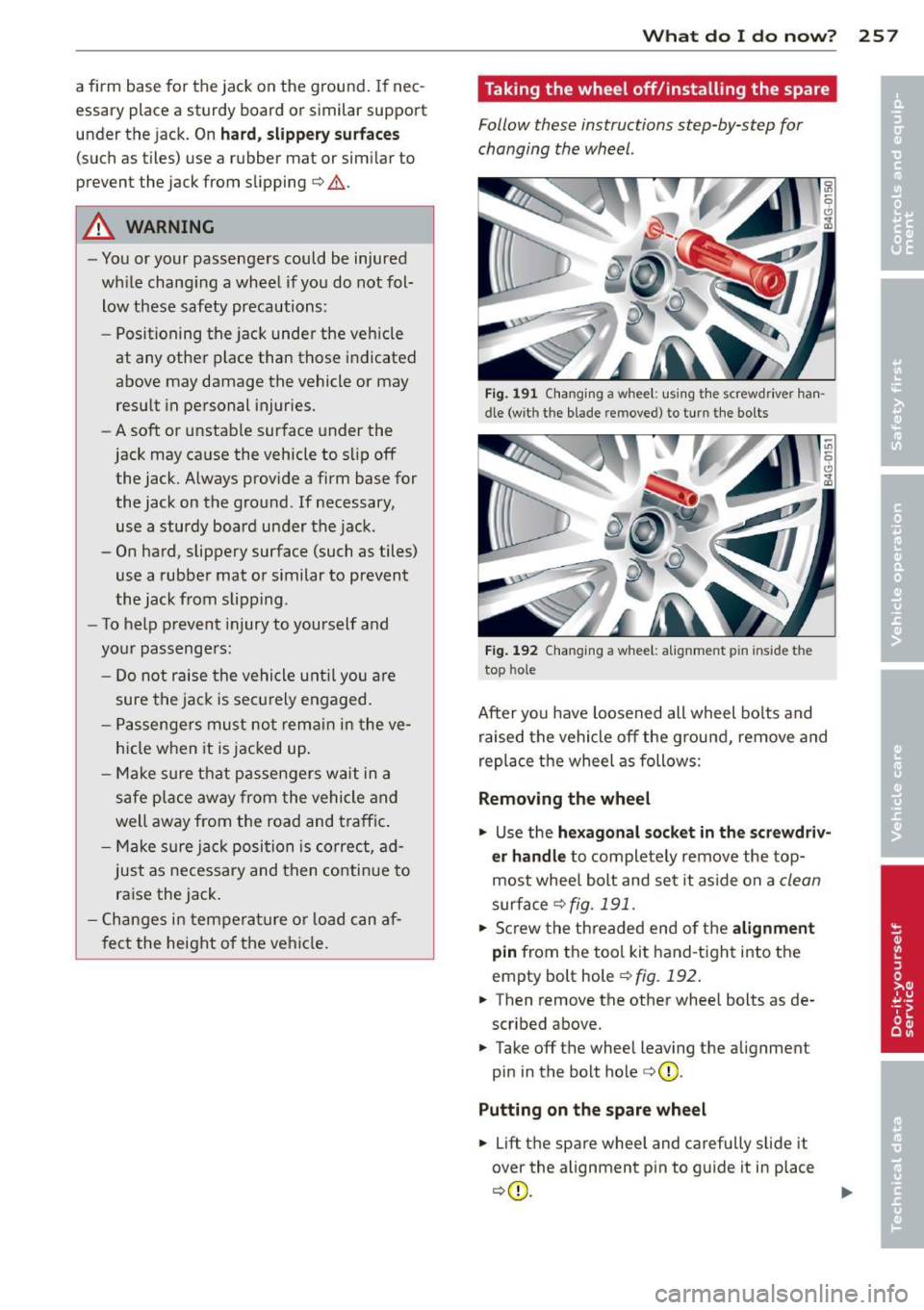
F ig . 191 Changing a wheel: u sin g the screwd river han
dle (with the blade removed) to turn the bolts
Fig. 192 Changing a whee l: alignment pin inside the
top ho le
After you have loosened all wheel bolts and
raised the vehicle off the ground, remove and
replace the wheel as follows:
Removing the wheel
.., Use the hexagonal socket in the screwdriv
er handle
to completely remove the top·
most wheel bolt and set it aside on a
clean
surface ¢fig. 191.
.., Screw the threaded end of the alignment
pin
from the tool kit hand-t ight into the
empty bolt hole
¢fig. 192 .
.., Then remove the other wheel bolts as de
scribed above .
.., Take off the wheel leaving the alignment
pin in the bolt hole ¢(D.
Putting on the spare wheel
.., Lift the spare wheel and carefully slide it
over the alignment pin to guide it in place
¢(D.
Page 288 of 294
286 Index
Replacing Fuses . ..... ... . ...... ... .. .. .... . 260
Light bulbs .... ... .... ... .. .. .... . 263
Tires and whee ls ......... .. .. ..... 243
W indshield wiper blades ..... .. .... .. 46
Report ing Safety Defects . ... .. ... ... . 12 6
Rese t button . . . . . . . . . . . . . . . . . . . . . . . . 25
Retractor ...... ........... ........ . 131
Revers ible ma t .......... .. .. .. .. .. .. 6 2
R ims (cleaning) ............. ... .. ... 205
Roof rac k ..... .. .. ..... ... .. .. .... .. 57
L oading . ... .. . .. ..... ... .. .. .... .. 58
Roof weight . . . . . . . . . . . . . . . . . . . . . . . 58
s
SA FE .. ... ... .. .. ..... ... .. .. .... .. 25
S afe d riving hab its ......... .. .. .. .. . 118
Safety belt position ........ .. .. .. .. . 132
Safety belt he ight ad justment .. .... . 134
Safety belts worn by p regnant women . 133
Safety belt pretensioner ... .. .. .. .. ... 135
Service and disposal .......... .. .. . 135
S afety bel t pre tens io ners
Pr e sense . .... .. ..... ... .. .. .... . 18 2
Safety belts . . . . . . . . . . . . . . . . . . . . . . . . 13 1
cleaning . .. ................ ... ... 209
D anger to passe ngers w ho do not wea r a
s a fety be lt .............. .. .. ..... 129
F asten ing . .... .. ..... ... .. .. .... . 13 1
Height adjustment . . . . . . . . . . . . . . . . . 134
Imp roperly worn . ..... ... .. .. .... . 134
Not worn . . . . . . . . . . . . . . . . . . . . . . . . 129
Safety belt position ....... .. .. .. .. . 132
Safety instructions . . . . . . . . . . . . . . . . . 131
Secur ing ch ild safety seats . . . . . . . . . . 17 4
Specia l co nsiderations fo r pregnant
women .. .. ............. .. .. .. .. . 133
Unfaste ning .. ........... .... .... . 133
War ning/ indica to r li gh t .... .. .. ..... 12 8
Warn ing ligh t . ... ..... ... .. .. .... .. 16
Why YOU MUST wear them ... ... ... . 128
Worn properly . . . . . . . . . . . . . . . . . . . . 130
Safety bel t tensione r
d rive sele ct . ... .......... .. .. .. .. .. 9 6
Safety belt warn ing light .. .. .. .. .. .. . 128
Safety compliance sticker ... .. .. .. .. . 270 Sa
fety eq uipment . .... .. ..... ... .. .. 118
Safety featu res for occupant rest ra int and
protection .. .... .. ............. .... 118
Safety gu idelines
Seat adjustment . . . . . . . . . . . . . . . . . . . . 50
Safety instr uctions
E ngine compartment . .. ..... ... .. .. 216
for side c urtain airbags ......... .... 161
for using child safety seats .... .. .. .. 167
fo r using safety belts ........... .. .. 131
Monitoring the Advanced Airbag Sys -
tem .. ..... ... .. .. .......... .... . 152
Safety systems Warning/ind icator lights ........ .... . 17
S eat adjustment
Contro ls . . . . . . . . . . . . . . . . . . . . . . . . . . 51
Drive r's seat . . . . . . . . . . . . . . . . . . . . . . . 50
Front passenger's seat .............. . 51
Front seats . . . . . . . . . . . . . . . . . . . . . . . . 50
Head restra ints . . . . . . . . . . . . . . . 52, 122
Safety gu idelines . ................ .. 50
Seat be lts
WhyYOUMUSTwearthem .... .. .. .. 128
Seat heating/ven tila tion (automat ic cli-
mate control) . . . . . . . . . . . . . . . . . . . . . . . 68
Seat heating (climate con trol) . . . . . . . . . . 66
Seating position Driver .... .... ................... 119
Front passenger ............... .... 120
How to adj ust the front seats .... .. .. 120
Incorrect seat position .............. 122
Occu pan ts .. ... .. ..... ....... ... .. 119
Rea r passengers .. ............. .... 121
Seat memory . . . . . . . . . . . . . . . . . . . . . . . 53
Seats ( number) .... ... .. ..... ... .. .. 128
Se lective unlock feature . .......... ... . 32
Se lector lever ... .. .. .... .... ... .. .. 103
Emergency re lease ............. .... 107
Se rv ice and d isposa l
Safety be lt pre tensioner ..... .... . .. 135
Se rv ice interval display . . . . . . . . . . . . . . . . 25
S hi ft buttons .. .. .. ............. .. .. 106
S id e ai rbags
D escription . ..... .. .... .... ... .. .. 15 7
How they wor k ... .. ... ..... ... .. .. 158