tire pressure AUDI A7 2012 Owner's Manual
[x] Cancel search | Manufacturer: AUDI, Model Year: 2012, Model line: A7, Model: AUDI A7 2012Pages: 294, PDF Size: 73.33 MB
Page 251 of 294

In o rder to minimize the occurrence o f impact
damage to the tires of your vehicle, we recom mend that you observe the following precau
tions :
- Always maintain recommended inflation
pressures. Check your tire pressure every
2,000 miles (3,000 km) and add a ir if neces
sary.
- Drive carefu lly on roads with potholes, deep
gullies or ridges. The impact from driving
through or over such obstacles can damage
your tires. Impact with a curb may also cause damage to your tires .
- After any impact, immediately inspect your
tires or have them inspected by the nearest
authorized Aud i dealer . Replace a damaged
t ire as soon as poss ible .
- In spect your t ires every 2,000 miles (3,000
km) for damage and wear . Damage is not al
ways easy to see. Damage can lead to loss of
air and unde rinflation, wh ic h could eventu
ally cause ti re fail ure.
If yo u be lieve that a
ti re may have been damaged , replace the
tire as soon as possible.
- These tires may wear more quick ly than oth
ers.
- Please a lso remembe r that, whi le these t ires
deliver respons ive handling, they may ride
less comfortably and make more noise than
other c hoices.
Reduced p erformance in winter /cold
s ea son condit ion s
All ti res are designed for certain purposes .
The low aspect ratio, ultra hig h performance
tires originally installed on your veh icle are in
tended for max imum dry and wet road per
formance and handling . They are not suitable
for cold, snowy or icy weather cond it ions . If
you dr ive under those circumstances, you
should equip your vehicle with all-season or
winter tires, whi ch offe r better traction under
those cond it ions . We suggest you use the rec
ommended snow or all -season tires specified
for your ve hicle, or their equiva lent .
Refe r to ~
page 246 for mo re deta iled info r
mat io n regarding w in ter t ires.
Tire s an d wheel s 249
Tire pressure
monitoring system
ill General notes
App lies to vehicles : wi th tire p ress ure mo nito rin g system
Each tire, incl uding the spare (if provided),
shou ld be checked monthly when co ld and in
flated to the inflation pressure recommended
by the veh icle manufacturer on the veh icle
placard or tire inflation pressure label. (If your
vehicle has tires of a d ifferent size than the
s iz e indicated on the vehicle placard or tire in
flat io n pressu re labe l, you shou ld dete rmine
the p roper t ire inflation p ress ure fo r those
t i r es).
As an added safety feature, your veh icle has
been equipped with a tire pressure monitoring
system ( TPMS) that illum inates a low ti re
pressure te lltale whe n one or more o f your
ti res is significant ly under -inflated . According
ly, when the low tire pressure te lltale i llumi
nates, you shou ld stop and check your tires as
soon as possib le, and inflate them to the
proper pressure. Driving on a sign ificantly un
der- inflated t ire causes the tire to overheat
and can lead to tire fa ilure . Under-inflation al
so reduces fuel effic iency and tire tread life,
and may affect the vehicle 's hand ling and
stopp ing abil ity.
Please note that the TPMS is not a subst itute
fo r proper tire ma intenanc e, and it is the d riv
er's respo nsibility to maintain co rrect tire
pressure, even if under-inflation has not
reached the leve l to tr igger illum inat ion of the
T PMS low ti re p ressu re tellta le .
You r vehicle has also been equipped with a
T PMS ma lf u nction indicator to ind icate w hen
the sys tem is not operating prope rly . T he
T PMS ma lfunction indicator is combined w ith
the low tire pressure te lltale. When the sys
tem detects a malfunction, the telltale wi ll
flash for approximate ly one min ute and then
rema in con tinuously i llum inated . T hi s se
quence will continue upon subsequent vehicle
start-ups as long as the malfunct ion exists . ..,.
•
•
Page 252 of 294

250 Tires and wheels
When the malfunction indicator is illuminat
ed, the system may not be able to detect or
signal low tire pressure as intended . TPMS
malfunctions may occur for a variety of rea
sons, including the installation of replace ment or alternate tires or wheels on the vehi
cle that prevent the TPMS from funct ioning
properly . Always check the TPMS malfunction
telltale after replacing one or more t ires or
wheels on your veh icle to ensure that the re
p lacement or a lternate tires and wheels allow
the TPMS to continue to function properly.
Tire pressure indicator appears
Applies to vehicles: with tire p ressure mo nitoring syste m
The tire pressure indicator in the instrument
cluster informs you if the tire pressure is too
low or if there is a system malfunction.
Fig. 181 Display : underinflatio n warning
Fig. 182 Display : Syste m mal functio n
Using the ABS sensors, the tire pressure moni
toring system compares the tire tread circum
ference and vibration characteristics of the in
d ividual tires.
If the pressure decreases in one
or more tires, th is is indicated in the instru
ment cluster with a warning symbol
'9] and a
message ¢
fig . 181.
The tire pressure monitoring system must be
reset via MMI each time the pressures are ad- justed
(e.g. when switching between partial
and full load pressure) or after changing or re
placing a tire on your vehicle ¢
page 251. You
can find the recommended tire pressures for
your vehicle on the label on driver 's side B-pil
lar ¢
page 235 .
Tire tread circumference and vibration charac
teristics can change and cause a tire pressure
warning if:
- the tire pressure in one or more tires is too
low,
- the tire has structural damage,
- the tire pressure was changed, wheels rotat -
ed or replaced but the TPMS was not reset
¢page 251.
Warning symbols
'9] Loss of pressu re in at least one tir e ¢ & .
Check the tire or tires and replace or repa ir if
necessary. The indicator light
'9] in the instru
ment cluster also illuminates
¢page 11.
Check/correct the pressures of all four tires
and reset TPMS via MMI.
••MIS, ( Ti re Pressure Monitoring System) Tire
pressure! System malfunction .
If IIMIS, appears after switching the ignition
on or while driving¢
fig. 182 and the indica
tor light
'9] in the instrument cluster blinks
f or approximately one minute and then stays
on, there is a system malfunction . See your
authorized Audi dea ler as soon as possible .
A WARNING
--If the tire pressure indicator appears in
the instrument cluster display, one or more of your tires is significant ly under
inflated. Reduce you r speed immediately
and avoid any hard steer ing or braking
maneuvers. Stop as soon as possible and
check the tires and their pressures. In
flate the tire pressure to the proper pres
sure as indicated on the vehicle's tire
pressure label¢
page 235. Driving on a
significantly under- inflated tire causes
the tire to overheat and can lead to tire
failure. Under-inflation also is likely to
Page 253 of 294

impair the vehicle's handling and stop
ping ability.
- The driver is responsible for maintaining
the correct tire pressures. You must
check the t ire pressures regularly.
- Under certain conditions (such as a spor
ty driving style, w inter condit ions or un
paved roads), the pressure monitor ind i
cator may be de layed.
- Ask your authorized Audi dealer if run
flat tires may be used on your veh icle.
Your vehicle registrat ion becomes invalid
if you use these tires when not permit
ted. Damage to your veh icle or acc idents
cou ld also resu lt.
(0 Tips
- The t ire pressure monitoring system
stops working when there is an ESP/ABS malfunction.
- Using snow chains may result in a system malfunction .
- To ensure a proper TPMS function use
AUDI Origina l Tires wh ich are marked
with "AO" or "RO" on the tire sidewall.
¢page 242.
- The t ire pressure monitoring sys tem on
you r A udi was syntoni zed using tires w ith
the "AO" or "RO" identific ation. We rec
omme nd using these tires.
Reset tire pressure monitoring system
Applies to vehicles: with tire pressure monito ring system
If the tire pressure is adjusted, wheels are ro
tated or changed, the T PMS must be reset via
MMI .
"' Switc h on the igni tion.
"' Se lect in the M MI: !CAR !func tion button>
Car system s contro l button > Servi cing &
checks > Ti re pre ssure mon itoring > Store
tire press ures> Ye s, store now .
@ Tips
Before reset ting the TPMS, the current
pressures of all four tires must correspond
to the specified values. Adjust the t ire
Tire s an d wheel s 251
pressure and reset the pressure in the ti re
pressure monitoring system according to
the load you are car ry ing
c::!;> page 235 .
-Do not store the tire p ressu res if you are
driving with snow chains . Othe rwise, a
system malfunction may occur.
•
•
Page 255 of 294

-Never use the jack s upplied with your Au
di on another vehicle, particularly on a
heavier one. The jack is only suitable for
use on the vehicle it came w ith.
(D Tips
- Some of the on board items listed above
are provided on certain mode ls only or
are optional extras.
- Before you can raise your vehicle using
the jack, you must activate the jack ing
mode
¢ page 256.
Space-saving spare tire (compact spare
tire)
The spare tire/wheel is located in the luggage
compartment under the cargo floor cover . It
is intended for short-term use only.
Taking out the sp are tire
... Fo ld the floor to the seatback with the help
of the handle.
... Turn the large sc rew
¢ page 2 52, fig. 184
counter-clockw ise .
.,. Take out the spare tire .
Securing the replaced tire
.,. The fault wheel will not fit ins ide the spare
wheel well. Store it in the luggage compart
ment and secure it so that it does not slide
¢ page 59 .
Using the spa re tire (compact spare tire )
The compact spare tire is only intended for
emergencies until you can reach a repair shop.
Replace it as quickly as poss ible with a stand
ard wheel and t ire .
There are some restrictions on the use of the
compact spare t ire. The compact spare t ire
has been des igned specifically for your type of
vehicle.
It must not be swapped with a com
pact spare t ire from another type of veh icle .
Snow chain s
For technical reasons, the use of snow chains
on the compact spare tire is
not perm itted .
What do I do now? 253
If you do have to drive with snow chains and a
front tire fails, mount the spare wheel with
tire instead of a rear tire. Install the snow
chains on the rear tire and use it to rep lace
the defect ive front tire.
A WARNING
- Never use the spare t ire if it is damaged
or if it is worn down to the tread wear in
dicators .
- If the spare tire is more than 6 years old,
use it only in an emergency and with ex
treme caution and careful driv ing.
- The spare tire is intended only for tem
porary and short-term use.
It should be
replaced as soon as poss ible wi th the
normal whee l and tire.
- After mounting the compact spare t ire,
the t ire pressure must be checked as
soon as possible. T he tire pressure of the
compact spare tire must be 4 .2 bar; oth
erwise, you risk having an accident.
- Do not dr ive faste r than 50 mph (80 km/
h). You ris k having an accident.
- Avoid full-thrott le accelera tion, heavy
braking, and fast cornering . You risk hav
ing an accident.
- Never drive using more than one spare
wheel and tire . You risk having an acci
dent .
- Normal summer or winter t ires must not
be mounted on the compact spare wheel
rim.
- For technical reasons, the use of tire chains on the spare tire is not permitted.
If it is necessary to drive with t ire chains,
the spare wheel must be mounted on the
front axle in the event of a flat in a rear
tire. The newly available front wheel must then be installed in place of the
rea r whee l w ith the flat tire . Installing
the t ire cha in before mounting the whee l
and tire is re commended.
- Loose items in the passenger compart
men t can cause se rious personal injury
during hard brak ing or in an accident. •
•
Page 257 of 294
.. The fault wheel will not fit ins ide the spa re
whee l wel l. Store it in the luggage compart
ment and secure it so that it does not slide
r=> page 59 .
.. Check the tire pres sure on the spare wheel
immediately after mounting it .
.. As soon as possible, have the
tightening
t o rqu es
on a ll wheel bolts checked with a
torque wrench . The correct tightening tor
que is 90 ft lb ( 120 Nm) .
.. Have the flat tire
re pl ac ed as soon as possi
ble.
(D Tips
- If you notice that the whee l bolts are
corroded and difficult to t urn w hile
changing a tire, they should be replaced
before you check the tightening torque .
- Drive at reduced speed until you have the
tightening torques checked .
- After changing a wheel, the tire pressure
in a ll four tires must be checked/cor rect
ed and the tire pressure monitoring indi
cator must be stored in the MMI
r=> page 251.
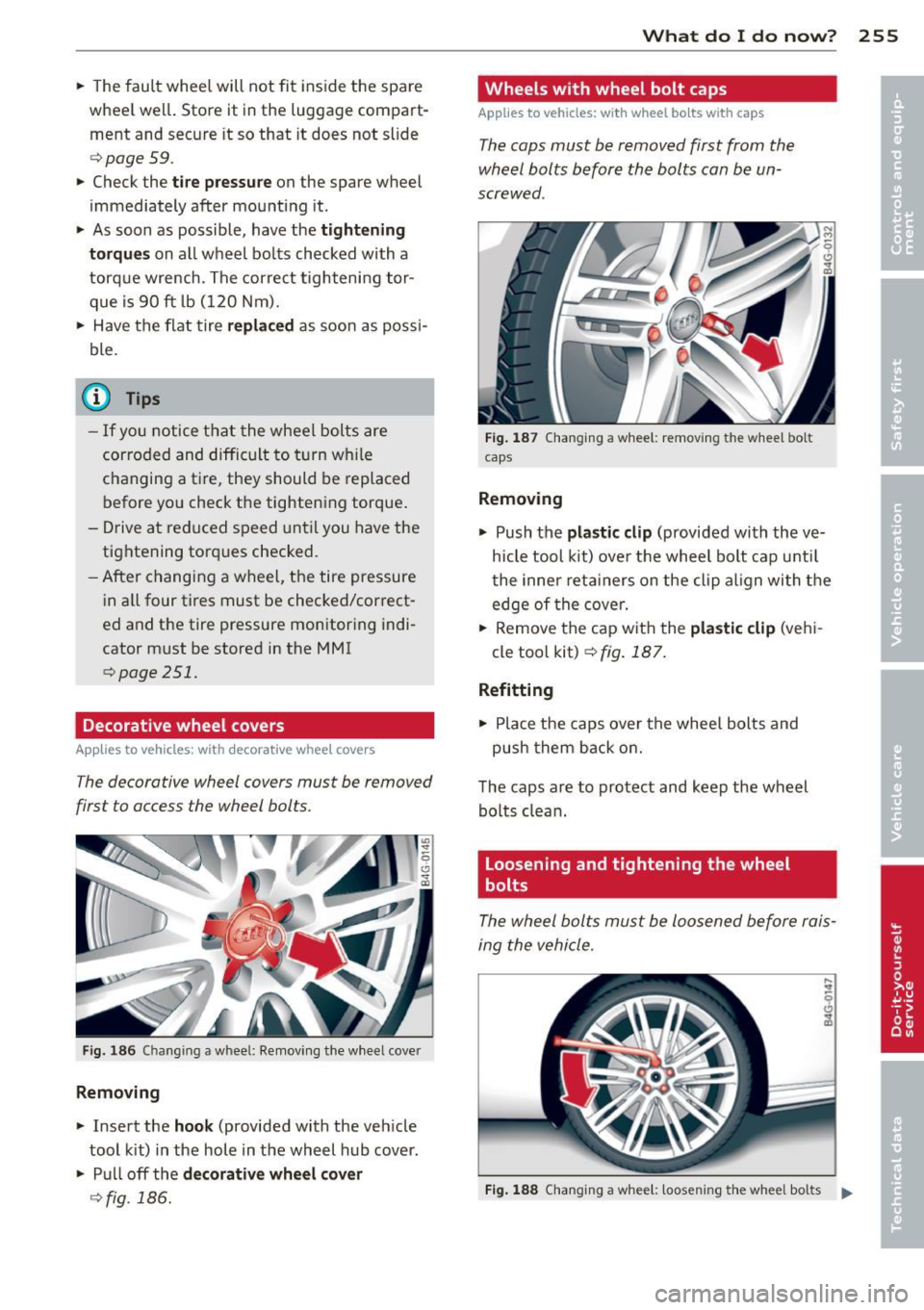
Decorative wheel covers
App lies to vehicles: with deco rat ive wheel cove rs
T h e decorativ e whe el covers must b e re moved
firs t to access the wheel bol ts.
Fi g. 186 Ch ang ing a w hee l: Remov ing the wheel cove r
Removing
.. Insert the hook (provided with the vehicle
tool kit) in the hole in the wheel hub cover .
.. Pu ll off the
dec orativ e whe el c over
r=> fig . 186.
What do I d o now ? 255
Wheels with wheel bolt caps
Applies to vehicles: wit h wheel bo lts with caps
T he cops must be removed first from the
wheel bolts before the bolts con be un
screwed .
Fig . 1 87 Changin g a whee l: r emovi ng th e wheel bolt
c ap s
Removing
.. Push the pla stic clip (provided with the ve
hicle tool kit) over the wheel bolt cap unt il
the inner reta iners on the clip align with the
edge of the cove r.
.. Remove the cap w it h the
pl as tic clip (veh i
cle too l kit)
r::!:> fig . 187.
Refitting
.. Place the caps over the wheel bolts and
push them back on.
The caps are to protect and keep the wheel bolts clean.
Loosening and tightening the wheel
bolts
The wheel bolts must be loosened before rais
ing the vehicle .
Fig. 188 Changing a whee l: loosening t he w hee l bo lts ..
Page 281 of 294

Manual shift program . . . . . . . . . . . . . . 105
Selector lever .................. ... 103
Shift buttons . . . . . . . . . . . . . . . . . . . . . 106
Steering wheel with tiptronic . .. .. .. . 106
Automatic wipers .......... .. .. .. .... 45
Auto Safety Hotline ............ ... .. 126
Average consumption .......... ... .. .. 23
Average speed . . . . . . . . . . . . . . . . . . . . . . . 23
Avoid damaging the vehicle .. .. .. .. .. . 193
B
Battery ... .. .. ............. .. .. ... 226
Charging . .. ............. .... .. ... 229
Important warnings ...... .. .. .. .. . 227
Jump starting ............... ... ... 264
Location ... ... .. .. ...... .. .. .. .. . 227
l ow . .. .. .. .. ... .. ..... ... .. .. .. . 190
Replacing the battery ..... .. .. .. .. . 230
State of charge ........... .... .. ... 190
Winter operation ............ ... .. . 226
Working on the battery ....... ... .. . 227
Before driving . . . . . . . . . . . . . . . . . . . . . . 118
Blended gasoline .......... .... .. .. . 211
Blower (automatic climate control) . . . . . . 68
Blower (climate control) . . . . . . . . . . . . . . . 65
Body cavity sealing ............ ... .. . 205
Booster seats ............. .. .. .. .. . 172
Brake fluid Changing the brake fluid ....... ... .. 226
Checking the brake fluid level ... ... .. 225
What is the correct brake fluid level? .. 225
What should I do if the brake fluid warn-
ing light comes on? ....... .. .. .. .. . 225
Brake system Anti-lock braking system . ......... ... 18
Brake assist system .......... .... .. 184
Brake booster ............ .... .. .. . 188
Brake fluid .............. .... .. .. . 225
Brake fluid specifications for refill and re-
placement ................. ... ... 226
Brake light defective ......... ... .. .. 20
Brake pads . ............. .... .. ... 192
Electromechanical parking brake .. .. .. 74
Fluid reservoir ........... .... .. .. . 225
How does moisture or road salt affect the
brakes? .. ............ ...... .... .. 187
Index 279
Warning/indicator lights ............. 14
Worn brake pads symbol ............. 19
braking guard . . . . . . . . . . . . . . . . . . . . . . . 79
Messages . .. .. .. .... ........... .. . 86
Settings .. .. .. .. ................. . 86
Break-in period .. .... .. .. ...... ..... 192
Brake pads ...... .. ............... 192
T ires ... .. .. .. .. ... .. .......... .. 192
Bulbs .... .. .. .. .. .. ............... 263
C
California Proposition 65 Warning ..... 217
Battery specific .. .... ............. 228
Capacities .. .. .. .. .... ........... .. 272
Engine oil ........................ 218
Car care .. .. .. .. .. .. . .. .... ........ 200
Exterior ... .. .. .... ... .. ..... ..... 200
Interior . .. .... .. .. . .............. 206
Cargo area . . . . . . . . . . . . . . . . . . . . . . . . . 124
Cargo net . . . . . . . . . . . . . . . . . . . . . . . . . . . 61
Catalytic converter ................. . 193
Center armrest Cockpi t ..... .. ................... .
Sl
Central locking . . . . . . . . . . . . . . . . . . . . . . 31
Emergency locking . ............... .. 35
Certification ...... .. ............... 276
Changing a wheel .. ............. .. .. 254
Changi ng engine oil .... ............. 222
Chassis (undercoating) ............... 205
Checking Engine coolant level ............ .... 223
Tire pressure . .. .. ................. 237
Child restraints Danger of using child restraints in the
front seat ........................ 139
Where can I get additional information
about child restraints and their use? .. 181
Child restraint system anchors ....... . 177
Child safety ....... .. ..... .......... 163
Convertib le locking retractor ......... 17 4
Important safety instructions for using
child safety seats . .. ........... .... 167
Important things to know when driving
with children .. .... ............... 163
Tether anchors ..... .............. . 180
Tether straps .. .. ................. 180
•
•
Page 282 of 294

280 Index
Child safety lock Rear doors .... .... ...... .. .. .... ..
37
C hild safety seats .......... .... .... . 169
Booster seats .......... .. .. .. .. .. . 172
Conve rtible child seats .... .. .. .... . 170
Conve rtible locking retractor . ..... .. .
How do I properly install a child safety
. h. l ? seat in my ve 1c e. . ............... .
Infant seats .. ........... .. .. .... .
Installing .. ............... .. .... .
Installing a child restraint using the
LATCH system .. .... ...... .. .. .. .. .
174
167
169
174
179
L ATC H system ............. ... .. ... 179
Lower anchorages ............ .... . 178
Mounting and releasing the anchorage
hook .. .. .. ... .... ......... ..... .
179
Safety instructions ......... ... .... . 167
Cigarette lighter . . . . . . . . . . . . . . . . . . . . . 54
Cleaning and protection ..... .. .. .... .
200
Alcantara (synthetic suede) . .. .. .. .. . 209
Eng ine compartment .... .. .. .. .... . 210
Exhaust tail pipes .......... ... .. .. . 206
Fabrics and fabr ic coverings .. .. .. .. . 206
Instrument panel ......... .. .. .... . 207
Inter ior .. .. ............. .. .. .. .. . 206
Lea ther .. .... ........... .... .... . 208
MMI display/controls ............... 206
Plastic and vinyl ................... 203
Plastic parts .. .......... ... .. .. .. . 207
Safety belts ............. .... .... . 209
trim strips 204
Trim str ips .... .. .. ... ... .. .. .. .. . 203
Climate control
Air vents ... .......... ..... .. .... .. 66
C limate controls . . . . . . . . . . . . . . . . . . . . .
64
Climate control (four-zone)
Operation .. ................ ... .. ..
67
Climate control (three-zone)
Operation . . . . . . . . . . . . . . . . . . . . . . . . . 65
C lock ... .. .. ............. .. .. .. .. .. 25
Closing Rear lid .. .. ................ ... ... . 35
Sliding/tilting sunroof ...... ..... .. ..
39
Cold tire inflation pressure ..... .. .... . 235
Com ing home ............. .. .. .... ..
43
Compact spare tire ...... .... ... .. .. . 253
Compartments .. ........ .. .. .. .... .. 55 Compliance
..... .. ... .. ........ .. ..
276
Consumer Information . . . . . . . . . . 126, 273
Consumption (fuel) ... .......... .. .. . 23
Contacting NHTSA
Convenience key ... ................ . . 126
33
Starting the engine ............. ... . 71
Stopping the engine (START ENG INE
STOP button) . . . . . . . . . . . . . . . . . . . . . .
73
Switching the ignition on ....... .. .. . 71
U nlocking and locking vehicle ...... .. . 33
Co nvertible child safety seats ... .. .. .. 170
Convertib le locking retractor
Activating . .... .. .. ........... ....
176
Deact ivat ing ... ... .............. .. 177
Using to secure a child safety seat 1.74, 176
Coolant
refer to Engine coolant ............. 223
Cooling mode (automat ic climate control) 67
Cooling mode (climate control) . . . . . . . . . 65
Cornering light .... ... .......... .. .. .
96
Cruise contro l
Changing speed .. ............. .... .
77
Presetting your speed .......... .. .. . 78
Switching off . . . . . . . . . . . . . . . . . . . . . . 78
Switching on . . . . . . . . . . . . . . . . . . . . . . . 77
Warning/ind icator lights .......... .. . 21
(upholder .... .. .. .. ........... .... . 55
D
Data ........ ... .. .. ... ........... . 272
Data recorder ... .. .. ........... .. .. 184
Date display .. .. .. ............. .... . 25
Daytime running lights ... ..... ... .. .. .
41
Declaration of compliance
Adaptive cruise control ........... ..
276
Audi s ide assist .. ............. .. .. 276
Cell phone package . ........... .. .. 276
Convenience key ... ................ 276
Electronic immob ilizer ....... ...... . 276
Homelink ® un iversal remote control .. 276
Remote control key
DEF What does this mean when it appears in 276
the tr ip odometer display? ....... ... . 25
Defective light bulb warning ...........
20
Page 284 of 294

28 2 Index
Oil grades . ...... ..... ... .. .. .... . 218
Oil level symbol ....... ... .. .. .... .. 20
Pressure malfunction . .... ... .. .... . . 1 6
Recommended oil check intervals ..... 221
Sensor defective . . . . . . . . . . . . . . . . . . . . 20
Specification and viscos ity ... ... .. ... 218
Engine speed limitation ... .. .. .. .... . . 20
E ng ine start system (indicator lights) .... 17
Environment Break- in period ........... .. .. .... . 192
Catalytic converter ................. 193
D isposing of your vehicle battery ..... 230
D riving at high speeds ..... .. .. .. .. . 195
D riving to m inim ize pollution and no ise 194
F uel ... ...... ............. ...... . 213
F uel economy .. . ...... ... .. .. .... . 194
L eaks under your veh icle ... .. .. .. .. . 2 16
L etting the vehicle stand and warm up . 195
Proper disposal of dra ined brake fluid . 226
Proper disposal of dra ined engine coo l-
ant . .. .. .... ........ ...... ... .. . 224
Proper disposal of dra ined engine
oil . . . . . . . . . . . . . . . . . . . . . . . . . 22 1, 222
Recycl ing used engine oil ... .. .. .. .. . 22 1
Un leaded fuel ............ .. .. .. .. . 211
What should I do wi th an old ba ttery? . 230
ESP (Electronic stabilization program) Warn ing/ indicato r lights . ....... ..... 18
Event Data Recorder ( EDR) ..... .. .... . 184
E xha ust tail p ipes .......... .. .. ..... 206
Expansion tank ............. .... .... 223
Exterior lighting . .. ..... ... .. .. .... .. 41
E xterio r m irrors
Ad just ing ............... .. .. .. .. .. 47
Di mm ing . ... ............ .. .. .. .. .. 48
H eating ..... .. .. ..... ... .. .. .... .. 47
E xte rio r temperatu re d isplay ... .. .. .. . . 22
F
Fastening
Booster seats ............... ... ... 172
Conve rtible c hild safety seats ... .. .. . 170
I nfant seats ... .......... .. .. .. .. . 169
Fastening eyes . ........... .. .. .... .. 62
Fl oor mats . . . . . . . . . . . . . . . . . . . . . . . . . 123
Foot pedals . . . . . . . . . . . . . . . . . . . . . . . . 123 F
or the sake of the environment
Gasoline fumes and the environment . . 213
Red ucing engine noise by early upshift-
ing ... .... .... .. .................. 10
Refueling . ................... .... 213
Sav ing fuel by early ups hifting ...... .. 10
Fo ur-zone automatic climate control ... . 67
Front a irbags
Descrip tion ................... .... 141
How they work ................ .. .. 14 7
Frontal collis ions and the laws of phys ics 129
F ront seats . . . . . . . . . . . . . . . . . . . . . . . . . 50
Adjusting . ....................... 120
Child restraints in the front seat .. .... 139
F uel
Additives . ..... .. ... .. ..... .... . .. 211
B lended gaso line ... ... ..... ... .. .. 211
C urrent consumption ............... . 23
Economy messages (effic iency program) 24
Fuel filler flap emergency release . .... 214
Fuel filler neck . .. ................ . 212
Fuel gauge .. .. .. ... .. .. ... ..... .. . 11
Gasoli ne .. .. .. .. .. .... .... .... ... 211
Gasoli ne add it ives ............... .. 212
Low fue l level symbol .......... .. .. . 20
Octane rat ing .... .. .... .... ... .. .. 211
Recommendation .... .. ..... .... . .. 211
Ref uel ling ..... .. .. ... ..... ... .. .. 213
Reserve ... ...... ................. . 11
Tank capac ity ................. 11,272
F uses
Assignment ..... .. ... ..... ... .. .. 260
Replacing ..... .. ... .. ..... .... . .. 260
G
Garage door opener (HomeLink ®) . ... .. 115
Garment hooks . . . . . . . . . . . . . . . . . . . . . . 56
Gas discharge lamps ............. .... 263
Ga uges
E ngine coo lan t temperature . . . . . . . . . . 10
Fuel gauge . . . . . . . . . . . . . . . . . . . . . . . . 11
Speedometer .... .. .... .... ... .. .. . 25
Tachometer . . . . . . . . . . . . . . . . . . . . . . . 11
Tr ip odometer .................. .. . 25
Genera l illustr ation ... .......... .. .. .. 8
Generator (warning/indicator lights) .... 16
G lossary of tire and loading terminology 232
Page 289 of 294

Side assist Activating and deactivating . . . . . . . . . . . 88
Cleaning sensors ............ ... .. . 202
Description . ............. .... .. .... 88
Informational and alert stage signals .. 90
Messages in instrument cluster display . 94
MMI settings .... .. ...... .. .. .. .. .. 93
Operation . . . . . . . . . . . . . . . . . . . . . . . . . 89
Safety tips . . . . . . . . . . . . . . . . . . . . . . . . 94
Sensor detection area . . . . . . . . . . . . . . . 89
Side curtain airbags ........... .... .. 160
Description .... .. .. ...... .. .. .. .. . 160
How they work .............. ... ... 161
Safety instructions ........ .. .. .. .. . 161
Side marker lights ......... .. .. .. .. .. 41
Ski sack ..... .. ................ ..... 62
also refer to Trunk pass-through .. .. .. 63
Sliding/tilting sunroof Emergency closing .......... .. .. .. .. 40
Opening and closing ...... .. .. .. .. .. 39
Snow chains . ................ ... ... 247
Socket . . . . . . . . . . . . . . . . . . . . . . . . . . . . . 55
Sources of information about child re-
straints and their use ....... .. .. .. .. . 181
Space-saving spare tire ...... .. .. .. .. . 253
Spare tire .... ................ ... ... 253
Speedometer . . . . . . . . . . . . . . . . . . . . . . . 25
Speed rating letter code ..... .. .. .. .. . 243
Speed warning system ...... .. .. .. .. .. 76
Star button . . . . . . . . . . . . . . . . . . . . . . . . . 23
START ENGINE STOP button ........... 71
Starting from rest .......... .. .. .. .. .. 75
Startingoffwithatrailer .... .. .. .. .. .. 75
Starting the engine .................. 71
Steering Electrically adjustable steering wheel .. 70
Manually adjustable steering wheel .. .. 70
also refer to Electro-mechanical power
assist ..... .. ................ .... 189
Steering wheel Easy entry feature . . . . . . . . . . . . . . . . . . 71
Indicator light . . . . . . . . . . . . . . . . . . . . . 17
Steering wheel heating .... .. .. .. .. .. 69
Steering wheel column Adjusting electrically ...... .. .. .. .. .. 70
Adjusting manually ....... .. .. .. .. .. 70
Steps for determining correct load limit . 239
Index 287
Stopping the engine . ............... .. 73
Storage . . . . . . . . . . . . . . . . . . . . . . . . 55, 60
Sunroof .... .. .. .. ... ............ ... 39
Sun shade .. .. .. .. ................. . 45
Sun visors ........ .. ................ 45
Symbols
refer to Warning/indicator lights ..... . 11
T
Tachometer . . . . . . . . . . . . . . . . . . . . . 11, 22
Technical modifications .............. 276
Temperature display ............. .. .. . 22
T ether anchors . . . . . . . . . . . . . . . . . . . . . 180
Tether strap . . . . . . . . . . . . . . . . . . . . . . . 180
The first 1,000 miles (1,500 km) and after-
wards ...... .. .. .. ................. 192
Three-zone climate control . . . . . . . . . . . . 65
Tie-downs . . . . . . . . . . . . . . . . . . . . . 61, 125
Tips for the environment
Saving fuel . ... .. .. ................ 58
tiptronic ... .. .. .. ................. 102
A ut omatic Shift Lock (ASL) ...... .. .. 104
Driving .......................... 102
Dynamic shift program ............. 105
Emergency mode ... ............... 106
Kick-down . .. .. .. ................. 104
Manual shift program .............. 105
Selector lever .. .. ... ... ...... ..... 103
Tire pressure . ...................... 23 7
Tire pressure monitoring system ....... 249
Loss of air pressure ................ 250
Malfunction . .. .. ................. 250
Resetting tire pressures ............ . 251
Tires ...... ... .. .... .......... ..... 231
Service life ....... ................ 241
Speed rating letter code ........ .. .. 243
Tire manufacturing date ........ .. .. 243
Tire specifications ................ . 243
Tread depth ....... ............... 241
Uniform tire quality grading ........ . 245
Winter tires . .. ...... ............. 246
T ires and vehicle load limits ....... .... 239
Tires and wheels Checking tire pressure ............. . 237
Cold tire inflation pressure ......... . 235
Dimensions .. .. .. ................. 242
•
•
Page 290 of 294

288 Index
General notes .............. .. .... . 231
Glossary of tire and loading termino lo-
gy . ... .. .. ... ............. ..... . 232
Low aspect ratio tires ............... 248
New tires and wheels ............... 242
Replacing .. ................ ... ... 243
Snow chains ... ... .... ..... .. .. .. . 247
Tires and vehicle load lim its ......... 239
Wheel bo lts . . . . . . . . . . . . . . . . . . . . . . 248
W inter t ires .. ........... .. .. .... . 246
Tire serv ice life ................ .. ... 241
Tools ..... .. ................ ..... . 252
Torn or frayed safety belts ... .. .. .. .. . 131
Touch-up paint ................ .... . 204
Towing Tow truck procedures ....... ... .... . 266
TPMS Tire pressure monitoring system .... . 250
Trailer towing . . . . . . . . . . . . . . . . . . . . . . 197
Operating instructions ...... .... .... 197
Technical requirements . . . . . . . . 197,198
Trailer towing tips ............ .. ... 198
Transm ission
tiptronic . . . . . . . . . . . . . . . . . . . . . . . . . 102
Transmission malfunction (indicator
light) ..... .. ................ ..... . 106
Transport Canada ................... 126
Tread Wear Indicator (TWI) .. .. .. .. .. . 241
Trip odometer . . . . . . . . . . . . . . . . . . . . . . . 25
What does it mean when DEF appea rs in
the trip odometer display? ... .... .. .. 25
Trunk
refer to Luggage compartment .. .. .... 59
Trunk pass-through .................. 63
Turn signa ls . ............... ... .... .. 43
Warning/indicator lights ........ ... .. 21
u
Unde rcoating .............. ... .... . 205
Unfasten ing safety belts .... .. .. .. .. . 133
Unidirectiona l tires .................. 231
Uniform tire quality grading ... .. .. .. . 245
Unlocking Power locking sw itch . . . . . . . . . . . . . . . . 34
Remote control ............... ..... 33
Using the key . . . . . . . . . . . . . . . . . . . . . . 34
V
Valet parking . . . . . . . . . . . . . . . . . . . . . . . . 39
Vanity mirrors ... .. ... ......... ... .. . 45
Vehicle-care products ............ .. .. 200
Vehicle electrical system ......... .... . 16
Vehicle identification label ............ 270
Vehicle Identification Number (VIN) .... 270
Vehicle jack . . . . . . . . . . . . . . . . . . . 252, 256
Vehicle literature .. ... .......... .. .... 5
Ventilation . . . . . . . . . . . . . . . . . . . . . . . . . 64
w
Warning/ind icator lights .............. 11
Airbag system . . . . . . . . . . . . . . . . . . . . . 17
Anti- lock braking system (ABS) . . . . . . . . 18
Brake system . . . . . . . . . . . . . . . . . . . . . . 14
Cruise contro l .... .................. 21
E lectromechanical parking brake ..... . 15
Electronic power control ........ .... . 19
Electronic stabilization program (ESP) . . 18
Generator ..... ....... ........... .. 16
Instrument cluster ................ .. 10
Malfunction Ind icator Lamp (MIL) .. .. . 19
Safety belt .. .. .. ............. .... . 16
T urn signals . .. .. ............... ... 21
Warning/Indicator lights
Airbag system . . . . . . . . . . . . . . . 149, 150
PASSENGER AIR BAG OFF ........... 150
Warranty coverages ............... .. 273
Washer reservoir .. ... .......... .. .. 230
Washing .......................... 200
Automatic car wash ...... ...... .. .. 201
by hand . .. .. .. .. ............. .... 201
with a power washer ........... .... 202
Waxing .... .... .. .... ........... .. 203
Wear indicator .... ................. 241
We ights ....... .... .... ........... . 270
What happens if you wear your safety belt
too loose? ...... ............... .... 132
What happens to unbe lted occupants? . . 129
What impairs driving safety? ......... . 119
What should I do after changing a
wheel? . .... .... ............... .... 238
What shou ld I do after replacing whee ls? 238