weight AUDI A7 2012 Owner's Manual
[x] Cancel search | Manufacturer: AUDI, Model Year: 2012, Model line: A7, Model: AUDI A7 2012Pages: 294, PDF Size: 73.33 MB
Page 175 of 294
~ Always make sure that the shoulder portion
of the safety belt never rests against or across the child's neck.
~ Always make sure that the child can proper
ly wear the lap portion of the belt low across
the thighs or pelvis and
never over the
stomach or abdomen .
Children up to at least 8 years old (over 40 lbs
or 18 kg) are best protected in child safety
seats designed for their age and weight . Ex
perts say that the skeletal structure, particu
larly the pelvis, of these children is not fully
developed, and they must not use the vehicle
safety belts without a suitable child restraint.
It is usually best to put these children in ap
propriate booster seats. Be sure the booster
seat meets all applicable safety standards.
Booster seats raise the seating position of the
child and reposition both the lap and shoulder parts of the safety belt so that they pass
across the child's body in the right places. The
routing of the belt over the child's body is very
important for the child's protection, whether
or not a booster seat is used . Children age 12
and under must always ride in the rear seat.
Children who are at least 4 ft. 9 in. (57 in
ches/1.45 meters) tall can generally use the
vehicle's three point lap and shoulder belts.
Never use the lap belt portion of the vehicle 's
safety belt alone to restrain any child, regard
less of how big the child is. Always remember
that children do not have the pronounced pel
vic structure required for the proper function of lap belt portion of the vehicle's three point
lap and shoulder belts. The child's safety ab
solutely requires that a lap belt portion of the
safety belt be fastened snugly and as low as possible around the pelvis. Never let the lap
belt portion of the safety belt pass over the
child's stomach or abdomen.
In a crash, airbags must inflate within a blink
of an eye and with considerable force. In order
to do its job , the airbag needs room to inflate
so that it will be there to protect the occupant
as the occupant moves forward into the air bag.
Child Safety 173
A vehicle occupant who is out of position and
too close to the airbag gets in the way of an inflating airbag. When an occupant is too
close, he or she will be struck violently and
will receive serious or possibly even fatal in
jury .
In order for the airbag to offer protection, it is
important that all vehicle occupants, especial
ly any children, who must be in the front seat
because of exceptional circumstances, be
properly restrained and as far away from the
airbag as possible . By keeping room between
the child's body and the front of the passen
ger compartment, the airbag can inflate com
pletely and provide supplemental protection
in certain frontal collisions.
A WARNING
Not using a booster seat, using the boos
ter seat improperly, incorrectly installing a booster seat or using the vehicle safety
belt improperly increases the risk of seri
ous personal injury and death in a collision
or other emergency situation. To help re·
duce the risk of serious personal injury
and/or death:
-Always make sure to position the should
er portion of the three-point belt over
the middle of child's shoulder.
- Never let the shoulder portion of the belt
rest against or across the neck, face,
chin, or throat of the child.
- Always make sure the lap belt portion of
the three-point belt is worn snug and
passes as low as possible across the
child's pelvis. Never let the belt pass over
the soft abdomen.
- Failure to properly route safety belts
over a child's body will cause severe inju
ries in an accident or other emergency
situation <=>
page 128.
-The rear side of the booster seat should
be positioned as close as possible to the
backrest on the vehicle seat. Adjust or re
move the rear seat head restraint if it is
difficult to install the child seat with the head restraint in place
<=>page 52 . Install Ill-
•
•
Page 178 of 294
176 Child Safety
-Always move the passenger seat into its
rearmost position in the seat's fore and
aft adjustment range, as far away from
the airbag as possible before installing
the forward-facing child restraint. The
backrest must be adjusted to an upright
position.
- Make sure that the
PASSENGER AIR BAG
OFF
light comes on and stays on all the
time whenever the ignition is switched
on.
A WARNING
Rearward-facing child restraints:
- A child in a rearward-facing child safety
seat installed on the front passenger
seat will be seriously injured and can be
killed if the front airbag inflates -even
with an Advanced Airbag System.
- The inflating airbag will hit the child
safety seat or infant carrier with great
force and will smash the child safety seat
and child against the backrest, center
armrest, door or roof.
- Always be especially careful if you must
install a rearward facing child safety seat
on the front passenger seat in exception
al circumstances.
- Make sure that the
PASSENGER AIR BAG
OFF
light comes on and stays on all the
time whenever the ignition is switched
on .
- If the
PASSENGER AIR BAG OFF light
does not come on and stay on, immedi
ately install the rear-facing child safety
seat in a rear seating position and have
the airbag system inspected by your Audi
dealer.
Activating the convertible locking retractor
Use the convertible locking retractor to se
cure a child restraint.
Always heed the child safety seat manufactur
er's instructions when installing a child re- straint in your vehicle. To activate the conver
tible locking retractor:
.,. Place the child restraint on a seat, prefera
bly on the rear seat.
.,. Slowly pull the belt
all the way out.
.,. Route it around or through the child re
straint belt path
¢ A -
.,. Push the child safety seat down with your
full weight to get the safety belt really tight .
.,. Insert the belt tongue into the buckle for
that seating position .
.,. Guide the safety belt back into the retractor
until the belt lies flat and snug on the child
safety seat.
.,. You should hear a "clicking" noise as the
belt winds back into the inertia reel. Test the
convertible locking retractor by pulling on
the belt. You should no longer be able to
pull the belt out of the retractor. The con
vertible locking retractor is now activated .
.,. Make sure that the red release button is fac
ing away from the child restraint so that it
can be unbuckled quickly.
.,. Pull on the belt to make sure the safety belt
is properly tight and fastened so that the
seat cannot move forward or sideways more
than one inch (2.5 cm).
A WARNING
Using the wrong child restraint or an im
properly installed child restraint can cause
serious personal injury or death in a crash.
- Always make sure that the safety belt re- tractor is locked when installing a child
safety seat. An unlocked safety belt re
tractor cannot hold the child safety seat in place during normal driving or in a
crash.
- Always buckle the child safety seat firmly
in place even if a child is not sitting in it.
A loose child safety seat can fly around
during a sudden stop or in a crash.
- Always make sure the seat backrest to
which the child restraint is installed is in
an upright position and securely latched
-
Page 199 of 294
Trailer towing Driving with a trailer
General information
Your Audi was designed primarily for passen
ger transportation .
If you plan to tow a tra iler, p lease remember
that the addit ional load will affect durab ility,
economy and performance .
T railer towing not on ly places more stress on
the vehicle, it also calls for more concentra
tion from the driver.
F or this reason, a lways fo llow the operating
and driving instructions provided and use
common sense.
Technical requirements
Traile r hitch
Use a weight-carrying hitch conforming to the
gross trailer we ight. The hitch must be suita
b le for your veh icle and trailer and must be
mounted secure ly on t he veh icle's chassis at a
technically sound location . Use only a t railer
h itch w ith a removab le ball moun t. A lways
check with the tr ailer hitch man ufac tur er to
make sure that you are using the correct
hitch.
Do not use a bumper hitch.
T he hitc h must be installed in such a way that
it does not inte rfe re with the impac t-absorb
i ng b umper syst em. No modifica tions should
be made to the vehicle exhaus t and b rake sys
tems . From t ime to time, check that a ll hitch
mo unt ing bolt s remain securely fas tened.
W hen you are not tow ing a trailer, remove the
trai le r hi tch ball moun t. T h is prevents the
hi tch from causing damage sho uld your ve hi
cle be str uck from be hind
¢ &. .
Trailer brakes
If yo ur tra iler is equ ipped w it h a braking sys
tem, check to be su re that it conforms to a ll
r eg ulat io ns.
Trailer towin g 197
The trailer hyd ra ulic bra ke system must not be
direct ly connected to the vehicle's hydraulic
brake system .
Safety chains
Alw ays use saf ety chains between your ve hicle
and t he tra ile r.
Trailer lights
Tra iler lights must meet all reg ulations . Be
su re to check with your Audi dea ler fo r cor re ct
wir ing, swi tches and relays.
Mirrors
If you a re unable to see the traffic behind you
u sing the regula r outside m irrors, then you
must i nsta ll ext ended mir rors . It is important
t h at you
always have clea r vis ion to the rear .
.8, WARNING
-
Afte r removing the trailer hit ch, do no t
s tore i t in yo ur vehicle . In case of sudden
b raking, the h itch cou ld fly forwar d an d in
ju re you or yo ur passengers .
Operating instructions
Maximum trailer weight
A tra ile r fo r you r vehicle is limited to a ty pical
cl ass 1 or class 2 tra ile r.
Trailer load distribution
B e sure the loa d in the tr aile r is held secure ly
i n place to p reven t it from shift ing forw ard,
ba ckward or sideways.
Never allow a passenger to ride in a trailer
¢&. in Driving instru ctions on page 198.
Engine cooling system
Towing a trailer makes the engine work hard
er . It is impo rtant that the cooling system's
perfo rmance is up to the additional load .
Make sure that the coo ling syst em has enough
f lui d.
Tire pressure
When towing a trailer , inflate the tires of your
vehicle to t he cold tire pressure listed under .,..
•
•
Page 200 of 294
198 Trailer towing
"Full load" on the label located on the driver's
side B-pillar (visible when the door is open) .
Inflate trailer t ires to tra iler and t ire manufac
turers' specif ications.
Lights
Check to ma ke s ure bot h ve hicle and trailer
lights are working proper ly.
Safet y chains
Be sure tra ile r safety cha ins are prope rly con
nected from the trailer to the hi tch on the ve
h icle. Leave enough s lack in the chains to per
mit turning corners. When you install safety
chains, make sure they wi ll not drag on the
road when yo u are driving .
The cha ins shou ld cross under the tra ile r
tongue to prevent it from dropping in case o f
separation from the hitch.
Driving instructions
Driving with a trailer always requires extra
care and consideration .
To obtain the best poss ible handling of vehicle
and tra ile r, p lease no te the following:
.. Do not tow a loaded tra ile r when your car it
self is not loaded.
.,. Be especia lly ca reful whe n passing other
ve
hicles.
.. Observe speed limits .
.. Do not d rive at the maximum permissible
speed.
.. Always apply brakes early .
.. Monitor the temperature gauge.
W eight distribution
Towing a loaded trai le r with an empty ca r re
sults in a high ly unstable distribution of
weight . If this cannot be avoided, drive at
very
low speeds only to avoid the risk of losing
steering control.
A "balanced" rig is eas ier to operate and con
trol. This means that the tow vehicle should be loaded to the extent poss ible and permiss i
ble, while keeping the trailer as light as possi
b le under the circumstances . Whenever possi- ble, transfer some cargo to the luggage com
partment of the tow vehicle while observing
tong ue load requ irements and vehicle load ing
considerations.
Speed
T he higher the speed, the mo re d iff icu lt it be
comes for the driver to control the rig . Do not
drive at the maximum permissible speed . Re
duce your speed
even more if load, weather or
wind conditions are unfavorable -particularly
when going downhill .
Red uce vehicle speed
immediatel y if the trail
er shows the slightest s ign of sway ing.
Do not
try to stop the swaying by accelerating.
Observe speed limits. In some areas, speeds
for vehicles towing trai lers are lower than for
regular vehicles .
Always apply brakes early . When driving
down hill , shift into a lower gear to use the en
gine braking effect to s low the vehicle. Use of
the brakes alone can cause them to overheat
and fail.
Coolant temperatur e
The coo lant temperat ure gauge ¢ page 10
must be observed carefu lly. The coolant tem
perature can increase if you drive on long in
clines in a low gear at h igh engine speeds. Re
duce your speed immediately if the LEDs in
the top part of the d isp lay turn on .
For more information about indicator lights,
referto .¢page
15 .
A WARNING
Anyone not properly restrained in a mov
i ng vehicle is at a much greater risk in an
accident. Never let anyone ride in your car
who is not p roperly wea ring the rest raints
p rov ided by A udi.
Trailer towing tips
Important to know
Your vehicle handles differently when towing
a trai ler because of the additional weight and ..,.
Page 201 of 294
different weight distribution. Safety, perform
ance and economy wi ll greatly depend on how
carefu lly you load your trailer and operate
your rig.
Before you actua lly tow your trailer, practice
turning, stopping and backing up in an area
away from traffic. Keep practicing until you
have become comp letely fam iliar with the way
your vehicle- trailer combination behaves and
responds .
Backing up is d ifficult and requires practice.
Backing up with a trai ler generally requires
steering action opposite to that when backing up your vehicle without a trailer .
Maintain a greater distance between your ve
hicle and the one in front of you. You will need
more room to stop. To compensate for the
trailer, you will need a larger than normal
turn ing radius.
When passing, remember that you cannot ac
celerate as fast as you normally would be
cause of the added load. Make sure you have
enough room to pass . After passing, allow
p lenty of room for your tra iler before chang
ing lanes again.
Avoid jerky starts, sharp turns or rapid lane
changes.
(D Tips
- Do not tow a trailer during the break- in
period of your vehicle.
- If you tow a trailer, your Audi may re
quire more frequent maintenance due to
the extra load
¢ page 2 73 .
Parking on a slope
Do not park on a slope with a trailer. If i t can
not be avoided, do so only after doing the fol
lowing:
When parking:
.. Apply the foot brake .
.. Have someone place chocks under both the
vehicle and the trailer wheels.
Trailer towing 199
.. With chocks in place, slowly release the
brakes until the wheel chocks absorb the
load .
.. Turn the wheels towards the curb .
.. Apply the parking brake.
.. Select the
P selector lever position .
When restarting after parking:
.. App ly the foot brake.
.. Start the engine .
.. Select the
D/S selector lever position.
.. Release the parking brake and slowly pull
out and away from the wheel chocks .
.. Stop and have someone retr ieve the wheel
chocks.
(D Tips
If you move the selector lever of the auto
matic transmission to
P before applying
the pa rking brake and before blocking the
whee ls, you may have to use more force
lat er to move the lever out of the
P posi
tion.
•
•
Page 233 of 294
Tires and wheels
Tires
General notes
Tires may be the least appreciated and most
abused parts of a motor vehicle .
Tires may be the least appreciated and most
abused parts of a motor vehicle . Tires are,
however, one of the most important parts of a
vehicle, particularly considering the compara
tively small patch of rubber on each tire that
assures that a ll- important contact between
you, your vehicle and the road.
Maintaining the correct tire pressure, mak ing
sure that your vehicle and its tires do not have
to carry more weight than they can safely han
d le, avoiding damage from road hazards and
r eg ularly inspect ing t ires for damage i nclud
ing cuts, slashes irregu la r wear and ove rall
condition are the most important things that
you can do to he lp avoid sudden tire failure in
cluding tread separat ion and blowouts.
A vo idin g damage
If you have to drive over a curb or similar ob
stacle, drive very slow ly and as close as possi
b le at a right angle to the curb.
A lways keep chemicals includ ing grease, o il ,
gasoline and brake fluid off the t ires .
I nspect the t ires regularly for damage (cuts,
cracks or b listers, etc.). Remove any fo reign
bod ies embedded in the treads.
Storing tires Mark tires when you remove them to indicate
the direction of rotation . Th is ensures you to
be ab le to mount them correctly when you re
i nstall them .
When removed, the wheels or t ires should be
sto red in a cool, dry and preferably dark place .
Store tires in a vertical pos ition if they are not
mounted on rims, in a horizontal pos it ion if
they are mounted on rims .
Tires an d wheel s 231
New tires
New ti res have to be broken in¢& .
The tread depth of new t ires may vary, accord
ing to the type a nd make of t ire and the tread
patte rn.
H idden damage
Damage to tires and r ims is often not readily
visible . If you notice unusual v ib rat ion or the
vehicle pulls to one s ide, th is may ind icate
that one of the t ires has been damaged . T he
ti res m ust be chec ked immed iate ly by an au
thorized Audi dea le r or q ua lified wor kshop .
Unidirectional tires
A un idirectional tire can be identified by ar
rows on the sidewa ll, that po int in the direc
tion the t ire is designed to rotate. You must
f ol low the specified di rection of rotation . T his
is necessary so that these tires can develop
their optimum characteristics regarding grip, road noise, wear and hydrop laning resistance.
For more information ¢
page 258.
A WARNING
New tires or t ires that are o ld, worn or
damaged cannot provide maximum con
trol and braking ability .
-
-New tires tend to be slippery and must
be broken in. To reduce the r isk of losing
control, a co llision and ser ious personal
in ju ries, d rive with special ca re for the
fi rst 350 m iles (560 km).
- Driving with worn or damaged tires can
lead to loss of control, sudden tire fail
ure, including a blowout and sudden de
fl ation, cras hes and se riou s personal in
juries . Have worn or damaged t ires re
placed immediate ly.
- Tires age even if they are not being used
and can fai l sudden ly, especially at hig h
speeds. Tires that are more than 6 years
old can only be used in an emergency
and then w ith special care and at low
speed.
•
•
Page 234 of 294
232 Tire s and wheel s
-Never mount used tires on yo ur vehicle if
you are not sure of their "previous histo
ry." Old used tires may have been dam
aged even though the damage cannot be
seen that can lead to sudden tire failure
and loss of vehicle control.
Glossary of tire and loading terminology
Accessory weight
means the comb ined we ight (in excess of
those standard items which may be rep laced)
of automa tic tra nsmission, power steer ing,
power br akes, power windows, power seats,
radio, and heater, to the extent that these
items are availab le as factory -installed equip
ment (whether installed or not) .
Aspect ratio
means the ratio of the height to the w idt h of
the tire in percent. Numbers of 55 or lower in
dicate a low sidewall fo r improved steer ing re
sponse and better overall handling on dry
pavement.
Bead
means t he pa rt of the tire that is made of
steel wires, wrapped o r reinforced by ply cords
and that is shaped to fit the r im.
Bead s eparation
means a b reakdown of the bond between
components in the bead.
Cord
means the strands forming the plies in the
tire.
Cold tire inflatio n pre ssure
means the tire pressure recommended by the
ve hicle manufacturer for a tire of a designated
size that has not been dr iven for more than a
couple of miles (kilometers) at low speeds in
the three hour period before the tire pressure i s measu red or adjusted. -
If you notice unusual vibration or if the
veh icle pulls to one side when driv ing, a l
ways stop as soon as it is safe to do so and check the wheels and tires for dam
age.
Curb weight
means the weight of a motor ve hicle w ith
standard equipment including t he maximum
capa city of fuel, o il, and coola nt, a ir cond i
tion ing and additional weig ht o f option al
equipment .
Extra load tire
means a tire design to operate at h igher loads
and at h igher inflation pressures than the cor
respondi ng standa rd tire. Extra load tires may
be identified as "X L", "xl", "EXTRA LOA D", o r
"R F" on the sidewall .
Gross Axle Weight Rating ( "GAWR ")
means the load-carrying capacity of a s ingle
axle system, measured at the tire-ground in
te rfaces .
Gross Vehicle Weight Rating ( "GVWR ")
means the maximum total loaded we ight of
t h e ve hicle.
Groove
means the space between two adjacent tread
ribs .
Load rat ing (code )
means the maximum load that a tire is rated
to carry for a given inflation press ure. Yo u
may not find this information on all tires be
ca use it is not required by law.
Maximum load rating
me ans the lo ad r ating for a tire a t the m axi
mum pe rm issib le inflation pressure for that
t ir e.
Page 235 of 294

Maximum loaded vehicle weight
means the sum of:
(a) Curb weight
(b) Accessory weight
(c) Vehicle capacity weight, and
(d) Production options weight
Maximum (permissible) inflation pressure
means the maximum cold inflation pressure
to which a tire may be inflated. Also called
"maximum inflation pressu re."
Normal occupant weight
means 150 lbs . (68 k ilograms) times the
number of occupants seated in the vehicle up
to the total seating capacity of your vehicle .
Occupant distribution
means distribution of occupants in a vehicle .
Outer diameter means the overall diameter of an inflated new
tire.
Overall width
means the linear distance between the exteri
ors of the sidewalls of an inflated tire, includ
ing e levations due to labeling, decorations, or
protective bands or ribs.
Ply
means a layer of rubber-coated para llel cords.
Production options weight
means the comb ined weight of those installed
regular production options weighing over 5
lbs . (2 .3 kg) in excess of those standard items
which they replace, not previously considered
in curb weight or accessory weight, including
heavy duty brakes, r ide leve lers, roof rack,
heavy duty battery, and specia l trim .
Radial ply tire
means a pneumatic t ire in which the p ly cords
that extend to the beads are laid at substan
tially 90 degrees to the centerline of the
tread.
Tires and wheels 233
Recommended inflation pressure
see~
page 232, Cold tire inflation pressure.
Reinforced tire
means a t ire design to operate at higher loads
and at higher inflation pressures than the cor
responding standard tire. Reinforced tires
may be identified as "XL" , "x l", " EXTRA LOAD",
o r "R F" on the sidewall.
Rim
means a metal support for a tire or a t ire and
tube assembly upon which the tire beads are
seated.
Rim diameter
means nom inal d iameter of the bead seat. If
you change your wheel s ize, you w ill have to
purchase new tires to match the new r im di
ameter.
Rim size designation
means r im diameter and width.
Rim width
means nom inal distance between rim fla nges.
Sidewall
means that portion of a tire between the
tread and bead.
Speed rating (letter code)
means the speed at which a tire is designed to
be driven for extended periods of time. The
ratings range from 93 mph (150 km/h) to
186 mph (298 km/h)
~ page 243 . You may
not find this information on all tires because
it is not requ ired by law.
The speed rating letter code, where applica
ble, is molded on the tire sidewall and indi
cates the max imum pe rm issib le road speeds
~ .&. in Winter tires on page 247 .
Tire pressure monitoring system*
means a system that detects when one or
more of a veh icle's tires are underinflated and
illuminates a low tire pressure warning tell
tale.
•
•
Page 236 of 294
234 Tires and wheels
Tread
means that portion of a tire that comes into
contact with the road.
Tread separation
means pull ing away of the tread from the tire
carcass .
Treadwear indicators (TWI)
means the projections within the principal
grooves designed to give a visual ind ication of
the degrees of wear of the tread . See
~ page 241, Tread Wear Indicator (TWI) for
more informat ion on measuring tire wear.
Uniform Tire Quality Grading
is a tire information system developed by the
United States Nat ional Highway Traffic Safety
Administration (NH TSA) that is designed to
help buyers make relative comparisons among
tires. The UTQG is not a safety rating and not a
guarantee that a tir e will last fo r a prescribed
number of miles (kilometers) or perform in a
certain way. It simply gives tire buyers addi
tional information to combine with other con
siderat ions, such as price, brand loyalty and
dealer recommendations. Under UTQG, tires
are graded by the tire manufacturers in three
areas: treadwear, tract ion, and temperature
res istance. The UTQG information on the tires,
mo lded into the sidewalls.
U.S. DOT Tire Identification Number (TIN)
This is the tire's "serial number". It begins
with the letters "DOT" and indicates that the ti
re meets a ll federal standards. The next two
numbers or letters indicate the plant where it
was manufactured, and the last four numbers
represent the week and year of manufacture.
For example,
DOT . .. 2211 ...
means that the tire was produced in the 22nd
week of 2011. The other numbers are market
ing codes that may or may not be used by the
tire manufacturer . This information is used to
contact consumers if a tire defect requires a
recall.
Vehicle capacity weight
means the rated cargo and luggage load plus
150 lbs. (68 kilograms) times the vehicle's to
ta l seating capacity as listed on the label lo
cated on the driver's side B-pillar.
Vehicle maximum load on the tire
means that load on an individua l tire that is
determined by distributing to each axle its
share of the maximum loaded vehicle weight
and dividing by two.
Vehicle normal load on the tire
means that load on an individua l tire that is
determined by distributing to eac h axle its
share of the curb weight , accessory weight,
and normal occupant weight (distributed in
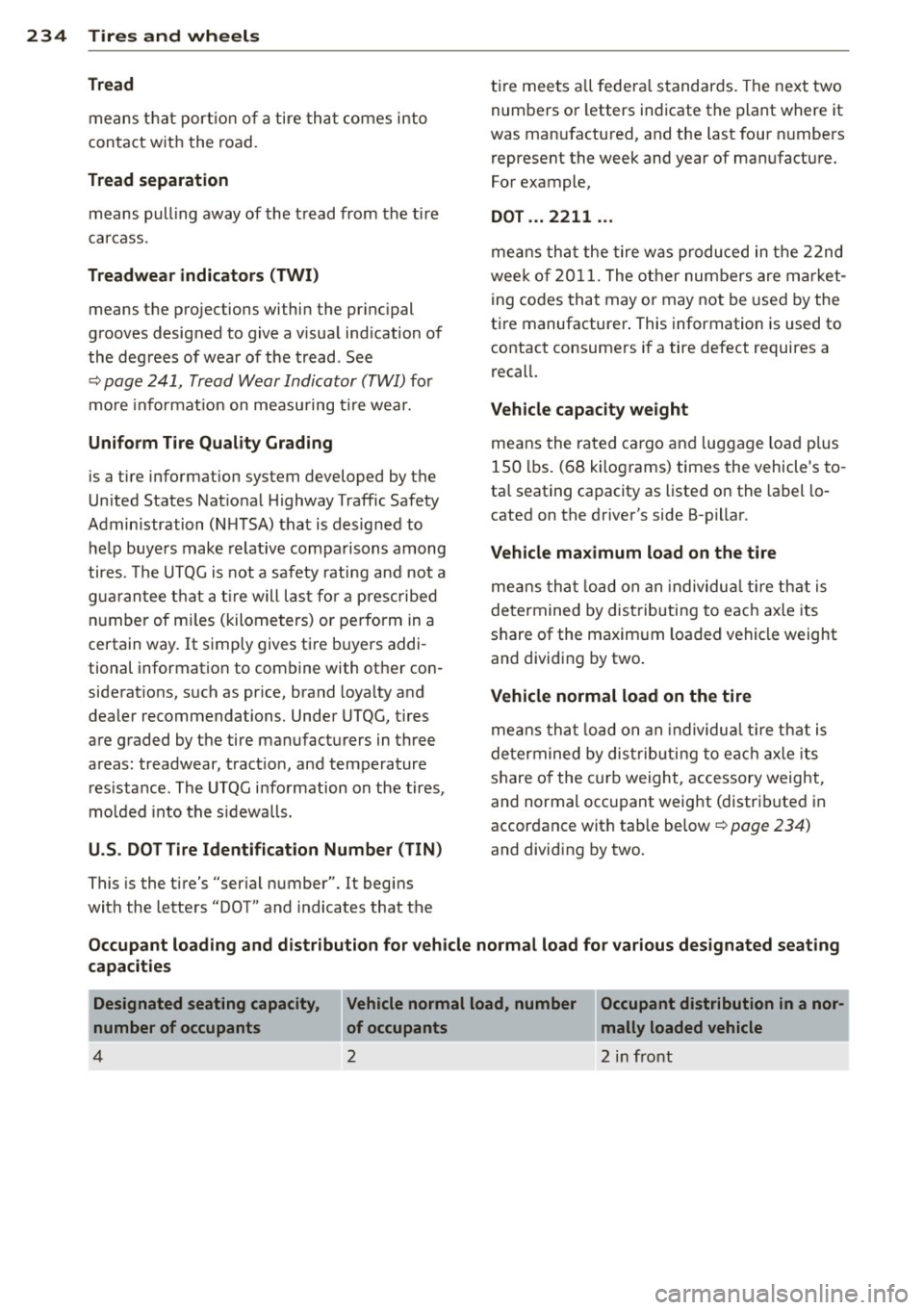
accordance with tab le below ~
page 234)
and dividing by two.
Occupant loading and distribution for vehicle normal load for various designated seating
capacities
Designated seating capacity,
number of occupants
4
Vehicle normal load, number Occupant distribution in a nor-
of occupants _____ malty loaded vehicle
2 2 in front
Page 237 of 294
Tires and wheels 235
Cold tire inflation pressure
Tire pressure affects the overall handling, performance and safety of a vehicle .
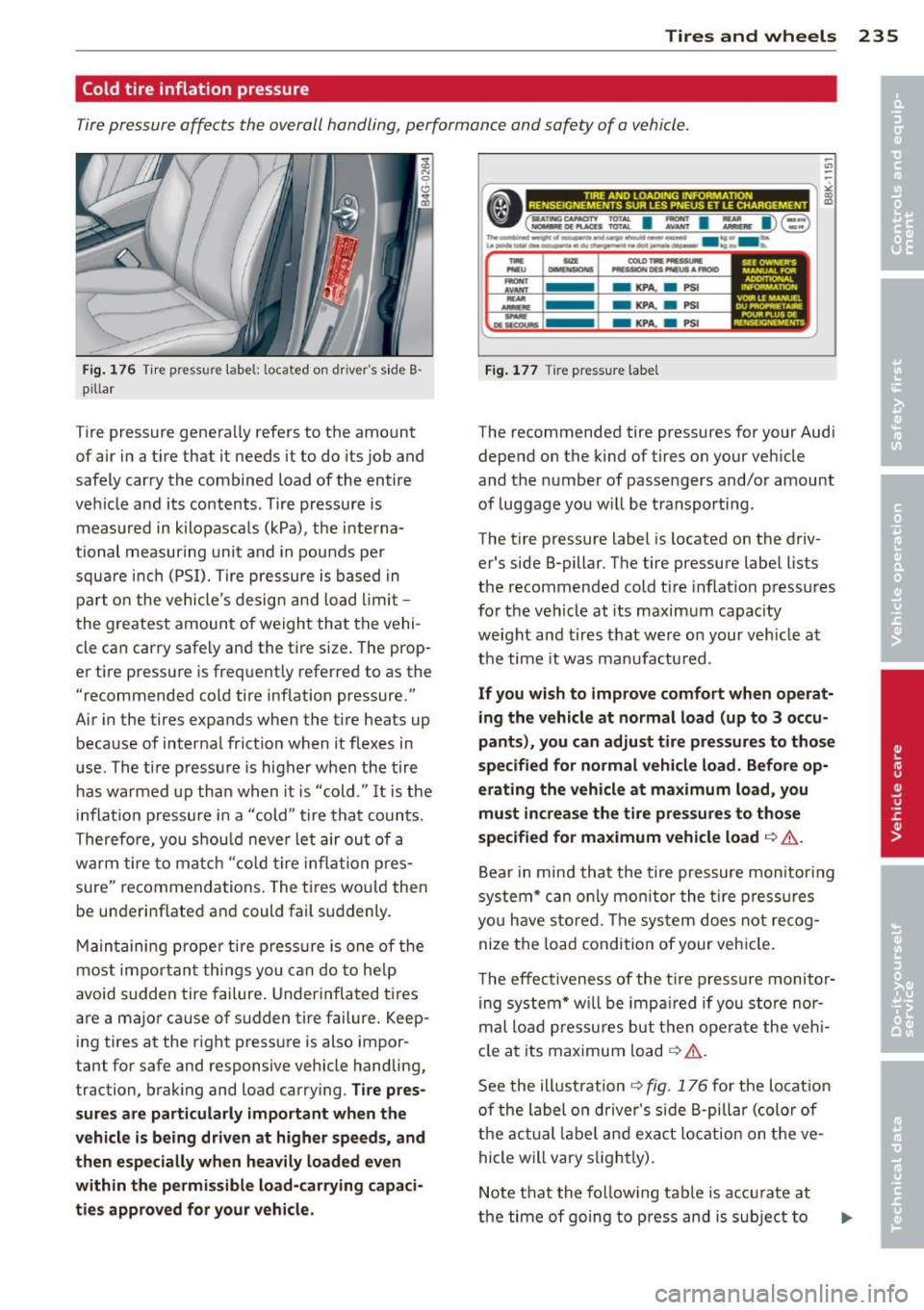
Fig . 17 6 Tir e pr essur e labe l: located on drive r's s ide B ·
p ill ar
Tire pressu re genera lly refers to the amount
of air in a t ire tha t it needs it to do its job and
safely carry the combined load of the entire
vehicle and its contents . Tire pressure is
measured in kilopasca ls (kPa), the i nterna
tional measuring unit and in pounds pe r
square inc h (PSI). Tire pressure is based in
p ar t o n the vehicle's desig n an d load limit
the greatest amount of weight that the vehi
cle can carry safe ly and the ti re size . The prop
er tire pressure is freq uent ly referred to as the
"recommended cold tire inf lation pressure ."
Air in the tires expands when the tire heats up
because of interna l frict io n when it flexes in
use . The ti re p ressu re is higher when the tire
has warmed up than when it is "cold ." It is the
i nflat io n pressure i n a "cold" tire that counts.
Therefo re, you s ho ul d never let air ou t of a
warm tire to matc h "cold tire infla tion p res
sure" recommendations . The tires wo uld then
be underinf lated a nd could fail suddenly.
M ain taining proper t ire press ure is one of the
most impor tan t thi ngs you c an do to he lp
avoid sudden tire failure. Underinfla ted tires
are a major cause of s udden tire failure . Keep
ing tires at the r ight pressure is also impor
tant for safe and responsive vehicle handling,
traction, b rak ing and load carrying .
Tire pres
sures are part icularly important wh en th e
vehicle is being driven at higher speeds , and
then especially when h eavily loaded even
within the permi ssible load -carrying capaci
tie s approved for your vehi cle.
~
"' ~
,.------------------- ~
•(=~: I := I ~ I )§ :ll
,.,,. ........................ ...., .... ~----.... _ ... t.._.. .... _..,.. .... ......,... .. ~--......... ·- ..
- KPA. . PSI
- KPA. . PSI
- KPA. . PSI
Fig. 17 7 Tir e pressu re labe l
The recommended tire pressures for your Audi
depe nd on the kind of tires on your ve hicle
and t he number of passe ngers and/or amount
of luggage you w ill be t ransporting .
The tire pressure label is located on the driv
er's side 8-pillar . The tire pressure labe l lists
the recommended cold t ire inflat io n pressures
for the veh icle at its maximum capac ity
weight and tires that we re o n your veh icle at
t h e time it was manufactu red.
If you wish to improve comfort when op erat
ing the ve hicle at normal load (up to 3 occu
pant s), you can adju st tire pres sures to those
spe cified for normal vehi cle load . Before op
erating the vehicle at maximum load, you
must increase the tire pressure s to those
speci fied for maximum vehicle load
¢ .&.
Bear in mind that the tire pressure mon itor ing
system* can on ly mon itor the tire p ress ures
yo u have sto red. The sys tem does not recog
nize the load condi tion of your veh icle.
T he effectiveness of the t ire p ress ure monitor
ing system * w ill be impa ired i f you s to re no r
m al load pressures but t hen opera te the veh i
cle a t its maximum load
¢ .& .
See the ill ustration 9 fig. 176 fo r the lo cat ion
of the label o n driver's s ide B-pillar (color of
the actu al label a nd exact lo cat ion on the ve
hicle will vary s light ly).
Note t hat the follow ing table is accu rate at
the time of going to press and is s ubject to