oil AUDI A7 2012 Owner's Guide
[x] Cancel search | Manufacturer: AUDI, Model Year: 2012, Model line: A7, Model: AUDI A7 2012Pages: 294, PDF Size: 73.33 MB
Page 224 of 294
222 Check ing and filling
and ad versely a ffect yo ur New Vehicl e
W arr ant y.
@) For the sake of the environment
- Under no circumstances can the oil come
in contact with the sewage network o r
the soil.
- Observe and follow lega l regu lations
when disposing of empty oil containers .
Changing the engine oil
We recommend that have your oil changed by
an authorized Audi dealer or a qualified serv
ice station.
Before you check anything in the engine com
partment,
a lw ays rea d an d h eed all WARN
INGS c::> .& in Working in the engine compart
ment on page 216.
The engine oil must be changed accord ing to
the intervals specified in your Warranty
&
Maintenance book let. This is very important
because the lubricating properties of oil di
minish gradua lly during normal vehicle use .
Under some ci rcumstances the engine oi l
should be changed more frequently. Change
oil more often if you drive most ly short dis
tances, operate the vehicle in dusty areas or under predominantly stop-and-go traffic con
ditions, or have your vehicle where tempera
tures remain below freezing for extended pe
riods .
Detergent addit ives in the oil w ill make fresh
oil look dark after the engine has been run n ing for a short time. This is normal and is not
a reason to change the oil more often than recommended.
Because of the problem of proper disposal,
along w ith the special tools and necessary ex
pertise required , we strongly recommend that
you have your o il changed by an authorized
Audi de ale r or a qual ified servi ce station.
If you choo se to c hang e y our oi l y our self,
please note the followi ng important informa
tion :
A WARNING
To reduce the risk of personal injury if you
must change the eng ine oil in your vehicle
yourself:
- Wear eye protect ion.
- To reduce the risk of burns from hot en- gine oil, let the engine cool down to the
touch.
- When removing the o il dra in plug with
your fingers, stay as far away as possible.
Always keep your forearm parallel to the
ground to help prevent hot oil from runn ing down you r arm.
- Dra in the oil into a container designed
for this purpose, one large enough to
hold at least the total amount of oil in
your engine.
- Engine oil is poisonous. Keep it we ll out
of the rea ch of childre n.
- Continuous contact with used eng ine o il
is harmfu l to your sk in. Always protect
your skin by washing oil off tho roughly
with soap and wate r.
@ Note
Never mix oil additives with your engine
oi l. These additives can damage your en
g ine and adversely affect you r A ud i Limit
ed New Veh icle War ranty.
@ For the sake of the environment
- Before changing your oil, first make su re
you know where you can prope rly dispose
o f the used oil.
- Always dispose of used eng ine oi l proper
ly. Do not dump it on garden soil, wood
ed areas, into open streams or down
sewage drains.
- Recycle used engi ne oil by taking it to a
used engine oil collection facility in you r
area, or contact a service station.
Page 225 of 294
Engine cooling system
Coolant
The engine coolant performs two functions: it
keeps the engine from overheating and it pro
tects the engine from freezing in the winter .
The cooling system is sealed and generally re
quires little attention .
The cooling system has been filled at the fac
tory with a permanent coolant which does not
need to be changed. The coolant consists of a
mixture of water and the manufacturer's gly
col-based coolant additive G12++ antifreeze
with anticorrosion additives (50% for USA
models; 60% for Canadian models). This mix
ture both assures the necessary frost protec
tion and protects metal components in the
engine's cooling system from corrosion and
scaling. It also raises the boiling point of the
coolant.
Do not reduce the concentration of the cool
ant in the summer by adding plain water.
The
proportion of coolant additive must be at
least 50% but not more than 60%
to main
tain antifree ze protection and cooling efficien
cy. If the coolant frost protection is too low,
the coolant could freeze and damage the vehi
cle heating and engine cooling system.
For year-round driving, antifreeze is added at
the factory for temperatures down to:
- -31 °F ( -3 5 °C) USA
- -40 °F ( - 40 °C) Canada.
You can mix the G12 ++ coolant additive with
other additives (G12+ or G12). Always check
with your authorized Audi dealer.
& WARNING
Before you check anything in the engine
compartment, always read and heed all
WARNINGS
~ .&. in Working in the engine
compartment on page 216.
(D Note
- Before winter sets in, have the coolant
checked to see if the coolant additive in
Checking and filling 223
your vehicle is sufficient to meet the cli
mate conditions. This is especially impor
tant if you live in a region where the win
ter is extremely cold. If necessary, in
crease the proportion of coolant additive
to 60% .
- When adding coolant additive to your
cooling system, remember :
- We recommend using only coolant ad
ditive G12++ (check the label) for your
vehicle. This coolant additive is availa
ble at authorized Audi dealers. Other
types of antifreeze can significantly re
duce corrosion protection. The result
ing corrosion can cause a loss of cool
ant and serious engine damage.
- Do not add any type of radiator leak seal
ant to your vehicle's engine coolant.
Adding radiator repair fluid may adverse
ly affect the function and performance of
your cooling system and could result in
damage not covered by your New Vehicle
Limited Warranty.
Checking the engine coolant level
The engine coolant level can be checked with
a quick glance.
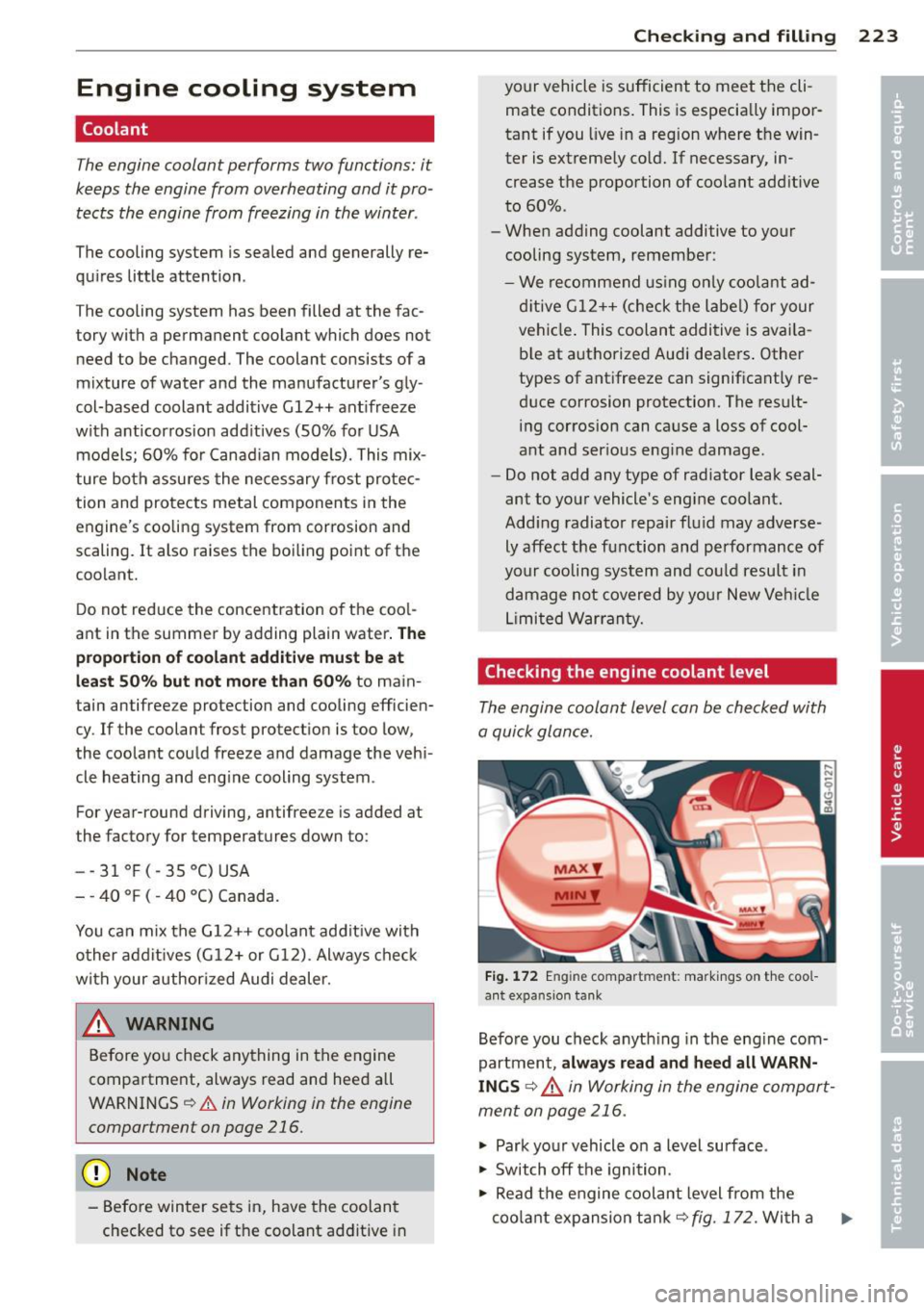
M AX f
MINf
Fig. 172 Engine compar tment: markings on the coo l
an t expa nsion tank
Before you check anything in the engine com
partment,
always read and heed all WARN
INGS ¢.&, in Working in the engine compart
ment on page 216 .
"' Park your vehicle on a level surface .
"' Switch off the ignition.
"' Read the engine coolant level from the
coolant expansion tank~
fig. 172. With a
Page 226 of 294
224 Check ing and filling
cold engine, the coo lant level should be be
tween the "min" and "max" markings. When
the engine is warm, the level may be s light ly
above the "max" marking.
The location of the coolant expansion tank
can be seen in the engine compartment illus
tration
c:> page 218.
To obtain an accurate reading, the engine must be switched
off.
The expansion tank in you r vehicle is equipped
with an e lectric coolant level sensor.
When the coolant level is too low, the warning light in the Auto-Check System
c:> page 15 will
i l lum ina te unti l you add coolant and the level
has been restored to normal. Even though
there is an electric coolant level senso r, we
still recommend you check the coolant leve l
from time to time.
Coolant los s
Coolant loss may indicate a leak in the cool ing
system. In the event of coolant loss, the cool
ing system should be inspected immediately
by your authorized Audi dealer. It is not
enough merely to add coolant.
I n a
sea led system, losses can occur only if
the boiling point of the coolant is exceeded as
a result of overheat ing.
A WARNING
The cooling system is under pressure and
can get very hot. Reduce the risk of scald
ing from hot coolant by following these
steps.
- Turn
off the engine and allow it to cool
down.
- Protect yo ur face, hands and arms from
escaping fluid and steam by covering the
cap with a large, thick rag.
- Turn the cap slowly and very carefully in
a counter-clockwise direction wh ile ap
plying light, downward pressure on the
top of the cap.
- To avoid be ing burned, do not spill ant i
freeze or coolant on the exhaust system
'
or hot engine parts. Under certain cond i
tions, the ethylene glycol in engine coo l
ant can catch fire.
(D Note
Do not add any type of radiator leak sea l
ant to your vehicle's engine coolant. Add i ng radiator repa ir fl uid may adverse ly af
fect the funct ion and performance of your
cooling system and could result in damage
not covered by your New Veh icle L imited
War ranty.
Adding coolant
Be very careful when adding engine coolant.
Before you check anyth ing in the eng ine com
partment,
always read and heed all W ARN
INGS c:> A in Working in the engine compart
ment on page 216 .
.. Turn off the engine.
.. Let the engine cool down.
.. Place a thick rag over the coolant expansion
tank
c:> page 223, fig . 172 and carefully
twist the cap co unte r-clockwise c:> .&, .
.,. Add coolant .
.,. Twist the cap on aga in
tightly.
Replacement engine coo lant must conform to
exact spec ificat ions
c:> page 223, Coolant.
E ven in a n emerge ncy, if coolant add i-
t ive G12 ++, G 12+ or G12 is not available, do
not use a d iffe rent addit ive. Use plain water
instead unti l you can get the correct additive
and can restore the correct ratio . This shou ld
be done as soon as possible.
If you have lost a considerab le amount o f
coolant, then you sho uld add cold antifreeze
and co ld water on ly w hen the engine is cold.
Always use
new engine coo la nt whe n refilling.
Do not fill coola nt above the "MAX" mark . Ex
cess coola nt will be fo rced out through the
pressure relief valve in the cap w hen the e n-
gine becomes hot. .,.
Page 241 of 294
@ For the sake of the environment
Underinflated tires will a lso increase the
fue l consumption .
Tires and vehicle load limits
There are limits to the amount of load or
weight that any vehicle and any t ire can carry.
A vehicle that is overloaded w ill not handle
well and is more difficult to stop. Overload ing
can not only lead to loss of vehicle control, but can a lso damage importan t pa rts of the
ve hicle and can lead to s udden tire failure, in
cluding a blowout and sudden deflation that
can cause the veh icle to crash.
Your safety and that of yo ur passenge rs a lso
depends on making s ure that load limits are
not exceeded . Vehicle load includes everybody
and everything in and on the vehicle. These
load limits are technica lly referred to as the
vehicle's
Gross Veh icle We ight R ating
("GVWR").
The "GVWR" includes the weight of the basic
vehicle, all factory insta lled accessories, a full
tank of f ue l, oil, coolant and other fluids plus
maximum load. The maximum load includes
the number of passengers that the vehicle is intended to carry ("seating capacity") with an
assumed weight of 150 lbs (68 kg) for each
passenger at a des ignated seat ing pos ition
and the total we ight of any l uggage in the ve
hi cle. If you tow a trailer, the weight of the
trailer hitch and the tong ue weight of the
loaded trailer must be included as part of the
vehicle load.
The
Gro ss Axl e W eight R ating ("GAWR") is
the maximum load that can be app lied at each
of the vehicle's two axles.
The Gross Vehicle Weight Rating and the
Gross Axle Weight Rating a re listed on the
safety compliance sticker labe l located on the
driver's side B -pillar . Your A udi has 4 seating
positions, 2 in the front and 2 in the rear for
total seating capacity of 4. Each seating pos i
tion has a safety belt¢
page 128, Safety
belts .
Tire s an d wheel s 239
The fact that there is an upper limit to your
vehicle's Gross Vehicle Weight Rating means
that the total weight of whatever is being car
ried in the vehicle ( includ ing the weight of a
trailer hitch and the tongue weight of the
loaded tra iler) is lim ited. The more passen
gers in the vehicle or passengers w ho are
heavier than the standard we ights assumed
mean that less we ight can be ca rried as lug
gage.
The tire pressure label on your Aud i also lists
the maximum combined weight of a ll of the
occupants and luggage or other cargo that
the ve hicl e can carry . For t he locat ion of the
label¢
page 235, fig . 176.
.&_ WARNING ~
Overloading a vehicle can cause loss of ve -
h icle contro l, a crash or other accident, se
rious personal injury, and even death.
- Carrying more weight than your vehicle
was designed to carry wi ll prevent the
veh icle from handling properly and in
crease the risk of the loss of vehicle con
trol.
- The brakes on a vehicle that has been
overloaded may not be able to stop the
veh icle w ith in a safe distance.
- Tires on a vehicle that has been over load
ed can fail suddenly, including a blowout
and sudden deflation, causing loss of
control and a crash .
- Always make sure that the total load be
ing transported -includ ing the weight of
a t railer hitch and the tongue we ight of a
loaded trailer - does not ma ke t he vehi
cle heavier than the vehicle's G ross Vehi
cle Weight Rating.
Determining correct load limit
U se th e exa mple below to cal
c ulat e the total weight of the
pa ssen ger s a nd lu ggag e or ot h-
e r thin gs that you pl an t o .,..
•
•
Page 244 of 294

242 Tires and wheels
& WARNING
Sudden tire failure can lead to loss of con
trol, a crash and serious personal injury!
- Never drive a vehicle when the tread on
any tire is worn down to the wear indica
tors.
- Worn tires are a safety hazard, they do
not grip well on wet roads and increase
your risk of "hydroplaning" and loss of control.
- Always keep chemicals that can cause tire damage, such as grease, oil, gasoline
and brake fluid away from tires.
- Tires age even if they are not be ing used
and can fail suddenly, especially at high
speeds. Tires that are more than 6 years
old can only be used in an emergency
and then with special care and at lower
speeds.
- Never mount used tires on your vehicle if
you are not sure of their "previous histo
ry." Old used tires may have been dam
aged even though the damage cannot be
seen that can lead to sudden tire failure
and loss of vehicle control.
New tires and replacing tires and wheels
New tires and wheels have to be broken in .
Fig. 180 Tir e specificat ion codes on the s idewall of a
t ire
No. Description
(!) Passenger car tire (where applicable)
@ Nominal width of t ire in millimeters
@ Ratio of height to width (aspect ratio)
© Rad ial
® Rim diameter code
@ L oad index and speed rating
(J) U.S. DOT tire identification number
@ Audi Original tire
@ Sever snow conditions
@ T ire ply composition and materials
used
Maximum load rating
Treadwear, traction and temperature
grades
Maximum permissible inflation pres
sure
T he tires and rims are essential parts of the
vehicle 's design . The tires and rims approved
by Audi are spec ially matched to the charac
teristics of the vehicle and can make a major .,..
Page 250 of 294
248 Tire s and whee ls
Where snow chains are mandatory oncer
tain roads, this normally also applies to ve
hicles with a ll-wheel drive.
Wheel bolts
Wheel bolts must always be tightened to the
correct torque .
The design of whee l bolts is matched to the
factory insta lled rims . If different rims are fit
ted, the correct wheel bolts with the r ight
length and correctly shaped bolt heads must
be used. This ensures that wheels are fitted
securely and that the brake system functions
correctly .
In certain circumstances, you may not use
wheel bolts from a different vehicle -even if it
is the same model
r=> page 275.
A WARNING
Improperly tightened or maintained wheel
bolts can become loose caus ing loss of
cont ro l, a co llision and serious persona l in
Jury .
- Always keep the wheel bolts and the
threads in the wheel hubs clean so the
wheel bolts can turn easily and be prop
er ly t ightened .
- Never grease or oil the wheel bo lts and
the threads in the wheel hubs. They can
become loose while d riving if greased or
oiled, even if tightened to the specified
torque.
- Only use wheel bolts that belong to the
rim being installed.
- Never use different whee ls bolts on your
vehicle.
- Always maintain the co rrect tighten ing
torq ue fo r the wheel bo lts to reduce the
risk of a wheel loss . If the tightening tor
que of the wheel bo lts is too low, they
can loosen and come out w hen the veh i
cle is moving. If the tighteni ng torque is
too high, the whee l bolts and threads can be damaged and the whee
l can be
come loose.
@ Note
The specified torque for the whee l bolts is
90 ft lb (120 Nm) with a tolerance of± 7,4
ft lb(± 10 Nm) . Torque whee l bolts diago
nally. After changing a whee l, the torque
must be checked as soon as possible with a
torque wrench -preferably by an author
i zed Audi dealer or qualified workshop .
Low aspect ratio tires
Your Audi is factory-eq uipped w it h low aspect
ratio tires. These tires have been tho roughly
tested and been se lected specifically fo r your
model for their superb perfo rmance, road fee l
and handling under a variety of driving condi
t ions . Ask your author ized A udi dealer for
more details.
T he low aspect ratio of these tires is ind icated
by a numera l of
55 or less in the tire's s ize
designation. The numera l represents the ratio
of the tire's sidewa ll height in relation to its
tread width expressed in percentage. Conven
t iona l tires have a he ight/w idth ratio of 60 or
more .
The performance of low-aspect -ratio tires is
particularly sens iti ve to imp roper inflation
pre ssure. It is therefore important that low
a spect ratio tires ar e inflat ed to the specified
pre ssure and that the inflation pressure i s
r e gularly ch ecked and maintain ed. Tire pre s·
sure s should be checked at lea st once a
m onth and alw ays bef ore a long trip
r=> page 237, Checking tire pressure .
What you can do to avoid tire and rim
damage
Low aspect ratio tires can be d amaged more
easily by impact with potholes, curbs, gull ies
or ridges on t he road, particularly if the tire is
u nd eri nflated.
Page 263 of 294

Fuse panel@ (bl ack )
No. Equipment
Vehicle electrical system control
6 module 1, Vehicle e lectr ica l sys-
tern control module 2
7 Audi adaptive cruise control
8
Airbag control module, front
passenger 's seat sensor system
9 Gateway
Homelink (garage door opener),
10 night vision system contro
l
module
Image processing (Audi active
11 lane assist , Audi adaptive cruise
control)
12 Steering
13 Terminal 15 in the luggage com-
partment
14 Terminal 15 in the
instrument
panel (front passenger's s ide)
15 Terminal 15 engine
16 Starter
Fuse panel e (brown)
No . Equipment
1 Gateway
2 Climate control
3 ESP co ntrol module
Front door (driver's side)
5
Power seat adjustment (dr iver's
seat)
6
Steering
7 Sunroof
8
Rear door control module (driv-
er's side)
9
Lumbar suppor t (Fro nt p assen-
ger seat)
11 Sunroof, rear spoiler
12 Driver door control mod ule
Amps
5
10
5
5
5
10
5
15
30 15
4 0
Amps
5
10
10
30
7,5 35
20 1 5
5
20
1 5
Fu se s and bulb s 261
Fuse panel © (red )
No. Equipment
2 Fue l pump
3 Brake light sensor/brake pedal
sensor system
4 Engine acoust ics
5 Rear door control module (driv-
er's side)
6 Left rear seat
7 Horn
8 Win dsh ield wipe r
9 Light/rain sensor
10 L
u mbar support (dr iver seat)
11 Front passenge
r door control
module
12 Right rear door control mod
ule
Front passenger side cockpit fuse
assignment Amps
2
5
5/5
7,5 30
7,5 15
30
5
5
15 15
Fi g. 195 Fro nt passe nge r side cock pit : fu se pa nel with
p last ic bracket
Fuse panel A (black )
No. Equipment
1 Head-up D isplay
2 MMI Display
3 CD/DVD changer
Chip card reader (not in all coun-
5 tr ies)
6 Instrument cluster
Amps
5
5
5
7,5
5
5
7 Steeri ng col umn switch module 5
Page 264 of 294

262 Fuses and bulb s
Fuse panel @ (black )
No . Equ ipment Amps
=
8
Headlight range adjustment/
5/7,5
adaptive lighting system
10 Left headlight (headlight with
7,5
adaptive light)
Fuse panel
@ ( brown )
No .II Equ ipm ent
II Amp s
1 Climate control 10
2 Climate control system blower 40
3 Diagnostic connector 10
4 Electrical ignition lock 5
5 Power steering column adjust-
ment
5
Steering column switch module 10
7 Power steer
ing column adjust-
ment 25
8 Light switch
Luggage compartment fuse assignment
Fig. 196 Luggage compartment: fuse panel with plas·
tic bracket
Fuse panel @ (bl ack )
No. II Equipment
I[ Amp s
4 E lectromechanical parking brake 30
5 Electromechanical parking brake 30
6 Front door (front passenger's
35
side)
7 Rear exterior lighting Rear sun shade, closing aid, lug
s gage compartment lock, con
venience key, START ENGINE
STOP, fuel filler door 30
20
-Fuse pane
l@ (blac k) I
No. Equipm ent Amps
=· 9 Power seat adjustment 15
10 Parking system
s
30
Fus e pane l
B (red)
No . Equipment Amps
1 Left belt tensioner
25
Right belt tensioner 25
3 Socket 20
20
Electromechanical parking brake
5
adaptive air suspension 15
7 Rear door (front passenger's
35
side)
Rear exterior lighting 30
9
Luggage compartment lid con-
30
t rol module
10 Telephone 5
11 Sound amp lifier 30
12 Rear spoiler 20
Fuse pane l c (b rown )
No. Equipment Amps
1 Rad
io receiver, Sound amplif ier/
30/20
MMI unit/dr ives
2 Tank leak detection system 5
AEM control module/battery 15/
4
module 7,5
6 Battery fan 35
Rad io receiver
7,5
7,5
9
Automatic dimming interior
5/15
rearview mirror/battery module
Parking system 5
Fu se panel o (gre en)
No. Equipment Amps
1 Audi pre sense 5
2 Electromechanical parking brake 5
3 adaptive a
ir suspension
5
Automatic transmission 7,5
...
Page 270 of 294

268 Emergency situations
@ Tips
Check carefully to make sure the hook- up
is sec ure before moving the ca r up the flat
bed truck ramp.
Lifting vehicle
Lifting with workshop hoist and with
floor jack
T he vehi cle may only be li~ed at the lifting
points illustrated .
Fig. 204 Front lift ing po int
Fi g. 205 Rear lift ing point
• Read and heed WARNING q &_ .
• Locate lifting points qfig. 204 and
qfig. 205.
• Adjust lift ing arms of workshop hoist or
floor jack to match vehicle lifting points.
• Inse rt a r ubber pad betw een the floor jack/
wor kshop hoist and the lifti ng points.
If you must lift your vehicle with a floor jack
to work underneath, be sure the vehicle is
safely supported on stands intended for thi s
purpose .
Front lifting point
The lifting point is located on t he floor pan re
i n forcement about at the same level as the j
ac k mounting po int
~ fig. 204. Do not lift
the veh icle at the vertical sill reinforcement .
Rear lifting point
The lifti ng po int is located o n the vert ica l rein
f orcemen t of the lowe r sill for the on- boar d
j a ck
q fig . 205.
Lifting with vehicle jack
Refer to ¢ page 256 .
A WARNING
-- To reduce the risk of s erio us injury and
ve hicl e damage.
- Always lift the vehicle only at the spe
c ia l workshop hoist and floor jack lift
po ints illustrated
¢ fig. 204 and
q fig. 205.
-Fail ure to lift the ve hicle at these
po ints could cause the vehicle to tilt or
fall from a lift if there is a change i n ve
h icle weight distribution and balanc e.
T his mig ht happen, fo r example, whe n
h eavy com ponen ts such as the eng ine
b lo ck o r trans mission a re remove d.
- W hen removi ng heavy compone nts like
t hese, anch or vehicle to h oist or ad d cor
resp onding we ig hts t o main tain t he cen
t er of gravity. Oth erwise, t he ve hicle
might tilt or slip off the ho ist , ca using
serio us personal injury.
(D Note
- B e aw are o f the followin g poin ts before
li ft ing t he vehicle:
-The vehicle should never be lifted or
jacked up from underneath the engine oil pan, the transmission housing, the
front or rear axle or the body side
members. This could lead to serious
damage .
- To avoid damage to the underbody or
chas sis frame, a rubber pad must be
inserted between the floor jack and
the lift points.
-
- Before driving over a workshop hoist,
check that the vehicle weight doe s not .,..
Page 273 of 294

designated seating position) and luggage
weight~&. .
Gros s Axle W eight Rating
The G ross Axle Weight Rating is the maximum
l oad tha t can be applied at each axle of the
vehicle
q .&. .
Vehicle capacit y weight
The vehicle capac ity we ight (max. load) is list
ed either on the dr iver's side B-pillar or inside
the fuel filler flap.
Roof weight
The max imum perm issible roof weight is
22 0 lb (100 kg ). The roof weight is made up
of the weight of the roof rack system and the
weight of the object be ing transported
q page 58, Loading the roof rack .
.&, WARNING
- T he ac tual Gross Axle Weight Rat ing at
the front and rear axles shou ld not ex
ceed the permiss ible weights, and their
combination must not exceed the Gross
Vehicle Weight Rat ing .
- Exceeding permissib le weight ratings can
result in vehicle damage, accidents and
personal injury.
CD Note
- The vehicle capacity weight figures apply
when the load is distributed evenly in the
vehicle (passengers and luggage) . When
transporting a heavy load in the luggage
compartment, carry the load as near to
the rear axle as possib le so that the veh i
cle's handling is not impa ired.
- Do not exceed the maximum permissible
axle loads or the max imum gross vehicle
weight . Always remember that the vehi
cle's handling will be affected by the ex
tra load. Therefore, adjust you r speed ac
cord ingly.
- Always observe loca l regu lations.
-
G ene ral in formation 2 7 1
Dimensions
The specifications refer to the basic model.
Differences may occur depending on the mod
el type and options ordered, for example, tire
sizes.
CD Note
When driving up steep ramps, on rough roads, over curbs, etc. it is important to re
member that some parts of your vehicle,
such as spoilers or exhaust system compo nents, may be close to the ground . Be
careful not to damage them .
•
•