oil pressure AUDI A7 2012 Owners Manual
[x] Cancel search | Manufacturer: AUDI, Model Year: 2012, Model line: A7, Model: AUDI A7 2012Pages: 294, PDF Size: 73.33 MB
Page 5 of 294
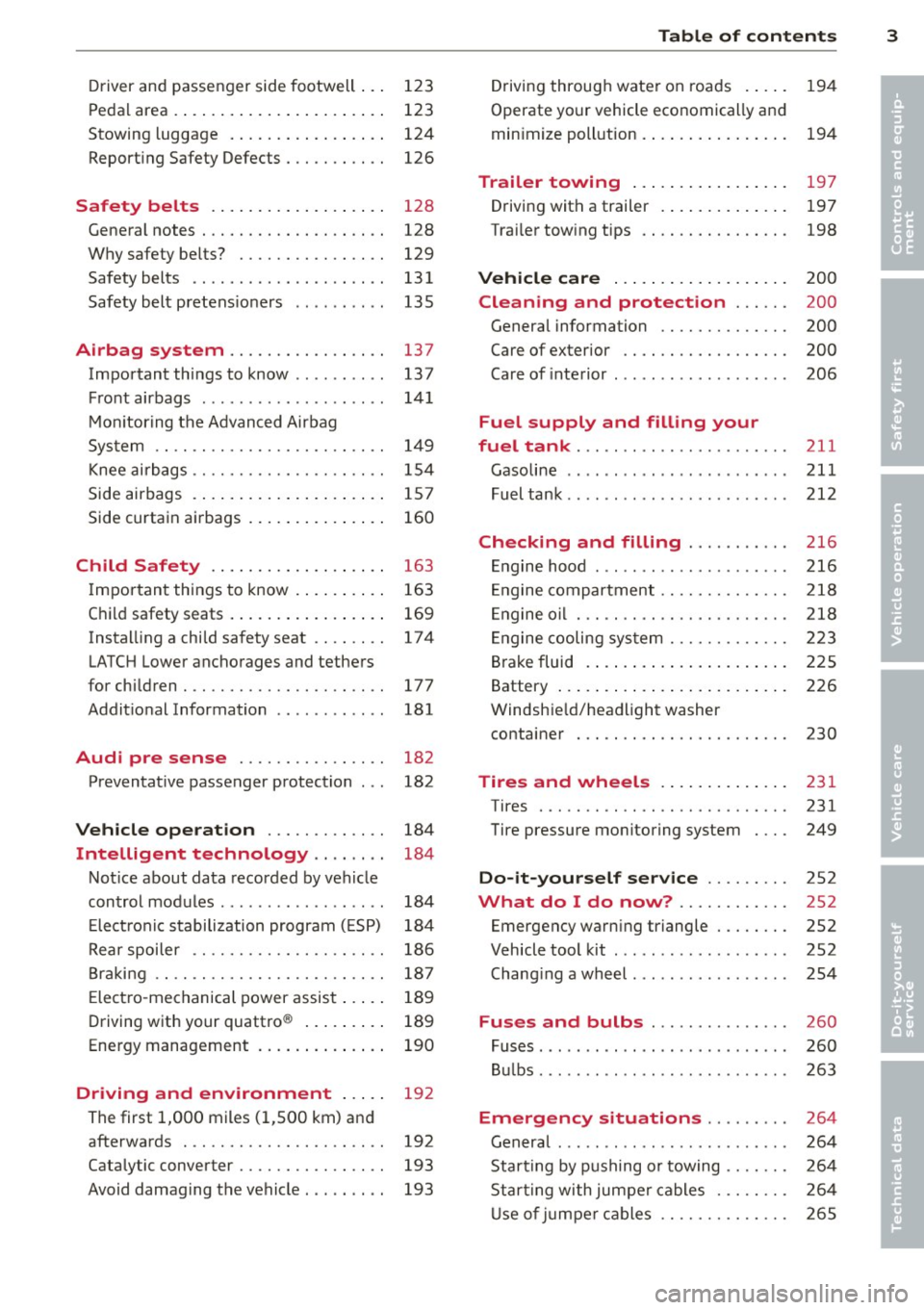
Driver and passenger side footwell . . . 123
Pedal area . . . . . . . . . . . . . . . . . . . . . . . 123
Stowing luggage . ..... ... .. .. .. .. 124
Report ing Safety Defects . . . . . . . . . . . 126
Safety belts ... ..... ... .. .. .. . .
General notes ............ .... .. . .
Why safety belts? ........ .... .. . .
Safety belts ............ .... ... . .
Safety belt pretens ioners ...... .. . . 128
128
129
131
135
Airbag system ................. 137
Important things to know . . . . . . . . . . 137
F ront airbags . . . . . . . . . . . . . . . . . . . . 141
Mo nitoring the Advanced Airbag
System . . . . . . . . . . . . . . . . . . . . . . . . . 149
Knee airbags . . . . . . . . . . . . . . . . . . . . . 154
Side airbags . . . . . . . . . . . . . . . . . . . . . 157
Side curtain airbags . . . . . . . . . . . . . . . 160
Child Safety .. .. .... ... .. .. ... .
Important things to know . ... .. .. . .
C hild safety seats . ..... ... .. .. .. . .
Instal ling a child safety seat .. .. .. . .
LATCH Lower anchorages and tethers
for chi ldren . ............. .... .. . .
Addit ional Information 163
163
169
174
177
181
Audi pre sense . . . . . . . . . . . . . . . . 182
Preventat ive passenger protection 182
Vehicle operat ion . . . . . . . . . . . . . 184
Intelligent technology . . . . . . . . 184
Not ice about data recorded by veh icle
control modules . . . . . . . . . . . . . . . . . . 184
E lect ron ic stabilization program ( ESP) 184
Rear spoiler . . . . . . . . . . . . . . . . . . . . . 186
Braki ng . . . . . . . . . . . . . . . . . . . . . . . . . 18 7
E lect ro-mechanical power assist . . . . . 189
Driving with your quattro ® . . . . . . . . . 189
Energy management . . . . . . . . . . . . . . 190
Driving and environment . . . . . 19 2
The first 1,000 miles (1 ,500 km) and
afterwards . . . . . . . . . . . . . . . . . . . . . . 192
Catalytic converter . . . . . . . . . . . . . . . . 193
Avoid damaging the vehicle. . . . . . . . . 193
Table of contents 3
Driving through wate r on roads . . . . . 194
Operate yo ur vehicle economically and
min imize poll ution. .. .. ... .... ... . 194
Trailer towing . . . . . . . . . . . . . . . . . 197
Driving with a trailer . .. ..... ... .. .
Trai ler tow ing tips
Vehicle care ...... .. .. ..... ... .
Cleaning and protection ..... .
197
198
200
200
General information . . . . . . . . . . . . . . 200
Care of exterior . . . . . . . . . . . . . . . . . . 200
Care of interior . . . . . . . . . . . . . . . . . . . 206
Fuel supply and filling your
fuel tank .............. .........
211
Gasoline . . . . . . . . . . . . . . . . . . . . . . . . 211
Fuel tank .. .. .. .. .. . .. .... ...... . 212
Checking and filling . . . . . . . . . . . 216
En gine hood . . . . . . . . . . . . . . . . . . . . . 216
E ngine compartment........... ... 218
E ngine o il . . . . . . . . . . . . . . . . . . . . . . . 218
E ngine cooling sys tem . . . . . . . . . . . . . 223
Brake fluid . . . . . . . . . . . . . . . . . . . . . . 225
Battery . . . . . . . . . . . . . . . . . . . . . . . . . 226
Windsh ie ld/headlight washer
container . . . . . . . . . . . . . . . . . . . . . . . 230
Tires and wheels . . . . . . . . . . . . . . 231
Tires . . . . . . . . . . . . . . . . . . . . . . . . . . . 231
Tire pressure monitoring system 249
Do-it-yourself service . . . . . . . . . 252
What do I do now? . . . . . . . . . . . . 2S2
Emergency warn ing triangle . . . . . . . . 252
Vehicle tool kit . . . . . . . . . . . . . . . . . . . 252
Chang ing a wheel . . . . . . . . . . . . . . . . . 254
Fuses and bulbs . . . . . . . . . . . . . . . 260
Fuses ........ ... .. .............. 260
Bul bs. . . . . . . . . . . . . . . . . . . . . . . . . . . 263
Emergency situations . . . . . . . . . 264
General . . . . . . . . . . . . . . . . . . . . . . . . . 264
Star ting by pushing or towing . . . . . . . 264
Starting with jumpe r cable s . . . . . . . . 264
U se o f ju mpe r cables . . . . . . . . . . . . . . 265
•
•
Page 14 of 294
12 Instrum ent s and w arn ing /indic ato r light s
compartment, stop the engine and let it
cool down. Always exercise extreme cau
tion when work ing under the hood
¢ page 210, Engine compartment
Malf u nctions or faults wi ll be identified ei
ther with a red symbol (pr iority 1 -Dan
ger!) or with a yellow symbol (priority 2 -
Warn ing).
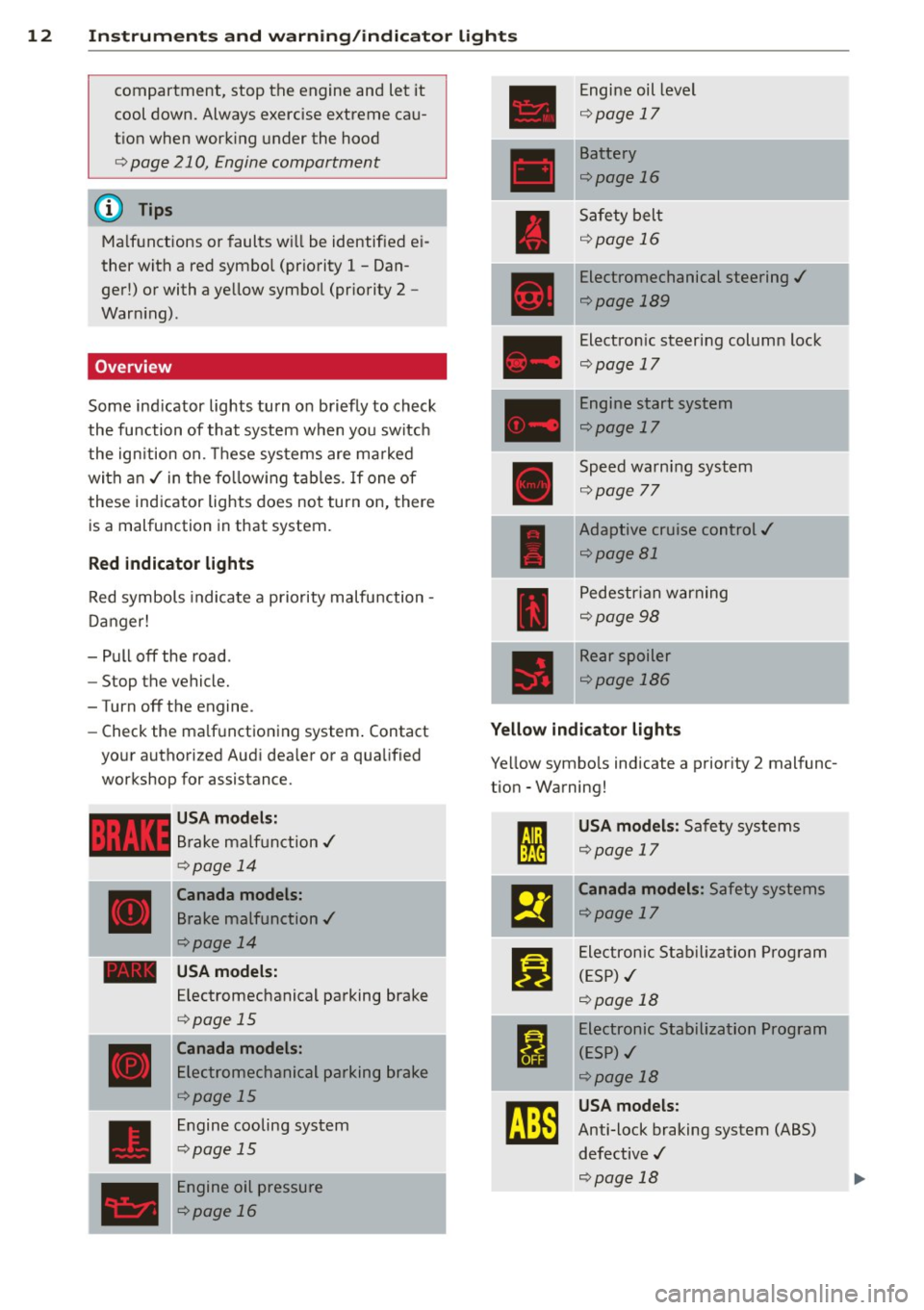
Overview
Some indicator lights turn on briefly to check
the function of that system when you switch
the ignition on. These systems are ma rked
with an./ in the follow ing tab les. If one of
these indicator lights does not turn on, there
is a malfunction in that system.
Red indicator lights
Red symbols indicate a priority malfunction -
Danger!
- Pull off the road.
- Stop the vehicle.
-Turn off the engine.
- Check the ma lfunctioning system. Contact
your authorized Audi dealer or a qualified
workshop for assistance.
USA model s:
Brake ma lf u nction./
¢page 14
Canada model s:
Brake malfunction ./
¢page 14
- USA model s:
____ ,
Electromechanical parking brake
¢ page 15
Canada models:
Electromechanical parking brake
¢page 15
Engine cooling system
¢page 15
Engine oil pressure
¢page 16
I
Engine oil level
¢ page 17
Battery
Qpage 16
Safety belt
¢page 16
Electromechanical steering ./
¢page 189
Electronic steering column lock
Qpage 17
Engine start system
¢page 17
Speed warning system
Qpage 77
Adaptive cruise control./
Qpage 81
-
Pedestrian warning
¢page98
Rear spoiler
¢page 186
Yellow indicator light s
Yellow symbo ls indicate a priority 2 malfunc-
tion - Warning!
I
USA model s: Safety systems
Qpage 17 '
m
Canada models : Safety systems
Qpage 17
Ji]
Electronic Stab ilizat ion Program
(ESP)./
¢page 18
I
Electronic Stabilization Program
(E SP)./
¢page 18
rJ}E
USA models:
Anti-lock braking system (ABS)
defective ./
Qpage 18
I
Page 15 of 294
Instrument s and warnin g/indic ator ligh ts 13
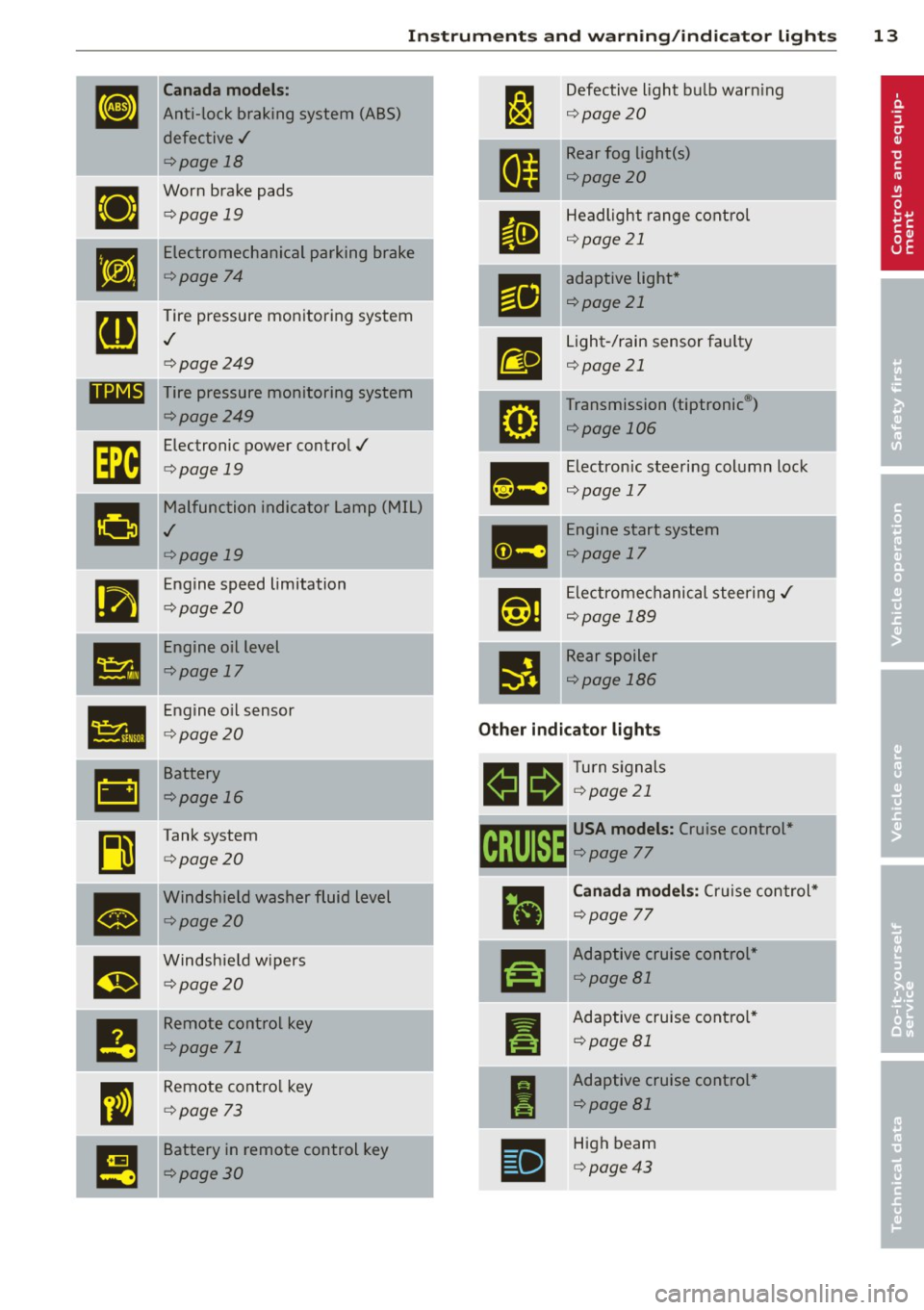
Canada models:
Anti-lock braking system (ABS)
defective ./
c:>page 18
Worn brake pads
c:>page 19
Electromechanical parking brake
c:>page 74
Tire pressure mon itoring system
./
c:> page249
-pa ....,.,.. -,,
ll@l@t Tire pressure monitoring system
-
•
•
-
•
•
m
-
I!
c:>page2 49
Electronic power contro l ./
c:> page 19
Malfunction indicator Lamp (MIL)
./
c:>page19
Engine speed limitation
c:>page 20
Engine oil level
c:>page 17
Engine o il sensor
c:> page20
Battery
c:>page 16
Tank system
c:>page20
Windshield washer fluid level
c:>page20
Windshie ld w ipers
c:>page20
Remote control key
c:>page 71
Remote cont ro l key
c:> page 73
Battery in remote control key
c:>page30
-
Defective light bu lb warn ing
9 page20
Rear fog light(s)
c:>page20
Headlight range cont rol
9 page 21
-
adaptive lig ht*
¢page 21
Light-/rain sensor faulty
¢page 21
Transmission (tiptronic®)
c:>page 106
Electronic steering col umn lock
9page 17
Engine start system
c:>page 17
Ele ctrome chanical steering ./
¢page 189
-
Rear spoiler
c:>page 186
Other indicator light s
11!1 a Turn s ignals
Iii !!!9':ii ¢ page 21
~ USA models: Cruise con trol*
~ c:> page 77
• -
r!I
I
I
Canada models : Cruis e control*
¢page 77
-
Adaptive cruise control *
c:>page Bl
Adaptive cruise cont ro l*
¢page Bl
Adaptive cruise control *
¢page 81
High beam
c:>page43
Page 18 of 294
16 Instrum ent s and w arn ing /indic ato r light s
-The engine compartment of any vehicle
is a dangerous area. Before you perform
any work in the engine compartment,
turn of the eng ine and allow it to cool.
Follow the warning stickers¢
page 210,
Engine compartment.
@ Note
Do not continue driving if the. symbol
illuminates. There is a malfunct ion in the
eng ine cooling system -you could damage
your eng ine .
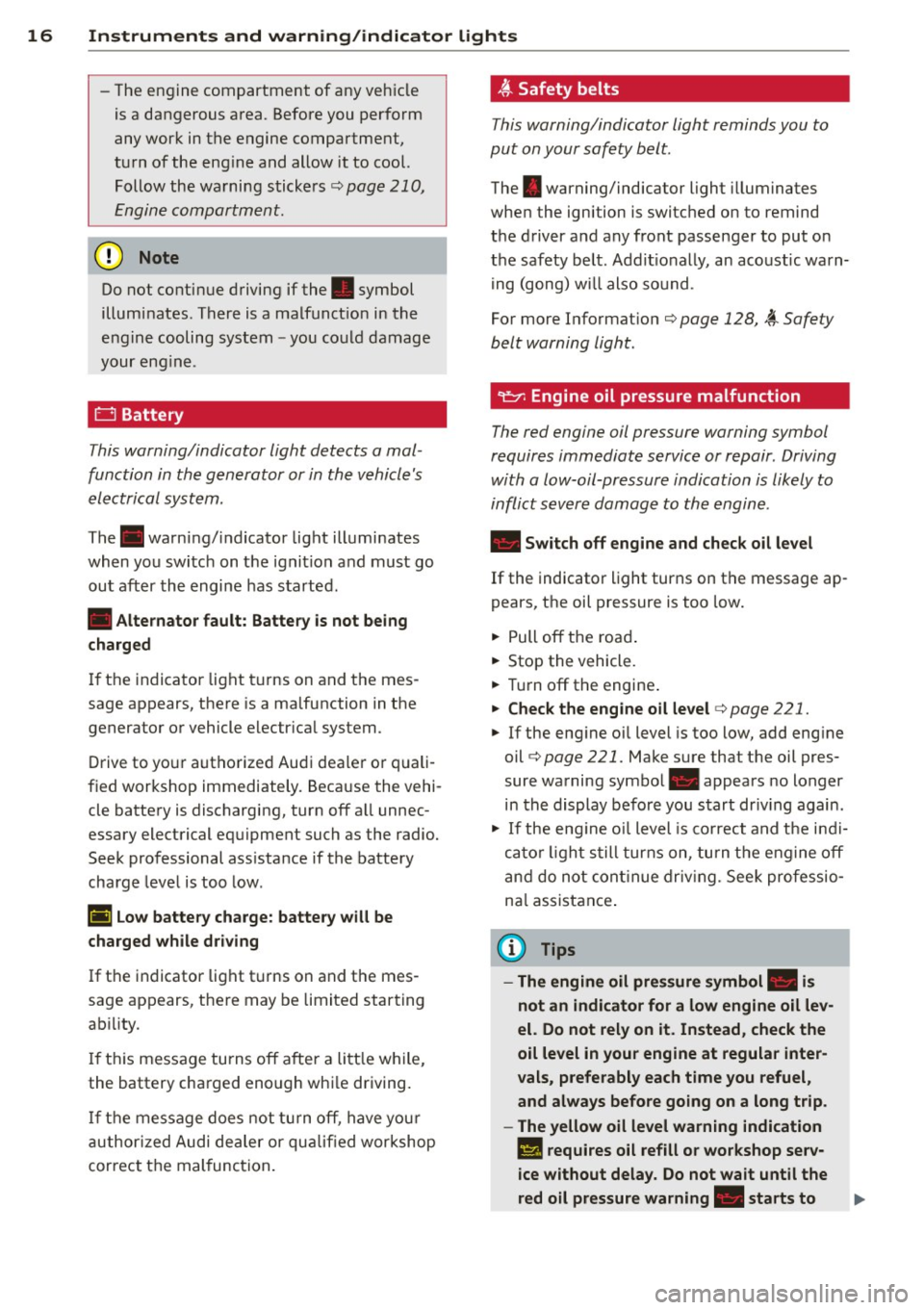
0 Battery
This warning/indicator light detects a mal
function in the generator or in the vehicle's
electrical system.
The .warning/indicator light illuminates
when you sw itc h on the ignit ion and must go
out after the engine has started .
• Alte rnator fault: Batte ry is not being
c ha rged
I f the indicator light t urns on and the mes
sage appears, there is a malfunction in the
generator or vehicle electr ica l system.
Drive to yo ur authorized Audi dea ler or quali
fied workshop immediately. Because the vehi
cle battery is discharging, turn off a ll unnec
essary electrical equ ipment such as the radio.
Seek professional ass istance if the battery
charge level is too low .
(•i Low battery charge: b atte ry will be
cha rged while dri ving
If the indicator light turns on and the mes
sage appears, there may be limited starting
ab ility.
If th is message turns off after a litt le while,
the battery charged enough whi le driving.
I f the message does not turn off, have you r
author ized Audi dealer or qua lified workshop
correct the mal function.
,(,. Safety belts
This warning/indicator light reminds you to
put on your safety belt.
The . warning/indicator light illuminates
when the ignition is switched on to remind
the driver and any front passenger to put on
the safety belt. Addit ionally, an acoustic warn
ing (gong) wi ll also sound .
For more Information¢
page 128, ~ Safety
belt warning light .
"l!::7": Engine oil pressure malfunction
The red engine oil pressure warning symbol
requires immediate service or repair . Driving
with a low-oil-pressure indication is likely to
inflict severe damage to the engine .
• Swit ch off engine and check oil le vel
If the indicator light turns on the message ap
pears, the oil pressure is too low .
"" Pull off the road .
... Stop the vehicle.
... Tu rn off the engine .
... Check the engine oil level ¢ page 221.
"" If the eng ine oil level is too low, add eng ine
oil
¢ page 221. Make sure that the oil pres
sure warning symbol. appears no longer
in the display befo re you start dr iv ing again .
"" If the eng ine o il level is co rrect and the i ndi
cato r ligh t still turns on, tu rn the engine off
and do not cont inue dr iv ing. Seek professio
na l assistance .
@ Tips
- The engin e oil pressure symbol. is
not an indicator for a low engine oil lev
el. Do not rel y on it. In ste ad, check the
oil level in your engine at regula r inter
vals, p referably each time you refuel ,
and always be fore going on a long tr ip.
- The yellow oil level warning indication
II requires oil refill or workshop se rv
i ce without delay. Do not wait until the
red oil pressure warning. sta rts to
Page 74 of 294

72 On the road
By pressing the I STAR T ENGINE S TOP I button
without depressing the brake peda l, the igni
tion is on and switched
off by pressing it
again .
After a cold engine is started, the re may be a
brief period of increased noise because oil
pressure must first bu ild up in the hydraulic
va lve adjusters. This is normal and not a cause
f or concern.
If the engine should not start immediately,
the starting process is automatically stopped
after a short time . Repeat starting procedure.
Driver m essag e in th e in strum ent clu ster
d is pl ay
P re ss brake pedal to sta rt engi ne
This message appears if you press the
I START ENGINE STOP ! button to start the en
gine and do not depress the brake peda l. The
engine can on ly be started if the brake pedal
is depressed.
B C o nve nience ke y: Is ke y not in th e vehi
cle?
This message appears a long with the B sym
bol i f the master key is removed from the ve
hicle with the engine r unning . It is intended
to remind you (e .g . when changing drivers)
not to continue the journey without the mas
te r key .
If the master key is no longer in the vehicle,
you cannot switch on the ignit ion after stop
ping the engine and yo u also cannot start the
engine again. Moreover, you cannot lock the
vehicle from the outs ide with the key.
S hift to P , o ther wise v ehicl e can roll away.
Doors do not lock if le ver i s not i n P.
This message appears for sa fe ty reasons
a long w ith an audib le warning tone if the
P
selector lever posit ion is not engaged when
stopping the eng ine with the
I STAR T ENGINE S TOP ! button. Select the P se
lector lever posit ion. Otherwise the veh icle
could roll and it cannot be locked .
Key not recogni sed . H old bac k of ke y against
ma rked are a. See o wner' s manual.
If the indicator l ight turns on and this mes
sage appears, there is a malf unct ion
¢ page 73.
Steering lock
The steering locks when you turn the eng ine
off using the I STAR T ENGINE S TOP I butto n
and open t he driver's doo r. T he loc ked s teer
i ng helps prevent vehicle theft.
& WARNING ~
- Never a llow the engine to run in confined
spaces -danger of asphyx iat ion .
- Never turn
off the engine until the vehi
cle has come to a complete stop .
- The brake booster and powe r steering
only work when the engine is running . If
the engine is
off, you have to use more
force when steering or brak ing . Because
you cannot steer and brake as you usual ly would, th is cou ld lead to crashes and
serious injuries .
(Q) Note
-Avo id h igh engine rpm, full thrott le and
heavy eng ine loads until the eng ine has
reached operating temperature -other
wise you risk engine damage .
- The engine cannot be started by pushing
or towing the vehicle.
- If the eng ine has been under heavy load
for an extended per iod, heat builds up in
the engine compartment after the en
gine is switched
off -there is a risk of
damaging th e engine. Allow the engine
to run at idle for about 2 minutes before
switching it
off .
@ Tips
-If you open the driver's doo r with the ig
nition on, a buzzer sou nds and the mes
sage
Ignition i s on appears in the instru
ment cl uste r display . Sw itch the ignition
off . ll-
Page 205 of 294

-make s ure there is enough distance to
sensors in the front and rear bumper,
- do not clean the camera lenses and the
area around them with the pressure
washer.
- Never use warm or hot water to remove
snow or ice from the camera lens. This
could cause the lens to crack .
- Never clean the camera lens with abra
s ive prod ucts .
Waxing and Polishing
Wa xing
A good wax coating protects the vehicle paint
to a large extent against the environmental
factors listed under¢
page 200, Washing and
even against slig ht scratches.
You can use a liq uid ca r wax to protect your
paint as soon as one week after your vehicle
has been delivered.
Even if you regularly use a
wax ing process in
automatic ca r washes, we recommend that
you manua lly app ly a coat of wax to give the
pa int extra protection, particularly if water no
longer beads o n the clean paint.
Protect p lastic body pa rts with car wax in the
same way as the vehicle body.
D uring wa rm weather dead insec ts tend to
collect on the front bumper and on the for
ward area of the hood . They are much easier
to remove from paint that is waxed
often.
P olish ing
P olish you r vehicle on ly if the pa int has lost its
shine and the g loss cannot be brought back
with wax.
If the po lish used does not conta in prese rva
tive compounds , the paint must be waxed af
terwa rds .
A WARNING
Always read and heed a ll WARNINGS and
other information ¢
page 200.
Cleaning and protec tion 203
@ Note
Do not use car wax on
- matte o r anodized meta l trim
- rubber or rubber- lik e t rim.
Trim strips
Metal trim needs special care .
For environmental reasons, Audi fabricates
the b right t rim strips and trim p ieces from
pure chromium-free al uminum .
Dirt and marks on the trim strips shou ld be
removed w it h a
pH-balanced cleaning agent
(do not use a chrome cleane r). Audi dealers
ca rry clea ning products which have been test
ed fo r use on your vehicle and are not ha rmfu l
to the environment.
T o avoid co rrosion on the exter io r trim st rips ,
o nly a pH-balanced solution should be used
for t he windsh ie ld washer.
A WARNING
A lways read and heed all WARN INGS and
other informat ion ¢
page 200 .
Plastic and vinyl
Plastic needs special care.
Use a clean, damp cloth or sponge to remove
dust and light su rface d irt. For other soil, use
a lukewa rm all-p urpose cleaning solution or a
mild saddle soap for v inyl tr im . Remove water
spots and t races of soap wi th a clean, damp
cl oth or sponge. Use a clean, soft cloth to rub
dry .
G rease , ta r or oil stains can be removed w it h a
cl ea n clot h or sponge soaked with a ll- purpose
cl eaner or with a so lvent designe d espec ia lly
to clean v inyl.
Oc cas iona lly app ly a color less v inyl or leathe r
preserva tive to re tain the ma ter ia l's lus ter
and pliabili ty .
•
•
Page 219 of 294
-Never smoke or work near heate rs or
open flames. Fluids in the engine com
partment could start a fire.
- Keep an approved fire extinguisher im
mediately ava ilable.
- To avoid electrical shock and persona l in
jury while the engine is running or be ing
started, never touch:
- I gnition cables
- Other components of the high voltage
electronic ignition system.
- If you must pe rform a check or repa ir
with the engine running:
- F irst, fully apply the parking brake,
move selector lever to "P" (Park) .
- Always use extreme caution to prevent
clothing, jewelry, or long hai r from get
ting caught in the radiator fan, V-belts
or other moving parts, or from contact ing hot parts. T ie back hair before
starting, and do not wear cloth ing that
will hang or droop into the eng ine.
- Min imize exposure to emission and
chemical hazards
c:> &,.
A WARNING
California Propos ition 65 Warning:
- Engine exhaust, some of its constituents,
and certai n veh icle components co nta in
or em it chemicals known to the State of
Californ ia to cause cancer a nd b irth d e
fects a nd rep roduct ive ha rm. In addi tion,
c e rta in fluids cont ained in vehicle s and
certain p rod ucts of component wear con
tain or emit chemicals known to the
State of Ca lifo rnia to cause cancer and
birth defects or other reproductive harm.
- Battery posts, terminals and re lated ac
cessories contain lead and lead com-
Checkin g and fillin g 217
pounds, c hemicals known to the State of
California to cause cancer and reproduc
tive harms. Wash hands after handling.
([) Note
When adding fluids, always make su re that
they are poured into the p roper conta iner
or fi ller opening, otherwise serious dam
age to vehicle systems w ill occur .
@ For the sake of the environment
To detect lea ks in time, inspect the vehicle
floor pan from underneath regular ly. If
you see spots from oil or other veh icle flu
i ds, have you r vehicle inspected by an au
thorized Audi dea ler.
Closing the engine hood
.. Pull the hood down until the pressure from
t he st ruts is reduced.
.. Let the hoo d
drop down and latc h in p lace.
Do not try to push it shut; it may fail to en
gage 9 A_ .
A WARNING
-
A hood that is not completely latched
could fly up and b lock your view while dr iv
ing.
- When you close the engine hood, check it to make sure t he safety catch has prope r
ly engaged. The hood shou ld be flush
with the surround ing vehicle body parts .
- If you notice while driv ing that the hood
is not secured prope rly, stop at once and
close it. •
•
Page 222 of 294
220 Checking and filling
temperatures stay below freezing point for long periods.
Detergent additives in the oil w il l make fresh
oil look dark after the eng ine has been run
ning for a short time . This is norma l and is not
a reason to change the oi l more often than
recommended.
Damage or malfun ctions due to lack of
maintenance
It
is essential that you change your oil at the
recommended intervals using only engine o il
that complies with Audi oi l standard
VW 502 00. Your Limited New Vehicle War
ranty does not cover damage or malfunctions
due to fail ure to fo llow recommended mainte
nance and use requ irements as set forth in
the Audi Owner's Manual and Warranty
&
Maintenance booklet . Your dealer will have to
deny warranty coverage unless you present to
the dea ler proof in the form of Service or Re
pa ir Orders that all scheduled ma intenance
was performed in a timely manner.
Eng ine oil consumption
The engine in your vehicle depends on an ade
quate amount of oil to lubricate and cool all
of its moving parts.
In order to provide effective lubrication and
cool ing of internal engine components, all in
ternal combustion eng ines consume a certain
amount of oil. Oil consumption varies from
engine to engine and may change significantly
over the life of the engine. Typically, engines
with a specif ied break-in period (see
¢
page 192) consume more oil during the
break-in period than they consume after oil
consumption has stabilized.
Under norma l conditions, the rate of oil con
sumption depends on the quality and viscosity
of the oil, the RPM (revolutions per minute) at
which the engine is operated, the ambient
temperature and road condit ions . Further fac
tors are the amount of oil d ilution from water
condensat ion or fuel residue and the oxida
tion level of the oil. As any engine is subject to wear as mi
leage builds up, the oil consump
tion may increase over time until replacement
of worn components may become necessary.
With all these variables coming into play, no
standard rate of oil consumption can be es
tablished or specified. There is no alternative
to regu lar and frequent checking of the o il lev
el, see
Note .
If
the yellow engine oil leve l warning symbo l
in the instrument cluster
II! lights up, you
shou ld check the oil leve l as soon as possible
¢
page 221. Top off the oil at your earliest
convenience ¢
page 221.
A WARNING '"---
Before you check anythi ng in the engine
compartment, always read and heed all
WARNINGS¢
A in Working in the engine
compartment on page 216.
(D Note
Driving with an insufficient o il level is like
ly to cause severe damage to the engine.
(D Tips
-The oil pressure warning display. is
not an indicator of the oil level. Do not
rely on it. Instead, check the oil level in
your engine at regular intervals, pref
erably each time you refuel, and always
before going on a long trip.
- If you have th e impression your engine
consumes excessive amoun ts of oil, we
recommend that you consult your Audi
dealer to have the cause of your concern
properly diagnosed. Keep in mind that
the accurate meas urement of oil con
sumption requ ires great care and may
take some t ime. Your Audi dealer has in
structions about how to measure oil con
sumption accurately.
-
Page 226 of 294
224 Check ing and filling
cold engine, the coo lant level should be be
tween the "min" and "max" markings. When
the engine is warm, the level may be s light ly
above the "max" marking.
The location of the coolant expansion tank
can be seen in the engine compartment illus
tration
c:> page 218.
To obtain an accurate reading, the engine must be switched
off.
The expansion tank in you r vehicle is equipped
with an e lectric coolant level sensor.
When the coolant level is too low, the warning light in the Auto-Check System
c:> page 15 will
i l lum ina te unti l you add coolant and the level
has been restored to normal. Even though
there is an electric coolant level senso r, we
still recommend you check the coolant leve l
from time to time.
Coolant los s
Coolant loss may indicate a leak in the cool ing
system. In the event of coolant loss, the cool
ing system should be inspected immediately
by your authorized Audi dealer. It is not
enough merely to add coolant.
I n a
sea led system, losses can occur only if
the boiling point of the coolant is exceeded as
a result of overheat ing.
A WARNING
The cooling system is under pressure and
can get very hot. Reduce the risk of scald
ing from hot coolant by following these
steps.
- Turn
off the engine and allow it to cool
down.
- Protect yo ur face, hands and arms from
escaping fluid and steam by covering the
cap with a large, thick rag.
- Turn the cap slowly and very carefully in
a counter-clockwise direction wh ile ap
plying light, downward pressure on the
top of the cap.
- To avoid be ing burned, do not spill ant i
freeze or coolant on the exhaust system
'
or hot engine parts. Under certain cond i
tions, the ethylene glycol in engine coo l
ant can catch fire.
(D Note
Do not add any type of radiator leak sea l
ant to your vehicle's engine coolant. Add i ng radiator repa ir fl uid may adverse ly af
fect the funct ion and performance of your
cooling system and could result in damage
not covered by your New Veh icle L imited
War ranty.
Adding coolant
Be very careful when adding engine coolant.
Before you check anyth ing in the eng ine com
partment,
always read and heed all W ARN
INGS c:> A in Working in the engine compart
ment on page 216 .
.. Turn off the engine.
.. Let the engine cool down.
.. Place a thick rag over the coolant expansion
tank
c:> page 223, fig . 172 and carefully
twist the cap co unte r-clockwise c:> .&, .
.,. Add coolant .
.,. Twist the cap on aga in
tightly.
Replacement engine coo lant must conform to
exact spec ificat ions
c:> page 223, Coolant.
E ven in a n emerge ncy, if coolant add i-
t ive G12 ++, G 12+ or G12 is not available, do
not use a d iffe rent addit ive. Use plain water
instead unti l you can get the correct additive
and can restore the correct ratio . This shou ld
be done as soon as possible.
If you have lost a considerab le amount o f
coolant, then you sho uld add cold antifreeze
and co ld water on ly w hen the engine is cold.
Always use
new engine coo la nt whe n refilling.
Do not fill coola nt above the "MAX" mark . Ex
cess coola nt will be fo rced out through the
pressure relief valve in the cap w hen the e n-
gine becomes hot. .,.
Page 241 of 294
@ For the sake of the environment
Underinflated tires will a lso increase the
fue l consumption .
Tires and vehicle load limits
There are limits to the amount of load or
weight that any vehicle and any t ire can carry.
A vehicle that is overloaded w ill not handle
well and is more difficult to stop. Overload ing
can not only lead to loss of vehicle control, but can a lso damage importan t pa rts of the
ve hicle and can lead to s udden tire failure, in
cluding a blowout and sudden deflation that
can cause the veh icle to crash.
Your safety and that of yo ur passenge rs a lso
depends on making s ure that load limits are
not exceeded . Vehicle load includes everybody
and everything in and on the vehicle. These
load limits are technica lly referred to as the
vehicle's
Gross Veh icle We ight R ating
("GVWR").
The "GVWR" includes the weight of the basic
vehicle, all factory insta lled accessories, a full
tank of f ue l, oil, coolant and other fluids plus
maximum load. The maximum load includes
the number of passengers that the vehicle is intended to carry ("seating capacity") with an
assumed weight of 150 lbs (68 kg) for each
passenger at a des ignated seat ing pos ition
and the total we ight of any l uggage in the ve
hi cle. If you tow a trailer, the weight of the
trailer hitch and the tong ue weight of the
loaded trailer must be included as part of the
vehicle load.
The
Gro ss Axl e W eight R ating ("GAWR") is
the maximum load that can be app lied at each
of the vehicle's two axles.
The Gross Vehicle Weight Rating and the
Gross Axle Weight Rating a re listed on the
safety compliance sticker labe l located on the
driver's side B -pillar . Your A udi has 4 seating
positions, 2 in the front and 2 in the rear for
total seating capacity of 4. Each seating pos i
tion has a safety belt¢
page 128, Safety
belts .
Tire s an d wheel s 239
The fact that there is an upper limit to your
vehicle's Gross Vehicle Weight Rating means
that the total weight of whatever is being car
ried in the vehicle ( includ ing the weight of a
trailer hitch and the tongue weight of the
loaded tra iler) is lim ited. The more passen
gers in the vehicle or passengers w ho are
heavier than the standard we ights assumed
mean that less we ight can be ca rried as lug
gage.
The tire pressure label on your Aud i also lists
the maximum combined weight of a ll of the
occupants and luggage or other cargo that
the ve hicl e can carry . For t he locat ion of the
label¢
page 235, fig . 176.
.&_ WARNING ~
Overloading a vehicle can cause loss of ve -
h icle contro l, a crash or other accident, se
rious personal injury, and even death.
- Carrying more weight than your vehicle
was designed to carry wi ll prevent the
veh icle from handling properly and in
crease the risk of the loss of vehicle con
trol.
- The brakes on a vehicle that has been
overloaded may not be able to stop the
veh icle w ith in a safe distance.
- Tires on a vehicle that has been over load
ed can fail suddenly, including a blowout
and sudden deflation, causing loss of
control and a crash .
- Always make sure that the total load be
ing transported -includ ing the weight of
a t railer hitch and the tongue we ight of a
loaded trailer - does not ma ke t he vehi
cle heavier than the vehicle's G ross Vehi
cle Weight Rating.
Determining correct load limit
U se th e exa mple below to cal
c ulat e the total weight of the
pa ssen ger s a nd lu ggag e or ot h-
e r thin gs that you pl an t o .,..
•
•