warning AUDI A7 2013 Owners Manual
[x] Cancel search | Manufacturer: AUDI, Model Year: 2013, Model line: A7, Model: AUDI A7 2013Pages: 310, PDF Size: 77.45 MB
Page 221 of 310
To preserve the decorative appearance of the
cast a lloy whee ls , some specia l care is neces
sary. In add it ion to road dirt and sa lt, brake
dust is also corros ive. If left on for too long,
brake dust can cause pitting.
Use only specia l
acid-free cleaners formulated
for a lloy rims. Safe products are available at
your Aud i dealer. Never leave the cleaner on
t he r ims longer than spec ified on the label. If
not rinsed off promptly, the acid conta ined in
some cleaners can attack the threads on the
wheel bo lts.
Never use abras ive or metal polishing clean
ing agents . If the protective coat ing has been
chipped, e .g . by k icked up road d irt, touch it
up as soon as possib le.
.8, WARNING
- Moist ure and ice on brakes may affect
braking efficiency
r::!;> page 199, General
information .
Test the brakes caref ully
each time you wash the vehicle.
- Alw ays read and hee d all WARN INGS and
other information ¢
page 213 .
-
Body cavity sealing
The body cavity sealing does not need to be
checked.
All body cavities wh ich could be affected by
corrosion have been thoroughly p rotected at
the facto ry.
This sea ling does not require any inspection or
addit ional treatment . If any wax should seep
out of the cav ity w hen the ambient tempera
ture is high, it can be removed wit h a plastic
scrape r and a su itab le solvent.
.8, WARNING
So lvents can be dangerous.
- Benzine is flammable and toxic.
If you
u se benzine for removing the wax, keep
sparks, flame and lighted c igarettes
away. Never dump benzine on t he
ground, into open streams or down sew
age drains .
Cleaning and protec tion 219
- Be s ure to observe all safety and environ
mental reg ulations . Follow all instruc
tions on the container.
- Always read and heed a ll WARNINGS and
other information
r::!;> page 213.
Chassis
Have the undercoating checked for damage
from time to time .
The lower body shell of your Aud i is also thor
oughly protected against corrosion .
A ny damage to the unde rcoa ting caused by
road hazards sho uld be repaired prompt ly.
.8, WARNING ,.____
T oo much undercoating in the wrong p la
ces can cause a fire.
- Do not app ly addition al u nder coati ng or
r u stp roof ing on or nea r the exhaust
manifold, exhaust pipes, catalytic con
verter or heat shields . While driving, the
substance used for undercoating could
overheat and cause a fire.
- Always read and heed a ll WARNINGS and
other information
r::!;> page 213.
Exhaust tail pipes
Road salt and other corrosive materials will
damage the material in the exhaust tail pipes
if they are not clea ned regular ly . Do not clea n
the tail pipes with w heel cleaner, pa int polish,
c hr ome polish or other ab ras ive clea ne rs.
C lean t he tail pipes with ca r c are products
that are suitable for stainless steel.
Your authorized Audi dea ler ca n provide clean
ing products that have been tested and ap
proved for yo ur vehicle .
Care of interior
Infotainment components
The MMI/RSE* display may be cleaned w it h a
soft clot h and commercia lly-available "LCD
cleaner" . T he cloth should be coated lightly .,..
•
•
Page 222 of 310
220 Cleaning and protec tio n
when the cleaning so lution when cleaning the
display .
The MMI/RS E* contro ls must be cleaned first
with a brush so that d irt does not enter the
unit or enter between the buttons and the
housing . Then wiping the controls with a cloth
dampened with dish detergent and water is
recommended.
- To avoid scratching the disp lay, you
shou ld never clean it dry.
- To prevent damage, make sure fl uids do
not enter the controls .
Head-up Display
Applies to vehicles: with Head-up Display
The Head-up Display may be cleaned with a
damp cloth. The cloth should be free from
dust and lint, like a m icrofiber cloth for exam
ple .
Q) Note
-To prevent scratches, do not clean the
display when it is dry.
- To prevent damage, make sure that flu
i ds do not enter the disp lay.
Aluminum trim
Use only n eutral -pH products to remove spots
and depos its from alum inum surfaces .
Ch rome ca re products and alkaline cleaners
will attack alum inum s urfaces and can dam
age them over time.
A WARNING
Always read and heed a ll WARNINGS and
other information ¢
page 213.
Fabrics and fabric coverings
Fabrics and fabric coverings (e .g. seats, door
tr im panels, etc.) should be cleaned at reg ular
intervals with a vacuum cleaner . This removes
surface dirt particles which could become em bedded in the fabr ic through use . Steam cleaners should not be
used, because the
steam tends to p ush the dirt deeper into the
fabric and lock it there.
Normal cl eaning
Genera lly, we recommend using a soft sponge
o r a lint-free microfiber cloth to the clean fab
ric. Brushes shou ld only be used for carpets
and floor mats, since other fabric surfaces cou ld be harmed by brushes.
Normal s urface stains can be cleaned using a
commercially availab le foam cleaner . Spread
the foam on the surface of the fabric with a soft sponge and work it in gently . Do not satu
rate the fabric. Then pat the foam dry us ing
absorbent, dry cloths (e.g. m icrofiber cloth)
and vacuum it after it has dried completely.
Cle aning stains
Stains caused by beverages (e .g. coffee, fruit
juice, etc .) can be treated with a mild deter
gent solution. Apply the detergent solution
wi th a sponge. In the case of stubborn s tains,
a detergent paste can be applied directly to
the stain and worked i nto the fabric . After
wards, use copious amounts of clean water to
remove the rema ining deterge nt. Apply the
water with a damp cloth or sponge a nd pat
the fabr ic dry with an absorbent, dry cloth .
Stai ns from choco late or makeup should have
detergent paste (e.g. ox-gall soap) rubbed in
to them. Afterwa rds, remove the soap with
water (damp sponge) .
Alcohol can be used to treat stains from grease, o il , lipstick or a ballpoint pen . Melted
gre ase or dye mus t be patted
off using ab
sorbent material. It may be necessary to re
treat the areas with detergent paste and wa
ter.
In the case of general soiling of the upho ls
te ry and cover material, we recommend hiring
a specia list that has the equipment to clean
the seat covers and other fabric surfac es by
shampooing and spray extraction.
Page 223 of 310
A WARNING ,~
Always read an d heed all WARNINGS and
the information
c';> page 213.
(D Tips
Open Velcro fasteners on your clothing can
damage the seat cover . Please make sure
that Velcro fasteners are closed.
Plastic parts and instrument panel
Always use a clean cloth moistened in clear
water to clean these areas . For pers istent dirt
use an Audi app roved
s olvent-fr ee plastic
cleane r/pro te ctant.
A WARNING
So lvents can c ha n ge the properties o f
some plast ics and make it ha rder for the
airbag to dep loy.
-
- N ever clean the instr ument pane l o r the
s u rface of airbag modules with clea ning
products that contain solvents.
- Products containing solvents w ill make
the surface of this part porous.
- Serious injur ies can resu lt if plastic pa rts
come loose when the airbag is deployed .
- Alw ays re ad and hee d all WAR NINGS and
other informa tion
c:';> page 213.
(D Note
Clea ning agents containing solvents will
atta ck th e mater ial a nd can change the
way it behaves.
Trim and molding
Trim and mo lding in the ve hicle interio r can
be cleaned w it h a dry microfibe r cloth. To pre
vent scratches, do not use any clean ing solu
t ions.
Cleaning and protec tion 221
Natural leather
Applies to vehicles: with natural leather
Audi makes great efforts to maintain the
properties, natural look and feel of interior
leather .
General
We offer many different types of leather o n
our vehicles. Mos t are different types of nappa
l eather, which has a smooth surface and
comes in various colo rs .
The intensity of the co lor determines the visu
al characteristics and appearance. If the sur
face of the leather has a typ ica l natural look,
t h en the leather is a nappa leather that has
been left in a re lative ly natura l condit io n . This
leat her offe rs particularly good comfort and
brea thes we ll. Fine veins , cl osed grai ns, in sect
bites, sk in fo lds, and s ubt le var ia tions in co lor
rema in visible . These charac teristics demon
strate that the material is natura l.
Natura l n a p pa le athe r is no t covered by a col
o r finish. It is therefo re more sens it ive to soil
ing and wea r, which is someth ing you need to
consider if children , anima ls or ot her facto rs
might prove to be pa rt icu larly hard on the
leat her .
By cont rast, leather types t hat are covered by
a colo red finish layer are more durab le . T his
has a positive effect on the leather's resist
ance to wear and soiling in dai ly use. On the
other hand, the typical characteristics of na tu
ral leathe r are barely or not apparent. Howev
er, th is does not mean that the leathe r itse lf
is of infe rior quality .
Care and handling
Because of the exclusive nature of the types of
leat her that Aud i uses and their unique p rop
erties (such as sens it iv ity to oils, grease , soil
ing, etc.), yo u w ill need to be somewhat ca re
ful with these leathers, and a ce rtain type of
ca re is req uired. Fo r exam ple , da rk clothing
m at eria ls can dis co lor le ather seats (especi al
ly if su ch clo thing is damp and was not dyed
correct ly). Dust and dirt particles in pores,
fo lds, and seams can have an abrasive effect .,.. •
•
Page 225 of 310
-Leather cleaning and care kit
- Creams to care for colo red leather
- Spot removers fo r ballpo int pens, shoe pol-
ish , etc.
- Oil/grease dissolving spray
- New and upcoming products.
A WARNING
Always read and heed all WARNINGS and
other information ~
page 213.
-Never use chemical solvents (e .g. lighter
flu id , turpentine), waxes, shoe polish or
s imilar products on the leather surfaces
i n your Audi.
- To avoid damage, have stubborn stains
r emoved by a commerc ial cleaning spe
c ia list .
Cleaning Alcantara ® (synthetic suede)
Ap plies to vehicles : wit h Alcanta ra up hols tery
Removing dust and dirt
.,. Moisten a cloth, squeeze out excess water
and wipe down the se at s urfaces .
Removing stains
.,. Moisten a cloth w it h lukewarm water or
with diluted
ethyl (rubb ing) alcoho l.
.,. Dab at the stai n. Start at the outside and
wor k inwards.
.,. Once the s tain is no longer visib le , use a
soft dry cloth or t issue to soak up the mois
tu re .
D o no t use leather cleaning produc ts on Al
cantara .
You may use a suitable s hampoo fo r removi ng
dust and dirt.
Dust and grit in the pores and seams can
scratch and damage the surface . If the car is
l eft standing in the sun fo r long pe riods , the
A lcantara covers sho uld be protected against
d ir ect sunlight to preve nt i t from fading.
Slight color var iat ions w ill deve lop in normal
Cleaning and protec tion 223
use and a re not an indication of material dete
rioration .
(D Note
-Never use chem ic al so lvents (e .g. lighter
fluid , tur pentine), waxes, shoe polish o r
simi lar products on A lcantara ® surfaces.
- To avoid damage, have stub born sta ins
removed by a commercial clean ing spe
cialist .
- Do not use b rushes, sti ff spon ges or sim
ilar ly abrasive cleaning a ids.
Safety belts
Only well-maintained safety belts work relia
bly when needed.
.,. Keep belts clean.
.,. For cleaning, use a mild soap and water so l
ution. Let belts dry thoroug hly and away
from direct sunlight .
.. Do not allow inertia ree l sa fety belts to re
tract before they are completely dry.
.,. Check t he condition of your safety belts reg·
ularly .
Heavi ly so iled safety belts may not retract
proper ly.
A WARNING
Damaged safety belts can break in a crash .
-Anyth ing that might damage your safety
be lts could mea n that you and your pas
sengers would not be adequate ly pro
t e cted in an accide nt.
- Safety belt performance depends on co r
rect installation . Never remove be lts
from the veh icle to clean t hem .
- Do not use chemical clea ning agents,
bleach or dyes . T hey have corrosive prop
erties which wea ken the webb ing .
- When clea ning your safety be lts, inspect
them for damage . If you discover dam
age, see your Audi d ealer.
- Always read a nd heed a ll WAR NINGS and
other information
~ page 213 .
•
•
Page 226 of 310
224 Cleaning and protection
Engine compartment
Be especially careful when cleaning the en
gine compartment.
Al way s switch o ff t he ign ition b efore clean
ing the engi ne
c:> &. .
Plenum p ane l
Remove leaves from the plenum pane l in front
of the windshield under the engine compart
ment. This p revents the water drain holes
from becoming blocked, and it preven ts de
bris from enter ing the veh icle inter ior through
the heating and venti lation ducts.
Cor rosion protecti on
The engine compartment and transmission
have been corrosion-protected at the factory.
Good anti -corrosion treatment is very impor
tant, particular ly in the winter. If the vehicle
is frequent ly driven on sa lt treated roads, the
entire engine compartment and plenum panel
should be thoroughly cleaned at the end of
winter and retreated to prevent salt damage .
At the same time, the underside of the vehicle
should be washed as well.
If the engine compartment is cleaned at any
time with grease removing solut ions
1>, or if
you have the engine washed, the anti-corro
sion treatment is a lmost always removed as
well. It is therefore essential to have a long
l asting co rrosion protection reapp lied to all
surfaces, seams, joints and components in the
engine compartment .
&_ WARNING
Be aware: The engine compartment of any
motor vehicle is a potentially hazardous
area.
- Before working in the engine compart
ment, be sure to read the informat ion
c:> page 230.
- Before reaching into the front pane l, al
ways switch off the ignition. Otherwise,
1l Use o nly the co rrect cle anin g so lu ti on s. Never use gas
o lin e or d ie se l fuel.
the windshield wiper system could unin
tentionally be switched on, possibly
causing personal injury from the moving
wiper linkage .
- Never reach into the area around or
touch the rad iator fan. The auxiliary fan
is temperature controlled and can sw itch
on suddenly- even when the ignition is
off.
- Do not wash, wax or dry the eng ine with
the engine running. Mov ing or hot parts
could injure you.
- Do not clean the underside of the chas
sis, fenders, wheel covers, or other hard
to reach parts without protect ing your
hands and arms . You may cut yourself on
sharp-edged metal parts .
- Always read and heed all WARNINGS and
other info rmation
c:> page 213.
Page 228 of 310
226 Fuel supply and filling your fuel tank
-Blend must contain not more than 15%
MTBE.
Seasonally adjusted gasoline
Many gasoline grades are blended to perform
espec ially we ll for winter or summer driv ing.
During seasonal change-over, we suggest that
you fill up at busy gas stat ions where the sea
sonal adjustment is more likely to be made in
time.
(CT) Note
- Methanol fuels which do not meet these
requirements may cause corrosion and
damage to plastic and rubber compo
nents in the fuel system .
- Do not use fuels that fai l to meet the
specified criteria in this chapter.
- If yo u are unable to determine whether
or not a particular fuel blend meets the
specifications, ask your service station or
its fuel sup plier.
- Do not use fuel for which the contents cannot be identified.
- Fuel system damage and performance
problems resulting from the use of fuels
different from those specified are not
the respons ibility of Audi and are not
covered under the New Vehicle or the Emission Control System Warranties.
- If you experience a loss of fuel economy
or driveability and performance prob l ems due to the use of one of these fuel
blends, we recommend that you switch
to unblended fuel.
Gasoline additives
A major concern among many auto manufac
turers is carbon deposit build- up caused by
the type of gasoline you use.
A lthough gasoline grades differ from one
manufacturer to another, they have certain
things in common. All gasoline g rades contain
substances that can cause deposits to co llect
on vital engine parts, such as fuel injectors
and intake valves. Although most gasoline
brands include additives to keep engine and fuel
systems clean, they a re not equally effec
tive .
A udi recommends using TOP TIER Detergent
Gasoline. For more information on TOP TIER
Detergent Gasoline, please go to the official
website (www.toptiergas.com).
After an extended period of using inadequate
f uels, carbon deposit build-ups can rob yo ur
engine of peak performance.
(D Note
'
Damage or malf u nct ion due to poor fuel
quality is not covered by the Aud i New Ve
hicle Limited Warranty.
Fuel tank
Fuel filler neck
The fuel filler neck is located on the right rear
s ide panel behind the fuel filler flap.
If the power locking system should fail, you
can still open the flap manually- for detailed
instructions see¢
page 228 .
You can find the fuel tank capacity of your ve
hicle in
Technical Data ¢ page 287.
The label on the inside of the fuel fi ller flap
tells you the correct fue l for your veh icle. For
more information about fuel specifications,
see ¢
page 225.
Your vehicle fuel tank has an on board refuel
li ng vapor recovery system. This feature helps
to prevent fuel vapors from escaping from the
tank and polluting the environment while you refuel your vehicle . In order to fill the tank
properly wh ile protecting the environment,
please fo llow this refueling procedure careful
ly.
.8, WARNING
Under normal operating cond itions, never
carry additional fuel containers in your car.
Gas canisters and other containers used to
transport fuel can be dangerous. Such con
tainers, full or empty, may leak and could
cause a fire in a collision. If you must
Page 229 of 310
transport fuel to use for your lawn mower,
snow blower, etc., be very careful and al
ways observe local and state laws regard
ing the use, transportation and storage of
such fuel containers. Make certain the con
tainer meets industry standards (ANSI/
ASTM F8S2 -86) .
@ Note
Never drive your vehicle until the fuel tank
is completely empty. The irregular supply
of fuel can cause misfiring. Gasoline could
enter the exhaust system and damage the
catalyt ic converter.
Refuelling
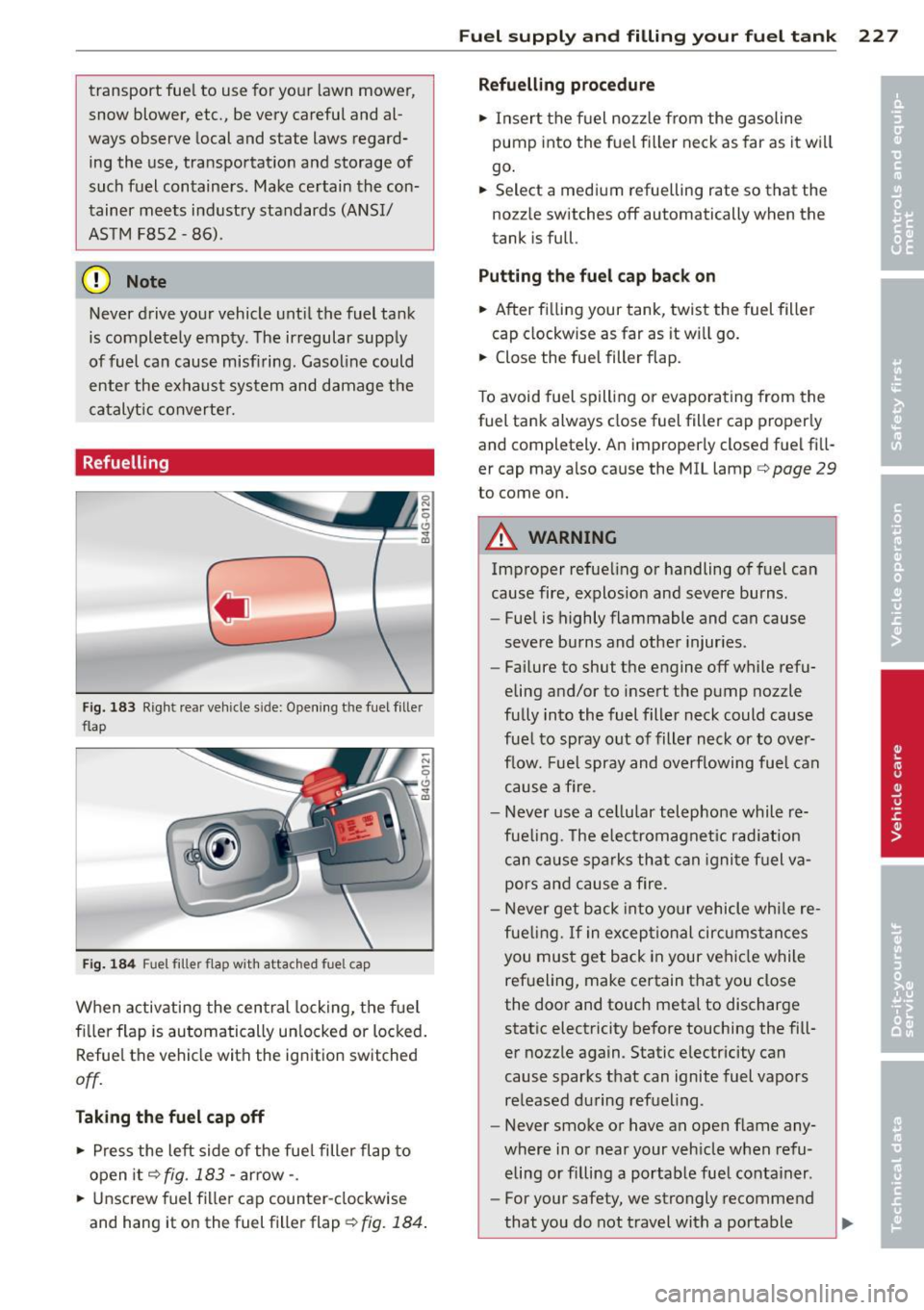
Fig. 183 Right rear vehicle s ide: Opening the fuel filler
flap
Fig. 184 Fuel filler flap with attached fuel cap
When activating the central locking, the fuel
f ill er flap is automatically un locked or locked.
Refuel the vehicle with the ignition switched
off.
Taking the fuel cap off
• Press the left side of the fuel filler flap to
open it¢
fig. 183 -arrow-.
• Unscrew fuel filler cap counter-clockwise
and hang it on the fuel filler flap~
fig. 184.
Fuel supply and filling your fuel tank 22 7
Refuelling procedure
• Insert the fuel nozzle from the gasoline
pump into the fuel filler neck as far as it will
go.
• Select a medium refuelling rate so that the
nozzle switches off automatically when the
tank is full.
Putting the fuel cap back on
• After filling your tank, twist the fuel filler
cap clockwise as far as it will go.
• Close the fuel filler flap.
To avoid fuel spill ing or evaporating from the
fuel tank always close fuel filler cap proper ly
and completely. An improperly closed fuel fill
er cap may also cause the MIL lamp ¢
page 29
to come on.
A WARNING
Improper refueling or handling of fuel can
cause fire, explosion and severe burns.
- Fuel is highly flammable and can cause
severe burns and other injuries.
- Failure to shut the engine off while refu
eling and/or to insert the pump nozzle
fully into the fuel filler neck could cause
fue l to spray out of filler neck or to over
flow. Fuel spray and overflowing fuel can
cause a fire.
- Never use a cellular telephone while re
fue ling. The electromagnet ic rad iation
can cause sparks that can ignite fuel va
pors and cause a fire.
- Never get back into your vehicle while re
fueling.
If in exceptional circumstances
you must get back in your vehicle while
refueling, make certain that you close
the door and touch metal to discharge static electricity before touching the fill
er nozzle again. Static electricity can
cause sparks that can ignite fuel vapors
released during refueling.
- Never smoke or have an open flame any
where in or near your vehicle when refu
eling or filling a portable fue l container.
- For your safety, we strongly recommend
that you do not travel with a portable
Page 232 of 310
230 Checking and filling
Checking and filling Engine hood
Releasing the engine hood
The engine hood is released from inside the
vehicle .
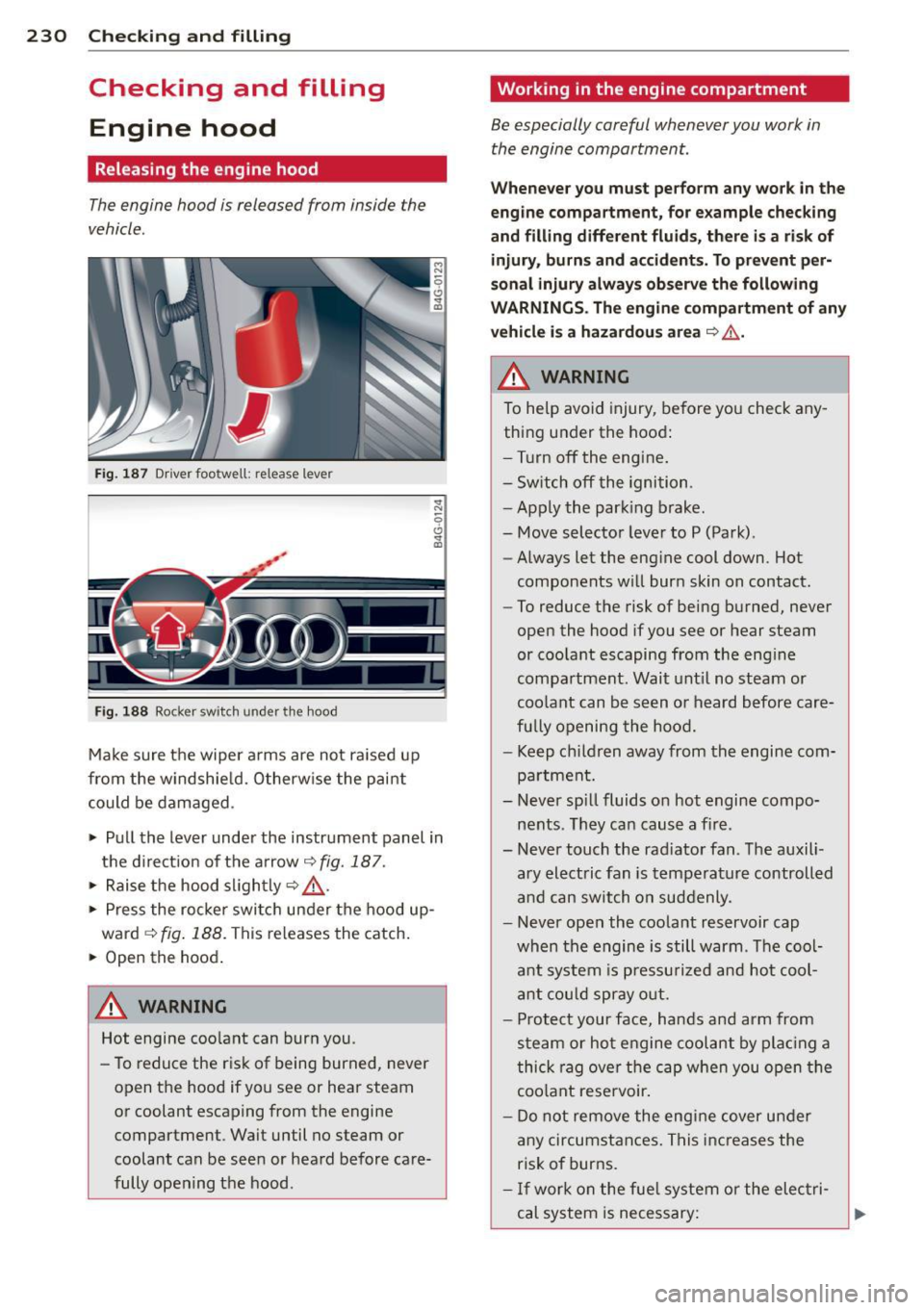
Fig. 187 Driver foo twell: release lever
Fig. 188 Rocker switch un der the hood
Make sure the wiper arms are not raised up
from the windshield. Otherwise the paint
could be damaged .
.,. Pull the lever under the instrument panel in
the direction of the arrow
~ fig. 187.
.,. Raise the hood slightly~,&. .
... Press the rocker switch under the hood up
ward
~ fig. 188. This releases th e catch.
... Open the hood.
&_ WARNING
Hot engine coolant can burn you.
- To reduce the risk of being burned, never
open the hood if you see or hear steam
or coolant escaping from the engine compartment . Wait until no steam or
coolant can be seen or heard before care
fully opening the hood .
'Working in the engine compartment
Be especially careful whenever you work in
the engine compartment.
Whenever you must perform any work in the
engine compartment, for example checking
and filling different fluids, there is a risk of injury, burns and accidents. To prevent per
sonal injury always observe the following
WARNINGS. The engine compartment of any
vehicle is a hazardous area
~ ,&. .
A WARNING
To help avoid injury, before you check any
thing under the hood:
- Turn off the engine.
- Switch off the ignition .
- Apply the parking brake.
- Move selector lever to P (Park).
- Always let the engine cool down. Hot
components will burn skin on contact.
- To reduce the risk of being burned, never
open the hood if you see or hear steam
or coolant escaping from the engine
compartment. Wait until no steam or
coolant can be seen or heard before care
fully opening the hood.
- Keep children away from the engine com
partment.
- Never spill fluids on hot engine compo
nents . They can cause a fire .
- Never touch the radiator fan. The auxili
ary electric fan is temperature controlled
and can switch on suddenly .
- Never open the coolant reservoir cap
when the engine is still warm . The cool
ant system is pressurized and hot cool
ant could spray out.
- Protect your face, hands and arm from
steam or hot engine coolant by placing a
thick rag over the cap when you open the
coolant reservoir.
- Do not remove the engine cover under
any circumstances. This increases the
risk of burns.
- If work on the fuel system or the electri
cal system is necessary:
Page 233 of 310

-Always disconnect the battery.
- Never smoke or work near heaters or open flames. Fluids in the engine com
partment could start a fire.
- Keep an approved fire extinguisher im
mediately available.
- To avoid electrical shock and personal in
jury while the engine is running or being
started, never touch :
- Ignition cables
- Other components of the high voltage
electronic ignition system.
- If you must perform a check or repair
with the engine running:
- First, fully apply the parking brake,
move selector lever to P (Park).
- Always use extreme caution to prevent
clothing, jewelry, or long hair from get
ting caught in the radiator fan, V-belts
or other moving parts, or from contact ing hot parts. Tie back hair before
starting, and do not wear clothing that
will hang or droop into the engine.
- Minimize exposure to emission and
chemical ha zards c:::> & .
A WARNING
California Proposition 65 Warning:
- Engine exhaust, some of its constituents,
and certain vehicle components contain
or emit chemicals known to the State of
California to cause cancer and birth de
fects and reproductive harm. In addition ,
certain fluids contained in vehicles and
certain products of component wear con
tain or emit chemicals known to the
State of California to cause cancer and
birth defects or other reproductive harm .
Checking and filling 231
-Battery posts, terminals and related ac
cessories contain lead and lead com
pounds, chemicals known to the State of
California to cause cancer and reproduc
tive harms. Wash hands after handling.
(D Note
When adding fluids, always make sure that
they are poured into the proper container
or filler opening, otherwise serious dam
age to vehicle systems will occur.
(® For the sake of the environment
To detect leaks in time, inspect the vehicle
floor pan from underneath regularly . If
you see spots from oil or other vehicle flu ids, have your vehicle inspected by an au
thorized Audi dealer.
Closing the engine hood
.,. Pull the hood down until the pressure from
the struts is reduced.
.,. Let the hood
drop down and latch in place.
Do not try to push it shut; it may fail to en
gage
c:::> ,A .
A WARNING
-
A hood that is not completely latched
could fly up and block your view while driv
ing .
- When you close the engine hood, check it
to make sure the safety catch has proper ly engaged. The hood should be flush
with the surrounding vehicle body parts.
- If you notice while driving that the hood
is not secured properly , stop at once and
close it. •
•
Page 234 of 310
232 Checking and filling
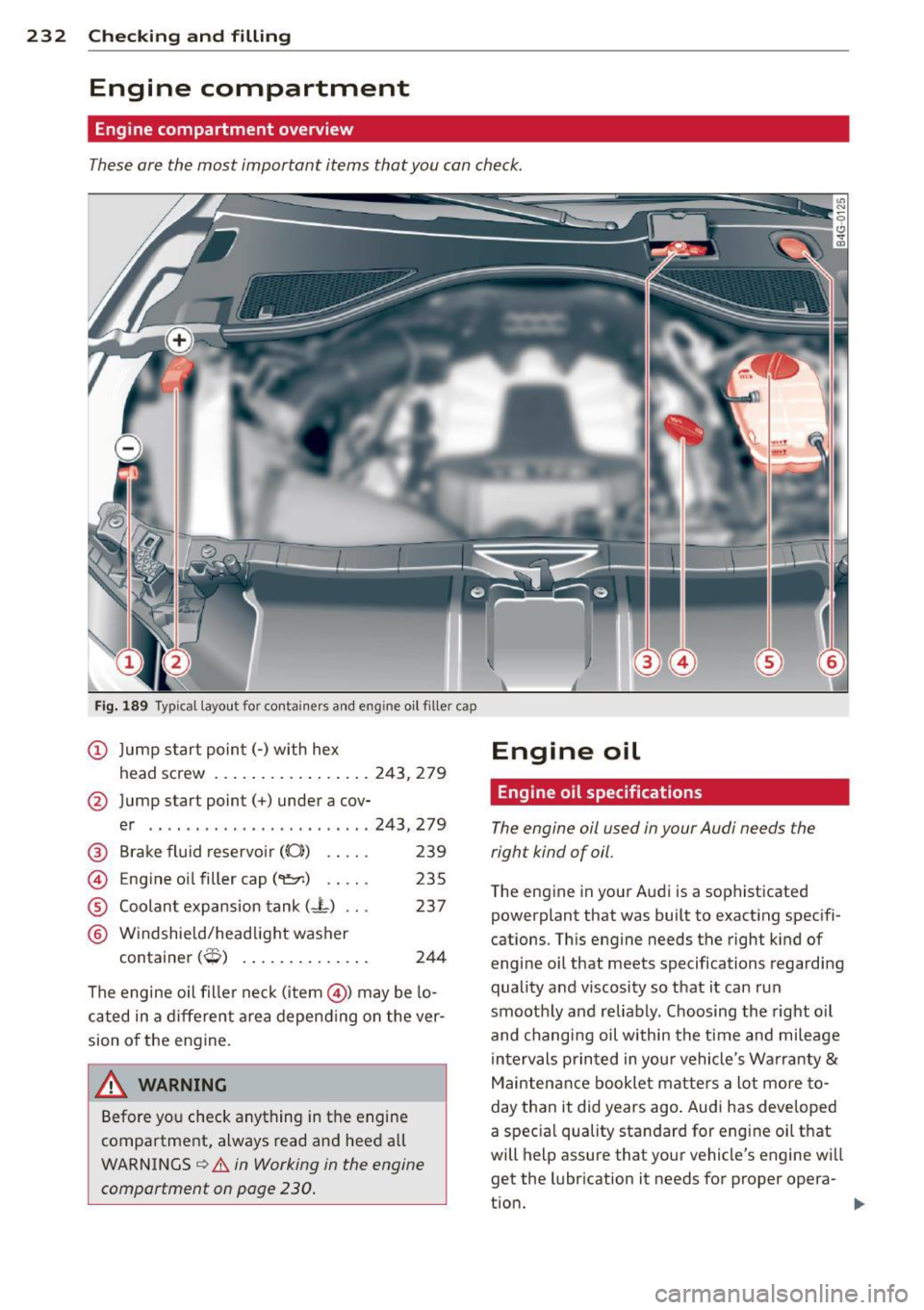
Engine compartment
Engine compartment overview
These are the most important items that you can check.
Fig. 189 Typ ical layout for contai ners and eng ine o il filler cap
(D Jump start point(-) with hex
head screw .... .............
243, 279
@ Jump start point(+) under a cov-
er .. .. ............... .... .
243,279
®
©
®
®
Brake fluid reservoir ((0)) . . . . . 239
Engine oil filler cap (
(-L) ...
Windshield/headlight washer
237
t . (.'R) con ainer ,,.., ............ . . 244
The engine oil filler neck (item @) may be lo
cated in a different area depending on the ver
sion of the engine.
~ WARNING
Before you check anything in the engine
compartment, always read and heed all
WARNINGS
¢ &. in Working in the engine
compartment on page 230.
-
Engine oil
Engine oil specifications
The engine oil used in your Audi needs the
right kind of oil.
The engine in your Audi is a sophisticated
powerplant that was built to exacting specifi
cations . This engine needs the right kind of
engine oil that meets specifications regarding
quality and viscosity so that it can run
smoothly and reliably . Choosing the right oil
and changing oil within the time and mileage
intervals printed in you r vehicle's Warranty
&
Maintenance booklet matters a lot more to
day than it did years ago . Audi has developed
a special quality standard for engine oil that
will help assure that your vehicle's engine wi ll
get the lubrication it needs for proper opera-
tion. ..,.