air condition AUDI A7 2013 User Guide
[x] Cancel search | Manufacturer: AUDI, Model Year: 2013, Model line: A7, Model: AUDI A7 2013Pages: 310, PDF Size: 77.45 MB
Page 163 of 310
-Never place or attach accessories or o th
er objects (such as cup hol ders, tele
phone brackets, large, heavy or bulky ob
jects) on the doors, over or near the area
marked ''AIRBAG" on the steering wheel,
instrument panel, seat backrests or be
tween those a reas and yourself. These
objects co uld cause injury in a crash, es
pecially when the airbags inflate .
- Never recline the front passenger's seat
to transport objec ts. Items can also
move into the area o f the side airbag or
the front airbag during braking or in a
sudden maneuver . Objects near the air
bags can become project iles and cause
injury, part icularly when the seat is re
cl ined .
- Never place or transport ob jects on the
front passenger seat. Objects on the
front passenger seat could cause the ca pacitive senso r in the seat to s ignal to
airbag system that the seat is occupied
by a person when it in fa ct is not, o r that
the person on the se at is he avier than he
or she actually is. The change in electric
capacitance beca use of such objects can
cause the passenger front airbag to be
turned on when it sho uld be
off, or can
cause the airbag to work in a way that is
different from the way it wou ld have
worked w ithout objects on the seat.
- Always make sure that there is nothing
on the front passenger seat that will
cause the capacitive passenge r detection
system in the s eat to s ignal to the A irbag
System that the seat is oc cupied by a
pers on when it is not, or to sign al that it
is occupied by someone who is heavier
than the pe rson actually s itting on the
seat . The presence of an object co uld
cause the passenger front a irbag to be
turned on when it sho uld be
off, or co uld
cause the airbag to work in a way that is
different from the way it wou ld have
worked w ithout the object on the seat. A
irbag
sys tem 161
A WARNING
The fine dust created when airbags deploy
can cause breathing prob lems fo r people
with a history of as thma or other breath
ing cond itions.
- To reduce the risk of breath ing problems,
those wi th asthma o r other respiratory
conditions s hou ld get fresh air r ight
away by get ting o ut o f the veh icle or
open ing win dows or do ors.
- If you are in a collision in which airbags
deploy, was h your ha nds and fa ce with
mild soap and wate r be fore eating.
- Be ca reful not to get the dust in to your
eyes, o r into any c uts or sc ratches.
- If the resid ue should get into your eyes,
f lus h t hem w ith wa te r.
Monitoring the
Advanced Airbag System
fl~ Airbag monitoring indicator light
Two separate indicators monitor the function
of the Advan ced Airbag System: the airbag
monitoring indi cator light and the
PASSEN
GER AIR BAG O FF
light.
The Advanced A irbag System ( includ ing the
electron ic co ntro l unit, sensor circu its and sys
tem wir ing) is monitored con tinuously to
make sure that it is functio ning properly
whenever the ignition is on. Each time you
switch on the ignition, the airbag monitor ing
indicator light
fl will come on for a few sec
onds (self diagnost ics).
The sy stem must be in spected when the
indicator light
I :
- does not come on when the ignition is
sw itched on,
- does not go out a few seconds after you
have switched on the ignit ion, or
- comes on while driv ing.
If an airbag system malfunc tion is detec ted,
the indicator light wi ll first start f lashing to
catch the driver's attention and then stay on
llo-
•
•
Page 165 of 310
-The PA SS ENGER AIR BAG OFF light must
come on and stay on if the ignition is on
and . ..
- a car bed has been insta lled on the front
passenger seat, or
- a rearward -facing chi ld restraint has been
installed on the front passenger seat, or
- a fo rward-facing child restraint has been in
stalled on the front passenger seat,
- and if the e lectr ica l capaci tance registered
on the front passenger seat is equal to or
l ess than the combined capacitance of a typ
ical 1 year-old infant and one of the rear
ward-facing or forward -facing child re
stra ints listed in Federal Motor Veh icle Safe
ty Standard 208 w ith which the Advanced
Airbag System in your vehicle was certified.
If the front passenger seat is not occupied,
the front airbag will not deploy, and the
P A S·
SE NG ER AIR BA G OFF
light w ill stay on . Nev
er install a rearward-fac ing ch ild restra int on
the front passenger seat, the safest place fo r
a child in any ki nd of child restraint is at o ne
of the seati ng positions on the rear seat
¢ page 151, Child restraints on the front seat
- some important things to know
and
¢ page 175, Child Safety.
If the PASSENGER AIR BAG light com es
on ...
If the PA SSENGER AIR BAG OFF light comes
on w hen one of the conditions listed above is
met, be sure to check the light regular ly to
make certa in that the
PA SSENGER AIR BA G
OFF
light stays on cont inuous ly whenever the
ignit ion is on.
If the PA SSE NGER A IR BA G
OFF
l ight does not appear on and does not
stay on all the time, stop as soon as it is safe
to do so and
- react ivate the system by turning the ignition
off for more than 4 seconds and then turn
i ng it on agai n;
- remove and reinstall the child restraint .
Make sure that the child restraint is properly
installed a nd that the safety be lt fo r the
front passenger seat has been correct ly
ro uted through the child rest raint as descr i-
A irbag system 163
bed in the child restraint manufacturer's in
structions;
- make sure that the convertible locking fea
t u re on the safety belt for the front passen
ger seat has been activated and that the
safety belt has been pulled tight.
- make sure t hat no electrical device (s uch as
a laptop, CD p layer, e lectronic games device
or power inverter) is p laced or used on the
front passenger seat if the device is connect
ed to the 12-volt socket or the cigarette
lighter socket;
- make sure that no seat heater has been ret
rofitted or otherwise added to the front pas
senger seat;
- make sure that nothing can interfere with
the safety belt buckles and that they are not
obstructed;
- make sure that there are no wet objects
(such as a wet towel) and no water or other
liquids on the front passenger seat cushion .
If the PASSENGER AIR BAG light still
does not come on ...
If the PASSENGER AIR BAG OFF light still
does not come on and does not stay on con
ti nuously (whe n the ignition is sw itched on),
- take the child restraint off the front passen-
ger seat and install it properly at one of the
rear seat positions . Have the airbag system
inspected by yo ur Audi dealer immed iate ly.
- move the ch ild to a rear seat position and
ma ke sure that the c hild is properly restra in
ed in a c hild restra int that is app rop riate fo r
its size an d age.
The PASSENGER AIR BAG light should
NOT come on .. .
The PAS SENGER AIR BAG OFF lig ht sho uld
NOT come on when t he ignit io n i s on and an
adult is sitting in a proper seating position on
the front passenger seat . If the
PASSENGER
AIR BAG O FF
light comes on and stays on or
flashes for about 5 seconds wh ile driving, un
der these c ircumstances, make sure that:
- the adult on the front passenger seat is
properly seated on the center of the seat •
•
Page 177 of 310
Child Safety
Important things to know
Introduction
The rear seat is generally the safest place in a
collision.
The physical principles of what happens when
your veh icle is in a crash app ly also to chi ldren
~ page 141, What happens to occupants not
wearing safety belts?.
But unlike adu lts and
teenagers, their muscles and bones are not
fu lly developed . In many respects children are
at greater risk of serious injury in crashes than
ad ults.
Because children's bod ies a re not fu lly deve l
oped, they require restraint systems especial l y designed for their size, weight, and body
structure. Many co untries and all states of the
United States and provinces of Canada have
laws requ iring the use of approved ch ild re
straint systems for infants and small children.
In a fronta l crash at a speed of 20 -35 mph
(30-56 km/h) the forces acting on a 13-pound
(6 kg) infa nt w ill be more than 20 t imes the
weight of the child . T his means the weight of
the child would suddenly be more than
260 pounds ( 120 kg). Under these conditions,
on ly an appropr ia t e chi ld restraint properly
used can reduce the risk of ser ious injury.
Ch ild restra ints, like adult safety belts, must
be used properly to be effective. Used improp
erly, they can increase the risk of ser ious in
jury in an accident.
Consult the ch ild safety seat manufacture r's
instr uctions in order to be sure the seat is
right fo r you r ch ild's size ~
page 179, Impor
tant safety instructions for using child safety
seats.
Please be sure to read and heed all of
the impo rtant informat ion and WARNINGS
about ch ild safety, Advanced A irbags, and the
i nstallation of child rest raints in this chapter .
There is a lot you need to know about the Ad
vanced A irbags in your vehicle and how they
wo rk when infants and children in child re-
Child Sa fet y 175
stra ints are on the front passenge r seat . Be
ca use of the large amount of important infor
mation, we cannot repeat it a ll here . We urge
you to read the detailed information in th is
owner's manua l about airbags and the Ad
vanced Airbag System in your vehicle and the
very important information about transport
ing children on the front passenge r seat .
Please be sure to heed the WARN INGS -they
are ex tremely importa nt for yo ur safety and
the safety o f you r passengers, especially in
f ants and small chi ldren .
.A, WARNING
-Accident statistics have shown that c hil
dren a re generally safer in the rear seat
area than in the front seating position.
Always restrain any child age 12 and un der in the rea r.
- All vehicle occupants and especially chil
dren must be restrai ned p roperly when
eve r riding in a vehicle . An unr est rained
or improperly restrained chi ld could be
in ju red by str iking the interio r or by be
ing ejected from the vehicle during a
sudden maneuve r or impac t. An un re
strained or improper ly restrai ned ch ild is
also at greater risk of injury o r death
through contact with an inflating airbag.
- A suitable chi ld restraint properly instal
led and used at one of the rear seat ing
positions p rov ides the highest degree of
protection for infants and small children
in most accident situations.
A WARNING
Ch ildren on the front seat of any car even
with Advanced Airbags ca n be ser iously in
ju red or even kil led when an a irbag in
fla tes. A child in a rearwar d-fac ing ch ild
safety seat installed on t he front passen
ger seat will be ser iously injure d and ca n
be killed i f the front airbag inflates .
- T he infla ting air bag will h it the ch ild
safety sea t or i nfan t carrie r wi th great
force and will smash the child safe ty seat
an d child against the bac krest , center
armrest, or door .
•
•
Page 198 of 310
196 Intelligent technology
Intelligent technology
Notice about data
recorded by vehicle
control modules
Your vehicle is not equipped with an Event Da
ta Recorder (EDR), installed by some manu
facturers fo r the express purpose of capturing
data for retrieval after an accident or crash
event . EDR's are sometimes ca lled "crash re
corders".
Some state laws restrict the retr ieval or down
loading of data stored by EDR's that were in
stalled in a vehicle for the express purpose of
retrieving data after an accident or crash
event without the owner's consent.
A lthough your vehicle is not equipped with an
EDR, it is equipped with a number of electron
ic control modules for various vehicle systems
such as, for examp le, eng ine function, em is
sion control, as well as for the airbags and
safety belts.
These electronic contro l modules also record
vehicle-re lated data during normal vehicle op
eration for diagnostic and repair purposes.
The recording capacity of the electronic con
trol modules is limited to data (no sound is re
corded) and only a small amount of data is ac
tually recorded over a very limited pe riod of
time and stored when a system fault or other
condition is sensed by a control unit. Some of
the data then stored may relate to vehicle
speed, direction, braking as we ll as restraint
system use and performance in the event of a
crash or other condition. Stored data can only
be read and downloaded with special equip
ment.
Electronic Stabilization
Control (ESC)
Description
ESC helps to improve road holding and vehicle
dynamics to help reduce the probability of
skidd ing and loss of vehicle control. It works
only when the engine is running. ESC detects certain difficult driving situat
ions, including
when the vehicle is beginning to spin (yaw)
out of control and helps you to get the veh icle
back under control by se lectively braking the
wheels, and/or reducing engine power and
providing steering assistance to help hold the
vehicle on the driver's intended course. The in
dicator light
G) in the instrument cluster
blinks when ESC is taking action to help you
control the vehicle.
ESC has limitations.
It is important to remem
ber that ESC cannot overcome the laws of
physics. It wi ll not always be able to help out
under all conditions you may come up against.
For example, ESC may not always be able to
help you master situations where there is a
sudden change in the coefficient of friction of
the road surface. When there is a section of
dry road that is suddenly covered with water,
slush or snow, ESC cannot perform the same
way it wou ld on the dry surface . If the vehicle
hydroplanes (rides on a cushion of water in
stead of the road surface), ESC will not be
able to help you steer the vehicle because con
tact with the pavement has been interrupted
and the vehicle cannot be braked or steered.
During fast cornering, particularly on winding
roads, ESC cannot always deal as effectively
with difficult driving situations than at lower
speeds. When towing a trailer, ESC is not able
to help you regain control as it would if you
were not tow ing a trailer.
Always adjust your speed and driving style to road, traffic; and weather condit ions. ESC can
not override the vehicle's physical limits, in
crease the available traction, or keep a vehicle
on the road if road departure is a result of
drive r inattention. Instead, ESC improves the
poss ibility of keeping the vehicle under con
trol and on the road during ex treme maneu
vers by using the driver's steering inputs to
help keep the vehicle going in the intended di
rection . If you are traveling at a speed that
causes you to run off the road before ESC can
provide any assistance, you may not experi
ence the benefits of ESC.
Page 201 of 310
Manual mod e
-Manua l dep loyment: Tapping b riefly on the
switch
¢ fig. 182 dep loys the rear spoiler.
- Manua l retraction: A t speeds up to abo ut
10 mph (20 km/h) , ret ract the rear spoiler
by pressing and holding the switch
¢ fig. 182 . At speeds between 10 mph (20
km/h) and 80 mph (130 km/h), retract the
rear spoiler by tapping on the switch
¢ fig . 182.
In dicat or light s
rJ /. R ea r spoiler: system m alfun ct io n!
The rear spoiler may not have extended due to
a ma lf u nction. This could change the vehicle 's
driving characteristics at high speeds . Do not
exceed 85 mph (140 km/h). Drive to your au
thorized Audi dealer immed iate ly to have the
malfunction corrected. The co lor of the indica
tor light depends on the vehicle speed.
A WARNING
Dr iv ing at higher speeds w ithout the rear
spoiler dep loyed can impair handling char
acteristics, making the veh icle harde r to
cont ro l.
- Always make sure that the spoiler is de
ployed when driving at speeds over
85 mph (140 km/h). If the rear spoiler
warning/ind icator light in the i nstr u
ment cluster comes on, the rear spoiler
may not have dep loyed .
- Never drive at speeds higher than
85 mph (140 km/h) if the spoiler is not
deployed. Have the spoiler inspected as
soon as possible by an authorized A udi
dealer or qualif ied workshop.
- Always obey speed limits and other traf
fic laws.
A WARNING
Improper operation of the rear spoiler can
cause crushing injuries.
- Always make sure that nobody, especially
children, is in the way when the rear
spoiler is deployed or retracted.
Int ellig ent technolog y 199
@ Note
-Never push the vehicle or apply force to
the rear spoiler -it could be damaged.
- Only operate the rear spoiler manua lly
when the rear lid is closed . Otherwise,
damage cou ld occur.
(D Tips
C lean the spoiler compa rtment every 2 to
3 months. The spoiler compartment must
a lways be free of ice, snow, leaves or other
debris .
Braking
General information
What affects braking efficiency?
Operating condition s and dri ving h abit s
The brakes on today's automobiles are still
subject to wear, depending largely on operat
ing condit ions and driving habits ¢.&, . On
vehicles that are either driven mostly in stop
and-go c ity traff ic or are dr iven hard, the
brake pads should be checked by your author
ized Audi dea ler more often th an specified in
the
Warran ty & Maintenan ce boo kle t. Failure
to have you r brake pads inspected can result
in reduced brake performance .
On steep slopes, you sho uld use the braking
effect o f the engine . This way, you prevent un
necessary wear on the b rake system. If you
must use your brakes, do not hold the brakes
down cont inuous ly. Pump the brakes at inter
vals.
Mo istur e or road salt
U nder certain conditions , for example, when
driving through water or very heavy rain , or
even after washing your vehicle, the braking
effect can be reduced due to moisture (or in
free zing cond itions ice) on the brake pads. A
few carefu l brake applications should dry off
the brake pads or remove any ice coatings .
When you are driving at higher speeds with
the windshield w ipers on, the brake pads will
Ill-
•
•
Page 207 of 310
Catalytic converter
It is very important that your emission control system (catalytic converter) is function
ing properly to ensure that your vehicle is run
ning in an environmentally sound manner .
.. Always use lead-free gasoline¢ page 225,
Fuel supply.
.,. Never run the tank down all the way to
empty.
.,. Never put too much motor oil in your en-
gine
¢ page 235, Adding engine oil~-
.,. Never try to push- or tow-start your veh icle.
The catalytic converter is an eff icient "clean
up" device built into the exhaust system of
the vehicle . The catalytic converter burns
many of the pollutants in the exhaust gas be
fore they are released into the atmosphere.
The exclusive use of unleaded fuel is critically
importa nt for the life of the cata lytic convert
e r and proper functioning of the engine.
A WARNING
-
- Do not park or operate the vehicle in
areas where the hot exhaust system may
come in contact with dry grass, brush,
fuel spill or other material which can cause a fire.
- Do not apply additional undercoating or
rustproofing on or near the exhaust
man ifold, exhaust pipes, catalytic con
verter or heat shields. During driving, the
substance used for undercoating cou ld
overheat and cause a fire.
0 Note
- Be aware that just one tank filling with
leaded fuel will already seriously de
grade the performance of the catalytic
converter.
- Do not exceed the correct engine oil level
¢ page 235.
-Do not drive until the fuel tank becomes
completely empty. The eng ine could mis
fire . U nburned fuel could a lso get i nto
Dri vin g and en vironm ent 205
the exhaust system and this cou ld cause
the catalytic converter to overheat .
- Do not switch off the ignit ion while the
vehicle is mov ing.
- Do not continue to ope rate your veh icle
unde r these conditions, as othe rwise fuel
can reach the catalytic converter. This
co uld result in overheating of the con
verter, requir ing its replacement .
- To assure efficient operation of the Emis
sion Control System:
- H ave your vehicle maintained prope rly
and in accordance w ith the se rv ice rec
ommendat ions in you r Warranty &
M aintenance boo klet.
- L ack of prope r maintenance as we ll as
improper use of the vehi cle w il l impair
the function of the em ission contro l
system and could lead to damage .
@ For the sake of the environment
Even when the Emiss ion Control System is
operat ing properly, the exha ust gas can
have a sul fur -li ke exhaust gas smell under
some operating states . This depends on
the sulfur content of the fuel being used .
Using a different brand of fue l may help,
or filling the tank with lead-free super
grade gasoline .
Avoid damaging the
vehicle
When you are drivi ng on poo r roads, or over
c ur bs, s teep ramps, etc., ma ke certai n that
low -lying parts s uch as spoilers and exhaust
system pa rts do not bottom o ut and get dam
aged.
T h is is espec ially true for veh icles w ith low
s lung chassis (spor ts chassis)* and fully load
ed vehicles. •
•
Page 215 of 310
Cleaning and protect ion
General information
Regular core preserves vehicle value.
Any automobile is exposed to industrial
fumes , corrosive road salt, etc. A well cared
for Audi can look like new many years after
purchase . Regu lar and correct care w ill con
tr ibute to maintaining the beauty and value of
your Aud i.
F u rth ermor e, good c are may be a conditi on
for subs tantiati ng a w arrant y cla im sho uld
c orrosion d amag e or paint d efects oc cur.
Your authorized Audi dealer has a variety of
dedic ated veh icle-car e products and can ad
vise which ones to use for cleaning the exter i
or and interior of your vehicle.
Whether you use products recommended by
Aud i or other commercially available clean ing
agents, please make sure you apply them cor
rectly .
A WARNING
-Cleaning agents may be poisonous. Keep
them out of the reach of children.
- Heed all caut ion labels.
- Always read directions on the container
before using any product. Follow the di
rect ions carefu lly.
- Most chemical cleaners are concentrated
and have to be diluted .
- Use spot removing fluids only in well
ventilated areas.
- Do not use gasoline, kerosene, d iesel
fuel, nail polish remover or other volatile
fluids. They may be toxic, flammab le or
haza rdous in other ways. Do not wash,
wax or dry the vehicle with the ign it ion
on or the engine running.
- Do not clean the undersides of chassis,
fenders, wheel covers, e tc. w ithout pro
tecting your hands and arms. You may c u t yourself on sharp -edged metal parts .
Cleaning and protec tion 213
- Moisture and ice on brakes may impair
brak ing effic iency¢
page 199, General
information.
Test the brakes carefully
each time you wash the vehicle.
@) For the sake of the environment
Select on ly environmentally friend ly clean
i ng products . Leftover cleaning products
should not d isposed of in the household
waste.
Care of exterior
Washing
Frequent washing protects the vehicle .
The best protection against environmental i n
fluences is
frequent washing and waxing . How
often t his is required depends on:
- How much the veh icle is used
- Where the veh icle is parked (garage, in the
open under trees, etc.)
- The seasonal and weather conditions
- Environmental infl uences
T he longer b ird droppings, insects, tree resin,
road and indus tria l gr ime, ta r, soot, road salt
and other materials remain on the vehicle
body, the more lasting their destructive ef
fects wi ll be . High temperatures caused by ex
posure to intense sun light intens ify the corro
s ive effect, particularly when humid ity is high
as well.
Under certain circumstances,
weekl y washing
may be necessary. Under other cond itions, a
monthly washing and waxing may be ade
quate .
After the winter, the underside of the vehicle
should be thoroughly washed, preferab ly in a
professional car wash .
Vehicles with matte finish paint¢
page 215 .
A WARNING
Always read and heed all WARNINGS and
other information
¢page 213.
•
•
Page 235 of 310
Modern eng ine lubrication has taken a quan
tum leap in the last few years . Many synt hetic
oils ava ilable today provide better engine lu
brication that can outlast traditional petrole
um-based o ils, making them a smart choice
for use throughout the life of your Audi .
Whether you use synthetic or petroleum based engine oil, the oil that you use must
conform to Audi's oil quality standard
VW 502 00 to help keep your vehicle's engine running smoothly and help prevent the for
mat ion of harmfu l deposits, sometimes called
"s ludge," that ove r time can lead to expensive
r epairs .
At the t ime of pri nting, engine o ils available in
the U .S . and Canada that meet the exacting
specifications of Audi oi l standard VW 502 00
are synthetic engine oils. This does not mean, h owever, that every synthetic engine oil w ill
meet Audi oil standard VW 502 00. So always
be sure that you use an approved oi l.
To help preve nt the format ion of harmful de
posits use only oi l with the fo llowing spec ifi
cations printed on the oil container:
Audi oil standard VW 502 00
O il conta iner labels may carry the specif ica
tion s ingly or in comb inat ion w ith other des ig
nations and oil qua lity standards .
Viscosity
Engine oi ls are graded according to their vis
cosity. The proper v iscosity grade oi l for your
engine depends on cl imactic or seasonal con
d itions where you dr ive. You can use oil with a
viscosity grade of SAE SW40 across all tem
pe rature ranges for normal d riving conditions .
However, if eng ine oi l viscosity grade
SAE SW40 is not ava ilable, you can a lso use
viscosity grade SAE SW-30 or SAE OW-40 as
long as it meets Audi o il quality standard
VW 502 00 specifications.
Because engine oil that meets the Audi oil
standard may not be available everywhere
when you need it, we st rongly recomme nd
that you always carry with you a n ext ra quart
Checkin g and fillin g 233
(li ter) of oil that exp ress ly con forms to the
VW 502 00 specificatio n, in case you have to
top
off the o il while on the road.
Only if the level of the o il is at or be low the
minimum mark -and no oi l that expressly
confo rms to Audi oil standard VW 502 00
spec ifications is available -may you top
off
with a h igh quality engine o il, preferab ly syn
thet ic-based, that meets ACEA A3 or API SM
spec ifications, but even then, only in v iscosity
grades SAE SW-40, SA E SW-30, or
SA E OW-40 . However, during the ent ire time
betwee n oil change in tervals, never top
off
wi th more than a total of 0.5 q t/ li ter engine
o il t hat does no t conform to A udi o il specifica
tion VW 502 00.
Fo r more information abo ut eng ine oi l tha t
has been approved for your veh icle, ple ase
contac t eit h er yo ur autho rized Aud i dea le r or
Audi C ustomer Re lations at 1 (800) 822 -2834
or visit our web site at www .a u diusa.com or
www.aud icanada .ca. Here you w ill also find a
current list of oils (manufacturers, brand
names etc.) that conform to Audi oil standard
vw 502 00.
Changing the engine oil
T he eng ine oi l and o il f ilter m ust be changed
according to the mileage (kilometers) and
time intervals specified i n your ve hicle's War
ranty
& Maintenance booklet. Do not exceed
these interva ls - harmful deposits from old
engine oil can reduce engine performance and
can lead to expensive engine repairs.
Changi ng the oil at the recommended inter
vals is so very important beca use the lubricat
ing propert ies of oil decrease gradually during
norma l veh icle use . If you a re not sure when
yo u have your o il cha nged, ask your author
i zed Audi Se rv ice Adv isor.
Under some circumstances the engine oil
shou ld eve n be changed more frequent ly.
Change oil more often if you dr ive most ly
sho rt distances, operate the ve hicle in dusty
areas o r most ly under stop-and -go traff ic con-
di tions, o r when you use your vehi cle where .,..
•
•
Page 253 of 310
Tires and wheels 251
Bear in mind that the tire pressure monitoring
system* can only monitor the tire pressures
you have stored. The system does not recog
ni ze the load cond it ion of your vehicle.
The effectiveness of the tire pressure monitor
ing system* will be impaired if you store nor
mal load pressures but then operate the vehi
cle at its maximum load
c;, & .
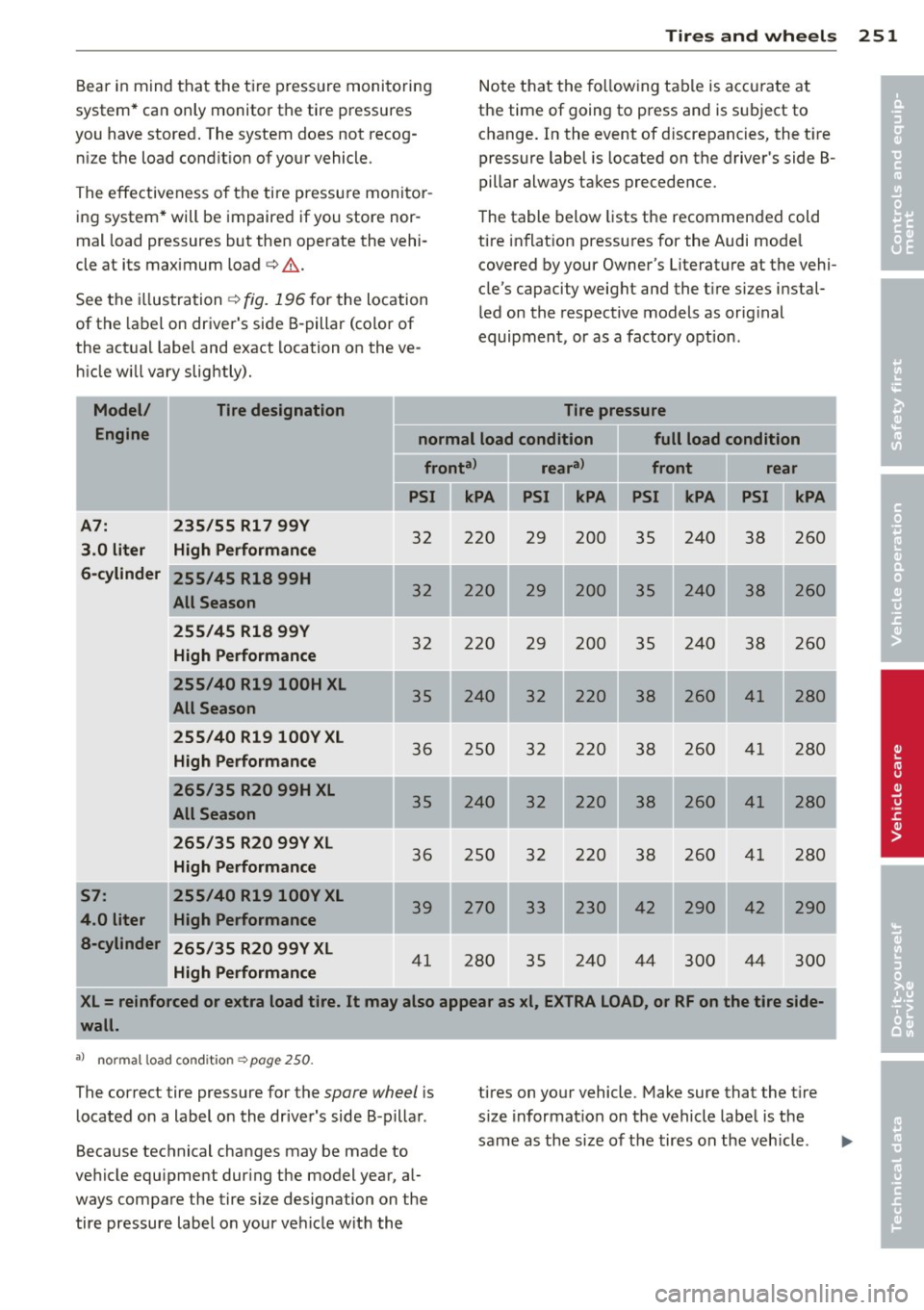
See the illustration c;, fig. 196 for the location
of the label on driver's side B-pillar (co lor of
the actua l labe l and exact location on the ve
hicle will vary slightly).
Tire designation
Note that the following table is accurate at
the time of going to press and is subject to change. In the event of d iscrepancies, the t ire
pressure label is located on the driver's side B
pillar always takes precedence.
The table below lists the recommended cold
tire inflat ion pressures for the Audi mode l
covered by your Owner's Literature at the vehi
cle's capacity weight and the t ire sizes instal
led on the respective models as orig inal
equipment, or as a factory option.
Tire pressure
Model/
Engine normal load condition full load condition
fronta> reara>
front rear
PSI kPA PSI
A7: 235/55 Rl 7 99Y
3.0 liter High Performance
6-cylinder
S7:
4.0 liter a-cylinder 255/45 R18 99H
All Season
255/45 R18
99Y
High Performance
255/40 R19 l00H XL
All Season
255/40 R19100YXL
High Performance
265/35 R20 99H XL
All Season
265/35 R20 99Y XL
High Performance
255/40 R19
l00Y XL
High Performance
265/35 R20 99Y XL
High Performance
32 220
32 220
32 220
35 240
36 250
240
36 250
39 270
41 280 29 200
35 240 38 260
29 200 35 240 38 260
29 200 35 240 38 260
32 220 38 260 41 280
32 220 38 260 41 280
32 220 38 260 4
1
280
32 220 38 260 41 280
33 230
42 290
42 290
35 240
44 300 44
300
XL= reinforced or extra load tire. It may also appear as xl, EXTRA LOAD, or RF on the tire side-
wall.
al no rmal load condition c:;,page 250.
The correct tire pressure for the spare wheel is
located on a label on the driver's side B-pillar.
Because technical changes may be made to
vehicle equ ipment dur ing the model year, al
ways compare the tire size designation on the
tire pressure label on your vehicle w ith the tires on your vehicle.
Make sure that the tir e
s ize informat ion on the vehicle label is the
same as the size of the tires on the vehicle .
'
I
'
I
•
•
Page 259 of 310
Unbalanced whee ls must be rebalanced to
avoid excessive wea r on steering, suspension
and tires. A wheel must a lso be rebalanced
when a new tire is installed .
Incorrect wheel alignment
Incorrect whee l alignment can cause exces
sive tire wear, impairing the safety o f the vehi
cle. If tires show excess ive wear, have the
wheel alignment checked by an authorized
Audi dealer or qualified workshop .
All-wheel d rive
Vehicles w ith quattro ® must always have tires
of the same size, construction and tread type .
F or detai ls see
r=!:> page 201 .
A WARNING
Sudden tire failure can lead to loss of con
trol, a crash and serious persona l injury!
- Never drive a veh icle when the tread on
any tire is worn down to the wear indica
tors.
- Worn tires are a safety hazard, they do not grip well on wet roads and increase
your risk of"hydrop lan ing" and loss of
co ntrol.
- Always keep chemicals that can cause
tire damage, such as grease, oil , gasoline
and brake fluid away from t ires.
- Tires age eve n if they are not be ing used
and can fail suddenly, especially at high
speeds. T ires that are more than 6 years
o ld can only be used in an emergency
and then with spe cial care a nd at lower
s peeds.
- Never mount used ti res on yo ur vehicle if
yo u a re not s ure of their "prev ious histo
ry." Old used ti res may have been dam
aged even though the damage cannot be
seen that can lead to s udden tire failure
and loss of vehicle control. Tires and wheels 25
7
New tires and replacing tires and wheels
New tires and wheels have to be broken in .
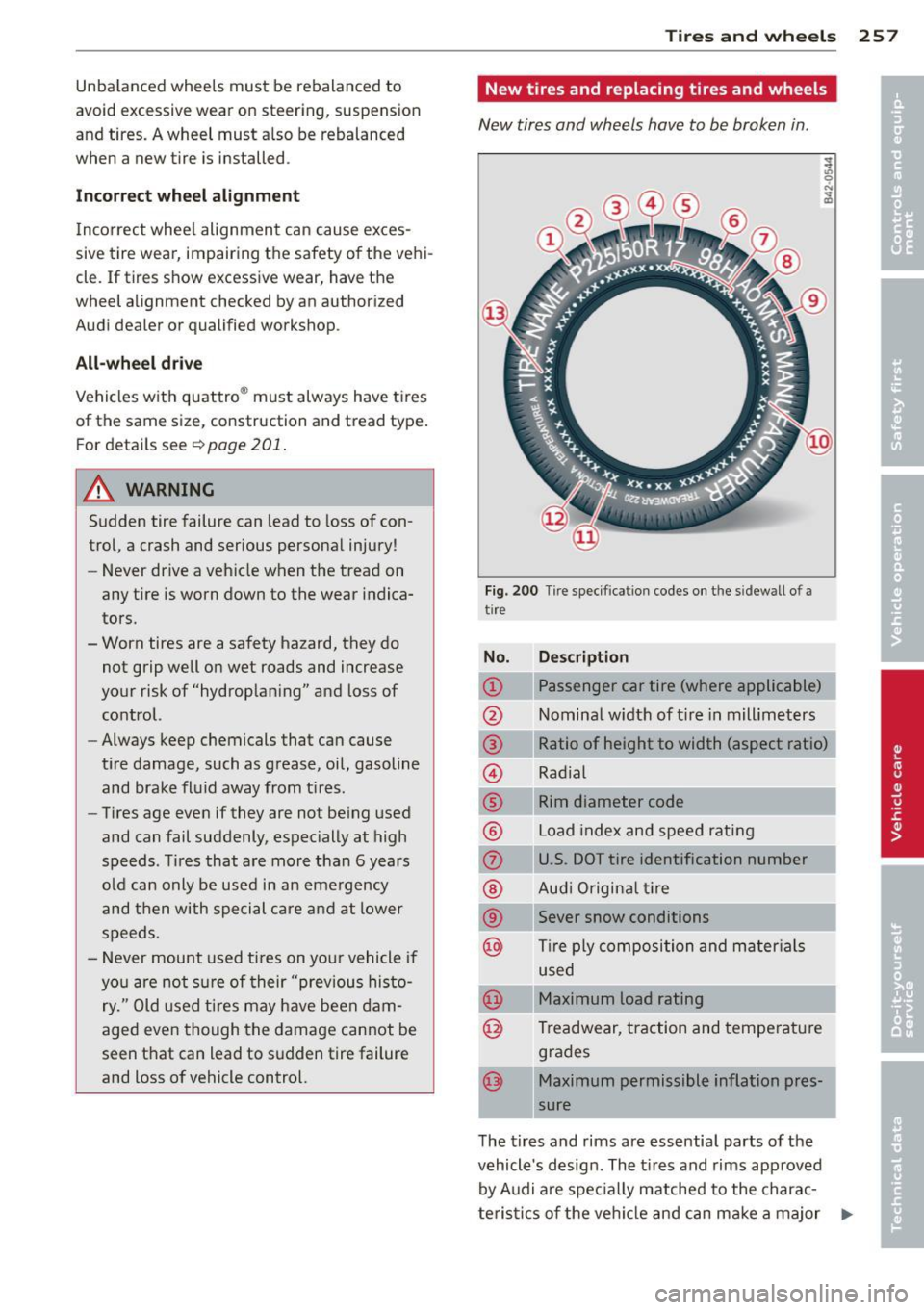
Fig. 20 0 Tir e spec ificat io n codes on t he s idewall o f a
tire
No. De sc ription
CD Passenger car tire (where applicable)
@ Nomina l w idth of t ire in mill imeters
® Ratio of height to width (aspect ratio)
© Rad ial
® Rim diameter code
® Load index and speed rating
(f) U.S. DOT tire identification number
® Aud i Origina l tire
® Sever snow conditions
@ T ire ply composition and mater ials
used
@ Maximum load rating
@ Treadwear, traction and temperat ure
grades
@ Maximum permissible inflation pres-
sure
T he tires and rims are essential parts o f the
vehicle's design . The ti res and rims app roved
by Audi a re spec ia lly matched to the charac
teris tic s of the ve hicl e and can m ake a major .,.
•