open hood AUDI A7 2013 User Guide
[x] Cancel search | Manufacturer: AUDI, Model Year: 2013, Model line: A7, Model: AUDI A7 2013Pages: 310, PDF Size: 77.45 MB
Page 233 of 310

-Always disconnect the battery.
- Never smoke or work near heaters or open flames. Fluids in the engine com
partment could start a fire.
- Keep an approved fire extinguisher im
mediately available.
- To avoid electrical shock and personal in
jury while the engine is running or being
started, never touch :
- Ignition cables
- Other components of the high voltage
electronic ignition system.
- If you must perform a check or repair
with the engine running:
- First, fully apply the parking brake,
move selector lever to P (Park).
- Always use extreme caution to prevent
clothing, jewelry, or long hair from get
ting caught in the radiator fan, V-belts
or other moving parts, or from contact ing hot parts. Tie back hair before
starting, and do not wear clothing that
will hang or droop into the engine.
- Minimize exposure to emission and
chemical ha zards c:::> & .
A WARNING
California Proposition 65 Warning:
- Engine exhaust, some of its constituents,
and certain vehicle components contain
or emit chemicals known to the State of
California to cause cancer and birth de
fects and reproductive harm. In addition ,
certain fluids contained in vehicles and
certain products of component wear con
tain or emit chemicals known to the
State of California to cause cancer and
birth defects or other reproductive harm .
Checking and filling 231
-Battery posts, terminals and related ac
cessories contain lead and lead com
pounds, chemicals known to the State of
California to cause cancer and reproduc
tive harms. Wash hands after handling.
(D Note
When adding fluids, always make sure that
they are poured into the proper container
or filler opening, otherwise serious dam
age to vehicle systems will occur.
(® For the sake of the environment
To detect leaks in time, inspect the vehicle
floor pan from underneath regularly . If
you see spots from oil or other vehicle flu ids, have your vehicle inspected by an au
thorized Audi dealer.
Closing the engine hood
.,. Pull the hood down until the pressure from
the struts is reduced.
.,. Let the hood
drop down and latch in place.
Do not try to push it shut; it may fail to en
gage
c:::> ,A .
A WARNING
-
A hood that is not completely latched
could fly up and block your view while driv
ing .
- When you close the engine hood, check it
to make sure the safety catch has proper ly engaged. The hood should be flush
with the surrounding vehicle body parts.
- If you notice while driving that the hood
is not secured properly , stop at once and
close it. •
•
Page 237 of 310
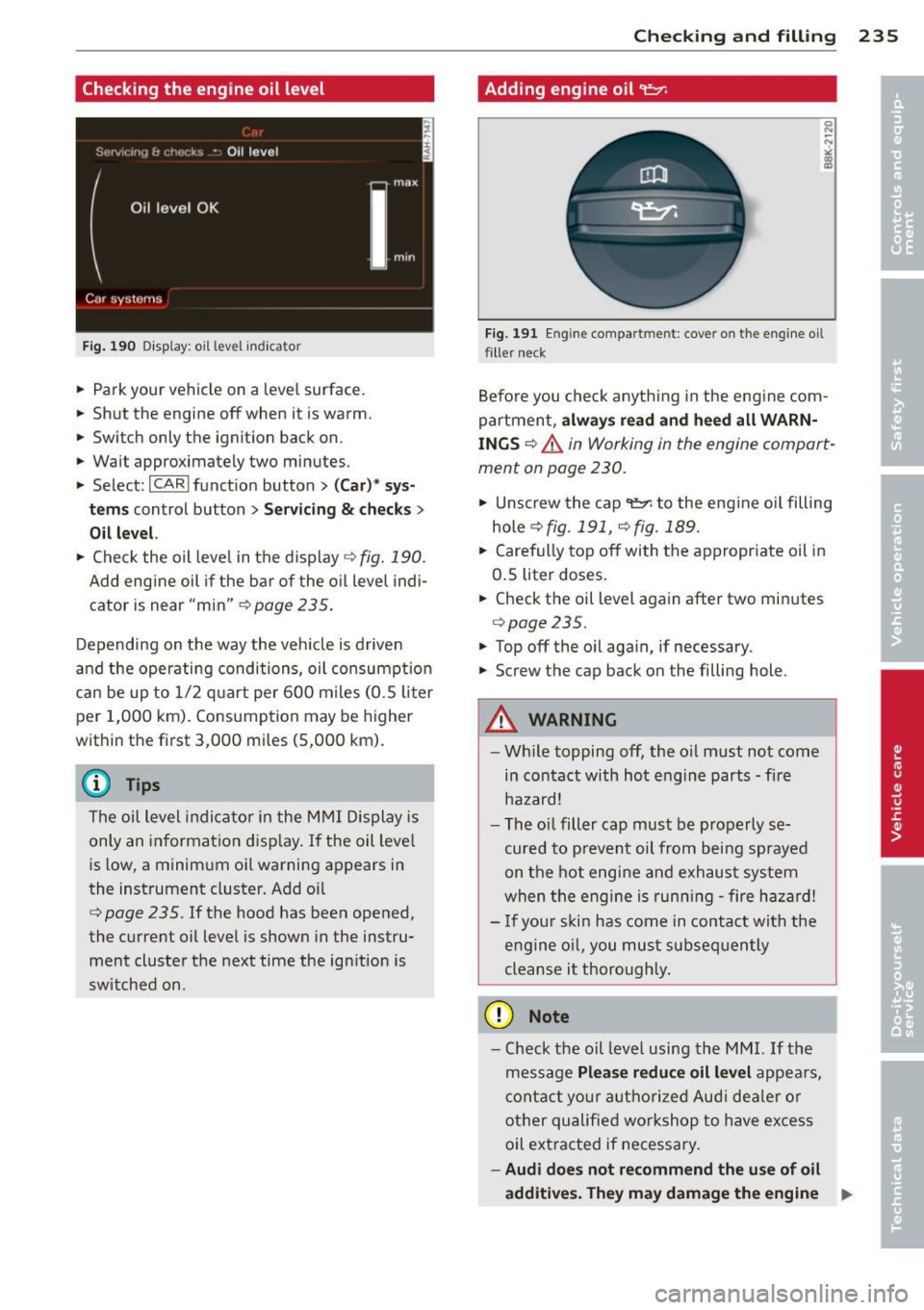
Checking the engine oil level
Fig . 190 D is p la y : o il level indi ca tor
• Park your vehicle on a lev el surfac e.
• Shut the engine off when it is warm.
• Switch only the ignition b ack on.
• W ait approxima tely two minutes .
• Se lect :
ICARI function button > ( C ar)* sys
t e m s
control button > Se rvicing & c h ecks >
Oil l ev el.
• Check the o il leve l in the display ¢ fig. 190.
Add engine oil if the bar of the oil level indi
cator is near "min "
¢page 235.
Depending on the way the veh icle is driven
and the operating conditions, oil consumpt ion
can be up to 1/2 q uart per 600 m iles (0.5 li ter
pe r 1,000 km) . Consumption may be higher
within the f irst 3 ,000 miles (5,000 km).
(D Tips
The oi l level indicator in the MMI Dis play is
only an in format ion disp lay . If the oil leve l
is low, a minim um oi l warni ng appears in
the instrument cluster. Add oi l
<=> page 235. If the hood has been opened,
the curre nt oil level is shown in the instru
ment cluste r the next time the ign ition is
sw itched on .
Checkin g and fillin g 235
Adding engine oil 'i=:1:
Fig. 191 Eng in e compa rtm en t: co ve r on the engine oi l
filler n eck
Before you check anything in the eng ine com
partment ,
alw ay s re ad and he ed all WARN
INGS ¢&.
in Working in the engine compart
ment on page 230.
• Uns crew the cap ce:r. to the eng ine oi l filling
hole
¢ fig . 191, ¢fig. 189.
• Caref ully top off with the appropr iate oil in
0.5 liter doses .
• Check t he oil level aga in after two minutes
¢ page 235 .
• Top off the o il aga in, if necessary .
• Screw the cap back on the filling hole .
A WARNING
-Wh ile topping off, the o il must not come
i n contact w ith hot engine parts -fi re
hazard!
- The oi l filler cap must be p roperly se
cured to prevent oil from bei ng sprayed
on the hot engine and exhaust system
when the engine is runn ing -fire ha zard!
- I f your ski n has come in contact with the
engine o il, you mus t subse quently
cleanse it thoroughly.
(D Note
- Check the oil level using the MMI. If the
message
Please reduce oil level appe ars,
c ontact yo ur a uth ori zed Aud i dea ler o r
ot her qualified workshop to have excess
oil ext racted if necessary.
- Audi d oes not re commend the u se of oil
additiv es. They m ay damage the engine
1111-
Page 245 of 310
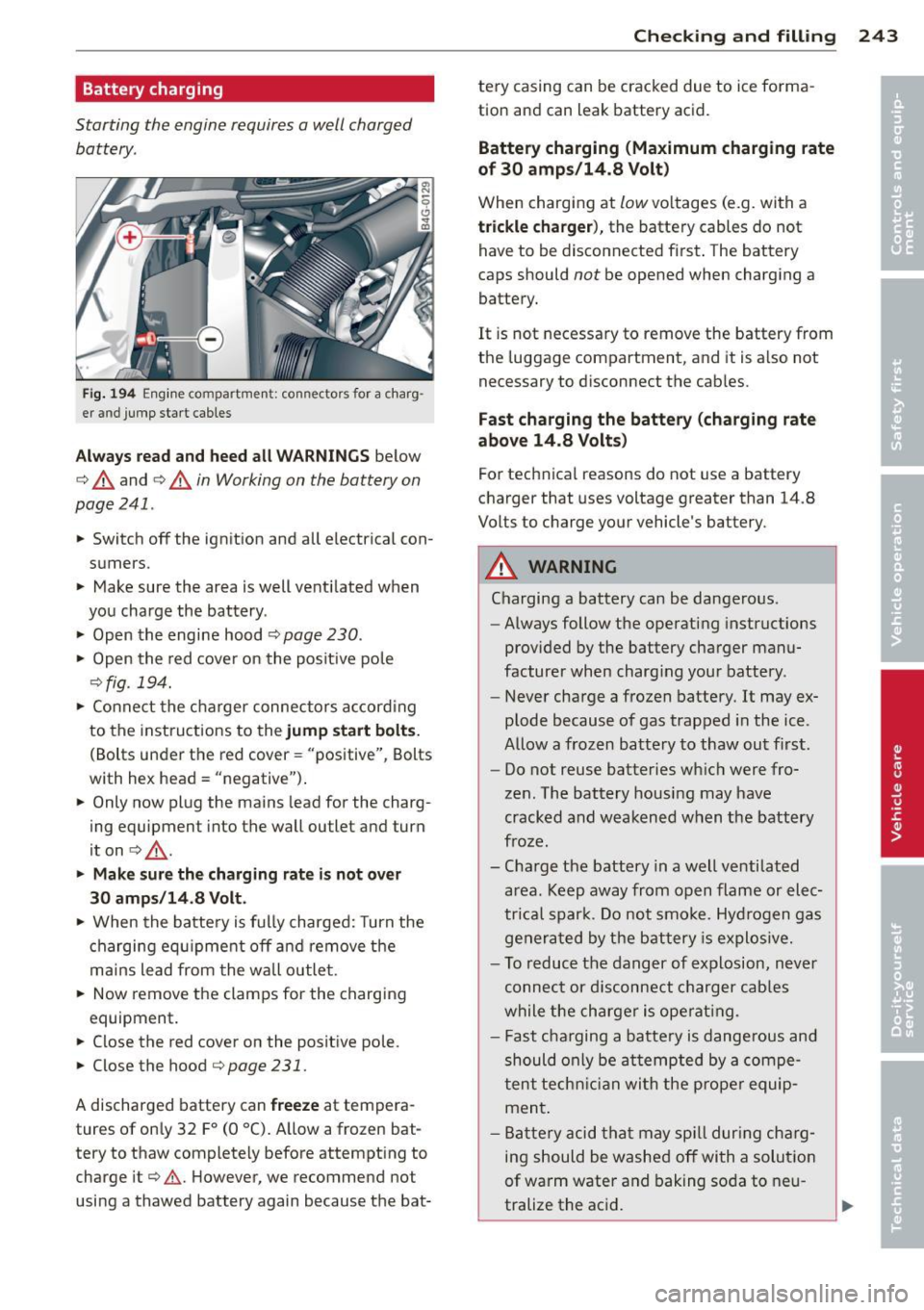
Battery charging
Starting the engine requires a well charged battery .
Fig. 194 Eng ine co mpa rtmen t: connectors for a charg
er a nd jump sta rt cab les
A lwa ys re ad and heed all WARNING S below
c:> &. and c:> &. in Working on the battery on
page 241 .
.. Switch off the ignit ion and all electrical con
sumers .
.. Make sure the area is well ventilated when
you charge the battery .
.. Open the engine hood
c:> page 230 .
.. Open the red cove r on the posit ive pole
c:>fig. 194.
.. Connect the charger connectors accord ing
to the instructions to the
jump start b olts .
(Bolts under the red cover= "positive", Bolts
with hex head= "negative") .
.. Only now plug the mains lead for the charg
ing equipmen t into the wall outlet and turn
it on
c:> 8_ .
.. Ma ke sur e t he charging rat e is not over
30 amp s/14 .8 Vol t.
.. When the batte ry is fully charged: Turn the
charging eq uipment off and remove the
ma ins lead from the wall outlet .
.. Now remove the clamps for the charging
equipment.
.. Close the red cover on the positive pole.
.. Close the hood
c:> page 2 31.
A discharged battery can free ze at tempera
tures of on ly 32 F
0 (0 °C). A llow a frozen bat
tery to thaw completely before attempt ing to
charge it
c:> .&. . However, we recommend not
using a thawed battery again because the bat-
Checkin g and fillin g 243
tery casing can be cracked due to ice fo rma
tion and can leak battery acid.
Battery charging (Maximum charging rate
of 30 amps /14.8 Volt )
When charging at low voltages (e.g. with a
trickle cha rger ), the battery cables do not
have to be disconnected f irst . The battery
caps should
not be opened when charging a
battery.
It is not necessary to remove the battery from
the luggage compartment, and it is a lso not
necessary to disconnect the cab les.
Fast ch arging the batte ry (charging rat e
a bove 14.8 V olt s)
For technica l reasons do not use a battery
charger that uses voltage greater than 14.8
Volts to charge your vehicle's battery .
A WARNING
-
Charging a battery can be dangerous .
- Always follow the operating instructions
provided by the battery charger manu
facturer when charg ing your battery .
- Never charge a frozen battery. It may ex
plode because of gas trapped in the ice .
Allow a frozen battery to thaw out first.
- Do not reuse batteries wh ic h were fro
zen. The battery housing may have
cracked and weakened when the battery
froze.
- Cha rge the battery in a well ventilated
area . Keep away from open flame or elec
trical spar k. Do not smo ke. Hyd rogen gas
generated by the battery is explos ive.
- To reduce the danger of explosion, never
connect or d isconnect charger cab les
while the charger is ope rat ing.
- Fast cha rging a batte ry is dange rous and
should only be at tempted by a compe
tent techn ic ian wi th the prope r equip
ment .
- Ba ttery acid that may spi ll dur ing charg
ing should be washed off with a solution
of warm water and baking soda to neu
tralize the ac id.
Page 300 of 310
298 Index
------------------------------------
Data .... ....... ......... ... .... . 28 7
Start-Stop-System . . . . . . . . . . . . . . . . . . 80
start ing .. .. ................ ..... .. 75
Starting with jumper cables .. .. ..... 279
Stopping . . . . . . . . . . . . . . . . . . . . . . . . . . 77
Engine compartment ........ .... ... . 232
C losing the hood . . . . . . . . . . . . . . . . . . 231
Opening the hood ................. 230
Safety instructions ........ .. .. .... . 230
Working in the engine compartment .. 230
Engine coolant .................... . 237
Adding coolant ............ ... .... . 238
Checking the engine coolant level . . . . . 23 7
Expansion tank ........... .. .. .. .. . 237
Malfunction symbol ....... .. .. .... .. 16
Radiator fan .............. ... .. .. . 239
Temperature gauge ........ ..... .. .. 11
Engine oil ... ................ ..... . 232
Adding .. .... ........... .... .... . 235
Additives . .. ............. .. .. .. ... 235
Changing .... ... .... .... .. .. .. .. . 236
Check ing the engine oil level .. .. .. .. . 235
I ndications and cond it ions requ iring ex-
tra checking .. ........... .. .. .... . 235
I ndicator light ........... .. .. .. .. .. 18
O il consumption .......... .... .... . 234
Oil grades . ................. ..... . 232
Oil level symbol .................... 21
Pressure malfunction ....... ... .. .. .. 18
Recommended oil check intervals ..... 235
Sensor defective . . . . . . . . . . . . . . . . . . . . 21
Specification and viscosity .. .. .. .. .. . 232
Engine sound .............. ... .... . 102
E ng ine speed limitation ....... .. .. .. . . 21
Engine start-stop mode
refer to Star t-Stop-System ... .. .. .. .. 82
Engine start system (indicator lights) . ... 18
Environment Break-in period ......... .. .. .. .. .. . 204
Cata lytic converter ........ .. .. .. .. . 205
Disposing of your vehicle battery . ... . 244
Driving at high speeds .............. 207
Driving to minimize pollution and noise 206
Fuel . .. .. ............... .. .. .... . 227
Fuel economy ............ .... .... . 206
Leaks under your vehicle ... .. .. .. .. . 230
Lett ing the vehicle stand and warm up . 207
Proper disposal of drained brake fluid . 240 Proper disposal of d
rained engine cool-
ant ..... ..... .. .. .............. . 238
Proper disposal of drained eng ine
oil . . . . . . . . . . . . . . . . . . . . . . . . . 235, 236
Recycling used engine oil ........ .... 23S
Unleaded fuel .. .. ................ . 22S
What should I do with an old battery? . 244
ESC (Electronic Stabilization Control) Warning/indicator lights ........ .. .. . 19
Event Data Recorder (EDR) ........ .. .. 196
Exhaust tail pipes .. .......... ...... . 219
Expansion tank .... ................ . 237
Exterior lighting . ... ............ .. .. . 43
Exterior mirrors Adjusting ..... .. .. ........ ...... .. 49
Dimming . . . . . . . . . . . . . . . . . . . . . . . . . . 50
Heating ...... ... .. .............. .. 49
Exterior temperature display ...... .. .. . 23
F
Fastening
Booster seats .. .. ............. .... 184
Convertible child safety seats . . . . . . . . 182
Infant seats ... .. ............. .... 181
Floor mats . ..... .. ................ . 13S
Foot pedals ..... .. ..... ........... . 13S
For the sake of the environment Gasoline fumes and the environment .. 227
Reducing engine noise by early upshift-
ing ...... .... ... .. ................ 11
Refueling ... .. .. ....... ...... .. .. 227
Sav ing fuel by early upsh ifting . .. .. .. . 11
Four- zone automatic climate control . .. . 71
Front airbags
Description .... .. ................ . 1S3
How they work ... ................ . 159
Frontal coll is ions and the laws of phys ics 141
Front seats . . . . . . . . . . . . . . . . . . . . . . . . . 52
Adjusting ... .. .. ....... ...... .. .. 132
Child restraints in the front seat ...... 151
Fuel Additives .. .... .. ............. .... 225
Blended gasoline .............. .... 225
Current consumption .............. .. 25
Economy messages (efficiency program) 26
Fuel filler flap emergency release ... .. 228
Page 301 of 310
Fue l filler neck . ... .... ... .. .. .. ... 226
F ue l gauge ...... ..... ... ... ... .... 12
Gasoline ... .... ........ ... .. .. .. . 225
Gasoline additives ........ .. .. .. .. . 226
Low fuel level symbol . . . . . . . . . . . . . . . 22
Octane rating ............... ... ... 225
Recommendation .... ..... .. .. .. .. . 225
Refue lling ............ ...... .... .. 227
Reserve .. .. ............. .. .. .. .. .. 12
Tank capacity . . . . . . . . . . . . . . . . . 12, 287
Fuses Assignment ..... .. ...... .. .. .. .. . 275
Replacing .. ................ ... ... 275
G
Garage door opener (Homel ink ®) . ... .. 128
Garment hooks . . . . . . . . . . . . . . . . . . . . . . 60
Gas dis charge lamps ........ .. .. .. .. . 278
Gauges Eng ine coolant temperature .. .. .. ... . 11
Fuel gauge . .. .............. ... ... . 12
Speedometer . ........ .... ... ... ... 27
Tachometer . . . . . . . . . . . . . . . . . . . . . . . 12
Trip odometer ........... .. .. .. .. .. 27
General illustration . ....... .. .. .. .. ... 8
Generator (warning/indicator lights) . ... 17
Glossary of t ire and load ing te rmino logy 247
Glove compartment (cooled) . .. .. .. .. .. 60
Gross Veh icle Weight Ra ting (GVWR) .. . 285
H
Head -up Display . . . . . . . . . . . . . . . . . . . . . 29
H eadlights
Cleaning system . ............. ... ... 47
Defective . . . . . . . . . . . . . . . . . . . . . . . . . 22
H eadlight range control . . . . . . . . . 22, 43
Washer rese rvoir ......... .. .. .. .. . 24 4
H ead restraints . . . . . . . . . . . . . . . . . 55, 134
Ad justing .. .. ... .. ... ... .. .. .. .. . 134
F ront seats ........ ... ...... .... ... 55
Rear seats . . . . . . . . . . . . . . . . . . . . . . . . . 55
Removing .. .... ......... .... .. .. .. 55
Heated exterior m irrors . ...... ... .. .. .. .. .. 49
rear window (automatic climate control) 72
rea r wi ndow (cl imate control) . .. ... ... 70
Inde x 299
seats (automatic cl imate control) ... ... 72
seats (climate cont ro l) . . . . . . . . . . . . . . . 70
windshield washer spray nozz les ... .. . 47
Heating .. .. .. .. .. .... ........... .. . 68
Heavy clothing and safety be lts .. .. .. .. 143
Hig h beam . ... .... .. . .. .. ..... ... .. . 45
Hig h voltage warn ing label .......... . 285
Hill descent contro l ................. 112
Homelin k® un iversal remote control . .. 128
Hood (re lease lever) .. ... ....... .... . 230
Hooks ... .. .. .. .... . ... ...... ... .. . 65
Hor n ...... .. .. .. ................. .. 8
How are child restraint system anchors re-
l ated to ch ild safety .. .............. . 189
How many airbags does my vehicle have? 157
How often should I chec k my tire pres-
s ur es? ....... .. ...... ............. 253
How safety belt pretens ioners work .. .. 147
Hydrop laning ..... .. . .. .. ..... ... .. 257
I
Immobili ze r .. .. .. .... ........... .. . 27
Impo rtant th ings to do before driving .. 130
Improper ly worn safety be lts . . . . . . . . . . 146
Ind icator lig hts
refer to Warn ing/ indica to r li ghts ... .. . 12
Infant seats . . . . . . . . . . . . . . . . . . . . . . . 181
Installing child safety seats Safety be lts ..... .. . .. .. ..... ... .. 186
Installing the upper tether strap on the
an chorage .. .. .. .. .. .. ........... .. 192
Instruments Adjusting the light ing .. .. .. ... ... .. . 46
Instruments and controls General illustration . . . . . . . . . . . . . . . . . . 8
Instrument cluster ................. . 11
Interior lighting Amb ience lighting . .. .. .. ..... ... .. . 46
Front and rear ... .. .. .. .. .... ... .. . 46
Inter mittent (w indshield wipers) .. .. .. . 47
J
Jack 267
Jump-starting . .. .. ................. 279
Jumper cables . .. .. ................. 280
•
•
Page 303 of 310
Night vision assistant .... ... .. .. .. .. . 105
C leaning camera lens ... ... .. .. .. .. . 2 16
Number of seats ........... .... .. ... 1 40
0
Occupa nt seating pos it ions .. .. .. .. .. . 13 1
Octane rating . ..... .... ... .. .. .. .. . 225
Odometer . .. .... ............. .. .. .. 27
OFF (automatic climate control) . . . . . . . . 71
OFF (climate control) .... ... .. .. .. .. .. 69
O il
refer to Engine oil ........ .... .. .. . 23 2
On-board computer ........ .. .. .. .. .. 25
On -Board Diagnostic System (OBD)
D ata L ink Connector (DLC) . ... .. .. .. .. 30
Electronic speed limiter . . . . . . . . . . . . . . 30
Malfunct ion Indicator Lamp (MIL) . .. .. 29
Open doo r/hood/ rear lid warning . . . . . . . 23
Opening Hood .. .. .. .. ........ ... .. ... ... . 230
Powe r windows . ...... ... .. .. .. .. .. 40
R ear lid . . . . . . . . . . . . . . . . . . . . . . . . . . . 38
Sliding/ tilt ing su nroof ..... .. .. .. .. .. 42
Operate your vehicle econom ically and
m inim ize po llution ... ...... .. .. .. .. . 206
Othe r equipment (effic iency program) . .. 26
O utle t .. .. .. .... ............. .. .. .. 58
p
Paint
Touch-up . .. .... ......... .... .. .. .
Paint No. 2
18
285
P ark ing ..... ... .. ..... ... .. .. .. .... 79
Automatic transmission ... .. .. .. .. . 11 1
Va let parking ... .. .... ... .. .. .. .. .. 41
P ark ing b rake .... ......... .. .. .. .. .. 78
also refer to E lectromechan ica l par king
b rake . ..... .. ... .. ... ... .. .. .. .... 78
Park ing system
Ad justing the disp lay/wa rni ng tone .. . 126
C lean ing camera lens ...... .. .. .. .. . 216
C le a ning the rear view camera .. .. .. . 118
M alf u nc tion . .... .. ... ... .. .. .. ... 127
Parking system p lus .... ... .. .. .. .. . 117
Periphera l came ras . . . . . . . . . . . . . . . . 12 1
Rearviewcamera ......... .. .. .. .. . 118
Inde x 301
Trai le r hitch
127
also refer to Parking systems . . . 117, 118
Pa rking systems . .. ................. 116
Parts replacement . ............. .... 291
Pass- through w ith ski sack . . . . . . . . . . . . . 66
PASS ENGER AIR BAG OFF light ....... . 162
Passenger protect ion .. .. ... .... ... .. 194
Passive safe ty system ... ......... .. .. 130
Pedals . .. .. .. .. .. .. . ... ...... ... .. 135
Physical p rinciples of a frontal collision . 141
Polishing .......... ................ 217
Pollen filter
refer to Poll utant filter ........... .. . 68
Pollu tan t filter .. .. .. . ... ...... ... .. . 68
Power locking system . ................ 34
L ocking/unloc king t he veh icle from in-
s ide ...... .. .. .. .... ............. . 37
Se lective unloc k feature ........ .. .. . 35
S ettings . ... .... .. . .. .. ..... ... .. . 3S
Unl ocking and locking vehicle . ... .. .. . 35
Power seat adjustment Fron t seats . . . . . . . . . . . . . . . . . . . . . . . . 53
Power steer ing
refer to Electro -mechanical power as
s ist
. . ... ... .. .... .. ........ ..... 201
Power w indows .. .. ............. .... . 40
malfunction . .. .. ................. . 41
Pregnant women Special considerations when wearing a
safety belt . . . . . . . . . . . . . . . . . . . . . . . 145
pre sense . . . . . . . . . . . . . . . . . . . . . . . . . . 194
Preventative passenger protection . .. .. 194
Programming the Homelin k® un iversa l re -
mote control . ..... .. . .. .. ..... ... .. 128
Proper occupant seating positions . .. .. 131
Proper safety belt position . . . . . . . . . . . . 144
P roper sea ting posi tion
Fron t passenger .... . .. .. ..... ... .. 132
Occ upants ... .... .. . .. .. ..... ... .. 131
Rea r passengers ...... ............. 133
Q
quatt ro®
refer to All-whee l drive . ..... ... .. .. 201
•
•