ESP AUDI A7 2013 Manual PDF
[x] Cancel search | Manufacturer: AUDI, Model Year: 2013, Model line: A7, Model: AUDI A7 2013Pages: 310, PDF Size: 77.45 MB
Page 226 of 310
224 Cleaning and protection
Engine compartment
Be especially careful when cleaning the en
gine compartment.
Al way s switch o ff t he ign ition b efore clean
ing the engi ne
c:> &. .
Plenum p ane l
Remove leaves from the plenum pane l in front
of the windshield under the engine compart
ment. This p revents the water drain holes
from becoming blocked, and it preven ts de
bris from enter ing the veh icle inter ior through
the heating and venti lation ducts.
Cor rosion protecti on
The engine compartment and transmission
have been corrosion-protected at the factory.
Good anti -corrosion treatment is very impor
tant, particular ly in the winter. If the vehicle
is frequent ly driven on sa lt treated roads, the
entire engine compartment and plenum panel
should be thoroughly cleaned at the end of
winter and retreated to prevent salt damage .
At the same time, the underside of the vehicle
should be washed as well.
If the engine compartment is cleaned at any
time with grease removing solut ions
1>, or if
you have the engine washed, the anti-corro
sion treatment is a lmost always removed as
well. It is therefore essential to have a long
l asting co rrosion protection reapp lied to all
surfaces, seams, joints and components in the
engine compartment .
&_ WARNING
Be aware: The engine compartment of any
motor vehicle is a potentially hazardous
area.
- Before working in the engine compart
ment, be sure to read the informat ion
c:> page 230.
- Before reaching into the front pane l, al
ways switch off the ignition. Otherwise,
1l Use o nly the co rrect cle anin g so lu ti on s. Never use gas
o lin e or d ie se l fuel.
the windshield wiper system could unin
tentionally be switched on, possibly
causing personal injury from the moving
wiper linkage .
- Never reach into the area around or
touch the rad iator fan. The auxiliary fan
is temperature controlled and can sw itch
on suddenly- even when the ignition is
off.
- Do not wash, wax or dry the eng ine with
the engine running. Mov ing or hot parts
could injure you.
- Do not clean the underside of the chas
sis, fenders, wheel covers, or other hard
to reach parts without protect ing your
hands and arms . You may cut yourself on
sharp-edged metal parts .
- Always read and heed all WARNINGS and
other info rmation
c:> page 213.
Page 228 of 310
226 Fuel supply and filling your fuel tank
-Blend must contain not more than 15%
MTBE.
Seasonally adjusted gasoline
Many gasoline grades are blended to perform
espec ially we ll for winter or summer driv ing.
During seasonal change-over, we suggest that
you fill up at busy gas stat ions where the sea
sonal adjustment is more likely to be made in
time.
(CT) Note
- Methanol fuels which do not meet these
requirements may cause corrosion and
damage to plastic and rubber compo
nents in the fuel system .
- Do not use fuels that fai l to meet the
specified criteria in this chapter.
- If yo u are unable to determine whether
or not a particular fuel blend meets the
specifications, ask your service station or
its fuel sup plier.
- Do not use fuel for which the contents cannot be identified.
- Fuel system damage and performance
problems resulting from the use of fuels
different from those specified are not
the respons ibility of Audi and are not
covered under the New Vehicle or the Emission Control System Warranties.
- If you experience a loss of fuel economy
or driveability and performance prob l ems due to the use of one of these fuel
blends, we recommend that you switch
to unblended fuel.
Gasoline additives
A major concern among many auto manufac
turers is carbon deposit build- up caused by
the type of gasoline you use.
A lthough gasoline grades differ from one
manufacturer to another, they have certain
things in common. All gasoline g rades contain
substances that can cause deposits to co llect
on vital engine parts, such as fuel injectors
and intake valves. Although most gasoline
brands include additives to keep engine and fuel
systems clean, they a re not equally effec
tive .
A udi recommends using TOP TIER Detergent
Gasoline. For more information on TOP TIER
Detergent Gasoline, please go to the official
website (www.toptiergas.com).
After an extended period of using inadequate
f uels, carbon deposit build-ups can rob yo ur
engine of peak performance.
(D Note
'
Damage or malf u nct ion due to poor fuel
quality is not covered by the Aud i New Ve
hicle Limited Warranty.
Fuel tank
Fuel filler neck
The fuel filler neck is located on the right rear
s ide panel behind the fuel filler flap.
If the power locking system should fail, you
can still open the flap manually- for detailed
instructions see¢
page 228 .
You can find the fuel tank capacity of your ve
hicle in
Technical Data ¢ page 287.
The label on the inside of the fuel fi ller flap
tells you the correct fue l for your veh icle. For
more information about fuel specifications,
see ¢
page 225.
Your vehicle fuel tank has an on board refuel
li ng vapor recovery system. This feature helps
to prevent fuel vapors from escaping from the
tank and polluting the environment while you refuel your vehicle . In order to fill the tank
properly wh ile protecting the environment,
please fo llow this refueling procedure careful
ly.
.8, WARNING
Under normal operating cond itions, never
carry additional fuel containers in your car.
Gas canisters and other containers used to
transport fuel can be dangerous. Such con
tainers, full or empty, may leak and could
cause a fire in a collision. If you must
Page 230 of 310
228 Fuel supply and filling your fuel tank
fuel container in your vehicle. The con
tainer, full or empty may leak and could
cause a fire, especially in a crash.
- If, under exceptional circumstances, you
must transport a portable fuel container,
please observe the following:
- Never fill a portable fuel container
while it is anywhere in or on the vehicle
(for example, in the luggage compart
ment, or on the trunk). Static electrici
ty can bui ld up while filling and can ig
nite fuel vapors causing a fire .
- Always place a portable fuel container
on the ground before filling.
- Always keep the filler nozzle complete
ly inside the portable container before
and during filling.
- If filling a portable container made of
metal, the filler nozz le must always be
in contact with the container. This will
help prevent static electricity from dis
charging and cause a fire .
- Never spill fuel inside the vehicle or
luggage compartment. Fuel vapors are
highly flammable.
- Always observe local and state/provin
cial laws regarding the use, storage
and transportation of fuel conta iners .
- Make certain the fuel container meets
industry standards (ANSI/ ASTM
F8S2 -86) .
d) Note
If any fuel has spilled onto the car, it
should be removed immediately to prevent
damage to the paint.
@ For the sake of the environment
As soon as the correctly operated noz zle
switches off automatically for the first
time, the tank is full. Do not try to add
more fuel because fuel may spill out. In
addition, the expansion space in the fuel
tank will be filled -causing the fuel to
overflow when it becomes warm and pol
lute the environment.
(D Tips
-Running your engine whi le refue lling
may cause vapors to escape or even
cause fuel to spi ll out of the tank. This
would then shut off the fuel nozzle be
fore the tank is full.
- Do not refuel your vehicle with the igni
tion switched on. The fuel gauge may otherwise not ind icate the correct fuel
level after refuelling .
- The fuel filler flap of your vehicle is not
locked when you lock the vehicle from
the ins ide .
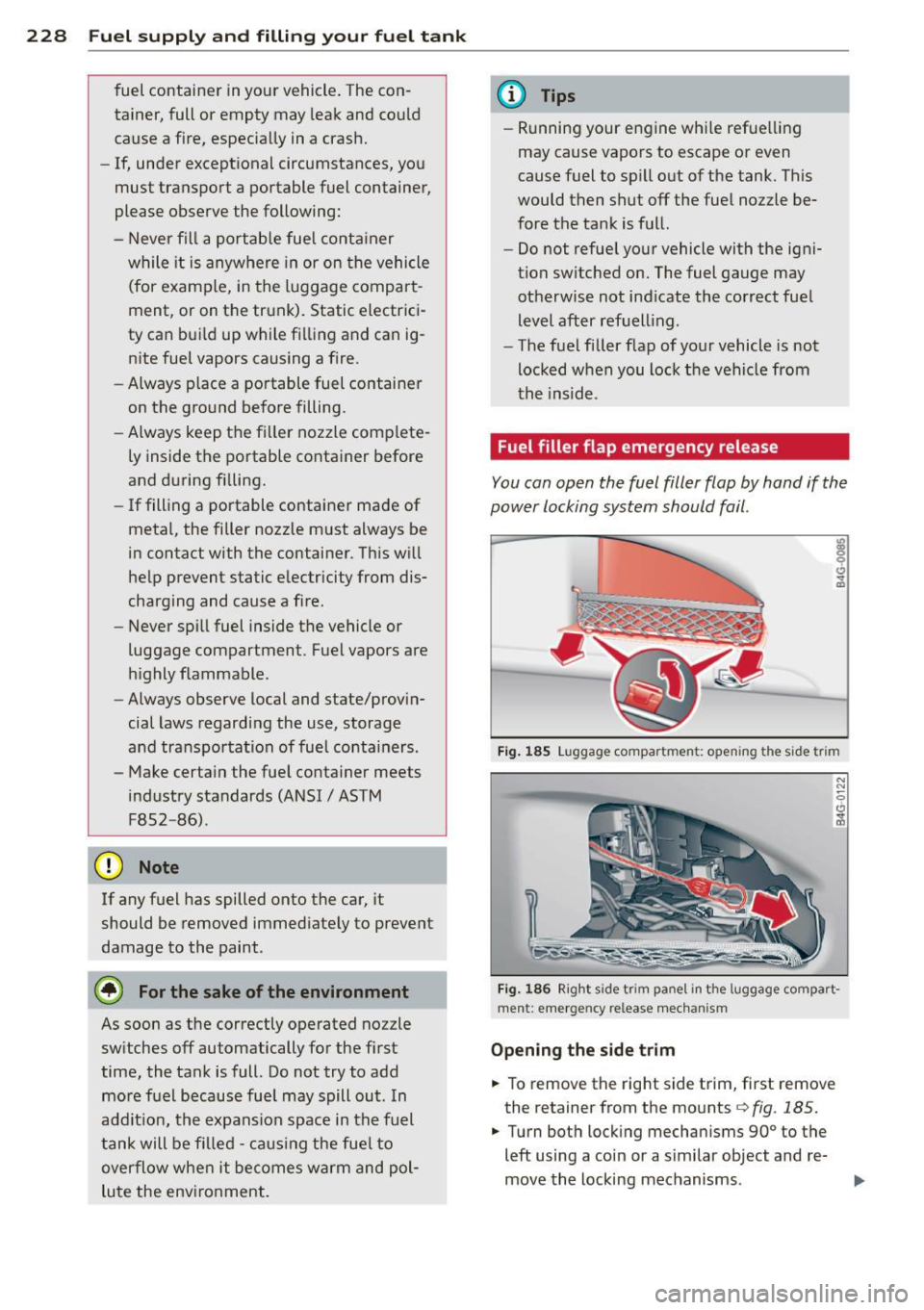
Fuel filler flap emergency release
You can open the fuel filler flap by hand if the
power locking system should fail.
Fig. 185 Lug g ag e compar tmen t: o pe ning th e side tri m
N
N
0 <.:)
iii
Fig. 186 Rig ht s ide t rim p an el in t he luggage compart
ment : emer gen cy re lease mech anism
Opening the side trim
.. To r emove th e right side trim, first remove
the retainer from the mounts
¢ fig . 185.
.. Turn both locking mechanisms 90° to the
left using a coin or a similar object and re-
move the locking mechanisms. ..,_
Page 232 of 310
230 Checking and filling
Checking and filling Engine hood
Releasing the engine hood
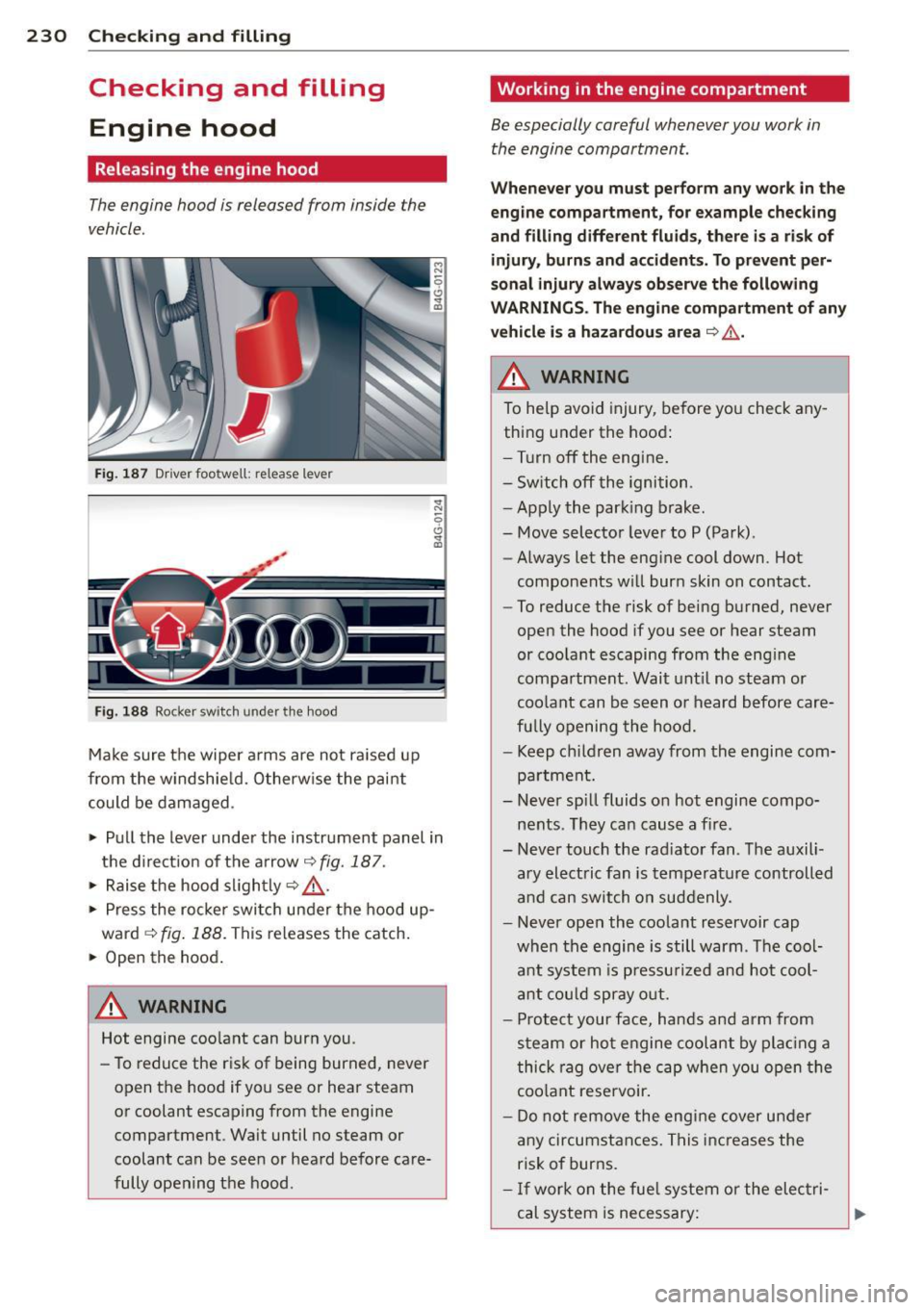
The engine hood is released from inside the
vehicle .
Fig. 187 Driver foo twell: release lever
Fig. 188 Rocker switch un der the hood
Make sure the wiper arms are not raised up
from the windshield. Otherwise the paint
could be damaged .
.,. Pull the lever under the instrument panel in
the direction of the arrow
~ fig. 187.
.,. Raise the hood slightly~,&. .
... Press the rocker switch under the hood up
ward
~ fig. 188. This releases th e catch.
... Open the hood.
&_ WARNING
Hot engine coolant can burn you.
- To reduce the risk of being burned, never
open the hood if you see or hear steam
or coolant escaping from the engine compartment . Wait until no steam or
coolant can be seen or heard before care
fully opening the hood .
'Working in the engine compartment
Be especially careful whenever you work in
the engine compartment.
Whenever you must perform any work in the
engine compartment, for example checking
and filling different fluids, there is a risk of injury, burns and accidents. To prevent per
sonal injury always observe the following
WARNINGS. The engine compartment of any
vehicle is a hazardous area
~ ,&. .
A WARNING
To help avoid injury, before you check any
thing under the hood:
- Turn off the engine.
- Switch off the ignition .
- Apply the parking brake.
- Move selector lever to P (Park).
- Always let the engine cool down. Hot
components will burn skin on contact.
- To reduce the risk of being burned, never
open the hood if you see or hear steam
or coolant escaping from the engine
compartment. Wait until no steam or
coolant can be seen or heard before care
fully opening the hood.
- Keep children away from the engine com
partment.
- Never spill fluids on hot engine compo
nents . They can cause a fire .
- Never touch the radiator fan. The auxili
ary electric fan is temperature controlled
and can switch on suddenly .
- Never open the coolant reservoir cap
when the engine is still warm . The cool
ant system is pressurized and hot cool
ant could spray out.
- Protect your face, hands and arm from
steam or hot engine coolant by placing a
thick rag over the cap when you open the
coolant reservoir.
- Do not remove the engine cover under
any circumstances. This increases the
risk of burns.
- If work on the fuel system or the electri
cal system is necessary:
Page 239 of 310
Engine cooling system
Coolant
The engine coolant performs two functions: it
keeps the engine from overheating and it pro
te cts the engine from freezing in the winter .
The cooling system is sealed and generally re
qu ires little attention .
The cooling system has been filled at the fac
tory with a permanent coolant which does not need to be changed. The coolant consists of a
mixture of water and the manufacturer's gly
col-based coolant additive G13 ant ifreeze
w ith anticorrosion add itives (50% fo r USA
models; 60% for Canad ian models). This mix
ture bot h assu res the ne cessary frost protec
tion and protects metal components in the
engine's coo ling system from corrosion and
scaling. It also raises the boili ng po int of t he
coolant.
D o not red uce the concentration o f the coo l
ant in the summer by adding plain water .
The
proportion of coolant addit ive must be at
least 50% but not mo re than 60 %
to main
tain antifree ze protection and cooling efficien
cy. If the coolant frost protection is too low,
the coolant cou ld freeze and damage the veh i
cle heating and eng ine cooling system .
For year-round driving, antifree ze is added at
the factory for temperatures down to:
- -3 1°F (-35°C)USA
- -40 ° F ( - 4 0 °C) Canada.
A WARNING
Before yo u check anything in the engine
compartment , always read and heed a ll
WARNINGS
¢ & in Working in the engine
compartment on page 230.
(D Note
- Befo re winter sets i n, have the coolant
chec ked to see i f th e coo lant ad dit ive i n
you r vehicle is suffic ient to meet the cli
mate cond itions . T hi s is especially impor
ta nt if yo u live in a regi on whe re the w in-
-
Checkin g and fillin g 237
ter is ex treme ly co ld. If necessary, i n
crease t he p ro po rtion of coo lant additive
to 60%.
- W hen a dding coolant additive to yo ur
cooling system , remembe r:
- We recommend us ing on ly coo la nt ad
di tive G 12++ or G 13 (check the labe l)
fo r you r ve hicl e. This coolant additive is
a v ailabl e at author ized Aud i de alers.
Ot he r ty pes of antifree ze can signifi
cantly reduce corros ion p rotec tion. The
r es ulting co rrosion can cause a loss of
coolant and serio us engine damage .
- Do not add any ty pe of rad iator leak seal
ant to you r vehicle's engine coo lant .
Add ing radiator repair flu id may adverse
ly affect t he fu nction and performance of
your cooling system and cou ld result in
damage not covered by yo ur New Ve hicle
L imited Warranty .
Checking the engine coolant level
The engine coolant level can be checked with
a quick glance.
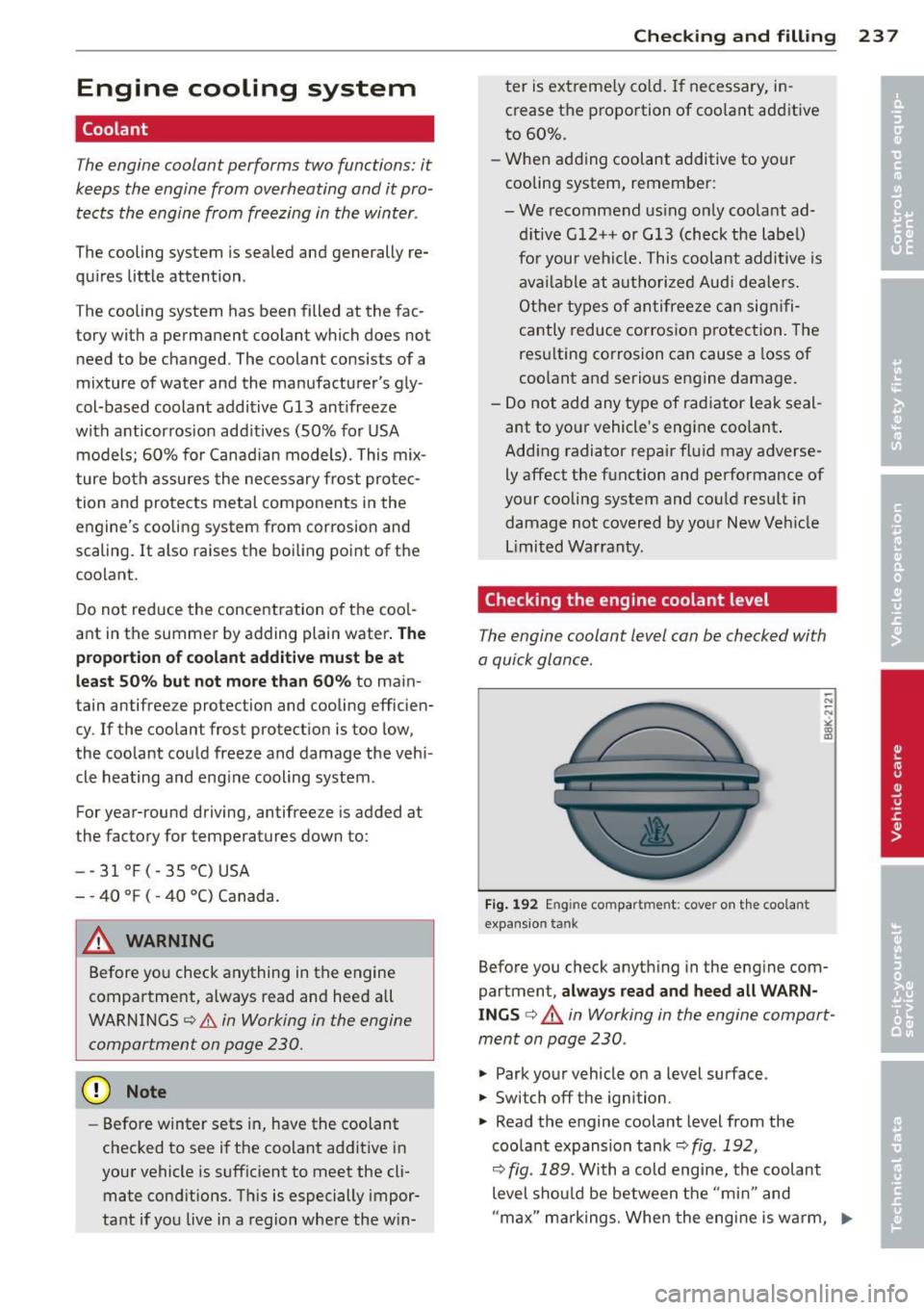
Fig. 19 2 Engine co mpart ment: cover on t he coo la nt
expansio n ta nk
Before you check a nyth ing in the eng ine com
partment,
always read and heed all WARN
INGS <=>&.
in Working in the engine compart
ment on page 230 .
.,. Park yo ur vehicle on a level surface .
.,. Switch off the ignition .
.,. Read the e ngine coolant level from the
coo la nt expansion tan k<=>
fig . 192,
¢ fig. 189 . With a cold engine, the coolant
level s hou ld be be tween the "m in" and
" max" mar kings. Whe n the engi ne is w arm,
Ill>-
Page 243 of 310
Disconne cting the batt ery t erminals
Some vehicle functions (power w indow regu
l ators, for example) are lost if the battery ter
minals are disconnected . These functions have
to be re learned after the battery terminals are
connected again. To prevent this, the battery
should only be disconnected from the vehicle
electrical system when absolutely necessary
for repairs .
Vehicles not driven fo r lo ng period s
If you do not drive your vehicle over a period
of several days or weeks, electrical compo
nents are gradually cut back or switched off .
This reduces energy consumption and main
tains starting capab ility over a longer per iod
c> page 202 . Some of the convenience func
tions may not operate, such as the inte rior
lights or power seat adjustment. The conven
ience functions will be ava ilable again when
you switch on the ignition and start the en
g ine.
Winter operation
D uring the winter months, batte ry capacity
tends to decrease as tempe ratu res d rop . This
is because more power is also consumed while
starting , and the headlights, rear window de
fogger, etc., are used more often.
Avoid unnecessary power consumption, par
ticularly in city t raffic or when traveling on ly
short distances. Let your a uthorized Audi
dealer check the capacity of the vehicle bat
tery before winter sets inc>
page 243. A well
charged battery w ill not only prevent starting
prob lems when the weather is cold, but will
also last longer .
@ Tips
If your vehicle is left standing for severa l
weeks at extremely low temperatu res, the
veh icle battery should be removed and
sto red where it will not freeze. This will
prevent it from being damaged and hav ing
t o be rep la ced.
Checkin g and fillin g 241
Working on the battery
Be especially careful when working on or near
the battery.
The battery is located in the luggage compart ment under the floor. Before you check any
th ing in the luggage compartment,
read and
he ed all WARNINGS
<=> ..&_ .
Always heed the safet y warnings , when work
i ng on the vehicle batte ry or the vehicle e lec
trical system to prevent inju ry.
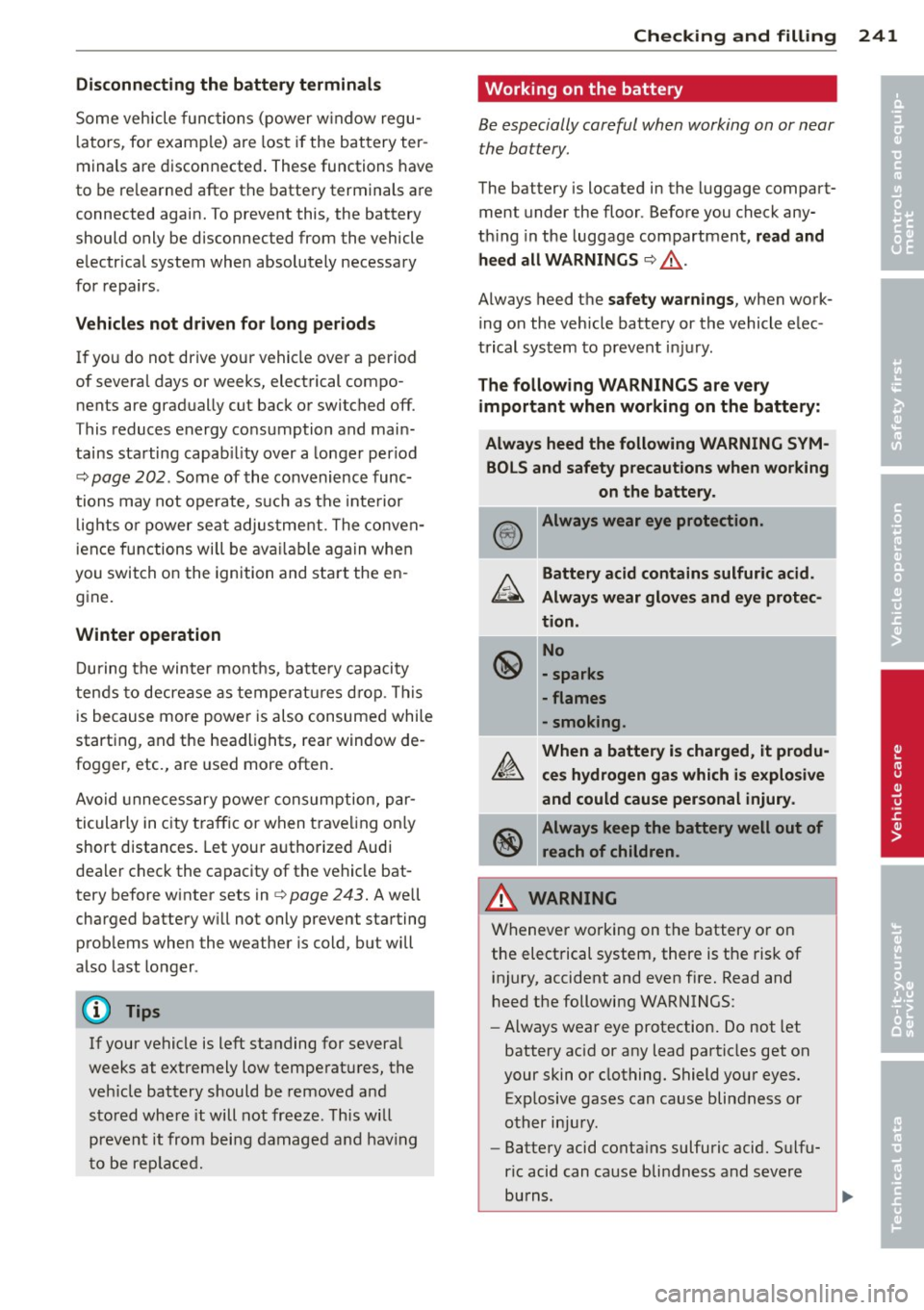
The following WARNINGS ar e very
important when wor king on the battery:
Always heed the following WARNING SYM BOLS and safety pre cautions when working
on the battery.
Always wear eye protection.
Battery acid contains sulfuri c acid .
Always w ear glove s and eye protec
tion.
No
- sparks
- flames
- smoking .
1
When a batter y is charged, it produ
ce s hydrogen g as which is e xplo sive
and could cause per sonal injury .
---·-
®
Always keep the battery well out of
reach of children .
A WARNING
Whenever working on the battery o r on
the electrical system, there is the risk of injury, accident and even fire. Read and
heed the following WARNINGS :
- Always wear eye protection. Do not let
-
battery ac id or any lead particles get on
your skin or clothing. Shield your eyes. Exp losive gases can cause blindness or
other inju ry.
- Battery acid conta ins sulfuric acid. Sulfu
ric acid can cause blindness and severe
bu rns.
•
•
Page 246 of 310
24 4 Ch eck ing and filling
Never use a fast charger as a booster to
start the engine. This will seriously dam
age sensitive electronic components, such
as control units, relays, rad io, etc., as well
as the battery charger.
Battery replacement
The new battery must have the same specifi
cations and dimensions as the original equip
ment battery .
Intelligent energy management in your veh i
cle is respons ible for d istributing the electr i
cal energy throughout your vehicle
c::> page 202. The intell igent energy manage
ment system w ill keep the engine battery
cha rged bette r than vehicles w ithout t his sys
tem. To make sure the additional e lectrica l en
e rgy is availab le once again after you have
changed the battery, we recommend that you
install batteries of the same type and man u
facture only (the same as those installed at
the time your vehicle was delivered). Specifi
cations are listed on the battery hous ing. Your
author ized dealer must code the battery in
the energy management system to enable you
to use the energy management funct ions cor
rectly after replac ing the battery .
The new battery must have the same capacity ,
voltage (12-volts), amperage, const ruct ion
and p lug sealing.
When insta lling the battery, make sure the ig
n ition and all e lectr ica l consumers are sw itch
ed off .
{[) Note
Make sure the venti lation hose on the s ide
of the battery is connected, ot herwise
fumes or battery ac id can leak out.
- Vehicles with the Start-Stop-System* are
equipped with a special cycle-proof AGM
batte ry. Insta lling a differe nt type of
batte ry can ca use p rob lems in the vehi
cle elect rical system. When rep lacing the
vehicle bat tery, always ins ta ll one wi th the same specifica
tions as the o rigina l
battery .
~ For the sake of the env ironment
B ec ause o f th e p rob lem of p roper disposal
of a battery, we recommend your author
ized Audi dealer change the battery fo r
you. Batteries contain sul fur ic acid and
l ead and must always be disposed of prop
erly in compl iance with all environmental
regulations. Disposing of veh icle batter ies
i mproperly is very dange rous to the envi
r onment.
Windshield/headlight
washer container
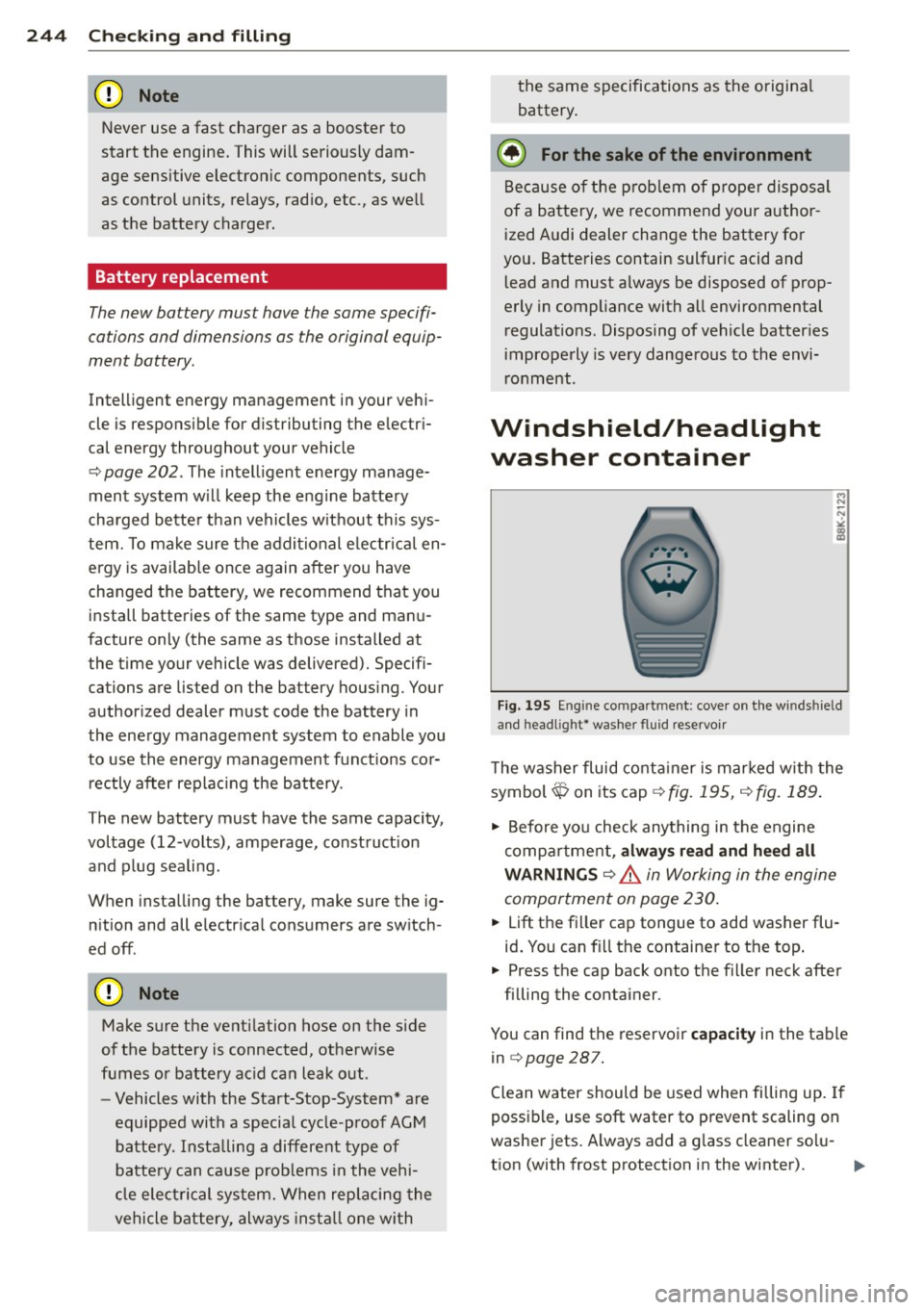
Fi g. 195 Eng in e compa rt m ent: cove r on t he w inds hield
and head lig ht* was her flu id reservo ir
T he washer fluid co nta iner is mar ked w ith the
symbol$ on its cap
c::> fig. 195, c::> fig. 189.
.,. Before yo u check anything in the engine
compa rtment,
alwa ys read and heed all
WARNINGS
c::> A in Working in the engine
compartment on page 230 .
.. Lift the fi ller cap tongue to add washer flu
id . You can fi ll the containe r to the top .
.. Press the cap back onto the filler neck after
filling the container .
You can find the reservoi r
capacity in the table
in
c::> page 287.
C lean water should be used when filling up . If
possible, use soft water to prevent scaling on
washe r jets. Always add a g lass cleaner so lu
t ion (with frost protection in the winter).
Page 248 of 310
24 6 T ire s and whee ls
Tires and wheels
Tires
General notes
Tires may be the least appreciated and most
abused parts of a motor vehicle .
Tires may be the least appreciated and most
abused parts of a motor vehicle . Tires are,
however, one of the most important parts of a
vehicle, particularly considering the compara
tive ly small patch of rubber on each tire that
assures that all -important contact between
you, your vehicle and the road.
Maintaining the correct tire pressure, making
sure that your vehicle and its tires do not have
to carry more weight than they can safe ly han
d le, avoiding damage from road hazards and
reg ularly inspecting t ires for damage includ
ing cuts, slashes irregu la r wear and overall
condition are the most important things that
you can do to he lp avoid sudden tire failure in
cluding tread separation and blowouts.
A vo idin g dama ge
I f you have to drive over a curb or similar ob
stacle, drive very slow ly and as close as possi
ble at a right angle to the curb.
A lways keep chem icals including grease, oil,
gasoline and b rake fluid off the tires.
Inspect the tires regularly for damage (cuts,
cracks or bl isters, etc.). Remove any foreign
bod ies embedded in the treads.
St orin g tire s
Mark tires when you remove them to indicate
the direction of rotation . Th is ensures you to
be ab le to mount them correctly when you re
install them.
When removed, the wheels or tires should be
stored in a cool, dry and preferably dark place .
Store tires in a vertical position if they are not mounted on rims, in a horizontal position if
they are mounted on rims. N
ew tir es
New t ires have to be broken in¢&,. .
The tread depth of new t ires may vary, accord
ing to the type and make of t ire and the tread
pattern .
Hidden damag e
Damage to tires and r ims is often not readily
vis ible . If you notice unusual vibrat ion or the
vehicle pulls to one s ide, th is may ind icate
that one of the t ires has been damaged . T he
t ir es must be checked immed iate ly by an au
tho rized Aud i dea le r or q ualified wor kshop.
Unidirecti onal t ires
A un idirectional tire can be identified by ar
rows on the sidewall, that po int in the direc
t ion the t ire is designed to rotate. You must
fol low the specified direction of rotation . This
is necessary so that these tires can develop
their optimum characteristics regarding grip, road noise, wear and hydrop laning resistance.
For more information
¢ page 274.
A WARNING
-New tires or tires that are old, worn or
damaged cannot provide maximum con
trol and braking ability .
-
-New tires tend to be slippery and must
be broken in . To reduce the risk of losing
control, a collision and ser ious personal
injuries, drive w ith special ca re for the
fi rst 350 m iles (560 km).
- Driving with worn or damaged tires can lead to loss of control, sudden tire fail
ure, including a blowou t and sudden de
flation, c rashes and serious personal in
juries . Have worn or damaged tires re
p laced immediate ly .
- Tires age even if they are not being used
and can fai l sudden ly, especially at high
speeds. Tires that are more than 6 years
old can only be used in an emergency
and then w ith special care and at low
speed.
Page 249 of 310
-Never mount used tires on yo ur vehicle if
yo u are not sure of their "previous histo
ry." Old used tires may have been dam
aged even though the damage cannot be
seen that can lead to sudden tire failure
and loss of vehicle control.
- If you notice unusual vibration or if the
vehicle pulls to one side when d riving, al
ways stop as soon as it is safe to do so
and check the wheels and tires for dam
age .
(D Note
Please note that summe r and wi nte r tires
are designed for the cond itions that are
Glossary of tire and loading terminology
Accessory weight means the comb ined weight (in excess of
those sta ndard items which may be rep laced)
of au toma tic transmission, power steer ing ,
power brakes, power windows, power seats,
radio, and heater, to the extent that these
items are availab le as factory-installed equip
ment (whether installed or not) .
Aspect ratio
means the rat io o f the height to the w idth of
the tire in percent . Numbers of 55 or lower in
dicate a low sidewall for improved steering re
sponse and better overa ll handling on dry
pavement .
Bead
means the part of the t ire t hat is made o f
steel wires, wrapped or reinforced by ply cords
and that is shaped to fit the r im.
Bead separation
means a b reakdown of the bond between
components in the bead .
Cord means the strands forming the plies in the
tire.
Tire s an d wheel s 24 7
typica l in those seasons . Aud i recommends
using winter tires during the winter
months . Low temperatures signif icant ly
dec rease the e lasticity of summer t ires,
which affects tract ion and brak ing ability.
If summer t ires are used i n very co ld tem
peratures, cracks ca n form o n the tread
bars , res ulting in perma nen t tire damage
that can cause loud driving noise and un
bala nced ti re s. Audi i s not respon sible for
th is type of damage .
Cold tire inflation pressure
means the t ire p ress ure recommended by t he
vehicle manufacture r fo r a tire o f a des ignated
s ize t hat has not bee n driven for more than a
coup le o f miles (k ilometers) at low speeds in
the three hour period before the tire press ure
is m easured or adjusted.
Curb weight
me ans the we ight of a motor ve hicle with
st andard equipmen t incl ud ing the max imum
capacity of fuel, oi l, and coolant, air condi
tioning and additional weig ht of optiona l
equipment.
Extra load tire
means a t ire design to oper ate a t higher load s
and at higher inflation pressures than the cor
responding standa rd tire . Extra load tires may
be identified as "XL", "x l", "EXTRA LOAD", o r
"RF" on the sidewal l.
Gross Axle Weight Rating ("GAWR")
me ans the load-ca rry ing capac ity of a single
axle system , measured at the tire -ground in
te rfaces.
Gross Vehicle Weight Rating ( "GVWR ")
mea ns the maximum total loaded we ight of
the ve hicl e. .,..
•
•
Page 252 of 310
250 Tires and wheels
Occupant loading and distribution for vehicle normal load for various designated seating
capacities
Designated seating capacity,
number of occupants Vehicle normal load
, number Occupant distribution in a nor-
of occupants _____ mally loaded vehicle
4 2 _________ 2infro nt
5 3 2 in front, 1 in back seat
Cold tire inflation pressure
Tire pressure affects the overall handling, performance and safety of a vehicle.
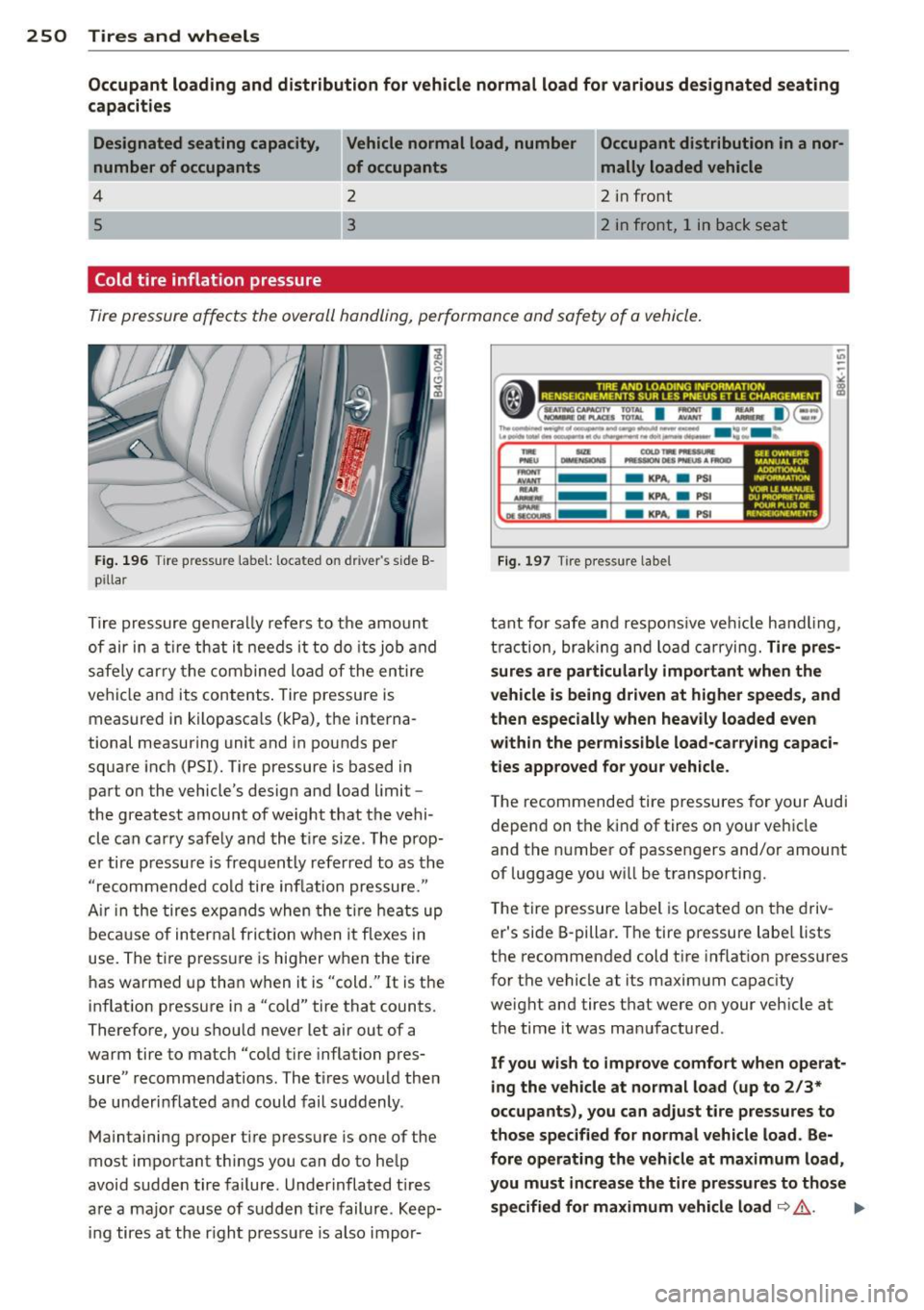
Fi g. 196 Tire pressure label: located on drive r's si de 8 -
pilla r
Tire pressure gene ra lly refers to the amo unt
of air i n a tir e th at i t needs it to do its job and
s a fe ly c arry the combined load of the entire
ve hicl e and its contents . Tire pressure is
measured in kilopasca ls (kPa), the i nterna
tional measuring unit and in pounds per
squa re inc h (PSI). Tire pressure is based in
part o n the vehicle's design and load limit -
the greatest amount of we ight that the vehi
cle can car ry safely an d the t ire s ize. The prop
e r tire p ressu re is freq uen tly referred to as the
"recommende d cold tire inf lation pressure."
A ir in the tires exp ands when the ti re heats up
beca use of in ter nal fri ct ion when i t flexes in
use. The tire p ress ure is higher when the tire
has warmed up tha n when it is "cold." It is the
inflat ion pressure in a "cold" tire that counts.
Therefore, you sho uld never let air out of a
warm tire to match "cold ti re inflation pres
sure" recommendations. The t ires wo uld the n
be underinflated a nd could fail suddenly .
Maintaining proper t ire p ressure is one of the
most important things you can do to he lp
avoid sudden tire failure. Underinflated t ires
a re a majo r ca use of s udden tire failure. Keep
ing tires a t the r ight pressu re is also impor-
-~
-
( • (==. ~r: I := I :... 1)-~- -:-i
n. ........... ....,. .................... ,...,,.. ...... ...... .. '--............................................... ·-..
TN IIZE CO.O TN.,,.... ,.,._u OWlHSIONt ......,., DU ,.,._ua .-,--
-.....
--...........
- KP a PSI
- ICPA. a PSI
- ICPA. a PSI
Fig. 197 Tire p ressu re labe l
SEEOWHf:ft"S
MA. NUAl FOR
IHFOll:MA TION Va.t Lf M>.MJ!:L OU PltOPfllE f A.IN: ,ol.M"-.UtDf NNSCIOM.:MErtf5
tant for safe an d respo ns ive ve hicle ha ndling,
t raction, br aking and load ca rrying .
Tire pres
sures are particularly important when the
vehicle i s being dr iven at higher speeds, and
then especially when heavily loaded even
within the permissible load-carrying capaci
ties approved for your vehicle .
The recommende d tire pressures for your Audi
depen d on t he kind of tires o n your vehicle
and the number of passengers and/or amount
of luggage you w ill be transporti ng.
T he tire pressure label is located on the d riv
er's side B -pillar . The tire pressure labe l lists
the recommended cold t ire inflat ion pressures
fo r the vehicle at its maxim um capac ity
weight and tires t hat were on your veh icle at
t h e time it was ma nufactured.
If you wish to improve comfort when operat
ing the vehicle at normal load (up to 2 /3*
occupants ), you can adjust t ire pressures to
those specified for normal vehicle load. Be·
fore operating the vehicle at maximum load,
you mu st increase the tire pres sures to those
specified for maximum vehicle load
i:::> .&, . II>-