service AUDI A7 2014 Owner's Manual
[x] Cancel search | Manufacturer: AUDI, Model Year: 2014, Model line: A7, Model: AUDI A7 2014Pages: 306, PDF Size: 76.83 MB
Page 235 of 306

-The oil filler cap must be properly se
cured to prevent oil from being sprayed
on the hot engine and exhaust system
when the engine is running - fire hazard!
-If your skin has come in contact with the
engine oil, you must subsequently
cleanse it thoroughly .
@ Note
-Check the oil level using the MMI. If the
message
Please reduce oil level appears,
contact your authorized Audi dealer or
other qualified workshop to have excess
oil extracted if necessary .
-Audi does not recommend the use of oil
additives. They may damage the engine
and adversely affect your New Vehicle
Warranty.
@ For the sake of the environment
- Under no circumstances can the oil come
in contact with the sewage network or
the soil.
- Observe and follow legal regulations
when disposing of empty oil containers.
Changing the engine oil
We recommend that have your oil changed by
an authorized Audi dealer or a qualified serv
ice station .
Before you check anything in the engine com
partment,
always read and heed all WARN
INGS
~ .&. in Working in the engine compart
ment on page 22
7.
T he engine oil must be changed according to
the intervals specified in your Warranty
&
Maintenance booklet . This is very important
because the lubricating properties of oil di
minish gradually during normal vehicle use.
Under some circumstances the engine oil
should be changed more frequently . Change
oil more often if you drive mostly short dis
tances , operate the vehicle in dusty areas or
under predominantly stop-and-go traffic con
ditions , or have your vehicle where tempera-
Checking and filling 233
tu res remain below freezing for extended pe
riods.
Detergent additives in the oil will make fresh
oil look dark after the engine has been run ning for a short time. This is normal and is not
a reason to change the oil more often than
recommended.
Because of the problem of proper disposal,
along with the special tools and necessary ex
pertise requir ed, we strongly recommend that
you have your oil changed by an authorized
Audi dealer or a qualified service station.
If you choose to change your oil yourself,
please note the following important informa
tion:
_& WARNING
To reduce the risk of personal injury if you
must change the engine oil in your vehicle
yourself:
- Wear eye protection.
- To reduce the risk of burns from hot en-
gine oil, let the engine cool down to the
touch.
- When removing the oil drain plug with
your fingers, stay as far away as possible.
Always keep your forearm parallel to the
ground to help prevent hot oil from run
ning down your arm.
- Drain the oil into a container designed
for this purpose, one large enough to hold at least the total amount of oil in
your engine .
- Engine oil is poisonous. Keep it well out
of the reach of children.
- Continuous contact with used engine oil
is harmful to your skin. Always protect
your skin by washing oil
off thoroughly
with soap and water.
(D Note
Never mix oil additives with your engine
oil. These additives can damage your en
gine and adversely affect your Audi Limit
ed New Vehicle Warranty.
•
•
Page 236 of 306

234 Check ing and filling
@ For the sake of the environment
- Before changing your oil , first make sure
you know where you can properly dispose
of the used o il.
- Always dispose of used engine oil proper
l y. Do not dump it on garden soi l, wood
ed areas, into open streams or down
sewage dra ins.
- Recycle used engine oil by taking it to a
used engine oil collection facility in your
area, or contact a service station .
Engine cooling system
Coolant
The engine coolant performs two functions: it
keeps the engine from overheating and it pro tects the engine from freezing in the winter.
The cooling system is sea led and generally re
q uir es little attention .
The cooling system has been filled at the fac
tory with a pe rmanent coolant which does not
need to be c hanged. The coolant consists of a
mixture of spec ia lly conditioned water and the
manufacturer 's glyco l-b ased coo lant add i-
tive G l3 antifreeze with ant icorrosion addi
tives (50% for USA models ; 60% for Canadian
mod els). This mixture both assures the nec es
sary frost protection and protects metal com ponents in the engine's cooling sys tem from
corrosion and scaling . It a lso raises the boil
ing point of the coolant .
Do not red uce the concentration o f the coo l
ant in the summer by adding plain water.
The
proportion of coolant add itive mu st be at
l e a st 50 % but not more than 60 %
to main
tain antifreez e protection and cooling efficien
cy . If the coolant frost prote ct ion is too low,
the coo lant cou ld freeze and damage the veh i
cle hea ting and eng ine cooling system.
For yea r-round d riving, antifreeze is added at
the fac to ry for temperatures down to:
-- 31°F( -35°C)USA
- -40 °F ( -40 °C) Canada. If
you must add coolant, use a mixture o f wa
ter and coolant additive . Mixing the coo lant
additive with distilled water is recommended.
A WARNING
-
Before you c heck anything in the engine
compartment, always read and heed a ll
WAR NINGS
c::, & in Working in the engine
compartment on page 22
7 .
(D Note
- Before winter sets in, have the coo lant
checked to see if the coolant additive in
your vehicle is sufficient to meet the cli mate conditions . This is especia lly impor
tan t if you live in a reg io n where the win
t er is ex treme ly cold. If ne cessa ry, i n
crease the pr opo rtion of coo lant add itive
t o 60%.
- Whe n adding coolant additive to yo ur
c oolin g sys tem, remembe r:
- We recommend using on ly coolant ad
d itive Gl2++ or Gl3 (check the label)
for your vehicle . This coolant additive is
ava ila ble at autho rized Aud i deale rs.
Other types of antifreeze ca n sig nifi
ca ntly reduce co rr os io n protection. The
r es ult ing co rrosion c an c ause a los s o f
coolant and serious engine damage.
- Do not add any type of rad iator leak seal
a n t to y our vehicle 's engine coolant.
Add ing radiator repai r fl uid may adverse
ly affect the function and performance of
your cooling system and co uld resu lt in
damage not covered by yo ur New Vehicle
Limited Warranty.
-
Page 240 of 306
238 Checking and filling
@ For the sake of the environment
Because of the problem of proper disposal
of brake fluid as we ll as the special tools
required and the necessary expertise, we recommend that you have the brake fluid
changed by your author ized Audi dealer.
Battery
General information
Under normal operating conditions, the bat
tery in your Audi does not need any mainte
nance. With
high outside temperatures or
long daily drives we recommend that you have
the electro lyte level checked by a service fa
cility . The electrolyte level should also be
checked each time the battery is charged
<=:> page 240.
Have the battery checked when you take your
vehicle in for service . You are well adv ised to
replace a battery that is older than 5 years .
With certain types of airbag deployment, the battery is disconnected from the vehicle elec
tr ical system for safety reasons
c::> & in Re
pair, care and disposal of the airbags on
page 165.
Disconnecting the battery terminals
Some vehicle functions (power window regu
lators, for example) are lost if the battery ter
minals are disconnected. These functions have
to be relearned after the battery terminals are
connected again. To prevent this , the battery
should only be disconnected from the vehicle
e lectrica l system when absolutely necessary
for repairs.
Vehicles not driven for long periods
If you do not drive your vehicle over a period
of severa l days or weeks, electrical compo
nents are gradually cut back or switched off.
This reduces energy consumption and main
tains starting capability over a longer period
c::> page 202. Some of the convenience func
tions may not operate, such as the interior
lights or power seat adjustment. The conven- ience
functions will be available again when
you switch on the ignition and start the en gine.
Winter operation
During the winter months, battery capac ity
tends to decrease as temperatures drop. This
is because more power is a lso consumed whi le
starting, and the headlights, rear window de
fogger, etc., are used more often.
Avoid unnecessary power consumption, par
ticularly in city traffic or when traveling only
short distances. Let your authorized Audi
deale r check the capacity of the vehicle bat
tery before winter sets in
c::> page 240 . A well
charged battery will no t only prevent star ting
problems when the weather is cold, but will
also last longer .
@ Tips
If your vehicle is left standing for several
weeks at extremely low temperatures, the
vehicle battery should be removed and
stored where it w ill not freeze. This will
prevent it from be ing damaged and having
to be replaced .
Working on the battery
Be especially careful when working on or near
the battery.
The battery is located in the luggage compart
ment under the floor . Before you check any
thing in the luggage compartment,
read and
heed all WARNINGS
c::> .&,.
Always heed the safety warnings , when work
ing on the vehicle battery or the vehicle elec
trical system to prevent injury.
The following WARNINGS are very
important when working on the battery:
Always heed the following WARNING SYM-
BOLS and safety precautions when working
on the battery.
®
Always wear eye protection.
Page 253 of 306
-The use of incorrect tire pressure values
can lead to accidents or other damage.
Therefore it is essential that the driver observe the specified tire pressure values
for the tires and the correct pressu res for
the funct ion of the tire pressure mon itor
ing system*.
- Always inflate t ires to the recommended
and correct tire pressure before driving
off.
- Driv ing with under inflated tires bend
more, letting them get too hot resu lting
in tread separation, sudden t ire fa il u re
and loss o f control.
- Excessive speed and/ove rloading can
cause heat bui ld-up, sudden tire fail ure
and loss o f control.
- If the t ire pressure is too low or too high,
the tires w ill wear prematurely and the
vehicle will not hand le we ll.
- If the t ire is no t flat and you do not have
to change a wheel immediate ly, drive at
reduced speed to the nearest service sta
tio n to check the tire pressure and add
air as required.
(D Note
Dr iving without va lve stem caps ca n cause
damage to the tire va lves. To prevent this,
always make sure that factory installed
valve stem caps on all wheels are secure ly
mounted on the va lve.
@ For the sake of the environment
Underinflated tires will a lso increase the
fue l consumption .
Tires and vehicle load limits
There are limits to the amount of load or
weight that any veh icle and any t ire can carry .
A vehicle that is overloaded w ill not handle
well and is more difficult to stop . Overload ing
can not on ly lead to loss of vehicle con trol,
b ut can a lso damage important par ts of the
vehicle and can lead to sudden tire failure, in
cluding a blowout and sudden deflation that
can cause the vehicle to crash.
Tire s an d wheel s 251
Your safety and that of your passengers also
depends on making sure that load limits are
not exceeded. Vehicle load includes everybody
and everything in and on the veh icle. These
load lim its are technically referred to as the
vehicle's
Gro ss Ve hicle Wei ght R ating
("GVWR") .
The "GVWR" includes the weight of the basic
vehicle, all factory installed accessories, a full
tank of fuel, o il, coolant and other fluids plus
maximum load. The max imum load includes
the number of passengers that the vehicle is
in tended to carry ("seat ing capac ity") with an
assumed we ight of 150 lbs (68 kg) for each
passenger at a designated seating posit ion
and the total weight of any luggage in the ve hicle . If you tow a trai ler, the weight of the
trailer hitch and the tongue weight of the
loaded tra iler must be included as part of the
vehicle load.
The
Gr oss Ax le We ight R ating ("GAWR") is
the maximum load that can be applied at each
of the vehicle's two axles.
The Gross Vehicle Weight Rating and the
Gross Axle Weight Rating are listed on the
safety comp liance sticker label located on the
driver's side B-pillar. Your Audi has 4 seat ing
pos itions, 2 in the front and 2 in the rear for
total seating capacity of 4 . In some vehicles
there are 5 seating pos it ions, 2 in the front
and 3 in the rear for tota l seating capacity of
5. Each seat ing position has a safety belt
~ page 140, Safety belts .
The fact that there is a n upper limit to you r
vehicle's Gross Vehicle Weight Rating means
that the total weig ht of whatever is being car
ried in the vehicle ( includ ing the weight of a
trailer hitch and the tongue weight of the
loaded trai ler) is limited . The more passen
gers in the vehicle or passengers who are
heavier than the standard we ights assumed
mean that less we ight can be carried as lug
gage .
The tire pressure label on your Audi also lists
the maximum combined weight of a ll of the
occupants and luggage or other cargo that ..,.
•
•
Page 255 of 306

6. If your vehicle will be towing
a trailer, load from your trail
er will be transfe rred to your
vehicle. Consult this manual
to determine how this re
duces the available cargo
and luggage load capacity of
your vehicle.
... check the tire sidewall
(q page 254, fig. 204) to de
termine the de signated load
rating for a specific tire.
Tire service life
The service life of tires depends on a lot of
different things including proper installation
and balancing, correct tire pressure and driv
ing style.
Fig. 202 Tir e tread: tread wea r indi cators (TWI)
Fig. 203 Rotat ing t ires for more even wear
Tread Wear Indicator (TWI)
The original tires on your vehicle have
1/16 inch (1.6 mm) high "wear indicators"
Tires and wheels 253
¢ fig. 202 ru nning across the tread. Depend
ing on the make, t here will be six to eight of
them evenly placed around the tire. Marks on
the tire sidewall (for examp le "TWI" or other
symbols) indicate the positions of the tread
wear indicato rs . Worn tires must be rep laced .
D iffere nt figures may apply in othe r countr ies
~ A .
Tire pressure
Incorrect t ire pressure causes premature wear
and can cause sudden tire blow-out. For this reason, tire pressure must be checked at least
once a month ¢
page 249.
Driving style
Driving fast around curves, heavy acce lerat ion
and hard braking increase tire wear .
Rotating tires for more even wear
For all four tires on your vehicle to have the
same service life, we recommend that the
front and rear tires a re rotated according to
the tire manufacturer's suggested tire rota
tion intervals. Please remember the follow ing:
- Tire rotation intervals may differ from the
veh icle service interva ls outlined in your
Warra nty
& Maintenance booklet.
- The longer one tire is used in one location
on the vehicle, the more it wears at certain
points ; therefore, we recommend t hat you
follow t he tire manufacturer's suggested
tire rotation intervals.
- Veh icles w ith front-wheel dr ive experience
more tread wear on the front wheels com
pared to all-wheel drive (quattro).
- Please rotate tires as shown ¢
fig. 203.
- Extra care must be taken when rotating di-
rection-specific tires¢
page 2 71 .
Wheel balancing
The wheels on new veh icles are balanced.
However, various situations during everyday
driv ing can cause them to become unbal
anced, resulting in vibrations you can usually
feel through the steer ing wheel. ..,.
Page 273 of 306

Tires with unidirectional tread design
Tires with unidirectional tread design must be
mounted with their tread pattern pointed in
the right direction.
Using a spare tire with a tread pattern
intended for use in a specific direction
When using a spare tire w ith a tread pattern
in tended for use in a specific direction, please
note the following:
- The direction of rotation is marked by an ar
row on the side of the tire.
- If the spare t ire has to be installed in the in
correct direction, use the spare tire only
temporarily since the tire will not be able to
achieve its optimum performance character
istic s with rega rd to aquaplaning, noise and
wear.
- We recommend that you pay particular at
tention to this fact during wet weather and
that you adjust your speed to match road
conditions.
- Replace the flat tire with a new one and
have it installed on your veh icle as soon as
possib le to restore the handling advantages
of a unid irectiona l tire .
Notes on wheel changing
Please read the information c:> page 254, New
tires and replacing tires and wheels
if you are
going to use a spare t ire which is different
from the tires on your veh icle.
After you change a tire :
-Check the tire pressure on the spare imme
diately after installation .
- Have the wheel bolt tightening torque
checked with a torque wrench as soon as
possible by your authorized Audi dealer or
a qualified service station.
- With steel and alloy wheel rims, the wheel
bolts are correctly tightened at a torque of
90 ft lb (120 Nm).
- If you notice that the wheel bolts are cor
roded and difficult to turn while changing
a tire, they should be replaced before you
check the tightening torque. What do I do now? 271
- Replace the flat tire with a new one and
have it installed on your vehicle as soon as
possible. Remount the wheel cover.
Until then , drive with extra care and at re
duced speeds.
A WARNING
-
- If you are going to equ ip your vehicle
with tires or rims which differ from those
which were factory installed, then be
sure to read the information<=>
page 254,
New tires and replacing tires and
wheels.
- Always make sure the damaged wheel or
even a flat tire and the jack and tool kit
are properly secured in the luggage com
pa rtment and are not loose in the pas
senger compartment .
- In an accident or sudden maneuver they
could fly forward, in juring anyone in the
veh icle.
- Always store damaged wheel, jack and
too ls securely in the luggage compa rt
ment. Otherwise , in an accident or su d
den maneuver they could fly forward,
causing injury to passengers in the vehi
cle.
•
•
Page 279 of 306
@ Tips
The disc harged battery must be properly
connected to the vehicle's electrical sys
tem. When jump starting or charg ing the
battery, never connect the negative
ground cable to the battery negat ive post
because the ba ttery manager system must
be ab le to detect the battery's state of
charge. Always connect the negative
g round cab le to the negative ground pos t
of t he battery manager cont ro l unit.
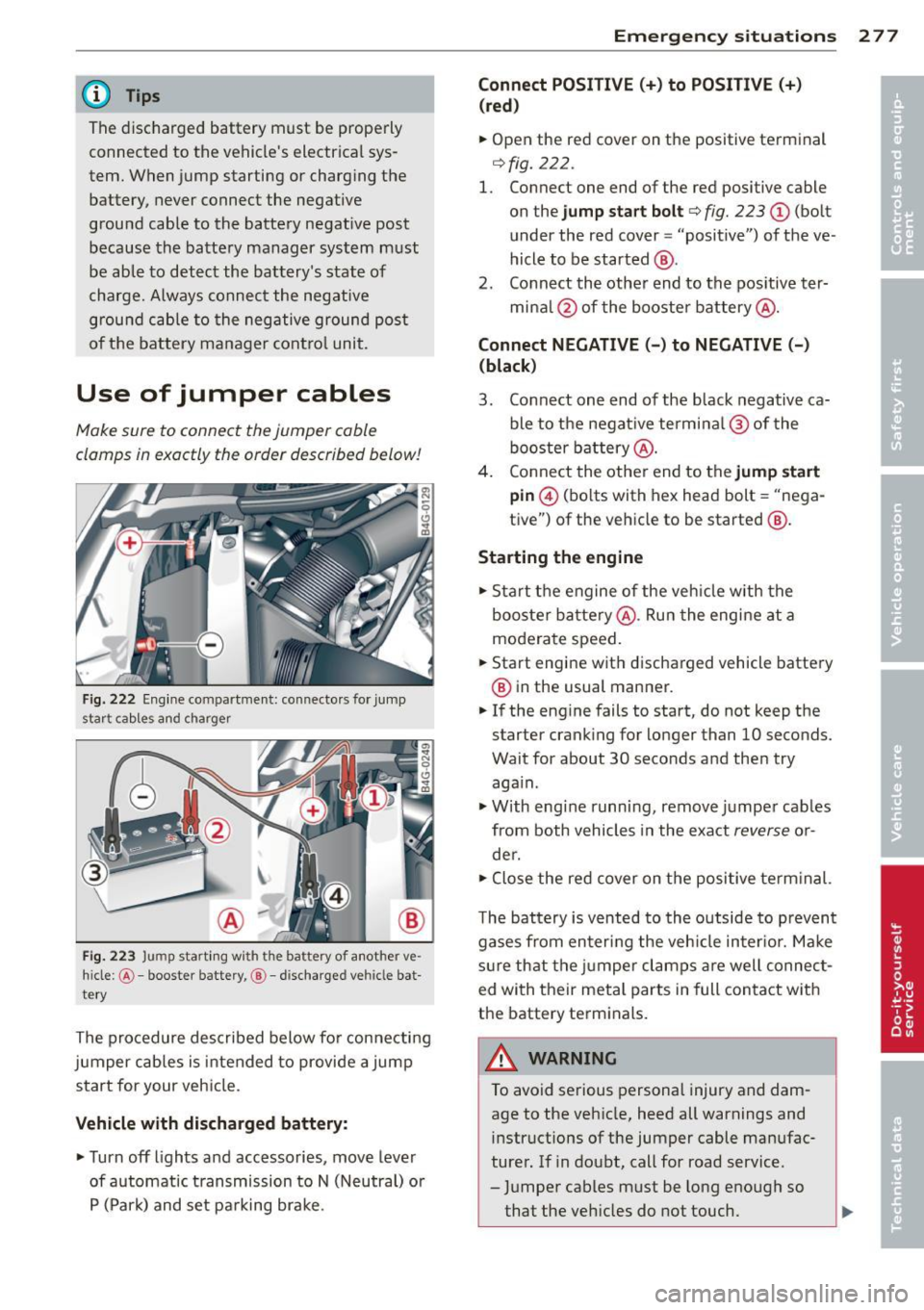
Use of jumper cables
Make sure to connect the jumper coble
clomps in exactly the order described below!
Fi g. 222 Eng ine compar tment: connecto rs for jum p
start cables and charger
F ig. 223 Jump starting w ith the battery of a nother ve ·
hicle:
@ -booster battery, ®-discharged veh icle bat
te ry
The procedure described below fo r connecting
jumper cables is intended to provide a jump
start for your veh icle.
Vehicle with discharged battery :
• Turnoff lights and accessories, move lever
of automatic t ransmission to N (Neutral) o r
P ( Par k) and set pa rking brake.
Emergenc y situ ation s 2 77
Connect POSI TIVE(+) to POSITIVE(+)
(red )
• Open the red cover on the positive te rminal
¢fig. 222.
1. Connect one end of the red positive cable
on the jump sta rt bolt ¢
fig. 223 (D (bolt
under the red cover = "positive") of the ve
hicle to be started @.
2. Co nnect th e othe r end to the pos itive ter-
mi na l@ of the booster battery @.
Connect NEGATIVE( -) to NEGATIVE(-)
(black )
3. Connect one end of the black negative ca ble to the negat ive termi na l@ of the
booster b attery @.
4. Connect the othe r end to the jump start
pin @ (bo lts with hex head bolt = "nega
tive") of the vehicle to be started @.
Starting the engine • Sta rt the engine of the veh icle w ith the
booste r ba tte ry @ . Ru n the engine at a
moderate speed.
• Start engine wit h discharged vehicle battery
@ in the usual manner.
• If the eng ine fails to start, do not keep the
starter cranking for longer than 10 seconds.
Wait for about 30 seco nds a nd the n try
aga in .
• With eng ine runni ng,
remove ju mpe r cab les
from both vehicles in the exact
reverse o r
de r.
• Close the re d
cover on the positive te rm inal.
T he battery is v ented to th e outside to p rev ent
gases from en ter ing the veh icle in ter io r. Ma ke
s ur e th at the j umper clamps are well connec t
ed with their meta l parts in full con ta ct w ith
the battery term inals.
,8. WARNING
To avoid se rious personal injury and dam
age to the veh icle, heed all warnings and
instructions of the jumper cable man ufac
ture r. If in doubt, call for road service.
- Ju mpe r cables m ust be long enough so
that the veh icles d o not touch.
-
Page 287 of 306

Consumer Information
Warranty coverages
Your Audi is covered by the following war
ranties :
- New Vehicle Limited Warranty
- Limited Warranty Against Corrosion Perfo-
ration
- Emissions Control System Warranty
- Emissions Performance Warranty
- California Emissions Control Warranty (USA
vehicles only)
- California Emissions Performance Warranty
(USA vehicles only)
Detailed information regarding yo ur warran
ties can be found in your
Warranty & Mainte
nance booklet .
Operating your vehicle
outside the U.S.A. or
Canada
Government regulations in the United States
and Canada require that automobiles meet
specific emission regulations and safety
standards. Therefore, veh icles built for the
U.S.A. and Canada differ from vehicles sold in
other countries .
I f you p lan to take your vehicle outside the
continental limits of the United States or Can
ada, there is the possibility that:
- unleaded fuels for vehicles with cata lytic
converter may not be available;
- fuel may have a considerably lower octane
rating . Improper fuel may cause engine
damage;
- service may be inadequate due to lack of
proper service facilities, tools or testing
equipment;
- replacement parts may not be readily availa
ble.
- Navigation systems for vehicles built for the
U.S.A. and Canada will not necessari ly work
in Europe, and may not work in other coun
tries outside North America .
Consumer Information 285
@ Note
Audi cannot be responsible for mechanical
damage that could result from inadequate
fuel, serv ice or parts availab ility.
Audi Service Repair
Manuals and Literature
Audi Offic ial Factory Service Manuals and Lit
erature are published as soon as possible after
model introduct ion. Service manuals and lit
erat ure are available to order from the Audi
T echnical Literature Ordering Center at:
www.audi.techliterature.com
Maintenance
' General
Your vehicle has been designed to help keep
maintenance requirements to a m inimum.
However, a certain amount of regular mainte
nance is still necessary to assure your vehicle's
safety, economy and reliability . For detailed
vehicle maintenance consult your Warranty
&
Maintenance booklet.
Under difficult operating conditions , for ex
ample at extremely low outside temperatures,
in very dusty regions, when towing a trailer
very frequently, etc., some serv ice work
shou ld be pe rformed between the intervals
specified. This applies particularly to:
- oil changes, and
- cleaning or replacing the air filter.
® For the sake of the environment
By regularly maintaining your veh icle, you
help make sure that emission standards
are maintained, thus min imiz ing adverse
effects on the environment .
Important considerations for you and
your vehicle
The increasing use of electronics, sophistica t
ed fuel injection and emission contro l sys-
tems, and the genera lly increasing technica l ..,_
•
•
Page 300 of 306

298 Index
Proper seating position
Front passenger ....... ... .. .. .... . 132
Occupants . .... ... .... ... .. .. .... . 131
Rea r passenger s . . . . . . . . . . . . . . . . . . . 133
P rotec ting 215
Q
quattro
re fer to All-wheel dr ive 201
Question What happens to unbelted occupants? 141
Why safety be lts? . . . . . . . . . . . . . . . . . 140
R
Radiator fan ........... .... .... .... 236
Radio clock . .... .. ..... ... .. .. .... .. 28
Ra in/ lig ht sensor
H ead lig hts ... ... .. .. .... .. .. .. .. .. 44
I n termi ttent (win dshield wipe rs) .. .... 48
Sensor defective . . . . . . . . . . . . . . . . . . . . 23
Range (fuel level) ... .... ... .. .. .. .. .. 25
Reading lights .... .. ... .. .. .. .. .. .. .. 4 7
Rear fog lights . .... .... ..... .. .. .. .. 44
Rear lid Automatic operation . . . . . . . . . . . . . . . . 38
E me rgency release . . . . . . . . . . . . . . . . . . 40
Rea r light
De fe ct ive . . . . . . . . . . . . . . . . . . . . . . . . . 23
Rear she lf . . . . . . . . . . . . . . . . . . . . . . . . . . 64
Rear spoiler .. ... ... .... ... .. .. .. .. . 199
Rea r view came ra
refer to P a rk ing systems ... .. .. 117,118
Rear view mirror . ... .... ... .. .. .... .. 51
Rear window heating (a utomat ic cl imate
control) . . . . . . . . . . . . . . . . . . . . . . . . . . . . 73
Rea r window heating (clim ate contro l) ... 71
Recirculation mode (automatic climate
control) . . . . . . . . . . . . . . . . . . . . . . . . . . . . 72
Recirculation mode (climate control) . . . . 70
Refue lling . ...... .. ... .... .. .. .. .. . 221
Remote cont rol
Garage door opener (HomeL in k) . .. ... 128
Unlocking and locking ... .. .. .. .... . . 35
Repa ir manua ls .. ... .... ... .. .. .. .. . 285 Repairs
Airbag system 165
Rep lacing
Fuse s ... .. .. .. .. ........ .... ... .. 272
Light bu lbs .. .. .. ...... ..... .. .... 275
T ires and wheels ... ... ..... ... .. .. 255
Windshie ld wiper b la d es ..... .... . .. . 49
Repo rting Safety Defects ..... .... .. .. 138
Rese t button .. .. .. .... ... .. .. .. .. .. . 27
Retractor . . . . . . . . . . . . . . . . . . . . . . . . . . 14 3
Reve rsible mat .. .. ... .. .. ... ..... .. . 67
Rims Cleaning .. .. .. .. .. .... .. .. ... .... 214
Roof rack . .. .. .. . .......... ... ... .. . 62
Load ing ... .... .. .. ... .. ... ... .. .. . 63
Roof weight ..... .. .... .... ... .. .. . 63
s
SA FE .... .. .. .. . .......... ... ... .. . 27
Safe driv ing habits . .......... ...... . 130
Saf ety be lt pos ition . . . . . . . . . . . . . . . . . 144
S afety be lt height adjustment . . . . . . . 146
Safe ty be lts wo rn by pregnant women . 14S
Safety be lt pre tensioner ... .... ... .. .. 147
Service and disposal . .. ..... .... . .. 147
Safety be lt p retensioners
P re sense . . . . . . . . . . . . . . . . . . . . . . . . 194
Safety be lt s . . . . . . . . . . . . . . . . . . . . . . . . 143
Cleaning ...... .. ..... ........... . 215
Danger to passengers who do not wear a
safety belt ...... ................ . 141
Fasten ing . .. .. .. ... .......... .... 143
Heig ht adj ustmen t ............. .. .. 146
Improper ly wo rn ... .... .... ... .. .. 146
Not wor n ..... .. .. ... ..... ... .. .. 141
Safety be lt position . . . . . . . . . . . . . . . . 144
Safety inst ru ctions ............. .... 143
Securing child safety seats ...... .. .. 186
Spec ial considerations for pregnant
women ....... .. .. ... ........... . 145
Un fastening . .. .. ..... ........... . 145
Warning/ind icator light .... ..... .. .. 140
Wa rning light . . . . . . . . . . . . . . . . . . . . . . 17
Why YOU MUST wea r them .... .. .. .. 140
Worn p roperly ... .. .... .... ... .. .. 142
Safety belt tens ioner
drive select .. .. .. ... .. ........... . 102
Page 302 of 306
300 Index
Starting from rest . . . . . . . . . . . . . . . . . . . . 80
Starting off with a tra iler ... ... .. .. .. . . 80
Starting the engine .......... .. .. .. .. 76
Steer ing
Electrically adjustable steering whee l .. 75
Manually adjustable steering whee l .. .. 75
also refer to Electro -mechanical power
assist . ...... ................... . 201
Steer ing whee l
Easy entry feature ......... ... .... .. 76
Indicator light . . . . . . . . . . . . . . . . . . . . . 18
Steering whee l heating ..... ... .. ... . 74
Steering wheel column
Adj usting e lectr ically ...... .. .. .. .. . . 75
Adjusting manually ........ ... .. .. .. 75
Steer ing wheel w ith tiptronic ... .. .. .. . 113
Steps for determining correct load limit . 252
Stopping the engine . . . . . . . . . . . . . . . . . . 77
Storage . . . . . . . . . . . . . . . . . . . . . . . . 60, 64
S tronic transmission Launch Control Program ............ 114
S tron ic (automatic transmission) . .... . 109
Sunroof . .. ................... .... .. 42
Sun shade ... ................ ..... .. 48
Sun visors . . . . . . . . . . . . . . . . . . . . . . . . . . 48
Symbols
refer to Warning/indicator lights ...... 12
T
Tachometer . . . . . . . . . . . . . . . . . . . . . 12, 24
Tail lights
C leaning ................ .... ..... 214
TOI clean diesel
refer to Ad Blue .. ...... .... ... .. .. . 223
Technical data .............. ... .. .. . 282
Technical modifications ..... .. .. .... . 288
Temperature d isplay ...... .. .... .. .. .. 24
Tether anchors ..................... 192
Tether strap . ... ......... ... .. .. ... 192
Textiles Cleaning . .. ............. .. .. .. ... 216
The first 1,000 miles (1,500 km) and after-
wards ..... .. ................ ..... . 204
Three-zone climate control .. .. .. .. .. . . 70
Tie-downs . . . . . . . . . . . . . . . . . . . . . 66, 137 T
ips for the environment
Saving fuel . ..... ................ .. 63
t iptron ic (automatic transmission) 109, 113
Tire pressure .... ................... 249
T ire pressure monitoring system ....... 261
Loss of air pressure ................ 262
Malfunction ..... ................ . 262
Resetting tire pressures ......... .... 263
T ires ....... .. .. .. ............... .. 243
Service life .... .. ............. .... 253
Speed rating letter code ............ 255
Tire manufacturing date ............ 255
Tire specifications ............... .. 255
Tread depth ...................... 253
Uniform tire quality grading ..... .... 257
Winter tires ..... ... ........... ... 258
Tires and vehicle load limits ........ ... 251
T ires and wheels
Checking tire press ure ........ .. .. .. 249
Cold tire inflation pressure ....... ... 247
Dimensions . ..... ................ . 254
General notes .... ................ . 243
G lossary of tire and loading terminolo-
gy ....... .. .. .. .. ............... 244
Low aspect ratio tires ............. .. 260
New tires and wheels ........ ... .. .. 254
Replac ing ... .. .. ....... ...... .. .. 255
Snow chains ..... ... ........... ... 259
T ires and veh icle load limits ..... .... 251
Wheel bolts .................. .... 260
Winter tires ...... ................ 258
Tire service life .. .. ..... ..... ... .. .. 253
Too ls ..... ... .. .. ................ . 264
T orn or frayed safety belts ............ 143
Towing Tow truck procedures ........ ... .. .. 278
TPMS Tire pressure monitoring system . .. .. 262
T rai le r towing . .. .. ............... .. 209
Operating instructions .............. 209
Parking system ... ................ . 127
Technical requirements . . . . . . . . 209,210
Trai ler towing tips ................. 211
T rain (transport ing you r vehicle) . .. .. .. 280
Transmission .. .. .. ....... ...... .... 109
Transmission malfunction (indicator
light) . . . . . . . . . . . . . . . . . . . . . . . . . . . . . 114