brake AUDI A7 2014 Repair Manual
[x] Cancel search | Manufacturer: AUDI, Model Year: 2014, Model line: A7, Model: AUDI A7 2014Pages: 306, PDF Size: 76.83 MB
Page 262 of 306

260 Tire s and wheel s
chains because the vehicle will be ex
tremely low. If you do drive with snow
chains on while the vehicle is at this lev
el, the snow chains might severe ly dam
age the wheelhouse and other parts of
the veh icle.
(D} Tips
Where snow chains are mandatory oncer
tain roads, this normally also applies to
veh icles with all-wheel dr ive.
Wheel bolts
Wheel bolts must always be tightened to the
correct torque .
The design of whee l bolts is matched to the
factory installed r ims. If different rims
are fit
ted, the correct wheel bolts with the right length and correctly shaped bolt heads must
be used. This ensures that wheels are fitted
secure ly and that the brake system functions
correctly .
In certain circumstances, you may not use
wheel bolts from a different vehicle -even if it
is the same mode l
¢page 287.
_& WARNING
Imprope rly tig htened o r maintained whee l
bolts can be come loose ca using loss of
contro l, a co llision and serious persona l in
jury.
- Always keep the wheel bol ts an d the
threads in the wheel hubs clea n so the
wheel bolts can tu rn easily and be prop
er ly tightened .
- Never grease or oil the wheel bo lts and
the threads in the wheel h ubs. They can
become loose w hile driving if greased or
oiled, even if tightened to the specif ied
torque.
- Only use wheel bolts that belong to the rim being installed.
- Never use different whee ls bolts on your
vehicle.
- Always maintain the correct tighten ing
torq ue for the wheel bo lts to reduce the risk of a whee
l loss. If the tightening tor
que of the wheel bolts is too low, they
can loosen and come out when the vehi
cle is mov ing. If the tighte ning torque is
too high, the wheel bolts a nd threads
can be damaged and the whee l can be
come loose.
([) Note
The specified torque for the whee l bolts is
90 ft lb (120 Nm) with a tolerance of± 7,4
ft lb(± 10 Nm). Torque whee l bolts diago
nally. Afte r changing a whee l, the torque
must be checked as soon as possible wi th a
torque wrench -pre ferably by an au thor
ized Audi dealer or qualified workshop .
Low aspect ratio tires
Your Audi is factory-equipped with low aspect
ratio tires. These tires have been thoro ughly
tested and been se lected specifically for your
model for their superb performance, road fee l
and hand ling u nder a var iety of d riv ing condi
t ions . As k your author ized Audi dealer for
more details.
The low aspect ratio of these tires is ind icated
by a numeral of
55 or less in the tire's s ize
designation . The numeral rep resents the ratio
of the t ire's s idewa ll height in relation to its
t read width ex pressed in percentage. Conven
t iona l tires have a he igh t/w idth rat io of 60 or
more.
The performanc e of low -a sp ec t-ratio tires i s
pa rticularly sensitive to improper inflation
pre ssure . It is therefore important that low
a spect ratio tires are inflated to the specified
pre ssure and that the inflation pressure i s
regularly checked and maintained. Tire pre s
sures should be checked at least once a month and always befo re a long trip
¢ page 249, Checking tire pressure .
What you can do to avoid tire and rim
damage
Low aspect ratio tires can be damaged more
easily by impact w ith potholes, curbs, gull ies .,..
Page 268 of 306
266 What do I do now?
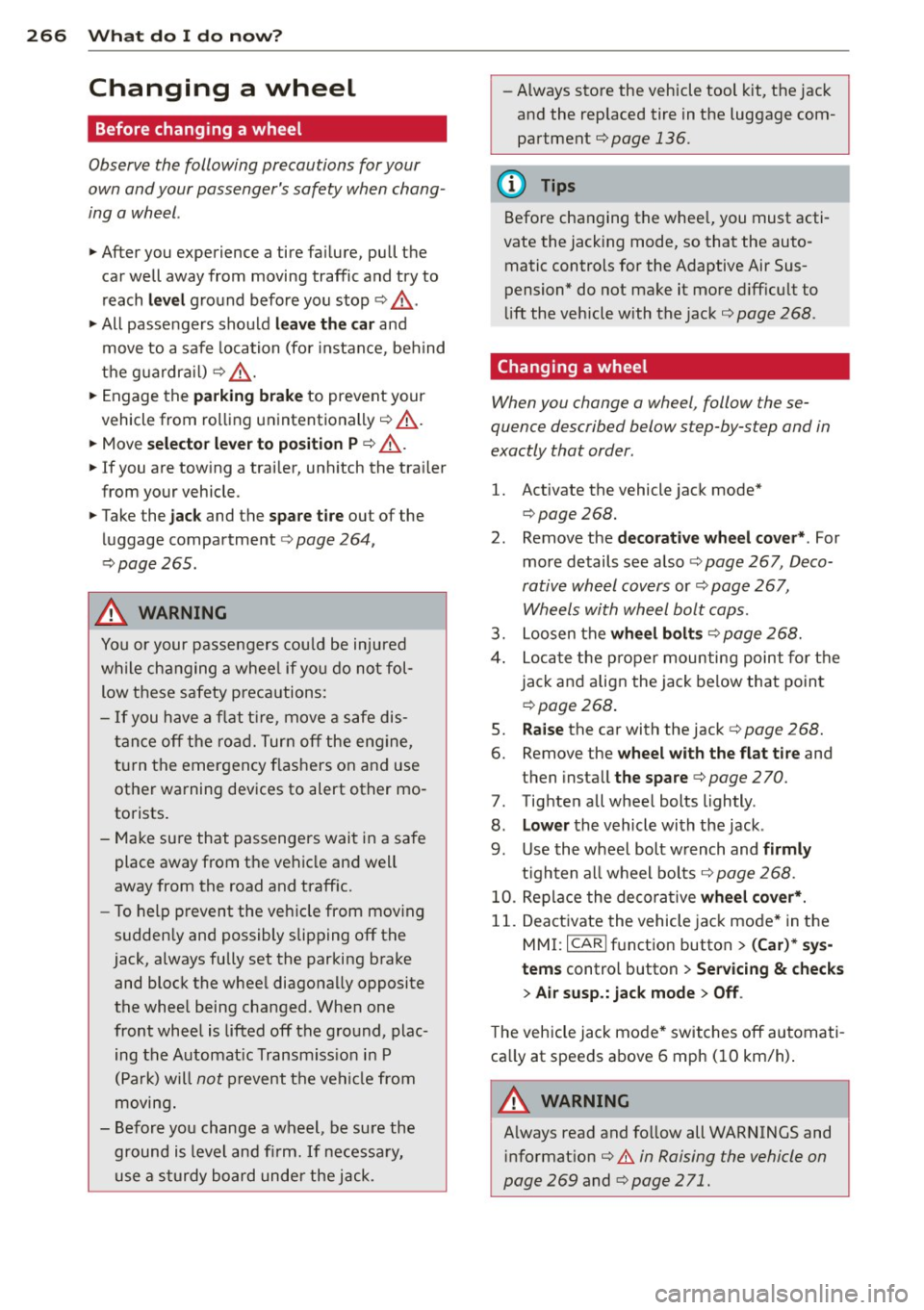
Changing a wheel
Before changing a wheel
Observe the following precautions for your
own and your passenger's safety when chang
ing a wheel .
... After you experience a tire failure, pull the
car well away from moving traffic and try to
reach
level ground before you stop o ,&.
... All passengers should leave the car and
move to a safe location (for instance, behind
the guardrail)
o A-
.. Engage the parking brake to prevent your
vehicle from rolling unintentionally
o ,&.
... Move selector lever to position Po ,& .
• If you are towing a trailer, unhitch the trailer
from your vehicle .
... Take the
jack and the spare tire out of the
luggage compartment
o page 264,
o page265.
A WARNING
You or your passengers could be injured
while changing a wheel if you do not fol
low these safety precautions:
- If you have a flat tire,
move a safe dis
tance off the road. Turn off the engine,
turn the emergency flashers on and use
other warning devices to alert other mo
torists.
- Make sure that passengers wait in a safe
place away from the vehicle and well
away from the road and traffic.
- To help prevent the vehicle from moving
sudden ly and possibly slipping off the
jack, always fully set the parking brake
and block the wheel diagonally opposite
the wheel being changed . When one
front wheel is lifted off the ground, plac
ing the Automatic Transmission in P
(Park) will
not prevent the vehicle from
moving.
- Before you change a wheel, be sure the
ground is level and firm.
If necessary,
use a sturdy board under the jack.
-
-Always store the vehicle tool kit, the jack
and the replaced tire in the luggage com
partment
opage 136.
@ Tips
Before changing the whee l, you must acti
vate the jacking mode, so that the auto
matic controls for the Adaptive Air Sus
pension* do not make it more difficult to
lift the vehicle with the jack
o page 268 .
Changing a wheel
When you change a wheel, follow these
quence described below step-by-step and in
exactly that order.
l. Activate the vehicle jack mode*
opage 268 .
2. Remove the decorative wheel cover* . For
more details see also
o page 267, Deco
rative wheel covers
or o page 267,
Wheels with wheel bolt caps.
3. Loosen the wheel bolts o page 268.
4. Locate the proper mounting point for the
jack and align the jack below that point
opage 268.
5. Raise the car with the jack o page 268.
6. Remove the wheel with the flat tire and
then install
the spare opage 270.
7. Tighten all wheel bolts lightly .
8.
Lower the vehicle with the jack .
9 . Use the wheel bolt w rench and
firmly
tighten all wheel bolts o page 268.
10. Replace the decorative wheel cover*.
11. Deactivate the vehicle jack mode * in the
MMI:
I CARI function button > (Ca r)* sys
tems
control button > Servicing & checks
> Air susp.: jack mode > Off.
The vehicle jack mode* switches off automati
ca lly at speeds above 6 mph (10 km/h) .
A WARNING ,-
Always read and follow all WARNINGS and
in format ion
o .&. in Raising the vehicle on
page 269
and opage 271.
Page 270 of 306
268 What do I do now ?
loosening and tightening the wheel
bolts
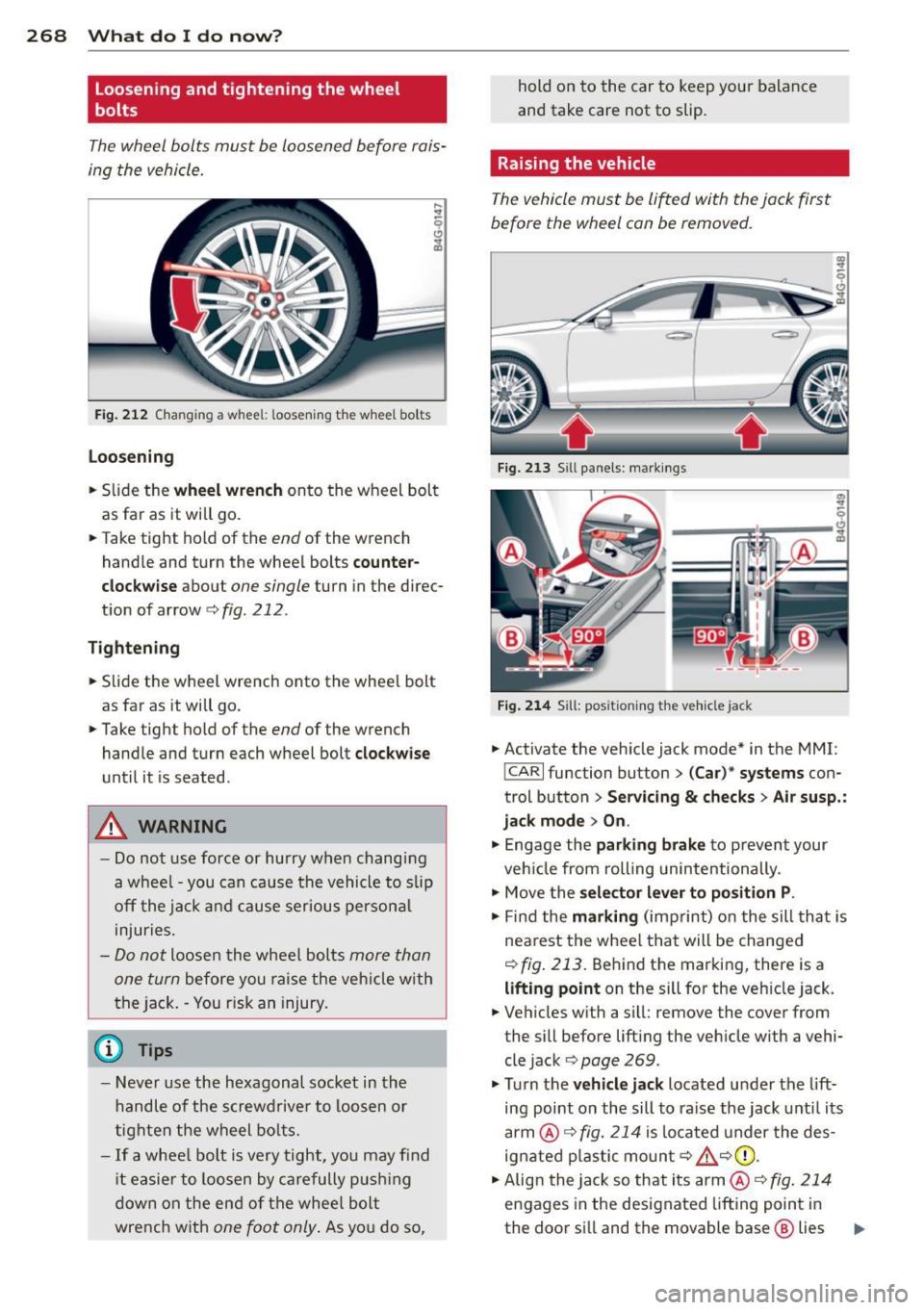
The wheel bolts must be loosened before rais
ing the vehicle.
Fig. 212 Changing a wheel: loosening the whee l bo lts
loosening
.. Slide the
w heel wr ench onto the wheel bolt
as far as it will go .
.. Take tight hold of the
end of the wrench
handle and turn the wheel bolts co unte r
clock w ise about one single turn in the direc
t ion of arrow
c:> fig. 212 .
Tighten ing
.. Slide the wheel wrench onto the wheel bolt
as far as it will go.
.. Take tight hold of the
end of the wrench
handle and turn each wheel bolt
clock wise
until it is seated.
A WARNING
- Do not use force or hurry when changing
a whee l - you can cause the vehicle to slip
off the jack a nd cause serious persona l
injuries.
- Do not loosen the wheel bolts more than
one turn
before you raise the veh icle with
the jack. - You risk an injury.
@ Tips
- Never use the hexagonal socket in the
handle of the screwdriver to loosen o r
tighten the wheel bo lts.
- If a wheel bolt is very tight, you may fi nd
i t easier to loosen by ca refully p ushi ng
down on the end of the wheel bolt
wrench with
one foot only . As you do so, hold on to the car to keep your balance
and take care not to slip.
Raising the vehicle
The vehicle must be lifted with the jack first
before the wheel can be removed.
Fig. 213 Sill panels: markings
Fig. 2 14 Sill: pos ition ing t he ve hicle jack
.. Activate the vehicle jack mode* in the MMI:
!CARI function button> (Car) * syst ems con
trol button>
Serv icing & ch eck s> Air su sp .:
ja ck mode > On .
.,. Engage the parki ng brake to prevent your
veh icle from rolling unintentionally .
.,. Move the
sele cto r lever to p osition P .
.. Find the mark ing (imprint) on the sill tha t is
nearest the whee l that will be changed
c:>fig. 213. Be hind the marking, there is a
lifting point on the sill for the vehicle jack.
.. Ve hicles with a si ll: remove the cover from
the sill before lift ing the veh icle w ith a vehi
cle jack c:>
page 269 .
.,. Turn the ve hicl e ja ck located under the lift
ing point on the sill to ra ise the jack until its
arm @c:>
fig. 214 is located under the des
ignated plastic moun t c:>
£ c:> (D .
.. Align the jack so that its arm @c:>
fig. 214
engages in the designated lifting point in
the door sill and the movable base @ lies
IJJ>
Page 274 of 306

272 Fuses and bulbs
Fuses and bulbs
Fuses
Replacing fuses
Fuses that have blown will have metal strips
that have burned through.
Fig. 218 Dr iver side of the cockpit: fuse panel cover
The fuses are located at the front left and
right of the cockpit and behi nd the trim on
the right side of the luggage compartment.
• Switch the ign ition and the affected electri
c al equ ipment off.
• Check the following table to see which fuse
belongs to the consumer.
• Remove the cover ¢
fig. 218 or¢ page 223,
Opening the side trim.
• To remove the purple plast ic clip if necessa
ry
ll, hold onto it at the small side and pull
i t out of the fuse panel
c:> page 2 72 ,
fig. 219 .
• Remove the clamp from the rea r side of the
fusecover <>fig.
218.
• Remove the fuse using the cla mp and re
pla ce the blown fuse w ith an ident ical new
one.
A WARNING
Do not repair fuses and never rep lace a
blown fuse with one that has a higher amp
rating. This can cause damage to the e lec
trical system and a fi re.
ll You can dis pose of the plastic clip after removing it.
(D Note
If a new fuse burns out again after shortly
have you have installed it, have the electri
ca l system checked by yo ur authorized
Audi dealer.
(D Tips
- The following table does not list fuse lo
cations that are not used .
- Some of the equipment items listed are
optional or only available on certain
model configurations.
Driver side cockpit fuse assignment
Fig . 219 Dr iver side cockpit: fuse pa nel w ith plast ic
bracket
Fuse panel ® (blac k)
No. Equipment Amps
Switch panel, electromechan ica l
1 parking brake, seat heating, 5
starting assist, control module
2 Automatic d imm ing in terior
5 rea rview mirro r, horn
3 Exhaust system (diesel engine) 10
Page 275 of 306

No. Equ ipment Amps
4 Suspension control system sen-s sor
s
E
lectronic Stabilization Cont rol
s (ESC) module
6 Climate control
s
7 Adaptive cruise control
10
8
Airbag control module, front
s passenger's seat sensor system
9 Gateway
s
Homelink (garage door opener),
10 night vis ion system cont ro l
s
module
11 Image
processing (active lane
10
ass ist, adaptive cruise control)
12 Dynamic steering
s
13 Terminal 15 in
the instrument
15
panel
14 Terminal 15
in the luggage com-
partment 30
15 Terminal 15
(engine)
15
16 Starter 40
Fu se pa nel ® (b rown )
No . Equipment Amps
1 Gateway s
2 C
limate control 10
3 E
lectronic Stabili zation Control
10
(ESC) module
4 Fron
t door (driver 's side)
30
s
Power seat adjustment (driver's
7,5
seat)
6 Dynam
ic steering
35
7 Sunroof 20
8
Rear door control module (driv-
15
er 's side)
9 Lumbar support (
Front passen-
s ger seat)
10 Tire pressure
monitoring system
s
11 Su
nroof, rear spoi ler (Sportba ck)
20
12 Driver
door control module
15
Fuse s and bulb s 2 7 3
Fuse pan el© (r e d )
No . Equipment
2 Fuel pump
3 Brake light
sensor/brake pedal
sensor system
AdBlue control module (Diesel)/
4 Engine acoust ics
s Left rear door cont rol modu le
6 Power seat adjustment
(pas-
senge r's seat)
7 Horn
8 Windshield wiper motor
9 Light/rain sensor, heater
for vid-
eo camera in windscreen
10 Lumba r support (driver seat)
11 Front
passenger door control
modu le
12 Right rea r door cont rol modu le
Front passenger side cockpit fuse
assignment Amp
s
25
S/S
S/7,S 30
7,5 15
30
s
s
15
15
F ig . 22 0 Front passenger side cockpit: fuse pa nel w it h
plast ic brac ket
Fuse panel @ (bla ck)
No . Equipment Amps
1 Head-up
Display s
2 MMI Display s
3 CD/DVD changer s
4 MMI unit/drives 7,5
s
Chip card reader (not in all coun-
s tries)
6 Instrument
cluster
s
7 Steering column switch module s ...
Page 276 of 306

274 Fu ses and bulb s
No. Equ ipment Amps
8
Headlight range adjustment/
5/7,S
adaptive lighting system
10 Left headlight
(headlight with
7,5
adaptive light)
11 Supplementary heater
s
F
u se p ane l@ (b ro wn)
No . Equipmen t Amps
1 Climate control
10
2 Climate control system blower 40
3 Diagnostic interface
10
4 E lectrical ignition lock
s
s
Power steering column adjust-
s ment
6 Steering column switch module
10
7 Power
steering column adjust-
ment 25
8 Light switch
s
Luggage compartment fuse assignment
Fig
. 22 1 Luggage compartment: fuse panel with plas
tic bracket
Fuse p anel @ (b la ck )
No. Equipment Amps
4 E lectromechanical parking brake 30
s Electromechanical parking brake
30
6 Front door
(front passenger's
30
s ide)
7 Rear exter ior lighting
30
Rear sun shade, closing aid, lug-
8 gage compartment
lock, con-
20
venience key, START ENGINE
STOP, fuel filler door
No. Equipment Amps
9 Power seat adjustment
15
10 Parking system
s
11 Rear seat
heating
30
Fuse pan el@ (r e d )
No . Equipment Amps
l Left belt tensioner
25
2 Right belt tensioner 25
3 Socket/cigarette
lighter
20
4 Socket 20
5 Electromechanical
parking brake
5
6 adaptive ai r suspension 15
7 Rear door
(front passenger's
30
side)
8 Rear exterior lighting 30
9 Luggage compartment
lid con-
30
t rol module
10 Telephone 5
11 Sound amplifier 30
12 Rear
spoiler (Sportback)
20
Fuse p anel© (brown)
No . Equipment Amps
1 Radio receiver,
Sound amplifier/
30/20
MMI unit/drives
2 Tank leak detection system
s
4 AEM
control module/battery
10/15
module
6 Battery fan 35
7 Rad
io receiver 7,5
8 Rear Seat Entertainment 7,5
9 Automatic dimming interior
5/15
rearview mirror/battery module
10 Parking system 5
Fuse pan el@ (gre en)
No . Equipment Amps
1 pre sense 5
2 Electromechanical parking brake
s
3 adaptive
air suspension
5
4 Automatic transmission 7,5
Page 279 of 306
@ Tips
The disc harged battery must be properly
connected to the vehicle's electrical sys
tem. When jump starting or charg ing the
battery, never connect the negative
ground cable to the battery negat ive post
because the ba ttery manager system must
be ab le to detect the battery's state of
charge. Always connect the negative
g round cab le to the negative ground pos t
of t he battery manager cont ro l unit.
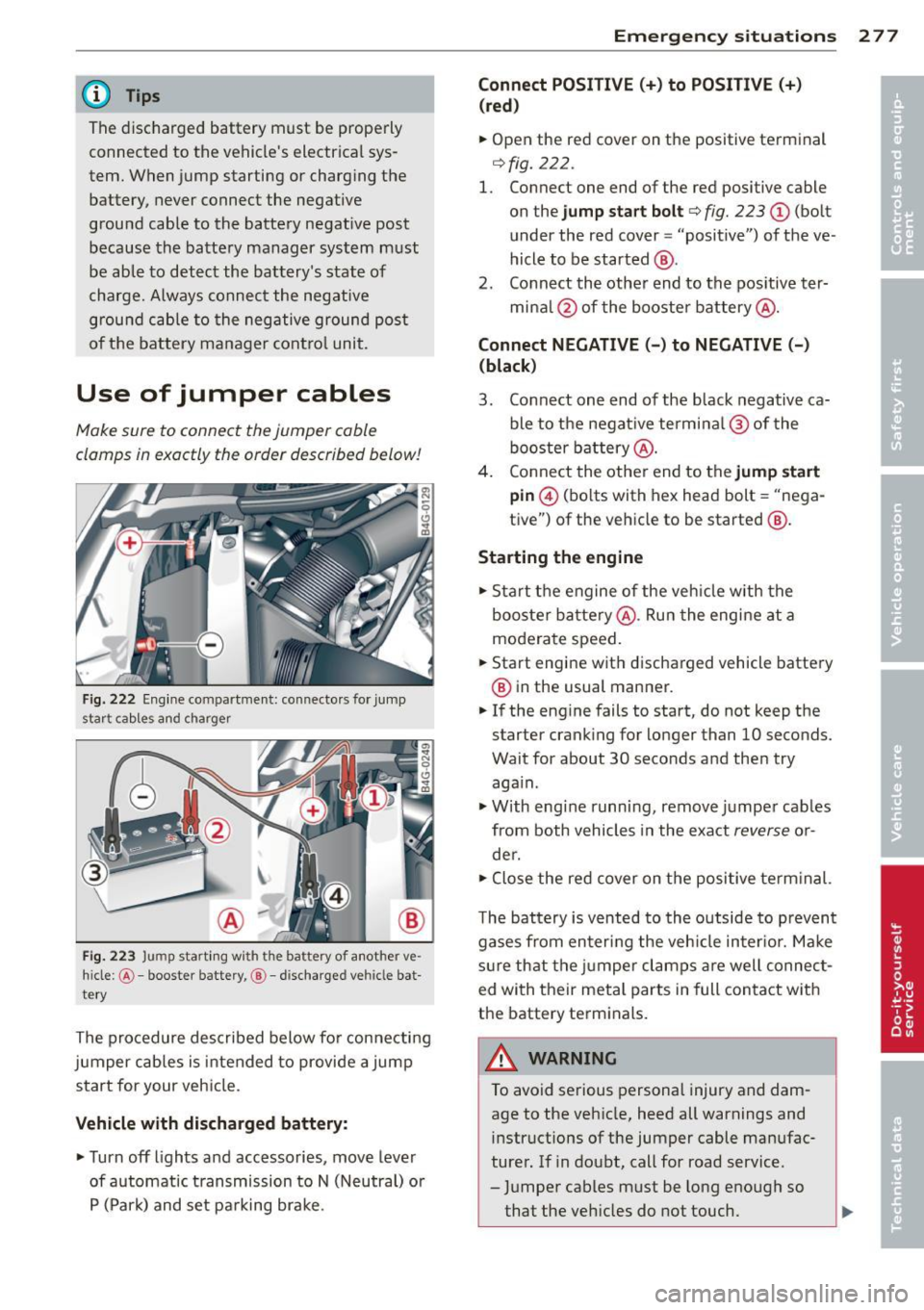
Use of jumper cables
Make sure to connect the jumper coble
clomps in exactly the order described below!
Fi g. 222 Eng ine compar tment: connecto rs for jum p
start cables and charger
F ig. 223 Jump starting w ith the battery of a nother ve ·
hicle:
@ -booster battery, ®-discharged veh icle bat
te ry
The procedure described below fo r connecting
jumper cables is intended to provide a jump
start for your veh icle.
Vehicle with discharged battery :
• Turnoff lights and accessories, move lever
of automatic t ransmission to N (Neutral) o r
P ( Par k) and set pa rking brake.
Emergenc y situ ation s 2 77
Connect POSI TIVE(+) to POSITIVE(+)
(red )
• Open the red cover on the positive te rminal
¢fig. 222.
1. Connect one end of the red positive cable
on the jump sta rt bolt ¢
fig. 223 (D (bolt
under the red cover = "positive") of the ve
hicle to be started @.
2. Co nnect th e othe r end to the pos itive ter-
mi na l@ of the booster battery @.
Connect NEGATIVE( -) to NEGATIVE(-)
(black )
3. Connect one end of the black negative ca ble to the negat ive termi na l@ of the
booster b attery @.
4. Connect the othe r end to the jump start
pin @ (bo lts with hex head bolt = "nega
tive") of the vehicle to be started @.
Starting the engine • Sta rt the engine of the veh icle w ith the
booste r ba tte ry @ . Ru n the engine at a
moderate speed.
• Start engine wit h discharged vehicle battery
@ in the usual manner.
• If the eng ine fails to start, do not keep the
starter cranking for longer than 10 seconds.
Wait for about 30 seco nds a nd the n try
aga in .
• With eng ine runni ng,
remove ju mpe r cab les
from both vehicles in the exact
reverse o r
de r.
• Close the re d
cover on the positive te rm inal.
T he battery is v ented to th e outside to p rev ent
gases from en ter ing the veh icle in ter io r. Ma ke
s ur e th at the j umper clamps are well connec t
ed with their meta l parts in full con ta ct w ith
the battery term inals.
,8. WARNING
To avoid se rious personal injury and dam
age to the veh icle, heed all warnings and
instructions of the jumper cable man ufac
ture r. If in doubt, call for road service.
- Ju mpe r cables m ust be long enough so
that the veh icles d o not touch.
-
Page 280 of 306
2 78 Emergency situations
-When connecting jumper cables, make
sure that they cannot get caught in any
moving parts in the engine compart
ment.
- Before you check anything in the engine
compartment, always read and heed all
WARNINGS
<=) page 227.
(D Note
Improper hook-up of jumper cables can ru
in the generator.
- Always connect POSITIVE( +) to POSI
TIVE(+), and NEGATIVE(-) to NEGATIVE
( - ) ground post of the battery manager
control unit.
- Check that all screw plugs on the battery
cells are screwed in firmly . If not, tighten
plugs prior to connecting clamp on nega
tive battery terminal.
- Please note that the procedure for con
necting a jumper cable as described
above applies specifically to the case of
your vehicle being jump started. When
you are giving a jump start to another ve
hicle , do
not connect the negat ive( -) ca
ble to the negative( -) terminal on the
discharged battery@<=)
fig. 223. In
stead, securely connect the negative( -)
cable to either a solid metal component
that is firmly bolted to the engine block
or to the engine block itself. If the bat
tery that is being charged does not vent
to the outside, escaping battery gas
could ignite and explode!
Emergency towing
with commercial tow
truck
General hints
Your Audi requires special handling for tow
tng.
The following information is to be used by
commercia l tow truck operators who know
how to operate their equipment safely.
-Never tow your Audi. Towing will cause
damage to the engine and transmission .
- Never wrap the safety chains or winch ca
bles around the brake lines.
- To prevent unne cessary damage , your Audi
must be transported with a flat bed truck.
- To load the vehicle on to the flat bed, use
the towing loop found in the vehicle tools
and attach to the front or rear anchorage
<=)page 278 and ¢page 279.
.&_ WARNING
=
A vehicle being towed is not safe for pas-
sengers. Never allow anyone to ride in a
vehicle be ing towed, for any reason.
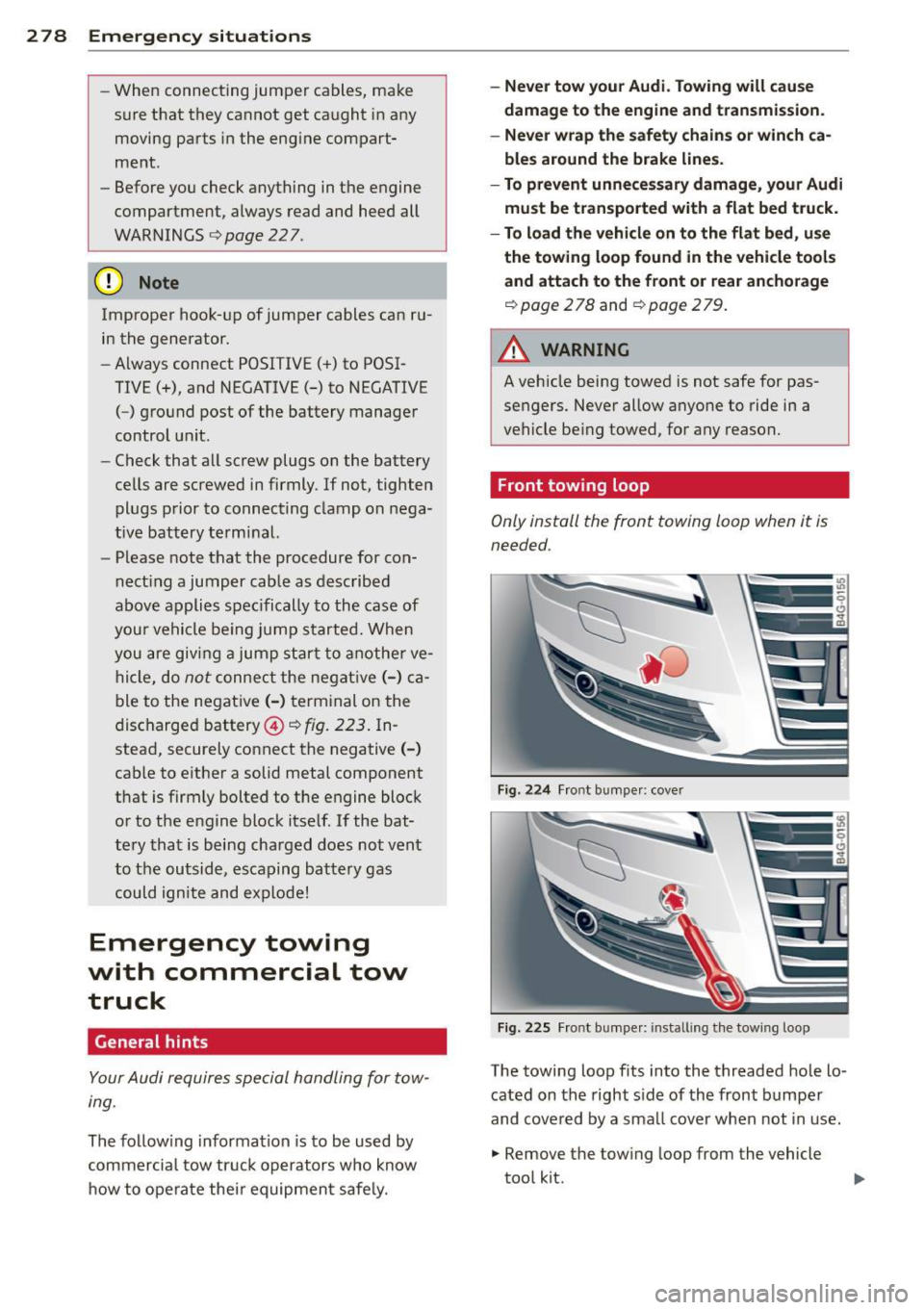
Front towing loop
Only install the front towing loop when it is
needed.
Fig. 224 Front bumper: cover
Fig. 225 Front bumper : in stalling the towing loop
-
The towing loop fits into the threaded hole lo
cated on the right side of the front bumper
and covered by a smal l cover when not in use.
.,. Remove the towing loop from the vehicle
tool kit.
Page 289 of 306

-Always make sure the transm ission se
lector lever (automatic transmiss ion) is
in P (Park position) and the park brake is
applied.
@) For the sake of the environment
- Changing the eng ine settings w ill ad
versely affect em ission levels. This is det
rimental to the environment and increas
es fuel consumption .
- Always observe env ironmental regula
tions when d isposing of old engine oil,
used brake fluid, dirty engine coolant,
spent batter ies or worn out t ires.
- Undeployed airbag modules and preten
s ioners might be classified as Perchlo
rate Material -specia l hand ling may ap
ply, see www.dts c.ca .gov/hazardous
waste/perch lorate. When the veh icle or
parts of the restraint system includ ing
airbag modules safety belts wit h preten
sioners are scrapped, all applicable laws
and regulations must be observed. Your
a uthorized Audi dea ler is familiar w ith
these requirements and we recommend
that you have your dea ler perform this
serv ice for you .
Additional accessories,
modifications and
parts replacement
Additional accessories and parts
replacement
Always consult an authorized Audi dealer be
fore purchasing accessories.
Your veh icle incorporates the latest safety de
sig n featu res ensu ring a high standard of ac
tive and passive safety.
This safety could be compromised by non-ap proved changes to the veh icle. For this reason,
if parts have to be replaced, please observe
the following points when install ing addition
a l accessories:
Con sumer In formation 287
Approved Audi accesso ries and genuine Audi
parts are available from authorized Audi deal
ers.
T hese dea lers a lso have the necessary facili
ties, tools and trained specialists to install the
parts and accessories proper ly.
A WARNING
Using the wrong spare parts or using non
approved accessories can cause damage to
the vehicle and serious persona l injury.
- Use on ly accessories express ly approved
by Audi and genu ine Audi spare parts
- These parts and accessories have been
specially designed to be used on your ve
hicle .
- Never install accessories such as tele
phone cradles or beverage holders on air
bag covers or within the airbag deploy
ment zones . Do ing so will increase the
risk of injury if a irbags are triggered in an
accident!
- Before you check anything in the engine
compa rtment, always read and heed all
WARNINGS ~
page 22 7.
(D Note
- If items other than genuine Audi spare
parts, add-on equipment and accessory
items are used or if repair work is not
performed accord ing to spe cified meth
ods, this can result in severe damage to
yo ur vehicle's engine and body (such as
corrosion) and adversely affect your vehi
cle's warranty .
- If emergency repairs must be performed
elsewhere, have the vehicle examined by
an authorized Audi dealer as soon as
possible.
- The manufacturer cannot be held liable
for damage wh ich occurs due to failure
to comply with these stipulations.
•
•
Page 293 of 306

_______________________________ I~ n~ d:::: e~x 291
AUTO
automatic climate control ... ... .. .. ..
73
Automatic headlights ............... 44
climate control . . . . . . . . . . . . . . . . . . . . . 70
Auto Lock . . . . . . . . . . . . . . . . . . . . . . . . . . 34
Automatic belt retractor . . . . . . . . . . . . . 143
Automatic climate control
Air vents ... ............. .... .. ....
73
Automatic recirculation ...... .. .. .. .. 74
Operation . . . . . . . . . . . . . . . . . . . . . . . . . 72
Setup . .. ... ...... ............. ... 74
synchron izing ......... ...... .... ... 73
Automatic Shift Lock (ASL) .. .. .. .. .. . 110
Automatic transmission ....... .. .. .. . 109
Automatic Shift Lock (ASL) .......... 110
Driving .... ................ ... ... 111
Emergency mode . . . . . . . . . . . . . . . . . . 114
Emergency release ........ .. .. .. .. . 115
Kick-down .. ............. .... .. ... 113
Manual shift program ....... .. .. .. . 113
Selector lever ............... ... ... 109
Automatic wipers .................... 48
Auto Safety Hotline .......... .. .. .. . 138
Average consumption ....... .. .. .. .. .. 25
Average speed . . . . . . . . . . . . . . . . . . . . . . .
25
Avoid damaging the vehicle .. .. .. .. .. . 206
B
Bag hooks . . . . . . . . . . . . . . . . . . . . . . . . . . 67
Battery ..... .. ................ .... 238
Charging ... ................ ... ... 240
Important warnings ...... .. .. .. .. . 238
Jump starting ............ .... .. ... 276
Location . .. ............. .... .. ... 238
low ..... ... ...... ............. .. 202
Replacing the battery ....... .. .. .. . 241
State of charge ........... .... .. .. . 202
w· t · 1n er operation ......... .. .. .. .. .
Working on the battery .... .. .. .. .. .
Before driving .............. ... ... . .
Blended gasoline 238
238
130
218
Blower (automatic climate control) . . . . . . 73
Blower (climate control) . . . . . . . . . . . . . . . 70
Booster seats ................ ... ... 184
Brake fluid
Changing the brake fluid ............
237
Checking the brake fluid level ........ 237
What is the correct brake fluid level? .. 237
What should I do if the brake fluid warn-
ing light comes on? . .............. .
237
Brake system
Anti- lock braking system .............
20
Brake assist system .............. .. 196
Brake booster .. .. ................. 200
Brake fluid ...... .. ..... .......... 237
Brake fluid specifications for refill and re-
placement ...... .. ...............
237
Brake light defective . . . . . . . . . . . . . . . . 23
Brake pads .. .. .. .... ........... .. 204
Electromechanical parking brake ..... . 79
Fluid reservoir ..... ............... 237
How does moisture or road salt affect the
brakes? . .. .. .. .. .. ...............
200
Warning/indicator lights ........ .. .. . 15
Worn brake pads symbol ............ . 21
braking guard
Settings ... ..... .. ................
93
Braking guard ... .. .... ........... .. . 86
Messages . .. .. .. .. ............... . 93
Break-in period .. .. ... ... ...... ..... 204
Brake pads ...... .. ............... 204
Tires
Bu lbs
C
...... .. .. .. .................
204
275
California Proposition 65 Warning ..... 228
Battery specific .. .. .............. . 239
Capacities .... .. .. .... ............. 283
Engine oil ... .. .. ................. 229
Carbon parts
Cleaning . . . . . . . . . . . . . . . . . . . .
215,216
Car carrier
Transporting your vehicle ......... ..
280
Care ....... .. .. .. ... ............ .. 213
Cargo area ........ .. ............... 136
Cargo net . . . . . . . . . . . . . . . . . . . . . . . . . . . 66
Catalytic converter . ............. .. .. 205
Center armrest
Cockpit ... .. .. .. .. . .. .... ........ .
56
Central locking . ..... ................ 34
Emergency locking .... ......... .. .. . 38
•
•