oil AUDI A7 2015 Owner's Guide
[x] Cancel search | Manufacturer: AUDI, Model Year: 2015, Model line: A7, Model: AUDI A7 2015Pages: 316, PDF Size: 78.09 MB
Page 257 of 316
M N <( (.J
'SI: ,...., \!) 1.1'1 ,...., 1.1'1 ,....,
tire failure and loss of
control.
-Excessive speed and/over loading can cause heat
build -up, sudden tire failure
and loss of control.
-If the tire pressure is too low or too high, the tires
will wear prematurely and
the vehicle will not handle
well.
-If the tire is not flat and you do not have to change a
wheel immediately, drive at
reduced speed to the near
est service station to check
the tire pressure and add air as required.
(D Note
Driving without valve stem
caps can cause damage to
the tire valves. To prevent
this, always make sure that
factory installed valve stem caps on all wheels are secure
ly mounted on the valve.
@ For the sake of the environment
Underinflated tires will also
increase the fuel consump
tion.
Tires and wheels 255
Tires and vehicle load limits
'
There are limits to the amount of load or weight that any vehi
cle and any tire can carry. Ave
hicle that is overloaded will not
handle well and is more diffi
cult to stop. Overloading can
not only lead to loss of vehicle
control, but can also damage important parts of the vehicle
and can lead to sudden tire fail
ure, including a blowout and
sudden deflation that can cause
the vehicle to crash.
Your safety and that of your passengers also depends on
making sure that load limits are
not exceeded. Vehicle load in
cludes everybody and every
thing in and on the vehicle .
These load limits are technical ly referred to as the vehicle's
Gross Vehicle Weight Rating
("GVWR").
The "GVWR" includes the
weight of the basic vehicle, all
factory installed accessories, a
full tank of fuel, oil, coolant and other fluids plus maximum ""
•
•
'
Page 262 of 316

260 Tires and wheels
A WARNING
Sudden tire failure can lead
to loss of control, a crash and serious personal injury!
-Never drive a vehicle when the tread on any tire is worn down to the wear indica
tors.
-Worn tires are a safety haz
ard, they do not grip well on
wet roads and increase your risk of "hydroplaning" and
loss of control.
-Always keep chemicals that
can cause tire damage, such
as grease, oil, gasoline and brake fluid away from tires.
-Tires age even if they are
not being used and can fail
suddenly, especially at high
speeds. Tires that are more
than 6 years old can only be used in an emergency and
then with special care and at lower speeds.
-Never mount used tires on your vehicle if you are not sure of their "previous histo
ry." Old used tires may have
been damaged even though
the damage cannot be seen
that can lead to sudden tire
-failure and loss of vehicle control.
New tires and replacing
tires and wheels
New tires and wheels have to
be broken in.
Fig. 204 Tire specification codes on
the sidewall of a tire
No. Description
CD Passenger car tire (where
applicable)
@ Nominal width of tire in
millimeters
® Ratio of height to width
(aspect ratio)
@ Radial
® Rim diameter code
Page 271 of 316
M N <( (.J
'SI: ,...., \!) ..,.,
,...., ..,., ,....,
Wheel bolts
Wheel bolts must always be tightened to the
correct torque .
The design of wheel bolts is matched to the
factory installed r ims. If differen t rims are fit
ted, the correct wheel bolts with the right l ength and correctly shaped bolt heads must
be used. This ensures that wheels are fitted
securely and that the brake system functions
correctly .
In certain circumstances, you may not use
wheel bo lts from a different vehicle -eve n if it
i s the same model
~ page 296.
_&. WARNING
Improperly tig htened or maintained whee l
bolts can become loose ca using loss of
contro l, a co llision and serious persona l in
jury.
- Always keep the wheel bolts and the threads in the wheel hubs clean so the
whee l bolts can turn easily and be prop
erly t ightened.
- Never grease or oil the wheel bo lts and
the threads in the wheel hubs. They can become loose wh ile driving if greased or
o iled, even if tightened to the specif ied
torque .
- Only use wheel bolts that belong to the
rim being installed.
- Never use different whee ls bolts on your
vehicle .
-Always maintain the correct tighten ing
torque for the wheel bo lts to reduce the
risk of a wheel loss . If the tightening tor
que of the wheel bolts is too low, they
can loosen and come out when the vehi
cl e is moving.
If the tightening torque is
too high, the whee l bolts and threads
can be damaged and the wheel can be
come loose.
Q;) Note
The spec ified torque fo r the wheel bo lts is
90 ft lb (120 Nm) w ith a toleran ce of± 7,4
ft lb(± 10 Nm). Torque wheel bo lts diago-
Tire s an d wheel s 269
nally . After changing a whee l, the torq ue
must be checked as soon as possible with a
torque wrench -preferably by an author
i zed Audi dealer or qualif ied workshop.
Low aspect ratio tires
Your Audi is factory-equ ipped w ith low aspect
ratio tires . These tires have been thoroughly
tested and been selected specifically for your model for their superb perfo rmance, road fee l
and hand ling u nder a variety of driving condi
tions . Ask your au thorized Aud i dealer for
more details .
T he low aspect ratio of these t ires is ind icated
by a numera l of
55 or l ess in the tire's si ze
designation. The n umera l represents the ra tio
of the ti re's sidewall height in relation to its
tread width expressed in percentage . Conven
tiona l tires have a height/width ratio of 60 or
more.
The perform ance o f low-a spe ct-r atio tire s is
p ar ticul arl y s ens it iv e to imp ro per infl ation
pressur e. It is t herefo re im porta nt t hat low
a spect ratio t ires are inflat ed to the specified
pr essure and that the inflation pressure is
r e gularly checked and ma int ained. Tire pr es
s ure s should be check ed at lea st on ce a
month and alwa ys befor e a long trip
~ page 252 , Checking tire pressure.
What you c an do to avoid tire and rim
damage
Low aspect ratio tires can be damaged more
easily by impact w it h potholes, curbs, gull ies
o r r idges on the road, pa rtic ularly if the tire is
u nder infla ted .
In order to minimize the occurrence of impact
damage to the tires of your vehicle, we recom
mend that you observe the following p re ca u
tions:
- Always ma inta in recommended inflation
p ressures . Check your tire pressu re eve ry
2 ,000 miles (3,000 km) and add air if neces
sary .
- Dr ive caref ully on roads wi th potholes , deep
gullies o r ridges. The impact from driv ing ..,. •
•
Page 284 of 316
282 Fuses and bulbs
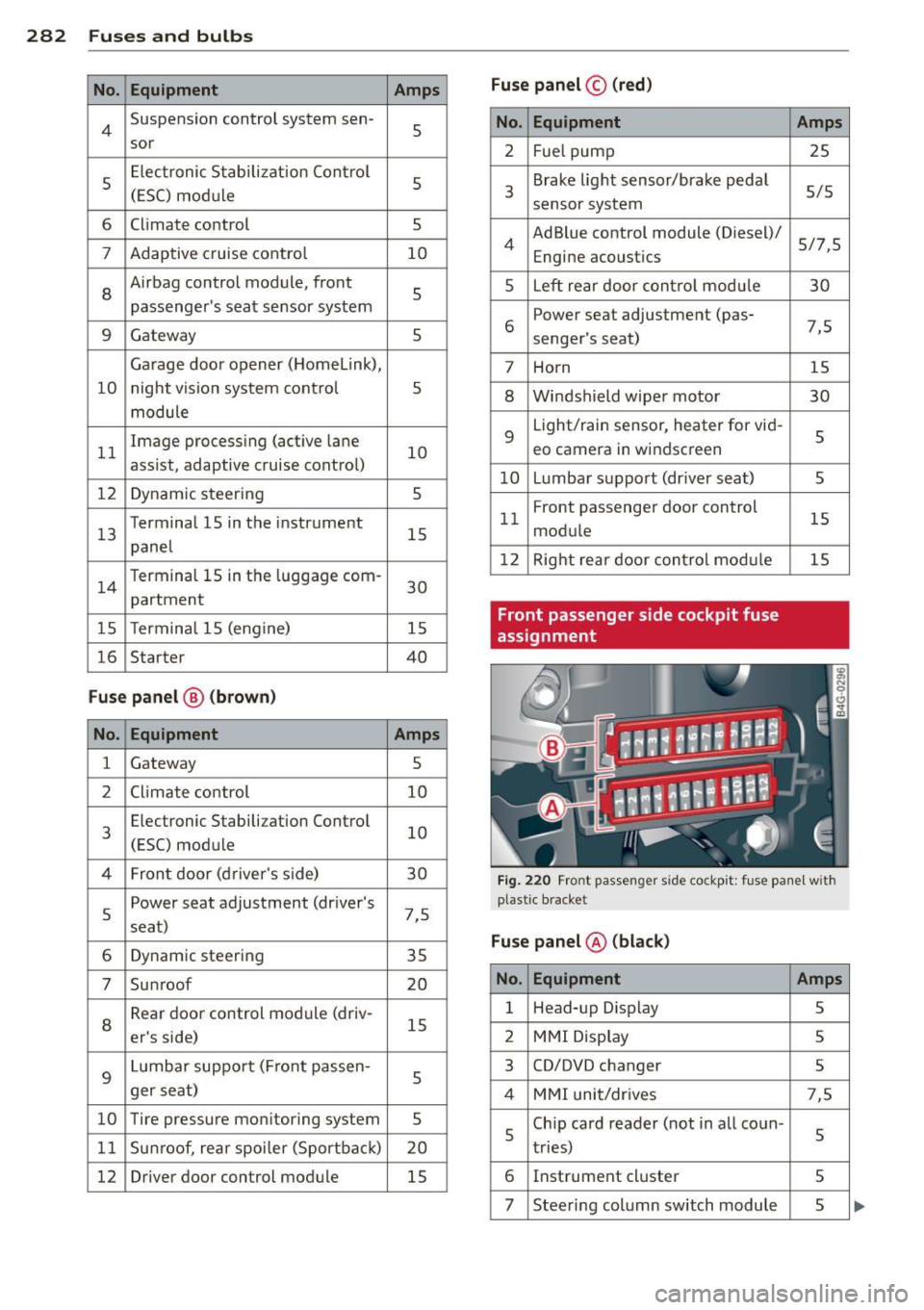
No . Equipment Amps
4 Suspension control system sen-
5
sor
5 Electron
ic Stabilization Control
5
(ESC) mod ule
6 Climate
control
5
7 Adaptive cruise control 10
8
Airbag control module, front
5
passenger's seat sensor system
9 Gateway 5
Garage door opener (Homelink),
10 night vision system contro l 5
module
11 Image processing (active
lane
10
ass ist, adaptive cruise control)
12 Dynamic steering 5
13 Terminal 15
in the instrument
15
panel
14 T
ermina l 15 in the luggage com-
partment 30
15 T
erminal 15 (engine)
15
16 Starter 40
Fuse panel @ (brown)
No . Equipment Amps
1 Gateway
5
2 Climate control 10
E lec tronic Stabilization Contro l
10
3
(ESC) module
4 Front door (driver's
side)
30
5 Power seat adjustment (driver's
7,5
seat)
6 Dynamic steering
35
7 Su nroof 20
Rear door control module (driv- 15
8
er's side)
9 Lumbar support (Front passen-
5
ger seat)
10 Tire pressure monitoring system
5
11 Su
nroof, rear spoiler (Sportbac k)
20
12 Driver door
control module
15
Fuse panel© (red)
No . Equipment
2 Fuel pump
3 Brake light sensor/brake pedal
sensor system
4 AdBlue control module (Diesel)/
Engine acoustics
5 Left rear door contro l modu le
6 Power
seat adjustment (pas-
senger's seat)
7 Horn
8 Windshield wiper motor
9
Light/rain sensor, heater for vid-
eo camera in windscreen
10 Lumbar support (dr iver seat)
11 Front
passenger door control
module
12 Right rear door control mod ule
Front passenger side cockpit fuse
assignment Amps
25
5/5
5/7,5 30
7,5 15
30
5
5
15
15
Fig. 220 Front passenger side cockpit: fu se pane l w ith
plastic bracket
Fuse panel @ (black)
No. Equipment Amps
1 Head-up Display
5
2 MMI Display 5
3 CD/DVD changer
5
4 MMI unit/dr ives 7,5
5 Chip card reader (not
in all coun-
5
tries)
6 Instrument cluster
5
7 Steering column switch module 5
Page 285 of 316
M N <( I.J "". rl I.O
"' rl
"' rl
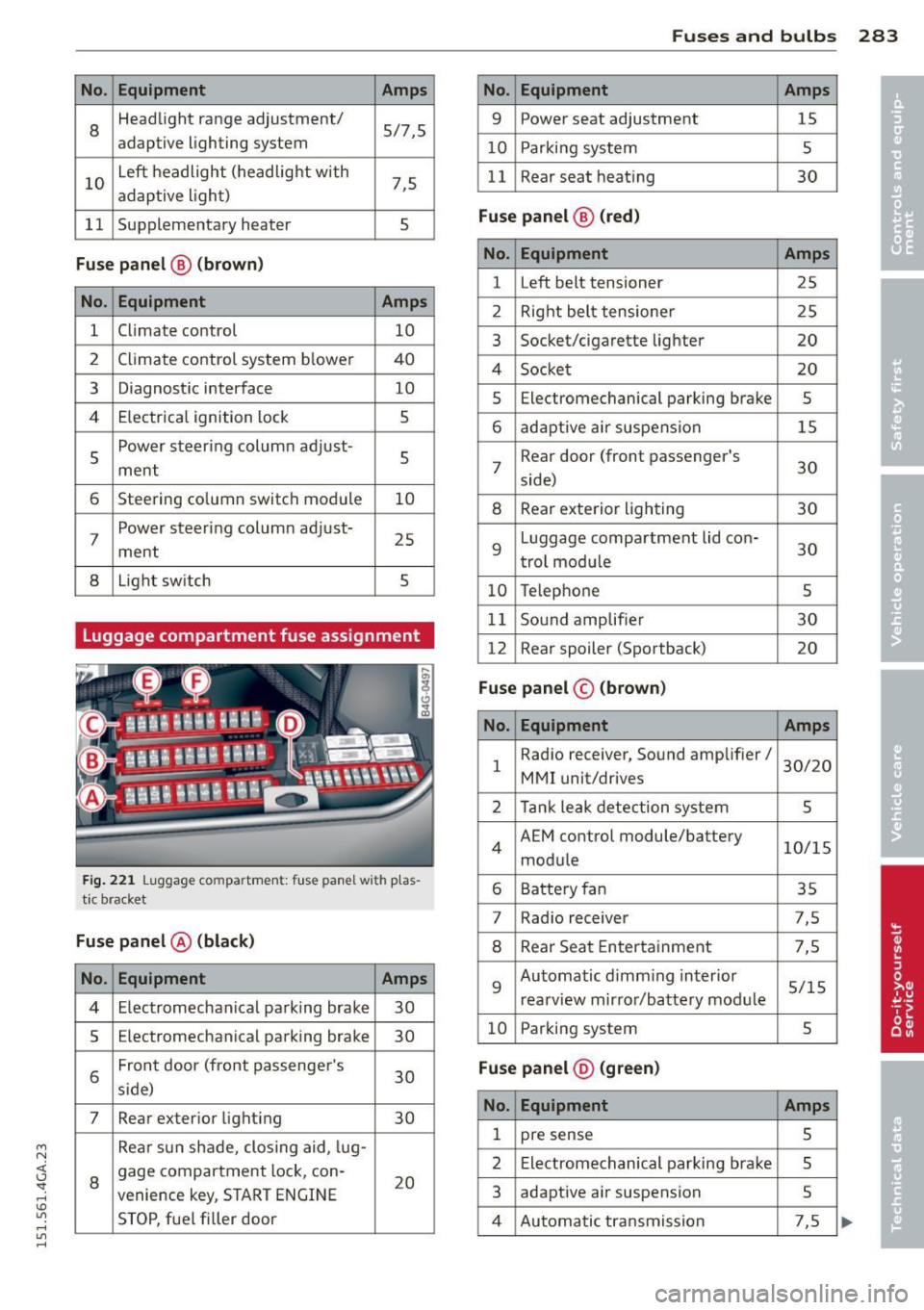
No. Equ ipment Amps
8
Headlight range adjustment/ 5/7,5
adaptive lighting system
10
Left headlight (headlight with 7,5 adaptive light)
11 Supplementary heater s
Fuse p anel @ (b ro w n)
No . Equipment Amps
1 Climate control 10
2
Climate control system blower 40
3
Diagnostic interface 10
4
E lectrical ignition lock s
5
Power steering column adjust-
ment
s
6 Steering column switch module 10
7
Power steering column adjust-
ment
25
8 Light switch 5
Luggage compartment fuse assignment
Fig . 221 Luggage compa rtmen t: fuse panel wit h p las
tic bracket
Fuse p anel @ (black )
No. Equipment Amps
4 Electromechan ical parking brake 30
5
Electromechanical parking brake 30
6
Front door (front passenge r's
30 s ide)
7 Rear exterior light ing 30
Rea r sun shade, closing aid, lug-
8
gage compartment lock, con-
20 venience key, START ENGINE
STOP, fuel filler door
Fu se s and bulb s 283
No. Equipment Amps
9 Power seat adjustment 15
10
Parking system 5
11
Rear seat heating 30
Fu se p an el@ (r e d )
No . Equipment Amps
1 Left belt tensioner 25
2
Right belt tensioner 25
3
Socket/cigarette lighter 20
4
Socket 20
5
Electromechanical parking brake 5
6 adaptive air suspension 15
7
Rear door (front passenger's
30 side)
8 Rear exterior lighting 30
9
Luggage compartment lid con-
30 trol modu le
10 Telephone 5
11
Sound amplifier 30
12
Rear spoiler (Sportback) 20
Fuse panel© (brown)
No . Equ ipment Amps
1
Radio receiver, Sound amplifier/
30/20
MMI unit/drives
2 Tank leak detection system 5
4
AEM control module/battery 10/15
module
6 Battery fan 35
7
Rad io receiver 7,5
8 Rear Seat Entertainment 7,5
9
Automatic d imm ing interior 5/15
rearview mirror/battery module
10 Parking system 5
Fu se pan el@ (gr ee n)
No . Equipment Amps
1 pre sense 5
2
Electromechanical parking brake 5
3
adaptive air suspension 5
4 Automatic transmission 7,5
Page 292 of 316

2 90 Emergency situations
heavy components such as the engine
b lock or transmiss io n are removed.
- W he n removing heavy components like
these, ancho r vehicle to ho ist o r add cor
responding weig hts to ma inta in the cen
ter of g ravity . Othe rwise, the vehicle
might tilt or s lip off t he hoist, causing
ser ious p erson al injury.
(D Note
-Be awa re of the follow ing points befo re
li fting the vehicle:
- The vehicle should never be lifted or
jacked up from underneath the engine oil pan, the transmission housing, the
front or rear axle or the body side
membe rs. This could lead to ser ious
damage.
- To avoid damage to the underbody or
chassis frame , a rubber pad must be
i nserted between the floor jack and
the l ift points.
- Before driving over a workshop hoist,
check that the veh icle weight does not
exceed the permissible lifting capacity
of the hoist .
- Before driving over a workshop hoist,
ensure that there is sufficient clear
ance between the hoist and low parts
of the vehicle.
Page 293 of 316

M N <( I.J ""'. rl I.O
"' rl
"' rl
Technical data
Vehicle identification
F ig. 231 Veh ide Identificat ion Number (VlN) plate: lo ·
c ation on d river 's s ide das h pane l
XXXXX XX · X -XXXX XXX
~ fAllftlli. -llllll · NR. ~ W!ru -llllll -NO.
xx
XXXX XXXX XX X XXXXXXXX
XXX XXX
IYP /TYPE
XX XXXXXXX XX X X XX
XXX KW XXX
®i ~W.::·f :l~~ XXXX XXX XXX
©+ ::rw= xxxx I xxxx XXX I xx
M. · AUSSt I IJ'IIDIIS
~--
EOA 7D 5 4UB 6XM SSG SRW
2E H JOZ 1LB lA S 1BA
3FC SMU 7X l
FD A 9G3 OG7 OYH OJF
TL6 3 KA 8EH UlA X98 027
lXW 803 908 824 D2D
7T6 CV7 7KO 4X3 2K2
3L4 4KC 3YO 413 502
1S A 7GB 01A 4GO
XX. X XX X XX X XXXX
Fig. 232
The vehicle identification label - inside the
luggage co mpartment
Vehicle Identification Number (VlN)
The Veh icle Identification Number is located
in different p laces :
- under the w indshield on the driver's side
¢fig. 231.
- in the MMI: Select: Function button ICAR ! >
(Car)* systems> Servicing & checks > VIN
number.
-on the vehicle identification label.
Techni cal data 291
Vehicle identification label
The vehicle identification label is located in
the luggage compartment in the spare wheel
well.
T he label¢
fig. 232 shows the following vehi
cle data :
(D Vehicle Identificat ion Number (VIN)
@ Vehicle type, engine output, transmission
® Engine and transmission code
© Paint number and interior
® Optional equipment numbers
The information of the veh icle identification
label can also be found in your Warranty
&
Maintenance booklet .
Safety compliance sticker
The safety compliance sticker is your assur
ance that your new veh icle complies with all
applicable Federal Motor Vehicle Safety
Standards which were in effect at the time the
vehicle was manufactured . You can find this
sticker on the door jamb on the driver's side. It shows the month and year of production
and the vehicle ident ification number of your
vehicle (perforation) as well as the Gross Vehi
cle Weight Rating (GVWR) and the Gross Axle
Weight Rating (GAWR) .
High voltage warning label
The high voltage warning label is located in
the engine compartment next to the engine hood release. The spark ignition system com
plies with the Canadian standard ICES-002 .
Weights
Gross Vehicle Weight Rating
The Gross Vehicle Weight Rating (GVWR), and
the Gross Axle Weight Rating (GAWR) for
front and rear are listed on a sticker on the
door jamb on the driver's s ide.
The Gross Vehicle Weight Rating includes the
weight of the basic vehicle plus full fuel tank,
oil and coolant, plus maximum load, which in
cludes passenger we ight (150 lbs/68 kg per
II>--
Page 294 of 316
29 2 Techni cal data
designated seating position) and luggage
weight¢ .&,.
Gross Axle W eight Rating
The Gross Axle Weight Rating is the maximum
l oad that can be applied at each axle of the
vehicle ¢Lr!, .
Vehicle cap acit y weight
The vehicle capac ity we ight (max. load) is list
ed either on the dr iver's side B-pilla r or inside
the fuel filler flap.
_& WARNING
- T he actual Gross Axle Weight Rat ing at
the front and rear axles shou ld not ex
ceed the permissible weights, and their
combination must not exceed the Gross
Vehicle Weight Rating.
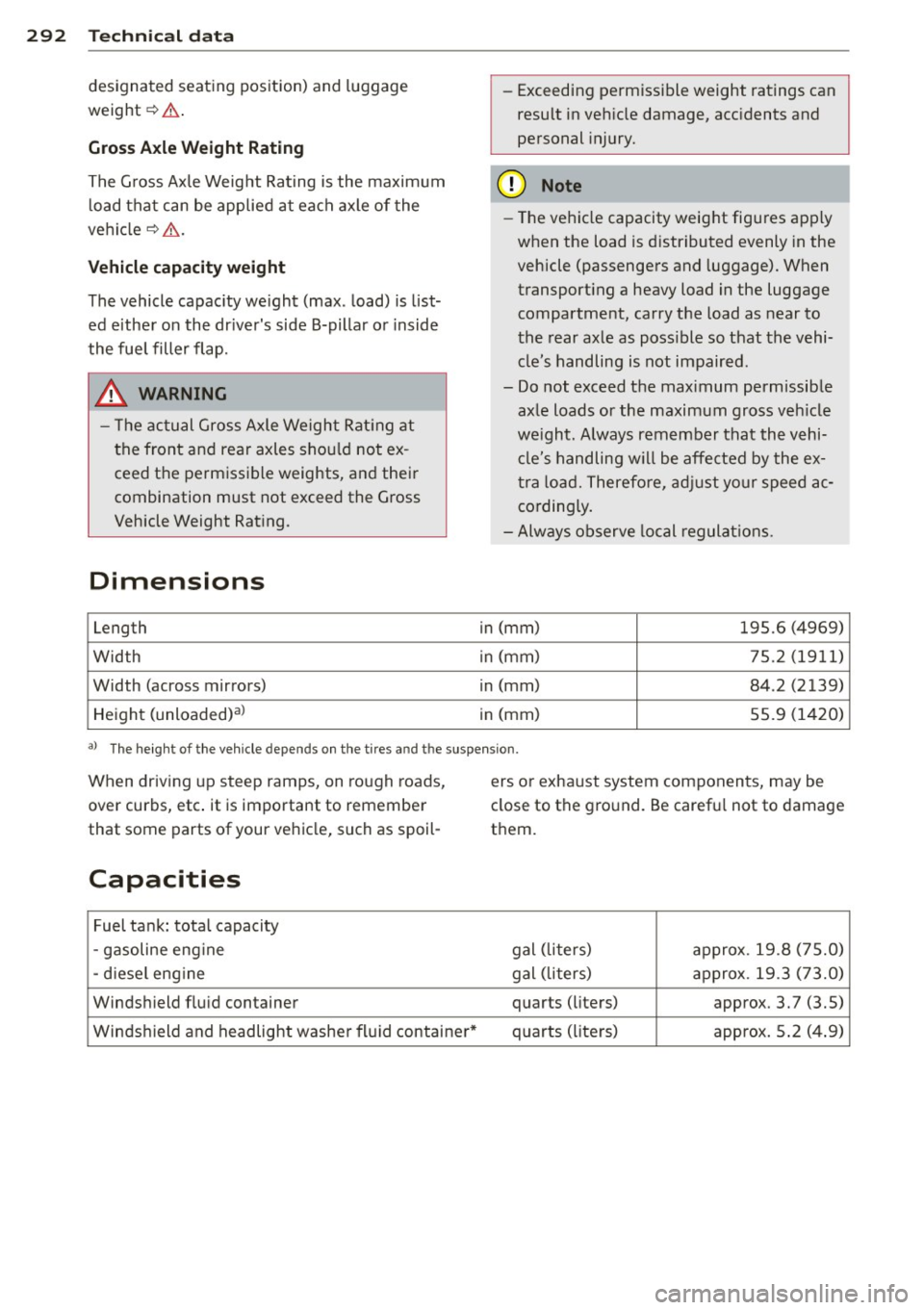
Dimensions
Length
Width
Width (across mirrors) Height (unloaded)al
-
-Exceeding permissible weight ratings can
result in vehicle damage, accidents and
personal injury.
(D Note
- The vehicle capacity weight figures apply
when the load is distributed evenly in the
vehicle (passengers and luggage). When
transport ing a heavy load in the luggage
compartment, carry the load as near to
the rear axle as poss ible so that the vehi
cle's handling is not impaired.
- Do not exceed the maximum permissible axle loads or the maximum gross veh icle
we ight. Always remember that the vehi
cle's handling w il l be affected by the ex
tra load. Therefo re, adj ust your speed ac
cordingly.
- Always observe local regulat ions.
in (mm)
195.6 (4969)
i n (mm) 75.2 (1911)
in (mm)
84.2 (2139)
in (mm) 55.9 (1420)
al The he ight of the veh icle depen ds on the t ires and the suspension.
When driving up steep ramps, on rough roads,
over curbs, etc . it is important to remember
that some parts of your vehicle, such as spoil-
Capacities
Fuel tank: total capacity
-gasoline engine
- d iesel engine
Windsh ield fluid container
Windsh ield and headlight washer fluid containeir* ers
or exhaust system components, may be
close to the ground . Be carefu l not to damage
them.
gal ( liters)
approx. 19.8 (75.0)
gal ( liters) approx. 19.3 (73.0)
quarts (liters) approx. 3.7 (3.5)
quarts (liters) approx. 5.2 (4 .9)
Page 295 of 316

M N <( (.J
'SI: ,...., \!) ..,.,
,...., ..,., ,....,
Gasoline engines
A7 3.0, 6 cylinder
Maximum output SAE net
Maximum torque SAE net
Displacement
Engine oil with filter change
Fuel
57 4.0, 8 cylinder
Maximum output SAE net
Maximum torque SAE net
Displacement
Engine oil with filter change
Fuel
Diesel engine
A7 3.0 TOI, 6 cylinder
Maximum output SAE net
Maximum torque SAE net
Displacement
Engine oil with filter change
Fuel
Techn ical data 293
•
•
hp@rpm 310@ 5500 -6500
l b-ft@ rpm 325@ 2900 - 4500
CID (cm
3 ) 182 (2995)
quarts (liters) 7.2 (6.8)
Premium unleaded (91 AKI), c> page 217, Gasoline
hp@rpm 420 @ 5500 - 6400
l b-ft@ rpm 406 @ 1400 -5200
CID (cm
3 ) 243.7 (3993)
quarts (liters) 8.8 (8.3)
Premium unleaded (91 AKI), i=>page 217, Gasoline
hp@ rpm 240@ 3500 - 3750
lb-ft@ rpm 428@ 1750 -2250
CID (cm
3
) 181 (2967)
quarts (liters) 6.8 (6.4)
ULSD No. 2, c> page 218, Diesel fuel
Page 296 of 316

294 Consumer Information
Consumer Information
Warranty coverages
You r Audi is covered by the following war
ranties:
- New Vehicle Limited Warranty
- Limited Warranty Against Corrosion Perfo-
ration
- Emissions Control System Warranty
- Emissions Performance Warranty
- California Emissions Control Warranty (USA
vehicles only)
- California Emissions Performance Warranty
(USA vehicles only)
Detailed information regarding your warran
ties can be found in your
Warranty & Mainte
nance booklet .
Operating your vehicle
outside the U.S.A. or
Canada
Government regu lations in the United States
and Canada require that automobiles meet
specific emission regulations and safety
standards. Therefore, veh icles built for the
U.S.A . and Canada differ from vehicles sold in
other countries .
If you p lan to take your vehicle outside the
continental limits of the United States or Can
ada, there is the possibility that:
- unleaded fuels for vehicles with cata lytic
converter may not be available;
- fuel may have a considerably lowe r octane
rating. Improper fuel may cause engine
damage ;
- service may be inadequate due to lack of
proper service facilities, tools or testing
equipment ;
- replacement pa rts may not be readily availa
ble.
- Navigation systems for vehicles built for the
U.S.A. and Canada will not necessar ily work
in Europe, and may not work in other coun
tries outside North America .
(D Note
Audi cannot be responsible for mechanical
damage that could result from inadequate
fuel, service or parts availability.
Audi Service Repair Manuals and Literature
Audi Official Factory Service Manuals and Lit
erature are published as soon as possible after
model introduction. Service manuals and lit
erature are available to order from the Audi
T echnical Literature Ordering Center at:
www.audi.techliterature.com
Maintenance
General
Your vehicle has been designed to help keep
maintenance requirements to a minimum.
However, a certain amount of regular mainte
nance is still necessary to assure your vehicle's
s afety, economy and rel iability. For detailed
vehicle maintenance consult your Warranty &
Maintenance booklet.
Under difficult operating conditions, for ex
ample at extremely low outside temperatures,
i n very dusty regions , when towing a trailer
very frequently, etc., some service work
should be performed between the intervals
specified. This applies particularly to:
- oil changes, and
- cleaning or replacing the air filter .
(® For the sake of the environment
By regularly maintaining your vehicle, you
help make sure that emission standards
are maintained, thus minimizing adverse
effects on the environment.
Important considerations for you and
your vehicle
The increasing use of electronics, sophisticat
ed fuel injection and emission contro l sys-
tems, and the genera lly increasing technical
liJJ,