lock AUDI A7 2015 Workshop Manual
[x] Cancel search | Manufacturer: AUDI, Model Year: 2015, Model line: A7, Model: AUDI A7 2015Pages: 316, PDF Size: 78.09 MB
Page 184 of 316
182 Child Safety -Always follow the manufacturer's in
structions provided with the child safety
seat or infant carrier.
- Always move the front passenger seat in
to the rearmost position of the passen
ger seat's fore and aft adjustment range,
and as far away from the airbag as possi ble before installing the child restraint .
- Always make sure that nothing prevents
the front passenger's seat from being
moved to the rearmost position in its
fore and aft adjustment range.
-Always make sure the backrest is in an
upright position.
- Never place or use any electrical device (such as a laptop, CD player, electronic
games device, power inverter or seat
heater for child seats) on the front pas
senger seat if the device is connected to
the 12-volt socket or the cigarette light
er socket.
- If a seat heater has been retrofitted or
otherwise added to the front passenger
seat, never install any child restraint sys
tem on this seat.
- Make sure that there are no wet objects
(such as a wet towel) and no water or
other liquids on the front passenger seat
cushion.
- Never place objects on the seat (such as
a laptop, CD player, electronic games de
vice, power inverter or seat heater for child seats). These may influence the
electrical capacitance measured by the
capacitive passenger detection system
and can also fly around in an accident
and cause serious personal injury.
- Make sure that the
PASSENGER AIR BAG
OFF
light comes on and stays on all the
time whenever the ignition is switched
on.
- If the
PASSENGER AIR BAG OFF light
does not come on and stay on, immedi
ately install the forward-facing child seat
at a seating position on the rear seat and have the airbag system inspected by your
authorized Audi dealer. -
Take the child restraint off the front pas
senger seat and install it properly at one
of the rear seat positions if the
PASSEN
GER AIR BAG OFF
light does not stay on
whenever the ignition is switched on.
Booster seats and safety belts
Properly used booster seats can help protect
children weighing between about 40 lbs. and
80 lbs. (18 kg and 36 kg) who are less than 4
ft. 9 in . (57 inches/1 .45 meters) tall.
"' ....
"' 0 ±
o5
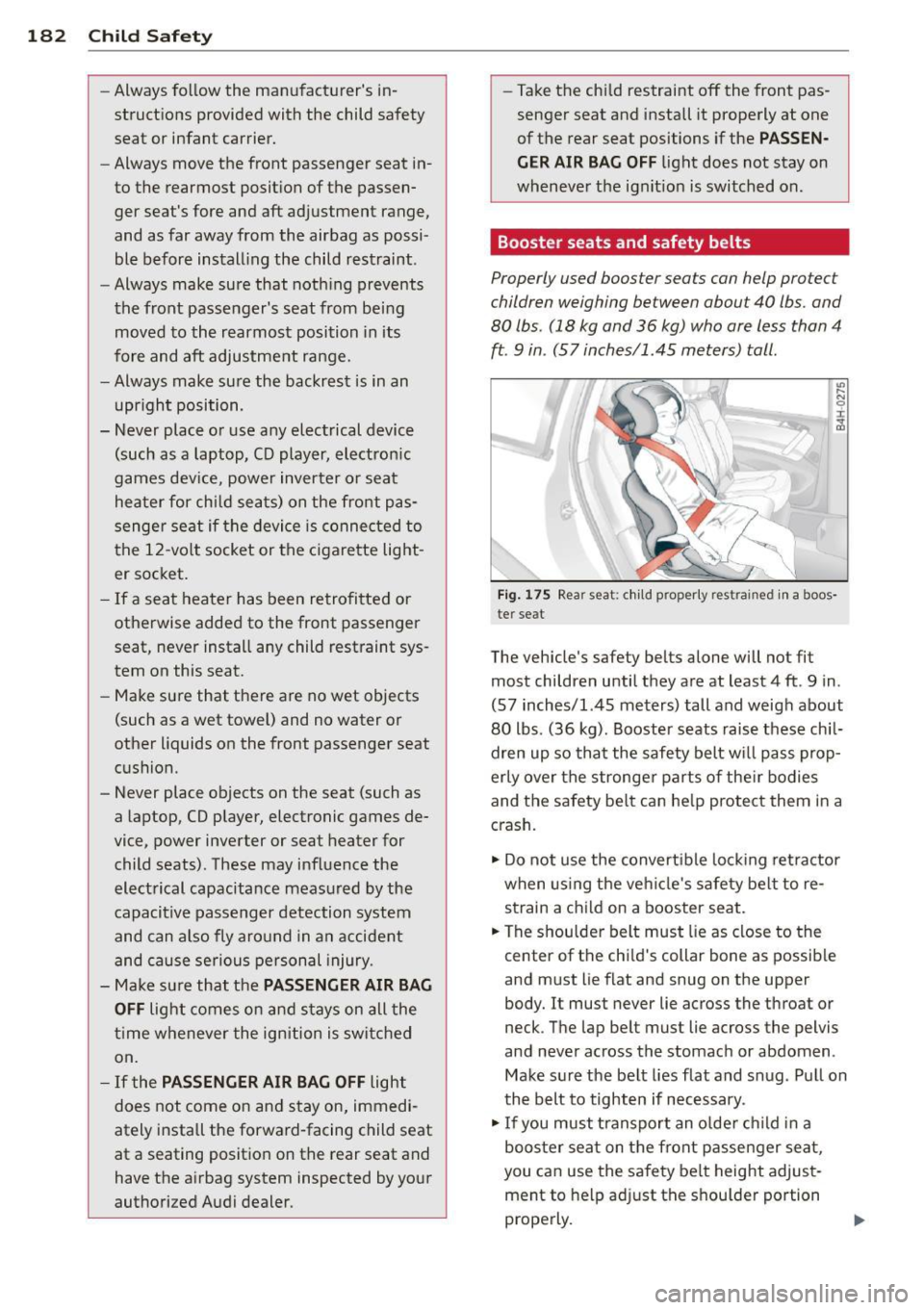
Fig. 175 Rear seat: child properly restrained in a boos
te r seat
The vehicle 's safety belts alone will not fit
most children until they are at least 4 ft . 9 in.
(57 inches/1.45 meters) tall and weigh about
80 lbs. (36 kg). Booster seats raise these chil
dren up so that the safety belt will pass prop
erly over the stronger parts of their bodies
and the safety belt can help protect them in a
crash.
.,. Do not use the convertible locking retractor
when using the vehicle's safety belt to re
strain a child on a booster seat.
.. The shoulder belt must lie as close to the
center of the child's collar bone as possible
and must lie flat and snug on the upper
body. It must never lie across the throat or
neck . The lap belt must lie across the pelvis
and never across the stomach or abdomen .
Make sure the belt lies flat and snug. Pull on
the belt to tighten if necessary .
.,. If you must transport an older child in a
booster seat on the front passenger seat,
you can use the safety belt height adjust
ment to help adjust the shoulder portion
properly. ..,.
Page 186 of 316
184 Child Saf ety
in creases the risk of serious or fatal neck
injury dramat ically.
- Children on the front seat of any car,
even w ith Advanced Airbags, can be seri
ous ly injured or even killed when an a ir
bag inf lates.
- Never let a child stand or knee l on any
seat, for example the front seat.
- Never let a child ride in the cargo area of
your vehicle.
- Always remember that a chi ld leaning
forward, sitt ing s ideways or out of posi
t ion in any way during an acc ident can be
struck by a deploying airbag . This will re
sult in serious personal injury or dea th .
- If you must install a booster seat on the
front passenger seat because of excep
t ional circumstances the
PASSENGER
AIR BAG OFF
light must come on and
stay on, whenever the igni tion is sw itch
ed on.
- If the
PASSENGER AIR BAG OFF light
does not come o n and s tay on, perform
the chec ks des cribed
<=> page 159, Moni
toring the Advanced Airbag System.
- T ake the child rest rain t off the front pas
senge r seat and install it proper ly at one
of the rea r seat positions if the
PASSEN
GER AIR BAG OFF
light does not stay on
whenever the ignition is switched on.
- Always read and hee d all WARNINGS
whenever using a child rest ra ined in ave
hicle is being used<=>
page 138, Safety
belts,<=> page 147, Airbag system
and
<=> page 173, Important things to know.
Installing a child safety
seat
Securing a child safety seat using a
safety belt
Safety belts for the rear seats and the front
passenger can be locked with the conver tible
locking retractor to properly secure child
safety seats.
The safety belts emergency locking retractors
f or the rear seats safe ty belts and for the fron
t passenger's seat safety be lt have a con
vertib le locking ret ractor for child restraints .
The safety belt m ust be locked so that be lt
webbing cannot unreel. The retractor can be activated to lock the safety belt and prevent
the safety belt webbing from looseni ng up
duri ng normal dr iv ing. A child safety seat can
o nl y be prope rly insta lled when the safety be lt
i s lo cked so that t he ch ild and child safety
sea t w ill stay in place .
Always remember : Even though your vehicle is
equipped with an Advanced Airbag system, all
c hi ld ren, especially those 1 2 years and young
er, sho uld always r ide in the back seat prope r
l y restra ined for the ir age and size.
& WARNING ,____._
I mproperly installed chi ld safety seats in
crease the risk of serious pe rsonal in jury
and death in a co llision.
-
- Always make s ure that the safety belt re
tracto r is locked when insta lling a child
safety seat. An un locked safety belt re
tractor cannot hold the child safety seat
in place dur ing no rma l driving o r in a
crash .
- Always buckle the child safety seat firmly
in place even if a ch ild is not sitt ing in it .
A loose child safety seat can fly arou nd
du ring a sudden stop or in a collision.
-Always make sure that the rear seat
backrest to wh ich the center r ear safety
be lt* is attached is sec urely latched
wheneve r the rea r ce nter sa fe ty belt i s
be ing use d to secu re a c hild re strain t.
- If th e backrest is not se curely la tched,
t he child and t he child res tra in t wi ll be
thrown forward together with the bac k
rest and will strike parts of the vehicle
interior. The chi ld can be seriously i n
jured or killed.
- Never install rear-facing child safety
seats or in fant ca rr ie rs on the front pas
senger seat. A child will be serious ly in
jured and can be killed whe n the passen-
ger a irbag i nflates .
~
Page 188 of 316
186 Child Safety
-Always be especially careful if you must
install a rearward facing child safety seat
on the front passenger seat in exception
al circumstances.
- Make sure that the
PASSENGER AIR BAG
OFF
light comes on and stays on all the
time whenever the ignition is switched
on.
- If the
PASSENGER AIR BAG OFF light
does not come on and stay on, immedi
ately install the rear-facing child safety
seat in a rear seating position and have
the airbag system inspected by your Audi dealer.
Activating the convertible locking retractor
Use the convertible locking retractor to se
cure a child restraint.
Always heed the child safety seat manufactur
er's instructions when installing a child re
straint in your vehicle. To activate the conver
tible locking retractor:
"" Place the child restraint on a seat, prefera
bly on the rear seat.
""Slowly pull the belt
all the way out.
""Route it around or through the child re
straint belt path¢,&. .
"" Push the child safety se at down with you r
full weight to get the safety belt really tight.
"" Insert the belt tongue into the buckle for
that seating position.
""Guide the safety belt back into the retractor
until the belt lies flat and snug on the child
safety seat.
""You should hear a "clicking" noise as the
belt winds back into the inertia reel. Test the
convertible locking retractor by pulling on
the belt. You should no longer be able to
pull the belt out of the retracto r. The con
vertible locking retractor is now activated.
"" Make sure that the red release button is fac
ing away from the child restraint so that it
can be unbuckled quickly .
""Pull on the belt to make sure the safety belt
is properly tight and fastened so that the seat cannot move forward or sideways more
than one inch (2.5 cm).
A WARNING .,__
Using the wrong child restraint or an im
properly installed child restraint can cause
serious personal injury or death in a crash.
- Always make sure that the safety belt re-
tractor is locked when installing a child
safety seat. An unlocked safety belt re
tractor cannot hold the child safety seat
in place during normal driving or in a
crash.
- Always buckle the child safety seat firmly
in place even if a child is not sitting in it.
A loose child safety seat can fly around
during a sudden stop or in a crash.
- Always make sure the seat backrest to
which the child restraint is installed is in
an upright position and securely latched
into place and cannot fold forward. Oth
erwise, the seatback with the child safety
seat attached to it could fly forward in
the event of an accident or other emer
gency situation.
- Always read and heed all WARNINGS
whenever using a child restrained in ave
hicle is being used
¢ page 173. Special
precautions apply when installing a child
safety seat on the front passenger seat
¢ page 149, Child restraints on the front
seat -some important things to know.
Deactivating the convertible locking
retractor
-
The convertible locking retractor for child re
straints will be deactivated automatically when the belt is wound all the way back into
the retractor.
"" Press the red button on the safety belt buck
le. The belt tongue will pop out of the buck
le.
""Guide the safety belt all the way back into
its stowed position .
Always let the safety belt retract completely
into its stowed position. The safety belt can
IJll-
Page 189 of 316
M N <( (.J
'SI: ,...., \!) 1.1'1 ,...., 1.1'1 ,....,
now be used as an ordinary safety belt with
out the convertible locking retractor for child
restra ints.
I f the convertible locking retractor shou ld be
activated inadvertently, the safety belt must
be unfastened and guided completely back in
to its stowed position to deactivate this fea
ture.
If the convertib le locking retractor is not
deactivated, the safety belt will gradually be
come tighter and uncomfortable to wear .
A WARNING
Improperly installed child safety seats in
crease the risk of ser ious personal injury
and death in a collision.
- Never unfasten the safety belt to deacti
vate the convert ible lock ing ret ractor for
c hild restraints while the veh icle is mov
ing. You would not be restrained and
cou ld be ser iously injured in an accident.
- Always read and heed all WARN INGS
whenever using a child rest rained in ave
hicle is being used
¢page 173. Special
precautions apply when installing a chi ld
safety seat on the front passenger seat
¢ page 149, Child restraints on the front
seat -some important things to know.
LATCH Lower
anchorages and tethers
for children
Child Restraint System anchors and how
are they related to child safety
To provide a s imp le r and more pract icable way
to attach the ch ild res traint on the veh icle
seat, Federa l regu lations require specia l lower
anchorages in vehicles and devices on new
chi ld restraints to attach to the vehicle ancho
rages.
The combination of the tether anchorages and
the lower anchorages is now generally called
the
LA TCH system for "Lower Anchorages and
T ethers for Children."
F orward- facing child restraints manufactured
after September 1, 1999, are required by U.S.
Child Sa fet y 187
federa l reg ulations to comply with new child
head movement performance requirements.
These new performance requirements make a
tether necessary on most new child seats.
Installing a ch ild restra int that requires a top
tethe r without one can seriously impair the
performance of the c hild restra int and its abil
ity to protect the child in a collis ion. Insta lling
a child restraint that requires a top tether
without the top tether may be a violat ion of
state law.
Child restraint manufacturers offer LATCH
lower anchorages on their child seats with
hook-on or push-on connectors attached to
adjustable straps.
In add ition to the LATCH lower anchorages,
these child restraint systems usually require
the use of tether straps to help keep the ch ild
restraint firmly in place.
A WARNING
Imp roper installat ion of child restra ints
will increase the r isk of injury a nd death in
a cr ash.
- Always follow the instr uctions provided
by the manufa cture r of the child re
s traint yo u intend to install in your vehi
cle.
- Never inst all a child restraint withou t a
properly attached top tether strap if the
child restraint manufacturer's instruc
tions require the top tether strap to be
used.
- Improper use of child rest raint LATCH
lowe r ancho rage points can lead to injury
in a collision. The LATCH lower anchorage
points are designed to withstand on ly
those loads imposed by correctly fitted
child restraints.
- Never mount two child restra int systems
on one LATCH lower anchorage point.
- Never secure or attach any luggage or
other item to the LATCH lower anchorag-
-
es. Ill-
•
•
Page 191 of 316

proper installation of the child restraint
and proper use of the lower anchora ges
or safety belts in your vehicle.
- Never secure or attach any luggage or
other items to the LATCH lower ancho
rages.
- Always read and heed the important in
formation about child restraints in this
chapter and WARNINGS ¢
page 173,
Child Safety.
Installing a child restraint with LATCH
lower anchorages
Whenever you install a child restraint always
follow the child restraint manufacturer's in
structions.
Fig. 179 Lower anchorages: p roper mo unting
Mounting
.. Make sure the seatback of the rear seat
bench is in the upright position and securely
latched in place.
.. Attach both hook-on connectors with the
spring catch release on the child safety seat
onto the LATCH lower anchorage so that the
connectors lock into place¢
fig. 179 .
.. Pull on the connector attachments to make
s ure they are properly attached to the LATCH
lower anchorage .
.. Pull straps tight following the child restra int
manufacturer's instructions.
Releasing
.. Loosen the tension on the straps following
"' the child restraint manufacturer's instruc-
N
i3 tions.
"". rl I.O
"' ......
"' rl
Child Safety 189
.. Depress the spring catches to release the
anchorage hooks from the lower anchorag
es.
Remember: Use tether straps to help keep the
child restraint firmly in place.
& WARNING ~
Improper use of the LATCH system can in-
crease the risk of serious personal injury
and death in an accident.
- These anchors were developed only for
child safety seats using the "LATCH" sys
tem.
- Never attach other child safety seats,
belts or other objects to these anchors.
- Always make sure that you hear a click
when latching the seat in place. If you do
not hear a click the seat
is not secure and
could fly forward and hit the interior of
the vehicle, or be ejected from the veh i
cle .
& WARNING
Improper installat ion of child restraints
will increase the risk of injury in an acci
dent.
- Always follow the child restraint system
manufacturer's instructions for proper
installation of the child restraint system
and proper use of tether straps as well as
the lower anchorages or safety belts in
your vehicle .
-Always read and heed the important in
formation and WARNINGS about child safety and the installation of child re
straint systems¢
page 173, Child Safe
ty.
-
Page 197 of 316

@ Tips
Your vehicle may be equipped with Audi
connect. Your use of certain Aud i connect
features req uires wireless serv ices that are
provided by a third party wireless telecom
municat ions provider. For details regard
ing how information obtained through
Aud i connect is collected, processed,
transmitted, used, and shared, please see
your contra ct w ith the wire less telecom
municat ions provider and the "About A udi
connect" tab in your vehicle's MMI:
!MENU !
button > Audi connect > About Audi con·
nect .
Electronic Stabilization
Control (ESC)
Description
ESC helps to improve road holding and vehicle
dynamics to help reduce the probability of
skidd ing and loss of veh icle control. It works
only when the eng ine is running. ESC detects
certain difficult driv ing s ituations, including
when the vehicle is beginning to spin (yaw)
out of cont ro l and helps you to get the vehicle
back under control by select ively brak ing the
wheels, and/or red ucing engine powe r and
p roviding steering assistance to help hold the
ve hicle on the driver's intended course . The in
dicator light
m in the instrument cluster
blinks when ESC is taking action to help you
control the vehicle.
ESC has limitations.
It is important to remem
ber that ESC cannot overcome the laws of
phys ics. It will not a lways be able to help out
under all conditions you may come up against.
For example, ESC may not always be able to
h elp you master situat ions where there is a
sudden change in the coefficient of fr iction of
the road surface. When there is a sect io n of
d ry road that is s udden ly cove red with water,
slush o r snow, ESC canno t perform the same
way it would on the dry su rface.
If the vehicle
hydroplanes (rides on a c ush ion of wate r in
stead of the road surface), ESC wi ll not be
ab le to he lp you steer the veh icle because con-
Int ellig ent technolog y 195
tact with the pavement has been interrupted
and the vehicle cannot be braked or steered .
D uring fast corner ing, particular ly on wind ing
roads, ESC cannot always deal as effectively
with difficult dr iv ing s ituations than at lower
speeds. When towing a trailer, ESC is not able
to help you regain control as it would if you
were not tow ing a trailer.
Always adjust your speed and driving style to road, traffic and weather conditions . ESC can
not override the vehicle's physical lim its, in
crease the availab le tract ion, or keep a veh icle
o n the road if road departu re is a result of
driver ina ttent io n. Instead , ESC imp roves the
poss ibility of keep ing t he vehicle under con
trol and on the road during extreme maneu
vers by using the driver's steering i nputs to
help keep the vehicle go ing in the intended di
rect ion. If you are traveling at a speed that
causes you to run off the road before ESC can
provide any assistance, you may not experi
ence the benefits of ESC.
ESC is switched on all the time. In certain sit
uat ions when you need less traction, you can
switch off ASR by pressing the butto n
[ill
~ page 197, fig. 182. Be su re to switch ASR
o n again when you no longer need less trac
tion.
The following systems are integrated in the
ESC:
Anti-lock bra king sy stem (ABS )
ABS prevents the whee ls from locking up
when brak ing. T he vehicle can st ill be steered
even dur ing hard braking. App ly steady pres
su re to the brake peda l. Do not pump the ped
al. A pulsing in the brake pedal ind icates that
the system is helping you to brake the veh icle .
Brake assi st system
The brake ass ist system can decrease braking
distance. It increases brak ing power when the
drive r presses the brake peda l quickly in emer
gency s ituations. You must press and hold the
brake pedal unti l the s ituation is over. In
vehicles wi th adap tive c rui se control*, the
brake assis t system is more sensitive if the
•
•
Page 198 of 316
196 Intellig ent technolog y
distance detected to the veh icle a head is too
smal l.
Anti -slip regulation (ASR )
ASR reduces engine power when the drive
wheels begin to spin and adapts the force to
the road condit ions. This makes it eas ier to
start, accelerate and drive up hills.
Electronic differential lock (EDL )
The ED L brakes wheels that are spinn ing and
transfers the d rive power to the other wheels.
This f unct ion is not availab le at h igher speeds.
In extreme cases, EDL automat ically switches
off to help keep the brake on the braked whee l
from overheating. EDL w ill switch on aga in au
tomatically when conditions have returned to norma l.
St eering recommendat ion
The ESC helps to stabilize the vehicle by
cha nging the steering to rque.
In vehicles with dynam ic steering*, ESC also
helps to stabilize the steering in critical s itua
tions .
Select ive w heel to rque control
Selective wheel torque control is used when
driving on curves . The front wheel on the in
side of the curve or both wheels on the inside
of the curve are braked selectively as needed.
This a llows more prec ise driving in curves. The
applicable system may not activate when d riv
ing i n wet or snowy conditions.
.&_ WARNING
- T he ESC and its integrated systems can
not overcome the limits posed by natural physical laws
. This is especially impor
tant on slippery or wet roads. If the sys tems beg in acting to stabilize your vehi
cle, you should immediately change your
speed to match the road and traffic con
d itions . Do not let the increased safety
p rovided by these systems tempt you to
take risks. Do ing so will increase the ri sk
of a loss of veh icle cont ro l, collision and
serio us personal inj uries.
- Always adapt your speed to road, traffic
and weather conditions . The risk of los
ing control of the vehicle increases when
driving too fast , especially through
curves and on slippery or wet roads, and
when dr iv ing too close to vehicles up
ahead . The ESC and its integrated sys
tems cannot a lways prevent collisions -
there is still a risk of acc idents!
- Always accelerate with special care on
even, smooth su rfaces such as those that
are wet or covered with ice and snow .
The drive wheels can spin even w ith
these assistance systems that c annot al
ways he lp to red uce the risk of loss of ve
h icle control.
(D Tips
- ABS and ASR only wo rk correctly when
all four wheels are equipped wi th iden ti
cal tires. D ifferen t tire sizes can lead to a
reduction in engine power.
- Yo u may hear noises when the systems
descr ibed are workin g.
-If the ind icator light DJ or Ea (USA
mode ls)/ lCO j
page 19,
<=>page 19.
Page 200 of 316
198 Intelligent technology
-Automatic retraction : When speed drops be
l ow about SO mph (80 km/h), the rear spoil
er retracts automatically.
Manual mode
- Manual deployment: Tappi ng briefly on the
switch
¢ fig. 183 dep loys the rear spoiler.
- Manua l retraction: At speeds up to about
10 mph (20 km/h), ret ract the rear spoiler
by pressing and holding the switch
¢fig. 183 . At speeds between 10 mph (20
km/h) and 80 mph (130 km/h), retract the
rear spoiler by tapping on the switch
¢fig . 183.
Indicator lights
1,1 /. Rear spoiler: system malfunction!
The rear spoiler may not have extended due to
a malfunction. This could change the vehicle's
driving characteristics at high speeds. Do not
exceed 85 mph (140 km/h). Drive to your au
thorized Audi dealer immediate ly to have the
malfunction corrected . The co lor of the indica
tor light depend s on the veh icle speed.
A WARNING
Dr iv ing at higher speeds w ithout the rear
spoiler deployed can impair handling char
acteristics, making the veh icle harder to
control.
-Always make sure that the spoiler is de
ployed when driving at speeds over
85 mph (140 km/h). If th e rear spoiler
wa rning/ind icator light in the instru
ment cluster comes on, the rear spoiler
may not have deployed.
- Never drive at speeds higher than
85 mph (140 km/h) if the spoiler is not
dep loyed. Have the spoiler inspected as
soon as possible by an authorized A udi
dealer or qualified workshop.
- Always obey speed limits and other traf
fic laws.
A WARNING
Improper operation of the rear spoiler can
cause crushing injuries. -
Always make sure that nobody, especially
children, is in the way when the rear
spoiler is deployed or retracted.
(D Note
- Never push the vehicle or apply force to
the rear spoiler -it could be damaged.
- To prevent damage to the rear spoiler do
not lean or place anything on it .
- Only operate the rear spoiler man ually
when the rear lid is closed and the rear
spoiler moving parts are not blocked.
Otherw ise, damage co uld occur.
(D Tips
Clean the spoiler compartment every 2 to
3 months. The spoiler compartment must
always be free of ice, snow, leaves or other
debris.
Braking
General information
What affects braking efficiency?
Operating conditions and driving habits
The brakes on today's automobiles are still
subject to wear, depending largely on operat
ing condit ions and driving hab its
r:::;, ,& . On
vehicles that are either dr iven mostly in stop
and-go city traff ic or are dr iven hard, the
brake pads should be checked by your author
ized Audi dea ler more often than specified in
the
Warranty & Maintenance booklet. Failure
to have your brake pads inspected can result
in reduced brake performance.
On steep slopes , you sho uld use the braking
effect o f the engine . This way, you prevent un
necessary wear on the brake system . If you
must use your brakes, do not hold the brakes
down cont inuous ly. Pump the brakes at inter
vals.
Moisture or road salt
Under certain conditions, for example, when
driving through water or very heavy rain, or
even after washing your vehicle, the braking .,..
Page 213 of 316

M N <( (.J
'SI: ,...., \!) ..,.,
,...., ..,., ,....,
~ Select the D/S se lecto r lever posit ion .
~ Release the parking b rake and slow ly pull
o ut and away from the whee l chocks.
~ Stop and have someone retrieve the wheel
chocks.
(D Tips
I f you move the selector lever of the a uto
mat ic transm ission to P before app lying
the parking b rake and befo re blocking the
wheels, you may have to use mo re force
la ter to move th e lever out of the P posi
tion.
Trailer towin g 211
•
•
Page 221 of 316
M N <( I.J "". rl I.O
"' rl
"' rl
Such damage will not be covered by your
New Vehicle Limited Warranty .
- If you p ut any amount of incorrect fue l in
t h e fue l tank, do not start the engine un
der any circumstances. Immediately con
tact the nearest author ized Audi dealer
or authorized Audi Service Facility for as
s istance. These fuels contain substances
that can severely damage the fuel sys
tem and the engin e if the engine is start
ed.
Fuel tank
Fuel filler neck
The fuel filler neck is located on the r ight rear
side panel behind the fuel f iller flap.
If the power loc king system should fail, you
can st ill open the flap manually -for detai led
instructions see ¢
page 221.
You can find the fue l tank capacity o f you r ve
hicle in
¢ page 292.
The label on the inside of the fuel filler flap
tells you the cor rec t f uel for yo ur vehicle . For
more in formation about fuel specificat ions,
see
¢ page 217 .
Your veh icle fuel tank has an on board refue l
ling vapor recove ry system . T his feature he lps
to p revent fuel vapo rs from escaping from the
tank and polluting the environment whi le you
refuel your ve hicle. In order to fill the tank
properly whi le protect ing the e nv ironment,
p lease follow t his refueling procedure careful
ly .
& WARNING
Under no rma l operating condi tions, neve r
car ry add itiona l fuel containe rs in your car.
G as can iste rs a nd other c ontaine rs used to
t ran sport fue l can be dange rous. Such con
t ainers, full or empty, may lea k and co uld
cause a fi re in a co llision . If you must
transport fue l to use for yo ur lawn mower,
snow blower, etc., be very ca refu l and al
ways observe local and state laws regard
ing the use, transportat io n and storage of
Fu el suppl y and filli ng your fuel t ank 219
such fuel containe rs . M ake certa in the con
tainer meets industry standa rds (ANSI/
ASTM F852 -86).
(D Note
Neve r drive your vehicle until the fuel tank
i s completely empty. T he irreg ular s upply
of fue l can ca use m isfir ing. Gasoline cou ld
enter t he exhaust system and damage the
catalytic converter .
Refuelling
Fig. 1 84 R ig ht rea r ve hicle s ide : Open ing t he fuel filler
flap
F ig . 185 Fu el f ille r fla p with attac hed fuel cap
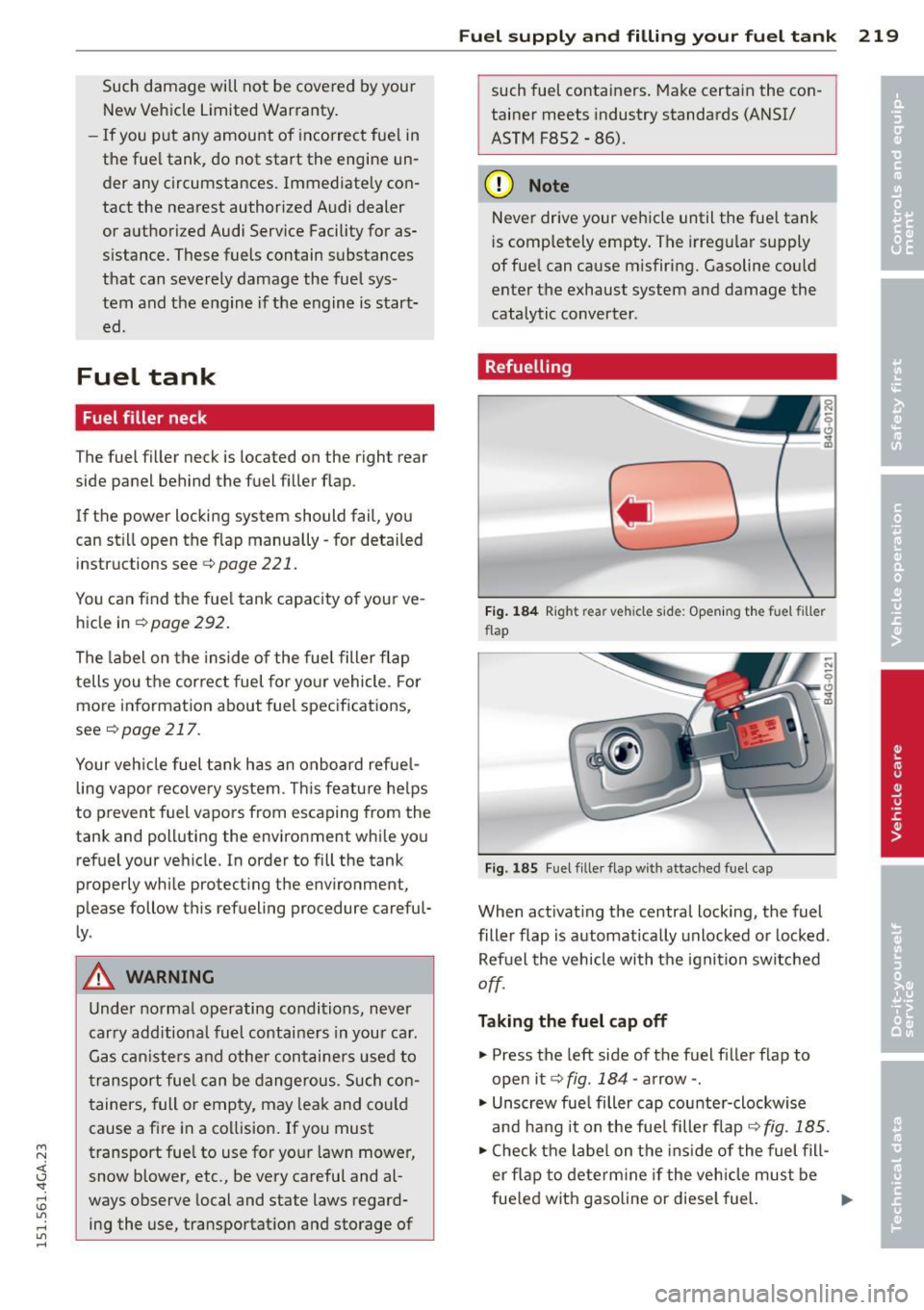
When act ivat ing the centra l locking, the fuel
filler flap is a utomatically unlocked o r locked .
Ref uel the vehicle wi th t he ignition switched
off.
Taking the fuel cap off
.,. Press the left side of the fuel f iller flap to
open it ¢
fig. 184 -arrow -.
.,. Unsc rew fue l filler cap counte r-clockw ise
and ha ng it on the fue l filler flap ¢
fig. 185.
.,. Check t he label on t he ins ide of the f uel fill
er f lap t o dete rm ine if the veh icle mus t be
fue led with gasoline or diese l fuel. ..,.