instrument panel AUDI A7 2016 User Guide
[x] Cancel search | Manufacturer: AUDI, Model Year: 2016, Model line: A7, Model: AUDI A7 2016Pages: 294, PDF Size: 73.82 MB
Page 145 of 294
M N <( (.J
'SI: ,...., \!) 1.1'1
N \!) ,....,
Airbag system Important information
Importance of wearing safety belts and
sitting properly
Airbags are only supplemental restraints. For
airbags to do their job, occupants must always
properly wear their safety belts and be in a prop er seating position.
For your safety and the safety of your passen
gers, before driving off, always:
.,. Adjust the driver's seat and steering wheel
properly
r:> page 12 7,
.,. Adjust the front passenger's seat properly
9 page 53,
.,. Wear safety belts properly r::> page 137 ,
.. Always properly use the proper child restraint
to protect children
r:> page 167.
In a collision, airbags must inflate within the
blink of an eye and with considerable force. The
supplemental airbags can cause injuries if the
driver or the front seat passeng er is not seated
properly . Therefo re in order to help the ai rbag to
do its job, it is important, both as a driver and as
a passenger to si t properly at all times.
By keeping room between your body and the
steering wheel and the front of the passenger
compartment, the airbag can inflate fully and
completely and provide supplemental protection in certain frontal collisions
r:> page 12 7, Correct
passenger seating positions .
For details on the
operation of the seat adjustment controls
r::> page 53.
It's especially important that children are proper
ly restrained
r:> page 167.
There is a lot that the driver and the passengers
can and must do to help the individual safety fea
tures installed in your Audi work together as a
system.
Proper seating position is important so that the
front airbag on the driver side can do its job . If
you have a physical impairment or condition that
prevents you from sitting properly on the driver
seat with the safety belt properly fastened and
Airbag system
reaching the pedals, or if you have concerns with
regard to the function or operation of the Ad
vanced Airbag System, please contact your au
thori zed Audi dealer or qualified workshop, or
call Audi Customer Relations at 1-800-822-2834
for possible modifications to your vehicle.
When the airbag system deploys, a gas generator
will fill the airbags, break open the padded cov ers, and inflate between the steering wheel and
the driver and between the instrument panel and
the front passenger . The airbags will deflate im
mediately after deployment so that the front oc
cupants can see through the windshield again
without interruption.
All of this takes place in the blink of an eye , so
fast that many people don't even realize that the airbags have deployed. The airbags also inflate
with a great deal of force and nothing should be
in their way when they deploy. Front airbags in
combination with properly worn safety belts slow
down and limit the occupant's forward move
ment . Together they help to prevent the driver
and front seat passenger from hitting parts of
the inside of the vehicle while reducing the forces
acting on the occupant during the crash . In this
way they help to reduce the risk of injury to the
head and upper body in the crash . Airbags do not
protect the arms or the lower parts of the body.
Both front airbags will not inflate in all frontal
collisions. The triggering of the airbag system de
pends on the vehicle deceleration rate caused by
the collision and registered by the electronic con
trol unit. If this rate is below the reference value
programmed into the control unit, the airbags
will not be triggered , even though the car may be
badly damaged as a result of the collision. Vehi
cle damage, repair costs or even the lack of vehi
cle damage is not necessarily an indication of
whe ther an airbag should infla te or not.
Since the circumstances will vary considerably between one collision and another, it is not possi
ble to define a range of vehicle speeds that will
cover every possible kind and angle of impact
that will always trigger the airbags . Important
factors include, for example, the nature (hard or
soft) of the object which the car hits, the angle of
impact, vehicle speed , etc. The front airbags will ..,.
143
Page 146 of 294
Airbag syste m
also not inflate in s ide or rear collisions, or in roll
overs.
A lwa ys rem ember : Airbags will deploy on ly once,
and only in certain kinds of collis ions. Your safety
be lts are a lways there to offer p rotection in those
situations in which airbags are not supposed to
deploy, or when they have already deployed; for
examp le, when your vehicle str ikes or is struck by
another vehicle after the first collision.
This is just one of the reasons why an airbag is a
supp lementary restra int and is not a substitute
for a safety belt. The airbag system works most
effectively when used w ith the safety belts.
Therefore, always properly wear your safety belts
c::> page 135.
A WARNING
Sitting too close to the steering wheel or in
strument panel wil l decrease the effect ive
ness of the airbags and will increase the risk
o f personal injury in a collision .
- Never sit closer than 10 inches (25 cm) to
the steering wheel or instrument panel.
- If you cannot sit more than 10 inches
( 2 5 cm) from the steer ing whee l, investi
gate whether adaptive equipment may be
available to help you reach the pedals and
increase yo ur seating distance from the
steering wheel.
- All veh icle occupants and especia lly children
must be restrained properly whenever riding
in a vehicle. An unrestrained or improperly
restrained child could be injured by striking
the interior or by being ejected from the ve
hicle du ring a sudden maneuver or impact.
An unrestrained or improperly restrained child is also at greater risk of injury or death
thro ugh contac t wit h an inflat ing airbag.
- If you are unrestrained, leaning forward, s it
t ing s ideways o r out of position in any way,
yo ur risk of in jury is much higher.
- You w ill also receive serious inju ries and
c ould even be killed if you are up against the
airbag or too close to it when it inflates -
even with an Advanced Airbag.
144
-
- To reduce the risk of injury when an airbag
inflates, always wear safety belts properly
c::> page 138, Safety belts.
- Always make certain that ch ildren age 12 or
younger always ride in the rear seat. If chil
dren are not properly restrained, they may
be severe ly injured or killed when an a irbag
inflates.
- Never let ch ildren ride unrestra ined or im
prope rly restrained in the vehicle . Ad just the
front sea ts prope rly .
- Never ride with the back rest reclined .
- Always sit as far as possible from the steer-
ing wheel or the instrument panel
c::>page 127.
-Always sit upright with your back against
the backrest of your seat.
- Never p lace your feet on the instrument
panel or on the seat. Always keep both feet
on the f loor in front of the seat to help p re
vent serious injur ies to the legs and hips if
the airbag infla tes.
- Never recline the front passenger 's seat to
transport objects . Items can also move into
the area of the side airbag o r the front air
b ag du ring bra king or in a sudden maneu
ver . Ob jects near the airbags can become
projectiles and cause in jury when an airbag
inflates.
A WARNING
Airbags that have deployed in a crash must be replaced.
- Use on ly original equipment airbags ap
proved by Audi and installed by a trained
technician who has the necessary too ls and
diagnostic equipment to properly rep lace
any airbag in you r vehicle and assure system
effectiveness in a crash.
- Never perm it salvaged or recycled airbags to
be installed in your vehicle.
Child restraints on the front seat - some
important things to know
.,. Be s ure to read the important information and
hee d the WAR NIN GS for import ant details .,..
Page 151 of 294
M N <( (.J
'SI: ,...., \!) 1.1'1
N \!) ,....,
and your passengers must always be properly re
strained, not just because the law requires you to
be.
The Advanced Airbag System in your vehicle has been certified to meet the "low risk" require
ments for 3 and 6 year-old children on the pas
senger side and very small adults on the driver
side. The low risk deployment criteria are intend
ed to help reduce the risk of injury through inter
action with the front airbag that can occur, for
example, by being too close to the steering wheel
and instrument panel when the airbag inflates.
In addition, the system has been certified to
comply with the "suppression" requirements of
the Safety Standard, to turn off the front airbag
for infants 12 months old and younger who are
restrained on the front passenger seat in child re
straints that are listed in the Standard
q page 169, Child restraints and Advanced front
airbag system.
"S uppression " requires the front airbag on the
passenger side to be turned off if:
- a child up to about one year of age is restrained
on the front passenger seat in one of the rear
facing or forward-facing infant restraints listed
in Federal Motor Vehicle Safety Standard 208
with which the Advanced Airbag System in your
vehicle was certified. For a listing of the child
restraints that were used to certify your vehi
cle's comp liance with the US Safety Standard
qpage 169,
- When a person is detected on the front passen
ger seat that has an electrical capacitance that
is more than the total electrical capacitance of
a child that is about 1 year old restrained in one
of the rear-facing or forward-facing infant re
stra ints (listed in Federal Motor Vehicle Safety
Standard 208 with which the Advanced Airbag
System in your vehicle was certified), the front
airbag on the passenger side may or may not
deploy.
The
PASSENGER AIR BAG OFF light comes on
when the electronic control unit detects a total
e lectr ical capacitance on the front passenger seat
that requires the front airbag to be turned off. If
the
PASSENGER AIR BAG OFF light does not
Airbag system
come on, the front airbag on the passenger side
has not been turned off by the control unit and
can deploy if the control unit senses an impact
that meets the conditions stored in its memory.
If the total electrical capacitance registered on
the front passenger seat is more than that of a
typical 1 year-old, but less than the weight of a
small adult, the front airbag on the passenger
side may deploy (the
PASSENGER AIR BAG OFF
light does not come on).
For example, the airbag may deploy if:
-a small child that is heavier than a typical 1
year-old child is on the front passenger seat (re
gardless of whether the child is in one of the
child seats listed
q page 169),
- a child who has outgrown child restraints is on
the front passenger seat.
If the front passenger airbag is turned off, the
PASSENGER AIR BAG OFF light in the center of
the instrument panel will come on and stay on.
If the front passenger airbag deploys, the Federal
Standard requires the airbag to meet the "low
risk" deployment criteria to help reduce the risk
of injury through interaction with the airbag.
"Low risk" deployment occurs in those crashes
that take place at lower decelerations as defined
in the electronic control unit
q page 154.
Always remember: Even though your vehicle is
equipped with Advanced Airbags, the safest place
for children is properly restrained on the back
seat. Please be sure to read the impor tant infor
mation in the sections that follow and be sure to
heed all of the WARNINGS .
_& WARNING
To reduce the risk of injury when an airbag in
flates, always wear safety belts properly.
- If you are unrestrained, leaning forward, sit
ting sideways or out of position in any way,
your risk of injury is much higher.
- You will also receive serious injuries and
could even be killed if you are up against the
airbag or too close to it when it inflates -
even with an Advanced Airbag
9page 143.
149
Page 153 of 294
-An Advanced Airbag with gas generator and
control valve for the driver inside the steering
wheel hub.
- An Advanced Airbag with gas generator and
control valve inside the instrument panel for
the front passenger .
- A capacitive passenger detection system under
neath the front passenger seat cover. This sys
tem measures the electrical capacitance of the
person in the seat. The information registered
is sent continuously to the electronic control
unit to regulate deployment of the front Ad
vanced Airbag on the passenger side .
- An airbag monitoring system and indicator
light in the instrument cluster~
page 154.
-A sensor in each front seat registers the dis
tance between the respective seat and the steering wheel or instrument panel. The infor
mation registered is sent continuously to the
electronic control unit to regulate deployment
of the front Advanced Airbags.
- The
PASSENGER AIR BAG OFF light comes on
and stays on in the center of the instrument
panel ~
page 155, fig. 160 and tells you when
the front Advanced Airbag on the passenger side has been turned
off.
- A sensor in the safety belt latch for the driver
and for the front seat passenger that senses
whether that safety belt is latched or not and
transmits this information to the electronic control unit.
A WARNING
Damage to the front passenger seat can pre
vent the front airbag from working properly.
- Improper repair or disassembly of the front
passenger and driver seat will prevent the
Advanced Airbag System from functioning properly.
- Repairs to the front passenger seat must be
performed by qualified and properly trained
workshop personnel.
- Never remove the front passenger or driver
seat from the vehicle.
~ - Never remove the upholstery from the front <(
~ passenger seat.
~ -Never disassemble or remove parts from the 1.1'1
N seat or disconnect wires from it. ID ......
Airbag system
-Never carry sharp objects in your pockets or
put them on the seat. The capacitive pas
senger detection mat in the front passenger
seat will not function properly if it is punc
tured.
- Never carry things on your lap or carry ob
jects on the front passenger seat . Such ob
jects can influence the capacitance regis
tered by the capacitive passenger detection
system, so that incorrect information is pro
vided to the airbag control unit.
- Never store items under the front passenger
seat. Parts of the Advanced Airbag System
under the passenger seat could be dam
aged, preventing them and the airbag sys
tem from working properly.
- Never place seat covers or replacement up
holstery that have not been specifically ap
proved by Audi on the front seats.
- Seat covers can prevent the Advanced Air
bag System from recognizing child re
straints or occupants on the front passenger
seat and prevent the side airbag in the seat
backrest from deploying properly.
- If a seat heater has been retrofitted or oth
erwise added to the front passenger seat,
never install any child restraint system on
this seat.
- Never use cushions, pillows, blankets, or
similar items on the front passenger seat .
The additional layers prevent the capacitive
passenger detection system from accurately
measuring the capacitance of the child safe
ty seat and/or the person on the seat and
thus keep the Advanced Airbag System from
working properly.
- Never place or use any electrical device
(such as a laptop, CD player, electronic
games device, power inverter or seat heater
for child seats) on the front passenger seat if the device is connected to the 12-volt
socket or the cigarette lighter socket. Such
devices can influence the capacitance regis
tered by the capacitive passenger detection
system, so that incorrect information is pro
vided to the airbag control unit.
- If you must use a child restraint on the front
passenger seat and the child restraint
~
151
Page 160 of 294

Airbag syste m
(D Tips
If the capaciti ve passenger detection system
determines that the front passenger seat is
empty, the frontal airbag on the passenger
side w ill be turned off, and the
PA SSEN GER
AIR BA G OFF
light w ill stay on.
Repair, care and disposal of the airbags
Parts of the a irbag system are installed at many
d iffe rent p laces on your Audi. Insta lling, remov
ing, servicing or repa iring a part in an area of the
veh icle can damage a part of an ai rbag system
and prevent that system from working properly
in a co llision.
There are some important thi ngs you have to
know to make sure that the effect iveness of the
system w ill not be impaired and that d isca rded
components do not cause injury or pollute the
environment.
A WARNING
-Improper care, servicing and repair proce
dures can increase the risk of personal injury
and death by preventing an a irbag from de
ploying when needed or deploying an airbag
unexpectedly:
- Never cover, obstruct, or change the steer ing wheel horn pad or airbag cover or the in
strument pane l or modify them in any way.
- Never attach any objects such as cup holders or te lephone mountings to the surfaces cov
ering the airbag units.
- For cleaning the ho rn pad or instrument
panel, use only a soft, dry cloth or one mois
tened with plain water. So lvents or cleaners
c ould damage the a irbag cover or change
the stiffness o r strength of the ma ter ial so
that the airbag cannot dep loy and protect
properly .
- Never repa ir, adjust, or change any parts of
the a irbag system.
- All work on the stee ring wheel, inst rument
panel, front seats or electrical system (in
cluding the installation of audio equipment,
cellular telephones and CB radios, etc.)
must be performed by a qualified technician
158
who has the training and special equipment necessary.
- For any work on the airbag system, we
strongly recommend that yo u see your au
thorized Audi dealer or qualified workshop.
- Never modify the front bumper or parts of
the vehicle body.
- Always make sure that the side airbag can
inflate w ithout interference:
- Never install seat covers or rep lacement
u pholstery over the front seatbacks that
have not been specifically approved by
A udi.
- Never use additional seat c ushions that
cover the areas where the side a irbags in
flate.
- Damage to the orig inal seat cove rs or to
the seam in the are a of the side ai rbag
module mus t always be repaired immedi
ate ly by an autho rized Aud i dealer.
- The a irb ag sys tem can deploy on ly on ce. Af
ter an airbag has been deployed, i t m ust be
rep laced with new replacement parts de
signed and approved especially fo r your A udi
model version. Replacement of complete
airbag systems or a irbag components must
be performed by qualified workshops only.
Ma ke sure that any airbag serv ice action is
e ntered in your Aud i Warranty
& Ma inte
nance booklet unde r
AIRBAG REPLAC EM ENT
R ECORD.
- For safety reasons in severe accidents, the
al ternator and starte r are separated from
the vehicle batte ry w ith a pyrotec hni c circ uit
interrupter .
- Work on the pyrotechnic c ircuit interrupt
er must on ly be performed by a qua lified
techn ic ians who have the experience, in
fo rmation and specia l tools necessa ry to
perfo rm the wor k safely.
- If the vehicle or the circuit interr upter is
scrapped, all app licable safety precautions
must be followed.
~
Page 161 of 294
M N <( I.J "". rl I.O
"' N I.O rl
@ For the sake of the environment
Undeployed airbag modu les and pretension
ers might be classified as Perchlorate Mater ial
- special handling may apply, see
www.dtsc.ca.gov/hazardouswaste/perchlo
rate. When the vehicle or parts of the re
straint system including airbag modules and
safety belts w ith pretens ioners are scrapped,
all applicable laws and regulations must be
observed. Your authorized Audi dealer is fa
miliar with these requirements and we recom
mend that you have your dealer perform this
service for yo u.
Other things that can affect Advanced
Airbag performance
Changing the vehicle's suspension system can
change the way that the Advanced A irbag System
performs in a crash. For example, using tire-rim
comb inat ions not approved by Audi, lowering the
vehicle, changing the stiffness of the su spension,
including the springs, suspension struts, shock
absorbers etc . can change the forces that are
measured by the airbag sensors and sent to the
e lectronic control un it. Some suspension changes
can, for example, increase the force levels meas
ured by the sensors and make the airbag system
deploy in crashes in which it would not deploy if
the changes had not been made . Other kinds of
changes may reduce the force levels measured by
the sensors and prevent the airbag from deploy
ing when it should.
_& WARNING
Changing the vehicle's suspension including
use of unapproved tire-rim combinations can
change Advanced Airbag performance and in
crease the risk of ser ious personal injury in a
crash.
- Never install suspens ion components that
do not have the same performance charac
teristics as the components originally instal
led on your veh icle.
- Never use tire-rim combinations that have
not been approved by Audi.
Airbag system
Knee airbags
Description of knee a irbags
Applies to vehicles: with knee airbags
The knee airbag system can provide supplemen
tal protection to properly restrained front seat
occupants .
Fig. 161 D river 's knee a irbag
T he driver knee airbag is in the instrument panel
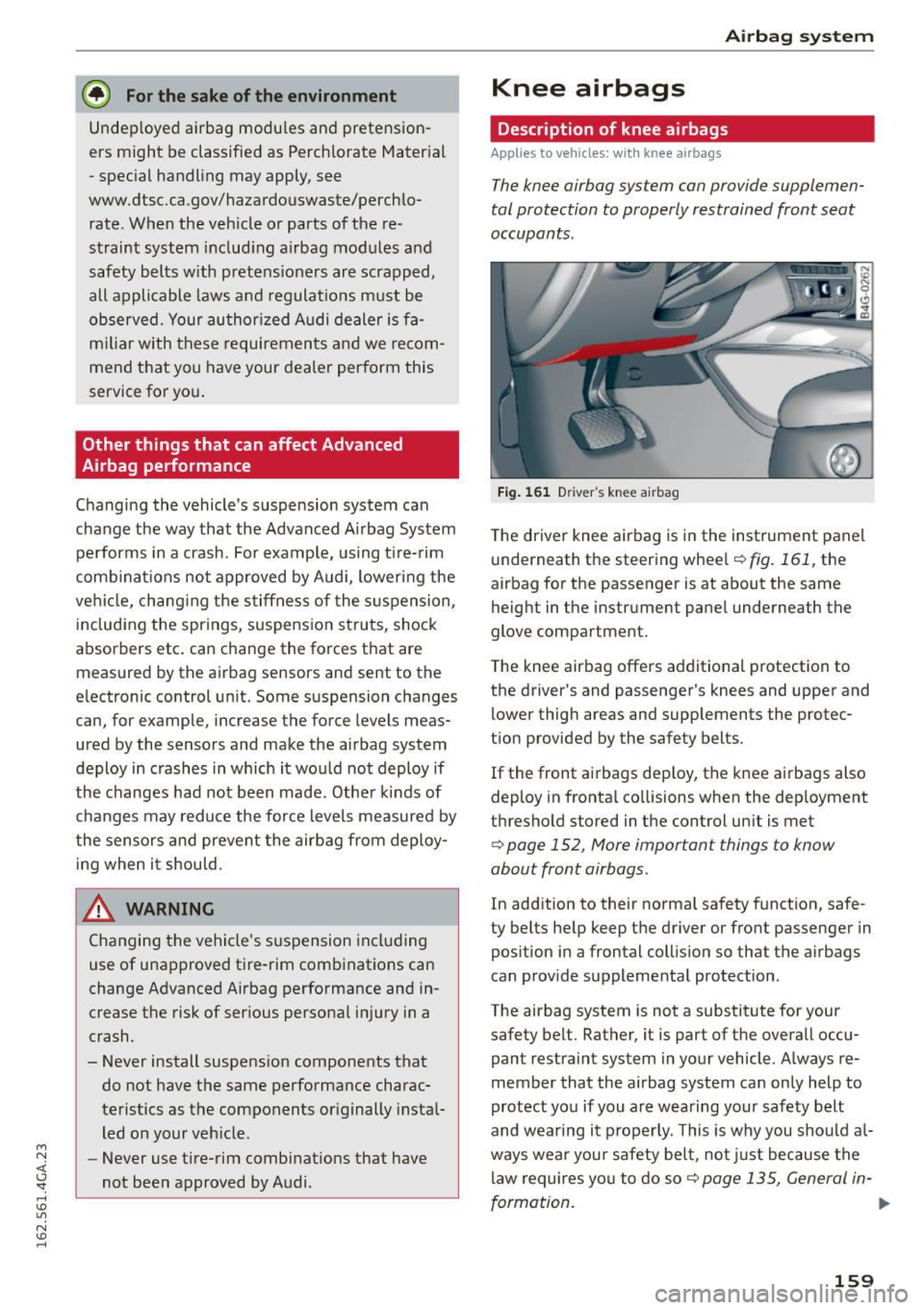
underneath the steering wheel
¢fig.161, the
airbag for the passenger is at about the same
height in the instrument panel underneath the
glove compartment.
The knee airbag offers additional protection to
the driver's and passenger's knees and upper and
lower thigh areas and supplements the protec
tion provided by the safety belts.
If the front airbags dep loy, the knee airbags also
deploy in frontal collisions when the dep loyment
threshold stored in the control unit is met
¢ page 152 , More important things to know
about front airbags .
In addition to their normal safety function, safe
ty belts help keep the driver or front passenger in
position in a frontal collision so that the airbags
can provide supplemental protection .
The airbag system is not a substitute for your
safety belt . Rather, it is part of the overall occu
pant restraint system in your vehicle. Always re
member that the airbag system can only help to
protect you if you are wearing your safety belt
and wearing it properly. This is why you should a l
ways wear your safety belt, not just because the
law requires you to do so¢
page 135, General in-
formation .
IJI>
159
Page 162 of 294
Airbag system
Remember too, airbags will deploy only once and
only in certain kinds of accidents -your safety
be lts are always there to offer protection in those
accidents in which airbags are not supposed to
deploy or when they have already deployed, for
examp le when your vehicle strikes or is struck by
another after the first collision .
This is just one of the reasons why an airbag is
not a substitute for the safety belt. The airbag
system works most effectively when used with
the safety belts. Therefore, always wear your
safety belts correctly .
It is important to remember that while the sup
plemental knee airbag system is des igned to re
duce the likelihood of serious injuries, other inju
ries, for example, swelling, bruising and minor
abrasions and friction burns can also occur when
an airbag inflates.
The knee airbag system basically consists of:
-The electronic control modu le
- Two inflatable airbags (airbag and gas genera-
tor), one for the driver and one for the front
passenger
- The airbag indicator light in the instrument
panel
The knee airbag system will not deploy:
-when the ignition is switched off
- in frontal collisions when the deceleration
measured by the control unit is too low
- in s ide collisions
- in rear-end collisions
- in rollovers
- in the event of a system malfunct ion (warning/
indicator light is on) ¢
page 18.
.&, WARNING
-Safety belts and the airbag system can only
provide protection when occupants are in
the proper seating position
¢page 152.
-If the airbag indica tor lig ht ¢page 18
comes when the vehicle is being used, have
the system inspected immediate ly by your
authorized Audi dealer. It is possible that
the airbag will inf late when it is not sup
posed to, or w ill not inflate when it should.
160
How knee airbags work
App lies to vehicles: wi th kne e airbags
The risk of injury to the leg area can be reduced
by fully inflated knee airbags .
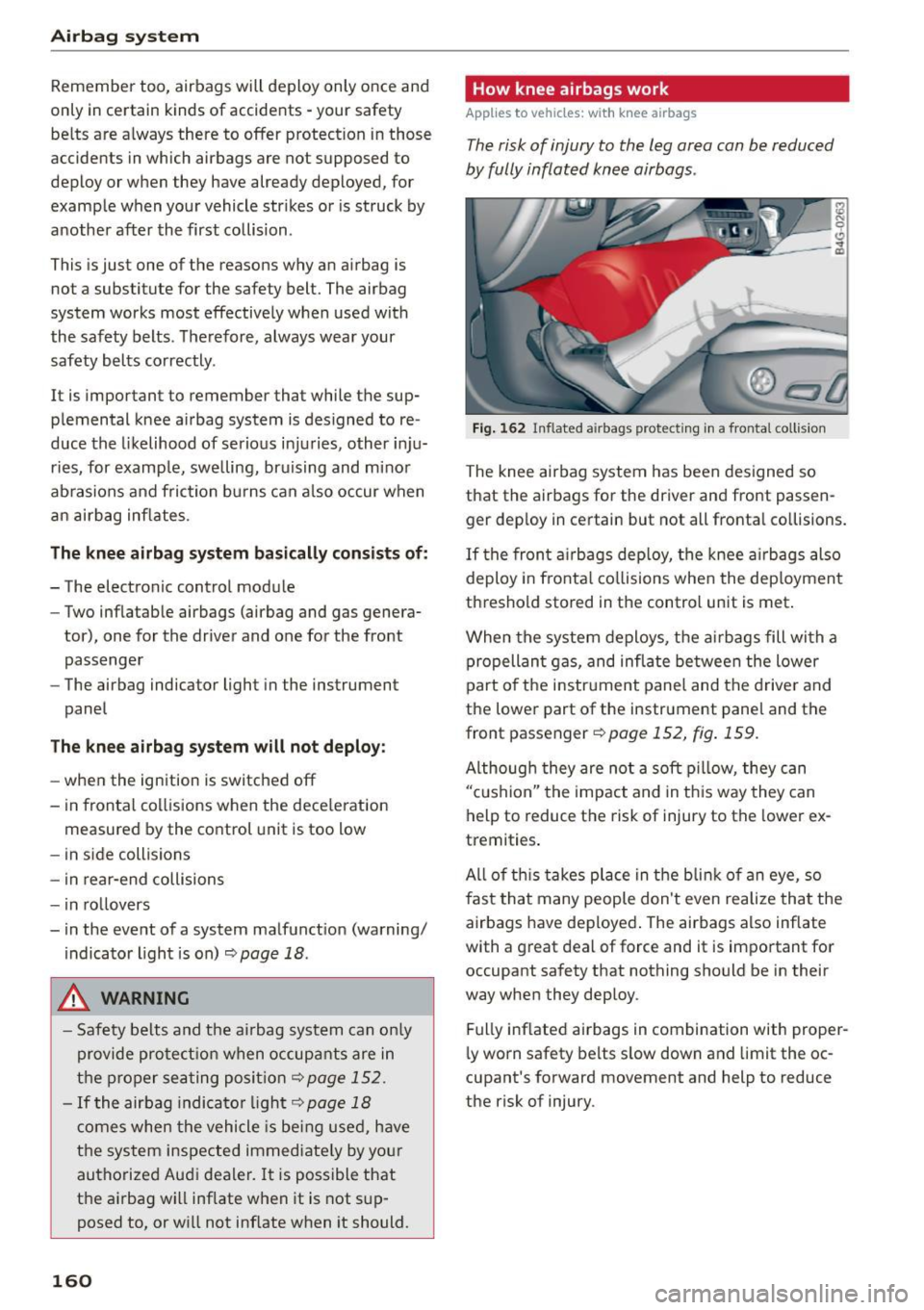
Fig. 162 Inflated airbags protect ing in a frontal collis ion
The knee airbag system has been designed so
that the airbags for the driver and front passen
ger dep loy in certain but not all fronta l co llisions .
If the front airbags deploy, the knee airbags also
deploy in frontal collisions when the deployment
threshold stored in the control unit is met.
When the system deploys, the airbags fill with a
propellant gas, and inflate between the lower
part of the instrument panel and the driver and
the lowe r part of the instrument panel and the
front passenger ¢
page 152, fig. 159.
Although they are not a soft pillow, they can
"c ushion" the impact and in this way they can
help to reduce the risk of injury to the lower ex
tremities .
A ll of this takes place in the blink of an eye, so
fast that many people don't even realize that the
airbags have deployed . The airbags also inflate
with a great deal of force and it is important for
occupant safety that nothing should be in their
way when they dep loy .
F ull y inflated airbags in combination with proper
l y worn safety belts s low down and limit the oc
cupant's forward movement and help to reduce
the risk of injury .
Page 167 of 294
M N <( I.J "". rl I.O
"' N I.O rl
below the refe rence value p rogrammed into the
control unit, the side curtain airbag will not be
tr iggered, even though the car may be badly
damaged as a result of the co llision. It is not pos
sible to define an airbag triggering range that
will cover every poss ible angle of impact, since
the circumstances will vary considerably between one co llision and another. Important factors in
clude, for example, the nature (hard or soft) of
the impacting object, the angle of impact, vehicle speed, etc.¢
page 165, How side curtain air
bags work.
Aside from the ir normal safety function , safety
be lts work to help keep the dr iver or front pas
senger in posit ion in the event of a co llision so
that the side curtain a irbags can provide protec
tion.
The airbag system is not a s ubst itute for yo ur
safety belt. Rather, it is part of the overall occu
pant restraint system in your vehicle . Always re
member that the airbag system can only help to
protect you if you are wear ing your safety be lt
and wearing it properly. Th is is another reason
why you should always wear your sa fety bel ts,
not just because the law requires you to do so
¢ page 135, General information.
It is important to remember that while the side
curta in airbag system is designed to help reduce
the likelihood of serious injuries, other injur ies,
for example , swelling , b ruising, fr iction burns
and minor abras ions can also be associated with
these airbags upon deployment . Remember too,
these airbags will deploy only once and only in
certain k inds of accidents -your safety belts are
always there to offer protectio n.
The side curtain airbag system basically
consis ts of :
- The elec tronic contro l mod ule and externa l side
impact sensors
- The side c urtain a irbags above the front and
rear side windows with ejection mitigation fea
tures
- T he airbag indicator light in the instrument
panel
The airbag system is monitored elect ron ically to
make certa in it is function ing properly a t all
Ai rb ag sy stem
times . Each time you switch on the ign ition, the
airbag system indicator light will come on for a
few seconds (self diagnostics).
Th e s ide curtain airbag is not activated:
- if the ignition is sw itched off,
- in side co llisions when the accele ration meas-
ured by the sensor is too low,
- in rear-end col lisions .
A WARNING
-Safety belts and the airbag system will only
p rovide p rotection when oc cupan ts are in
the proper seating position ¢
page 52, Gen
eral information.
- If the airbag ind ic a tor light~ page 18
comes when the veh icle is being used, have
the system inspected immediately by your
authorized Audi dealer . It is possib le that
the airbag will inflate when it is not sup
posed to, or will not inflate when it should.
How side curtain airbags work
Side curtain airbags con work together with side
airbags to help reduce the risk of head and upper
torso injuries for occupants who ore properly re
strained .
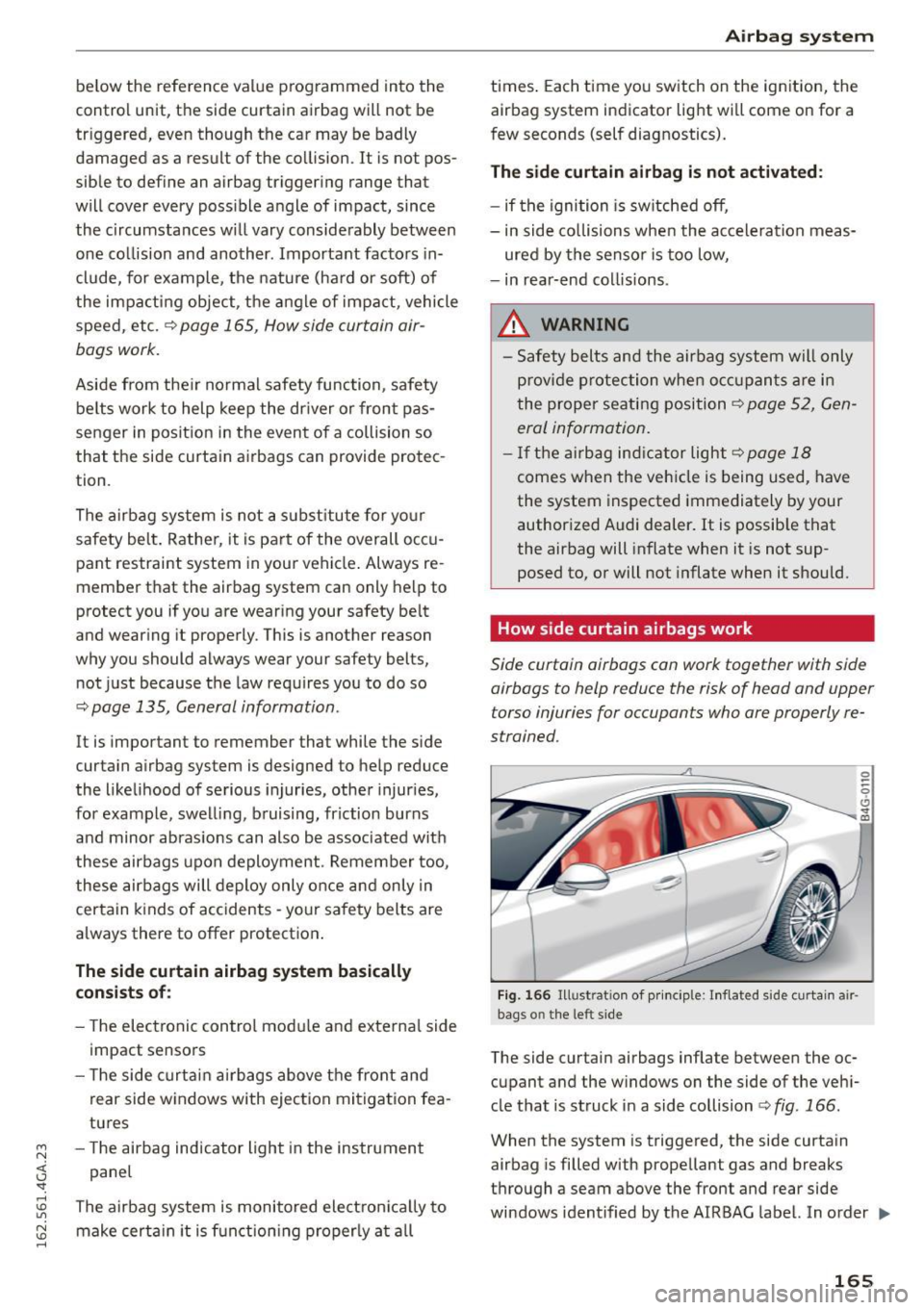
Fig. 166 Illust rat ion of pr incip le : I n flated si de curtai n air
bags o n th e le ft side
The side curtain airbags inflate betwee n the oc
cupant and the w indows on the side of the veh i-
cle that is struck in a side collision ¢
fig. 166 .
When the system is triggered, the side curtain
airbag is filled wi th propellant gas and breaks
t h rough a seam above the front and rear side
windows identified by the A IRBAG label. In order
ll>-
165
Page 171 of 294
M N <( (.J
'SI: ,...., \!) 1.1'1
N \!) ,....,
Advanced front airbag system and children
Your vehicle is equipped wit h a front "Advanced
A irbag System" i n compliance w it h United States
F ederal Motor Vehicle Safe ty Standard ( FMVSS)
208 as applicable at the time your vehicle was
manufactured .
The Advanced Airbag system in your ve hicl e has
been certified to mee t the " low -risk" requ ire
ments for 3 -and 6-year o ld children on the pas
senger side and small adults on the driver side.
T he low risk deployment criteria are intended to
reduce the r isk of injury through interaction with
the airbag that can occur, for example, by being
too close to the steering whee l and instrument
panel when the a irbag inflates . In add it io n, the
system has been cert ified to comply with the
"suppression" requiremen ts of the Safety Stand
ar d, to turn off t he front airbag for infa nts up to
12 months who are restra ined on the front pas
senger seat in child restraints that are listed i n
the Standard.
E ven though yo ur vehicle is equ ip ped with an Ad
vanced A irbag sys tem, all children, especia lly
those 12 years and younger, should always ride in
the back seat properly restrained for their age
and size. The airbag on the passenger side makes
the front seat a potent ially dangerous p lace for
a
chi ld to r ide. The fro nt seat is not the safes t place
for a child in a forward-facing child safety seat . It
can be a very dangerous place for a n infant or a
l arger child in a rea rward-facing seat .
T he vehicle's Advanced Airbag System has a ca
pacitive passenger detect ion system in the front
passenger seat cush ion that ca n detec t the p res
e n ce of a baby o r a child in a c hild restra int sys
tem on this seat.
The capacit ive passenger detection system regis
ters the changes that result in an electrical field
when a ch ild, a child rest raint, and a baby b la nk et
a re on the fron t passenger sea t. T he change in
the meas ured c apac it a nce due to the presence of
a child,
a chi ld restraint, and a baby blanket on
the front passenger seat is re lated to the child re
straint system resting on the seat . The measu red
capacitance of a chi ld restraint system va ries de-
Child sa fety
pending on the type of sys tem and specific make
and mode l.
T he elec trical c apacit a nce of the va rious types,
makes, and mo dels o f child restra ints specifie d
by the U.S.National Highway Traff ic Sa fety Ad
ministration (NH TSA) in the relevant safety
standard are stored in the Advanced Airbag Sys
tem control unit together w it h the capacitances
typ ica l of infants and a 1-year old child. When a
c h ild restra int is used on the front passenger seat
with
a typ ica l 1 year-old in fant, the Advanced Air
bag System compa res the capacitance measu red
by the capacitive passenge r dete ction system
wi th t he dat a stored in the elec tronic con trol
u ni t.
Child restraints and Advanced front airbag
system
Regardless of the c hild restra int that you use,
make sure that it has been cert ified to meet Unit
ed States Federa l Moto r Veh icle Safety Standa rds
and has been ce rtified by its manufacture r fo r
u se with an a irbag. Always b e sur e t hat t he c hild
r est rain t is prope rly insta lled a t one of the rear
sea ting pos itions. If in excep tional circ ums tan ces
yo u m ust use it on the front passenge r seat, care
fully read a ll of the information on chi ld safety
and Advanced Airbags and heed all of the appli
cable WARNINGS. Make certain that the child
and child restra int are correctly recogni zed by the
capacit ive passenger detection system i n the
front passenger seat, that the front passe nger
airbag is turned off, and that the a irbag status is
always cor rect ly signa led by the
PASSENGER AIR
BAG OFF
light .
Many types and models of child rest raints have
been available ove r the years, new mode ls a re in
t rod uced regu larly in co rporating new and im
proved de signs and older mode ls are take n ou t of
produ ct io n. Ch ild restra ints are not s tandar dized.
Child rest rain ts of the same type typ ically have
different weights and sizes and different "foot
prints", the size and shape of t he bottom of the
c hi ld restra int that sits on the seat, when they
are installed on
a vehicle seat. These d ifferences
make it virtua lly impossib le to cert ify compliance
with the requirements for advanced airbags with .,.
169
Page 220 of 294
Checking and Fill in g
Checking and Filling
Hood
Releasing the engine hood
The engine hood is released from inside the vehi
cle.
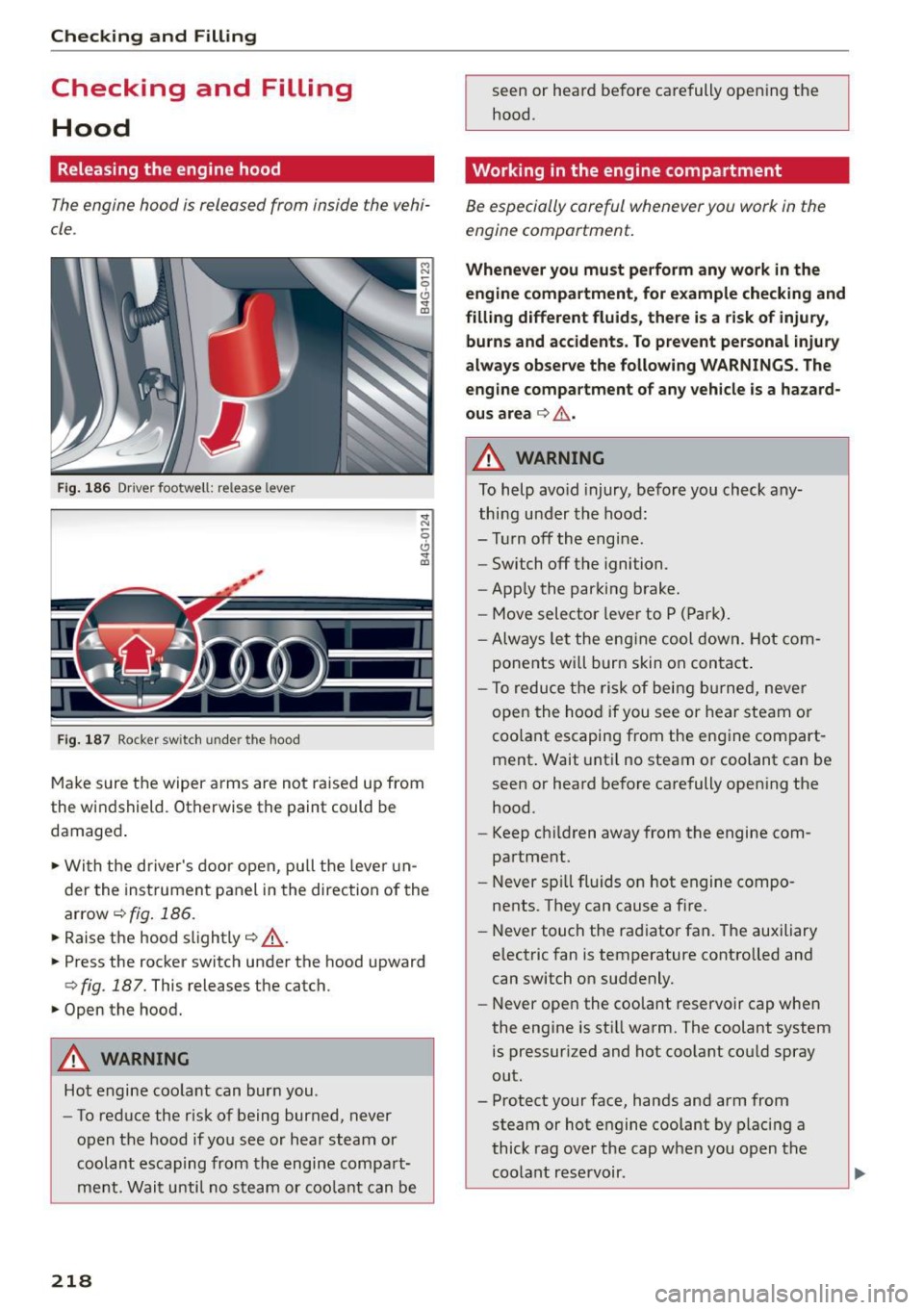
Fig. 1 86 Driver footwell: release lever
Fig. 187 Rocker sw itch under the hood
Make s ure the wiper arms are not ra ised up from
the windshield . Otherwise the paint could be
damaged .
.. Wi th the driver's door open, pu ll the lever un
der the instrument panel in the direction of the arrow
c::> fig. 186.
.. Raise the hood s lightly c::> _A .
.. Press the rocker switch under the hood upward
Q fig. 187. This releases the catch.
.. Open the hood.
A WARNING
Hot engine coo lant can burn you.
- To reduce the risk of being burned, never
open the hood if yo u see or hear steam or
coolant escap ing from the engine compa rt
me nt. Wait until no steam or coo lant can be
218
seen or heard before carefully open ing the
hood.
Working in the engine compartment
Be especially careful whenever you work in the
engine compartment.
Whenever you mu st perform any w ork in the
engine comp artment , for example checking and
filling d iff erent fluid s, the re i s a risk of injury ,
burns and accidents. To p revent pe rsonal injur y
alwa ys ob serv e the follow ing WARNING S. The
engi ne compartment o f an y vehicle is a h azard
ous are a
i::>_6 .
A WARNING
To help avo id injury, before you check any
thing under the hood:
- Turn off the engine.
- Switch off the ignition.
- App ly the parking brake.
- Move selector leve r to P (Park).
- Always le t the eng ine cool down. Hot com-
ponents wi ll burn skin on contact .
-
-To reduce the risk of bei ng bur ned, never
open the hood if you see or hear steam o r
coo lant escaping from the engine compart
ment . Wait unt il no steam o r coolant can be
seen or heard before carefully open ing the
hood.
- Keep c hildren away from the engine com
partment .
- Never sp ill fluids on hot engine compo
nents. They can cause a fire.
- Never touch the radiator fan. The auxiliary
electric fan is temperature cont ro lled and
can switch on suddenly.
- Never open the coolant reservoir cap when
the engine is sti ll warm. The coolant system
is pressur ized and hot coo lant co uld spray
out.
- Protect your face, hands and arm from
steam or hot engine coolant by placing a
thick rag ove r the cap w hen you open the
coo lant reservoir.