seat adjustment AUDI A7 2016 User Guide
[x] Cancel search | Manufacturer: AUDI, Model Year: 2016, Model line: A7, Model: AUDI A7 2016Pages: 294, PDF Size: 73.82 MB
Page 142 of 294
Safety belts
Pregnant women must also be correctly
restrained
The best way to protect the fetus is to make sure
that expectant mothers always wear safety belts
correctly -throughout the pregnancy.
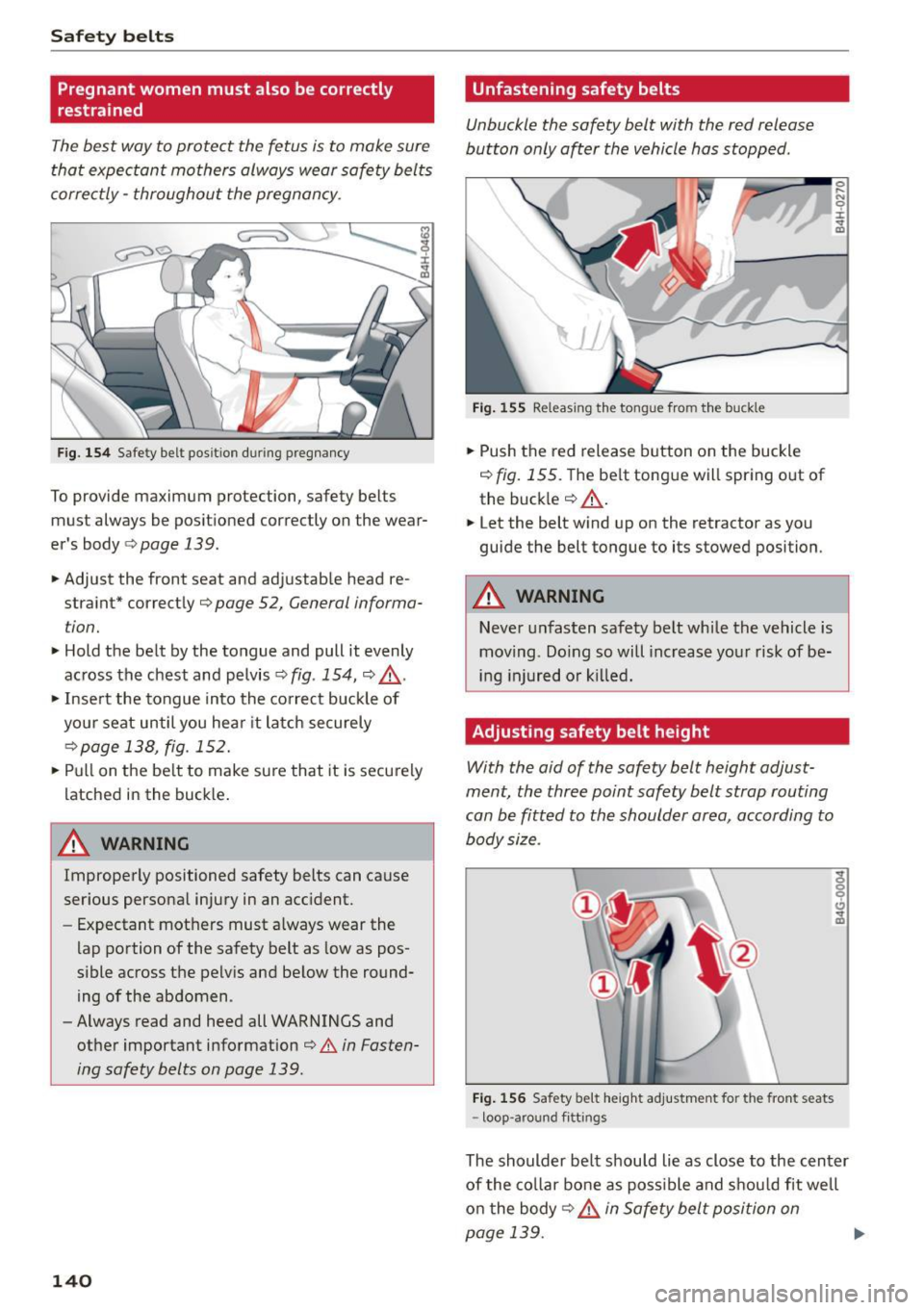
Fig. 154 Safety belt posit ion during pregnancy
To provide maximum protection, safety belts
must always be pos itioned correctly on the wear
er's body ¢
page 139 .
... Adjust the front seat and adjustab le head re
stra int* correctly ¢
page 52, General informa
tion .
... Hold the belt by the tongue and pull it evenly
across the chest and pelvis¢
fig. 154, ¢ ,.&. .
... Inse rt the tongue into the correct buckle of
your seat until you hear it latch securely
¢page 138, fig . 152.
... Pull on the belt to make sure that it is securely
latched in the buckle.
A WARNING
Improperly positioned safety belts can cause
serious personal injury in an accident.
- Expectant mothers must always wear the
lap portion of the safety belt as low as pos
sible across the pelvis and below the round
ing of the abdomen .
- Always read and heed all WARNINGS and
other important information
¢ A in Fasten
ing safety belts on page 139 .
140
Unfastening safety belts
Unbuckle the safety belt with the red release
button only after the vehicle has stopped.
.,,
Fig. 155 Re leasing th e tongue from th e buckle
... Push the red release button on the buckle
¢ fig. 155. The belt tongue will spring out of
the buckle
¢ A.
... Let the belt wind up on the retractor as you
guide the belt tongue to its stowed position .
A WARNING
Never unfasten safety belt while the vehicle is
moving . Doing so will increase your risk of be
ing injured or killed .
Adjusting safety belt height
With the aid of the safety belt height adjust
ment, the three point safety belt strap routing
can be fitted to the shoulder area, according to
body size.
Fig. 156 Safety belt heigh t adjustment for the front seats
- loop -around fittings
0 ,-. N 0 :i: .. m
The shoulder belt should lie as close to the center
of the collar bone as possible and should fit well
on the body
¢ ,.&. in Safety belt position on
page 139.
~
Page 143 of 294
M N <( (.J
'SI: ,...., \!) ..,.,
N \!) ,....,
~ Push the loop-aro und fittings up ¢ fig. 156 @,
or
~ squeeze together the (D button, and push the
loop-around fittings
do wn@ .
~ Pull the belt to make sure that the upper at
tachment is properly engaged.
A WARNING
Always read and heed all WARNINGS and oth
er important information
¢ page 137.
With the front seats, the height adjustment
of the seat can also be used to adjust the po
sition of the safety belts.
Improperly worn safety belts
Incorrectly positioned safety belts can cause se
vere injuries .
Wearing safety be lts improperly can cause seri
ous injury or death. Safety belts can on ly work
when they are correct ly posit ioned on the body .
Imp roper seat ing posit ions reduce the effective
n ess of safety belts and will even inc rease the risk
of inju ry and death by moving the sa fety be lt to
cr it ica l areas of the body. Improper seat ing posi
tions also increase the risk of ser ious injury and
deat h when an airbag deploys and stri kes an oc
cupant who is not in t he cor rect seating posit ion .
A driver is responsible for the safety of all veh icle
occupants and espec ially for children. Therefore :
~ Never permit anyone to ass ume an inco rrect sit-
t ing position in the vehicle while trave ling
¢ ,& .
A WARNING
Imprope rly worn safety belts increase the risk
of serious personal injury and death whe never
a vehicle is be ing used.
- Always make sure that al l vehicle occupants
are co rrectly restrained and stay in a cor rect
sea ting pos it ion whenever the veh icle is be
ing used.
- Always read and heed all WARNI NGS and
ot her important i nfo rmat ion
¢page 137 .
Safety bel ts
Belt tensioners
How safety belt pretensioners work
In front, side and rear-end collisions above a
particular severity and in a rollover, safety belts
are tensioned automatically.
Reversible safety belt tensioners
The safety belts on the front seats are eq uipped
with power reversib le tensioners. The fo llow ing
funct ions are availab le when the driver's/front
passenge r's safety belts are fastened:
- Automatic tens ioners : at the start of a drive,
the safety belts automat ica lly adjust to the
passenger after a certain time per iod or vehicle
speed. To sw itch the automat ic tensioners off,
s e lect the following in the MMI:
!CA RI fu nction
button
> (Car )* systems > Vehicle s etting s >
Seats > Driver's seat or Pass enger' s seat > Au
tomatic belt ten sioner
> Off .
- In ce rtai n dr iv ing s ituations, the safety belts
may tighten w ith a revers ible tens ion ing f unc
t ion
¢ page 185.
-The s afety be lt s may also t igh ten wi th th is re-
versible tens ion ing funct ion in m inor collisions.
Pyrotechnic safety belt pretensioners
The safety belts are equ ipped with safe ty belt
pretensioners . The system is act ivated by se nsors
i n front, side and rea r-e nd coll is ions of great se
ver ity and in a ro llover. This tig htens the belt and
ta kes up belt slack¢ .&.
in Service and disposal of
safety belt pre tensioner on page 14 2.
Taking up
t h e slack he lps to reduce forward occupa nt
movement during a collision.
A WARNING
- It is poss ible for the pretens ioners to deploy
incorrectly.
- The pyrotechnic system can only provide protection for one coll is ion. If the pyrotech
n ic pretensioners deploy, the pretens ion ing
sys tem must be replaced .
(1) Tips
The pyrotechnic safety be lt pretensioners can
o nl y dep loy once . .,.
141
Page 145 of 294
M N <( (.J
'SI: ,...., \!) 1.1'1
N \!) ,....,
Airbag system Important information
Importance of wearing safety belts and
sitting properly
Airbags are only supplemental restraints. For
airbags to do their job, occupants must always
properly wear their safety belts and be in a prop er seating position.
For your safety and the safety of your passen
gers, before driving off, always:
.,. Adjust the driver's seat and steering wheel
properly
r:> page 12 7,
.,. Adjust the front passenger's seat properly
9 page 53,
.,. Wear safety belts properly r::> page 137 ,
.. Always properly use the proper child restraint
to protect children
r:> page 167.
In a collision, airbags must inflate within the
blink of an eye and with considerable force. The
supplemental airbags can cause injuries if the
driver or the front seat passeng er is not seated
properly . Therefo re in order to help the ai rbag to
do its job, it is important, both as a driver and as
a passenger to si t properly at all times.
By keeping room between your body and the
steering wheel and the front of the passenger
compartment, the airbag can inflate fully and
completely and provide supplemental protection in certain frontal collisions
r:> page 12 7, Correct
passenger seating positions .
For details on the
operation of the seat adjustment controls
r::> page 53.
It's especially important that children are proper
ly restrained
r:> page 167.
There is a lot that the driver and the passengers
can and must do to help the individual safety fea
tures installed in your Audi work together as a
system.
Proper seating position is important so that the
front airbag on the driver side can do its job . If
you have a physical impairment or condition that
prevents you from sitting properly on the driver
seat with the safety belt properly fastened and
Airbag system
reaching the pedals, or if you have concerns with
regard to the function or operation of the Ad
vanced Airbag System, please contact your au
thori zed Audi dealer or qualified workshop, or
call Audi Customer Relations at 1-800-822-2834
for possible modifications to your vehicle.
When the airbag system deploys, a gas generator
will fill the airbags, break open the padded cov ers, and inflate between the steering wheel and
the driver and between the instrument panel and
the front passenger . The airbags will deflate im
mediately after deployment so that the front oc
cupants can see through the windshield again
without interruption.
All of this takes place in the blink of an eye , so
fast that many people don't even realize that the airbags have deployed. The airbags also inflate
with a great deal of force and nothing should be
in their way when they deploy. Front airbags in
combination with properly worn safety belts slow
down and limit the occupant's forward move
ment . Together they help to prevent the driver
and front seat passenger from hitting parts of
the inside of the vehicle while reducing the forces
acting on the occupant during the crash . In this
way they help to reduce the risk of injury to the
head and upper body in the crash . Airbags do not
protect the arms or the lower parts of the body.
Both front airbags will not inflate in all frontal
collisions. The triggering of the airbag system de
pends on the vehicle deceleration rate caused by
the collision and registered by the electronic con
trol unit. If this rate is below the reference value
programmed into the control unit, the airbags
will not be triggered , even though the car may be
badly damaged as a result of the collision. Vehi
cle damage, repair costs or even the lack of vehi
cle damage is not necessarily an indication of
whe ther an airbag should infla te or not.
Since the circumstances will vary considerably between one collision and another, it is not possi
ble to define a range of vehicle speeds that will
cover every possible kind and angle of impact
that will always trigger the airbags . Important
factors include, for example, the nature (hard or
soft) of the object which the car hits, the angle of
impact, vehicle speed , etc. The front airbags will ..,.
143
Page 148 of 294

Airbag syste m
take place at lower decelerations as defined in
the electronic contro l unit ¢
page 155, PASSEN
GER AIR BAG OFF light.
Always remember, a chi ld seat or infant carrier
installed on the front seat may be struck and
knocked out of position by the rapid ly inflating
passenger's airbag in a frontal collision. The air
bag could greatly reduce the effect iveness of the
child restraint and even seriously injure the child
during inflation .
For this reason, and because the back seat is the
safest place for ch ildren -when properly restrain
ed according to their age and s ize -we strongly
recommend that ch ildren always sit in the back
seat ¢
page 167, Child safety .
A WARNING
A child in a rearward-facing child seat instal
led on the front passenger seat will be seri
ously inju red and can be killed if the front air
bag inf lates -even with an Advanced Airbag
System.
- The inflating a irbag w il l hit the child seat or
infant carrier w ith great force and w ill
smash the chi ld seat and child against the
backrest, center armrest, door or roof .
- Always insta ll rear -facing child seats on the
rear seat .
- If you must install a rearward facing child
seat on the front passenger seat beca use of
exceptional circ umstances and the
PASSEN
GER AIR BAG OFF
light does not come on
and stay on, immediately install the rear
facing child seat in a rear seating position
and have the a irbag system inspected by
you r Audi dealer.
- Forward-facing ch ild seats installed on the
front passenger's seat may interfere w ith
the deployment of the airbag and cause se rious persona l injury to the ch ild.
A WARNING
If, in exceptional c ircums tances, you mus t in
stall a forward-facing chi ld restraint on the
front passenger 's seat:
- Always make sure the forward-fac ing seat
has been designed and ce rtified by i ts man-
146
-
ufacturer for use on a front seat with a pas
senger front and s ide a irbag.
- Never put the forward-facing child restraint
up against or very near the instrument pan
el.
- Always move the passenger seat into its
rearmost position in the seat's fore and aft
adjustment range, as far away from the a ir
bag as poss ible before installing the for
ward-facing child rest raint. The backrest
must be adjusted to an upr ight position.
- Make sure that the
PASSENGER AIR BAG
OFF
li ght comes on and stays on all the time
wheneve r the ignit ion is switched on.
A WARNING
To reduce the risk of ser ious injury, ma ke su re
that the
PA SSENGER AIR BAG OFF light will
be d isp layed wheneve r a ch ild restr aint is in
stalled on the front passenger seat and the
ignition is switched on.
- If the
PASSENGER AIR BAG OFF light does
not stay on, perform the checks described
c::> page 154, Monitoring the Advanced Air ·
bag System.
-Ta ke the child restraint off the front passen
ger seat and install it properly at one of the
rear seat positions if the
PA SSENGER AIR
BAG OFF
light does not stay on.
- Have the airbag system inspected by your
Aud i dea ler immediately.
- Always carefu lly follow instr uctions from
child restraint manufacturers when instal
ling child restraints.
A WARNING
If, in exceptiona l circumstances, you must in
stall a forward or rearward-facing ch ild re
straint on the front passenger's seat:
- Improper installation of ch ild restraints can
reduce their effectiveness or even prevent
them from providing any protect ion.
- An improperly installed ch ild restra int can
interfere w ith the airbag as it deploys and
seriously injure or even kill the child -even
w ith an Advanced A irbag System. ..,.
Page 152 of 294
Airbag syste m
A WARNING
A child in a rearward-facing child seat instal
led on the front passenger seat wi ll be seri
ously injured and can be killed if the front air
bag inflates -even with an Advanced Airbag
System.
- Although the Advanced Airbag System in
your vehicle is designed to turn off the front
airbag when a rearward-facing child re
straint has been installed on the front pas
senger seat, nobody can absolutely guaran
tee that deployment is impossible in all con
ceivable s ituations that may happen dur ing
the usef ul life o f you r vehicle.
- The inf lating a irbag w ill hit the child seat or
infa nt carrier w ith great force and w il l
smash the ch ild seat and child agains t the
backrest, center armrest, door, or roo f.
- Always insta ll rearward -facing child re
straints on the rear sea t.
-If you mus t install a rearward facing chi ld
seat on the fron t passenger sea t beca use of
exceptional circ umstances and the
PASSEN
GER AIR BAG OFF light does not come on
and stay on, immediately install the rear
facing child seat in a rear seating position
and have the a irbag system inspected by
your Audi dealer.
A WARNING
If, in exceptional c ircumstances, you must in
stall a forward-facing chi ld restraint on the
front passenger 's seat:
-Always make sure the forward-fac ing seat
has been designed and ce rtified by its man
ufact urer for use on a front seat wit h a pas
senger front and side airbag.
- Never put the forwa rd-facing child rest raint
up against or ve ry nea r the instrument pan
el.
- Always move the passenger seat into its
rearmost position in the se at's fore and aft
adjustment range, as far away from the air
bag as possib le, before installing the fo r
war d-fac ing c hild restraint . The backrest
must be adjuste d to an up right position .
150
-
-Always ma ke sure that there is nothing on
the front passenger seat that w ill cause the
capacitive passenger detection system in
the seat to signal to the Airbag System that
the seat is occup ied by a person when i t is
not, or to s ignal that it is occupied by some
one who is heavier than the person a ctua lly
si tti ng on the se at. T he presence of addi
tional objects could cause the p assenger
front airbag to be turned on when it s hou ld
be off, or co uld cause the a irbag to wo rk in a
way that is different from the way it would
have worked without the object on the seat.
- Make sure that the
PASSENGER AIR BAG
OF F light comes on and stays on all the time
whenever the ignit ion is switched on.
Advanced Airbag System components
The front passenger seat in your vehicle has a lot
of very impo rtant parts of the Advanced A irbag
System i n it. T hese pa rts include the capacitive
passenger detection system, wir ing, b ra ckets,
and more. The control u nit mon itors the system
o n the fron t passenger seat when the ign it ion is
swi tched on and turns the airbag indica tor ligh t
o n when a malfunction in the one of the system
components is detected~
page 155. Because
the front passenger seat contains important
parts of the Adv a need A irbag System, you must
take care to prevent it from being damaged .
Damage to the seat may prevent the Advanced
A irbag System for the front passenger seat from
do ing its job in a crash.
The front Advanced Airbag Sy stem consists
of the following:
- Cras h sensors in the front of the vehicle that
measu re vehicle acceleration/deceleration to
provide i nfo rmat ion to the Advanced Airbag
System abo ut the sever ity of the cr ash.
- An ele ct ro nic contro l unit, with integrated
crash sensor s for front and s ide impac ts. The
cont ro l uni t "dec ides" whether to fire the fron t
airbags based on the information received from
the crash se nsors . The control unit a lso "de
cides" whether the sa fety belt pretensioners
should be activated. ..,_
Page 170 of 294
Child safet y
exceptional circ umstances and the
PA SSENGE R AIR BAG OFF light does not
come on and stay on, immediately install
the rear-fac ing ch ild safety seat in a rear
seat ing pos ition and have the airbag system
inspected immediately by your Aud i dealer .
A WARNING
-Forward-facing ch ild seats insta lled on the
front passenger seat may interfere with the deployment of the a irbag and cause serious
persona l injury to the ch ild .
-If exceptiona l circumstances require the use
of a forwa rd-facing child rest raint on the
front passenger's seat, the child 's safety
and we ll-being requ ire the following specia l
precautions to be taken :
- Always make sure that the forward -facing
seat has been designed and certified by its manufacturer for use on a front passenger
seat with a front and side airbag.
- Always carefu lly follow the manufacturer's
instructions provided w ith the child seat
or infant car rier.
- Never install a chi ld restraint without a
properly attached top tether strap if the
child restraint manufacturer's instructions req uire the top tether strap to be used .
- Never put the fo rward-facing child re
straint up against or very near the instru
ment panel.
- Always set the safety belt upper anchor
age to the adjustment position that permits proper insta llation in accordance with
the child restraint manufacturer's instruc tions.
- Always move the passenger seat into its
rearmost position in the seat's fore and aft
adjustment range, as far away from the
airbag as possible before installing the
child restraint . The backrest must be ad
justed to an upr ight position .
- Always make sure that nothing prevents
the front passenger's seat from being moved to the rea rmost pos ition in its fore
and aft adjustment range.
168
- Never place objects on the seat (such as a
laptop, CD player, electronic games device,
power inverter or seat heater for child
seats) . These may influence the electrical
capac itance measured by the capac itive
passenger detection system and can also
fly around in an accident and cause se rious
personal injury .
- Never place or use any electrical device
(such as a laptop, CD player, e lectronic
games device, powe r inverter o r seat heat
er for child seats) on the front passenger
seat if the device is connected to the 12-
vo lt socket or the cigarette lighter socket .
- If a seat heater has been retrofitted or otherwise added to the front passenger seat, never install any child restra int sys
tem on this seat.
- Make sure that there are no wet objects
(such as a wet towel) and no water or oth
er liquids on the front passenger seat
cush ion.
- Always make sure that the
PAS SENGER
AIR BAG O FF
light comes on and stays on
all the time whenever the ignition is
switched on .
- If the
PAS SENGER AIR BAG OFF light
does not come on and stay on, immediate ly install the forward-fac ing child seat in a
rear seating position and have the airbag
system inspe cted by your authorized Audi
dealer.
- Always buc kle the ch ild seat firmly in
place even if a child is not s itting in it. A
l oose ch ild seat can fly around du ring a
sudden stop or in a collis ion .
- Always read and heed all WAR NINGS
whenever using a ch ild restraint in a vehi
cle ¢
page 135, Safety belts, ¢ page 143,
Airbag system
and ¢ page 167, Impor
tant information .
(D Tips
Always replace child restraints that were in
stalled in a vehicle during a crash . Damage to
a child restraint that is not visible could cause it to fail in another co llision situation.
Page 174 of 294
Child safety
-Make sure the forward-facing seat has
been designed and certified by its manu
facturer for use on a front seat with a pas
senger front and side airbag .
- Always carefully follow the manufacturer 's
instructions provided with the child sa fety
seat or carrier .
- Always move the front passenger seat into
the rearmost position of the passenger
seat's fore and aft adjustment range, and
as far away from the airbag as possible be
fore installing the child restraint.
- Always make sure that nothing prevents
the front passenger's seat from being moved to the rearmost position in its fore
and aft adjustment range.
- Always make sure that the backrest is in
the upright position .
- Never place or use any electrical device
(such as a laptop, CD player, electronic
games device, power inverter or seat heat
er for child seats) on the front passenger
seat if the device is connected to the 12-
volt socket or the cigarette lighter socket.
- If a seat heater has been retrofitted or
otherwise added to the front passenger
seat, never install any child restraint sys
tem on this seat .
- Make sure that there are no wet objects
(such as a wet towel) and no water or oth
er liquids on the front passenger seat
cushion .
- Never place objects on the seat (such as a laptop, CD player, electronic games device ,
power inverter or seat heater for child
seats) . These may influence the electrical
capacitance measured by the capacitive passenger detection system and can also
fly around in an accident and cause serious
personal injury.
- Always buckle the child safety seat firmly in
place even if a child is not sitting in it. A
loose child safety seat can fly around during
a sudden stop or in a collision.
- Always read and heed all WARNINGS when
ever using a child restrained in a vehicle is
being used
c::> poge 135, Safety belts,
172
c::> page 143, Airbag system and
c::> page 167, Child safety .
A WARNING
To reduce the risk of serious injury, make sure
that the
PASSENGER AIR BAG OFF light
comes on and stays on whenever a child re
straint is installed on the front passenger seat
and the ignition is switched on .
- Take the child restraint off the front passen
ger seat and install it properly at one of the
rear seat positions if the
PASSENGER AIR
BAG OFF
light does not stay on.
- Have the airbag system inspected by your
authorized Audi dealer immediately.
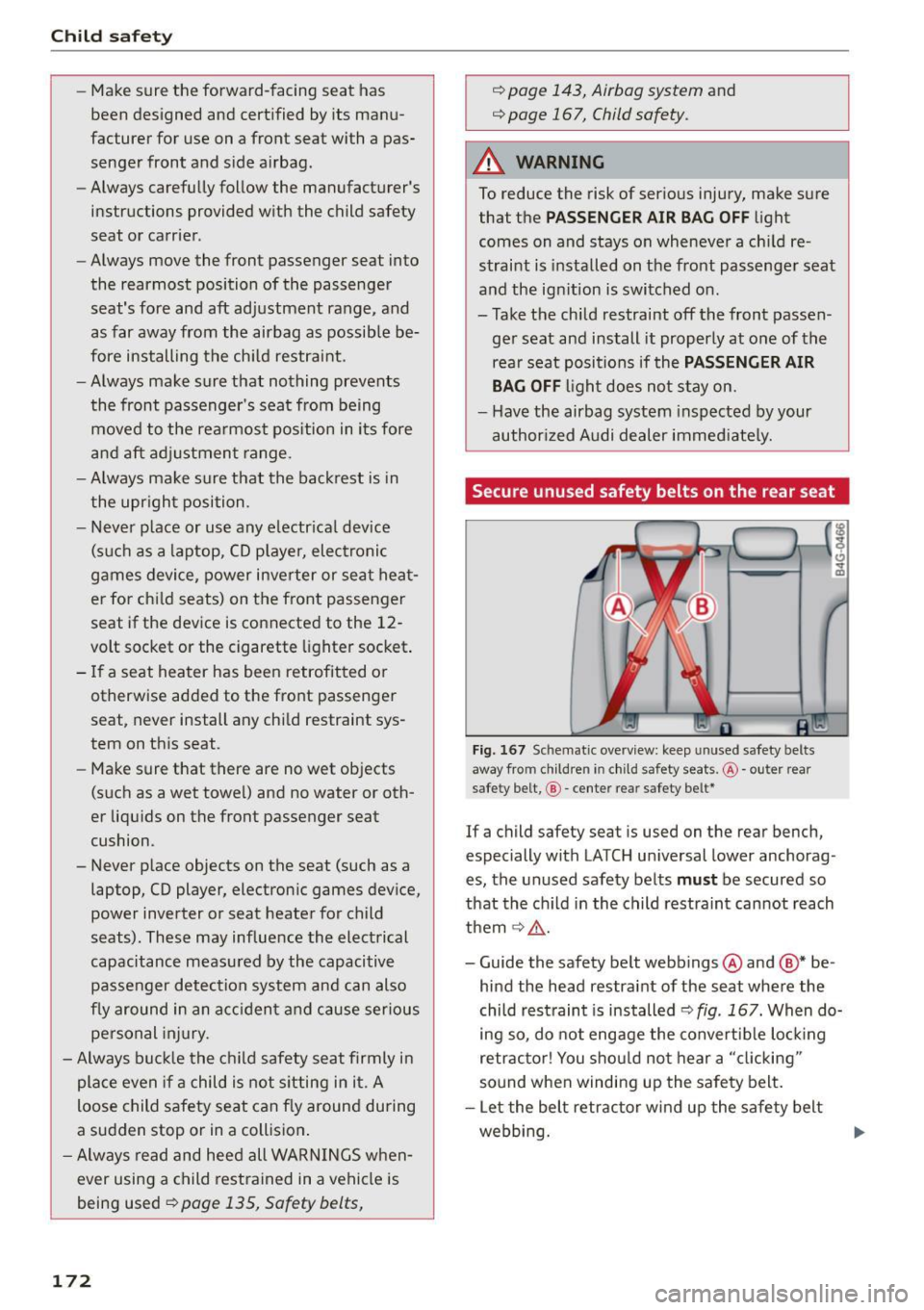
Secure unused safety belts on the rear seat
Fig. 167 Schem ati c o verview: keep unused safety belt s
away fro m childre n in child safety seats. @ -ou te r rear
s a fe ty belt, @ -center rea r sa fety belt*
If a child safety sea t is used on the rear bench,
especially with LATCH universal lower anchorag
es, the unused safety belts
must be secured so
that the child in the child restraint cannot reach
them
c::> _&. .
- Guide the safety belt webbings @and ®* be
hind the head restraint of the seat where the
child restraint is installed
c::> fig . 167. When do
ing so, do not engage the convertible locking
retractor! You should not hear a "clicking "
sound when winding up the safety belt.
- Let the belt retractor wind up the safety belt
webbing.
Page 177 of 294
M N <( (.J
'SI: ,...., \!) 1.1'1
N \!) ,....,
personal injury and death in a collision or oth
er emergency situation.
- Children on the front seat of any car, even
with Advanced Airbags, can be seriously in
jured or even killed when an airbag inflates.
A child in a rearward-facing child safety seat installed on the front passenger seat will be
seriously injured and can be killed if the
front airbag inflates -even with an Ad
vanced Airbag System.
- The inflating airbag will hit the child safety
seat or infant carrier with great force and
will smash the child safety seat and child against the backrest, center arm rest, door
or roof.
- Always install rear-facing child safety seats
on the rear seat.
- If you must install a rearward facing child
safety seat on the front passenger seat be
cause of exceptional circumstances and the
PASSENGER AIR BAG OFF light does not
come on and stay on, immediately install
the rear-facing child safety seat in a rear
seating position and have the airbag system
inspected by your Audi dealer .
- The rear side of the child safety seat should
be positioned as close as possible to the
backrest on the vehicle seat .
- For adjustable head restraints: adjust or re
move the rear seat head restraint if it is dif
ficult to install the child seat with the head
restraint in place
r=;.page 56. Install the
head restraint again immediately once the
child seat is removed. Driving without head
restraints or with head restraints that are
not properly adjusted increases the risk of
serious or fatal neck injury dramatically.
- Always read and heed all WARNINGS when
ever using a child restrained in a vehicle is
being used
r=;, page 135, Safety belts,
r=;, page 143, Airbag system and
9 page 167, Important information.
_&. WARNING
If exceptional circumstances require the use
of a forward-facing child restraint on the front
passenger's seat, the child's safety and well-
Child safety
being require that the following special pre
cautions be taken:
- Make sure the forward-facing seat has been
designed and certified by its manufacturer
for use on a front seat with a passenger
front and side airbag.
- Always follow the manufacturer's instruc
tions provided with the child safety seat or
infant carrier .
- Always move the front passenger seat into
the rearmost position of the passenger
seat's fore and aft adjustment range, and as
far away from the airbag as possible before installing the child restraint.
- Always make sure that nothing prevents the front passenger's seat from being moved to
the rearmost position in its fore and aft ad
justment range.
- Always make sure the backrest is in an up
right position.
- Never place or use any electrical device
(such as a laptop, CD player, electronic
games device, power inverter or seat heater
for child seats) on the front passenger seat
if the device is connected to the 12-volt
socket or the cigarette lighter socket.
- If a seat heater has been retrofitted or oth
erwise added to the front passenger seat, never install any child restraint system on
this seat.
- Make sure that there are no wet objects
(such as a wet towel) and no water or other
liquids on the front passenger seat cushion.
- Never place objects on the seat (such as a
laptop, CO player, electronic games device,
power inverter or seat heater for child
seats). These may influence the electrical
capacitance measured by the capacitive pas
senger detection system and can also fly
around in an accident and cause serious per
sonal injury.
- Make sure that the
PASSENGER AIR BAG
OFF
light comes on and stays on all the time
whenever the ignition is switched on.
- If the
PASSENGER AIR BAG OFF light does
not come on and stay on, immediately in
stall the forward-facing child seat at a seat-
ing position on the rear seat and have the
Ill-
175
Page 178 of 294
Child safety
airbag system inspected by your authorized
Audi dealer.
- Take the child restraint off the front passen
ger seat and install it properly at one of the
rear seat positions if the
PASSENGER AIR
BAG OFF
light does not stay on whenever
the ignition is switched on .
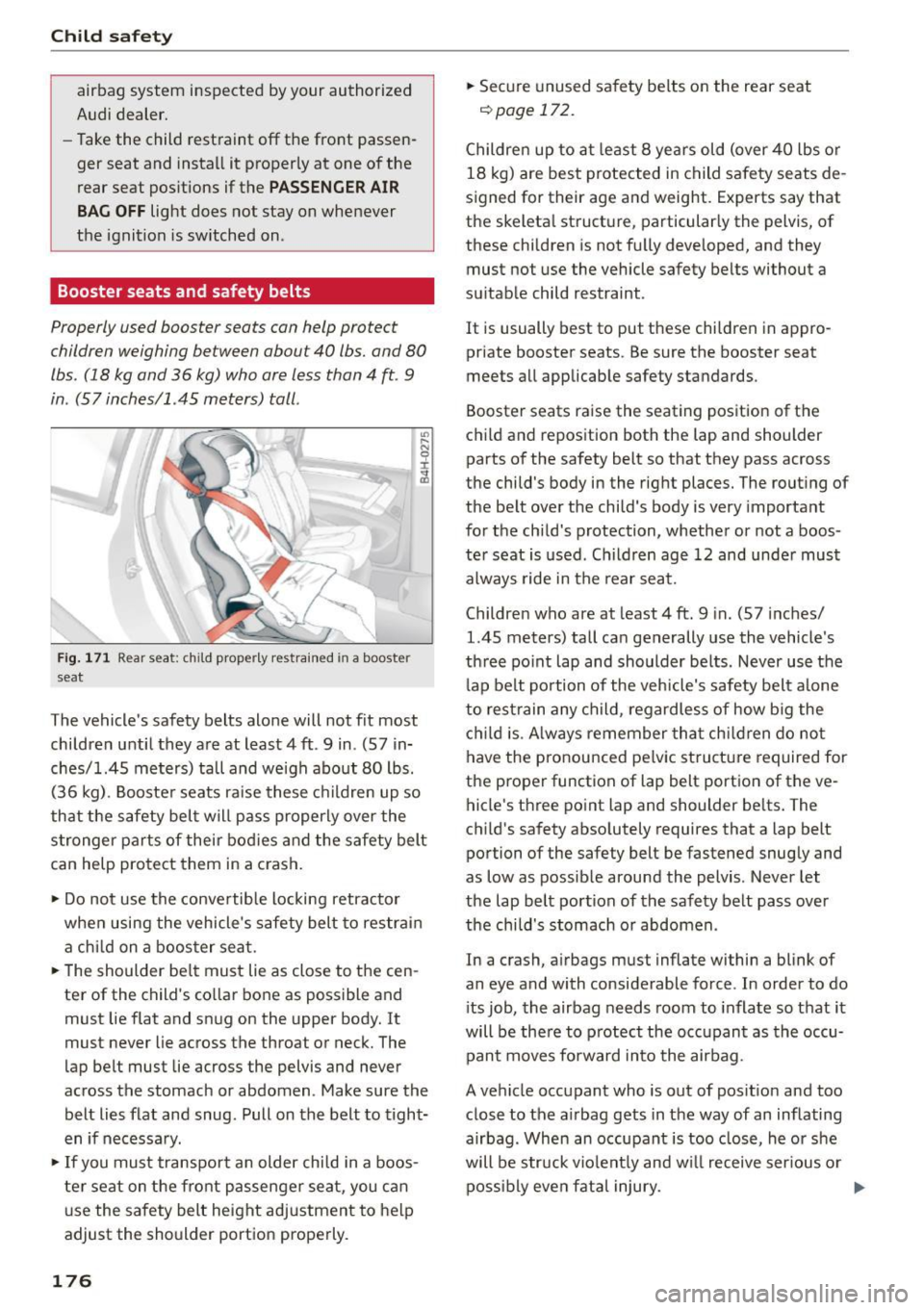
Booster seats and safety belts
Properly used booster seats con help protect
children weighing between about 40 lbs. and 80
lbs. (18 kg and 36 kg) who ore less than 4
ft. 9
in . (57 inches/1 .45 meters) tall .
Fig. 171 Rear seat: ch ild prope rly restrained in a booster
seat
"' ,-.
i i
The vehicle's safety belts alone will not fit most
children until they are at least 4
ft. 9 in . (57 in
ches/1.45 meters) tall and weigh about 80 lbs.
(36 kg). Booster seats raise these children up so
that the safety belt will pass properly over the
stronger parts of their bodies and the safety belt
can help protect them in a crash.
• Do not use the convertible locking retractor
when using the vehicle's safety belt to restrain
a child on a booster seat.
• The shoulder be lt must lie as close to the cen
ter of the child's collar bone as possible and
must lie flat and snug on the upper body. It
must never lie across the throat or neck. The
lap belt must lie across the pelvis and never
across the stomach or abdomen . Make sure the
belt lies flat and snug . Pull on the belt to tight
en if necessary.
• If you must transport an older child in a boos
ter seat on the front passenger seat, you can
use the safety belt height adjustment to help
adjust the shoulder portion properly .
176
• Secure unused safety belts on the rear seat
r=;, page 172 .
Children up to at least 8 years old (over 40 lbs or
18 kg) are best protected in child safety seats de
signed for their age and weight . Experts say that
the skeletal structure, particularly the pelvis, of
these children is not fully developed, and they
must not use the vehicle safety belts without a
suitable child restraint .
It is usually best to put these children in appro
priate booster seats . Be sure the booster seat
meets all applicable safety standards.
Booster seats raise the seating position of the
child and reposition both the lap and shoulder parts of the safety belt so that they pass across
the child 's body in the right places. The routing of
the belt over the child 's body is very important
for the child's protection, whether or not a boos
ter seat is used. Children age 12 and under must
always ride in the rear seat.
Children who are at least 4
ft. 9 in. (57 inches/
1.45 meters) tall can generally use the vehicle's
three point lap and shoulder belts . Never use the
lap belt portion of the vehicle's safety belt alone
to restrain any child, regardless of how big the
child is. Always remember that childr en do not
have the pronounced pelvic structure required for
the proper function of lap belt portion of the ve
hicle 's three point lap and shoulder belts. The
child's safety absolutely requires that a lap belt
portion of the safety belt be fastened snugly and
as low as possible around the pelvis . Never let
the lap belt portion of the safety belt pass over
the child's stomach or abdomen .
In a crash, airbags must inflate within a blink of
an eye and with considerable force . In order to do
its job, the airbag needs room to inflate so that it
will be there to protect the occupant as the occu
pant moves forward into the airbag .
A vehicle occupant who is out of position and too
close to the airbag gets in the way of an inflating
airbag . When an occupant is too close, he or she
will be struck violently and will receive serious or
possibly even fatal injury. .,..
Page 181 of 294
M N <( (.J
'SI: ,...., \!) ..,.,
N \!) ,....,
-Always mak e sure the forward-facing seat
has been designed and certified by its man
ufacturer for use on a front seat with a
passenger front and side airbag .
- Never pu t the forward-facing child restraint
up, aga inst or very near the ins trument pan
el.
- Always move the passenger seat into its
rearmost position in the seat's fore and aft
adjustment range, as far away from the air
bag as possib le befo re installing the for
wa rd-fac ing child restra int. The backres t
must be ad justed to an up right posit io n.
- Make sure that the
PASSENGER AIR BAG
OFF
light comes on and s tays on all the t ime
whe never the ignition is switched on.
_& WARNING
Rearw ard-fac ing ch ild restra ints:
- A ch ild in a rearwa rd-facing child safety seat
installed on the fron t passenger seat will be
seriously injured and can be k ille d if the
front airbag inflates - even with an Ad
vanced Airbag System .
- The inflati ng a irbag w ill hit the child safety
seat or infant carrier with great fo rce and
will smash the ch ild safety seat and chi ld
against the backrest, center armrest, door
o r roof.
- Always be especially caref ul if you must in
stall a rearward facing ch ild safety seat on
the front passenger seat in exceptional cir
cumstances .
- Make sure that the
PASSENGER AIR BAG
OFF
light comes on and stays on all the t ime
whenever the ignition is switched on .
- If the
PASSENGER AIR BAG OFF light does
not come on and stay on, immed iately in
stall the rear-fac ing c hild safety seat in a
rear seating position and have the airbag
system inspected by your Au di deale r.
Child sa fety
Act ivating the convertible locking retractor
Use the convertible locking retractor to secure a
child restraint .
Always heed the ch ild safety seat manufac ture r's
ins truc tions when ins talling a child res train t in
your vehicle . T o activate the convertible locking
re tractor:
.. Place the child restraint on a sea t, preferably on
the rear sea t.
.. Slowly p ull the belt
all the way out .
.. Route it a round or through the child rest ra int
be lt pat h
~ .& .
.. Push the c hild safety sea t down with you r full
we igh t to ge t the sa fe ty belt re ally t igh t.
.. Insert the belt tongue into the buc kle for tha t
seating posit ion .
.. Guide the saf ety belt back into the retractor un
til the belt lies flat and sn ug on the ch ild safety
seat .
.. You should hear a "clicking" noise as the belt
w inds bac k into the ine rtia reel. Test the con
vert ible locking retracto r by pu lli ng on the belt .
Yo u shou ld no lo nger be able to pull the belt
ou t of the re tr actor. The conve rtible locking re
t racto r is now ac tiva ted .
.. Ma ke s ure that the red release button is fac ing
away from the child rest raint so that it can be
unbuckled quickly .
.. Pull on the belt to make sure the safety be lt is
properly tight and fastened so t hat the se at
cannot move forward or sideways more than
one inch (2 .5 cm) .
_& WARNING
Using the wrong child re straint o r an i mprop
e rly insta lled child rest raint can cau se serious
p erson al injury or deat h in a cra sh .
- Always ma ke sure that the safe ty belt re
tr act o r i s lo cked when in sta lling a child safe
ty seat . An unloc ked sa fety belt retrac tor
cannot hold the child safety seat in place
du ring normal d riving or in a c rash.
- Always buckle the child sa fe ty seat firmly in
p lace even if a ch ild is not sitting in it. A
loose child safety seat can fly aro und durin g
a sudden stop or in a c rash. ..,.
179