seats AUDI A7 2016 User Guide
[x] Cancel search | Manufacturer: AUDI, Model Year: 2016, Model line: A7, Model: AUDI A7 2016Pages: 294, PDF Size: 73.82 MB
Page 62 of 294
Seats and storage
-Never carry any beverage containers with
hot liquids, such as hot coffee or hot tea, in
the vehicle while it is moving. In case of an
accident, sudden braking or other vehicle movement, hot liquid could spill, causing
scalding burns . Spilled hot liquid can also
cause an accident and personal injury.
- Use only soft cups in the cupholder. Hard
cups and glasses can cause injury in an acci
dent.
- Never use the cupholder or adapter as an
ashtray- risk of fire.
(D Note
Only drink containers with lids should be car
ried in the cupholder. Liquid could spill out
and damage your vehicle's electronic equip
ment or stain the upholstery, etc.
Cooled glove compartment
A pp lies to ve hicles: w ith coole d glove compart men t
The cooled glove compartment only functions
when the AIC system is switched on.
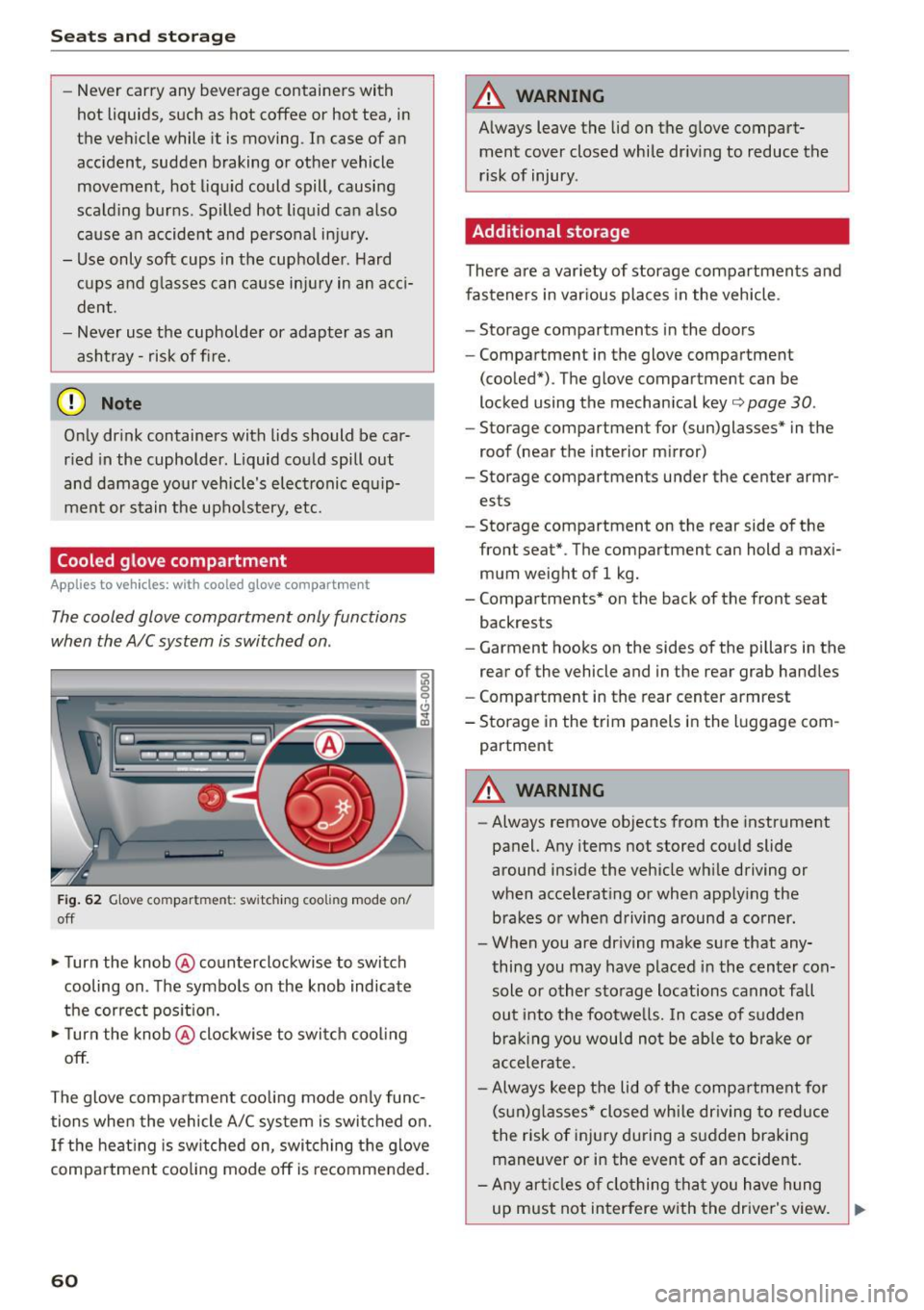
Fig. 62 Glove compartment: switching cooling mode on/
off
• Turn the knob @counterclockwise to switch
cooling on. The symbols on the knob indicate
the correct position.
• Turn the knob @clockwise to switch cooling
off.
The glove compartment cooling mode only func tions when the vehicle A/C system is switched on.
If the heating is switched on, switching the glove
compartment cooling mode off is recomme nded.
60
A WARNING
Always leave the lid on the glove compart
ment cover closed while driving to reduce the
risk of injury.
Additional storage
There are a variety of storage compartments and
fasteners in various places in the vehicle .
- Storage compartments in the doors
- Compartment in the glove compartment
(cooled*) . The glove compartment can be
locked using the mechanical key¢
page 30.
-Storage compartment for (sun)glasses* in the
roof (near the interior mirror)
- Storage compartments under the center armr
ests
- Storage compartment on the rear side of the
front
seat* . The compartment can hold a maxi
mum weight of 1 kg.
- Compartments* on the back of the front seat
backrests
- Garment hooks on the sides of the pillars in the
rear of the vehicle and in the rear grab handles
- Compartment in the rear center armrest
- Storage in the trim panels in the luggage com-
partment
A WARNING
-Always remove objects from the instrument
panel. Any items not stored could slide
around inside the vehicle while driving or
when accelerating or when applying the brakes or when driving around a corner.
- When you are driving make sure that any
thing you may have placed in the center con
sole or other storage locations cannot fall
out into the footwells. In case of sudden
braking you would not be able to brake or
accelerate .
- Always keep the lid of the compartment for
(sun)glasses* closed while driving to reduce
the risk of injury during a sudden braking
maneuver or in the event of an accident.
- Any articles of clothing that you have hung
up must not interfere with the driver's view.
~
Page 63 of 294
M N <( I.J "". rl I.O
"' N I.O rl
The coat hooks are designed only for light
weight clothing . Never hang any clothing
with hard, pointed or heavy objects in the
pockets on the coat hooks. During sudden
braking or in an accident -especially if the
airbag is deployed -these objects could in
jure any passengers inside the vehicle.
- To reduce the risk of personal injury in an ac
cident or sudden stop, always keep the
glove compartment closed while dr iv ing.
- Read and follow all WARNINGS
¢ page 163, Important safety instructions
on the side airbag system.
-Hang clothes in such a way that they do not
impair the driver's vision.
- The coat hooks must only be used for light
we ight clothing . Do not leave any heavy or
sharp edged objects in the pockets which
may in terfere with the sid e curtain airbag
deployment and can cause personal injury in
a crash .
- Do not use coat hangers for hanging cloth
ing on the coat hooks as this can interfere
with proper deployment of the side curtain
airbags in an accident.
- Do not hang heavy objects on the coat
hooks, as they could cause personal injury in
a sudden stop.
0 Note
Objects located on the rear shelf that rub
against the rear window could damage the
heating wires for the rear window defogger.
Seats and storage
Roof rack
Description and mounting locations
Additional cargo can be carried with a roof lug
gage rack.
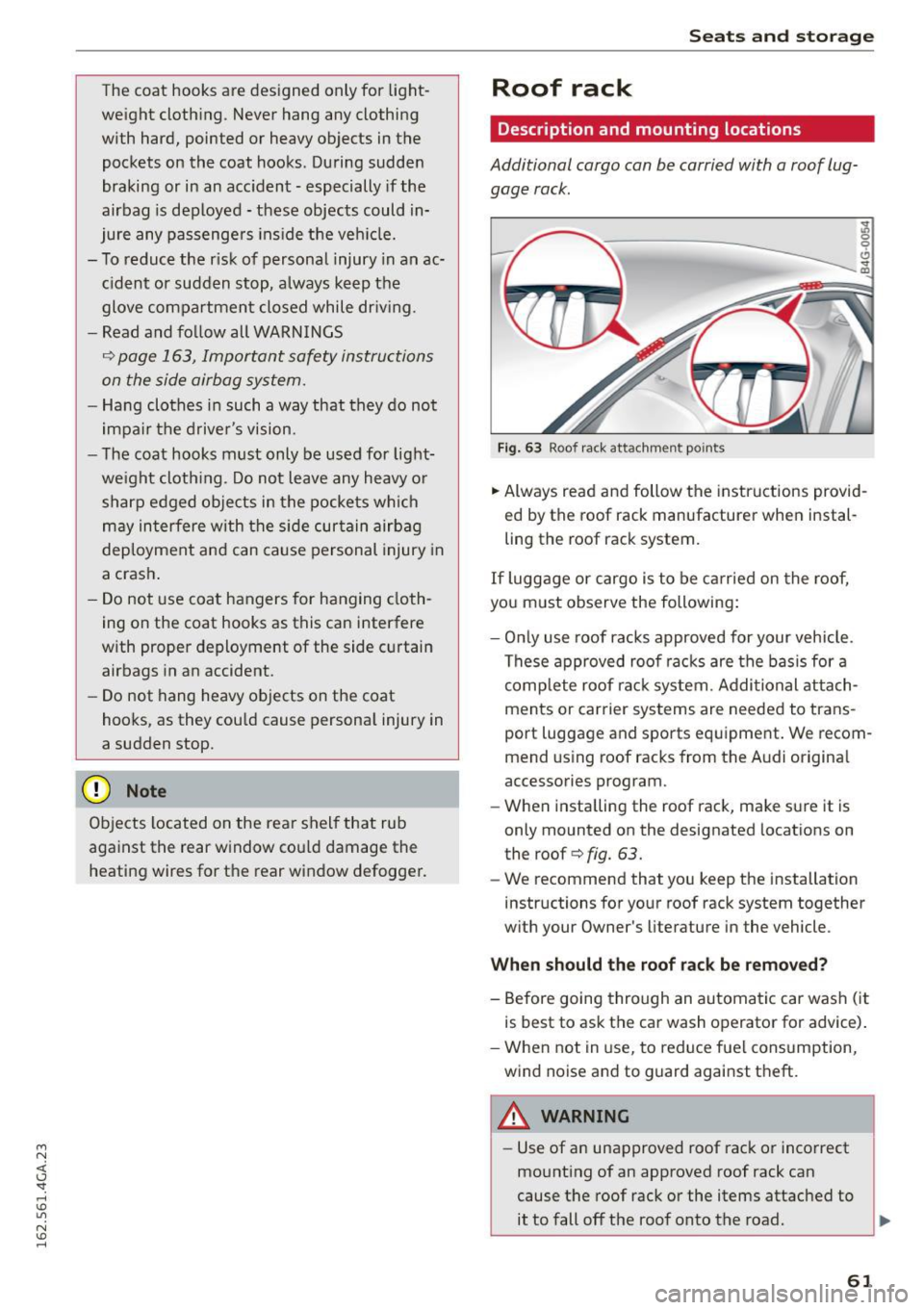
Fig. 63 Roof rack attachm en t po ints
~ 0
0 ., m
.,. Always read and follow the instructions provid
ed by the roof rack manufacturer when instal
ling the roof rack system.
If luggage or cargo is to be carried on the roof,
you must observe the following:
- Only use roof racks approved for your vehicle .
These approved roof racks are the basis for a
complete roof rack system . Additional attach
ments or carrier systems are needed to trans
port luggage and sports equipment. We recom
mend using roof racks from the Audi original
accessories program.
- When installing the roof rack, make sure it is
only mounted on the designated locations on
the roof
c> fig. 63.
- We recommend that you keep the installation
instructions for your roof rack system together
with your Owner's literature in the vehicle.
When should the roof rack be removed?
- Before going through an automatic car wash (it
is best to ask the car wash operator for adv ice).
- When not in use, to reduce fuel consumption,
wind noise and to guard against theft.
A WARNING ,...___
- Use of an unapproved roof rack or incorrect
mounting of an approved roof rack can
cause the roof rack or the items attached to
it to fall off the roof onto the road.
~
61
Page 65 of 294
M N <( I.J "". rl I.O
"' N I.O rl
Luggage compartment
Loading luggage compartment
Luggage items must be stowed securely.
"' (X) 0 9 Cl .,.
"'
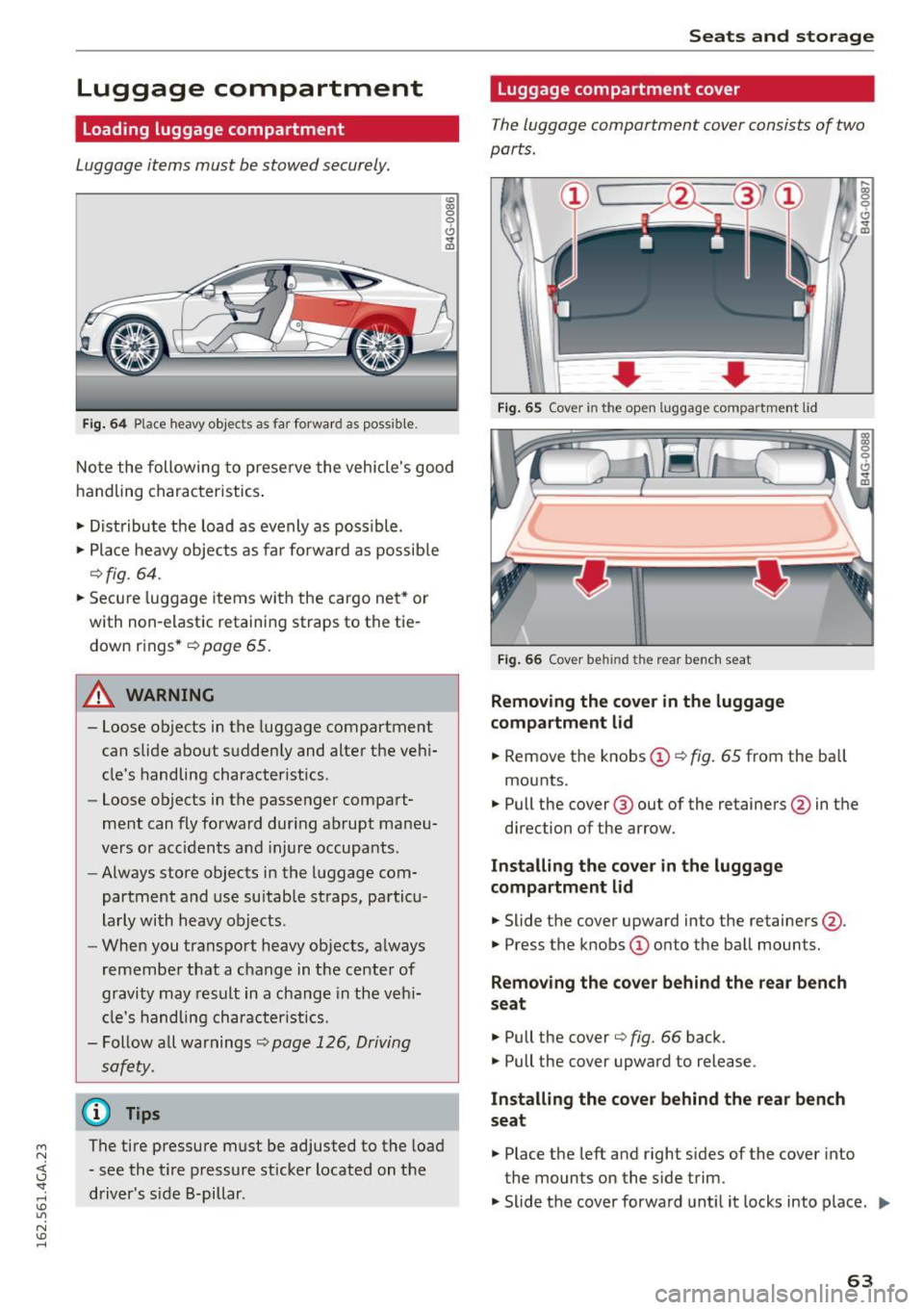
Fig. 64 P lace heavy objec ts as far fo rward as poss ib le .
Note the following to preserve the vehicle's good
handling characteristics .
.. Distribute the load as evenly as possible .
.. Place heavy objects as far fo rward as possib le
¢fig. 64 .
.. Secu re luggage items wi th the cargo ne t* or
with non-elastic retaining straps to the tie down r ings*
r=> page 65.
A WARNING
-Loose objects in the luggage compartment
can slide about suddenly and alter the vehi
cle's handling characteristics .
- Loose objects in the passenger compart
me nt can fly forward during abrupt maneu
vers or acc idents and injure occupants .
- Always store objects in the luggage com
partment and use suitab le straps, pa rticu
larly with heavy objects .
- When you transport heavy objects, always
remembe r that a change in t he center of
gravity may res ult in a change in the veh i
cl e's handling character istics.
- Follow all warnings
r=> page 126, Driving
safety.
@ Tips
The tire pressure must be adjusted to the load
- see the t ire pressure sticker located on the
driver's s ide B-pillar .
Seats and storage
Luggage compartment cover
The luggage compartment cover consists of two
parts.
,... a, 0 , 0
0 .,.
0 0. a)
F ig . 65 Cov er in the open lu ggag e compar tment lid
Fig . 66 Cov er behind the re ar bench seat
Removing the cover in the luggage
compartment lid
.. Remove the knobs @ r=> fig. 65 from the ba ll
mounts .
.. Pull the cover @ out of the retainers@in the
direction of the arrow.
Installing the co ve r in the luggage
compartm ent lid
.,._ Slide the cover upward into the retainers@.
.. Press the knobs
(I) onto the ball mounts.
Removing the cove r behind the rear bench
seat
.,._ Pull the cover r=> fig. 66 back.
.. Pull the cover upward to release.
Installing the cover behind the rea r bench
s eat
.. Place the left and right s ides of the cover into
the mounts on the side trim.
.. Slide t he cover forward unt il it locks into place.
IJI,,,
63
Page 66 of 294
Seats and storag e
_& WARNING
- To prevent accidents, never install the lug
gage compartment
cover unsecured.
- The luggage compartment
cover is not a
surface for storing objects . Objects placed
on the
cover cou ld endanger all vehicle oc
cupants during sudden brak ing maneuvers
or in a crash.
The defogger and antenna wires in the rear
w indow can be damaged by objects on the
luggage compartment
cover rubbing against
them.
Enlarging cargo capacity of the vehicle
interior
The seat backs can be folded forward to enlarge
the cargo capacity.
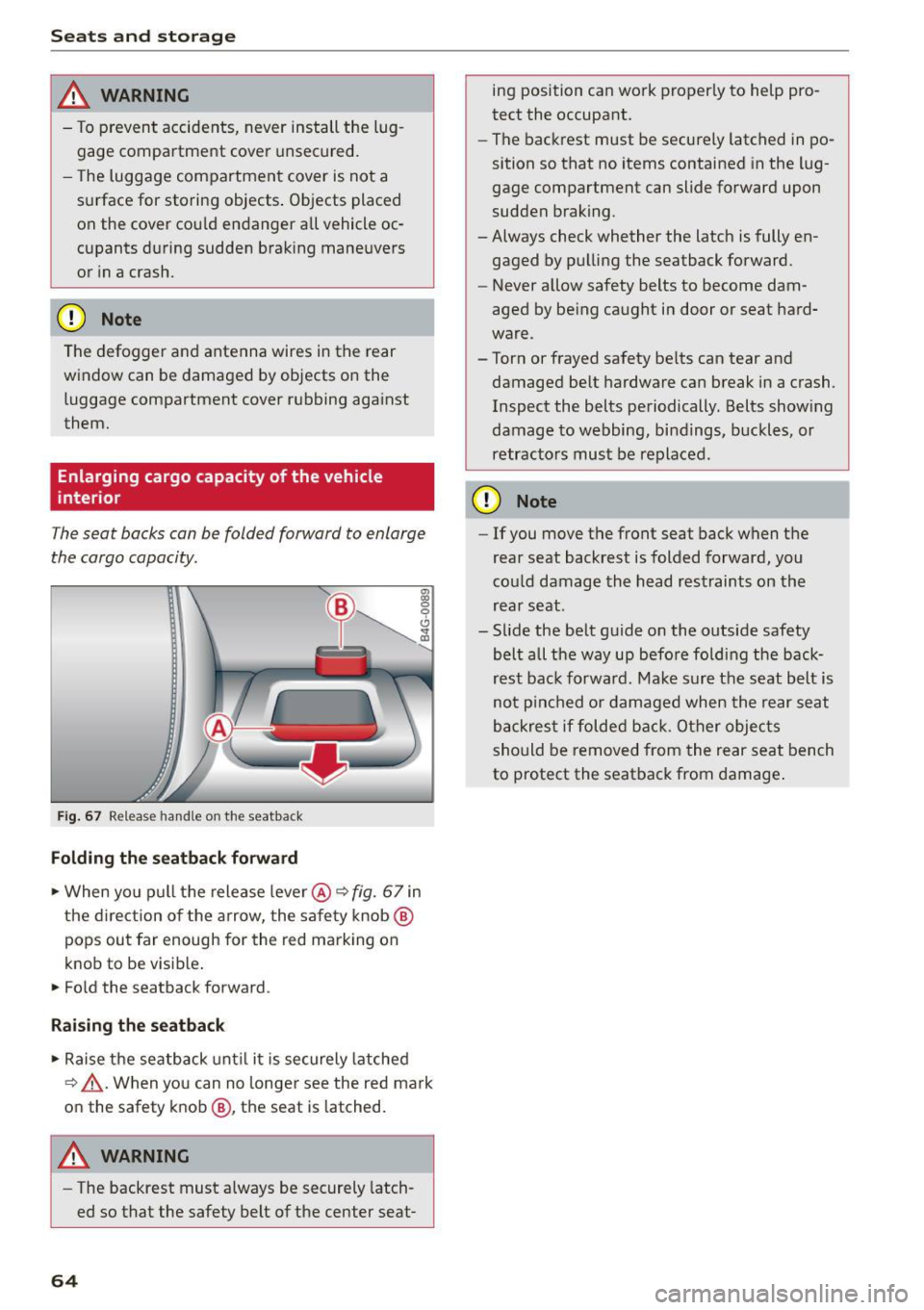
F ig. 67 Release handle on the seatback
Folding the s eatback forward
• When yo u pull the release lever @<=> fig. 67 in
the d irection o f the a rrow, the sa fe ty knob @
pops out far enough for the red marking on
knob to be visib le .
• Fo ld the seatback forward .
Raising the seatback
• Raise the seatback unt il it is securely latched
<=> A .When you can no longer see the red mark
on the safety knob @, the seat is latched.
A WARNING
-The backrest must always be securely latch
ed so that the safety belt of the center seat-
64
ing position can work proper ly to help pro
tect the occupant.
- The backrest must be securely latched in po
sition so that no items contained in the lug
gage compartment can slide forward upon
sudden braking.
- Always check whether the latch is fully en gaged by pu lling the seatback forward.
- Never allow safety belts to become dam
aged by being caught in door or seat hard
ware.
- Torn or frayed safety be lts can tear and
damaged be lt hardware can break in a crash.
Inspect the belts periodically. Belts show ing
damage to webbing, bindings, buckles, or
retractors must be replaced.
(D Note
- If you move the front seat back when t he
rear seat backrest is folded forward, you
cou ld damage the head res traints on the
rear seat .
- S lide the belt guide on the outside safety
belt all t he way up befo re fold ing the back
rest back forward . Make sure the seat belt is
no t pinched or damaged when the rear seat
backres t if folded back. Other objec ts
should be
removed from the rear seat bench
to protect the seatback from damage .
Page 67 of 294
M N <( I.J "". rl I.O
"' N I.O rl
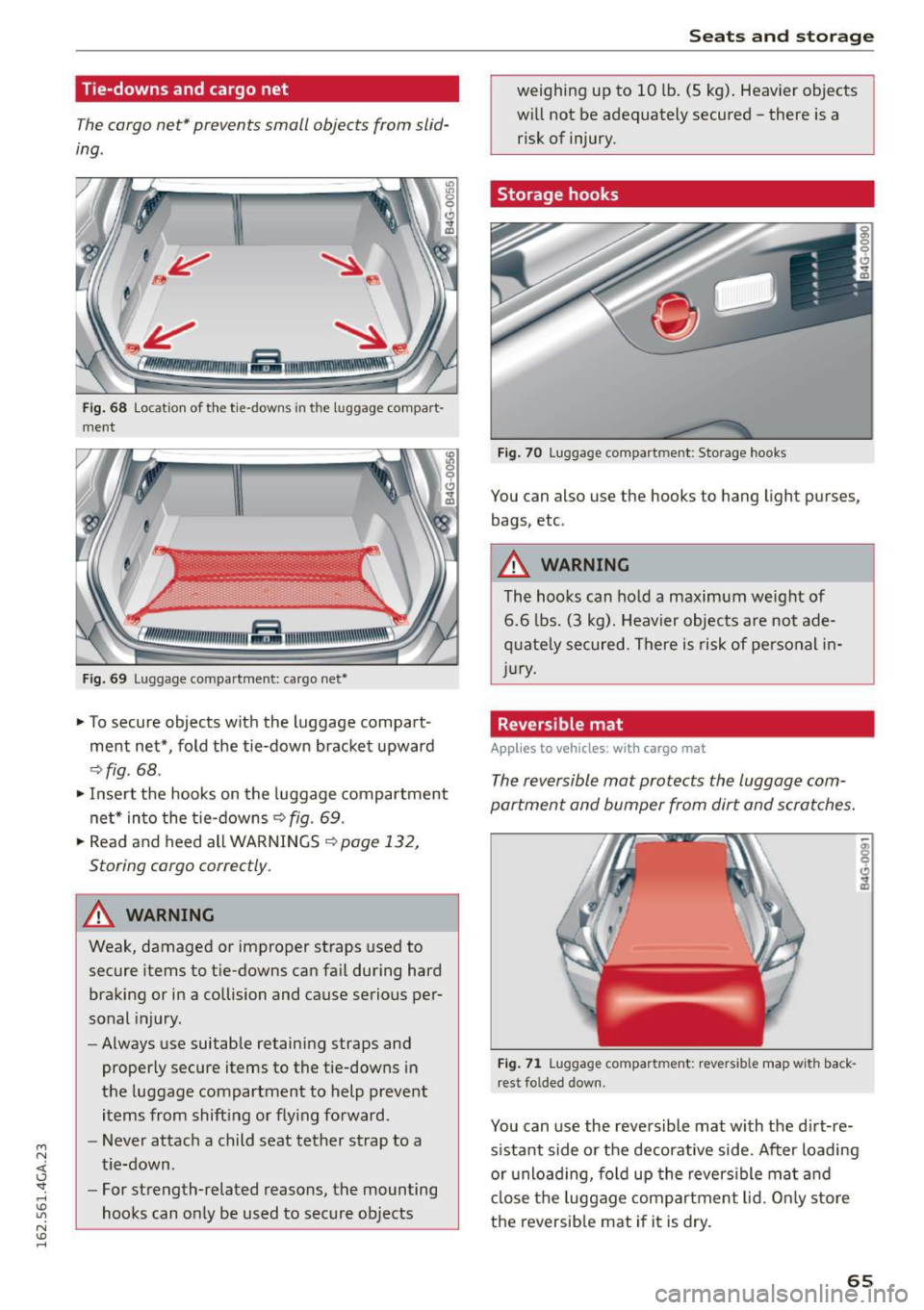
Tie-downs and cargo net
The cargo net* prevents small objects from slid
ing .
Fig. 6 8 Locat ion of th e tie-downs in the lug gage com part·
ment
F ig. 69 Luggage compartme nt: ca rgo net•
~ To secure objects with the luggage compart
ment net*, fold the tie-down bracket upward
~ fig . 68 .
~ Insert the hooks on the luggage compar tment
ne t* into the t ie-downs
~ fig . 69.
~ Read and heed all WARNINGS~ page 132,
Storing cargo correctly.
A WARNING
Weak , damaged or improper straps used to
secure items to tie-downs can fa il during hard
braking or in a co llision and cause serious per
sonal injury .
- Always use suitable retaining straps and
properly secure items to the tie-downs in
the luggage compartment to help prevent
items from shift ing or fly ing forward.
- Never attach a child seat tether strap to a
t ie-down.
- For strength-related reasons, the mounting
hoo ks can only be used to secure objects
Seats and storage
weighing up to 10 lb. (5 kg) . Heav ier objects
will not be adequately secured -there is a
risk of injury.
Storage hooks
Fig . 70 Luggage compartmen t: S to ra ge hooks
You can also use the hooks to hang light pu rses,
bags, etc .
A WARNING
The hooks can hold a maximum w eig ht of
6 .6 lbs . (3 kg) . Heavier obj ect s are not ade
q uate ly secured. There is risk of personal i n
jur y.
Reversible mat
Appl ies to veh icles : w it h ca rgo mat
-
The reversible mat protects the luggage com
partment and bumper from dirt and scratches.
Fig. 71 Luggage compart men t: revers ible map w ith back ·
r est folded dow n.
You can use the reversible mat with the d irt-re
s istant side o r the decorative side. After loading
o r u nlo ading, fo ld up the revers ible ma t and
cl ose the luggage compartment lid. O nly s to re
the reversib le mat if it is dry.
65
Page 68 of 294
Seats and storage
Pass-through with ski
bag
Preparing the pass-through
Applies to veh icles: with sk i sack
Long objects such as skis con be transported in
the ski sock*.
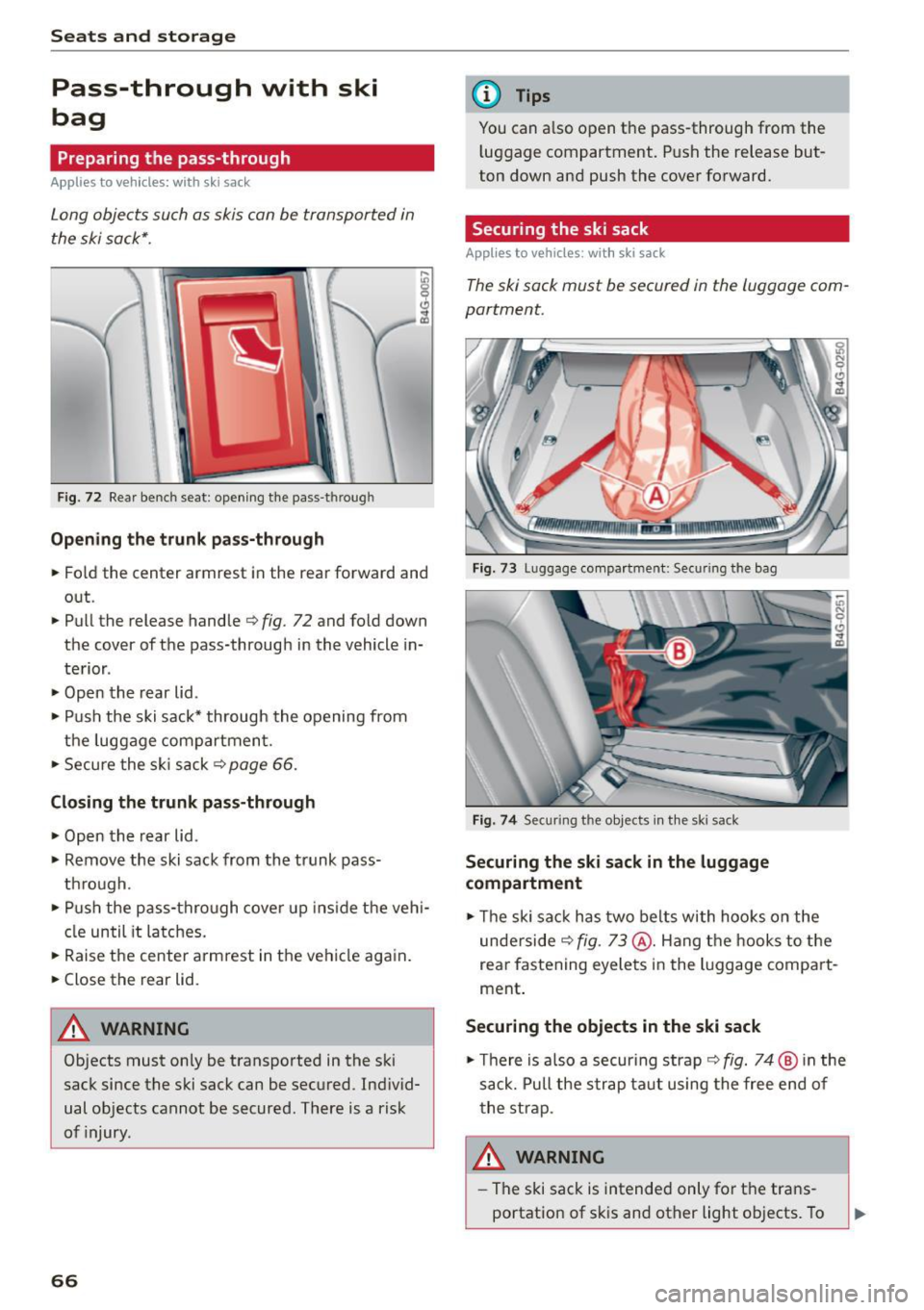
F ig. 72 Rear bench seat: open ing the pass-t hroug h
Opening the trunk pass-through
.. Fold the center armrest in the rear forward and
out .
.. Pull the release handle
c:> fig . 72 and fold down
the cover of the pass-through in the vehicle in
terior .
.. Open the rear lid .
.. Push the ski sack* through the opening from
the luggage compartment.
.. Secure the ski sack¢
page 66.
Closing the trunk pass-through
.. Open the rear lid .
.. Remove the ski sack from the trunk pass
through.
.. Push the pass-thro ugh cover up inside the vehi
cle until it latches.
.. Raise the center armrest in the vehicle again.
.. Close the rear lid.
A WARNING
Objects must only be transported in the ski
sack since the ski sack can be secured . Ind ivid
ual objects cannot be secured. There is a risk
of injury .
66
@ Tips
You can a lso open the pass-through from the
l uggage compartment. Push the release but
ton down and push the cover forward.
Securing the ski sack
Applies to vehicles: with ski sack
The ski sock must be secured in the luggage com
portment.
Fig. 73 Luggage compartme nt: Secu ring the bag
Fig. 74 Securing t he objects in the ski sack
Securing the ski sack in the luggage
compartment
.. Th e ski sack has two belts with hooks on the
underside
¢ fig . 73 @. Hang the hooks to the
rear fastening eyelets in the luggage compart
ment .
Securing the objects in the ski sack
.. Th ere is also a securing strap¢ fig. 74 @ in the
sack. Pull the strap taut using the free end of
the strap.
8_ WARNING ,._
-The ski sack is intended only for the trans
portation of skis and other light objects. To
Page 72 of 294
Warm and cold
mode switches off. The temperat ure shou ld be
set to approximately 72 ° F (22 °C).
The
IAU TOI button switches the defroster off.
I® REAR I Switching the rear window defogger
on /off
The rear w indow heater only operates when the
engine is r unning.
It sw itches off automatically
after a few m in utes, depending on the outs ide
temperature.
To prevent the rear w indow heater from switch
ing
off a utomat ica lly, press and hold the!@ R EAR I
but ton fo r more than 2 seconds. This rema ins
stored until the ignition is switched
off.
Q:I Adjusting seat h eating *
Pressing the button switches the seat heating on
at the highes t setting (level 3) . T he LEDs indicate
the tempe rature leve l. To red uce the tempe ra
ture, press the button again. To switch the seat
heating
off , press the button repeatedly until the
LED turns
off .
Afte r 10 minutes , the seat heat ing a utomat ica lly
sw itches from level 3 to leve l 2 .
Air vent s
You can open or close the center and rear vents in
the cockpit and the vents in the rear center con
sole using the r idged thumbwhee ls. The levers
adj ust the d irect ion of the a irf low from the vents.
70
A WARNING
-
- You should not use the recirculation mode
for an extended period since no fresh air is
drawn in . With the a ir-conditioning sw itched
off, the windows can fog up, which increases
the r isk of a n accident.
- Individuals w ith reduced sensitivity to pain
or temperatu re could develop burns when
using the seat heat ing f unct ion. To reduce
the r isk of inj ury, these indiv iduals should
not use seat heating.
(D Note
To avoid damage to the heat ing e lements in
the seats, do not kneel on the sea ts or place
h eavy loads on a sma ll area o f the seat .
Basic settings
Applies to vehicles: wit h three-zone climate control
The climate control system basic settings are ac
cessed in the Infotainment system.
~ Select: the I CARI funct ion button > ( Car )* S ys-
t e m s
control button > AC.
Au xilia ry heater*
In vehicles with diesel engines, the auxiliary heat
er helps to warm the vehicle interior more quick
ly. The aux iliary heater is controlled automatical
l y in the
A ut o setting .
Page 74 of 294
Warm and cold
At both of these settings, the climate control sys
tem runs continuously at maximum cooling or heating power. There is no temperat ure regula
tion.
Adju st ing th e bl ow er[!]
You can ad just the volume of air generated by the
b lower to yo ur preference. To have the blower
reg ulated automatically, press the
!AUTO I button .
~ Adjusting air d istribution
You ca n manually se lect the vents whe re the air
w ill flow. To have the air distrib ution regu lated
automatically, press the
! AUTO ! button.
~ Adjusting seat heating * /se at vent ilation*
Pressing the button switches the seat heating/
seat ventilat ion on at the highest setting ( leve l
3). The LEDs indicate the tempe ratu re leve l. To
red uce the tempe ratu re, p ress the butto n aga in.
To switch the seat heating/seat venti lation off,
press the button repeatedly until the LED turns
off .
After 10 minutes, the seat heating automat ica lly
switches from leve l 3 to leve l 2 .
I@ FRONT I Switching the defroster on /off
The windsh ield and s ide windows are defrosted
or cleared of condensation as quickly as possible.
The max imum amo unt of air flows ma inly from
t he ven ts below the w indshie ld. Rec irc ulat ion
mode switches off . The temperature shou ld be
set to approximately 22
°C.
The IAUTOI b utton swi tches the defroster off.
IOiil REAR I Switching the rear window defogger
on /off
The rear w indow heater only operates when the
eng ine is running.
It sw itches off automatically
after a few m in utes, depend ing on the outs ide
temperature.
To prevent the rear w indow heater from switc h
ing off a utomat ica lly, press and hold the
!l:iil REAR I
button fo r more t han 2 seconds. This rema ins
stored until the ignition is switched off.
72
I SYNC I Sy nchron izat ion
When synchroni zation is swi tched on, the set
tings for the driver's side a re applied to the front
passenger's side (except for seat heating/ventila
tion*). The settings in the rear are also synchron ized. Synchronization switches off if the settings
are adjusted on the front passenger's side or in
the rear.
You can synchronize the settings in a row by
pressing and holding a control. For example, to
apply the settings for the front passenger's side
to the driver's side, press and ho ld the control on
the front passenger's side. The same applies to
the rear .
Residual he at*
With the ign ition turned off, you can activate the
residual heat function by pressing the
[!:I button
<=> fig . 76 . The residua l heat from the coolant is
u sed to heat the veh icle interior. The residual
heat funct ion switches off automatically after
about 30 minutes.
Air vents
You can open or close the center and rear vents in
the cockpit and the vents in the rear center con
sole and door pillars using the ridged thumb
whee ls . T he levers adjust the direct ion of the air
flow from the vents.
.8, WARNING
- You should no t use the re ci rculation mode
for an extended period since no fresh air is drawn in. With the a ir-conditioning switched
off, the windows can fog up, which increases
the risk of an accident.
- Individ ua ls with red uced sensitivity to pain
or temperat ure could deve lop burns when
using the seat heating f unction. To reduce
the risk of inj ury, these indiv iduals should
not use seat heating .
(D Note
To avoid damage to the heating e lements in
the seats, do not kneel on the seats or place heavy loads on a small area of the seat.
Page 128 of 294
Driving safety
Driving safety
Basics
Safe driving habits
Please remember -safety first!
This chapter contains important information,
tips, instructions and warnings that you need to
read and observe for your own safety, the safety
of your passengers and others. We have summar ized here what you need to know about safety
belts, airbags, child restraints as well as child
safety. Your safety is for us
priority number 1. Al
ways observe the information and warnings in
this section - for your own safety as well as that
of your passengers .
The information in this section applies to all
model versions of your vehicle . Some of the fea
tures described in this sections may be standard
equipment on some models, or may be optional
equipment on others. If you are not sure, ask
your authorized Audi dealer.
A WARNING
- Always make sure that you follow the in
structions and heed the WARNINGS in this
Manual.
It is in your interest and in the in
terest of your passengers.
- Always keep the complete Owner's Litera
ture in your Audi when you lend or sell your
vehicle so that this important information
will always be available to the driver and
passengers.
-
- Always keep the Owner's literature handy so
that you can find it easily if you have ques
tions .
Safety equipment
The safety features are part of the occupant re
straint system and work together to help reduce
the risk of injury in a wide variety of occident sit
uations.
Your safety and the safety of your passengers
should not be left to chance. Advances in tech
nology have made a variety of features available
to help reduce the risk of injury in an accident.
126
The following is a list of just a few of the safety
features in your Audi:
-sophisticated safety belts for driver and all pas-
senger seating positions,
- safety belt pretensioners,
- safety belt force limiters for the front seats,
- safety belt height adjustment systems for the
front seats,
- front airbags,
- knee airbags for the front seats*
- side airbags in the front seats and outer rear
seats*,
- side curtain airbags with ejection mitigation
features,
- special LATCH anchorages for child restraints,
- head restraints for each seating position,
- adjustable steering column.
These individual safety features, can work to gether as a system to help protect you and your
passengers in a wide range of accidents . These
features cannot work as a system if they are not
always correctly adjusted and correctly used.
Safety is everybody's responsibility!
Important things to do before driving
Safety is everybody's job! Vehicle and occupant
safety always depends on the informed and care
ful driver.
For your safety and the safety of your passen
gers,
before driving always:
... Make sure that all lights and signals are operat
ing correctly.
... Make sure that the tire pressure is correct.
... Make sure that all windows are clean and afford
good visibility to the outs ide .
... Secure all luggage and other items carefully
~ page 63, ~page 60.
... Make sure that nothing can interfere with the
pedals .
... Adjust front seat, head restraint and mirrors
correctly for your height .
... Instruct passengers to adjust the head re
straints according to their height.
Page 130 of 294
Driving safety
"'Always keep both feet in the footwell so that
you are in control of the vehicle at all times.
For detailed information on how to adjust the
driver's seat, see
¢ page 53.
.&_ WARNING
Drivers who are unbelted , out of position or
too close to the airbag can be seriously in
jured by an airbag as it unfolds. To help re
duce the risk of serious personal injury :
- Always adjust the driver's seat and the
steering wheel so that there are at least
10 inches (25 cm) between your breastbone
and the steering wheel.
- Always adjust the driver's seat and the
steering wheel so that there are at least
4 inches (10 cm) between the knees and the lower part of the instrument panel.
- Always hold the steering wheel on the out
side of the steering wheel rim with your
hands at the 9 o'clock and 3 o'clock posi
tions to help reduce the risk of personal in
jury if the driver's airbag inflates .
- Never hold the steering wheel at the
12 o'clock position or with your hands at
other positions inside the steering wheel
rim or on the steering wheel hub. Holding
the steering wheel the wrong way can cause
serious injuries to the hands, arms and head if the driver's airbag inflates.
- Pointing the steering wheel toward your
face decreases the ability of the supplemen
tal driver's airbag to protect you in a colli
sion.
- Always sit in an upright position and never
lean against or place any part of your body
too close to the area where the airbags are located .
- Before driving, always adjust the front seats
properly and make sure that all passengers
are properly restrained .
- For adjustable head restraints: before driv
ing, always also adjust the head restraints
properly .
- Never adjust the seats while the vehicle is
moving. Your seat may move unexpectedly
and you could lose control of the vehicle .
128
-
-Never drive with the backrest reclined or
tilted far back! The farther the backrests are
tilted back, the greater the risk of injury due
to incorrect positioning of the safety belt
and improper seating position .
- Children must always ride in child seats
¢
page 167 . Special precautions apply
when installing a child seat on the front pas senger seat¢
page 143.
Proper seating position for the front
passenger
The proper front passenger seating position is
important for safe, relaxed driving.
For your own safety and to reduce the risk of in
jury in the event of an accident, we recommend
that you adjust the seat for the front passenger
to the following position:
"' Adjust the angle of the seatback so that it is in
an upright position and your back comes in full
contact with it whenever the vehicle is moving.
"'For adjustable head restraints: adjust the head
restraint so the upper edge is as even as possi
ble with the top of your head. If that is not pos
sible, try to adjust the head restraint so that it
is as close to this position as possible
c:> page 129 . Move the head restraint so that it
is as close to the back of the head as possible.
"' Keep both feet flat on the floor in front of the
front passenger seat .
"'Fasten and wear safety be lts correctly
¢ page 138.
For detailed information on how to adjust the
front passenger's seat, see
¢ page 52 .
.&_ WARNING
Front seat passengers who are unbelted, out
of position or too close to the airbag can be
seriously injured or killed by the airbag as it
unfolds. To help reduce the risk of serious per
sonal injury :
- Passengers must always sit in an upright po
sition and never lean against or place any part of their body too close to the area
where the airbags are located.
Ill>