window AUDI A7 2016 User Guide
[x] Cancel search | Manufacturer: AUDI, Model Year: 2016, Model line: A7, Model: AUDI A7 2016Pages: 294, PDF Size: 73.82 MB
Page 74 of 294
Warm and cold
At both of these settings, the climate control sys
tem runs continuously at maximum cooling or heating power. There is no temperat ure regula
tion.
Adju st ing th e bl ow er[!]
You can ad just the volume of air generated by the
b lower to yo ur preference. To have the blower
reg ulated automatically, press the
!AUTO I button .
~ Adjusting air d istribution
You ca n manually se lect the vents whe re the air
w ill flow. To have the air distrib ution regu lated
automatically, press the
! AUTO ! button.
~ Adjusting seat heating * /se at vent ilation*
Pressing the button switches the seat heating/
seat ventilat ion on at the highest setting ( leve l
3). The LEDs indicate the tempe ratu re leve l. To
red uce the tempe ratu re, p ress the butto n aga in.
To switch the seat heating/seat venti lation off,
press the button repeatedly until the LED turns
off .
After 10 minutes, the seat heating automat ica lly
switches from leve l 3 to leve l 2 .
I@ FRONT I Switching the defroster on /off
The windsh ield and s ide windows are defrosted
or cleared of condensation as quickly as possible.
The max imum amo unt of air flows ma inly from
t he ven ts below the w indshie ld. Rec irc ulat ion
mode switches off . The temperature shou ld be
set to approximately 22
°C.
The IAUTOI b utton swi tches the defroster off.
IOiil REAR I Switching the rear window defogger
on /off
The rear w indow heater only operates when the
eng ine is running.
It sw itches off automatically
after a few m in utes, depend ing on the outs ide
temperature.
To prevent the rear w indow heater from switc h
ing off a utomat ica lly, press and hold the
!l:iil REAR I
button fo r more t han 2 seconds. This rema ins
stored until the ignition is switched off.
72
I SYNC I Sy nchron izat ion
When synchroni zation is swi tched on, the set
tings for the driver's side a re applied to the front
passenger's side (except for seat heating/ventila
tion*). The settings in the rear are also synchron ized. Synchronization switches off if the settings
are adjusted on the front passenger's side or in
the rear.
You can synchronize the settings in a row by
pressing and holding a control. For example, to
apply the settings for the front passenger's side
to the driver's side, press and ho ld the control on
the front passenger's side. The same applies to
the rear .
Residual he at*
With the ign ition turned off, you can activate the
residual heat function by pressing the
[!:I button
<=> fig . 76 . The residua l heat from the coolant is
u sed to heat the veh icle interior. The residual
heat funct ion switches off automatically after
about 30 minutes.
Air vents
You can open or close the center and rear vents in
the cockpit and the vents in the rear center con
sole and door pillars using the ridged thumb
whee ls . T he levers adjust the direct ion of the air
flow from the vents.
.8, WARNING
- You should no t use the re ci rculation mode
for an extended period since no fresh air is drawn in. With the a ir-conditioning switched
off, the windows can fog up, which increases
the risk of an accident.
- Individ ua ls with red uced sensitivity to pain
or temperat ure could deve lop burns when
using the seat heating f unction. To reduce
the risk of inj ury, these indiv iduals should
not use seat heating .
(D Note
To avoid damage to the heating e lements in
the seats, do not kneel on the seats or place heavy loads on a small area of the seat.
Page 81 of 294
M N <( (.J
'SI: ,...., \!) ..,.,
N \!) ,....,
A WARNING ,~
- Always take the vehicle key with you when
leaving the vehicle, eve n for a short period
of time. Th is applies partic ula rly whe n chil
dren remain in the vehicle. Otherw ise chi l
dren co uld start the engine, re lease the
p arki ng brake or oper ate elec trical eq uip
ment such as power windows, which in
creases the r is k of an accident .
- No one sho uld remain in the vehicle when i t
is locked, especia lly children . Locked doors
make it more difficult for emergency wo rk
ers to get into the vehicle, which puts lives
at risk.
Starting from a stop
The start assist function ensures that the park
ing broke is released automatically upon start
ing .
Stopping and setting the parking brake
,.. Pu ll the swi tch~ to se t the p ark ing b rake.
Starting and automatically releasing the
parking brake
-
,.. When you press the ac cele ra to r pedal, the park
ing brake is au tom atically re lease d and you r ve
hicle begins to move.
The par kin g b rake can be set if yo u must stop the
ve hicl e at a stop light or in traffic. The vehicle
does not h ave to be he ld wit h t he brake pedal.
The parking b rake elim inates the tendency to
creep when a se lector lever position is engaged.
The parking brake re leases automatically and the
vehicle beg ins to move as soon as you press the
accelerator peda l as usual.
Starting on slopes
When starting on in clin es, the hill start assist
p revents the vehicle from uni ntentiona lly ro lling
back. The braking force o f the parking brake is
not released until sufficient driving force has
been built up at the whee ls .
Dri ving
{!) Tips
Fo r safety reasons, the pa rking bra ke is re
l eased automatically only when the d river 's
safety be lt is engaged in the b uckle.
Starting to drive with a trailer
To prevent rolling bock unintentionally on on in
cline, do the following:
,.. Keep the sw itch pulled ~ and p ress the acce l
erator peda l. The parking brake stays applied
and prevents the vehicle from roll ing backward .
,.. You can re lease the switch
[21 once you are s ure
that you are transferring enough drivi ng force
to the wheels by pressing the accele rato r pedal.
Depend ing on the we ight of the rig (vehicle and
trailer) and the severity of the incline, you may
ro ll backwards as you start.
Emergency braking function
This is used if the conventional broke system
fails or locks up.
,.. To brake your ve hicle in an eme rgency, pull the
[21 switc h and hold it p ulled.
,.. As soon as you release the
[21 switch or acce ler-
ate, the b rak ing stops.
If you pu ll the switch «el) and hold it above a
speed of about 5 mph (8 km/h), the emergency
braking fu nction is i nitiated. The vehicle is braked
at all four whee ls by activati ng the hydrau lic
brake system. The brake perfo rmance is s imi lar
to maki ng an emergency stop~.&. .
In order not to act ivate the emergency braking by
mistake, an aud ib le warn ing tone (buzze r)
sounds when the~ switch is pulled . As soon as
the~ switch is released, or the acce le rator pedal
is depressed, eme rgency b raking stops .
A WARNING
Emergency br aking should only be used in an
emergen cy, when t he norma l brake ped al has
failed or the bra ke peda l is obstructed . Us ing
the parking brake to perfo rm emergency brak-
-
ing will slow yo ur vehicle down as if you had ~
79
Page 101 of 294

M N <( I.J "". rl I.O
"' N I.O rl
-Improper reliance on the side assist system
can cause collisions and serious personal in
jury:
- Never rely only on side assist when chang
ing lanes .
- Always check rear view mirrors to make
sure that it is safe to change lanes.
- Sid e assist cannot detect a ll vehicles under
all conditions- danger of accident!
- Please note that side assist indicates there
are approaching vehicles, or vehicles in your
blind spot, only after your vehicle has
reached a driving speed of at least 19 mph
(30 km/h).
- In certain situations, the system may not
function or its function may be limited. For
example:
- if vehicles are approaching or being left
behind very quickly. The display may not
turn on in time.
- in poor weather conditions such as heavy
rain, snow or heavy m ist .
- on very wide lanes, in tight curves or if
there is a rise in the road surface . Vehicles
in the adjacent lane may not be detected
because they are outside of the sensor
range.
(D Note
The sensors can be displaced by impacts or damage to the bumper, wheel housing and
underbody. This can affect the system . Have
your authorized Audi dealer or authorized
Audi Service Facility check their function.
(D Tips
-If the window g lass in the driver's door or
front passenger's door has been tinted, the
display in the exterior mirror may be misin
terpreted.
- For Declarat ion of Compliance to United
States FCC and Industry Canada regulations
c:>page277 .
Audi side assist
Switching on and off
Applies to vehicles: wit h Audi side ass ist
Fig. 108 Driver 's door : side assist button
" Press the c:> A in General information on
page 98
button to switch the system on and
off. The LED in the button turns on when side
assist is switched on .
Adjusting the display brightness
Applies to vehicles: wit h Audi side ass ist
The display brightness can be adjusted in the In
fotainment system .
.,. Select: the I CAR I function button > (Car)* Sys
tems
control button > Driver assistance > Audi
side assist .
The display brightness adjusts automatically to
the brightness of the surroundings, both in the
information and in the warning stage. In very
dark or very bright surroundings, the display is al
ready set to the m inimum or maximum level by
the automatic adjustment. In such cases, you
may not ice no change when adjusting the bright
ness, or the change may only be noticeable once
the surroundings change.
Adjust the br ightness to a level where the display
in the info rmation stage will not disrupt your
view forward. If you change the brightness, the
display in the exterior mirror will briefly show the
brightness level in the information stage . The
brightness of the warning stage is linked to the
brightness in the information stage and is adjust
ed along with the information stage adjustment.
Ill>
99
Page 128 of 294
Driving safety
Driving safety
Basics
Safe driving habits
Please remember -safety first!
This chapter contains important information,
tips, instructions and warnings that you need to
read and observe for your own safety, the safety
of your passengers and others. We have summar ized here what you need to know about safety
belts, airbags, child restraints as well as child
safety. Your safety is for us
priority number 1. Al
ways observe the information and warnings in
this section - for your own safety as well as that
of your passengers .
The information in this section applies to all
model versions of your vehicle . Some of the fea
tures described in this sections may be standard
equipment on some models, or may be optional
equipment on others. If you are not sure, ask
your authorized Audi dealer.
A WARNING
- Always make sure that you follow the in
structions and heed the WARNINGS in this
Manual.
It is in your interest and in the in
terest of your passengers.
- Always keep the complete Owner's Litera
ture in your Audi when you lend or sell your
vehicle so that this important information
will always be available to the driver and
passengers.
-
- Always keep the Owner's literature handy so
that you can find it easily if you have ques
tions .
Safety equipment
The safety features are part of the occupant re
straint system and work together to help reduce
the risk of injury in a wide variety of occident sit
uations.
Your safety and the safety of your passengers
should not be left to chance. Advances in tech
nology have made a variety of features available
to help reduce the risk of injury in an accident.
126
The following is a list of just a few of the safety
features in your Audi:
-sophisticated safety belts for driver and all pas-
senger seating positions,
- safety belt pretensioners,
- safety belt force limiters for the front seats,
- safety belt height adjustment systems for the
front seats,
- front airbags,
- knee airbags for the front seats*
- side airbags in the front seats and outer rear
seats*,
- side curtain airbags with ejection mitigation
features,
- special LATCH anchorages for child restraints,
- head restraints for each seating position,
- adjustable steering column.
These individual safety features, can work to gether as a system to help protect you and your
passengers in a wide range of accidents . These
features cannot work as a system if they are not
always correctly adjusted and correctly used.
Safety is everybody's responsibility!
Important things to do before driving
Safety is everybody's job! Vehicle and occupant
safety always depends on the informed and care
ful driver.
For your safety and the safety of your passen
gers,
before driving always:
... Make sure that all lights and signals are operat
ing correctly.
... Make sure that the tire pressure is correct.
... Make sure that all windows are clean and afford
good visibility to the outs ide .
... Secure all luggage and other items carefully
~ page 63, ~page 60.
... Make sure that nothing can interfere with the
pedals .
... Adjust front seat, head restraint and mirrors
correctly for your height .
... Instruct passengers to adjust the head re
straints according to their height.
Page 131 of 294
M N <( I.J "". rl I.O
"'
-Passengers who are unbelted, out of posi
tion or too dose to the airbag can be seri
ously injured by an airbag as it unfolds with great force in the blink of an eye.
- Always make sure that there are at least
10 inches (25 cm) between the front pas
senger's breastbone and the instrument panel.
- Always make sure that there are at least
4 inches (10 cm) between the front passen
ger's knees and the lower part of the instru
ment panel.
- Each passenger must always sit on a seat of
their own and properly fasten and wear the safety belt belonging to that seat.
- Before driving, always adjust the front pas
senger seat properly.
- For adjustable head restraints: before driv
ing, always also adjust the head restraints
properly.
- Always keep your feet on the floor in front
of the seat. Never rest them on the seat, in
strument panel, out of the window, etc. The
airbag system and safety belt will not be
able to protect you properly and can even in
crease the risk of injury in a crash.
- Never drive with the backrest reclined or
tilted far back! The farther the backrests are
tilted back, the greater the risk of injury due
to incorrect positioning of the safety belt and improper seating position.
- Children must always ride in child seats
c> page 167. Special precautions apply
when installing a child seat on the front pas senger seat
c> page 143.
Proper seating positions for passengers in
rear seats
Rear seat passengers must sit upright with both
feet on the floor consistent with their physical
size and be properly restrained whenever the ve
hicle is in use.
To reduce the risk of injury caused by an incorrect
seating position in the event of a sudden braking
maneuver or an accident, your passengers on the
rear bench seat must always observe the follow-
~ 1ng: rl
Driving safety
.,. For adjustable head restraints : adjust the head
restraint so the upper edge is as even as possi
ble with the top of your head. If that is not pos
sible, try to adjust the head restraint so that it
is as close to this position as possible
c>page 129 .
.,. Keep both feet flat in the footwell in front of
the rear seat.
.,. Fasten and wear safety belts properly
c> page 138.
.,. Make sure that children are always properly re
strained in a child restraint that is appropriate
for their size and age
c> page 167.
A WARNING
-
Passengers who are improperly seated on the
rear seat can be seriously injured in a crash.
- Each passenger must always sit on a seat of
their own and properly fasten and wear the
safety belt belonging to that seat .
- Safety belts only offer maximum protection when the safety belts are properly posi
tioned on the body and securely latched. By not sitting upright, a rear seat passenger in
creases the risk of personal injury from im
properly positioned safety belts!
- For adjustable head restraints: always ad
just the head restraint properly so that it
can give maximum protection .
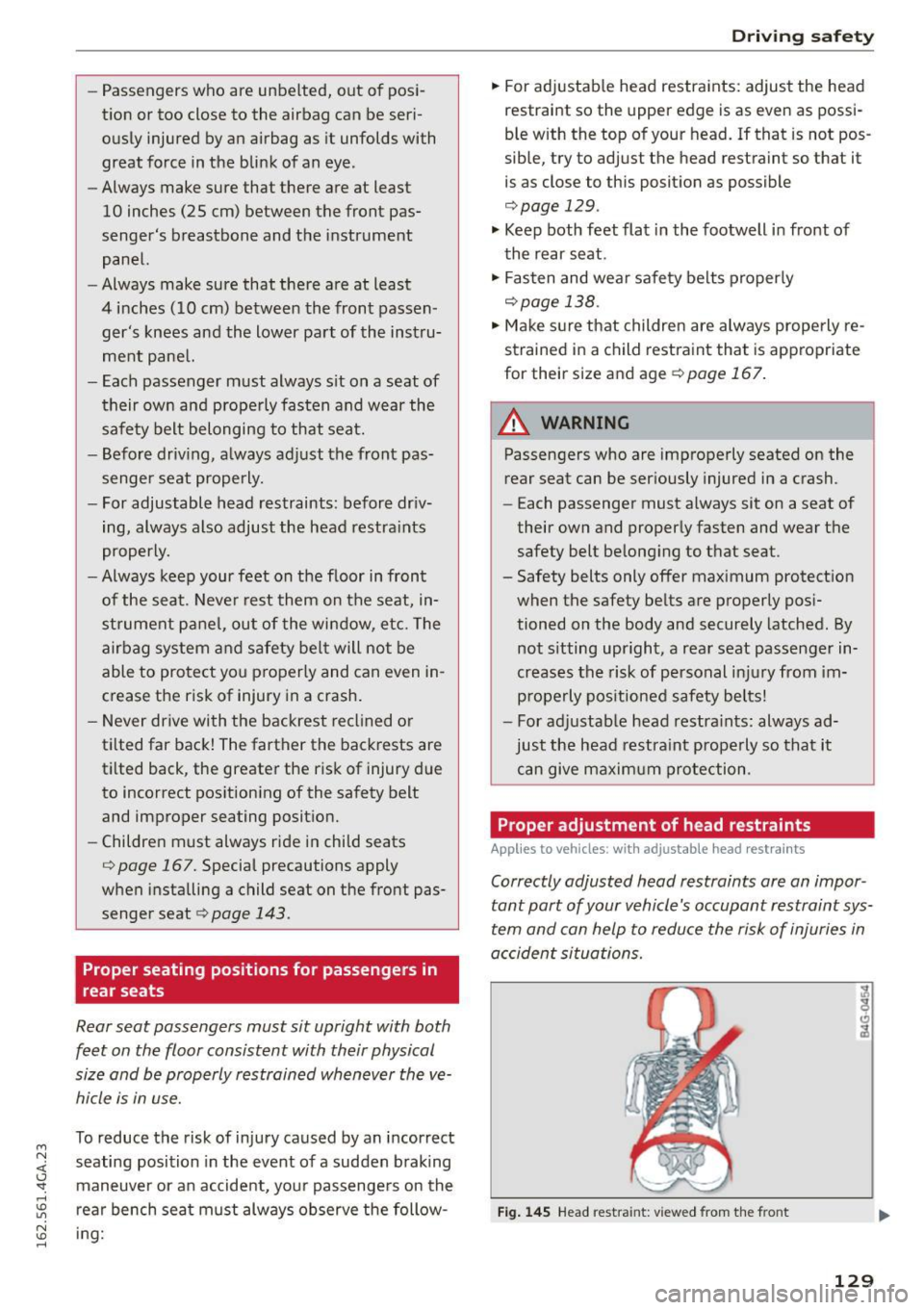
Proper adjustment of head restraints
Applies to vehicles: with adjustable head restraints
Correctly adjusted head restraints are an impor
tant part of your vehicle's occupant restraint sys
tem and can help to reduce the risk of injuries in
accident situations.
Fig. 145 Head restra int: v iewed from the front
129
Page 132 of 294

Driving safety
The head restraints must be correctly adjusted to
achieve the best protection.
.,. Adjust the head restraint so the upper edge is
as even as possible with the top of your head.
If
that is not possible, try to adjust the head re
straint so that it is as close to this position as
possible
c:::> fig. 145. Move the head restraint so
that it is as close to the back of the head as
possible.
.,. If there is a passenger on the rear center seat
ing position*, slide the center head restraint*
upward at least to the next notch.
Adjusting head restraints
c:::> page 55.
A WARNING
All seats are equipped with head restraints. Driving without head restraints or with head
restraints that are not properly adjusted in
creases the risk of serious or fatal neck injury
dramatically. To help reduce the risk of injury:
- Always drive with the head restraints in
place and properly adjusted.
- Every person in the vehicle must have a
properly adjusted head restraint.
-Always make sure each person in the vehicle
properly adjusts their head restraint. Adjust
the head restraint so the upper edge is as
even as possible with the top of your head.
If that is not possible, try to adjust the head
restraint so that it is as close to this position
as possible. Move the head restraint so that
it is as close to the back of the head as pos
sible.
- Never attempt to adjust head restraint while driving. If you have driven off and
must adjust the driver headrest for any rea
son, first stop the vehicle safely before at
tempting to adjust the head restraint.
- Children must always be properly restrained in a child restraint that is appropriate for
their age and size
c:::> page 167 .
130
-
Examples of improper seating positions
The occupant restraint system can only reduce
the risk of injury if vehicle occupants are properly
seated .
Improper seating positions can cause serious in
jury or death. Safety belts can only work when they are properly positioned on the body . Im
proper seating positions reduce the effectiveness
of safety belts and will even increase the risk of injury and death by moving the safety belt to crit
ical areas of the body. Improper seating positions
also increase the risk of serious injury and death
when an airbag deploys and strikes an occupant
who is not in the proper seating position. A driver
is responsible for the safety of all vehicle occu
pants and especially for children. Therefore:
.,. Never allow anyone to assume an incorrect
seating position when the vehicle is being used
c:::> A .
The following bulletins list only some sample po
sitions that will increase the risk of serious injury
and death . Our hope is that these examples will
make you more aware of seating positions that
are dangerous.
Therefore, whenever the vehicle is moving:
-never stand up in the vehicle
- never stand on the seats
- never kneel on the seats
- never ride with the seatback reclined
- never lie down on the rear seat
- never lean up against the instrument panel
- never sit on the edge of the seat
- never sit sideways
- never lean out the window
- never put your feet out the window
- never put your feet on the instrument panel
- never rest your feet on the seat cushion or back
of the seat
- never ride in the footwell
- never ride in the cargo area
Page 134 of 294
Driving safety
-Never place or install floor mats or other
floor coverings on top of already installed
floor mats. Additional floor mats and other coverings will reduce the size of the pedal
area and interfere with the pedals .
- Always properly reinstall and secure floor
mats that have been taken out for cleaning .
- Always make sure that objects cannot fall
into the driver footwell while the vehicle is
moving . Objects can become trapped under
the brake pedal and accelerator pedal caus ing a loss of veh icle control.
Storing cargo correctly
Loading the luggage compartment
All luggage and other objects must be properly
stowed and secured in the luggage compart
ment.
Loose items in the luggage compartment can
shift suddenly, changing vehicle handling charac
teristics. Loose items can also increase the risk of
serious personal injury in a sudden vehicle ma
neuver or in a collision.
.. Distribute the load evenly in the luggage com
partment.
.. Always place and properly secure heavy items in
the luggage compartment as far forward as
possible.
.. Secure luggage using the tie-downs provided
¢ page 63, Luggage compartment.
.,. Make sure that the rear seatback is securely
latched in place .
_& WARNING
Improperly stored luggage or other items can
fly through the vehicle causing serious per
sonal injury in the event of hard braking or an
accident. To help reduce the risk of serious
personal injury:
- Always put objects, for example, luggage or
other heavy items in the luggage compart
ment.
- Always secure objects in the luggage com
partment using the tie-down hooks and
suitable straps.
132
_& WARNING ~ -
Heavy loads will influence the way your vehi
cle handles. To help reduce the r isk of a loss
of control leading to serious personal injury:
- Always keep in mind when transporting
heavy objects, that a change in the center of
gravity can also cause changes in vehicle
handling:
- Always distribute the load as evenly as
possible .
- Place heavy objects as far forward in the luggage compartment as possible.
- Never exceed the Gross Axle Weight Rating
or the Gross Vehicle Weight Rating specified
on the safety compliance sticker on the left
door jamb. Exceeding permissible weight
standards can cause the vehicle to slide and
handle differently .
- Please observe information on safe driving
¢page 126.
_& WARNING
To help prevent poisonous exhaust gas from
being drawn into the vehicle, always keep the
rear lid closed wh ile driving .
- Never transport objects larger than those
fitting completely into the luggage area be
cause the rear lid cannot be fully closed .
- If you absolutely must drive with the rear lid open, observe the following notes to reduce
the risk of poisoning:
- Close all windows,
- Close the power roof*,
- Open all a ir outlets in the instrument pan-
el,
- Switch off the air rec irculat ion,
- Set the fresh air fan to the highest speed.
_& WARNING
Always make sure that the doors, all windows,
the power roof* and the rear lid are securely
closed and locked to reduce the risk of injury
when the vehicle is not be ing used.
- After closing the rear lid, always make sure
-
that it is properly closed and locked. ~
Page 135 of 294
M N <( (.J
'SI: ,...., \!) 1.1"1
N \!) ,....,
-Never leave your vehicle unattended espe
cially w ith the rear lid left open. A chi ld
could crawl into the vehicle through the lug
gage compartment and close the rear lid be
coming trapped and unable to get out . Be
ing trapped in a vehicle can lead to serious
persona l inju ry.
- Never let children play in or around the vehi
cle.
- Never let passengers r ide in the luggage
compartment . Veh icle occupants m ust al
ways be properly restrained in one of the ve
hicle's seat ing pos itions.
-Air c irculation helps to reduce window fog
ging . Stale air escapes to the outside
th rough vents in the trim pane l. Be su re to
k eep the se slots free and open.
- The t ire pressure must correspond to the
l oad. The t ire pressure is shown o n the tire
pres sure label. T he tire pressure l abe l is lo
cated on the d river 's side B-pi llar . The t ire
pressure label lists the recommended cold
tire inflation pressures for the vehicle at its max imum capacity weight and the t ires that
were on your vehicle at the time it was man
ufactured. For recommended tire pressures
for normal load cond it ions, please see chap
te r
c:> page 244.
Tie-downs
The luggage compartment is equipped with four
tie-downs to secure luggage and other items.
Use the tie-downs to secure your cargo properly
c:> page 132, Loading the luggage compartment.
I n a collision, the laws of physics mean that even
sma ller items that are loose in the vehicle wi ll
become heavy miss iles that can cause serious in
jury . Items in the vehicle possess energy which
vary with vehicle speed and the weight of the
item . Vehicle speed is the most s ignificant factor .
For example, in a frontal collis ion at a speed of
30 mph (48 km/h), the forces acting on a 10-lb
(4 .5 kg) object are about 20 times the normal
weight of the item. This means that the we ight
Dr ivin g s afet y
of the item would sudden ly be about
200 lbs. (90 kg) . You can imagine the injuries
that a 200 lbs. (90 kg) item flying freely through
the passenger compartment co uld cause in a col
li sion like this.
A WARNING
=
Weak, damaged or imprope r straps used to
secure items to tie-downs can fail during ha rd
b raking o r in a coll is ion and cause serious per
sona l injury.
- Always use su itable mount ing straps and
p roperly secu re items to the tie-downs in
the l uggage compa rtment to he lp prevent
items from sh ifting or flying forw ard as dan
ge ro us m issi les.
- W hen the rea r seat backrest is folded down,
always use s uitable mo unt ing straps and
properly secu re items to the tie -downs in
the l uggage compa rtment to he lp prevent
items from f ly ing forward as dangerous mis
siles into the passenger compartment.
- Never attach a chi ld safety seat tether strap
to a tie-down.
-
Reporting Safety Defects
Applicable to U.S.A.
If you belie ve that your vehicle
has a def ect which could cause a
c rash or could cau se injur y or
de ath, you should imm ediately in
form the National High way Traffic
S afet y Adm ini stration (NHTSA) in
a ddition to notif yin g Audi of
America, In c.
If NHT SA re ceive s similar com
pl aint s, it may open an inv estig a
tion , and if it finds that a safety
defe cts exists in a group of
ve hicles, it may ord er a recall and .,
133
Page 140 of 294

Safety belts
_&. WARNING
Not wearing safety belts or wearing them im
properly increases the risk of serious personal
injury and death . Safety belts can work only
when used correctly .
- Always fasten your safety belts correctly be
fore driving off and make sure all passen
gers are correctly restrained.
- For maximum protection, safety belts must
always be positioned properly on the body .
- Never strap more than one person, includ
ing small children, into any belt .
- Never place a safety belt over a child sitting
on your lap .
- Always keep feet in the footwell in front of
the seat while the vehicle is being driven .
- Never let any person ride with their feet on
the instrument panel or sticking out the
window or on the seat .
- Never
remove a safety belt while the vehicle
is moving . Doing so will increase your risk of
being injured or killed .
- Never wear belts twisted .
- Never wear belts
over rigid or breakable ob-
jects in or on your clothing, such as eye
glasses, pens, keys, etc ., as these may cause
injury .
- Never allow safety belts to become dam
aged by being caught in door or seat hard
ware.
- Do not wear the shoulder part of the belt
under your arm or otherwise out of position .
- Several layers of heavy clothing may inter
fere with correct positioning of belts and re
duce the overall effectiveness of the system.
- Always keep belt buckles free of anything
that may prevent the buckle from latching
securely .
- Never use comfort clips or devices that cre
ate slack in the shoulder belt. However, spe
cial clips may be required for the proper use
of some child restraint systems.
- Torn or frayed safety belts can tear, and
damaged belt hardware can break in an acci
dent . Inspect belts regularly. If webbing,
bindings, buckles, or retractors are dam-
138
aged, have belts replaced by an authorized
Audi dealer or qualified workshop .
- Safety belts that have been worn and loaded
in an accident must be replaced with the
correct replacement safety belt by an au
thorized Audi dealer. Replacement may be
necessary
even if damage cannot be clearly
seen. Anchorages that were loaded must al
so be inspected.
- Never
remove, modify, disassemble, or try
to repair the safety belts yourself .
-Always keep the belts clean . Dirty belts may
not work properly and can impair the func
tion of the inertia reel¢
table on page 207.
Safety belts
Fastening safety belts
Safety first -everybody buckle up!
Fig. 152 Be lt buckl e and to ngue o n th e dri ver's se at
To provide maximum protection, s afety belts
must always be positioned correctly on the wea r
er's body.
... Adjust the front seat and head restra int proper
ly ¢
page 52, General informa tion.
... Make sure the seatback of the rear seat bench is
in an upright position and securely latched in
place before using the belt
q &_ .
.,. Hold the belt by the tongue and pull it evenly
across the chest and pelvis ¢&_ .
.,. Insert the tongue into the correct buckle of
your seat until you hear it latch securely
¢fig. 152.
... Pull on the belt to make sure that it is securely
latched in the buckle .
II>
Page 165 of 294
M N <( I.J "". rl I.O
"' N I.O rl
How supplemental side airbags work
Side airbags deploy instantly and can help reduce the risk of upper torso injuries for occu
pants who are properly restrained.
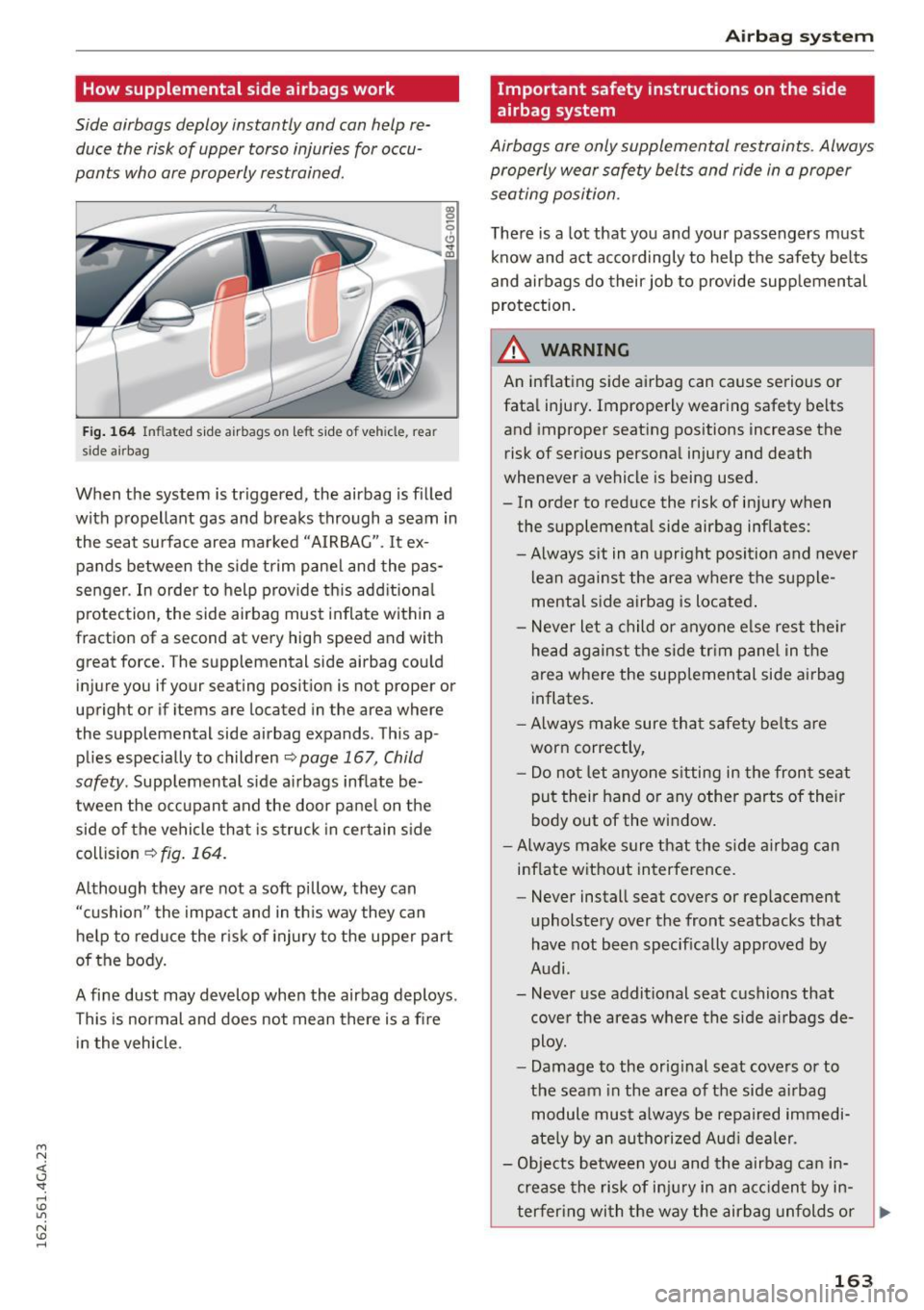
Fig. 164 Inflated side a irbags on left side of veh icle, rea r
side airbag
When the system is triggered, the airbag is filled
with propellant gas and breaks through a seam in
the seat surface area marked "AIRBAG". It ex
pands between the side trim panel and the pas
senger . In order to help provide this additional
protection, the side airbag must inflate within a
fraction of a second at very high speed and with
great force. The supplemental side airbag could
injure you if your seating position is not proper or
upright or if items are located in the area where
the supplemental side airbag expands. This ap
plies especially to children
r:::.>page 167, Child
safety.
Supplemental side airbags inflate be
tween the occupant and the door panel on the
side of the vehicle that is struck in certain side
coll ision
r:::.> fig. 164.
Although they are not a soft pillow, they can
"c ushion " the impact and in this way they can
help to reduce the risk of injury to the upper part
of the body.
A fine dust may develop when the airbag deploys .
This is normal and does not mean there is a fire
in the vehicle .
Airbag system
Important safety instructions on the side
airbag system
Airbags are only supplemental restraints. Always
properly wear safety belts and ride in a proper seating position .
There is a lot that you and your passengers must
know and act accordingly to help the safety belts
and airbags do their job to provide supplemental
protection.
A WARNING
An inflating side airbag can cause serious or
fatal injury. Improperly wearing safety belts
and improper seating positions increase the
risk of serious personal injury and death
whenever a vehicle is being used.
- In order to reduce the risk of injury when
the supplemental side airbag inflates:
- Always sit in an upright position and never
lean against the area where the supple
mental side airbag is located.
- Never let a child or anyone else rest their
head against the side trim panel in the
area where the supplemental side airbag
inflates.
- Always make sure that safety belts are
worn correctly,
- Do not let anyone sitting in the front seat
put their hand or any other parts of their
body out of the window.
- Always make sure that the side airbag can
inflate without interference.
- Never install seat covers or replacemen t
upholstery over the front seatbacks that
have not been specifically approved by
Audi.
- Never use additional seat cushions that cover the areas where the side airbags deploy.
- Damage to the original seat covers or to
the seam in the area of the side airbag
module must always be repaired immedi
ately by an authorized Audi dealer.
-
- Objects between you and the airbag can in
crease the risk of injury in an accident by in
terfering with the way the airbag unfolds or
~
163