airbag off AUDI A7 2016 Owner's Guide
[x] Cancel search | Manufacturer: AUDI, Model Year: 2016, Model line: A7, Model: AUDI A7 2016Pages: 294, PDF Size: 73.82 MB
Page 164 of 294
Airbag syste m
-the e lectronic control module and external side
impact sensors
- the two airbags located in the sides of the front
backrests and the two airbags* located in the
rear backrest
- the ai rbag warning light in the inst rument cl us-
ter .
The a irbag system is monitored electron ica lly to
make certa in that it is function ing properly at a ll
times. Each time you switch on the ignition, the
airbag system indicator light will come on for a
few seconds (self diagnostics).
The s ide a irbag system supplements the safety
be lts and can he lp to reduce the risk of injury to
the driver 's, front and rear passenger 's upper tor
so on the side of the vehicle that is struck in a
side collision. The airbag deploys only in side im
pacts and on ly when the vehicle accelera tion reg
istered by the control unit is high enough . If this
rate is below the reference value programmed in
to the contro l unit , the side airbags will not be
tr iggered, even though the car may be badly
damaged as a result of the co llision.
It is not pos
sible to def ine an a irbag tr igger ing range that
will cover every possible angle of impact, since
the circumstances wi ll vary considerably between
one co llision and another. Important factors in
clude, for example, the nature (hard or soft) of
t he impacting object, the angle of impact, vehicle
speed, etc. ¢
page 163, Important safety in
structions on the side airbag system.
Aside from the ir norma l safety function, safety
be lt s work to help keep the dr iver or front pas
senger in pos it ion in the event of a s ide collision
so that the side a irbags can provide protect ion.
The airbag system is
not a subst itute for your
safety belt. Ra ther, it is part o f the overall occu
pant restraint system in your vehicle . Always re
member that the s ide a irbag system can only
he lp to protect you if you are wear ing your safety
be lt and wearing it p roperly. This is another rea
son why you shou ld always wea r you r safety
be lts, not just because the law requ ires you to do
so ¢
page 135, General information.
It is important to remember that while the sup
p lemental side airbag system is des igned to re-
162
duce the like lihood of serious injur ies, other inju
ries , for example, swelling, bruising, friction
burns and m inor abrasions can a lso be associated
with deployed side airbags. Remember too, s ide
airbags will dep loy only once and only in certain
k inds of accidents -your safety belts are always
the re to offer protection .
Vehicle damage, repair costs or even the lack of
vehicle damage are no t necessarily an indication
of over-sensitive or failed airbag activation . In
some collis ions, both front and side ai rbags may
i nflate . Remember too, that a irbags w ill deploy
o nl y once and on ly in certa in kinds of collisions -
you r safety be lts a re a lways there to offer p rotec
tion in those accidents in which airbags are not s u pposed to deploy or when they have a lready
deployed.
The side airbag system will not deploy:
- when the ignit io n is swit ched off
- in side co llisions when the accele rat ion meas-
ured by the senso r is too low
- in front-end collisions
-in rear-end collisions
- in rollovers.
In some types of accidents the front airbags, side
curtain airbags and side airbags may be triggered
together.
A WARNING
- Safety belts and the airbag system will only
provide protection when occupants are in
the proper seating position
¢ page 163.
-If the airbag ind icator light¢ page 18
comes when the veh icle is being used, have
the system inspected immediately by your
author ized Audi dealer .
It is possible that
the airbag will in flate when i t is not sup
posed to, or will not infla te when it should.
Page 167 of 294
M N <( I.J "". rl I.O
"' N I.O rl
below the refe rence value p rogrammed into the
control unit, the side curtain airbag will not be
tr iggered, even though the car may be badly
damaged as a result of the co llision. It is not pos
sible to define an airbag triggering range that
will cover every poss ible angle of impact, since
the circumstances will vary considerably between one co llision and another. Important factors in
clude, for example, the nature (hard or soft) of
the impacting object, the angle of impact, vehicle speed, etc.¢
page 165, How side curtain air
bags work.
Aside from the ir normal safety function , safety
be lts work to help keep the dr iver or front pas
senger in posit ion in the event of a co llision so
that the side curtain a irbags can provide protec
tion.
The airbag system is not a s ubst itute for yo ur
safety belt. Rather, it is part of the overall occu
pant restraint system in your vehicle . Always re
member that the airbag system can only help to
protect you if you are wear ing your safety be lt
and wearing it properly. Th is is another reason
why you should always wear your sa fety bel ts,
not just because the law requires you to do so
¢ page 135, General information.
It is important to remember that while the side
curta in airbag system is designed to help reduce
the likelihood of serious injuries, other injur ies,
for example , swelling , b ruising, fr iction burns
and minor abras ions can also be associated with
these airbags upon deployment . Remember too,
these airbags will deploy only once and only in
certain k inds of accidents -your safety belts are
always there to offer protectio n.
The side curtain airbag system basically
consis ts of :
- The elec tronic contro l mod ule and externa l side
impact sensors
- The side c urtain a irbags above the front and
rear side windows with ejection mitigation fea
tures
- T he airbag indicator light in the instrument
panel
The airbag system is monitored elect ron ically to
make certa in it is function ing properly a t all
Ai rb ag sy stem
times . Each time you switch on the ign ition, the
airbag system indicator light will come on for a
few seconds (self diagnostics).
Th e s ide curtain airbag is not activated:
- if the ignition is sw itched off,
- in side co llisions when the accele ration meas-
ured by the sensor is too low,
- in rear-end col lisions .
A WARNING
-Safety belts and the airbag system will only
p rovide p rotection when oc cupan ts are in
the proper seating position ¢
page 52, Gen
eral information.
- If the airbag ind ic a tor light~ page 18
comes when the veh icle is being used, have
the system inspected immediately by your
authorized Audi dealer . It is possib le that
the airbag will inflate when it is not sup
posed to, or will not inflate when it should.
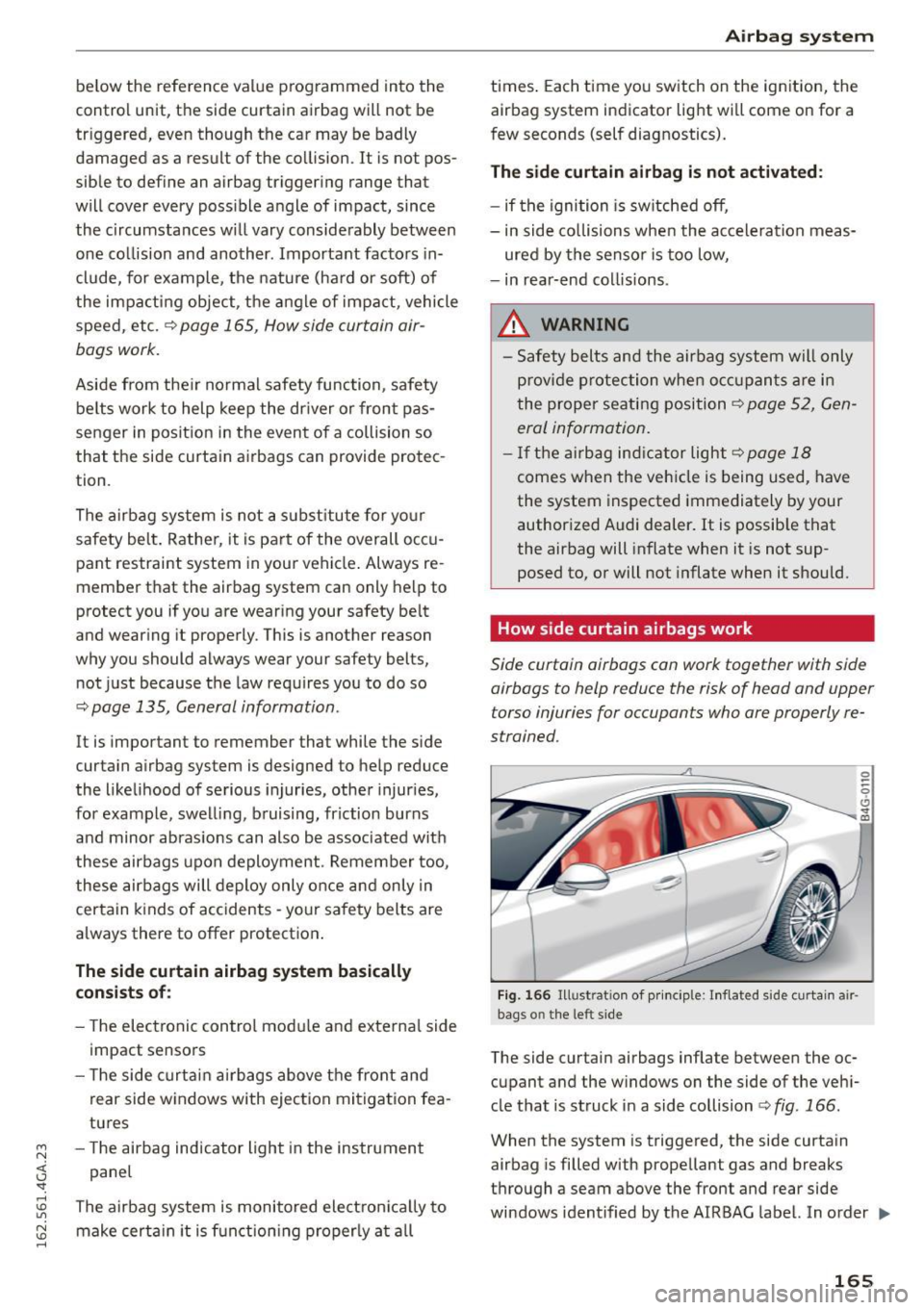
How side curtain airbags work
Side curtain airbags con work together with side
airbags to help reduce the risk of head and upper
torso injuries for occupants who ore properly re
strained .
Fig. 166 Illust rat ion of pr incip le : I n flated si de curtai n air
bags o n th e le ft side
The side curtain airbags inflate betwee n the oc
cupant and the w indows on the side of the veh i-
cle that is struck in a side collision ¢
fig. 166 .
When the system is triggered, the side curtain
airbag is filled wi th propellant gas and breaks
t h rough a seam above the front and rear side
windows identified by the A IRBAG label. In order
ll>-
165
Page 170 of 294
Child safet y
exceptional circ umstances and the
PA SSENGE R AIR BAG OFF light does not
come on and stay on, immediately install
the rear-fac ing ch ild safety seat in a rear
seat ing pos ition and have the airbag system
inspected immediately by your Aud i dealer .
A WARNING
-Forward-facing ch ild seats insta lled on the
front passenger seat may interfere with the deployment of the a irbag and cause serious
persona l injury to the ch ild .
-If exceptiona l circumstances require the use
of a forwa rd-facing child rest raint on the
front passenger's seat, the child 's safety
and we ll-being requ ire the following specia l
precautions to be taken :
- Always make sure that the forward -facing
seat has been designed and certified by its manufacturer for use on a front passenger
seat with a front and side airbag.
- Always carefu lly follow the manufacturer's
instructions provided w ith the child seat
or infant car rier.
- Never install a chi ld restraint without a
properly attached top tether strap if the
child restraint manufacturer's instructions req uire the top tether strap to be used .
- Never put the fo rward-facing child re
straint up against or very near the instru
ment panel.
- Always set the safety belt upper anchor
age to the adjustment position that permits proper insta llation in accordance with
the child restraint manufacturer's instruc tions.
- Always move the passenger seat into its
rearmost position in the seat's fore and aft
adjustment range, as far away from the
airbag as possible before installing the
child restraint . The backrest must be ad
justed to an upr ight position .
- Always make sure that nothing prevents
the front passenger's seat from being moved to the rea rmost pos ition in its fore
and aft adjustment range.
168
- Never place objects on the seat (such as a
laptop, CD player, electronic games device,
power inverter or seat heater for child
seats) . These may influence the electrical
capac itance measured by the capac itive
passenger detection system and can also
fly around in an accident and cause se rious
personal injury .
- Never place or use any electrical device
(such as a laptop, CD player, e lectronic
games device, powe r inverter o r seat heat
er for child seats) on the front passenger
seat if the device is connected to the 12-
vo lt socket or the cigarette lighter socket .
- If a seat heater has been retrofitted or otherwise added to the front passenger seat, never install any child restra int sys
tem on this seat.
- Make sure that there are no wet objects
(such as a wet towel) and no water or oth
er liquids on the front passenger seat
cush ion.
- Always make sure that the
PAS SENGER
AIR BAG O FF
light comes on and stays on
all the time whenever the ignition is
switched on .
- If the
PAS SENGER AIR BAG OFF light
does not come on and stay on, immediate ly install the forward-fac ing child seat in a
rear seating position and have the airbag
system inspe cted by your authorized Audi
dealer.
- Always buc kle the ch ild seat firmly in
place even if a child is not s itting in it. A
l oose ch ild seat can fly around du ring a
sudden stop or in a collis ion .
- Always read and heed all WAR NINGS
whenever using a ch ild restraint in a vehi
cle ¢
page 135, Safety belts, ¢ page 143,
Airbag system
and ¢ page 167, Impor
tant information .
(D Tips
Always replace child restraints that were in
stalled in a vehicle during a crash . Damage to
a child restraint that is not visible could cause it to fail in another co llision situation.
Page 171 of 294
M N <( (.J
'SI: ,...., \!) 1.1'1
N \!) ,....,
Advanced front airbag system and children
Your vehicle is equipped wit h a front "Advanced
A irbag System" i n compliance w it h United States
F ederal Motor Vehicle Safe ty Standard ( FMVSS)
208 as applicable at the time your vehicle was
manufactured .
The Advanced Airbag system in your ve hicl e has
been certified to mee t the " low -risk" requ ire
ments for 3 -and 6-year o ld children on the pas
senger side and small adults on the driver side.
T he low risk deployment criteria are intended to
reduce the r isk of injury through interaction with
the airbag that can occur, for example, by being
too close to the steering whee l and instrument
panel when the a irbag inflates . In add it io n, the
system has been cert ified to comply with the
"suppression" requiremen ts of the Safety Stand
ar d, to turn off t he front airbag for infa nts up to
12 months who are restra ined on the front pas
senger seat in child restraints that are listed i n
the Standard.
E ven though yo ur vehicle is equ ip ped with an Ad
vanced A irbag sys tem, all children, especia lly
those 12 years and younger, should always ride in
the back seat properly restrained for their age
and size. The airbag on the passenger side makes
the front seat a potent ially dangerous p lace for
a
chi ld to r ide. The fro nt seat is not the safes t place
for a child in a forward-facing child safety seat . It
can be a very dangerous place for a n infant or a
l arger child in a rea rward-facing seat .
T he vehicle's Advanced Airbag System has a ca
pacitive passenger detect ion system in the front
passenger seat cush ion that ca n detec t the p res
e n ce of a baby o r a child in a c hild restra int sys
tem on this seat.
The capacit ive passenger detection system regis
ters the changes that result in an electrical field
when a ch ild, a child rest raint, and a baby b la nk et
a re on the fron t passenger sea t. T he change in
the meas ured c apac it a nce due to the presence of
a child,
a chi ld restraint, and a baby blanket on
the front passenger seat is re lated to the child re
straint system resting on the seat . The measu red
capacitance of a chi ld restraint system va ries de-
Child sa fety
pending on the type of sys tem and specific make
and mode l.
T he elec trical c apacit a nce of the va rious types,
makes, and mo dels o f child restra ints specifie d
by the U.S.National Highway Traff ic Sa fety Ad
ministration (NH TSA) in the relevant safety
standard are stored in the Advanced Airbag Sys
tem control unit together w it h the capacitances
typ ica l of infants and a 1-year old child. When a
c h ild restra int is used on the front passenger seat
with
a typ ica l 1 year-old in fant, the Advanced Air
bag System compa res the capacitance measu red
by the capacitive passenge r dete ction system
wi th t he dat a stored in the elec tronic con trol
u ni t.
Child restraints and Advanced front airbag
system
Regardless of the c hild restra int that you use,
make sure that it has been cert ified to meet Unit
ed States Federa l Moto r Veh icle Safety Standa rds
and has been ce rtified by its manufacture r fo r
u se with an a irbag. Always b e sur e t hat t he c hild
r est rain t is prope rly insta lled a t one of the rear
sea ting pos itions. If in excep tional circ ums tan ces
yo u m ust use it on the front passenge r seat, care
fully read a ll of the information on chi ld safety
and Advanced Airbags and heed all of the appli
cable WARNINGS. Make certain that the child
and child restra int are correctly recogni zed by the
capacit ive passenger detection system i n the
front passenger seat, that the front passe nger
airbag is turned off, and that the a irbag status is
always cor rect ly signa led by the
PASSENGER AIR
BAG OFF
light .
Many types and models of child rest raints have
been available ove r the years, new mode ls a re in
t rod uced regu larly in co rporating new and im
proved de signs and older mode ls are take n ou t of
produ ct io n. Ch ild restra ints are not s tandar dized.
Child rest rain ts of the same type typ ically have
different weights and sizes and different "foot
prints", the size and shape of t he bottom of the
c hi ld restra int that sits on the seat, when they
are installed on
a vehicle seat. These d ifferences
make it virtua lly impossib le to cert ify compliance
with the requirements for advanced airbags with .,.
169
Page 172 of 294
Child safety
each and every child restraint that has ever been
sold in the past or will be sold over the course of
the useful life of your vehicle.
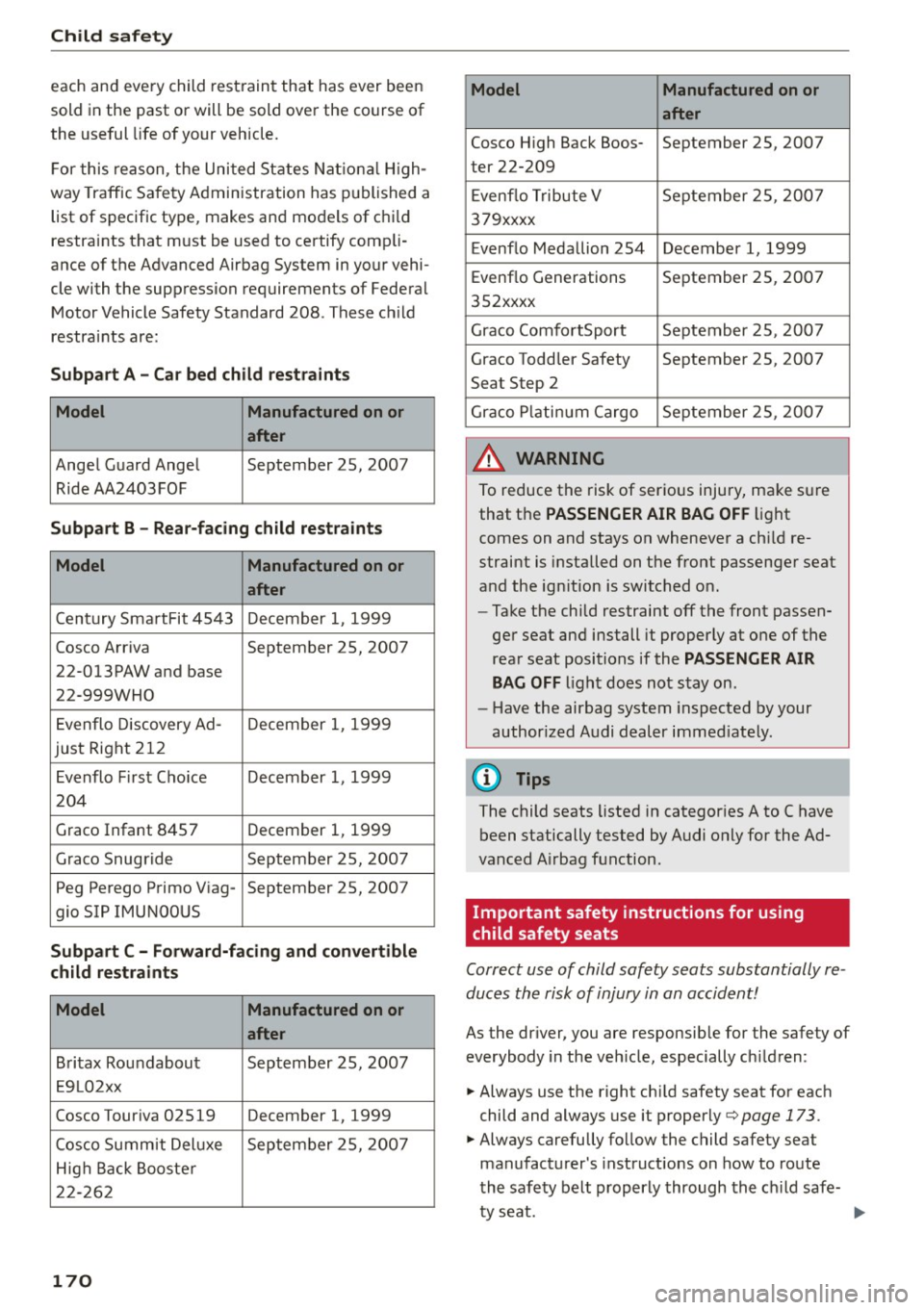
F or this reason, the Uni ted States Nat iona l H igh
way Traffic Sa fety Administration has p ublished a
list of specific type, makes and models of c hild
restraints that m ust be used to certify comp li
ance of the Advanced Airbag System in your vehi
cle with the suppression requirements of Federal
Motor Vehicle Safety Standard 208 . These ch ild
restra ints are:
Subpart A - Car bed child restr aint s
Model Manufactured on or
after
Angel Guard Angel September 25, 2007
Ride AA2403FOF
Subpa rt B -Rear-facing child restraints
Model Manufactured on or
after
Century SmartFit 4543 December 1, 1999
C osco Arriva
September 25, 2007
22-013PAW and base
22-999WHO
E venflo Discovery Ad -
December 1, 1 999
jus t Right 2 12
Evenflo F irst Cho ice December 1, 1999
204
Graco Infant 8457 December
1, 1999
G raco Snugride Sept ember 25, 2007
Peg Perego P rimo V iag- September 25, 2007
gio SIP IMU NOOUS
Subp art C - Forward-facing and convertible
child restraints
Model Manufactured on or
after
Brit ax Ro undabout September 25, 2007
E9L 02xx
Cosco Tour iva 02519 December 1, 1999
C osco Summ it Del uxe September 25, 200 7
H igh Back Booste r
22- 262
170
Model Manufactured on or
after
Cosco H igh Back Boos- September 25 , 2007
ter 22-209
E ven flo Tribute V September 25, 20 07
379xxxx
Evenflo Meda llion 254 December 1, 1999
Evenf lo Generations September 25, 2007
352xxxx
Graco Comfo rtSport September 25 , 2007
Graco Todd ler Safety September 25, 2007
Seat Step 2
Gr aco Platinu m Cargo Se pte mber 25, 200 7
_& WARNING
To reduce the risk of ser io us injury , ma ke s ure
that the
PASSENGER AIR BAG OFF lig ht
comes on and stays on whenever a ch ild re
straint is installed on the front passenger seat
and the ig nition is switched o n.
- Ta ke the child restraint off the front passen
ger seat and install it properly at o ne of the
rea r seat positions if the
PASSENG ER AIR
BAG OFF ligh t does not s tay on.
- Have the airbag system inspected by your
author ized Audi dealer immed iate ly.
(D Tips
The child seats listed in categor ies A to C have
been statically tested by Audi only for the Ad
vanced A irbag function.
Important safety instructions for using
child safety seats
Correct use of child safety seats substantially re
duces the risk of injury in an accident!
As the dr iver, you are responsib le for the safety of
everybody in the veh icle, especially ch ildren:
.. Always use the right ch ild safety seat for each
child and always use it properly
c::;, page 173 .
.. Always carefully fo llow the child safety seat
manufact urer's instructions on how to ro ute
the saf ety belt properly through the c hild safe
ty seat.
Page 174 of 294
Child safety
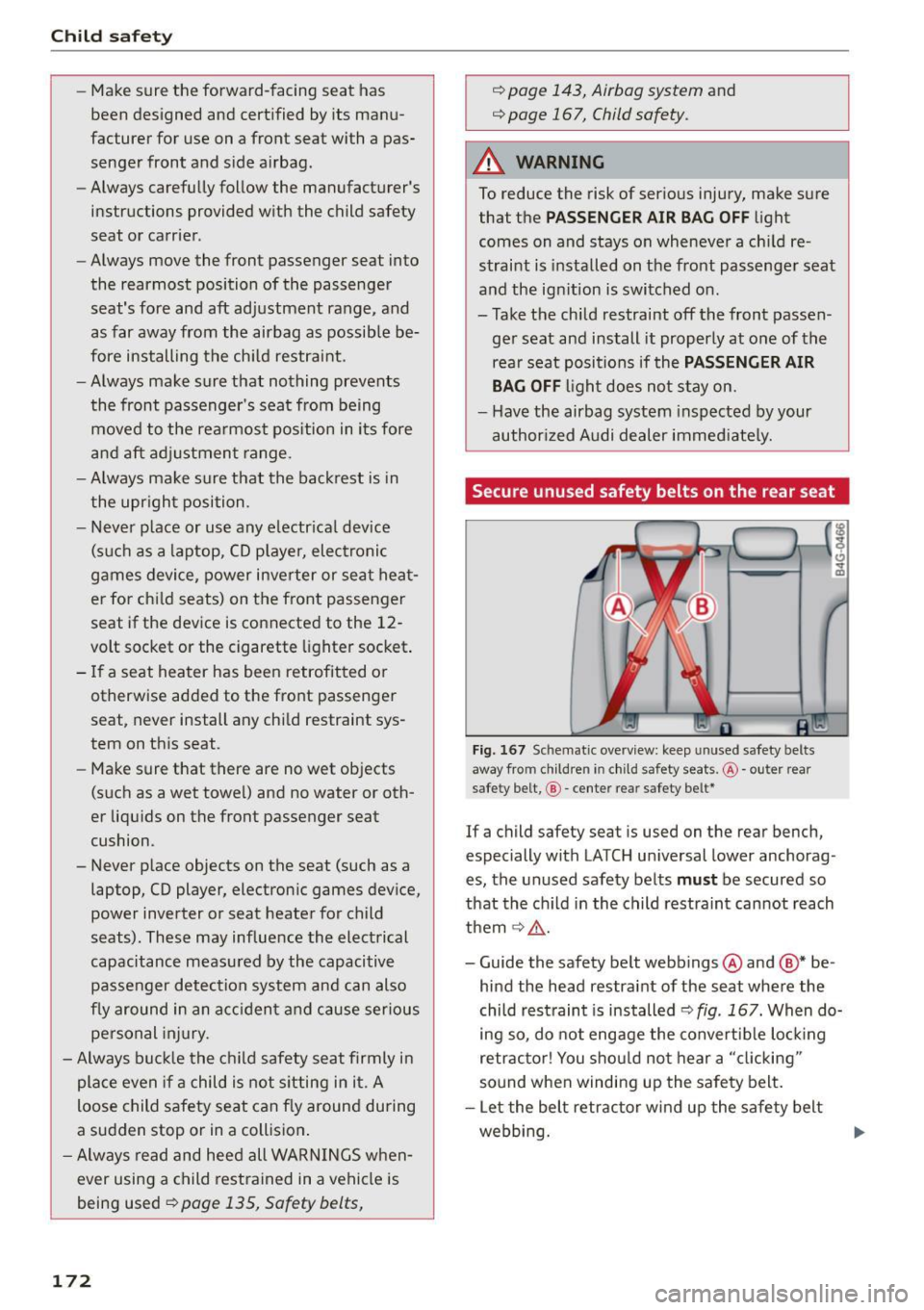
-Make sure the forward-facing seat has
been designed and certified by its manu
facturer for use on a front seat with a pas
senger front and side airbag .
- Always carefully follow the manufacturer 's
instructions provided with the child sa fety
seat or carrier .
- Always move the front passenger seat into
the rearmost position of the passenger
seat's fore and aft adjustment range, and
as far away from the airbag as possible be
fore installing the child restraint.
- Always make sure that nothing prevents
the front passenger's seat from being moved to the rearmost position in its fore
and aft adjustment range.
- Always make sure that the backrest is in
the upright position .
- Never place or use any electrical device
(such as a laptop, CD player, electronic
games device, power inverter or seat heat
er for child seats) on the front passenger
seat if the device is connected to the 12-
volt socket or the cigarette lighter socket.
- If a seat heater has been retrofitted or
otherwise added to the front passenger
seat, never install any child restraint sys
tem on this seat .
- Make sure that there are no wet objects
(such as a wet towel) and no water or oth
er liquids on the front passenger seat
cushion .
- Never place objects on the seat (such as a laptop, CD player, electronic games device ,
power inverter or seat heater for child
seats) . These may influence the electrical
capacitance measured by the capacitive passenger detection system and can also
fly around in an accident and cause serious
personal injury.
- Always buckle the child safety seat firmly in
place even if a child is not sitting in it. A
loose child safety seat can fly around during
a sudden stop or in a collision.
- Always read and heed all WARNINGS when
ever using a child restrained in a vehicle is
being used
c::> poge 135, Safety belts,
172
c::> page 143, Airbag system and
c::> page 167, Child safety .
A WARNING
To reduce the risk of serious injury, make sure
that the
PASSENGER AIR BAG OFF light
comes on and stays on whenever a child re
straint is installed on the front passenger seat
and the ignition is switched on .
- Take the child restraint off the front passen
ger seat and install it properly at one of the
rear seat positions if the
PASSENGER AIR
BAG OFF
light does not stay on.
- Have the airbag system inspected by your
authorized Audi dealer immediately.
Secure unused safety belts on the rear seat
Fig. 167 Schem ati c o verview: keep unused safety belt s
away fro m childre n in child safety seats. @ -ou te r rear
s a fe ty belt, @ -center rea r sa fety belt*
If a child safety sea t is used on the rear bench,
especially with LATCH universal lower anchorag
es, the unused safety belts
must be secured so
that the child in the child restraint cannot reach
them
c::> _&. .
- Guide the safety belt webbings @and ®* be
hind the head restraint of the seat where the
child restraint is installed
c::> fig . 167. When do
ing so, do not engage the convertible locking
retractor! You should not hear a "clicking "
sound when winding up the safety belt.
- Let the belt retractor wind up the safety belt
webbing.
Page 175 of 294
M N <( I.J "". rl I.O
"' N I.O rl
_& WARNING
A child in a child safety seat installed with the LATCH lower anchorages or with the standard
safety belt or a child in a booster seat on the
rear seat could play with unused rear seat
safety belts and become entangled. This
could cause the child serious personal injury
and even death.
- Always secure unused rear seat safety belts
out of reach of children in child seats such
as by properly routing them around the
head restraint of the seat where the child re
straint is installed.
- Never activate the convertible locking re
tractor when routing the safety belts around
the head restraints.
- Never let anyone sit at the center rear seat
ing position if the center rear safety belt has
been routed around a rear head restraint.
Child seats
Infant seats
Babies and infants up to about one year old and
20 lbs. or
9 kg need special rearward-facing
child restraints that support the back, neck and
head in a crash .
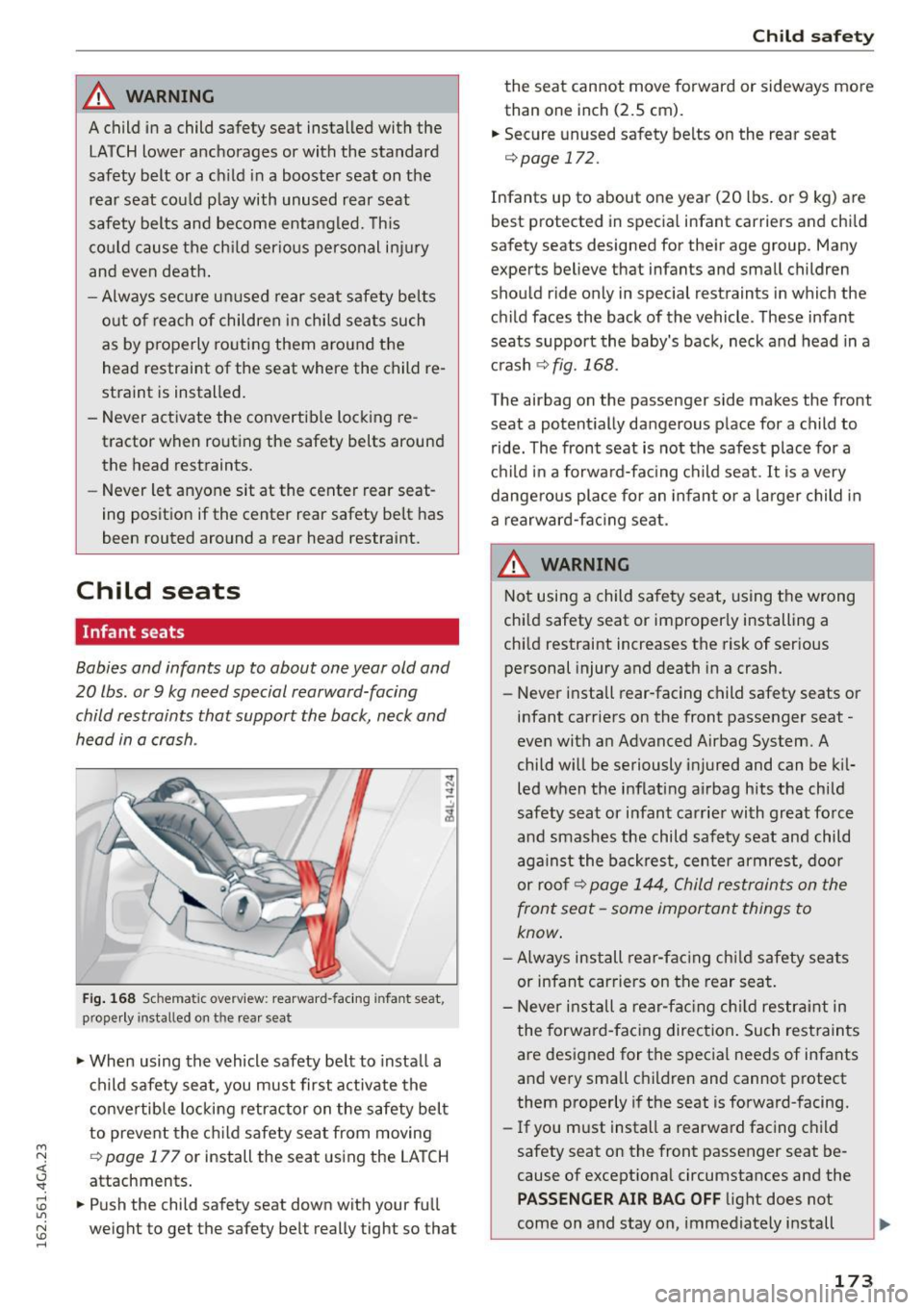
Fig. 168 Schematic overview: rearward-facing infa nt seat,
prope rly instal led on t he rear seat
"When using the vehicle safety belt to install a
child safety seat, you must first activate the convertible locking retractor on the safety belt
to prevent the child safety seat from moving
r::;,page 177 or install the seat using the LATCH
attachments.
"Push the child safety seat down with your full
weight to get the safety belt really tight so that
Child safety
the seat cannot move forward or sideways more
than one inch (2.5 cm).
... Secure unused safety belts on the rear seat
r::;, page 172.
Infants up to about one year (20 lbs. or 9 kg) are
best protected in special infant carriers and child
safety seats designed for their age group. Many
experts believe that infants and small children
should ride only in special restraints in which the
child faces the back of the vehicle . These infant
seats support the baby's back, neck and head in a
crash
¢ fig. 168.
The airbag on the passenger side makes the front
seat a potentially dangerous place for a child to
ride. The front seat is not the safest place for a
child in a forward-facing child seat. It is a very
dangerous place for an infant or a larger child in
a rearward-facing seat.
_& WARNING
-
Not using a child safety seat, using the wrong
child safety seat or improperly installing a
child restraint increases the risk of serious personal injury and death in a crash.
- Never install rear-facing child safety seats or
infant carriers on the front passenger seat -
even with an Advanced Airbag System. A
child will be seriously injured and can be kil led when the inflating airbag hits the child
safety seat or infant carrier with great force
and smashes the child safety seat and child
against the backrest, center armrest, door
or roof
r::;, page 144, Child restraints on the
front seat -some important things to
know.
-Always install rear-facing child safety seats
or infant carriers on the rear seat.
- Never install a rear-facing child restraint in
the forward-facing direction. Such restraints
are designed for the special needs of infants
and very small children and cannot protect
them properly if the seat is forward-facing.
- If you must install a rearward facing child
safety seat on the front passenger seat be
cause of exceptional circumstances and the
PASSENGER AIR BAG OFF light does not
come on and stay on, immediately install
173
Page 177 of 294
M N <( (.J
'SI: ,...., \!) 1.1'1
N \!) ,....,
personal injury and death in a collision or oth
er emergency situation.
- Children on the front seat of any car, even
with Advanced Airbags, can be seriously in
jured or even killed when an airbag inflates.
A child in a rearward-facing child safety seat installed on the front passenger seat will be
seriously injured and can be killed if the
front airbag inflates -even with an Ad
vanced Airbag System.
- The inflating airbag will hit the child safety
seat or infant carrier with great force and
will smash the child safety seat and child against the backrest, center arm rest, door
or roof.
- Always install rear-facing child safety seats
on the rear seat.
- If you must install a rearward facing child
safety seat on the front passenger seat be
cause of exceptional circumstances and the
PASSENGER AIR BAG OFF light does not
come on and stay on, immediately install
the rear-facing child safety seat in a rear
seating position and have the airbag system
inspected by your Audi dealer .
- The rear side of the child safety seat should
be positioned as close as possible to the
backrest on the vehicle seat .
- For adjustable head restraints: adjust or re
move the rear seat head restraint if it is dif
ficult to install the child seat with the head
restraint in place
r=;.page 56. Install the
head restraint again immediately once the
child seat is removed. Driving without head
restraints or with head restraints that are
not properly adjusted increases the risk of
serious or fatal neck injury dramatically.
- Always read and heed all WARNINGS when
ever using a child restrained in a vehicle is
being used
r=;, page 135, Safety belts,
r=;, page 143, Airbag system and
9 page 167, Important information.
_&. WARNING
If exceptional circumstances require the use
of a forward-facing child restraint on the front
passenger's seat, the child's safety and well-
Child safety
being require that the following special pre
cautions be taken:
- Make sure the forward-facing seat has been
designed and certified by its manufacturer
for use on a front seat with a passenger
front and side airbag.
- Always follow the manufacturer's instruc
tions provided with the child safety seat or
infant carrier .
- Always move the front passenger seat into
the rearmost position of the passenger
seat's fore and aft adjustment range, and as
far away from the airbag as possible before installing the child restraint.
- Always make sure that nothing prevents the front passenger's seat from being moved to
the rearmost position in its fore and aft ad
justment range.
- Always make sure the backrest is in an up
right position.
- Never place or use any electrical device
(such as a laptop, CD player, electronic
games device, power inverter or seat heater
for child seats) on the front passenger seat
if the device is connected to the 12-volt
socket or the cigarette lighter socket.
- If a seat heater has been retrofitted or oth
erwise added to the front passenger seat, never install any child restraint system on
this seat.
- Make sure that there are no wet objects
(such as a wet towel) and no water or other
liquids on the front passenger seat cushion.
- Never place objects on the seat (such as a
laptop, CO player, electronic games device,
power inverter or seat heater for child
seats). These may influence the electrical
capacitance measured by the capacitive pas
senger detection system and can also fly
around in an accident and cause serious per
sonal injury.
- Make sure that the
PASSENGER AIR BAG
OFF
light comes on and stays on all the time
whenever the ignition is switched on.
- If the
PASSENGER AIR BAG OFF light does
not come on and stay on, immediately in
stall the forward-facing child seat at a seat-
ing position on the rear seat and have the
Ill-
175
Page 178 of 294
Child safety
airbag system inspected by your authorized
Audi dealer.
- Take the child restraint off the front passen
ger seat and install it properly at one of the
rear seat positions if the
PASSENGER AIR
BAG OFF
light does not stay on whenever
the ignition is switched on .
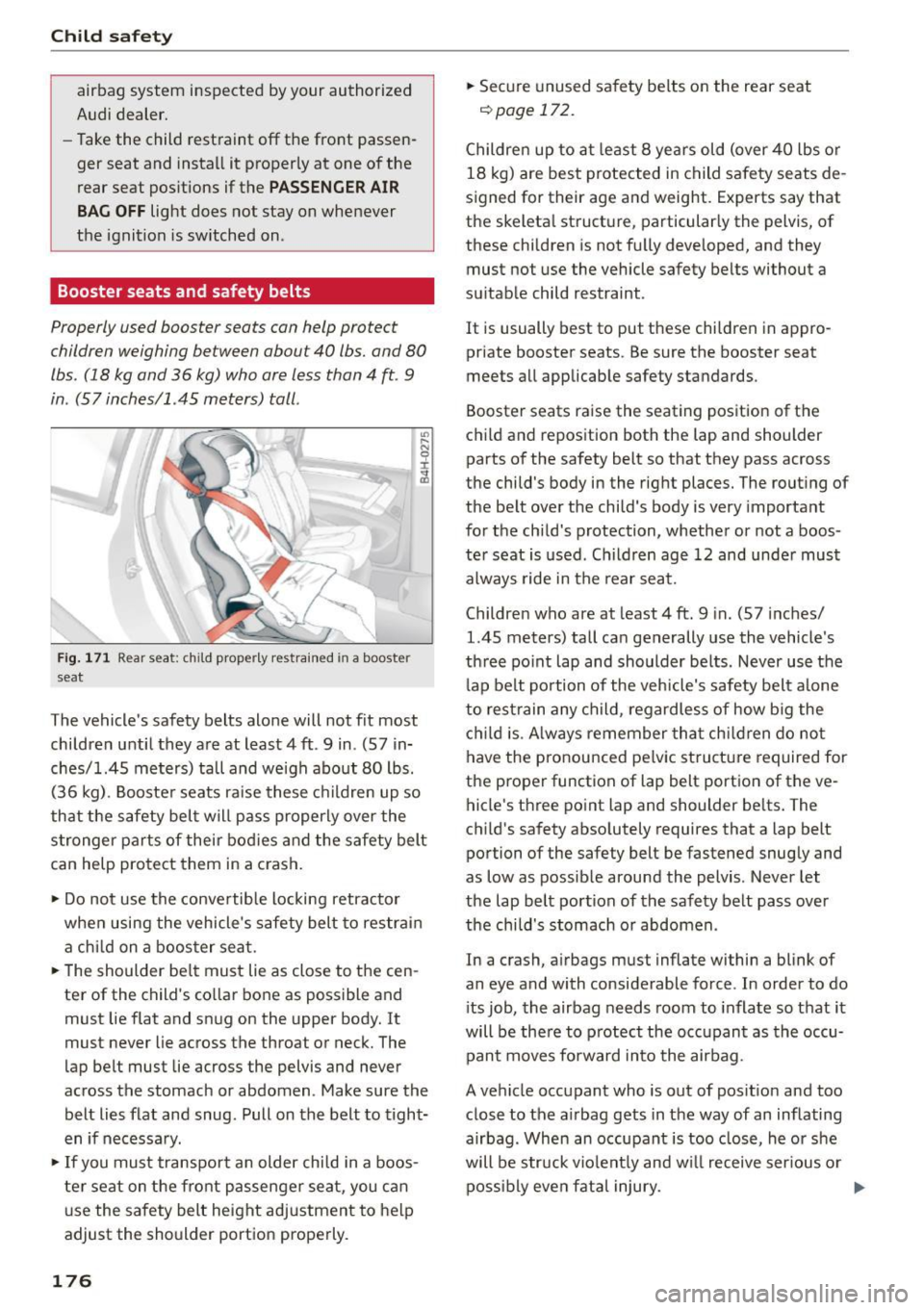
Booster seats and safety belts
Properly used booster seats con help protect
children weighing between about 40 lbs. and 80
lbs. (18 kg and 36 kg) who ore less than 4
ft. 9
in . (57 inches/1 .45 meters) tall .
Fig. 171 Rear seat: ch ild prope rly restrained in a booster
seat
"' ,-.
i i
The vehicle's safety belts alone will not fit most
children until they are at least 4
ft. 9 in . (57 in
ches/1.45 meters) tall and weigh about 80 lbs.
(36 kg). Booster seats raise these children up so
that the safety belt will pass properly over the
stronger parts of their bodies and the safety belt
can help protect them in a crash.
• Do not use the convertible locking retractor
when using the vehicle's safety belt to restrain
a child on a booster seat.
• The shoulder be lt must lie as close to the cen
ter of the child's collar bone as possible and
must lie flat and snug on the upper body. It
must never lie across the throat or neck. The
lap belt must lie across the pelvis and never
across the stomach or abdomen . Make sure the
belt lies flat and snug . Pull on the belt to tight
en if necessary.
• If you must transport an older child in a boos
ter seat on the front passenger seat, you can
use the safety belt height adjustment to help
adjust the shoulder portion properly .
176
• Secure unused safety belts on the rear seat
r=;, page 172 .
Children up to at least 8 years old (over 40 lbs or
18 kg) are best protected in child safety seats de
signed for their age and weight . Experts say that
the skeletal structure, particularly the pelvis, of
these children is not fully developed, and they
must not use the vehicle safety belts without a
suitable child restraint .
It is usually best to put these children in appro
priate booster seats . Be sure the booster seat
meets all applicable safety standards.
Booster seats raise the seating position of the
child and reposition both the lap and shoulder parts of the safety belt so that they pass across
the child 's body in the right places. The routing of
the belt over the child 's body is very important
for the child's protection, whether or not a boos
ter seat is used. Children age 12 and under must
always ride in the rear seat.
Children who are at least 4
ft. 9 in. (57 inches/
1.45 meters) tall can generally use the vehicle's
three point lap and shoulder belts . Never use the
lap belt portion of the vehicle's safety belt alone
to restrain any child, regardless of how big the
child is. Always remember that childr en do not
have the pronounced pelvic structure required for
the proper function of lap belt portion of the ve
hicle 's three point lap and shoulder belts. The
child's safety absolutely requires that a lap belt
portion of the safety belt be fastened snugly and
as low as possible around the pelvis . Never let
the lap belt portion of the safety belt pass over
the child's stomach or abdomen .
In a crash, airbags must inflate within a blink of
an eye and with considerable force . In order to do
its job, the airbag needs room to inflate so that it
will be there to protect the occupant as the occu
pant moves forward into the airbag .
A vehicle occupant who is out of position and too
close to the airbag gets in the way of an inflating
airbag . When an occupant is too close, he or she
will be struck violently and will receive serious or
possibly even fatal injury. .,..
Page 179 of 294
M N <( (.J
'SI: ,...., \!) 1.1'1
N \!) ,....,
In order for the airbag to offer protection, it is
important that all vehicle occupants, especially
any children, who must be in the front seat be
cause of exceptional circumstances, be properly
restrained and as far away from the airbag as
possible . By keeping room between the child's
body and the front of the passenger compart
ment, the airbag can inflate completely and pro
vide supplemental protection in certain frontal
collisions .
A WARNING
Not using a booster seat, using the booster
seat improperly, incorrectly installing a boos
ter seat or using the vehicle safety belt im
properly increases the risk of serious personal
injury and death in a collision or other emer
gency situation. To help reduce the risk of se
rious personal injury and/or death:
- The shoulder belt must lie as close to the
center of the child's collar bone as possible
and must lie flat and snug on the upper
body . It must never lie across the throat or
neck. The lap belt must lie across the pelvis
and never across the stomach or abdomen.
Make sure that the belt lies flat and snug.
Pull on the belt to tighten if necessary.
- Failure to properly route safety belts over a
child's body will cause severe injuries in an
accident or other emergency situation
¢ page 135.
-The rear side of the child safety seat should
be positioned as close as possible to the
backrest on the vehicle seat.
- For adjustable head restraints : adjust or re
move the rear seat head restraint if it is dif
ficult to install the child seat with the head restraint in place¢
page 56. Install the
head restraint again immediately once the
child seat is removed. Driving without head
restraints or with head restraints that are
not properly adjusted increases the risk of
serious or fatal neck injury dramatically .
- Children on the front seat of any car, even
with Advanced Airbags, can be seriously in
jured or even killed when an airbag inflates.
- Never let a child stand or kneel on any seat,
for example the front seat.
-
Child safety
-Never let a child ride in the cargo area of
your vehicle.
- Always remember that a child leaning for
ward, sitting sideways or out of position in any way during an accident can be struck by
a deploying airbag. This will result in serious
personal injury or death.
- If you must install a booster seat on the
front passenger seat because of exceptional
circumstances the
PASSENGER AIR BAG
OFF
light must come on and stay on, when
ever the ignition is switched on.
- If the
PASSENGER AIR BAG OFF light does
not come on and stay on, perform the
checks described ¢
page 154, Monitoring
the Advanced Airbag System.
- Take the child restraint off the front passen
ger seat and install it properly at one of the
rear seat positions if the
PASSENGER AIR
BAG OFF
light does not stay on whenever
the ignition is switched on.
- Always read and heed all WARNINGS when
ever using a child restrained in a vehicle is
being used
¢ page 135, Safety belts,
¢ page 143, Airbag system and
¢ page 167, Important information.
Securing child seats
Securing a child safety seat using a safety
belt
Safety belts for the rear seats and the front pas
senger can be locked with the convertible locking
retractor to properly secure child safety seats.
The safety belts emergency locking retractors for
the rear seats safety belts and for the front pas
senger's seat safety belt have a convertible lock
ing retractor for child restraints. The safety belt
must be locked so that belt webbing cannot un
reel. The retractor can be activated to lock the
safety belt and prevent the safety belt webbing
from loosening up during normal driving. A child
safety seat can only be properly installed when
the safety belt is locked so that the child and
child safety seat will stay in place .
Always remember: Even though your vehicle is equipped with an Advanced Airbag system, all
177