flat tire AUDI A7 2016 Owners Manual
[x] Cancel search | Manufacturer: AUDI, Model Year: 2016, Model line: A7, Model: AUDI A7 2016Pages: 294, PDF Size: 73.82 MB
Page 64 of 294
Seat s and storage
- Objects falling from the roof of a vehicle can
cause a crash and personal injury.
- Only mount the roof rack on the designated
locations on the roof¢
fig. 63.
-The roof rack system must be insta lled ex
actly according to the instructions provided .
- When driving with a roof rack system, changes to the center of gravity and w ind re
sistance can change the vehicle handling
and lead to a collision. A lways adapt your
dr iving and your speed to the current cond i
t ions.
(D Note
- Your vehicle warranty does not cover any
damages to the vehicle caused by using roof
racks or mounting structures not approved
by Aud i for your vehicle . The same app lies to
damage res ulting from incorrect roof rack
i nsta llation.
-A lways check the roof rack mount ings and
hardware before each trip and dur ing a tr ip
to make su re eve rything is securely tight
ened .
If necessary, re tighten the mo untings
a nd chec k the en tire system from time to
time.
- After mounting a roof rack syste m, or when
you transport objec ts on the roof o f yo ur ve
hicle, the height of the veh icle is naturally
increased. Be caref ul when driv ing under
l ow bridges or in parking garages for exam
ple. This cou ld cause damage to the load
and even t he vehicle itself.
- Make sure the open rear lid and the sun roof* do not come into contact with the roof
rack .
Loading the roof rack
Always distribu te loads evenly. Make sure any
t hing on the roof rack is securely tied down.
~ A lways distribute the loads on the roo f rack
evenly .
~ Always attach items to the roof rack secure ly
before you drive off .
The max imum permissib le roof weight is
220 lb
( 100 kg ).
The roof weight is the total of the
62
weight o f the roof rack, the attachments and the
cargo you are carry ing . You must a lso not exceed
the maximum load weight for the roof rack yo u
a re using .
When using a roof rack system which has a lower
l oad car rying capacity, you must not use up the
total max imum permissib le load carrying capaci
ty specified above. Inste ad, you should load the
roo f rack system only to the maximum capacity
specified by the manufacturer of the roof rack
system.
A WARNING
Weak, damaged or improper straps used to
secure i tems to the roof rack can fail d uring
hard br aking o r in a collision and cause ser i
ous persona l injury.
- Ma ke su re the roof ra ck is ins talled exactly
as spe cified above
c::> page 61 .
-Always use su itable mount ing straps for se
cur ing ite ms to the roof rack to help p reven t
i t ems from shifting o r flying forwa rd .
- It ems on t he roof rac k must always be se
curely mounted .
-The use of a roof rack ca n negat ively affect
the way a vehicle handles. C argo th at i s
large, heavy, bulky, long or flat will have a
greater negative influence on the vehi cle's
aerodynamics, center of gravity and overall
handling . A lways drive slowly, avoid sudden
brak ing and maneuvers whe n transporting
cargo on the roof of your veh icle.
- Never exceed the maxim um permissible
load carrying capacity of the roof of your ve
hicle, the perm iss ible axle weig hts and the
pe rm issib le tota l we ight of your vehicle
c::>page 271, Weights.
@) For the sake of the environment
As a result of the increased wind resistance
created by a roof rack, you r vehicle is using
fuel u nnecessarily . So remove the roof rack af
ter using it.
-
Page 135 of 294
M N <( (.J
'SI: ,...., \!) 1.1"1
N \!) ,....,
-Never leave your vehicle unattended espe
cially w ith the rear lid left open. A chi ld
could crawl into the vehicle through the lug
gage compartment and close the rear lid be
coming trapped and unable to get out . Be
ing trapped in a vehicle can lead to serious
persona l inju ry.
- Never let children play in or around the vehi
cle.
- Never let passengers r ide in the luggage
compartment . Veh icle occupants m ust al
ways be properly restrained in one of the ve
hicle's seat ing pos itions.
-Air c irculation helps to reduce window fog
ging . Stale air escapes to the outside
th rough vents in the trim pane l. Be su re to
k eep the se slots free and open.
- The t ire pressure must correspond to the
l oad. The t ire pressure is shown o n the tire
pres sure label. T he tire pressure l abe l is lo
cated on the d river 's side B-pi llar . The t ire
pressure label lists the recommended cold
tire inflation pressures for the vehicle at its max imum capacity weight and the t ires that
were on your vehicle at the time it was man
ufactured. For recommended tire pressures
for normal load cond it ions, please see chap
te r
c:> page 244.
Tie-downs
The luggage compartment is equipped with four
tie-downs to secure luggage and other items.
Use the tie-downs to secure your cargo properly
c:> page 132, Loading the luggage compartment.
I n a collision, the laws of physics mean that even
sma ller items that are loose in the vehicle wi ll
become heavy miss iles that can cause serious in
jury . Items in the vehicle possess energy which
vary with vehicle speed and the weight of the
item . Vehicle speed is the most s ignificant factor .
For example, in a frontal collis ion at a speed of
30 mph (48 km/h), the forces acting on a 10-lb
(4 .5 kg) object are about 20 times the normal
weight of the item. This means that the we ight
Dr ivin g s afet y
of the item would sudden ly be about
200 lbs. (90 kg) . You can imagine the injuries
that a 200 lbs. (90 kg) item flying freely through
the passenger compartment co uld cause in a col
li sion like this.
A WARNING
=
Weak, damaged or imprope r straps used to
secure items to tie-downs can fail during ha rd
b raking o r in a coll is ion and cause serious per
sona l injury.
- Always use su itable mount ing straps and
p roperly secu re items to the tie-downs in
the l uggage compa rtment to he lp prevent
items from sh ifting or flying forw ard as dan
ge ro us m issi les.
- W hen the rea r seat backrest is folded down,
always use s uitable mo unt ing straps and
properly secu re items to the tie -downs in
the l uggage compa rtment to he lp prevent
items from f ly ing forward as dangerous mis
siles into the passenger compartment.
- Never attach a chi ld safety seat tether strap
to a tie-down.
-
Reporting Safety Defects
Applicable to U.S.A.
If you belie ve that your vehicle
has a def ect which could cause a
c rash or could cau se injur y or
de ath, you should imm ediately in
form the National High way Traffic
S afet y Adm ini stration (NHTSA) in
a ddition to notif yin g Audi of
America, In c.
If NHT SA re ceive s similar com
pl aint s, it may open an inv estig a
tion , and if it finds that a safety
defe cts exists in a group of
ve hicles, it may ord er a recall and .,
133
Page 204 of 294

Trailer mode
Tire pressure
When tow ing a trailer, inflate the tires of your ve
hicle to the cold tire pressure listed under " Full
load" on the label located on the driver's side B
pillar (visible when the door is open). Inflate
trailer tires to trailer and tire manufacturers'
specifications.
Lights
Check to make sure both vehicle and trailer lights
are working properly .
Safety chains
Be sure trailer safety cha ins are p roperly connect
ed from the trailer to the hitch on the vehicle.
L eave enough slack in the chains to permit turn
ing corners. When you install safety chains, make
sure they will not drag on the road when you are
driving.
The chains should cross under the trai ler tongue
to prevent it from dropping in case of separation
from the hitch.
Adjusting the Audi drive select
Make su re the vehicle is on a level su rface before
h itching up the trailer and before adjusting the
tongue weight . The vehicle must be in
auto or
comfort driving mode and not raised
r::!> page 101, r::!> 0.
Make sure that the vehicle is lowered. In Info
tainment, select:
ICARI function button > Lower
control button.
If you must drive under poor road conditions, you
can raise the vehicle
after coupling the traile r or
after adjusting the tongue weight c::!> page 103 .
(D Note
-Changes in temperature or load can affect
the height of the vehicle.
- Always select
auto or comfort mode. Other
wise, the tongue load specified for your ve
hicle will no longer be applicable.
202
· Driving instructions
Driving with a trailer always requires extra care
and consideration .
To obtain the best possible handling of vehicle
and trailer, please note the follow ing:
.,. Do not tow a loaded trailer when your car itself
is not loaded .
.,. Be especially carefu l when passing other
vehicles.
.,. Observe speed lim its .
.,. Do not drive at the maximum permissib le
speed.
.,. Always app ly brakes early .
.,. Monitor the temperature gauge.
Weight distribution
Towing a loaded trailer with an empty car results
i n a h ighly unstab le distribution of weight. If th is
cannot be avoided, dr ive at very low speeds only
to avoid the risk of losing steer ing control.
A "balanced" rig is easier to operate and control.
This means that the tow vehicle shou ld be loaded
to the extent possible and permissib le, w hile
k eep ing the traile r as light as possible under the
circumstances. Whenever possible, transfer
some ca rgo to the luggage compartment of the
tow vehicle while observing tongue load require
ments and vehicle loading considerations.
Speed
The higher the speed, the more difficult it be
comes for the driver to contro l the rig. Do not
drive at the maximum permissible speed. Reduce
your speed even more if load, weather or wind cond itions are unfavorab le -particular ly when
going downh ill.
Red uce vehicle speed
immediately if the trailer
shows the slightest sign of swaying .
Do not try
to stop the swaying by accelerating.
Observe speed limits . In some areas, speeds for
vehicles towing trai lers are lower than for regular
vehicles.
Always apply brakes early. When driving dow n
hill, shift i nto a lower gear to use the engine
Page 235 of 294
Wheels
Wheels and Tires
General information
.,.Che ck your tires regularly for
damage (punctures, cuts, cracks
and bulges). Remove foreign ob
jects from the tire tread.
.,. If driving over curbs or similar
obstacles, drive slowly and ap
proach the curb at an angle.
.,.Have faulty tires or rims re
placed immediately.
"'Protec t your tires from oil,
grease and fuel.
.,.Ma rk tires before removing
them so that the same running direction can be maintained if
they are reinstalled .
.,.Lay tires flat when storing and
store them in a cool, dry location
with as little exposure to light as
possible.
(D Note
-Please note that summer and
winter tires are designed for
the conditions that are typical
in those seasons. Audi recom
mends using winter tires dur
ing the winter months. Low
temperatures significantly de crease the elasticity of summ
er tires, which affects traction
Wheels
and braking ability. If summer
tires are used in very cold tem
peratures, cracks can form on
the tread bars, resulting in
permanent tire damage that
can cause loud driving noise
and unbalanced tires.
-Burnished, polished or
chromed rims must not be
used in winter driving condi
tions. The surface of the rims
does not have sufficient corro
sion protection for this and
could be permanently dam
aged by road salt or similar
substances.
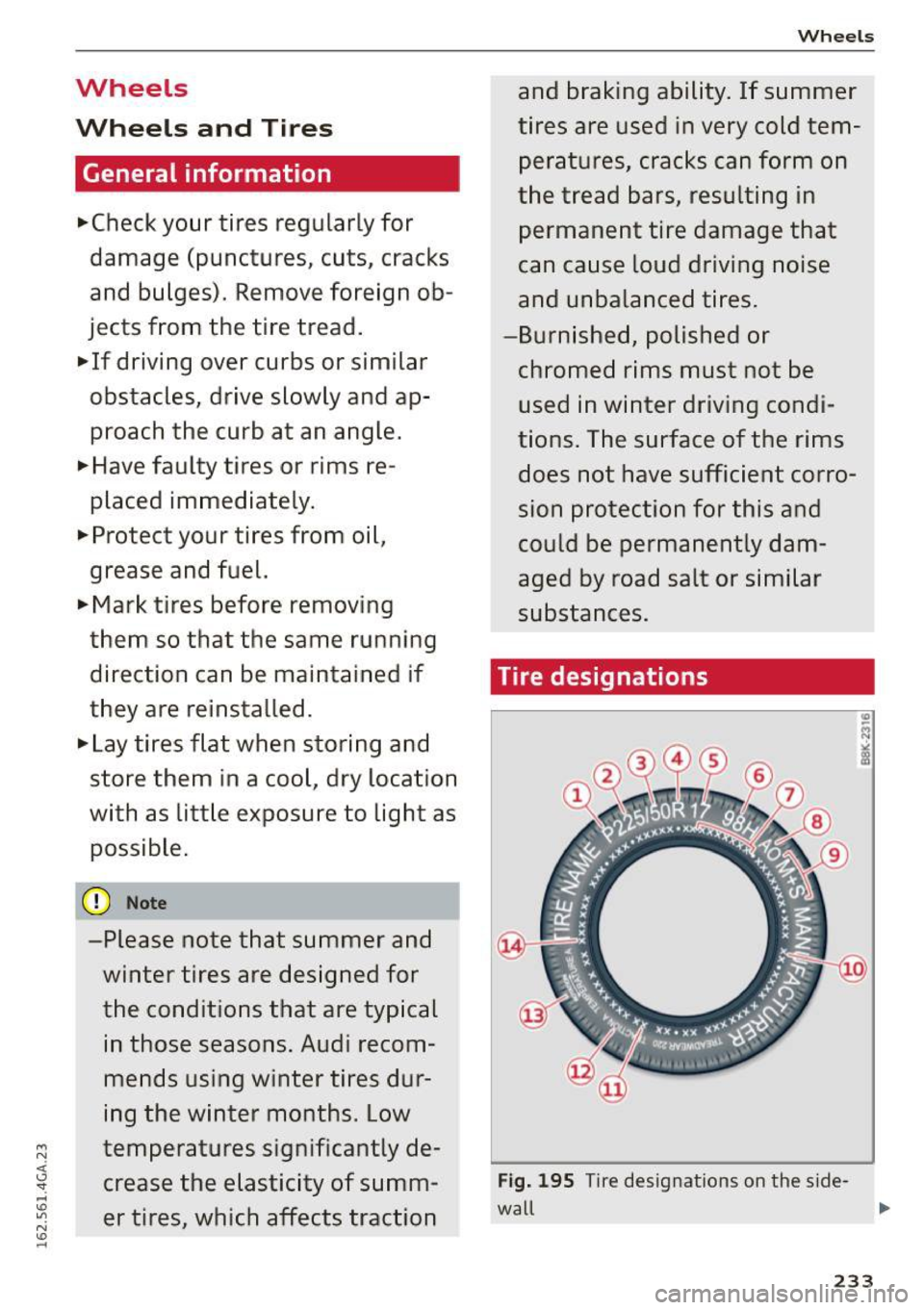
Tire designations
Fig. 195 T ir e designations on the sid e-
wall ,..
233
Page 237 of 294

® Mud and snow capability
"M/S" or "M+S" indicates the tire
has characte ris tics that make it
suitable for driving on mud and snow .
& indica tes a winter tire.
@ Composition of the tire cord
and materials
T he number of plies indicates the
number of rubber ized fabric lay
ers in the tire . In general: the
more layers, the more weight a
tire can carry. Tire manufacturers
must also specify the mater ials
used in the ti re. These include
stee l, nylon, polyester and other
materials.
@ Maximum permitted load
This number indicates the maxi
mum load in kilograms and
pounds that the tire can carry .
@ Uniform tire quality grade
standards for treadwear,
traction and temperature resistance
Treadwear , traction and tempera
ture ranges
c::::> page 250 .
@Running direction
The arrows ind icate the running
direction of unidirect ional tires.
You must always follow the speci- fied running direction
c::::> page 259.
€3) Ma
ximum permitted
inflation pressure
Whe els
This number indicates the maxi
mum pressure to which a tire can
be inflated unde r normal operat
ing conditions .
Glossary of tire and loading
terminology
Accessory weight
means the combined weight (in
excess of those standard items
which may be replaced) of auto matic transmission, power steer
ing, power brakes, power win
dows, power seats, radio, and
heater, to the extent that these
items are available as factory-in
stalled equipment (whether in
stalled or not).
Aspect ratio
means the ratio of the height to
the width of the tire in percent. Numbers of 55 or lower indicate a
low s idewall for improved steer
ing response and better overall
handling on dry pavement . .,.
235
Page 238 of 294
Wheels
Bead
means the part of the tire that is
made of steel wires, wrapped or
reinforced by ply cords and that is
shaped to fit the rim .
Bead separation
means a breakdown of the bond
between components in the bead.
Cord
means the strands form ing the
plies in the tire.
Cold tire inflation pressure
means the tire pressure recom
mended by the vehicle manufac
turer for a tire of a designated
size that has not been driven for
more than a coup le of miles (kilo
meters) at low speeds in the three
hour period before the tire pres
sure is measured or adjusted .
Curb weight
means the weight of a motor ve
hicle with standard equipment in
cluding the maximum capacity of
fuel, oi l, and coolant , air condi
tioning and additional weight of optional equipment.
E x tra load tire
means a tire des igned to operate
at higher loads and at higher in-
236
flation pressures than the corre
sponding standard tire . Extra load
tires may be identified as "XL",
"xl", "EXTRA LOAD", or "RF" on
the sidewall.
G ross A xle Weight Rating
("GAWR ")
means the load-carrying capacity
of a single axle system , measured
at the tire-ground interfaces .
Gross Vehicle Weight Rating
( "GVWR" )
means the max imum total loaded
weight of the vehicle .
Groove
means the space between two ad
jacent tread ribs .
Load rating (code )
means the max imum load that a
tire is rated to carry for a given in
flation pressure . You may not find
this information on all tires be cause it is not required by law.
Ma ximum load rating
means the load rating for a tire at
the maximum permissible infla
tion pressure for that tire .
Maximum loaded vehicle
w eight
means the sum of: ...
Page 239 of 294

(a) Curb weight
(b) Accessory weight
(c) Vehicle capacity weight, and
(d) Product ion options weight
Maximum (permissible)
inflation pressure
means the max im um cold infla
tion pressu re to which a tire may
be inflated . Also called "ma xi
mum inflation pressure ."
Normal occupant weight
means 150 lbs . (68 kilog rams)
times the number of occupants
seated in the veh ic le up to the to
tal seating capacity of yo ur vehi
c le.
Occupant distribution
means d istr ibution of occupants
in a vehicle.
Outer diameter
means the overall diameter of an
inflated new tire .
Overall width
means the linear dis tance be
tween the exter iors of the side
walls of an inflated tire , including
elevations d ue to labe ling, deco
rations , or protective bands or
ribs .
Whee ls
Ply
means a layer of rubbe r-coated
parallel cords .
Production options weight
means the comb ined weight o f
those installed regular production
options weighing over 5 lbs . (2 .3
kg) in excess o f those s tandard
items which they re place , not pre
viously conside red in c urb weight
or accessory weight, including heavy duty brakes, ride levelers,
roof rac k, heavy d uty batte ry, and
specia l trim .
Radial ply tire
means a pneumat ic t ire in which
the ply cords that ex tend to the
beads are la id at substantially 90
degrees to the centerli ne of the
tread .
Recommended inflation
pressure
see ~ page 2 36, Cold tire infla
tion pressure .
Reinforced tire
means a tire designed to operate
at higher loads and at h igher in
flat ion pressures than the corre
spon ding standard tire . Rein
f orced tires may be identified as
23 7
Page 240 of 294

Wheels
"XL" "xl" "EXTRA LOAD" or "RF" I I I
on the sidewal l.
Rim
means a metal support for a tire
or a tire and tube assembly upon
which the tire beads are seated .
Rim diameter
means nominal diameter of the
bead seat. If you change yo ur
wheel size , you w ill have to pur
chase new tires to match the new rim diameter .
Rim size designation
means rim diameter and width.
Rim width
means nomina l distance between
rim flanges .
Sidewall
means that port ion o f a t ire be
tween the tread and bead .
Speed rating (letter code)
means the speed at which a tire is
designed to be driven for extend
ed periods of t ime. The rat ings
range from 93 mph (150 km/h)
to 186 mph (298 km/h)
¢ table
on page 234 .
You may not find
this information on all tires be
cause it is not required by la w.
238
The speed rating letter code ,
where applicable , is mo lded on
the tire sidewall and indicates the maximum permiss ible road
speeds
¢ .&. in Winter tires on
page 248.
Tire pressure monitoring
system*
means a system that detects
when one or mo re of a ve hic le's
tires are under inflated and illumi
na tes a low tire p ressu re warning
tellta le .
Tread
means that portion of a tire that
comes into contact w ith the road.
Tread separation
means pu lling away of the tread
from the t ire carcass.
Treadwear indicators (TWI)
means the projections wi thin the
principal grooves designed to give
a visua l indication of the deg rees
of wear of the tread . See
¢ page 242 , Treadwear indicator
for mo re information on measur
ing t ire wear.
Page 242 of 294
Wheels
Occupant loading and distri
bution for veh icle normal load
for various designated seat ing
capacit ies
Refer to the tire inflation pressure
label
c:> page 243, fig . 198 for
the number of seating positions .
Refer to the table
c:> table on
page 245
for the number of peo
ple that correspond to the vehicle
normal load .
New tires or wheels
Audi recommends having all wo rk
on tires or wheels performed by
an authorized Audi dea ler or au
thorized repair fac ility. These fa
cilities have the proper knowledge
and are equipped with the re
quired tools and replacement
parts.
.,. New tires do not yet have the
optimum adhesion properties. Drive carefully and at moderate
speeds fo r the first 350 miles
(500 km) with new tires .
.,. Use tires of t he same constr uc
tion, size (rolling c ircumference)
and as close to the same tread pattern as possible on all four
wheels.
2 4 0
.,.Do not replace tires individ ually .
At least re place both t ires on the
same axle at the same time.
.,. A udi recommends that you use
Aud i O riginal equipment tires . If
you wo uld li ke to use different
tires, please note that the tires may perform d ifferently even if
they are the same s ize
c:> &. -
.,. If you would like to equip you r
vehic le with a tire/rim combina
tion that is different from what
was installed at the facto ry, con
sult w ith an authorized Aud i
dealer or authorized repair facili
ty be fore making a purchase
¢ .&_ .
The spare tire* is d ifferent from
the regular t ires installed on the
vehicle -for example, if winter
tires or wi de tires are installed -
then only use the spare tire* tem
porar ily in case of emergency and
drive carefully while it is in use . It
s h o u ld be replaced w ith a regular
tire as soon as poss ib le.
On
all wheel drive ve hic les, all
four wheels must be equipped
w ith tires that are the same brand
and have the same construction
and tread pattern so that the
drive system is not damaged by
Page 243 of 294
different tire speeds. For this rea
son, in case of emergency, only
use a spare tire* that is the same
circumference as the regular tires.
A WARNING -
-Only use tire/rim combina
tions and suitable wheel bolts
that have been approved by
Audi. Otherwise, damage to
the vehicle and an accident
could result.
-For technical reasons, it is not possible to use tires from oth
er vehicles - in some cases,
you cannot even use tires from
the same vehicle model.
-Make sure that the tires you select have enough clearance
to the vehicle . Replacement
tires should not be chosen
simply based on the nominal
size, because tires with a dif
ferent construction can differ greatly even if they are the
same size. If there is not
enough clearance, the tires or
the vehicle can be damaged
and this can reduce driving
safety and increase the risk of
an accident.
-Only use tires that are more
than 6 years old when abso-
Wheels
lutely necessary and drive
carefully when doing so.
-Do not use run-flat tires on your vehicle . Using them when
not permitted can lead to ve
hicle damage or accidents.
-If you install wheel covers on
the vehicle, make sure they al low enough air circulation to
cool the brake system. If they
do not, this could increase the
risk of an accident.
Tire wear/damage
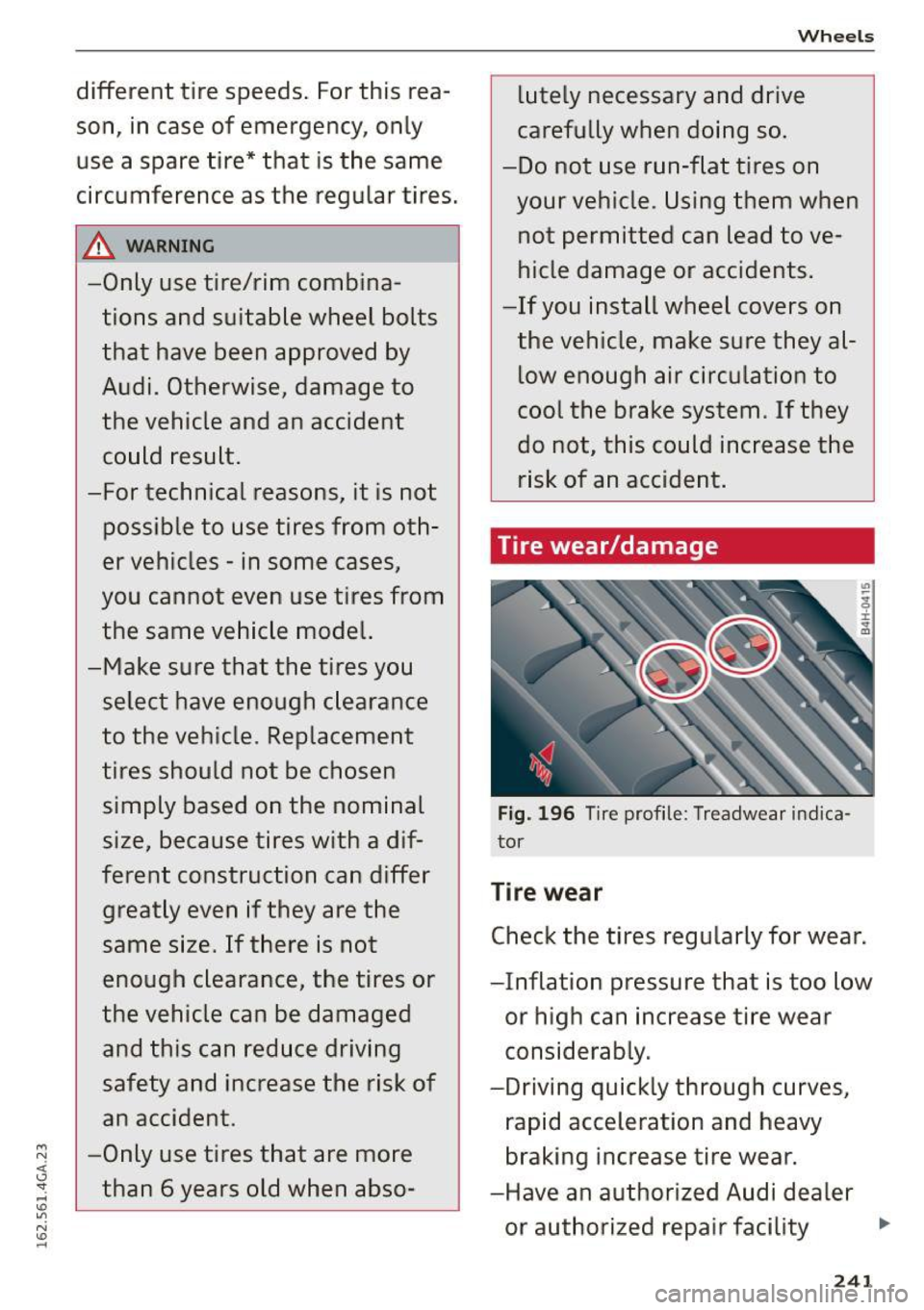
Fig. 196 T ir e profi le : Treadwear indica
tor
Tire wear
Check the tires regularly for wear.
-Inflation pressure that is too low
or high can increase tire wear
considerably .
-Driving quickly through curves,
rapid acceleration and heavy
braking increase tire wear.
-Have an authorized Audi dealer or authorized repair facility
241
...