tire pressure AUDI A7 2017 Owner´s Manual
[x] Cancel search | Manufacturer: AUDI, Model Year: 2017, Model line: A7, Model: AUDI A7 2017Pages: 284, PDF Size: 72.29 MB
Page 218 of 284

Wheels
Rim
means a metal support for a tire
or a tire and tube assembly upon
which the t ire beads are seated .
Rim diameter
means nominal diameter of the
bead seat . If you change your
wh eel size, you will have to p ur
chase new tires to match the new
rim d iameter .
Rim size designation
means rim diameter and w idth.
Rim width
means nomina l distance between
r im flanges .
Sidewall
means that portion of a t ire be
twee n the tread and bead .
Speed rating (letter code)
means the speed at which a t ire is
designed to be driven for extend
ed periods of ti me. The ratings
range from 93 mph (150 km/h)
to 186 mph (298 km/h)
¢ table
on page 212 .
You may not find
this information on all tires be
cause it is not required by law.
The speed rating letter code,
wh ere applicable, is molded on
the tire sidewall and ind icates the
2 16
maximum permissible road
speeds
¢ A in Winter tires on
page 227 .
Tire pressure monitoring
system *
means a system that detects
when one or mo re of a vehicle's
tires a re underinflated and illumi
nates a low tire pressure war ning
telltale .
Tread
means that portion of a tire that
comes into contact wi th the road.
Tread separation
means pulling away of the tread
from the tire carcass .
Treadwear indicators (TWI)
means the project ions wi thin the
pr inc ipal grooves designed to g ive
a visua l indication of the degrees
of wear of the tread . See
¢ page 2 20, Treadwear indicator
for mo re information on meas ur
ing tire wear.
Uniform Tire Quality Grading
i s a tire informa tion system devel
oped by the Unite d States Nation
a l Highway Traffic Safety Admin
istration (NHTSA) that is designed
to help buyers make re lative
..
Page 221 of 284
a)
a)
.--< N ,-.. N ..... 0 a) 0.:,
"'
circumference as the regular
tires .
8,_ WARNING , -
-Only use tire/rim combina-
tions and suitable wheel bolts
that have been approved by
Audi. Otherwise, damage to
the vehicle and an accident
could result.
-For technical reasons, it is not possible to use tires from oth
er vehicles -in some cases,
you cannot even use tires from
the same vehicle model.
-Make sure that the tires you select have enough clearance
to the vehicle. Replacement
tires should not be chosen simply based on the nominal
size, because tires with a dif
ferent construction can differ greatly even if they are the
same size. If there is not
enough clearance, the tires or
the vehicle can be damaged
and this can reduce driving
safety and increase the risk of
an accident.
-Only use tires that are more
than six years old when abso
lutely necessary and drive
carefully when doing so.
Wheels
-Do not use run-flat tires on
your vehicle. Using them when
not permitted can lead to ve hicle damage or accidents.
-If you install wheel covers on
the vehicle, make sure they al
low enough air circulation to
cool the brake system. If they
do not, this could increase the
risk of an accident.
Tire wear/damage
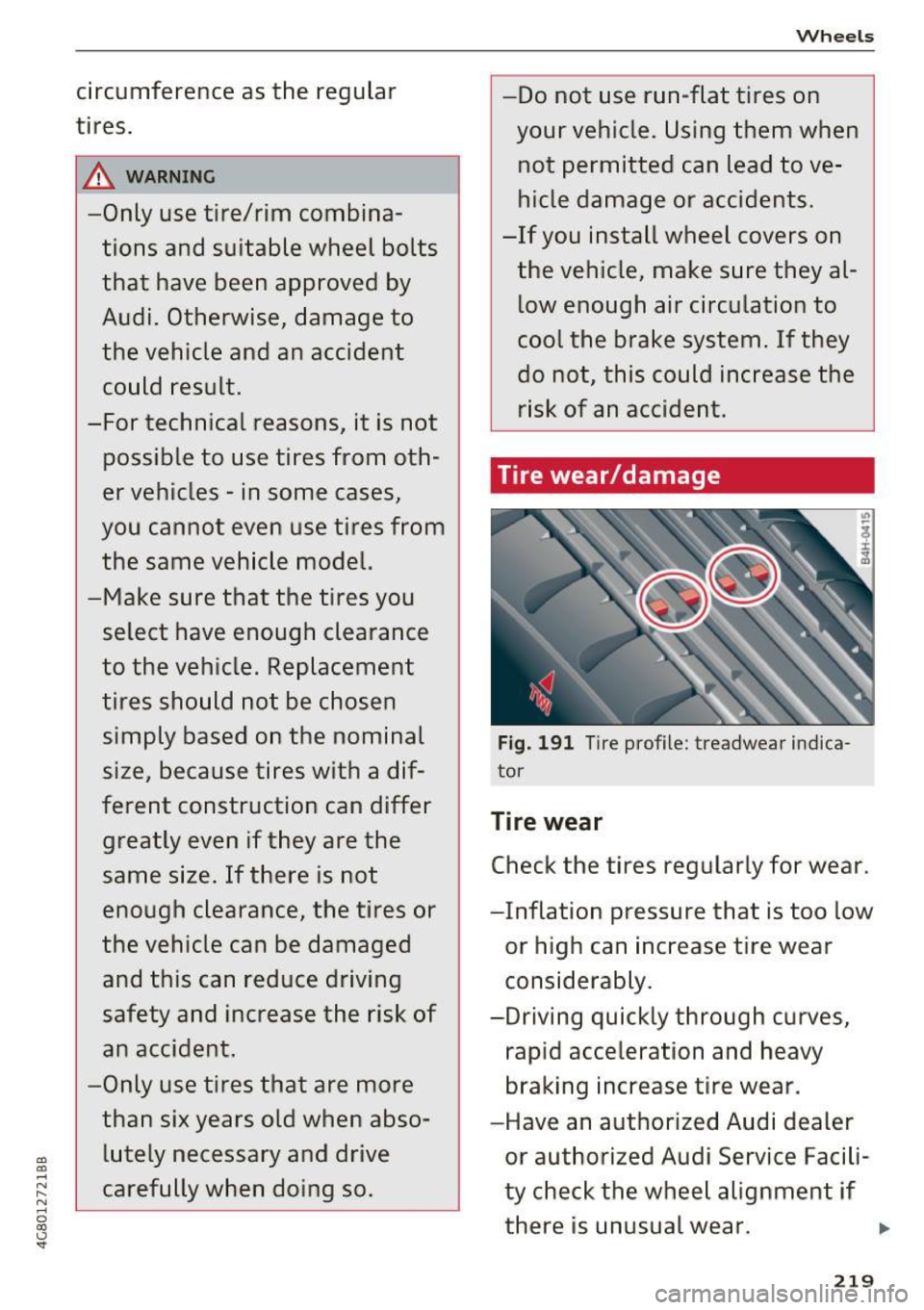
Fig. 191 Tire profile: treadwear indica
tor
Tire wear
Check the tires regularly for wear .
-Inflation pressure that is too low
or high can increase tire wear
considerably.
-Driving quickly through curves, rapid acceleration and heavy
braking increase tire wear .
-Have an authorized Audi dealer
or authorized Audi Service Facili
ty check the wheel alignment if
there is unusual wear. ..
219
Page 223 of 284
through curves and when braking, which increases the risk of
an accident.
Tire pressure
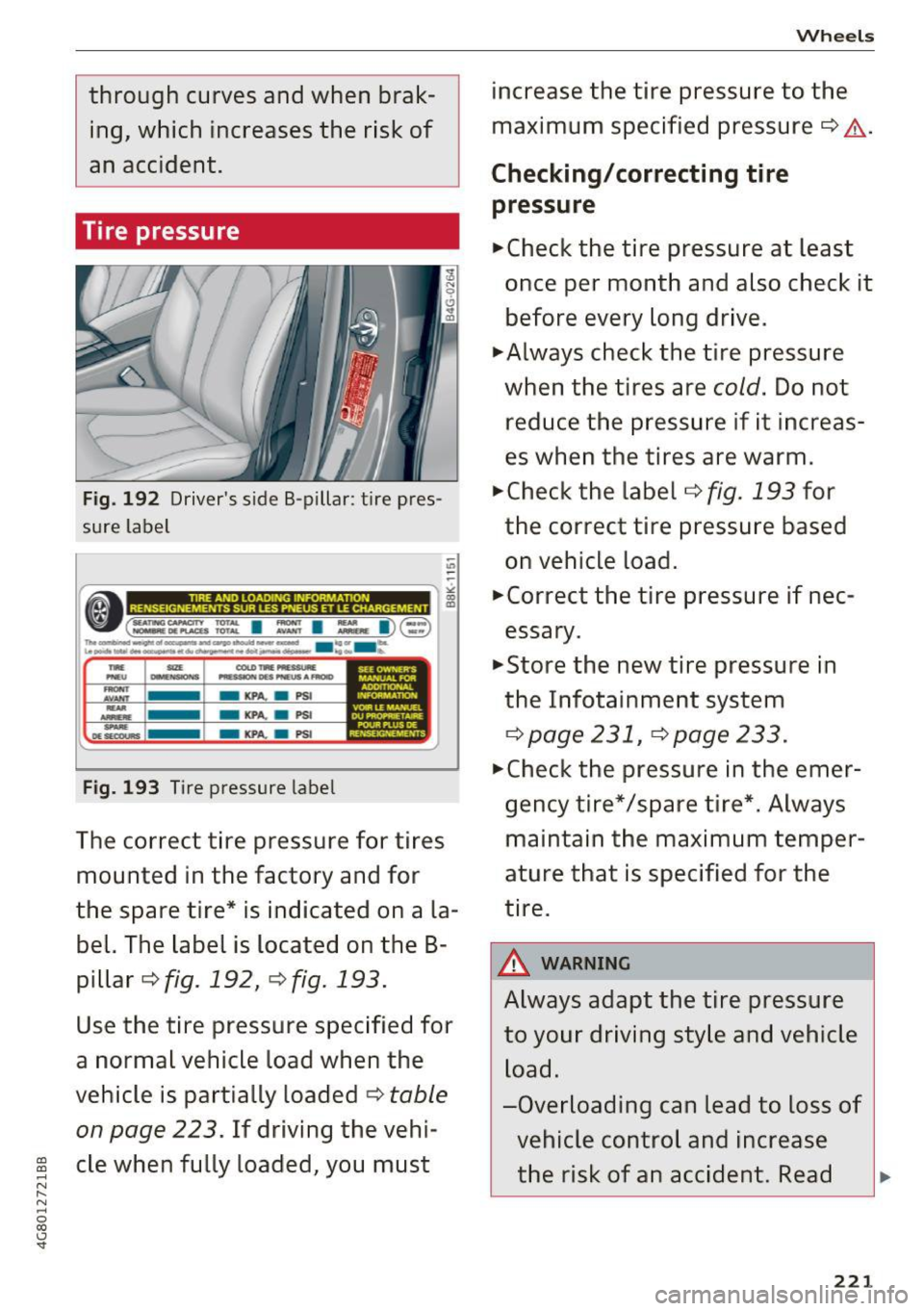
Fig. 192 Driver's side B-pillar : tire pres
sure label
"' -
-~-------------------,£
tM£. IIZl COLO tlllf fllllESSt.lW. PNfU Nl:4fN$IOM$ "IIISaoN OE$ PMEU$ A FROID
-AYIJff -KPA, a PSI
Fig. 193 Tire pressure label
The correct tire pressure for tires
mounted in the factory and for
the spare tire* is indicated on a la
bel. The label is located on the B
pillar ¢
fig. 192, ¢ fig. 193.
Use the tire pressure specified for
a normal vehicle load when the
vehicle is partially loaded¢
table
on page 223.
If driving the vehi-
; cle when fully loaded, you must
N
" N ... 0 CX) I..J st
Wheels
increase the tire pressure to the
maximum specified pressure¢&.-
Checking/correcting tire
pressure
.,,.Check the tire pressure at least
once per month and also check it before every long drive .
.,,.Always check the tire pressure
when the tires are
cold. Do not
reduce the pressure if it increas
es when the tires are warm .
... check the label ¢
fig. 193 for
the correct tire pressure based on vehicle load.
.,,.Correct the tire pressure if nec
essary.
... Store the new tire pressure in
the Infotainment system
¢page 231, ¢page 233 .
.,,.Check the pressure in the emer
gency tire* /spare tire*. Always maintain the maximum temper
ature that is specified for the
tire.
A WARNING
Always adapt the tire pressure to your driving style and vehicle load.
-Overloading can lead to loss of vehicle control and increase
the risk of an accident. Read
221
Page 224 of 284
Wheels
and follow the important safe
ty precautions in
q page 224,
Tires and vehicle load limits.
-The tire must flex more if the
tire pressure is too low or if
the vehicle speed or load are
too high. This heats the tire up
too much. This increases the
risk of an accident because it
can cause the tire to burst and
result in loss of vehicle con
trol.
-Incorrect tire pressure in
creases tire wear and has a
negative effect on driving and
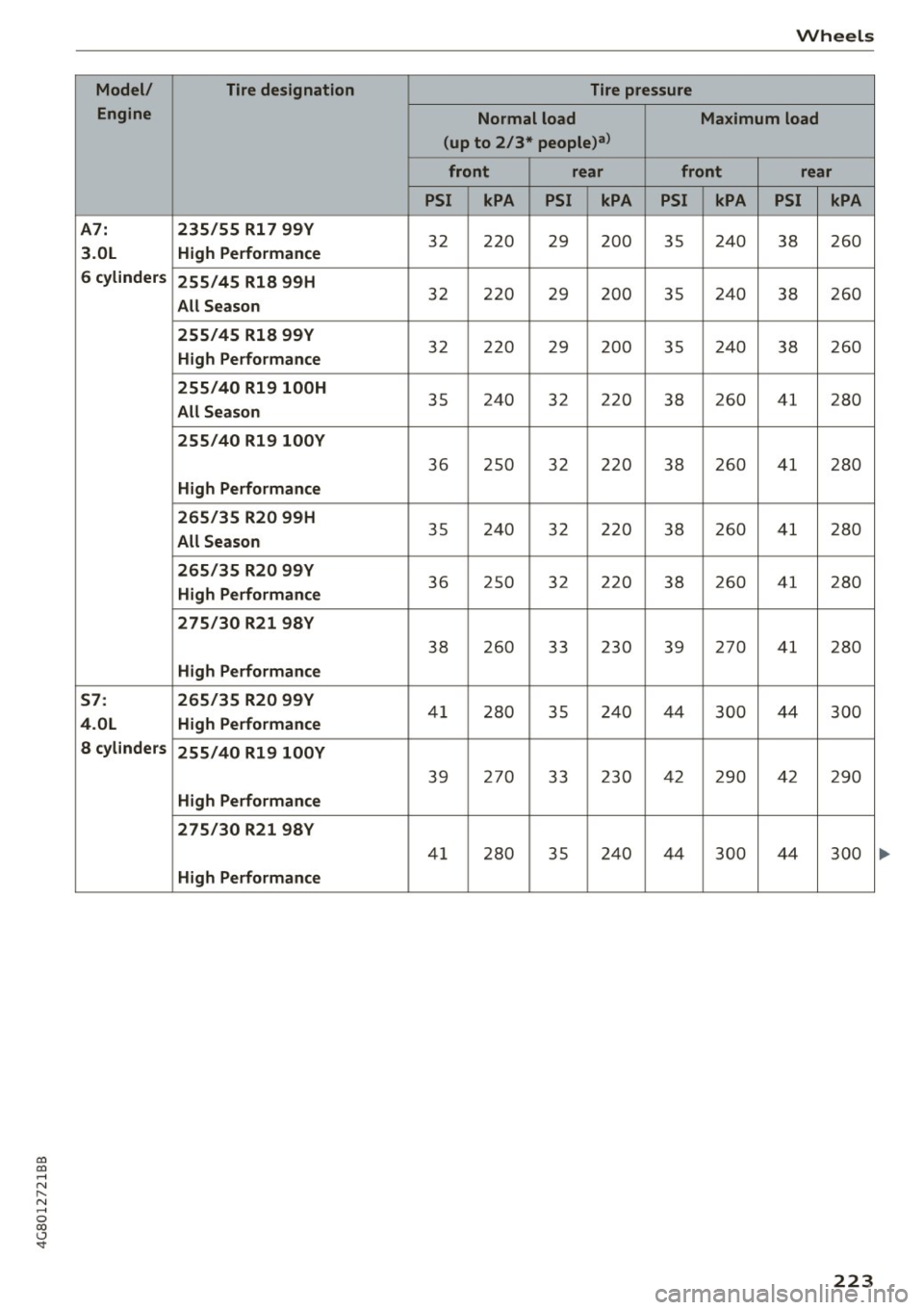
Tire pressure table
Please note that the information
contained in the following table
was correct at the time of print ing, and the information is sub
ject to change. If there are differ
ences between this information
and the tire pressures specified
on the label on the driver's side B
pillar, always follow the specifica
tion on the B-pillar label
q page 221, fig. 192.
222
braking behavior, which in
creases the risk of an accident.
(D Note
Replace lost valve caps to re
duce the risk of damage to the
tire valves.
@ For the sake of the environment
Tire pressure that is too low in
creases fuel consumption.
(D Tips
Audi recommends using the
tire pressure specified for a
normal load
q table on
page 223
or for a full load
when the vehicle is partially
loaded.
Make sure that the tire designa
tion on your tire matches the des
ignation on the tire pressure label
and the tire pressure table.
The following table lists recom
mended tire pressures in cold
tires according to the load and
the size of the tires installed.
Page 225 of 284
co
co
.... N
" N .... 0
00
\.J '
Engine
A7 :
3.0L
6 cylinder s
57:
4.0L 8 cylinders Tire designation
235 /55 R17 99Y
High Performance
255 /45 R18 99H
All Season
255/45 R18 99Y
High Perfo rmance
255 /40 R19 l00H
All Season
255 /40 R19 l00Y
High Performance
265/35 R20 99H
All Season
265 /35 R20 99Y
High Performance
275/30 R21 98 Y
High Performance
265/35 R20 99Y
High Performance
255/40 R19 l00Y
High Performance
275/30 R21 98Y
High Performance
Wheels
Tire pressure
Normal load Maximum load
(up to 2 /3* people )a>
front rear front rear
PSI kPA PSI kPA PSI kPA PSI kPA
32 220 29 200 35
240
38 260
32 220 29 2 00 35 240
38 260
32 220 29 200 35 240 38 260
35 240
32 220 38 260 41
280
36 250 32 220 38 260 41
280
35 2 40 32 220
38 260 41 280
36 250 32 220 38 260 41
280
38 260 33 230
39 270
41 280
41 280
35 2
4 0 44
300 44
300
39 270 33 2 30 42 290 42 290
41 280 35 240 44
300 44
300
223
Page 226 of 284
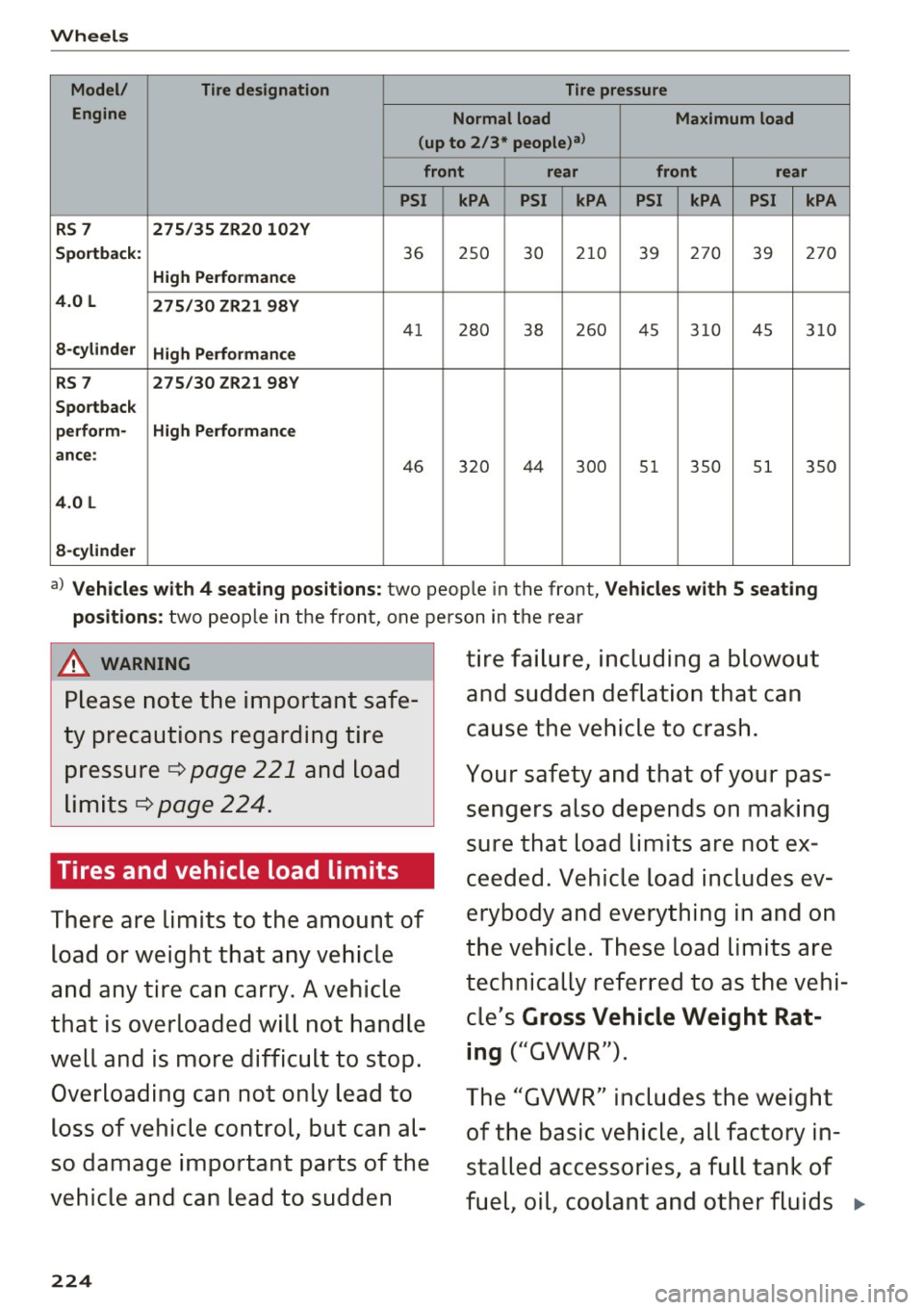
Wheels
Model/ Tire designation Tire pressure
Engine Normal load Maximum load
(up to 2/3* people)a>
front rear front rear
PSI kPA PSI kPA
PSI kPA PSI kPA
RS 7 275/35 ZR20 102Y
Sportback:
36 250 30 210 39 270
39 270
High Performance
4.0 L 275/30 ZR21 98Y
41 280 38 260 45 3 10 4 5 310
8-cylinder
High Performance
RS 7 275/30 ZR21 98Y
Sportback
perform- High Performance
ance:
46 320 44
300 51 350 51 350
4.0 L
8-cylinder
a) Vehicles with 4 seating positions: t wo people i n the front, Vehicles with 5 seating
positions:
two peop le in t he front , one pe rson in the re ar
A WARNING
Please note the important safe
ty precautions regarding tire pressure ¢
page 221 and load
limits¢
page 224.
Tires and vehicle load limits
There are limits to the amount of
load or weight that any vehicle
and any tire can carry. A vehicle
that is overloaded will not handle
well and is more difficult to stop.
Overloading can not only lead to
loss of vehicle control, but can al
so damage important parts of the
vehicle and can lead to sudden
224
tire failure, including a blowout
and sudden deflation that can
cause the vehicle to crash.
Your safety and that of your pas
sengers also depends on making
sure that load limits are not ex
ceeded. Vehicle load includes ev
erybody and everything in and on
the vehicle. These load limits are
technically referred to as the vehi
cle's
Gross Vehicle Weight Rat
ing
("GVWR").
The "GVWR" includes the weight
of the basic vehicle, all factory in
stalled accessories, a full tank of
fuel, oil, coolant and other fluids
111-
Page 230 of 284

Wheels
co ntrol, w hich inc reases t he risk of an
accident .
(D Note
-Snow cha ins can damage the rims/whee l
covers * if the chains come into d irect con
tact with them. Remove the whee l cove rs *
first. Use coated snow chains.
- Usin g sn ow chains that a dd more than 0 .4
i nch (10.5 mm) of he ight can severely dam
age the wheel ho usings and other vehicle
components .
- Do not install and use snow chains if there is
a malfunct ion in the adaptive air suspen
s io n*, because the vehicle height wi ll be
very low . If yo u drive with snow chains any
way, the wheel ho usings a nd othe r vehicle
co mp onen ts ca n be severe ly da mage d.
(D Tips
When using snow cha ins, it may b e usef ul to
sw itch on spo rt mo de
~ pag e 12 1.
Low aspect ratio tires
Your Aud i is f actory-equipped wi th low aspec t ra
t io tires. The se tir es h ave bee n thor oughly te sted
and b een se lected s pecific ally fo r yo ur model fo r
their superb perfo rmance , road feel and hand ling
un der a va riety of driving conditions. As k yo ur au
thor ized Audi dealer for mo re details .
Th e low aspect ratio of these tires is indi cate d by
a nume ra l of
55 or less in t he tire's size desig na
tion. The nume ra l r ep resents the rat io of t he
tire's sidewall he ight i n relat ion to its tread wi dth
expressed in pe rcentage. Conventional tires have
a heig ht/w idt h rat io o f 60 o r mo re.
The performance of low-aspect-ratio tires is par
ticularly sensitive to improper inflation pres
sure. It is therefore important that low aspect
ratio tires are inflated to the specified pressure
and that the inflation pressure is regularly
checked and maintained. Tire pressures should
be checked at least once a month and always
before a long trip~
page 221.
228
What you can do to avoid tire and rim
damage
Low aspect ratio tires can be damaged more eas i
l y by impact with potho les, curbs, gullies or
r idges on the road, particularly if the tire is un
der inflated.
In orde r to mi nimize the occurrence of impact
damage to the tires o f yo ur vehicle, we recom
mend that you observe the following preca u
tions:
- Always maintain recommended inflation pres
sures. Check yo ur tire pressure every 2,000
m iles (3,000 km) and add a ir if necessary.
- Dr ive carefully on roa ds w it h potholes, deep
gullies o r ridges. The impact from dr iv ing
throug h or over such obstacles can damage
your t ires. Impac t with a curb may a lso ca use
damage to yo ur tir es.
- After a ny impact, immed iate ly inspect you r
tires or have them inspected by the nearest au
t horize d Aud i dealer . Replace a damage d tire as
soo n as poss ible .
- Inspec t your tir es ev ery 2,000 m iles (3,000 km)
for d amage and wear . Damage is no t always
easy to see . Da mage ca n lead to loss o f air and
un derinfla tion, w hich could eve ntually ca use
t ire f ailure. If yo u be lieve th at a tir e m ay h ave
been dam age d, rep la ce the tire as soon as pos
sible .
- These tire s may wea r mo re quick ly th an ot hers.
- Ple ase also remember th at , while t hese tires
delive r respo nsive h andli ng, they may rid e less
c omforta bly an d make mo re noise than o ther
choices .
Reduced performance in winter/cold season
conditions
A ll t ires are des igned for certain purposes . T he
l ow aspect ratio, ultra h igh performance tires
o rigina lly installed on your veh icle are inten ded
fo r max imum d ry and wet road per formance and
h andling . They a re not suitable fo r co ld, snowy or
i cy weather conditions . If yo u drive under those
c ir cums tances, you should eq uip yo ur vehicle
wi th all-season o r winter tires, which offer be tter
t ra ct io n und er th ose condi tions. We suggest yo u ..,.
Page 231 of 284
co co .... N
" N .... 0
00
\.J '
specified for your vehicle, or their equivalent.
Refer to
~ page 22 7 for more deta iled i nfo rma
tion rega rding win ter tires.
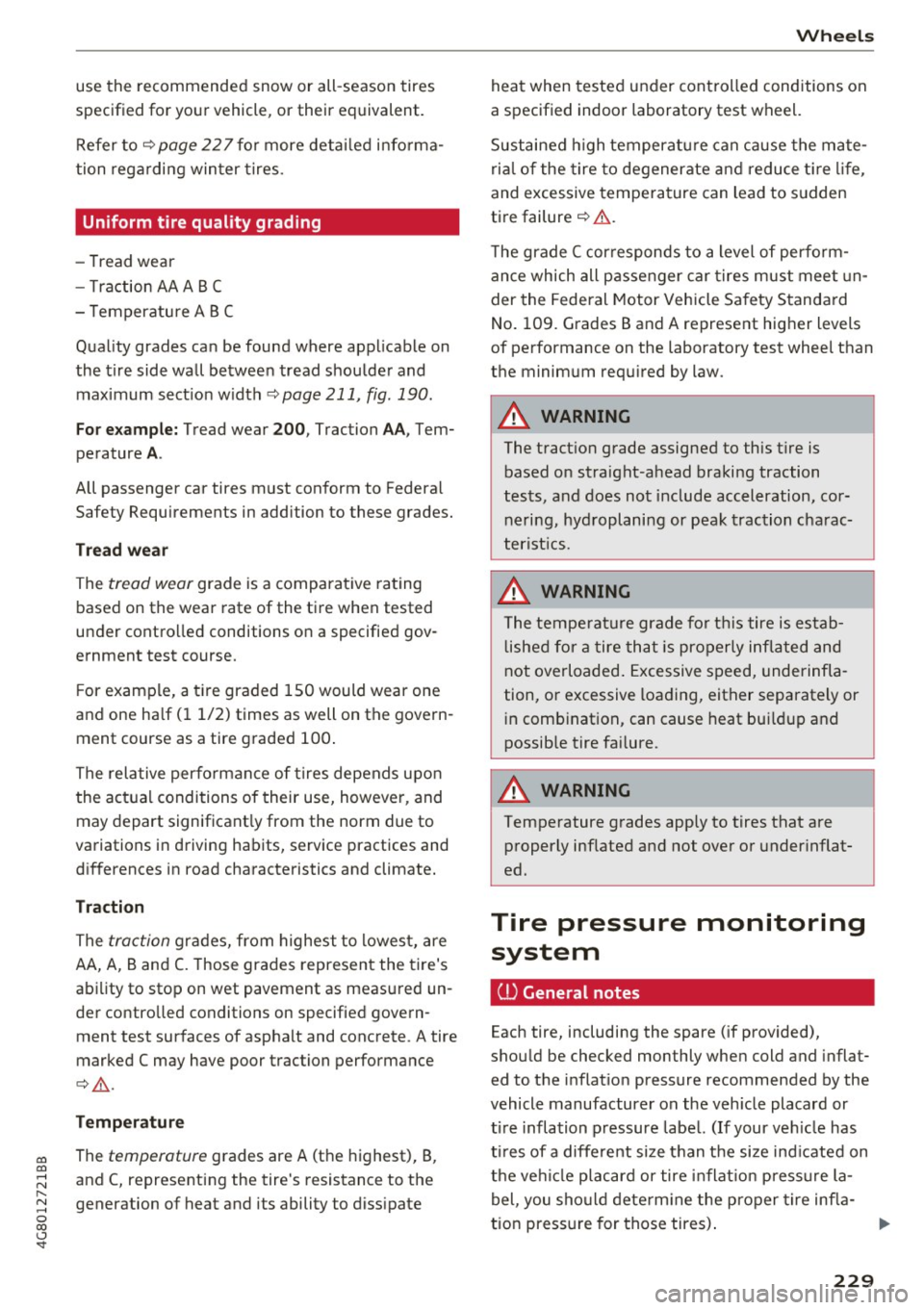
Uniform t ire quality grading
- Tread wear
- T raction AA A B C
- T emperatu re ABC
Quality grades ca n be found where applicable on
the ti re side wall between tread shoulder and
maximum sect ion w idth
¢ page 211, fig. 190.
For example: Tread wear 200, Traction AA, Tem
perature A.
All passenger car tires must conform to Federal
Safety Requirements in addition to these grades.
Tread wea r
The
tr ead w ear grade is a comparat ive rating
based on the wear rate of the t ire when tested
under controlled conditions on a specified gov
ernment test course.
F or examp le, a t ire graded 150 would wear one
and one ha lf
( 1 1/2) times as well on the govern
ment course as a tire graded
100 .
The relative perfo rmance of tires depends u po n
the actua l conditions of their use, however, and
may depart significant ly from the norm due to
va riations i n driving habits, service practices and
d ifferences in road characteristics and climate.
Traction
The
traction grades, from highest to lowest, are
AA, A, Band
C. T hose grades represent the tire's
ab ility to stop on wet pavement as measured un
de r contro lled conditions on specified gove rn
ment test surfaces of asphalt and concrete . A tire
marked C may have poor traction performance
¢ _& .
Temperatur e
The
temperature grades are A (the highest), B ,
and C, representing the tire's resistanc e to the
generation of heat and its ability to diss ipate
Wh eel s
heat when tested under cont rolled conditions on
a specified indoor laboratory test wheel.
Sustained high temperat ure can cause the mate
r ia l of the tire to degenerate and reduce t ire life ,
and excessive tempera ture can lead to s udden
tire failure ¢,& .
T he grade
C corresponds to a level of perfo rm
ance which all passenger car tires must meet un
der the Federal Motor Vehicle Sa fety Standa rd
No.
109. Grades Band A represent higher levels
of pe rformance on the laboratory test wheel than
the minim um req uired by law.
A WARNING
-
The tract ion grade assigned to this t ire is
based o n straight -ahead braking traction
tests, and does no t include acceleration, co r
n ering, hyd roplaning or pea k traction cha rac
t erist ic s .
A WARNING
The temperature grade fo r this tire is estab
lished for a tire that is properly infl,;1ted and
not overloaded . Excessive speed, underinfl a
tion, o r excessive loading, either separately or
i n comb inat ion, can cause heat bu ildup and
possib le tire fai lure .
A WARNING
-
-Temperature grades apply to tires that are
p roperly inf lated and not ove r or under inflat
ed.
Tire pressure monitoring system
(l) General notes
Each tire, including the spare (if provided),
shou ld be checked monthly when cold and inflat
ed to the inflat io n pressure recommended by the
vehicle manufacture r on the veh icle placard or
t ir e infla tion p ressure labe l. (If your ve hicle has
t ir es of a diffe re nt si ze t han t he si ze ind icated on
t h e ve hicl e p lacard or tire inflat io n pres sure la
bel, you sho uld dete rm ine the proper tire in fla-
t ion press ure for those tires) . ..,.
229
Page 232 of 284

Wheels
As an added safety feature, your vehicle has been
equipped with a tire pressure mon itor ing system
(TPMS) that illuminates a low tire pressure tell
tale when one or more of your tires is significant
ly under-inflated . Accordingly, when the low tire
pressure telltale illuminates, you should stop and
check your tires as soon as possible, and inflate
them to the proper pressure . Driving on a signifi
cantly under-inflated tire causes the tire to over
heat and can lead to tire failure. Under-inflation
also reduces fuel efficiency and ti re tread life,
and may affect the vehicle's handling and stop
ping ability.
Please note that the TPMS is not a substitute for
proper tire maintenance, and it is the driver's re
sponsibility to maintain correct tire pressure,
even if under- inflation has not reached the level
to trigger illumination of the TPMS low tire pres
sure telltale.
Your vehicle has also been equipped with a TPMS
malfunction indicator to indicate when the sys
tem is not operating properly. The TPMS mal
function indicator is combined with the low tire
pressure telltale . When the system detects a
malfunction, the telltale will flash for approxi
mately one m inute and then remain cont inuously
illuminated . This sequence will continue upon
subsequent vehicle start-ups as long as the mal
function exists .
When the malfunct ion indicator is illuminated,
the system may not be able to detect or signal
low tire pressure as intended. TPMS malfunctions
may occur for a variety of reasons, including the
installation of replacement or alternate tires or
wheels on the vehicle that prevent the TPMS
from functioning properly. Always check the
TPMS malfunction telltale after replacing one or more tires or wheels on your vehicle to ensure
that the replacement or alternate tires and
wheels allow the TPMS to continue to function
properly.
230
Tire pressure monitoring system
Applies to: vehicles with Tire Pressure Monitoring System in
dicator
The tire pressure indicator in the instrument
cluster informs you if the tire pressure is too low
or if there is a system malfunction.
Fig. 194 Instrumen t cl uster : indicator l ig ht with me ssage
Using the ABS sensors, the tire pressure monitor
ing system compares the tire tread circumfer
ence and vibration characteristics of the individu
al tires. If the pressure changes in one or more
tires, this is indicated in the instrument cluster
display with an indicator light
Rt] and a message.
If only one tire is affected, the location of that
tire will be indicated.
The tire pressures must be stored in the Infotain
ment system again each time the pressures
change (switching between partial and full load
pressure) or after changing or replacing a tire on
your vehicle
¢ page 231. The tire pressure mon i
toring system only monitors the tire pressure you have stored . Refer to the tire pressure label for
the recommended tire pressure for your vehicle
¢page 221, fig. 193.
Tire tread circumference and vibrat ion character
istics can change and cause a tire pressure warn
ing if :
- the tire pressure in one or more tires is too low.
- the tire has structural damage.
- the tire was replaced or the tire pressure was
changed and it was not stored¢
page 231 .
-the spare tire* is installed.
Indicator lights
RI]-Loss of pressure in at least one tire¢.&_ .
Check the tires and replace or repair if necessary . .,..
Page 233 of 284

co
co
.... N
" N .... 0
00
\.J -
store the pressure again in the Infotainment sys
tem
¢page 231.
ffim (T ire Pressure Monitoring System) T ire
pressu re : S ys tem malfunction !. If ffim
appears
after switching the ignition on or whi le driving
and the
[I] indicator light in the instrument clus
ter blinks for approximate ly one minute and then
stays on, there is system malfunction. Try to
store the correct tire pressures¢
page 231. If
the ind icator light does turn off or turns on again
after a short period of time, dr ive to an author
i zed A udi dealer o r authorized Audi Service Fac ili
ty immediately to have the malfunc tion correct
ed .
& WARNING ,___ -
-If the tire pressure indicator appea rs in the
display, reduce your speed immed iate ly and
avoid any hard steer ing or braking maneu
vers. Stop as soon as possib le and check the
t ires and their pressure.
- The driver is responsib le for maintaining the
correct tire pressure. You must check the
t ire pressure regu larly.
- Under certa in conditions (such as a sporty
driv ing style, winter cond itions or unpaved
roads), the tire p ressure monitoring system
indicator may be delayed.
{D) Tips
- The t ire pressure monitoring system can al
so stop work ing when there is an ESC mal
funct ion.
- Using snow chains may result in a system
malfunction .
- The t ire pressure monitoring system in your
Audi was calibrated with "Audi Orig inal
Tires"
¢ page 218. We recommend that you
use these t ires .
Wh eel s
Storing tire pressures
Applies to: vehicles with Tire Pressure Monitor ing System in
dicator
If the tire pressure changes or a tire is replaced,
it must be confirmed in the Infotainment sys tem.
.,. Make sure before storing that the tire pressures
of all four tires meet the specified values and
are adapted to the load
¢ page 221.
.,. Switch the ignit ion on.
.,. Select: the
I CAR ! funct ion button > ( C ar) * Sys
tem s
contro l button > S ervic e & ch eck s> Tire
pres sure monitor > Store tire pre ssure > Yes,
s tore now .
(D Tips
Do not store the tire pressures if snow chains
a re installed.
Tire pressure monitoring
system
ill General notes
Each tire, including the spare (if provided),
shou ld be checked monthly whe n cold and inflat
ed to the i nflat io n press ure recommended by the
vehicle manufacturer on the veh icle placard or
t ir e inflation pressure labe l. (If your ve hicle has
tires of a different size than the size indicated on
the vehicle placard or tire inflation pressure la
bel, you should determ ine the proper tire infla
t ion pressure for those tires).
As an added safety feature, yo ur vehicle has been
equipped with a tire pressure mon itor ing system
(TPMS) that illuminates a low tire pressure tell
ta le when one or more of your tires is signif icant
ly under-inflated. According ly, when the low t ire
pressure te lltale illum inates, you sho uld stop and
chec k your tires as soon as possib le, and inflate
t h em to the prope r pressure. Dr iving on a sig nifi
ca nt ly unde r-inflated t ire causes the t ire to over
hea t and can lead to tire fa il ur e. Under-inflat ion
also reduces fue l effic iency and tire tread life,
and may affect the vehicle's handling and stop -
ping ability .
liJJ,-
231