oil AUDI A7 2017 Owner´s Manual
[x] Cancel search | Manufacturer: AUDI, Model Year: 2017, Model line: A7, Model: AUDI A7 2017Pages: 284, PDF Size: 72.29 MB
Page 207 of 284

co
co
.... N
" N .... 0
00
\.J -
switched on .
- The engine oi l consumption may be up to
0.5 quart/600 miles (0.5 liter/1,000 km),
depending on driving style and operating
conditions. In RS models, the oil consump
tion may be up to 1 qt/600 mi (0.8 L/ 1,000 km). Consumption may be higher
during the first 3,000 miles (5,000 km). Be
cause of this, the engine oil level must be
checked regular ly.
It would be best to check
each time you ref uel your veh icle and befo re
l ong d rives.
Changing the engine oil
We recommend that hove your oil changed by on
authorized Audi dealer or a qualified service sta
tion .
Before you check a nyth ing in the eng ine compart
ment,
alway s re ad and heed all WARNING S 9 &.
in Working in the engine comportment on
page 199.
The engine oil must be changed according to the
intervals specified in you r Warranty
& Mainte
n ance booklet. This is very impo rtant because the
l ub ricating properties of oil diminish gradually
during normal vehicle use.
Unde r some ci rcumstances the e ngine o il should
be cha nged more frequently . Change oil mo re of
ten if yo u drive mostly short distances, operate
the vehicle in dusty areas or under predominant ly
stop-and-go traffic conditions, or have your vehi
cle where temperatures remain below freezing
for extended periods.
Detergent additives in the oil will make fresh oil
l ook dark after the engine has been running for a
short time. Th is is normal and is not a reason to
change the oil more often than recommended.
Because of the problem of proper disposa l, along
with the special tools and necessary expertise re
q ui red, we strongly recommend that you have
your oil changed by an authorized
A ud i dealer or
a qualified service station.
If you choose to chang e your o il your self, please
note the following important information:
Ch eck ing and Filling
A WARNING
To reduce the risk of persona l injury if you
must change the eng ine oil in you r vehicle
yourself:
- Wear eye protect ion.
-
- To reduce the r isk of burns from hot engine
oil, let the engine cool down to the touch.
- When remov ing the oil drain plug w ith your
f ingers, stay as far away as possible. Always
keep your forearm parallel to the ground to
help prevent hot oil from running down your
arm.
- Drain the oil into a container designed for
this purpose, one la rge enough to hold at
least the tota l amount of oi l in you r engine .
- Engine oil is poisonous. Keep it we ll out of
the reach of children.
- Continuous contact with used engine o il is
harmf ul to your skin. Always protect your
skin by washing oil off thoroughly with soap
and wate r.
Q) Note
Never mix oil additives with your engine oil.
These additives can damage your engine and
adverse ly affect you r Audi limited New Vehi
cle Warranty.
@ For the sake of the environment
- Before chang ing your oi l, first make sure
you know where you can properly d ispose of
the used oil.
- Always dispose of used e ngine o il properly .
Do not dump it on ga rden soil, wooded
areas, into open streams o r down sewage
dra ins.
- Recycle used e ngine o il by ta king it to a used
eng ine oil collection fac ility in yo ur area, or
c ont act a se rvice station.
Cooling system
Coolant
The eng ine cooling system is fi lled w ith a mixture
of purified water and coolant additive at the fac-
tory. This coolant m ust not be not changed . .,._
205
Page 208 of 284

Check ing and F illing
The coolant leve l is monitored through the. in
dicator light ¢
page 14. However, we do recom
mend occasionally check ing the coo lant level
manually.
I f you must add coolant, use a mixture of water
and coolant additive. Mixing the coolant additive
with d istilled water is recommended.
Coolant additiv e
The coolant addi tive is made of anti-freezi ng and
corros ion protection agents. Only use the fo llow
ing coolant additives . These additives may be
mixed with each other.
Coolant additive Specification
Gl3 TL 774)
Gl2++
TL 774 G
The amount of coolant add itive that needs to be
mixed w ith water depends on the climate where
the vehicle will be operated. If the coolant addi
tive percentage is too low, the coolant can freeze
a nd damage the engine.
Coolant
Freeze protec·
additive tion
Warm reg ions min. 40% m in. -13 ° F
max. 45% (-25 °C)
Cold regions min. 50% max . -40 °F
max . 55% (-40 °C)
([)
Note
-Before the start of winter, have your author
ized Audi dealer or authorized A udi Se rvice
Fac ility check if the coolant additive in you r
vehicle matches the percentage approp riate
fo r the clim ate. Thi s is especially important
when driving in co lder climates .
- If the approp riate coolant additive is not
available in an emergen cy, do no t add any
other additive. You cou ld damage the en
gine. If this happens, only use water and re store the correct mixture ratio with the
spec ified coolant additive as soon as possi
ble.
- Only refill with new coo lant.
- Radiator sealant must not be mixed w ith
the coo lant .
206
· Adding coolant
F ig. 186 En gin e compartment : coolant exp ansion tank
cover
-N
-~
~
Observe the safety precautions ~ .&. in Working
in the engine compartment on page 199.
Check ing the engin e coolant level
Park the vehicle on a leve l surface.
.,. Switch the ignit ion off.
.,. Read the coolant level on the coolant expansion
tank ¢
page 202, fig . 184. The coolant level
must be betwee n the MIN and MAX mark ings
when the e ngine in co ld. When the engine is
wa rm it c an be slightly above the MAX marking.
Adding coolant
Requirement: there must be a residual amount of
coolant in the expansion tank ¢(D .
.,. Let the engine cool down .
.,. Place a cloth over the coolant expansion tank
cap and unscrew the cap counterclockw ise
¢ .8_ .
.,. Add coo lant m ixed in the correct rat io
¢ page 205 up to t he MAX mar king.
.,. Make sure that the f luid level remains stab le.
Add mo re coolant if necessary.
.,. Close the cap securely .
Coolant loss usually ind icates there is a lea k. Im
med iate ly dr ive your vehi cle to a n author ized
Audi dealer or author ized A udi Service Fac ility
and have the cooling system inspected . If the
cooling system is not leaking, a loss can come
from the coolant boiling through overheating
and being pushed out of the cooling system.
Page 211 of 284
co
co
,...,
N
" N ,...,
0
00
\.J '
start pins according to the instructions. (pin un
der the red cover = "positive", pin with hexago
nal head = "negative").
~ Insert the power cable for the charging device
into the socket and switch the device on .
~ At the end of the charging process, switch the
charger off and pull the power cab le out of the
socket.
~ Remove the c harge r te rmi nal clamps.
~ Close the red cover on the positive term inal.
~ Close the hood ¢ page 201.
A WARNING
- A highly explosive mixtu re of gases can form
when charging batter ies. On ly charge the
vehicle battery in well-vent ilated areas.
- A drained battery can freeze at tempera
tures around 32 °F (0 °C). A frozen or
thawed vehicle battery must not be charged
and must not be used anymore . The battery
housing can crack and battery acid can leak
out if ice fo rms, wh ich increases the r is k of
an exp losion and chemical burns , Contact an
au thori zed Aud i dealer o r autho riz ed Aud i
Service Facility fo r more information.
- Do not con nect o r disconne ct the c harg ing
c able while charg ing be cause th is increases
the risk of an exp losion.
(j) Tips
- Only cha rge the vehicle bat tery through t he
con nections in the engine compartmen t.
- Read all of the manufacture r's instructions
fo r the charger befo re c harg ing the ve hicl e
batte ry.
Ch eck ing and Filling
Windshield washer
system
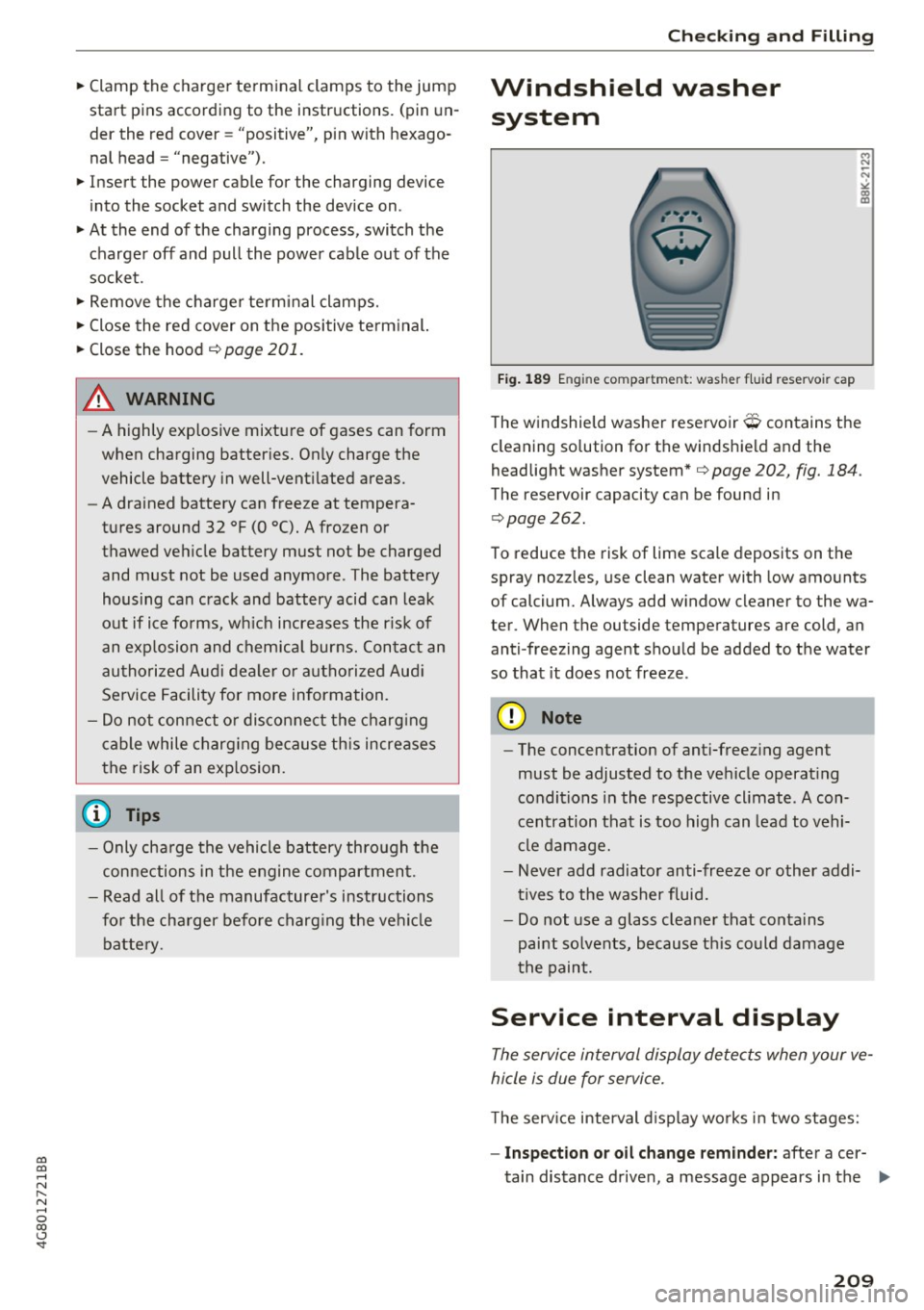
Fi g. 1 89 E ngine compar tmen t: washer f luid reservo ir cap
M N
-N ~
"' m
The windshield washer rese rvoir O contains the
cleaning so lution for the windshield and the
headlight washer system*
q page 202, fig. 184.
The reservoir capacity can be found in
¢page 262.
To reduce the risk of lime scale depos its on the
spray nozzles, use clean water with low amo unts
of calcium. Always add w indow cleaner to the wa
ter. When the outside temperatures are cold, an
anti-freezing agent shou ld be added to th e water
so that it does not freeze .
(!) Note
-The concentration of ant i-freez ing agent
must be adjusted to the vehicle operat ing
conditions in the respective climate . A con
centration that is too high can lead to vehi
cle damage.
- Never add radiator anti-freeze or other addi
tives to the washer fluid.
- Do not use a glass cleaner that contains
paint so lvents, because th is could damage
the paint.
Service interval display
The service in terval display detects when your ve
hicle is due for service.
T he serv ice inte rval d isplay wo rks in two stages:
-Inspect ion or oil change rem inder: after a cer-
tain distance driven, a message appears in the ..,.
209
Page 212 of 284

Check ing and F illing
instrument cluster display each time the ign i
tion is switched on or off . The remaining dis
tance or time is displayed br iefly.
- Inspection or oil change due: if yo ur vehicle
has reached an inspection o r oi l change interval
or both intervals at the same time, the mes
sage
Inspection due! or Oil change due! or Oil
change and inspection due!
appears briefly af
ter switch ing the ignit ion on/off .
Checking service intervals
You can check the rema ining distance o r time un
til the next oil change o r next inspection in the
Car menu. To do this, select : the
IC ARI function
button
> (Car) * Systems control button > Service
& checks > Service interv als .
Resetting the indicator
Your author ized Audi dealer or authoriz ed A udi
Serv ice Facility will reset the serv ice interval d is
p lay after performing serv ice.
If you have changed the oil yourself, you must re
set the oil change interva l.
fo reset the indica to r, se lec t: the
ICAR I fu nction
but ton
> (Car) * Systems con trol b utton > Service
& checks > Service intervals. Tu rn the control
knob downward to
Reset oil change interval and
press the cont rol knob.
(D Note
- Only reset the oil change indicato r if the oil
was changed .
- Fo llow ing the service i nte rva ls is critical to
maintai ning the service life an d va lue of
your ve hicle, especia lly the engine. Even if
the m ileage on the vehicle is low, do not ex
ceed the time for the next service.
- Ca lculating the t ime to the next oi l change
i s interrupted when the ve hicle battery is
d iscon nected¢
page 239 .
210
Page 213 of 284

a)
a)
.--< N
" N .... 0 a) 0.:,
"'
Wheels
Wheels and Tires
General information
.,.Check your tires regularly for
damage (punctures, cuts, cracks
and bulges). Remove foreign ob
jects from the tire tread.
.,. If driving over curbs or similar
obstacles, drive slowly and ap
proach the curb at an angle.
.,.Have faulty tires or rims re
placed immediately.
"'Protect your tires from oil,
grease and fuel.
.,.M ark tires before removing
them so that the same running
direction can be maintained if
they are reinstalled.
"'Lay tires flat when storing and
store them in a cool, dry location
with as little exposure to light as
possible.
(D Note
-Please note that summer and
winter tires are designed for
the conditions that are typical in those seasons. Audi recom
mends using winter tires dur
ing the winter months. Low
temperatures significantly de crease the elasticity of summ
er tires, which affects traction
Wheels
and braking ability. If summer
tires are used in very cold
temperatures, cracks can form
on the tread bars, resulting in
permanent tire damage that
can cause loud driving noise
and unbalanced tires.
-Burnished, polished or
chromed rims must not be
used in winter driving condi
tions. The surface of the rims
does not have sufficient corro
sion protection for this and
could be permanently dam aged by road salt or similar
substances.
Tire designations
Fig. 190 T ir e designations on the side -
wall Ill>
211
Page 216 of 284

Wheel s
Bead separation
means a breakdown of the bond
between components in the bead .
Cord
means the strands forming the
plies in the tire.
Cold tire inflation pressure
means the tire pressure recom
mended by the vehicle manufac
turer for a tire of a designated
size that has not been driven for more than a couple of miles (kilo
meters) at low speeds in the
three hour period before the tire
pressure is measured or adjusted.
Curb weight
means the weight of a motor ve
hicle with standard equipment in
cluding the maximum capacity of
fuel, oil, and coolant, air condi
tioning and additional weight of
optional equipment.
E x tra load tire
means a tire designed to operate
at higher loads and at higher in
flation pressures than the corre sponding standard tire . Extra load
tires may be identified as "XL",
"xl", "EXTRA LOAD", or "RF" on
the sidewal l.
214
Gross Axle Weight Rating
("GAWR ")
means the load-carrying capacity
of a single axle system, measured
at the tire -ground interfaces .
Gross Vehicle Weight Rating
(" GVWR ")
means the maximum total loaded
weight of the vehicle .
Groove
means the space between two ad
jacent tread ribs .
Load rating (code )
means the maximum load that a
tire is rated to carry for a given in
flation pressure. You may not find
this information on all tires be
cause it is not required by law.
Ma ximum load rating
means the load rating for a tire at
the maximum permissible infla tion pressure for that tire.
Ma ximum loaded vehicle
weight
means the sum of :
(a) Curb weight
(b) Accessory weight
(c) Vehicle capacity weight, and
(d) Production options we ight
Page 226 of 284
Wheels
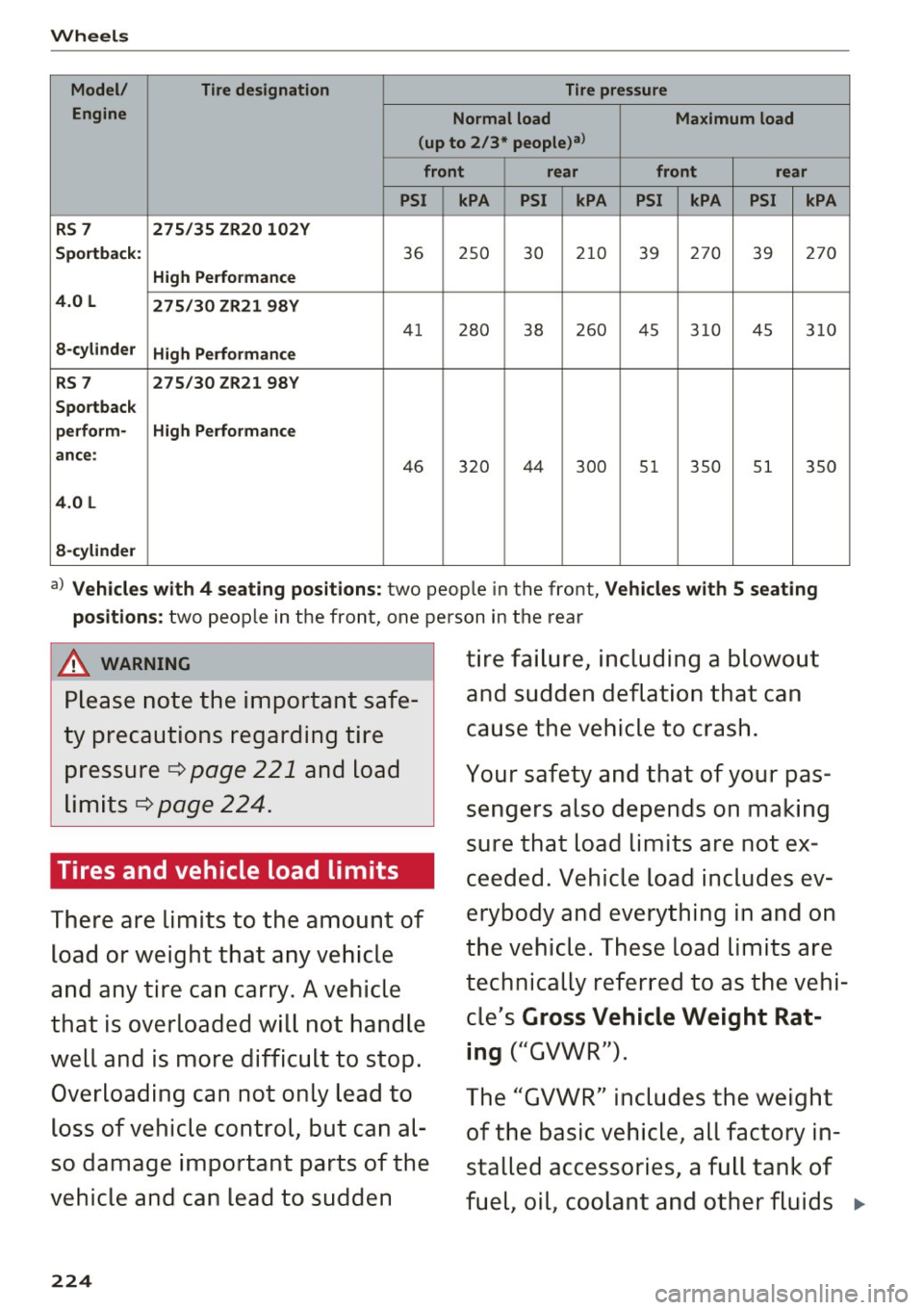
Model/ Tire designation Tire pressure
Engine Normal load Maximum load
(up to 2/3* people)a>
front rear front rear
PSI kPA PSI kPA
PSI kPA PSI kPA
RS 7 275/35 ZR20 102Y
Sportback:
36 250 30 210 39 270
39 270
High Performance
4.0 L 275/30 ZR21 98Y
41 280 38 260 45 3 10 4 5 310
8-cylinder
High Performance
RS 7 275/30 ZR21 98Y
Sportback
perform- High Performance
ance:
46 320 44
300 51 350 51 350
4.0 L
8-cylinder
a) Vehicles with 4 seating positions: t wo people i n the front, Vehicles with 5 seating
positions:
two peop le in t he front , one pe rson in the re ar
A WARNING
Please note the important safe
ty precautions regarding tire pressure ¢
page 221 and load
limits¢
page 224.
Tires and vehicle load limits
There are limits to the amount of
load or weight that any vehicle
and any tire can carry. A vehicle
that is overloaded will not handle
well and is more difficult to stop.
Overloading can not only lead to
loss of vehicle control, but can al
so damage important parts of the
vehicle and can lead to sudden
224
tire failure, including a blowout
and sudden deflation that can
cause the vehicle to crash.
Your safety and that of your pas
sengers also depends on making
sure that load limits are not ex
ceeded. Vehicle load includes ev
erybody and everything in and on
the vehicle. These load limits are
technically referred to as the vehi
cle's
Gross Vehicle Weight Rat
ing
("GVWR").
The "GVWR" includes the weight
of the basic vehicle, all factory in
stalled accessories, a full tank of
fuel, oil, coolant and other fluids
111-
Page 238 of 284

Care and cleaning
A WARNING
- Only wash the vehicle when the ignition is
off and follow the instructions from the car
wash operator to reduce the risk of acci
dents.
- To reduce the risk of cuts, protect yourself
from sharp metal components when wash
ing the underbody or the inside of the wheel
housings.
-After washing the vehicle, the braking effect
may be delayed due to mo isture on the
brake rotors or ice in the winter . This in
creases the risk of an acc ident. The brakes
must be d ried first w ith a few careful b rake
applications.
(D Note
- If yo u wash the ve hicle in an automatic car
wash, yo u m ust retract the rear spoiler if
necessary, and fold the exte rior mi rrors in
to reduce the risk of da mage. Power fo ld ing
ex ter ior mirro rs* m ust only be folded in and
out using the power folding func tion.
-
- To red uce the risk of pa int damage, do not
wash the vehicle in direct sun light .
- T o reduce the risk of damage to the s urface,
do not use insect removing sponges, kitchen
sponges o r similar items .
- Matte finish painted vehicle components:
-To reduce the risk of damage to the sur-
face, do not use polis hing agents or hard
wax .
- Never use protective wax. It can destroy
the matte finish effect .
- Do not place any stickers or magnetic
signs on vehicle parts painted with matte
finish paint. The paint could be damaged
when the stickers or magnets are re
moved.
@ For the sake of the environment
Only wash the veh icle in facili ties spec ially de
s igned for that pu rpose . This will reduce the
r isk of dirty wate r contam inated with o il from
ente ring the sewe r system.
Cleaning and care information
W hen clean ing and ca ring for ind ividua l vehicle
components, refer to the fo llow ing tables. The
i n formation conta ined there is s imply recom
mendations. For quest ions or for components t
h at are not listed, cons ult an autho rize d Aud i
dealer or au thor ized Aud i Servi ce Fac ility. Also
fo llow the informa tion found in <=> & .
Ext erior cleaning
Component Situation Solution
Windshield wiper
Deposits ¢ page 47, Cleaning windshield wiper blades
blades
Headlights /
Deposits Soft sponge wi th a m ild soap solution3>
Tail light s
Sensors /
Deposits Sensors: soft cloth with solvent-free cleaning solution
camera lens es Camera lenses: soft cloth w ith alcohol -free cleaning solu -
tion
Snow/ice Hand br ush/solvent-free de-icing spray
Wheels Road salt Water
Bra ke dust Acid-free special cleaning solution
Exhaust tail pipes Road salt Water, clea ning solution su itab le for s tainl ess stee l, if nee-
essa ry
236
Page 240 of 284

Care and cleaning
Component Situation Solution
Te xtil es
Deposits adhering to Vacuum cleaner
a rt ifici al le ather , the surface
Alcant ara Water-based deposits Absorben
t cloth and mild soap solutiona>
such as coffee, tea,
blood, etc.
O il-based deposits Apply a m ild soap solution a), blot away the dissolved oil or
such as oil, make-up, dye, treat afterward with water, if necessary
etc.
Special deposits such Special stain remover, b lot with absorbent material, treat
as ink, na il polish, la- afterward with mild soap solution, if necessary a)
tex paint, shoe pol-
ish, etc.
Natural leather Fresh stains Cotton cloth with a mi
ld soap solutiona>
Water-based deposits Fresh sta ins : absorbent cloth
such as coffee, tea, Dried sta ins: stain remover suitable fo r leather
blood, etc.
Oil-based deposits Fresh stains: absorbent cloth and stain remover suitable
such as oil, make-up, for leather
etc. Dried sta ins : grease dissolv ing spray
Special deposits such Spot remover suitab le for leather
as ink, nai l polish, la -
tex paint, shoe pol-
ish, etc.
Ca re Regularly apply cond ition ing cream that protects from
light and penet rates into the materia l. Use specia lly-co l-
ored conditioning cream, if necessary.
Carbon parts Deposits clean the same way as plastic parts
a) Mild soap solution: maximum two tablesp oons of neutral soap in 1 quart (l liter) of water
_& WARNING
The windshie ld may not be trea ted with wa
ter-repelling windshield coating agents. Un
favorable conditions s uch as wetness, dark
ness, or low sun can result in increased glare .
Wiper blade chatter is also possible.
(D Note
- Headlights /tail light s
-Never clean headlights or tail lights with a
dry cloth or sponge.
- Do not use any cleaning product that con
tains alcohol, because they could cause
cracks to form.
- Wheels
238
-
- Never use any paint polish or other abra
sive materials.
- Damage to the protect ive layer on the
rims such as stone chips or scratches must
be repaired immediately.
- Sensors /camera l enses
- Neve r use wa rm or ho t water to remove
snow or ice from the camera lens . This
could cause the lens to crack .
- Neve r use ab rasive cleaning materials or
a lcohol to clea n the camera lens . This
could cause scratches and cracks .
-Doo r window s
-Remove snow and ice on windows and ex-
terior mirrors with a plast ic scraper. To
Page 260 of 284
Emergency situations
Raising the vehicle
Lifting with workshop hoist and with floor
jack
Th e vehicle may only b e lift ed at the lifting
poin ts illust rated.
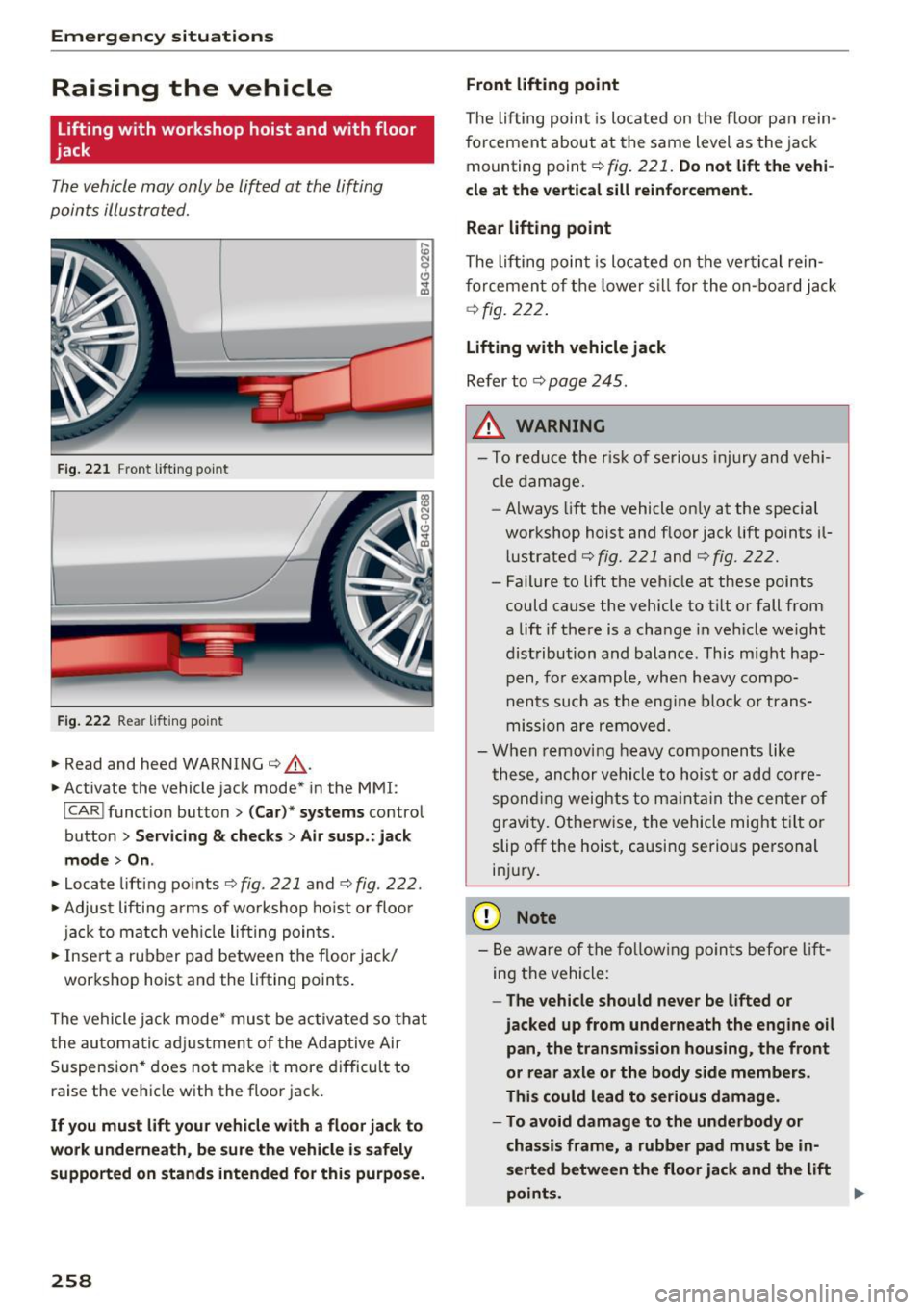
F ig .. 221 F ro nt lift ing po int
F ig. 222 Rea r lifti ng po int
.,. Read and heed WARNING c::> A -
.,. Activate the vehicle jac k mode* in the MMI:
I CAR I funct io n button > (Car) * systems co ntro l
button
> Servicing & checks > Air susp. : jack
mode > On .
.,. Lo ca te lift ing po ints c::> fig . 221 a nd c::> fig . 222 .
.,. Adjus t lifting arms of wo rk shop hoist o r floo r
jac k to m atch veh icle li fting poin ts.
.,. Inse rt a rubber pa d between the floor jack/
wor kshop hoist an d the lifting points .
Th e ve hicle jack mode* must be activa ted so that
the au tom atic a djustment of the Ad aptive Air
S uspens ion* does no t make it more d ifficult to
raise the ve hicle w ith the floor jac k.
If you must lift your vehicle with a floor jack to
work underneath, be sure the vehicle is safely
supported on stands intended for this purpose.
258
Front lifting point
The li fting point is lo cated on the floor pa n rein
f orcement about at the same level as the ja ck
mounting point
c::> fig . 221. Do not lift the vehi
cle at the vertical sill reinforcement.
Rear lifting point
The lif ting poin t is loca ted on the ve rtic al rein
forcement of t he lower sill for the o n-b o ard jack
c::>fig. 22 2.
Lifting with vehicle jack
Refer to c::> page 245 .
A WARNING
-To red uce the r is k of se rious inju ry and vehi
cle damage.
- Always lift the vehicle on ly at the special
workshop hoist an d floor jack lift points il
l ustrated
c::> fig. 221 and c::> fig. 222.
- Fail ure to lift the ve hicle at these points
could cause the vehicle to t ilt o r fall from
a lift i f there is a cha nge in ve hicle we ight
dist ribution and balance . This might hap
pen, fo r example, wh en heavy compo
n en ts such as the eng ine block o r tra ns
m iss ion are re moved .
- Whe n rem oving heavy co m po nents like
t hese, an chor vehicle to hois t or add cor re
s p ondin g weig hts to maintai n the cen ter of
gravi ty . O th erw ise, the vehicle might t ilt or
slip off the hoist, causi ng serio us pers onal
in jur y .
(D Note
- B e aw are of the follo wing p oints bef ore lift
ing the vehicle :
-The vehicle should never be lifted or
jacked up from underneath the engine oil
pan, the transmission housing, the front
or rear axle or the body side members.
This could lead to serious damage .
- To avoid damage to the underbody or
chassis frame, a rubber pad must be in
serted between the floor jack and the lift
points.