engine overheat AUDI A7 2017 Owner´s Manual
[x] Cancel search | Manufacturer: AUDI, Model Year: 2017, Model line: A7, Model: AUDI A7 2017Pages: 284, PDF Size: 72.29 MB
Page 11 of 284
co
co
....
Instruments and indicator lights
Instruments and indicator lights
Instruments
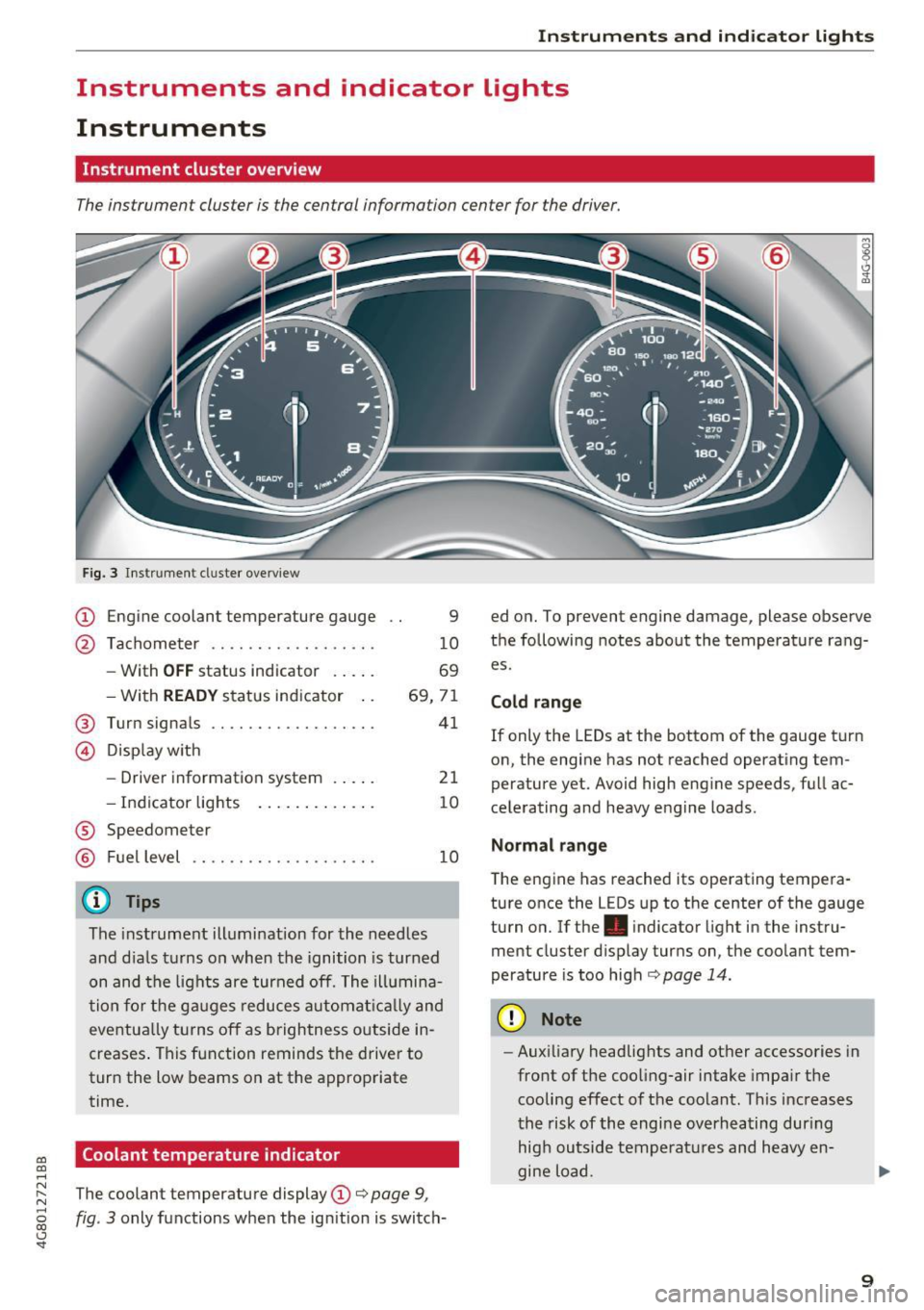
Instrument cluster overview
The instrument cluster is the central information center for the driver.
Fig . 3 Instru ment cl uste r overview
CD Engine coolant temperature gauge
@ Tachometer ...... .... ...... . .
- With
OFF status indicator . .. . .
- With
READY status ind icator ..
@ Turn signals ...... .... ....... .
© Dis p lay w ith
- Drive r information system . .. . .
- Indicator lig hts ..... .. . .. .. .
® Speedometer
® Fuel level
(D Tips
9
1 0
69
69, 7 1
41
21
10
10
The instrument illumination for the needles
and d ia ls t urns on when the ignition is turned
on and the lights are turned off. The ill umina
t ion fo r the g auges reduces aut omat ically and
eve ntu ally t urns off as brigh tness outside in
creases . This f unction reminds the drive r to
tur n the low beams on at the approp riate
time.
Coolant temperature indicator
ed o n. To prevent engine damage, please observe
t h e following notes about the temperature rang
es.
Cold range
If only the LEDs at the bottom of the gauge t urn
on, the engine has not reached operating tem
perature yet. Avoid high eng ine speeds, full ac
ce le rating and heavy e ngine loads.
Normal range
T he eng ine has reached its operating tempera
ture once the L EDs up to the center of the gauge
turn on.
If the. indicator light in the inst ru
ment cluster d isp lay turns on, the coolant tem
perature is too high¢
page 14.
(D Note
-Aux iliary headlig hts and ot her accessories in
front of the coo ling-air intake impa ir th e
cooling effect o f th e coolant . This increases
t he risk of th e engi ne overheating dur ing
hig h ou tsid e tempera tures and heavy en
gine load.
~ The coolant temperature display CD¢ page 9,
~ fig. 3 only functions w hen the ignition is switch-
<..:> 'SI"
9
Page 12 of 284
Instruments and indicator lights
-The front spoiler also he lps to distr ib ute
cooling air while driving . If the spoiler is
damaged, the cooling effect w ill be im
paired and the risk of the engine overheat
i ng will increase. See an author ized Audi
dealer or authorized Audi Service Fac ility for
ass istance.
(D Tips
Applies to: ve hicles w ith d iese l engines
Due to the high eff ic iency of these engines,
the engine may not always reac h opera ting
t em perature i n cold outside tempe ra tur es.
This is normal and not a cause for con cern .
Tachometer
The tachometer displays the engine speed in rev
olutions per minute (RPM).
You shou ld shift to the next lowest gea r whe n
the speed is below 1,S00 R PM. T he begin ning of
the re d zone in the tachome ter ind icates the
maximum permissible engine speed fo r all gea rs
once the engine has been bro ken in and when it is
warmed up to operating temperature . Before
reaching the red zone, you should shift into the
next h igher gea r, c hoose the Dor S selecto r lever
position, or remove your foot from the accelera
tor pedal.
CD Note
The needle in the tachometer @ c> page 9,
fig. 3
may only be in the red area of the gauge
for a short time or the re is a r isk of engine
damage.
@ For the sake of the environment
Upshifting early helps you to save fuel and re
duce operating no ise.
(D Tips
Applies to: Sa nd RS mo de ls
The engine speed is limi ted when the eng ine
is cold -the full engine o utp ut is not availa
ble. When the engi ne is at oper ating temper
at ure, the re d a rea in the ta chome ter move s
t o a higher RPM r ang e.
10
· Fuel level
The display @ only wor ks w hen the ig nition is
swi tched on.
If th e fue l level drops below 2.6 g al
(1 0
L), a red L ED w ill tu rn on and t he HJ indica
tor light wi ll turn o n
i=>page 18. The LED b links
red when the fue l level is very low .
The poss ible range base d on the cu rrent fue l lev
e l is shown in tab@¢
page 21, fig . 4.
For th e tank capacity i n your veh icle, refe r to the
Techn ica l Da ta
c> page 2 62.
CD Note
Neve r drive until t he tank is complete ly em p
ty. The irregu la r su pply of fuel that res ults
from tha t can cause engine misfires. Un co m
b uste d fue l w ill th en en ter the exhaust sys
tem . This c an cause overheating and damage
to the ca talyt ic converter .
Indicator Lights
· Description
The ind icator lights in the instrument cluster
bl ink or tur n on. They ind icate fu nctions or mal
funct io ns.
Messages may appear w ith some indicator lights.
A war ning s ignal will sound at the same time.
The ind icator lights and messages i n the instru
ment clus ter d isp lay can be cove red by ot he r dis
plays. To show them ag ai n, se lec t t he tab for in
dicator lights and messages using the mu ltifu nc
tion steering whee l
c> page 21. If there are sev
eral ma lfunctions, you can display them one at a
time us ing the thumbwheel.
Some indicator lights in the d isplay can disp lay in
severa l co lors .
Central indicator light
App lies to: vehicles wit h mo nochrome d isplay
If a message appears together with a central in
dicator light . or
U. the centra l ind icator light
will indicate the priority of the warning. If a
white indicator light also appea rs, the centra l in
dica tor light w ill have its ow n colo r. Fo r example, ..,.
Page 20 of 284
Instruments and indicator lights
If the i ndicator lig ht does not tu rn of f, drive im
mediately to an a utho rized Audi dea le r or author
ized A ud i Service Fac ility to have the malfunction
corrected.
A WARNING
Always ada pt yo ur speed to the cu rrent
weathe r, road and t raffic conditi ons. You
should never disob ey traffic laws in orde r to
follow drivi ng r ecomme nda tions .
@ Tips
For add it iona l information on the diese l par
tic ulate fi lter, se e
¢page 199.
!?'i Engine speed limitation
Applies to: vehicles with engine speed limitation
Ill Maximum engine speed: XXXX rpm
The engine speed is automatica lly lim ited to the
speed d isplayed in the instrument cluster. T his
p rotects the e ng ine from overheating .
The engine speed lim itation deactivates once the
engine is no longer in the critical temperature
range and you have released the acce le rato r ped
al once .
I f the engine speed lim itation was activated by
an eng ine contro l ma lf u nction,
the @B indicator
light also t urn s on. Make su re that the speed
does not go above t he speed d is p layed . Drive to
a n author ized A udi dealer or au thor ized A udi
Serv ice Facili ty im medi ately to have t he m alfunc
tion cor rec ted.
(D Tips
Applies to: Sand RS models
The e ngi ne sp eed is lim it e d whe n the eng ine
is cold -the full engine o utpu t is not av ail a
ble. When the engine is at operating temper
ature, the re d area in th e tachometer moves
to a highe r RPM ra nge.
_ ..., Engine oil sensor
• Oil level sensor: system fault!
18
The sensor to check the en gine o il level has
failed. Drive to an authorized A udi dealer or au
t h orized Aud i Serv ice Facility immediately to have
the malfunct ion corrected.
f Engine warm -up request
n Please warm up engine
F u el has entered t he engine oil, eithe r from low
outside temperatures or frequent sho rt d rives.
D rive until the eng ine is wa rm so that the f uel in
the e ngine o il w ill evaporate . Avoid hig h eng ine
speeds, f ull accelerating a nd heavy engine loads
wh en doi ng this .
5) Tank system
Ii] Please refuel
If the indicato r light turns on for the first time
and t he message appea rs, the re are abou t 2.6
gallons ( 10 li ters) of f uel left in t he tank .
Ii] Fuel tank system malfunction! Please con
tact dealer
There is a ma lf u nction in t he f uel tank system.
Dr ive to an au thor ized A udi d ealer or au thorize d
Audi Se rvice Facility immediate ly to have the
malfunction cor rected.
(D Tips
'
For add it ion al in format ion on ref ueli ng, see
¢ pag e 193 .
~ Washer fluid level
f"j i>lease add washer fluid
Fill the w ashe r flui d fo r th e win dsh ie ld was her
system and the he adlight washer sys tem* when
t h e ignit io n is switched off¢
page 209 .
• Windshield wipers
m Windshield wipe r: system fault!
There is a m alfu ncti on with the win dshi eld wip -
ers . ..,.
Page 69 of 284
co
co
.... N
" N .... 0
00
<.,;) 'SI"
lead to greater tire wear and will affect driving
behav ior.
Do not drive on
winter tires year-round , as this
will consume up to 10% more fuel.
Eliminate unnecessary weight
Since every kilogram of extra weight increases
fuel consumption, a quick inspection of the lug
gage compartment may be worth it to avoid un
necessary weight.
When not being used, a roof rack should be re moved to decrease the wind resistance of the ve
hicle. You will save approximately 12% of your
fuel when at speeds from 62-75 mph (100-120 km/h).
Save energy
The engine drives the generator, which generates
electricity; the fuel consumption also increases
with the demand for electricity. Therefore, switch
electrical equipment off when you no longer
need it. Examples of equipment that uses a lot of
energy are air blowers at a high setting, the rear
window defogger and seat heating*.
CD Note
Do not leave engine idling unattended after
starting. If warning lights should come on to
indicate improper operation, they would go
unheeded. Extended idling also produces
heat, which could result in overheating or
other damage to the vehicle or other proper
ty .
CD Note
-Have your vehicle maintained properly and
in accordance with the service recommenda
tions in your Warranty
& Maintenance book
let. Lack of proper maintenance as well as
improper use of the vehicle will impair the
function of the emission control system and
could lead to damage .
- Do not alter or remove any component of
the Emission Control System unless ap
proved by the manufacturer.
- Do not alter or remove any device, such as
heat shields, switches, ignition wires,
Driving
valves , which are designed to protect your
vehicle's Emission Control System and other
important vehicle components.
(D Tips
The consumption estimates as published by
ENVIRONMENTAL PROTECTION AGENCY
(EPA) and Transport Canada may not corre
spond to your actual consumption on the
road, which will vary depending upon vehicle
load and speed, road and weather conditions,
trip length, etc .
Steering
Manual steering wheel position adjustment
Applies to: vehicles with manual steering wheel adjustment
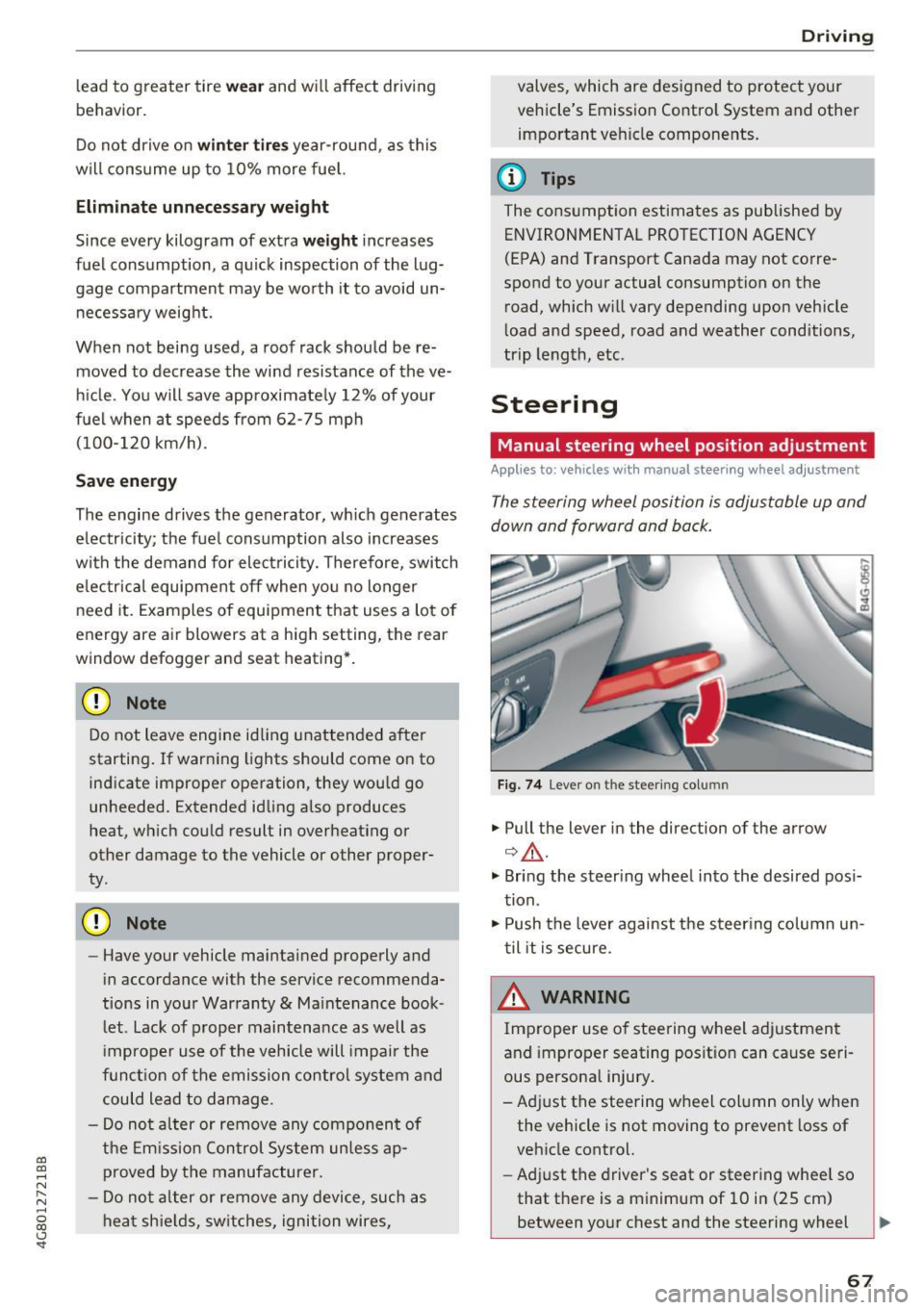
The steering wheel position is adjustable up and
down and forward and back.
Fig. 74 L eve r o n t he stee ring col umn
"'Pull the lever in the direction of the arrow
Q &_ .
"' Bring the steering wheel into the desired posi
tion.
"' Push the lever against the steering column un
til it is secure.
_& WARNING
~ -
Improper use of steering wheel adjustment
and improper seating position can cause seri
ous personal injury.
-Adjust the steering wheel column only when the vehicle is not moving to prevent loss of
vehicle control.
- Adjust the driver's seat or steering wheel so
that there is a minimum of 10 in (25 cm) between your chest and the steering wheel
II>
67
Page 81 of 284
co
co
.... N
" N .... 0
00
<.,;) 'SI"
-Never hold the vehicle on an incline with a
slipping clutch. The clutch opens automati
cally when it becomes too hot from the
overload . The
1§1 indicator light turns on
and a message appears
Q page 81 when
the clutch is overloaded.
(D Note
- When stopping on an incline, do not try to
hold the vehicle in place by pressing the ac
celerator pedal while a driving gear is se
l ected. This can cause the transmission to
overheat and can damage it. Set the parking
brake or press the brake pedal to prevent
the vehicle from rolling.
- Allow ing the vehicle to roll when the engine
is stopped will damage the transmission be
cause it is not lubricated .
(D Tips
For safety reasons, the parking brake is re
leased automatically only when the driver's
safety belt is fastened.
Hill descent control
The hill descent control system assists the driver
when driving down hills .
Hill descent contro l is activated when the selec
tor lever is in the Dor S position and you press
the brake pedal. The transmission automatically
selects a gear that is suitable for the hill. Hill de
scent control tries to maintain the speed ach
ieved at the time of braking, within physical and
technical limitations. If may still be necessary to adjust the speed with the brake pedal.
Hill descent control switches off once the hill lev
els out or you press the accelerator pedal.
On vehicles with a cruise control system*
¢ page 85, hill descent control is also activated
when the speed is set.
_& WARNING
Hill descent control cannot overcome physical
limitations, so it may not be able to maintain
Driving
a constant speed under all conditions. Always be ready to apply the brakes.
Shifting manually (tiptronic mode)
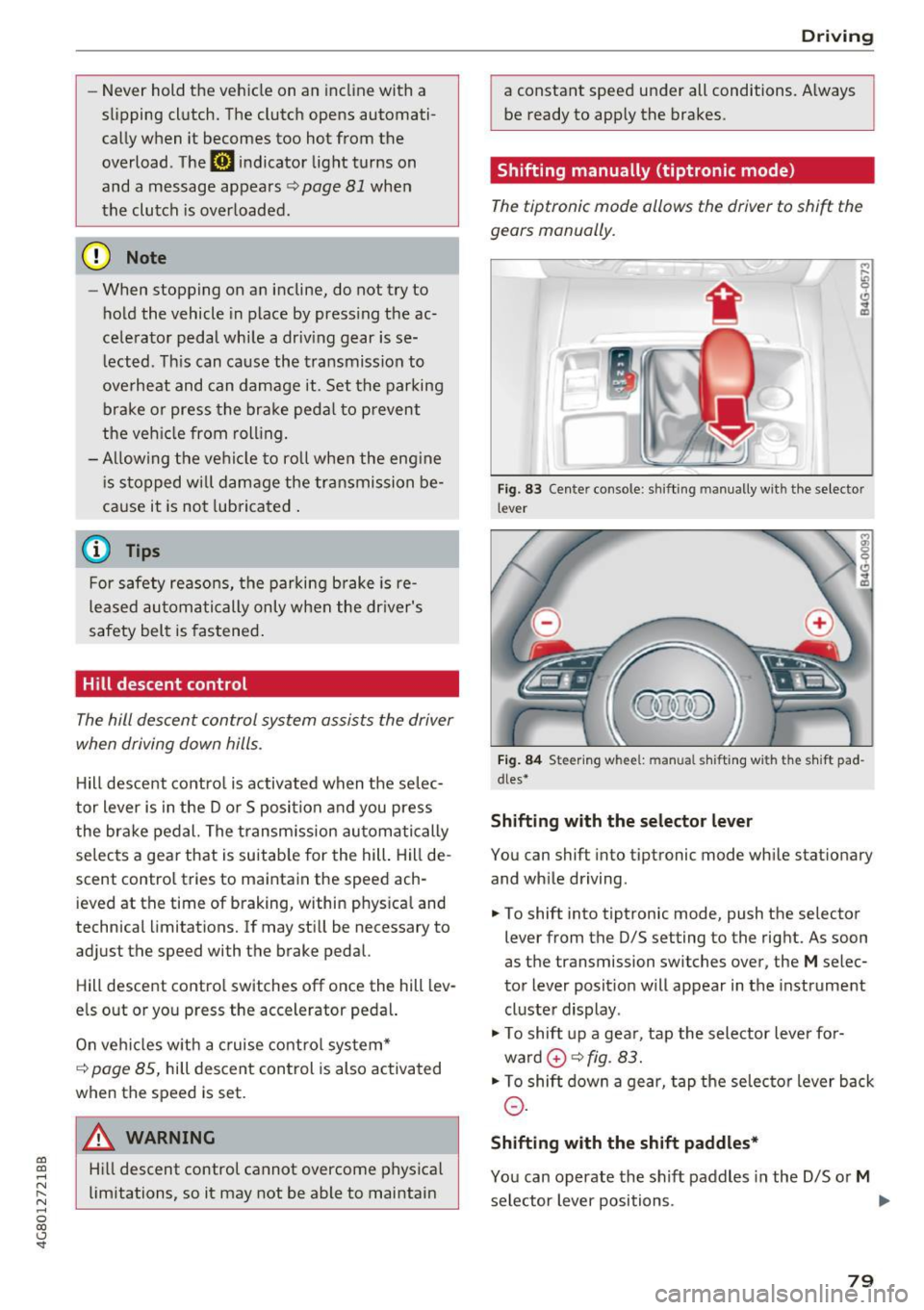
The tiptronic mode allows the driver to shi~ the
gears manually .
'
Fig. 83 Center console : shift ing manually wit h the selector
lever
Fig. 84 Steering w hee l: m anual s hifting wi th the sh ift pad
dles•
Shifting with the selector lever
You can shift into tiptronic mode while stationary
and while driving.
.,. To shift into tiptronic mode, push the selector
lever from the D/S setting to the right. As soon
as the transmission switches over, the
M selec
tor lever posit ion will appear in the instrument
cluster display .
"'To shift up a gear, tap the selector lever for
ward
0 ¢ fig. 83.
"'To shift down a gear, tap the selector lever back
0-
Shifting with the shift paddles*
You can operate the shift paddles in the D/S or M
selector lever positions. .,.
79
Page 85 of 284

co
co
.... N
" N .... 0
00
\.J '
When towing a trailer, inflate the tires of your
vehicle to the tire pressure listed under "Full
load" on the label
¢page 221. Inflate trailer
tires to trailer and tire manufacturers' specifica
tions .
Lights
Check to make sure both vehicle and trailer lights
are working properly.
Safety chains
Be sure trailer safety chains are properly connect
ed from the trailer to the hitch on the vehicle. Leave enough slack in the chains to permit turn
ing corners. When you install safety chains, make
sure they will not drag on the road when you are
driving.
The chains should cross under the trailer tongue
to prevent it from dropping in case of separation
from the hitch.
Adjusting the Audi drive select
Make sure the vehicle is on a level surface before
hitching up the trailer and before adjusting the
tongue weight. The vehicle must be in
auto or
comfort driving mode and not raised
¢page 105, ¢0 .
Make sure that the vehicle is lowered. In Info
tainment , select:
ICARI function button> Lower
control button.
If you must drive under poor road conditions , you
can raise the vehicle
after coupling the trailer or
after adjusting the tongue weight ¢page 107.
0 Note
-Changes in temperature or load can affect
the height of the vehicle.
- Always select
auto or comfort mode. Other
wise, the tongue load specified for your ve
hicle will no longer be applicable.
Trailer towing
Driving instructions
Driving with a trailer always requires extra care
and consideration .
Weight distribution
Towing a loaded trailer with an empty car results
in a highly unstable distribution of weight. If this
cannot be avoided, drive at very low speeds only
to avoid the risk of losing steering control.
A "balanced" rig is easier to operate and control.
This means that the tow vehicle should be loaded
to the extent possible and permissible, while keeping the trailer as light as possible under the
circumstances . Whenever possible, transfer
some cargo to the luggage compartment of the
tow vehicle while observing tongue load require
ments and vehicle loading considerations.
Speed
The higher the speed, the more difficult it be
comes for the driver to control the rig . Do not
drive at the maximum permissible speed. Reduce
your speed even more if load, weather or wind
conditions are unfavorable -particularly when
going downhill.
Reduce vehicle speed
immediately if the trailer
shows the slightest sign of swaying .
Do not try
to stop the swaying by accelerating.
Observe speed limits. In some areas, speeds for
vehicles towing trailers are lower than for regular
vehicles.
Always apply brakes early . When driving down
hill, shift into a lower gear to use the engine
braking effect to slow the vehicle. Use of the
brakes alone can cause them to overheat and fail.
Air suspension*
When driving with a trailer, activate the trailer
mode of the air suspension. Switch the air sus
pension trailer mode on when you are towing a
trailer. This will limit the regulation by the air
suspension while driving . Select in the MMI:
I CAR ! function button > (Car)* systems control
button
> Vehicle settings > Air susp.: towing >
On. 1J,,
83
Page 125 of 284
co
co
.... N
" N .... 0
00
\.J '
the brakes in wet weather.
The braki ng effect can also be red uced if you are
driving on salted roads and you do not apply the b rakes for long periods of time . The layer of salt
on the brake rotors and pads must be worn off
f irst when the brakes are app lied.
Due to its surface, the ceramic bra ke rotor* ab
sorbs moisture in certa in situations. There fore,
there will temporarily be less braking force than
when the brakes are dry . You can compensate for
this by pressing the brake pedal harder.
Cor rosion
L eaving the vehicle parked fo r long periods of
time, low mi leage and avoiding heavy braking
can contribute to corrosion on the brake rotors
and to dirty brake pads.
I f you usually avo id heavy braking or if there is
corrosion present , occasional heavy braking at
high speeds is recommended to clean the brake
rotors and pads
q ,& .
Brak e system malfunct ion
if you notice that the brake pedal travel has sud
denly increased, then a brake c ircui t in the dual
circuit brake system may have malfunctioned. Drive to an authorized Audi dea ler or a uthorized
Aud i Service Facility immediately to have the
problem corrected. On the way there, drive with
reduced speed and keep in mind that you w ill
need a longer distance to stop and you w ill need
to p ress the b rake pedal harde r.
L ow brake fluid level
When the brake fl uid level is low, malfunct ions in
the brake system may occur . The brake f lu id level
is electronically monitored.
Br ak e boost er
The brake booster amplifies the pressure you ap
p ly to the brake peda l. It only works when the en
g ine is running.
A WARNING
- Only apply the brakes for the purpose of
cleaning the brake system whe n road and
-
Intellig ent Technology
traffic conditions permit. You must not en
danger other road users. This increases the
risk of an accident.
- Never let the vehicle roll while the engine is
stopped because this increases the risk of an
accident.
- New brake pads do not ach ieve the ir full
braking effect during the first 250 m i
(400 km). They m ust be "broken in" first.
The break-in per iod ca n be cons iderably lon
ge r fo r vehicles with ceram ic brake rotors* .
H owever, you can compensate fo r the
slightly reduced braking force by pressi ng
fi rm ly on the brake pedal. Avo id heavy b rak
ing du ring the break -in pe riod.
- Ce rtain weathe r and ope rating condi tions
such as driving through water, dr iv ing in
heavy rain o r driv ing after was hing your ve
hicle can impa ir the effect iveness of the
brakes. In the winter, ice may build up on
the brake pads, rotors and drums . Check
these components by braking carefully. Ap
p lyi ng the brakes carefully several times
d ries the b rakes and removes ice build-up .
- The efficiency of the brakes can also be im
pa ired by dr iv ing for long stretches on roads
covered with sa lt without using the bra kes .
You can remove salt deposits from the
b rake rotors and pads by carefully applying
t he brakes several times .
- I f the fron t spoiler is damaged o r yo u install
another spoi ler, make su re the front wheel
b rakes are ven tilated properly . Othe rw ise,
the brake system co uld overheat, which re
duces their effectiveness .
- Fa ilure of a brake circuit impairs brak ing
pe rformance, which increases b raking dis
tance. Avo id driving the vehicle and have it
towed it to the nearest a uthorized Audi
deale r or authorized Aud i Serv ice Facility.
- I f the brake booster is not working, yo u w ill
have to p ress much harder on the brake
pedal to compensate fo r the lack of the
booster.
Q) Note
- Never let the brakes "rub" by pressing the
peda l lightly when braking is not actually
123
Page 200 of 284

Check ing and F illing
is empty or until no mo re fluid flows into the
tank.
~ Remove the canister and close the fi ller tube
c> page 198 , Completing AdBlue refill .
(D Note
Only use refi ll canisters that are approved for
your vehicle. Us ing other systems can cause
Ad Blue to leak.
@ Tips
- An authorized Audi dealer or authorized
Audi repair facility can te ll you which ref ill
can isters are approved for your vehicle.
- A permitted refill canister contains approxi
mately 1.3 ga llons (5 liters) of AdB lue.
Completing AdBlue refill
Applies to: vehicles with selective catalytic reduction
C losi ng the filler neck
~ Turn the cap on the filler neck to the right with
the wheel wrench unt il the cap clicks into place.
This t ightens the cap to the specification o &
in Filling AdBlue on page 197, c> (D in Filling
AdBlue on page 197 .
~ The n press on the left side of the tank doo r un-
ti l it l atches.
After filling
The vehicle must be driven so that the system
recognizes that the Ad Blue was refilled . T his can
take severa l m in utes.
~ If there was no Ad Blue left in the tank and a
range of O mi (0 km) was shown in the d isplay,
switch the ign it ion on for about 30 seconds be
fo re sta rting the engine.
(D Tips
Ad Blue can freeze at very low temperat ures .
If this happens, the system will not detect
that the Ad Blue was refilled a nd it will contin
ue to inform yo u of the low Ad Blue level. The
message turns off as soon as the tank thaws
out again.
198
Catalytic converter
Applies to: vehicles with gasoline engine
It is very important that your emission control
system (catalytic converter) is func tioning prop
erly to ensure that your vehicle is running in an
environmentally sound manner .
~ Always use lead-free gasoline c> page 191, Fuel
supply .
~ Never run the tank down all the way to empty.
~ Never put too much motor o il in your engine
c> page 204, Adding engine oil.
~ Never try to push- o r tow-start your vehicle .
The catalytic converter is an efficient "clean -up "
device built into the exhaust system of the veh i
cle. The catalyt ic converter b urns many of the
po llutants in the exhaust g as befo re they are re
l eased into the atmosphere.
The exclusive use of un leaded fuel is critically im
po rtant fo r the life of the catalytic converte r and
prope r funct io ni ng of the engine.
_&. WARNING
The temperat ure of the exhaus t sys tem is
high, both when driv ing and a fter stopping
the engine.
-
- Never tou ch the exhaust tail pipes once they
have become hot. This cou ld resu lt in burns.
- D o not p ark or operate the vehicle in ar eas
where the hot exhaust system may come in
contact with dry g rass, brush, fuel spi ll or
other mate rial which can ca use a fire.
- Do not apply additiona l undercoating or
rustp roofing on or near the exhaust mani
fold, exha ust pipes, cata lytic conve rter or
heat shields . D uring driving, the substance
used for unde rcoat ing could overheat and
cause a fire .
Cl) Note
-Be aware that just one tank f illing wit h
leaded fu e l w ill already seriously degrade
the performance of the catalytic converter.
- Do not exceed the correct engine oil leve l
c>page204.
Page 201 of 284

co
co
.... N
" N .... 0
00
\.J '
complete ly empty . The engine cou ld mis
fire. Unburned fuel could also get into the
exhaust system and this cou ld cause the
catalytic converter to overheat.
- Do not switch off the ignition while the vehi
cle is moving.
- Do not continue to operate your vehicle un
der these conditions, as otherwise fuel can
reach the catalytic converter. This could re
sult in overheating of the converter, requ ir
i ng its replacement.
- To assure efficient operation of the Emis
sion Control System:
- Have your vehicle maintained properly and
in accordance with the service recommen
dations in your Warranty
& Maintenance
book let.
- Lack of proper maintenance as we ll as im
proper use of the vehicle will impair the
function of the emission control system and could lead to damage.
® For the sake of the environment
Even when the Emission Control System is op
erating properly, the exhaust gas can have a
sulfur-like exhaust gas smell under some op
erat ing states. This depends on the su lfur
content of the fuel being used. Using a differ
ent brand of fue l may help, or filling the tank
w ith lead-free super grade gasoline .
Diesel particulate filter
Applies to: veh icles with diesel engine
The diesel particulate filter filters nearly all of
the soot particles out of the exhaust. The filter
cleans itself automatically under normal driving
conditions . If the filter cannot clean itself (for ex
ample , because you are only driving short distan
ces), the fi lter becomes clogged with soot and
the
II symbo l for the diesel particulate filter il
luminates
¢ page 17.
A WARNING
-Do not park your vehicle over flammable
materials such as grass or leaves because
-
Checking and Filling
the high temperature of the diesel particu
late filter could start a fire.
- Do not apply an underbody protectant in the
exhaust system area or a fire could start.
Engine compartment
Working in the engine compartment
Special care is required if you are working in the
engine compartment
For work in the engine compartment, such as
checking and filling fluids, there is a risk of in
jury, scalding, accidents, and burns. For this
reason, follow all the warnings and general
safety precaution s provided in the following in·
formation . The engine compartment is a dan
gerous area on the vehicle.
¢ ,&..
A WARNING
= =--
- Turn the engine off.
- Switch the ignition off.
- Set the parking brake.
-Select the P selector lever position.
- Let the engine cool down.
- Never open the hood when there is steam or
coolant escaping from the engine compart
ment, because there is a risk that you could
be burned. Wait until no steam or coolant is
escaping .
- Keep children away from the engine com
partment .
- Never sp ill fluids on a hot engine. These flu
ids (such as the freeze protection contained
in the coolant) can catch fire.
- Avoid short circuits in the electrical system.
- When working in the engine compartment,
remember that the radiator fan can switch
on even if the ignition is switched off, which
increases the risk of personal injury.
- Never open the cap on the coolant expan
sion tank when the engine is warm . The
coo ling system is under pressure.
- To protect your face, hands, and arms from
hot steam or coolant, cover the cap with a
large cloth when opening.
199
Page 208 of 284

Check ing and F illing
The coolant leve l is monitored through the. in
dicator light ¢
page 14. However, we do recom
mend occasionally check ing the coo lant level
manually.
I f you must add coolant, use a mixture of water
and coolant additive. Mixing the coolant additive
with d istilled water is recommended.
Coolant additiv e
The coolant addi tive is made of anti-freezi ng and
corros ion protection agents. Only use the fo llow
ing coolant additives . These additives may be
mixed with each other.
Coolant additive Specification
Gl3 TL 774)
Gl2++
TL 774 G
The amount of coolant add itive that needs to be
mixed w ith water depends on the climate where
the vehicle will be operated. If the coolant addi
tive percentage is too low, the coolant can freeze
a nd damage the engine.
Coolant
Freeze protec·
additive tion
Warm reg ions min. 40% m in. -13 ° F
max. 45% (-25 °C)
Cold regions min. 50% max . -40 °F
max . 55% (-40 °C)
([)
Note
-Before the start of winter, have your author
ized Audi dealer or authorized A udi Se rvice
Fac ility check if the coolant additive in you r
vehicle matches the percentage approp riate
fo r the clim ate. Thi s is especially important
when driving in co lder climates .
- If the approp riate coolant additive is not
available in an emergen cy, do no t add any
other additive. You cou ld damage the en
gine. If this happens, only use water and re store the correct mixture ratio with the
spec ified coolant additive as soon as possi
ble.
- Only refill with new coo lant.
- Radiator sealant must not be mixed w ith
the coo lant .
206
· Adding coolant
F ig. 186 En gin e compartment : coolant exp ansion tank
cover
-N
-~
~
Observe the safety precautions ~ .&. in Working
in the engine compartment on page 199.
Check ing the engin e coolant level
Park the vehicle on a leve l surface.
.,. Switch the ignit ion off.
.,. Read the coolant level on the coolant expansion
tank ¢
page 202, fig . 184. The coolant level
must be betwee n the MIN and MAX mark ings
when the e ngine in co ld. When the engine is
wa rm it c an be slightly above the MAX marking.
Adding coolant
Requirement: there must be a residual amount of
coolant in the expansion tank ¢(D .
.,. Let the engine cool down .
.,. Place a cloth over the coolant expansion tank
cap and unscrew the cap counterclockw ise
¢ .8_ .
.,. Add coo lant m ixed in the correct rat io
¢ page 205 up to t he MAX mar king.
.,. Make sure that the f luid level remains stab le.
Add mo re coolant if necessary.
.,. Close the cap securely .
Coolant loss usually ind icates there is a lea k. Im
med iate ly dr ive your vehi cle to a n author ized
Audi dealer or author ized A udi Service Fac ility
and have the cooling system inspected . If the
cooling system is not leaking, a loss can come
from the coolant boiling through overheating
and being pushed out of the cooling system.