sport mode AUDI A7 2018 User Guide
[x] Cancel search | Manufacturer: AUDI, Model Year: 2018, Model line: A7, Model: AUDI A7 2018Pages: 274, PDF Size: 42.77 MB
Page 109 of 274
a co .... N
" N .... 0 00 \.J '
matica lly drive in the
Ind ividual mode .
Systems comfort
Engine/transmission
ba lanced
Air suspension* comfortab le
Steering comfortab le
Assistance systems
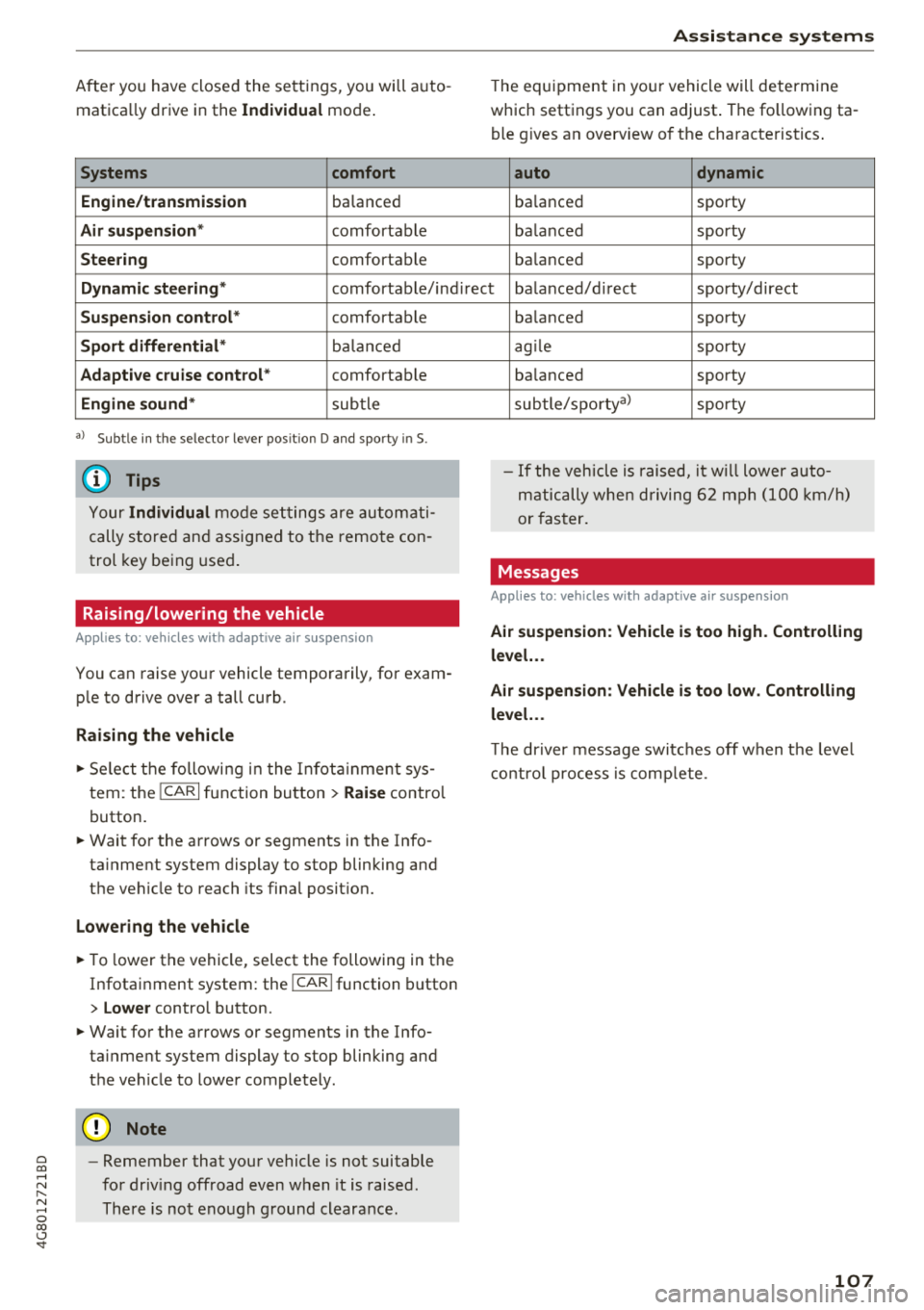
The equipment in yo ur vehicle will determine
which settings you can adjust . The fo llowing ta
ble gives a n overview of the characteristics .
auto dynamic
ba
lanced sporty
ba lanced sporty
ba lanced sporty
Dynamic steering
* comfortable/indirect ba lanced/d irect sporty/direct
Suspension control* comfortab le
Sport differential * balanc ed
Adaptive cruise control* comfortable
Engine sound* subtle
a) Subtle in the selector lever posit ion D and sporty in S.
(D Tips
Your Individual mode settings are automati
cally stored and assigned to the remo te con
trol key being used .
Raising/lowering the vehicle
Applies to: vehicles with adaptive air suspension
You can raise your vehicle temporarily, for exam
ple to drive over a tall curb.
Raising the vehicle
~ Select the following in the In fotainm ent sys
tem: the
ICARI function button > Raise control
button.
~ Wait for the arrows or segments in the Info
ta inment system display to stop blinking and
the vehicle to reach its fina l posit ion.
Lowering the vehicle
~ To lower the vehicle, select the following in the
Infotainment system: the
! CARI function button
> Lower control button.
~ Wait for the arrows or segments in the Info
ta inment system display to stop blinking and
the vehicle to lower completely .
@ Note
-Remember that your vehicle is not suitable
for driv ing offroad even when it is raised.
There is not enough ground clearance . ba
lanced sporty
ag ile sporty
ba lanced sporty
subtle/sportyal sporty
- If the vehicle is raised, it will lower auto
matically when driving 62 mph (100 km/h)
or faster.
Messages
Applies to: vehicles with adaptive air suspension
Air suspension : Vehicle is too high . Controlling
level. ..
Air suspension: Vehicle is too low. Controlling
level. ..
Th e driver message switches off when the leve l
control process is complete.
107
Page 123 of 274

a co ,...,
N
" N ,...,
0 00 <..:l '
your risk of a collision.
- Please note the risk of a co llision increases
when driving fast, especially through curves
and on slippery or wet roads, and when driv
ing too close to objects ahead. The ESC and
its integrated systems cannot always pre
vent collisions -there is still a risk of acci
dents!
- Press the accelerator pedal carefully when
accelerating on even, slippery surfaces such
as ice and snow. The drive wheels can spin
Switching on /off
Intelligent Technology
even when these control systems are instal
led and this can affect driving stability and increase the risk of a collision.
(D Tips
- ABS and ASR only function correctly when
all four wheels are equipped with identical
tires. Different tire sizes can lead to a reduc tion in engine power.
- You may hear noises when the systems de
scribed are working.
ESC turns on automatically when you start the engine.
Fig . 138 Ce nter console: O FF ~ button
The following examples are unusual situations
where it may make sense to switch sport mode
on in order to allow the wheels to spin:
ESC levels
Sport mode on
- Rocking the vehicle to free it when it is stuck
- Driving in deep snow or on loose ground
- Driving with snow chains
Applies to: RS models: the ESC is designed to
function in levels. Depending on the level that is
selected, the stabil izat ion function of the ESC is
limited or switched off. The amount of stabiliza
tion control will differ depending on the level.
Sport mode off
Behavior
The ESC and ASR stabilization functions Th
e full stabilization function of the ESC
are limited
c:::> &. . and ASR is available again.
Operation Press the I~ OFF I button . Press the I~ OF FI button again .
Indicator .turns on. II turns off.
lights
Me ssa ges Stabilization control (ESC): Sport Warn- Stabilization control (ESC): On
ing! Reduced stability
121
Page 124 of 274
Intelligent Technology
ESC levels
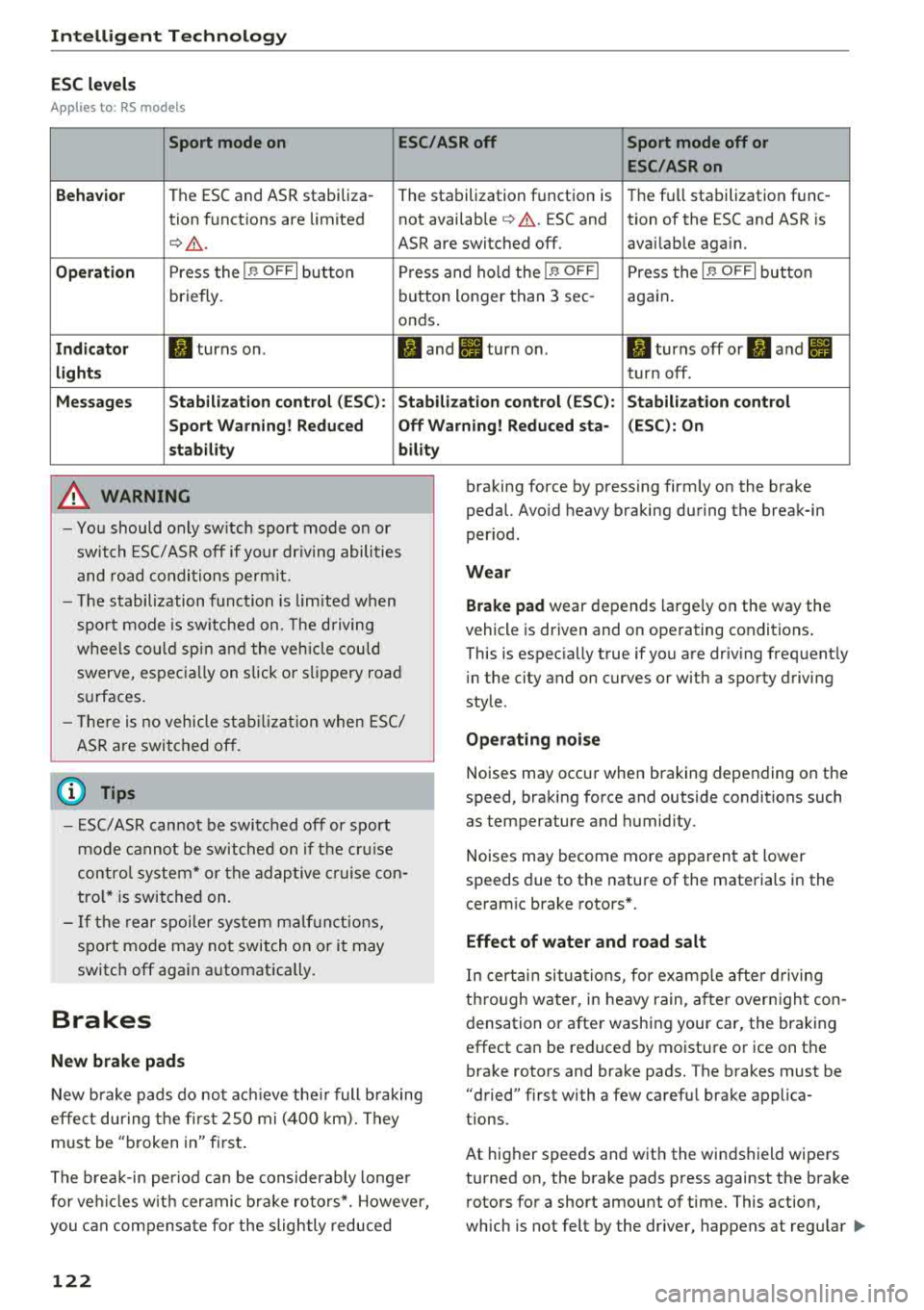
Applies to : RS models
Sport mode on ESC/ASR off Sport mode off or
ESC/ASRon
Behavior
The ESC and ASR stabiliza -
The stabilization function is Th
e fu ll stabilization func-
tion functions are limited not available
¢ .&. . ESC and tion of the ESC and ASR is
¢ .&_. ASR are switched off. avai lab le aga in.
Operation Press the I~ OFFI button Press and hold the I~ OFFI Press the I ~ OFFI button
briefly. button
longer than 3 sec-
again.
onds .
Indicator II turns on. II and II turn on. II turns off or II and II
lights turn off.
Messages Stabilization control (ESC): Stabilization control (ESC): Stabilization control
Sport Warning! Reduced Off Warning! Reduced sta- (ESC): On
stability bility
A WARNING
-You should only switch sport mode on or
switch ESC/ ASR off if your driving abilities
and road conditions permit.
- The stabilization function is limited when
sport mode is switched on. The driving
wheels could spin and the vehicle could swerve, especially on slick or slippery road
surfaces.
- There is no vehicle stabilization when ESC/
ASR are switched off.
(D Tips
- ESC/ASR cannot be switched off or sport
mode cannot be switched on if the cruise
control system* or the adaptive cruise con
trol* is switched on.
- If the rear spoiler system malfunctions,
sport mode may not switch on or it may
switch off again automatically.
Brakes
New brake pads
-
New brake pads do not achieve their full braking
effe ct during the first 2S0 mi (400 km). They
must be "broken in" first.
The break-in period can be considerably longer
for vehicles with ceramic brake rotors*. However,
you can compensate for the slightly reduced
122
braking force by pressing firmly on the brake
pedal. Avoid heavy braking during the break-in
period.
Wear
Brake pad
wear depends large ly on the way the
vehicle is driven and on operating conditions .
This is espec ia lly true if you are driv ing frequently
i n the city and on curves or with a sporty driving
style.
Operating noise
Noises may occur when braking depending on the
speed, braking force and outside conditions such
as temperature and humidity.
Noises may become more apparent at lower
speeds due to the nature of the materials in the
ceramic brake rotors*.
Effect of water and road salt
In certain situations, for example after driving
through water, in heavy rain, after overnight con
densation or after washing your car, the braking
effect can be reduced by moisture or ice on the
brake rotors and brake pads. The brakes must be
"dried" first with a few carefu l brake applica
tions.
At higher speeds and with the windshield wipers
turned on, the brake pads press against the brake
rotors for a short amount of time. This action,
which is not felt by the dr iver, happens at regular
IJIJ,
Page 163 of 274
a co .... N
" N .... 0 00 \,;J '
install a forward-facing child restraint on
the front passenger seat, always move the
seat into its rearmost position in the seat's
fore and aft adjustment range, as far away
from the airbag as possible. The backrest must be adjusted to an upright position.
- Make sure that the
PASSENGER AIR BAG
OFF
light comes on and stays on all the time
whenever the ignition is switched on.
A WARNING
- If the PASSENGER AIR BAG OFF light does
not go out when an adult is sitting on the
front passenger seat after taking the steps
described above, make sure the adult is
properly seated and restrained at one of the
rear seating positions.
- Have the airbag system inspected by your
Audi dealer before transporting anyone on
the front passenger seat .
(D Tips
If the capacitive passenger detection system
determines that the front passenger seat is
empty, the frontal airbag on the passenger
side will be turned off, and the
PASSENGER
AIR BAG OFF
light will stay on.
Repair, care and disposal of the airbags
Parts of the airbag system are installed at many
different places on your Audi . Installing , remov
ing , servicing or repairing a part in an area of the
vehicle can damage a part of an airbag system
and prevent that system from working properly
in a collision.
There are some important things you have to
know to make sure that the effectiveness of the
system will not be impaired and that discarded
components do not cause injury or pollute the
environment.
A WARNING
Improper care, servicing and repair proce
dures can increase the risk of personal injury
and death by preventing an airbag from de-
-
Airbag system
ploying when needed or deploying an airbag
unexpectedly :
- Never cover, obstruct, or change the steer
ing wheel horn pad or airbag cover or the in
strument panel or modify them in any way.
- Never attach any objects such as cup holders
or telephone mountings to the surfaces cov
ering the airbag units.
- For cleaning the horn pad or instrument
panel, use only a soft, dry cloth or one mois
tened with plain water . Solvents or cleaners
could damage the airbag cover or change
the stiffness or strength of the material so
that the airbag cannot deploy and protect properly.
- Never repair, adjust, or change any parts of
the airbag system.
-All work on the steering wheel, instrument
panel, front seats or electrical system (in
cluding the installation of audio equipment,
cellular telephones and CB radios, etc.)
must be performed by a qualified technician
who has the training and special equipment
necessary.
- For any work on the airbag system, we
strongly recommend that you see your au
thorized Audi dealer or qualified workshop.
- Never modify the front bumper or parts of
the vehicle body.
- Always make sure that the side airbag can inflate without interference:
- Never install seat covers or replacement
upholstery over the front seatbacks that
have not been specifically approved by
Audi .
- Never use additional seat cushions that
cover the areas where the side airbags in
flate.
- Damage to the original seat covers or to
the seam in the area of the side airbag
module must always be repaired immedi
ately by an authorized Audi dealer.
- The airbag system can deploy only once. Af
ter an airbag has been deployed, it must be
replaced with new replacement parts de
signed and approved especially for your
Audi model version. Replacement of com plete airbag systems or airbag components
161
Page 175 of 274
a co .... N
" N .... 0 00 \,;J '
one of the rear seating positions . If in exception
a l circumstances you must use it on the front
passenger seat, carefully read all of the informa
tion on chi ld safety and Advanced Airbags and
heed all of the applicable WARNINGS . Make cer
tain that the child and ch ild restraint are correct
l y recogn ized by the capacitive passenger detec
tion system in the front passenge r seat, that the
front passenger airbag is turned off, and t hat the
airbag status is always cor rectly signaled by the
PASSENGER AIR BAG OFF light.
M any types and models of ch ild rest rai nts have
been available ove r th e yea rs , new mode ls are in
trod uced regular ly incorporat ing new and im
proved designs and older mode ls are taken out o f
production . Chi ld restraints are not standardized .
Ch ild restraints of the same type typica lly have
d ifferent weights and s izes and different "foot
prints", the size and shape of the bottom of the
child restraint that sits on the seat, when they
are installed on a vehicle seat . T hese differences
make it virtually impossible to certify compliance
w ith the requirements fo r advanced airbags with
e ach and eve ry c hild rest raint t hat has ever been
sold in the past o r will be sold over t he course o f
the useful life of your vehicle.
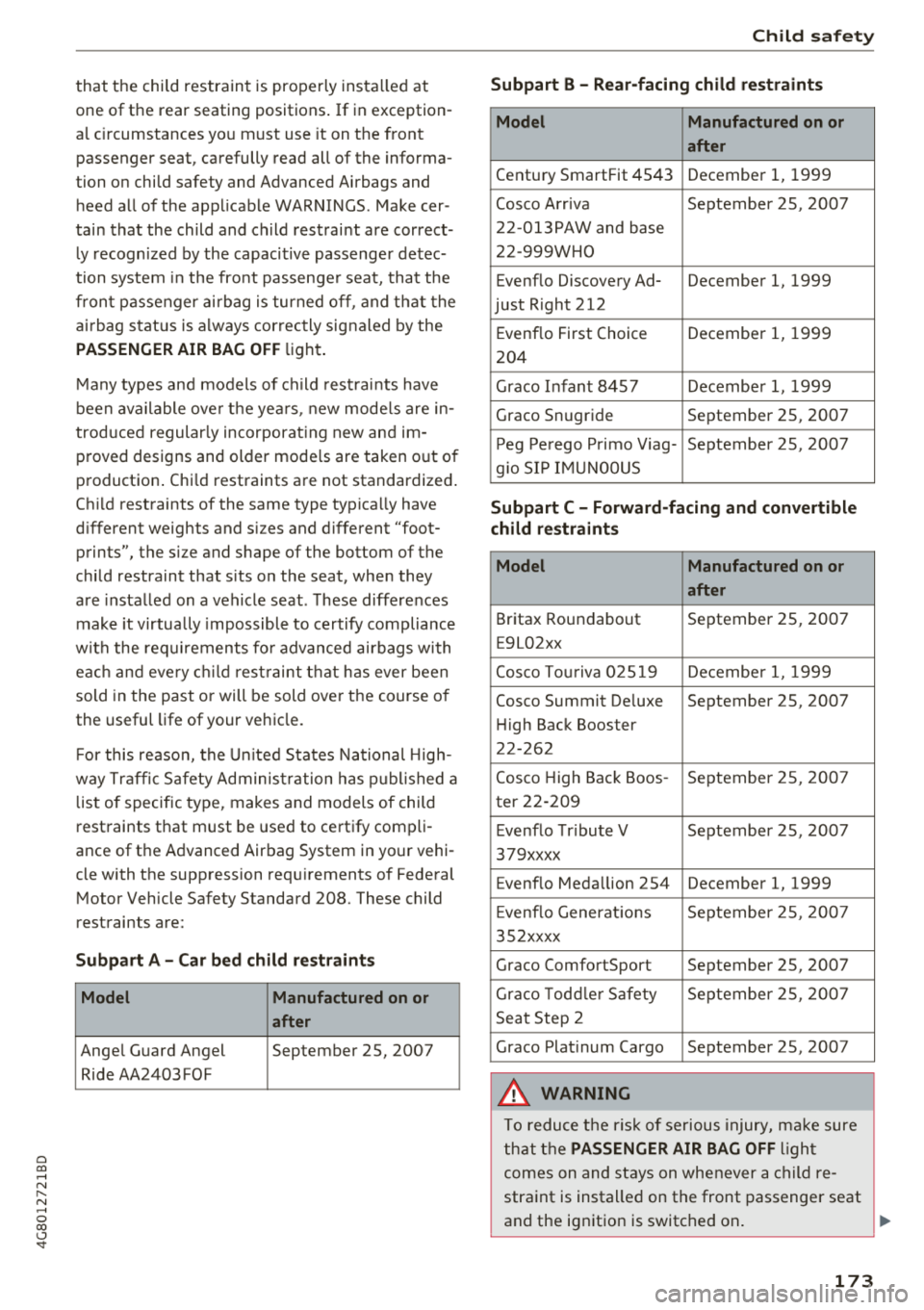
F or this reason, the U nited States National High
way Tr affic Safety Adminis tration has p ublished a
lis t of specific type, makes and models of child
restraints that must be used to certify compli
ance of th e Advanced Airbag System in your vehi
cle with the suppression requirements of Federal
Motor Vehicle Safety Standard 208. These child
restraints are:
Subpart A -Car bed child re straint s
Model Manufactured on or
after
Ange l Guard Angel September 25, 2007
Ride AA2403FOF
Ch ild saf ety
Subpart B -Rear-facing child restraints
Model Manufactured on or
after
Century SmartFit 4543 December 1, 1999
Cosco Arr iva September 25, 2007
22-013PAW and base
22 -999WHO
Evenflo Discovery
Ad-December 1, 1999
just Right 212
E venflo First Choice December 1, 1999
204
Graco Infant 8457 December 1, 1999
Graco Snug ride September 25, 2007
P eg Pe rego P rimo Viag- September 25, 2007
g io SI P IM UNOOUS
Subpart C -Forward -facing and convertible
child restraints
Model Manufactured on or
after
Britax Roundabout September 25, 2007
E9L02xx
Cosco Tou riva 025 19 Decembe r 1, 1999
Cosco Summit De luxe September 25, 2007
H igh Back Booster
22-262
Cosco High Back Boos -September 25, 2007
ter 22 -209
E venflo Tr ibute V September 25, 2007
379xxxx
Evenflo Medallion 254 December 1, 1999
E venflo Generat io ns September 25, 200 7
352xxxx
Graco ComfortSport September 25, 2007
Graco Todd le r Safety September 25, 200 7
Seat Step 2
Graco Platinum Cargo September 25, 2007
A WARNING
To reduce the r isk of serious injury, ma ke sure
that the
PASSENGER AIR BAG OFF l ight
comes on and stays on whenever a chil d re
straint is installed on the front passenger seat
and the ignition is switched on .
173
Page 219 of 274
a co .... N
" N .... 0 00 \,;J '
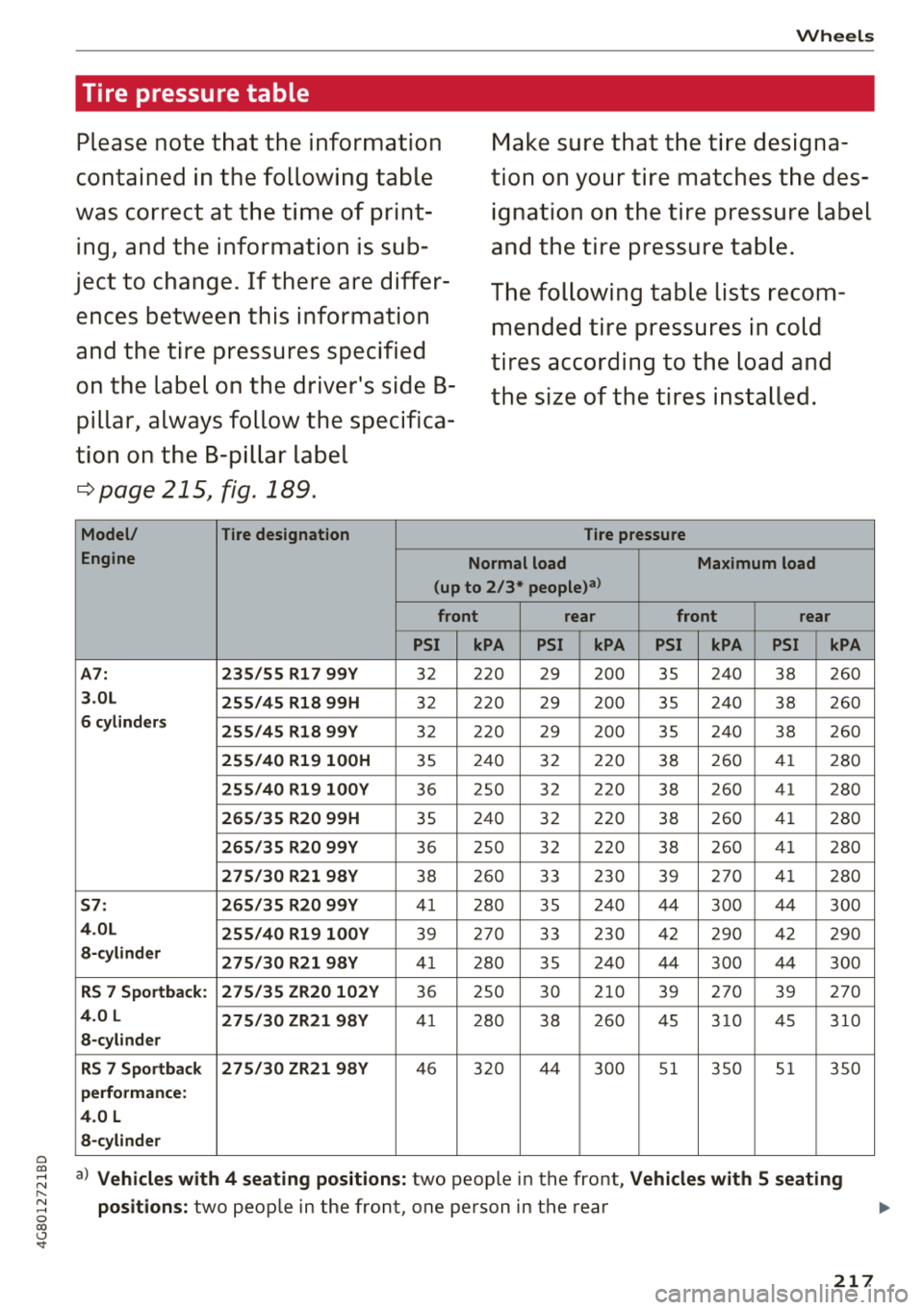
Please note that the information
contained in the following table
was correct at the time of print
ing, and the information is sub
ject to change. If there are differ
ences between this information
and the tire pressures specified
on the label on the driver's side
B
pillar, always follow the specifica
tion on the B-pillar label
¢ page 215, fig. 189.
Model/ Tire designation
Engine
Wheels
Make sure that the tire designa
tion on your tire matches the des
ignation on the tire pressure label
and the tire pressure table.
The following table lists recom mended tire pressures in cold
tires according to the load and
the size of the tires installed.
Tire pressure
Normal load Maximum load
(up to
2/3* people)a>
front rear front rear
PSI kPA PSI kPA PSI kPA PSI kPA
A7: 235/55 Rl 7 99V
32 220 29 200 35 240
38 260
3.0L
255/45 Rl8 99H 32 220 29 200 35 240 38 260
6 cylinders
255/45 Rl8 99V 32 220 29 200 35 240
38 260
255/40 Rl9 l00H 35 240 32 220 38 260 41
280
255/40 Rl9 l00Y 36 250 32 220
38 2
60 41 280
265/35 R20 99H 35 240 32 220 38 260 41
280
265/35 R20 99V 36 250 32 220
38 260 41 280
275/30 R21 98V 38 260 33 230 39 270 41
280
57: 265/35 R20 99V 41 280
35 240 44 300 44 300
4.0L
255/40 Rl9 l00Y 39 270 33 230 42
290 42
290
a-cylinder
275/30 R21 98V 41 280 35 240 44 300 44 300
RS 7 Sportback: 275/35 ZR20 102V 36 250 30 210 39 270 39 270
4.0 L 275/30 ZR21 9aY 41
280 38 260 45 310 45 310
a-cylinder
RS 7 Sportback 275/30 ZR21
9aY 46 320 44 300 51 350 51 350
performance:
4.0 L a-cylinder
a ) Vehicles with 4 seating positions: two people in the front, Vehicles with 5 seating
positions:
two people in the front, one person in the rear
217
Page 223 of 274
a co .... N
" N .... 0 00 \.J '
Reinstall summer tires at the appropriate
time, because they provide better handling
when roads are free of snow and ice. Summer
tires cause less road noise, tire wear and fuel
consumption.
(D Tips
You can also use all season tires instead of
winter tires. Please note that in some coun
tries where winter tires are required, only
winter tires with the
& symbol may be per
mitted .
Snow chains
Snow chains not only improve the driving in win
ter road conditions, but also the braking .
.,. Only install snow chains on the front wheels.
This applies also to vehicles with all wheel
drive*.
.,. Check and correct the seating of the snow
chains after driving a few feet, if necessary. Fol
low the instructions from the manufacturer .
.,. Note the maximum speed of 30 mph (SO km/
h). Note the local regulations.
Use of snow chains is only permitted with certain
rim/tire combinations due to technical reasons.
Check with an authorized Audi dealer or author i zed Audi Service Facility to see if you may use
snow chains.
You must remove the snow chains on roads with
out snow. Otherwise, you could impair driving
ability and damage the tires.
A WARNING
Using incorrect snow chains or installing snow
chains incorrectly can result in loss of vehicle
control, which increases the risk of an acci
dent.
@ Note
- Snow chains can damage the rims/wheel
covers* if the chains come into direct con
tact with them . Remove the wheel covers*
first . Use coated snow chains.
Wheels
- Using snow chains that add more than 0.4
inch (10.5 mm) of height can severely dam
age the wheel housings and other vehicle
components.
- Do not install and use snow chains if there is
a malfunction in the air suspension*, be
cause the vehicle height will be very low. If
you drive with snow chains anyway, the
wheel housings and other vehicle compo
nents can be severely damaged .
(D Tips
When using snow chains, it may be useful to
switch on sport mode
c> page 121.
Low-profile tires
Applies to: vehicles with low-profile tires
Compared to other tire/rim combinations, low
profile tires offer a wider tread surface and a
larger rim diameter with shorter tire sidewalls.
This results in an agile driving style. However, it
may reduce the level of comfort and increase
road noise when driving on roads in poor condi
tion.
Low-profile tires can become damaged more
quickly than standard tires when driving over
large bumps, potholes, manhole covers and
curbs. Therefore, it is particularly important to
maintain the correct tire pressure
c>page 215.
To reduce the risk of damage to the tires and
rims, drive very carefully on poor roads.
Check your wheels regularly every 2,000 mi
(3,000 km) for damage. For example, check for
bulges/cracks on the tires or deformations/
cracks on the rims.
After a heavy impact or damage, have the tires
and rims inspected or replaced immediately by
an authorized Audi dealer or authorized Audi
Service Facility.
Low-profile tires can wear out faster than stand
ard tires.
Uniform tire quality grading
-Tread wear
221
Page 271 of 274

a co .... N
" N .... 0 00 \,;J '
r e fer to Indicator lights . . . . . . . . . . . . . . . . 10
T
Tachometer . . . . . . . . . . . . . . . . . . . . . . 9, 10, 20
Tail lights Cleaning . . . . . . . . . . . . . . . . . . . . . . . . . . . 229
Technical data . . . . . . . . . . . . . . . . . . . . . . . . 253
Technical modifications . . . . . . . . . . . . . . . . 2S8
T emperature display
Exterior temperature . . . . . . . . . . . . . . . . . . 20
T emperature indicato r
Coolant . . . . . . . . . . . . . . . . . . . . . . . . . . . . . . 9
Engine oil . . . . . . . . . . . . . . . . . . . . . . . . . . . 23
Tether anchors . . . . . . . . . . . . . . . . . . . . . . . 187
Tether strap . . . . . . . . . . . . . . . . . . . . . . . . . 187
T ie-downs . . . . . . . . . . . . . . . . . . . . . . . . S5, 136
Time . .. .. .. .. ............. .. .. .. .. .. 23
tiptronic mode (automatic transmission) . . . 78
tiptronic (automatic transmission) . . . . . . . . 74
Tire Mobi lity System (tire repair set) . . . . . . 234
Tires.. .. .. .. .. ............... .. .. .. . 205
All wheel drive . . . . . . . . . . . . . . . . . . . . . . 124
L ow-profile tires ............... ... .. . 221
Repair set . . . . . . . . . . . . . . . . . . . . . . . . . . 234
Replac ing . . . . . . . . . . . . . . . . . . . . . . . . . . 236
Service life . . . . . . . . . . . . . . . . . . . . . . . . . 214
Tire pressure . . . . . . . . . . . . . . . . . . . . . . . 215
Tire pressure monitoring sys-
tem ....................... 222, 223, 224
Tire pressure table . . . . . . . . . . . . . . . . . . . 217
Tire pressure (trailer towing) . . . . . . . . . . . 81
Treadwear indicators .......... .. .. .. . 214
Unidirectional . . . . . . . . . . . . . . . . . . . . . . . 207
Uniform tire quality grading . . . . . . . . . . . 221
T ires and wheels
Glossary of tire and loading terminology . 208
Tires and vehicle load limits .... .. .. .. . 218
Too l kit . . . . . . . . . . . . . . . . . . . . . . . . . . . . . 233
Torn or frayed safety belts . . . . . . . . . . . . . . 140
T owing
Tow trucks
Towing loop
TPMS 249
249,250
Indicator light . . . . . . . . . . . . . . . . . . . . . . 227
Index
TPMS ( Tire Pressure Monitoring
System) . . . . . . . . . . . . . . . . . . . . . . . . . 223, 224
T railer towing . . . . . . . . . . . . . . . . . . . . . . . . . 81
Parking systems . . . . . . . . . . . . . . . . . . . . . 118
T railer load . . . . . . . . . . . . . . . . . . . . . . . . . . 81
Transmission malfunction (indicator light) . . 79
Transport Canada . . . . . . . . . . . . . . . . . . . . . 137
T urn signals . . . . . . . . . . . . . . . . . . . . . . . . . . 40
u
Unfastening safety belts
Uniform tire quality grading
Unlocking/locking 143
221
By remote control . . . . . . . . . . . . . . . . . . . . 29
Using the door lock cylinder . . . . . . . . . . . . 31
With the central locking switch . . . . . . . . . 30
With the convenience key 29
V
Vanity mirror . . . . . . . . . . . . . . . . . . . . . . . . . . 44
Vehicle Care/cleaning . . . . . . . . . . . . . . . . . . . . . . . 228
Dimens ions . . . . . . . . . . . . . . . . . . . . . . . . . 253
Out of service . . . . . . . . . . . . . . . . . . . . . . . 232
Specifications . . . . . . . . . . . . . . . . . . . . . . . 253
T ransporting . . . . . . . . . . . . . . . . . . . . . . . 252
Vehicle battery . . . . . . . . . . . . . . . . . . . . . . . 201
Charge level . . . . . . . . . . . . . . . . . . . . . . . . 126
Charging . . . . . . . . . . . . . . . . . . . . . . . . 14, 202
Energy management . . . . . . . . . . . . . . . . . 126
Indicator light . . . . . . . . . . . . . . . . . . . . . . . 14
Winter operation . . . . . . . . . . . . . . . . . . . . 202
Vehicle control modules . . . . . . . . . . . . . . . . 127
Vehicle jack . . . . . . . . . . . . . . . . . . . . . . 233, 238
Vehicle tool kit . . . . . . . . . . . . . . . . . . . . . . . 233
Ventilation . . . . . . . . . . . . . . . . . . . . . . . . . . . 58
VIN . . . . . . . . . . . . . . . . . . . . . . . . . . . . . . . . 253
vv
Warming up . . . . . . . . . . . . . . . . . . . . . . . . . . 64
Warning/Ind icator lights
Airbag system . . . . . . . . . . . . . . . . . . . . . . 158
PASSENGER A IR BAG OFF . . . . . . . . . . . . . 158
Warning lights
refer to Indicator lights . . . . . . . . . . . . . . . . 10
269