tire pressure AUDI A7 2018 User Guide
[x] Cancel search | Manufacturer: AUDI, Model Year: 2018, Model line: A7, Model: AUDI A7 2018Pages: 274, PDF Size: 42.77 MB
Page 216 of 274

Wheels
-Only use tires that are more than six years old when absolutely necessary and drive
carefully when doing so.
-Do not use run-flat tires on your vehicle. Using them when not permitted can lead to
ve
hicle damage or accidents.
-If you install wheel covers on the vehicle, make sure they allow enough a ir circulation to
cool the brake system. If they
do not, this could increase the risk of an accident.
Tire wear/damage
Fig. 188 Tire profile: trea dwear indica
tor
Tire wear
Check the tires regularly for wear.
-Inflation pressure that is too low
or high can increase tire wear
considerably.
l) Obey any applicable regulations in your
country.
214
-Driving qu ickly through curves,
rapid acceleration and heavy
braking increase tire wear.
-Have an authorized Audi dealer or authorized Audi Service Facili
ty check the wheel alignment if
there is unusual wear.
-Have the wheels rebalanced if an imbalance is causing noticeable
vibration in the steering wheel. If you do not, the tires and other
vehicle components could wear more quick ly.
Treadwear indicator
Original equipment tires contain
treadwear indicators in the tread pattern, which are bars that are 1/16 in (1.6 mm) high and are
spaced evenly around the tire per pendicular to the running direc
tion
c> fig . 188. The letters "TWI"
or triangles on the tire sidewall indicate the location of the tread
wear indicators.
The t ires have reached the mini
mum tread depth
l) when they
have worn down to the treadwear
indicators. Replace the tires with
new ones
c> A . "'
Page 217 of 274
Ti re rotation
Rotating the tires regularly is rec
ommended to ensure the tires
wear evenly. To rotate the t ires,
install the tires from the rear axle
on the front axle and vice versa.
This will allow the tires to have
approximately the same length of
service life.
For unidirectional tires , make
sure the tires are installed accord i ng to the running direction indi
cated on the tire sidewall
¢page 241.
Hidden damage
Damage to tires and rims can of
ten occur in locations that are hidden. Unusual vibrations in the
vehicle or pulling to one side may indicate that there is tire damage.
Reduce your speed immediately.
Check the tires for damage. If no
damage is visible from the out
side, dr ive slowly and carefully to
the nearest authorized Audi deal er or authorized Audi Service Fa
cility to have the vehicle inspect
ed.
A WARNING , ~ -
o Tread that has worn too low or co ...
~ different tread depths on the
... 0 Cl() I..J '
tires can reduce driving safety.
This can increase the risk of an accident because it has a nega
tive effect on handling, driving
through curves, and braking, and because it increases the
risk of hydroplaning when driv
ing through deep puddles.
Tire pressure
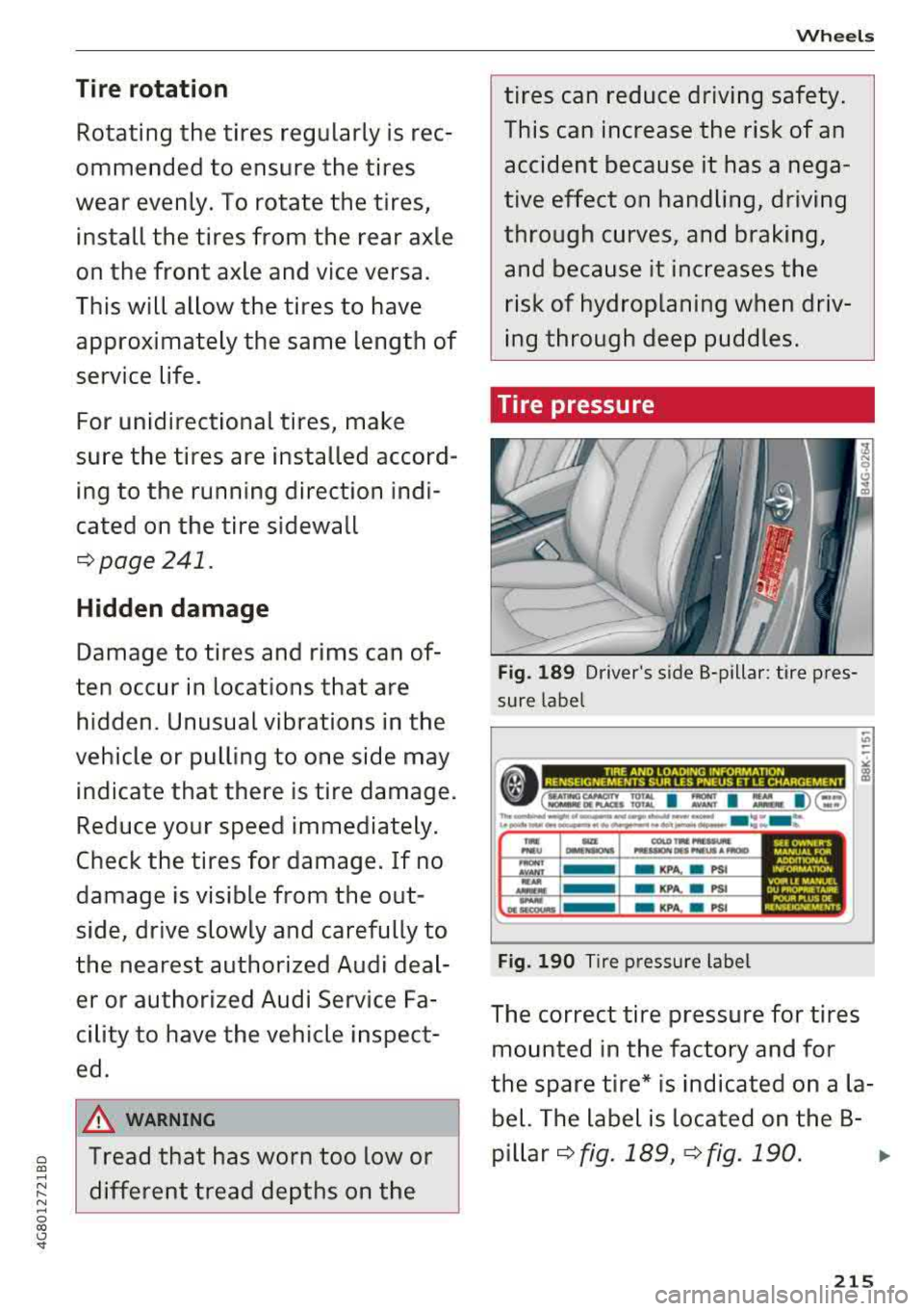
Fig. 189 Driver's side 8-pillar : tire pres
sur e lab el
;;;
--------------- -
(. c ==. ~:t I : I :,. I ) (':~ ) l ~
1111..-... ............................ -.. ..... ..... _ .... "" ................ .. .,_...._,. ..... .............. ... .
-KPA. . PSI
-KPA. . PSI
-KPA. . PSI
Fig. 190 Tire pressur e label
The correct tire pressure for tires
mounted in the factory and for
the spare tire* is indicated on a la
bel. The label is located on the B-
p illar
¢ fig. 189, ¢ fig. 190. ..,
215
Page 218 of 274
Wheels
Use the tire pressure specified for
a normal vehicle load when the
vehicle is partially
loaded ¢ table
on page 217 .
If driving the vehi
cle when fully loaded, you must
increase the tire pressure to the
maximum specified
pressure ¢.&. -
Checking/correcting tire
pressure
~check the tire pressure at least
once per month and also check it
before every long drive .
~Always check the tire pressure
when the tires are
cold. Do not
reduce the pressure if it increas
es when the tires are warm.
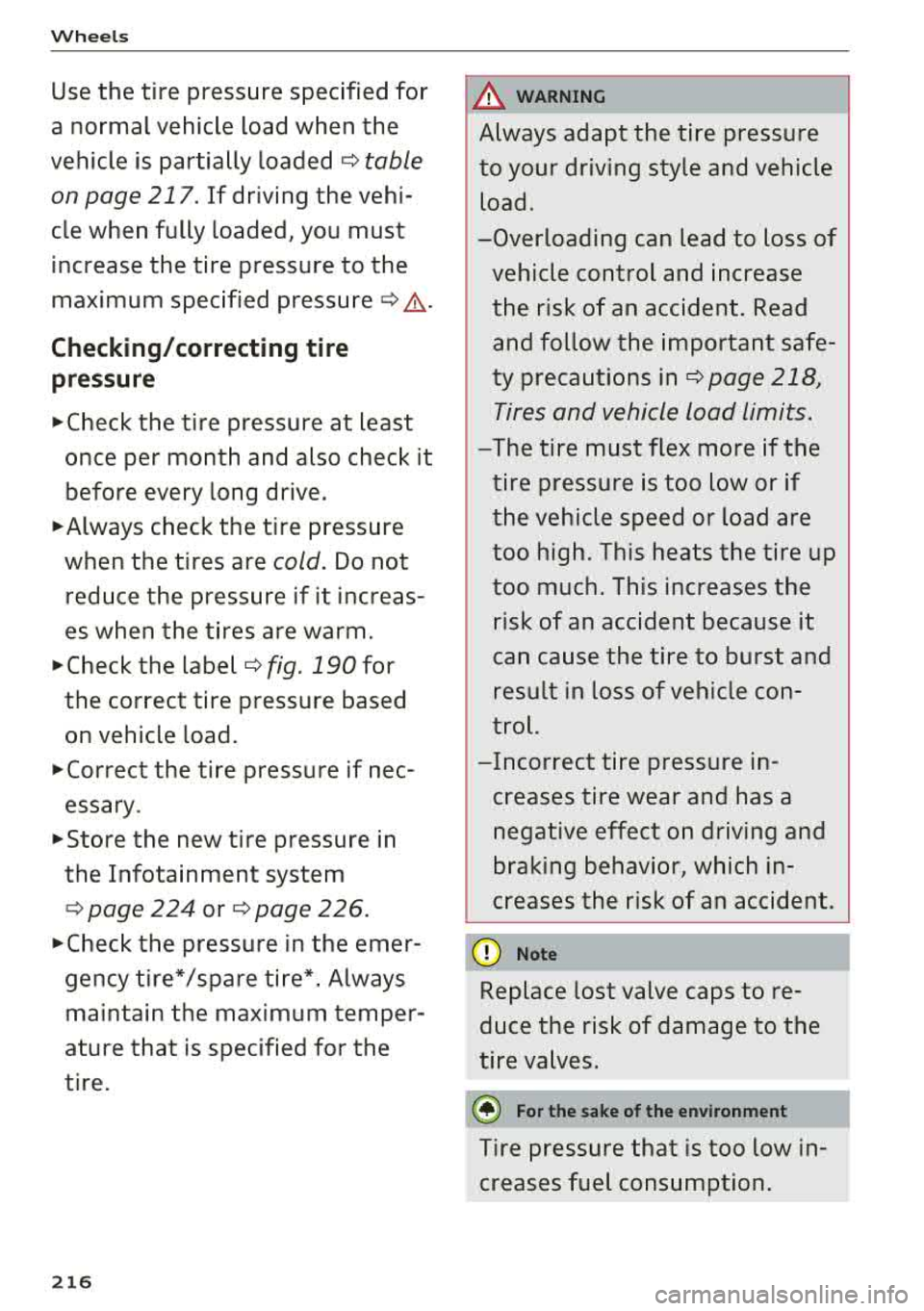
~check the label¢ fig . 190 for
the correct tire pressure based
on vehicle load.
~correct the tire pressure if nec
essary .
~store the new tire pressure in
the Infotainment system
¢ page 224 or ¢ page 226.
~check the pressure in the emer
gency tire*/spare tire*. Always
maintain the maximum temper
ature that is specified for the
tire.
216
& WARNING
Always adapt the tire pressure
to your driving style and vehicle
load .
-Overloading can lead to loss of
vehicle control and increase
the risk of an accident. Read and follow the important safe
ty precautions
in¢ page 218,
Tires and vehicle load limits.
-The tire must flex more if the
tire pressure is too low or if
the vehicle speed or load are
too high . This heats the tire up
too much. This increases the
risk of an accident because it
can cause the tire to burst and
result in loss of vehicle con
trol.
-Incorrect tire pressure in creases tire wear and has a
negative effect on driving and
braking behavior, which in
creases the risk of an accident.
{tfj) Note
Replace lost valve caps to re
duce the risk of damage to the
tire valves.
@ For the sake of the environment
Tire pressure that is too low in
creases fuel consumption.
Page 219 of 274
a co .... N
" N .... 0 00 \,;J '
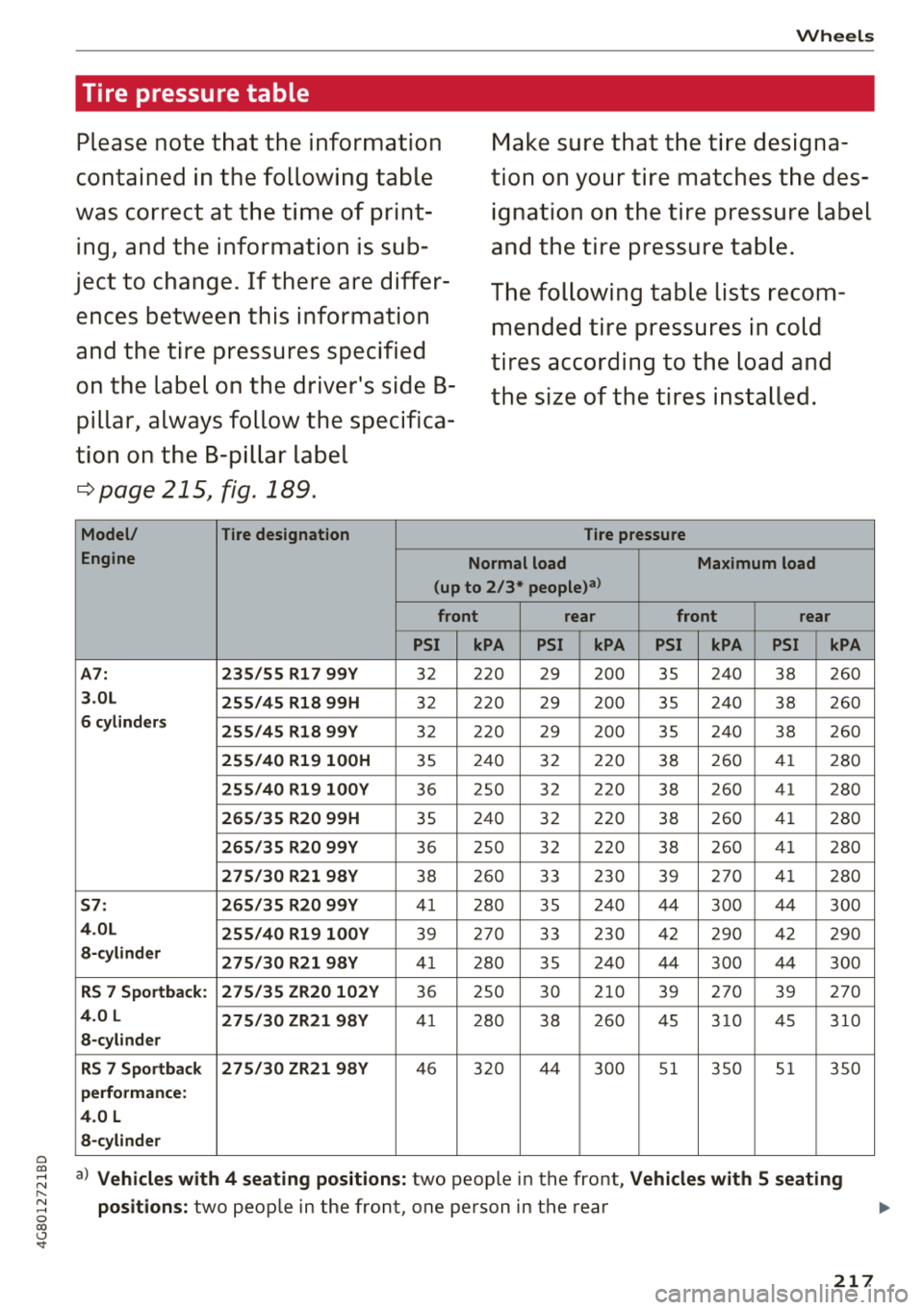
Please note that the information
contained in the following table
was correct at the time of print
ing, and the information is sub
ject to change. If there are differ
ences between this information
and the tire pressures specified
on the label on the driver's side
B
pillar, always follow the specifica
tion on the B-pillar label
¢ page 215, fig. 189.
Model/ Tire designation
Engine
Wheels
Make sure that the tire designa
tion on your tire matches the des
ignation on the tire pressure label
and the tire pressure table.
The following table lists recom mended tire pressures in cold
tires according to the load and
the size of the tires installed.
Tire pressure
Normal load Maximum load
(up to
2/3* people)a>
front rear front rear
PSI kPA PSI kPA PSI kPA PSI kPA
A7: 235/55 Rl 7 99V
32 220 29 200 35 240
38 260
3.0L
255/45 Rl8 99H 32 220 29 200 35 240 38 260
6 cylinders
255/45 Rl8 99V 32 220 29 200 35 240
38 260
255/40 Rl9 l00H 35 240 32 220 38 260 41
280
255/40 Rl9 l00Y 36 250 32 220
38 2
60 41 280
265/35 R20 99H 35 240 32 220 38 260 41
280
265/35 R20 99V 36 250 32 220
38 260 41 280
275/30 R21 98V 38 260 33 230 39 270 41
280
57: 265/35 R20 99V 41 280
35 240 44 300 44 300
4.0L
255/40 Rl9 l00Y 39 270 33 230 42
290 42
290
a-cylinder
275/30 R21 98V 41 280 35 240 44 300 44 300
RS 7 Sportback: 275/35 ZR20 102V 36 250 30 210 39 270 39 270
4.0 L 275/30 ZR21 9aY 41
280 38 260 45 310 45 310
a-cylinder
RS 7 Sportback 275/30 ZR21
9aY 46 320 44 300 51 350 51 350
performance:
4.0 L a-cylinder
a ) Vehicles with 4 seating positions: two people in the front, Vehicles with 5 seating
positions:
two people in the front, one person in the rear
217
Page 220 of 274
Wheels
A WARNING
Please note the important safe
ty precautions regarding tire
pressure
¢ page 215 and load
limits¢ page 218.
Tires and vehicle load limits
There are limits to the amount of
load or weight that any vehicle
and any tire can carry. A vehicle
that is overloaded will not handle
well and is more difficult to stop. Overloading can not only lead to loss of vehicle control, but can al
so damage important parts of the
vehicle and can lead to sudden
tire failure, including a blowout
and sudden deflat ion that can
cause the vehicle to crash .
Your safety and that of your pas
sengers also depends on making
sure that load limits are not ex
ceeded . Vehicle load inc ludes ev
erybody and everything in and on
the vehicle. These load limits are
technically referred to as the vehi
cle's
Gross Vehicle Weight Rat
ing
("GVWR") .
T he "GVWR" inc ludes the weight
of the basic vehicle, all factory in
stalled accessories, a full tank of
fuel, oil, coolant and other fluids
2 18
plus maximum load . The maxi
mum load includes the number of
passengers that the vehicle is in
tended to carry ("seating capaci
ty") with an assumed weight of
150 lbs . (68 kg) for each passen
ger at a designated seating posi
tion and the total weight of any luggage in the veh icle. If you tow
a trailer, the weight of the trailer
hitch and the tongue weight of
the loaded trailer must be includ ed as part of the vehic le load.
The
Gross Axle Weight Rating
("GAWR") is the maximum load
that can be applied at each of the
vehicle's two axles .
The fact that there is an upper limit to your vehicle's Gross Vehi
cle Weight Rating means that the
total weight of whatever is being
carried in the vehic le (inc luding
the weight of a trailer h itch and
the tongue weight of the loaded
trailer) is limited . The more pas
sengers in the vehicle or passen
gers who are heavier than the
standard weights assumed mean
that less weight can be carried as luggage .
The Gross Veh icle We igh t Ra ting
and the Gross Axle Weight Rat ing
.,.
Page 221 of 274
0 0)
-N ,.... N
-0 0) \.) ..
are listed on the safety compli
ance sticker labe l located on the
driver's side 8 -pillar .
A WAR NING
-
Overloading a vehicle can cause
loss of vehicle contro l, a crash
or other accident, serious per
sonal injury , and even death .
-Carrying more weight than your vehic le was designed to
carry will p revent the vehicle
from handling properly and increase the risk of the loss of
vehicle control.
-The brakes on a vehicle that has been over loaded may not
be able to stop the veh icle
within a safe dis tance .
-Tires on a vehicle that has been overloaded can fail sud
d en ly , including a blowout and
sudden deflation, causing loss
of control and a crash .
-Always make su re that the to
tal load being transported -
includ ing the weight of a trail
er hitch and the tongue
we ight of a loaded trailer -
d oes not make t he vehicle
heavier than the vehicle's
Gross Vehicle We ight Rating .
Wheels
Determining correct load
limit
Use the example below to calcu
late the total weight of the pas
sengers and luggage or other
things that you plan to transport
so that you can make sure that
your vehicle will not be overload
ed .
Steps for Determining Correct
Load Limit
1 . L ocate the statement " THE
COMB INED W EIGH T OF OCCU
PANTS AND CARGO S HOU LD
NEVER EXCEED XXX KG OR XXX
L BS" on your vehicle's placard
(tire inflation pressure label)
¢ page 215, fig. 189 .
2. Determine the combined
weight of the driver and pas
sengers that w ill be riding in
your vehicle .
3 . Subtract the combined weight
of the driver and passengers
from
" XXX " kilog rams or " XXX "
pounds shown on the sticker
¢page 215, fig. 189 .
4. T he resulting figure equals the
available amount of cargo and luggage load capacity. For ex
ample , if the
"XXX " amount
equa ls 1400 lbs . and there
will .,.
219
Page 223 of 274
a co .... N
" N .... 0 00 \.J '
Reinstall summer tires at the appropriate
time, because they provide better handling
when roads are free of snow and ice. Summer
tires cause less road noise, tire wear and fuel
consumption.
(D Tips
You can also use all season tires instead of
winter tires. Please note that in some coun
tries where winter tires are required, only
winter tires with the
& symbol may be per
mitted .
Snow chains
Snow chains not only improve the driving in win
ter road conditions, but also the braking .
.,. Only install snow chains on the front wheels.
This applies also to vehicles with all wheel
drive*.
.,. Check and correct the seating of the snow
chains after driving a few feet, if necessary. Fol
low the instructions from the manufacturer .
.,. Note the maximum speed of 30 mph (SO km/
h). Note the local regulations.
Use of snow chains is only permitted with certain
rim/tire combinations due to technical reasons.
Check with an authorized Audi dealer or author i zed Audi Service Facility to see if you may use
snow chains.
You must remove the snow chains on roads with
out snow. Otherwise, you could impair driving
ability and damage the tires.
A WARNING
Using incorrect snow chains or installing snow
chains incorrectly can result in loss of vehicle
control, which increases the risk of an acci
dent.
@ Note
- Snow chains can damage the rims/wheel
covers* if the chains come into direct con
tact with them . Remove the wheel covers*
first . Use coated snow chains.
Wheels
- Using snow chains that add more than 0.4
inch (10.5 mm) of height can severely dam
age the wheel housings and other vehicle
components.
- Do not install and use snow chains if there is
a malfunction in the air suspension*, be
cause the vehicle height will be very low. If
you drive with snow chains anyway, the
wheel housings and other vehicle compo
nents can be severely damaged .
(D Tips
When using snow chains, it may be useful to
switch on sport mode
c> page 121.
Low-profile tires
Applies to: vehicles with low-profile tires
Compared to other tire/rim combinations, low
profile tires offer a wider tread surface and a
larger rim diameter with shorter tire sidewalls.
This results in an agile driving style. However, it
may reduce the level of comfort and increase
road noise when driving on roads in poor condi
tion.
Low-profile tires can become damaged more
quickly than standard tires when driving over
large bumps, potholes, manhole covers and
curbs. Therefore, it is particularly important to
maintain the correct tire pressure
c>page 215.
To reduce the risk of damage to the tires and
rims, drive very carefully on poor roads.
Check your wheels regularly every 2,000 mi
(3,000 km) for damage. For example, check for
bulges/cracks on the tires or deformations/
cracks on the rims.
After a heavy impact or damage, have the tires
and rims inspected or replaced immediately by
an authorized Audi dealer or authorized Audi
Service Facility.
Low-profile tires can wear out faster than stand
ard tires.
Uniform tire quality grading
-Tread wear
221
Page 224 of 274
Wheels
- Traction AA A B C
- T emperature ABC
Quality grades can be found where appl icable on
the tire side wall between tread shoulder and
maximum section width
~ page 206, fig. 187.
For example: Tread wear 200, Traction AA, Tem
perature
A .
All passenger car tires must conform to Federal
Safety Requirements in addition to these grades.
Tread wear
The tread wear grade is a comparative rating
based on the wear rate of the tire when tested
under contro lled conditions on a specified gov
ernment test course.
F or examp le, a tire graded
150 would wear one
and one half (1 1/2) times as well on the govern
ment course as a tire graded
100.
The relative performance of tires depends upon
the actua l conditions of their use, however, and
may depart significantly from the norm due to
variations in driving habits, service practices and
d ifferences in road characteristics and climate.
Traction
The traction grades, from highest to lowest, are
AA, A, Band
C. T hose grades represent the tire's
abi lity to stop on wet pavement as measured un
der controlled conditions on specified govern ment test surfaces of asphalt and concrete. A tire
marked C may have poor traction performance
~ .&..
Temperature
The temperature grades are A (the highest), B,
and C, representing the tire's resistance to the
generation of heat and its ability to d iss ipate
heat when tested under controlled conditions on
a specified indoor laboratory test wheel.
Sustained high temperature can cause the mate rial of the tire to degenerate and reduce tire life,
and excess ive temperature can lead to sudden
tire
fa ilure ~.&. .
The grade C corresponds to a level of perform
ance which a ll passenger car tires must meet un-
222
der the Federal Motor Vehicle Safety Standard
No.
109. Grades Band A represent higher levels
of performance on the laboratory test wheel than
the minimum required by law.
A WARNING -
The tract ion grade assigned to this t ire is
based on straight-ahead braking traction
tests, and does not include acceleration, cor
nering, hydroplaning or peak traction charac
teristics .
A WARNING
The temperature grade for this tire is estab
lished for a tire tha t is properly inflated and
not overloaded. Excessive speed, underinfla
tion, or excessive loading, either separately or
in combination, can cause heat buildup and
possible tire failure.
A WARNING
-
-
Temperature grades apply to tires that are
proper ly inflated and not over or underinflat
ed.
Tire pressure monitoring system
ill General notes
Each tire, including the spare (if prov ided),
shou ld be checked monthly when cold and inflat
ed to the inflation pressure recommended by the
vehicle manufacturer on the vehicle placard or
tire inflation pressure label. (If your veh icle has
t ir es of a diffe rent size t han the size ind icated on
the vehicl e placard or tire infl ation press ure la
bel, you sho uld determine the proper tire infla
tion pressure for those tires).
As an added safety featu re, you r vehicle has been
equipped with a tire pressure monitoring system
(TPMS) that illuminates a low tire pressure tell
ta le when one or more of your tires is significant
l y under-inflated. According ly, w hen the low tire
pressure telltale illuminates, you should stop and
check your t ires as soon as possible, and inflate
them to the proper pressure. Dr iving on a
.,..
Page 225 of 274

a co ,...,
N
" N ,...,
0 00 <.,;) '
overheat and can lead to tire failure. Under-inf la
tion also reduces fuel efficiency and tire tread
life, and may affect the vehicle's handling and
stopping ability.
Please note that the TPMS is not a substitute for
proper tire maintenance, and it is the driver's re
sponsibility to maintain correct tire pressure,
even if under-inflation has not reached the level
to trigger illumination of the TPMS low tire pres
sure telltale .
Your vehicle has also been equipped with a TPMS
malfunction indicator to indicate when the sys
tem is not operating properly . The TPMS mal
function indicator is combined with the low tire pressure telltale . When the system detects a
malfunction, the telltale will flash for approxi
mately one minute and then remain continuously
illuminated. This sequence will continue upon
subsequent vehicle start-ups as long as the mal
function exists.
When the malfunction indicator is illuminated,
the system may not be able to detect or signal
low tire pressure as intended. TPMS malfunctions
may occur for a variety of reasons, including the
installation of replacement or alternate tires or
wheels on the vehicle that prevent the TPMS
from functioning properly . Always che ck the
TPMS malfunction telltale after replacing one or
more tires or wheels on your vehicle to ensure
that the replacement or alternate tires and
wheels allow the TPMS to continue to function
properly.
Wheels
If the tire pressure monitoring system
indicator appears
Applies to: vehicles with Tire Pressure Monito ring System in
dicator
The tire pressure indicator in the instrument
cluster informs you if the tire pressure is too low
or if there is a system malfunction.
Fig. 191 Ins trumen t cluster : indicator light w it h message
Using the ABS sensors, the tire pressure monitor
ing system compares the tire tread circumfer
ence and vibration characteristics of the individu
al tires.
If the pressure changes in one or more
tires, th is is ind icated in the instrument cluster
display with an indicato r light
[I] and a message .
If only one tire is affected, the location of that
tire will be indicated.
The tire pressures must be stored in the Infotain
ment system again each time the pressures
change (switching between partial and full load
pressure) or after changing or replacing a tire on
your
vehicle ~ page 224. The tire pressure moni
toring system only monitors the tire pressure you
have stored. Refer to the tire pressure label for
the recommended tire pressure for your vehicle
~ page 215, fig . 190.
Tire tread circumference and vibration character
istics can change and cause a tire pressure warn
ing if :
- the tire pressure in one or more tires is too low
- the tire has structural damage
- the tire was replaced or the tire pressure was
changed and it was not stored
~ page 224
- the spare tire* is installed
223
Page 226 of 274
![AUDI A7 2018 User Guide Wheels
Indicator lights
It]-loss of pressure in at least one tire¢,&. .
Check the tires and replace or repair if necessary.
Check/correct the pressures of all four tires and
st](/img/6/57599/w960_57599-225.png "AUDI A7 2018 User Guide Wheels
Indicator lights
It]-loss of pressure in at least one tire¢,&. .
Check the tires and replace or repair if necessary.
Check/correct the pressures of all four tires and
st")
Wheels
Indicator lights
It]-loss of pressure in at least one tire¢,&. .
Check the tires and replace or repair if necessary.
Check/correct the pressures of all four tires and
store the pressure again in the Infotainment sys
tem
¢ page 224.
[m]) (Tire Pressure Monitoring System) Tire
pressure: System malfunction!.
If[m]J appears
after switching the ignition on or while driving
and the
RI] indicator light in the instrument clus
ter blinks for approximately one minute and then
stays on, there is system malfunction. Try to
store the correct tire
pressures¢ page 224 . If
the indicator light does turn off or turns on again
after a short period of time, drive to an author
ized Audi dealer or authorized Audi Service Facili
ty immediately to have the malfunction correct
ed.
A WARNING
- If the tire pressure indicator appears in the
display, reduce your speed immediately and
avoid any hard steering or braking maneu
vers. Stop as soon as possible and check the
tires and their pressure .
- The driver is responsible for maintaining the
correct tire pressure. You must check the
tire pressure regularly.
- Under certain conditions (such as a sporty
driving style, winter conditions or unpaved
roads), the tire pressure monitoring system
indicator may be delayed.
(D Tips
- The tire pressure monitoring system can al
so stop working when there is an ESC mal
function.
- Using snow chains may result in a system
malfunction.
- The tire pressure monitoring system in your
Audi was calibrated with "Audi Original
Tires"
¢ page 212. Using these tires is rec
ommended .
224
Storing tire pressures
Applies to: vehicles with Tire P ressure Monitoring System in
dicator
If the tire pressure changes or a tire is replaced,
it must be confirmed in the Infotainment sys
tem.
.,. Make sure before storing that the tire pressures
of all four tires meet the specified values and
are adapted to the load
¢page 215.
.,. Switch the ignition on .
.,. Select: the I CARI function button > (Car)* Sys
tems
control button > Service & control > Tire
pressure monitor> Store tire pressure > Yes,
store now.
(D Tips
Do not store the tire pressures if snow chains
are installed.
Tire pressure monitoring
system
ill General notes
Each tire, including the spare (if provided),
should be checked monthly when cold and inflat
ed to the inflation pressure recommended by the
vehicle manufacturer on the vehicle placard or
tire inflation pressure label. (If your vehicle has
tires of a different size than the size indicated on
the vehicle placard or tire inflation pressure la
bel, you should determine the proper tire infla
tion pressure for those tires).
As an added safety feature, your vehicle has been
equipped with a tire pressure monitoring system
(TPMS) that illuminates a low tire pressure tell
tale when one or more of your tires is significant
ly under-inflated. Accordingly, when the low tire
pressure telltale illuminates, you should stop and
check your tires as soon as possible, and inflate
them to the proper pressure. Driving on a signifi
cantly under-inflated tire causes the tire to over
heat and can lead to tire failure. Under-inflation
also reduces fuel efficiency and tire tread life,
and may affect the vehicle's handling and stop-
ping ability.
.,.