transmission AUDI A7 2018 User Guide
[x] Cancel search | Manufacturer: AUDI, Model Year: 2018, Model line: A7, Model: AUDI A7 2018Pages: 274, PDF Size: 42.77 MB
Page 107 of 274

a co .... N
" N .... 0 00 \.J '
Applies to: vehicles with night vision assist
Night vi sion assist : S ys te m fault
The system cannot guarantee correct function
and is sw itched off . See an author ized Audi deal
er or authorized Audi Service Facility for ass is
tance.
Night vision a ssist : Currently una vailabl e
The system cannot guarantee correct function at
this t ime and is switched off.
Night vis ion assi st: Onl y av ailable at night with
light s turned on
Nig ht vision ass ist only wo rks when it is dar k out
side and the head lights are on.
Night vision a ssist : Pede strian marking curr ent
l y unavail abl e
The pedestrian and wild animal marking was
sw itched off by the system .
Audi drive select (drive
settings)
Introduction
Drive select makes it possible to experience dif
ferent types of veh icle settings in one vehicle .
The dr iver can se lect
Comf ort , Auto a nd D ynamic
modes in the I nfota inme nt system to switch be
tween , fo r example , a sporty and a comfo rtable
driving mode .
I n the
Indi vidual mode, the sett ings can be ad
justed to your perso nal preferences . This makes
it poss ible to comb ine settings such as a sporty
engine setting with light steering.
Description
The fo llowing systems, among other things, are
infl uenc ed by drive select:
Engine and automatic transmission
D epending on the mode, the e ng in e and auto
mat ic transmission respond more q uickl y o r in a
more balanced manner to accelerator pedal
A ss istance systems
movements . In the sporty dynamic mode, the
transmission shifts at higher speed ranges .
Adaptive air suspension*
The adapt ive a ir suspens ion* is an e lectron ica lly
contro lled air suspens io n and dampi ng sys tem.
T he adjustment depends o n the dr iving mode se
l ected, steering movements, the driver's braking
and acce leration, and as the road surface, ve hicle
speed and load.
T he vehi cle ground clearance depends on t he
mode selected and the speed . When you are in
the
a uto mode, the highway setting is activated
when you dr ive above 75 mph (120 km/h) for
more than 30 seconds. The ground clearance is
increased automatically if the speed drops below
44 mph (70 km/h) for more than 120 seconds .
Suspension control*
With the Audi Dynamic Ride Contro l damping
contro l, dampening characteristics of the vehicle
can be individually adjusted us ing drive select.
This makes it possib le to satisfy the des ire for
sporty suspens ion (DYNAMIC) and comfortable
suspension (COMFOR T) without g iv ing up bal
anced tu ning (AUTO) .
Steering
The power steering adapts. Indirect steering that
moves easily as in comfort mode is espec ially
su ited to long drives on a highway . The dynamic
mode provides sporty, direct steeri ng .
Applies to: vehicles with dynamic steering
The steering ratio changes based on veh icle
speed in order to maintain optimum steering ef
fort for the driver at all times . Th is sets the steer
i ng to be less sensitive at h igher speeds i n orde r
to prov ide improved ve hicl e cont rol. At red uced
speeds, stee ring is more d irect in orde r to keep
the steering effort as minimal as possible when
the driver is maneuvering the ve hicle. At low and
average speeds, dynamic steering * additionally
provides more responsive steering performance.
Sport differential *
As a compone nt o f the all whee l dr ive sys tem
(qua ttro)
q page 124, the sport different ia l dis -
tributes the driving power to the rear axle
.,.
105
Page 109 of 274
a co .... N
" N .... 0 00 \.J '
matica lly drive in the
Ind ividual mode .
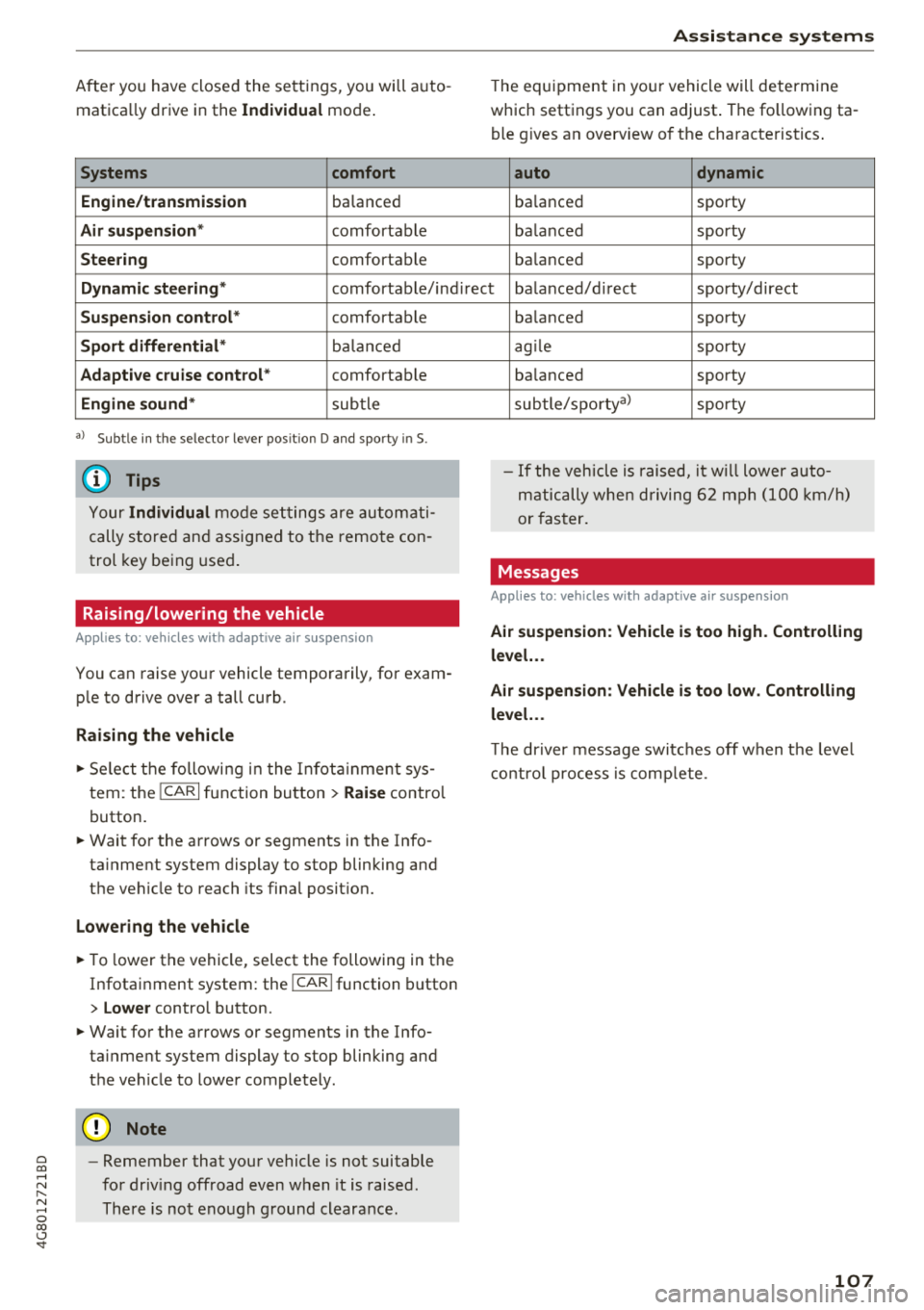
Systems comfort
Engine/transmission
ba lanced
Air suspension* comfortab le
Steering comfortab le
Assistance systems
The equipment in yo ur vehicle will determine
which settings you can adjust . The fo llowing ta
ble gives a n overview of the characteristics .
auto dynamic
ba
lanced sporty
ba lanced sporty
ba lanced sporty
Dynamic steering
* comfortable/indirect ba lanced/d irect sporty/direct
Suspension control* comfortab le
Sport differential * balanc ed
Adaptive cruise control* comfortable
Engine sound* subtle
a) Subtle in the selector lever posit ion D and sporty in S.
(D Tips
Your Individual mode settings are automati
cally stored and assigned to the remo te con
trol key being used .
Raising/lowering the vehicle
Applies to: vehicles with adaptive air suspension
You can raise your vehicle temporarily, for exam
ple to drive over a tall curb.
Raising the vehicle
~ Select the following in the In fotainm ent sys
tem: the
ICARI function button > Raise control
button.
~ Wait for the arrows or segments in the Info
ta inment system display to stop blinking and
the vehicle to reach its fina l posit ion.
Lowering the vehicle
~ To lower the vehicle, select the following in the
Infotainment system: the
! CARI function button
> Lower control button.
~ Wait for the arrows or segments in the Info
ta inment system display to stop blinking and
the vehicle to lower completely .
@ Note
-Remember that your vehicle is not suitable
for driv ing offroad even when it is raised.
There is not enough ground clearance . ba
lanced sporty
ag ile sporty
ba lanced sporty
subtle/sportyal sporty
- If the vehicle is raised, it will lower auto
matically when driving 62 mph (100 km/h)
or faster.
Messages
Applies to: vehicles with adaptive air suspension
Air suspension : Vehicle is too high . Controlling
level. ..
Air suspension: Vehicle is too low. Controlling
level. ..
Th e driver message switches off when the leve l
control process is complete.
107
Page 195 of 274

a co ,...,
N
" N ,...,
0 00 <..:l '
System (OBD)
The On-Board Diagnostic System monitors the
engine and transmission components that influ
ence emissions.
F ig . 178 Footwell o n le ft s ide of th e vehicle: con nectio n
port fo r th e On -Board Diagnostic System (OBD)
On -Board Diagnostic S ystem
Eng ine data can be read out using a special test
device at the On-Board D iagnost ic System con·
nection port
9 fig. 178.
Ind icat or light
If thE' ¢..ift indicator light blinks or turns on, there
is a malfunction that is causing poor emissions
quality and that could damage the catalytic con
verter .
Drive s lowly to an authorized Audi dealer or au
thor ized Audi Service Facility to have the mal
function corrected .
The indicator light can also turn on if the fuel fill
er cap is not closed correct ly
9 page 190 .
A WARNING
Incorrect use of the connection port for the
On-Board Diagnostic System can cause mal
functions, which can then result in acc idents
and ser io us injuries .
- Only allow an author ized Audi dealer or au
tho rized Aud i Serv ice Facility to read out the
engine data.
-
Chec king and Filling
Engine compartment
Working in the engine compartment
Special care is required if you are working in the
engine compartment
For wo rk in the engine com part ment , such a s
che cking and filling fluids, there i s a ris k of i n
jur y, sc alding, a cci dent s, and b urn s. For t his
r easo n, foll ow all the w arnings and g en e ral
s afe ty pre ca ution s pro vided in the f ollowing
in
formati on. The engine compartm ent i s a dan
ge rou s area in the vehicle .
9 &..
A WARNING
-Turn the engine off.
- Sw itch the ignition off.
- Set the parking brake.
- Select the P se lector lever position .
- Let the eng ine cool down .
- Never open the hood when there is steam or
coolant escaping from the engine compart ment, because there is a risk that you could
be burned . Wait unt il no steam or coolant is
escaping.
- Keep children away from the eng ine com
partment .
- Never sp ill fluids on a hot engine. These flu
ids (such as the freeze protection contained in the coolant) can catch fire.
- Avoid short c ircuits in the electrical system .
- When working in the engine compartment,
remember that the radiator fan can switch
on even if the ignition is switched off, which increases the ris k of personal injury .
- Never open the cap on the coolant expan
sion tank when the engine is warm . The
coo ling system is under pressure.
-To protect your face, hands, and arms from hot steam or coolant, cover the cap with a
large cloth when opening .
- Do not remove the eng ine cover under any
circumstances . This increases the risk of
bu rns .
- If tests need to be performed with the en
g ine runn ing, there is add it iona l danger due
to mov ing components (such as the ribbed
~
193
Page 210 of 274
Wheel s
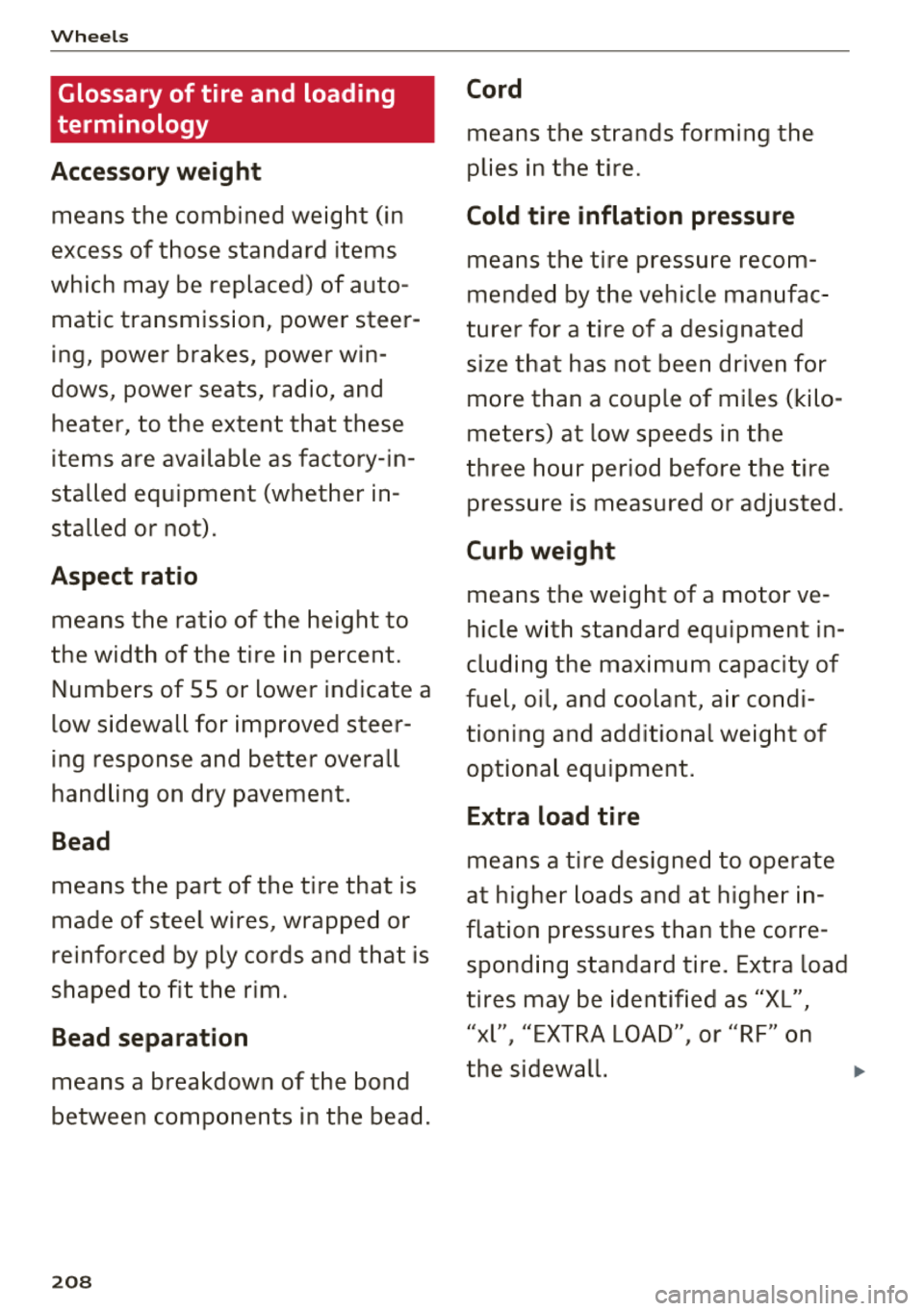
Glossary of tire and loading
terminology
Accessory weight
means the combined weight (in
excess of those standard items
which may be replaced) of auto matic transmission, power steer
ing , power brakes , power win
dows , power seats, radio, and
heater, to the extent that these
items are available as factory-in
stalled equipment (whether in
stalled or not).
Aspect ratio
means the ratio of the height to
the width of the tire in percent. Numbers of 55 or lower indicate a
low sidewall for improved steer
ing response and better overall
handling on dry pavement .
Bead
means the part of the tire that is
made of steel wires, wrapped or
reinforced by ply cords and that is
shaped to fit the rim.
Bead separation
means a breakdown of the bond
between components in the bead.
208
Cord
means the strands forming the
plies in the tire.
Cold tire inflation pressure
means the t ire pressure recom
mended by the vehicle manufac
turer for a tire of a designated
size that has not been driven for
more than a couple of miles (kilo
meters) at low speeds in the
three hour period before the tire pressure is measured or adjusted.
Curb weight
means the weight of a motor ve
hicle w ith standard equipment in
cluding the maximum capacity of
fuel, oil, and coolant, ai r condi
tioning and additional weight of
optional equipment.
E x tra load ti re
means a tire designed to operate
at higher loads and at higher in
flation pressures than the corre
sponding standard tire. Extra load
tires may be identified as "X L",
"
l" "EXTRA LOAD" or "RF" on X I I
the sidewall. .,.
Page 238 of 274
Emergency assistance
-If the tire is too severely damaged, see an
authorized Aud i dealer or authorized Aud i
Service Facility for assistance.
@ For the sake of the environment
You can give the used tire sealant bottle to an
authorized Audi dealer or authorized Audi
Serv ice Facility for disposal.
(D Tips
Remember to obtain a new bottle of sealant
from an authorized Audi dealer or authorized
Audi Serv ice Facility after repairing a tire.
Replacing wheels
Before changing a wheel
Observe the following precautions for your own
and your passenger's safety when changing a
wheel.
.,. After you exper ience a tire fa ilure, pull the car
well away from moving traff ic and try to reach
level ground
before you stop ¢.&, .
.,. All passengers sho uld leave the car and move
to a safe location (for instance, be hind t he
guardrail) ¢.&, .
.. Engage the parking brake to prevent your vehi
cle from rolling
unintentionally ¢.&, .
.. Move selector lever to position P ¢ A-
.. If you are towing a trailer, unhitch the trailer
from your veh icle .
.,. Take the jack and the spare tire* out of the lug
gage compartment
ca> page 233 .
.8, WARNING
You or your passengers could be inju red w hile
chan gin g a wheel if you do not follow these
safety precautions:
- If you have a flat ti re, move a safe d ista nee
off th e road. Turn off the engine, turn the
emergency flashers on and use other warn
ing devices to alert other motorists .
- Make sur e that passengers wait in a safe
place away from the vehicle and we ll away
from the road and traffic.
236
- To help prevent the vehicle from moving
suddenly and possibly s lipping off the jack,
always fully set the parking brake and block
the front and back of the wheel diagonally
opposite the wheel being changed. When
one front wheel is lifted off the ground,
p lacing the Automat ic Transmission in P
(Pa rk) w ill
not prevent the vehicle from
mov ing.
- Before you change a wheel, be sure the
ground is level and firm. If necessary, use a
sturdy board under the jack.
- Always store the vehicle tool kit, the jack
and the replaced tire in the lu ggage com
pa rtment
¢page 134 .
(D Tips
Before changing the wheel, you must activate
the jacking mode, so that the automatic con
trols for the Adaptive Air Suspension* do not
make it more difficult to lift the vehicle with
the jack
ca> page 238 .
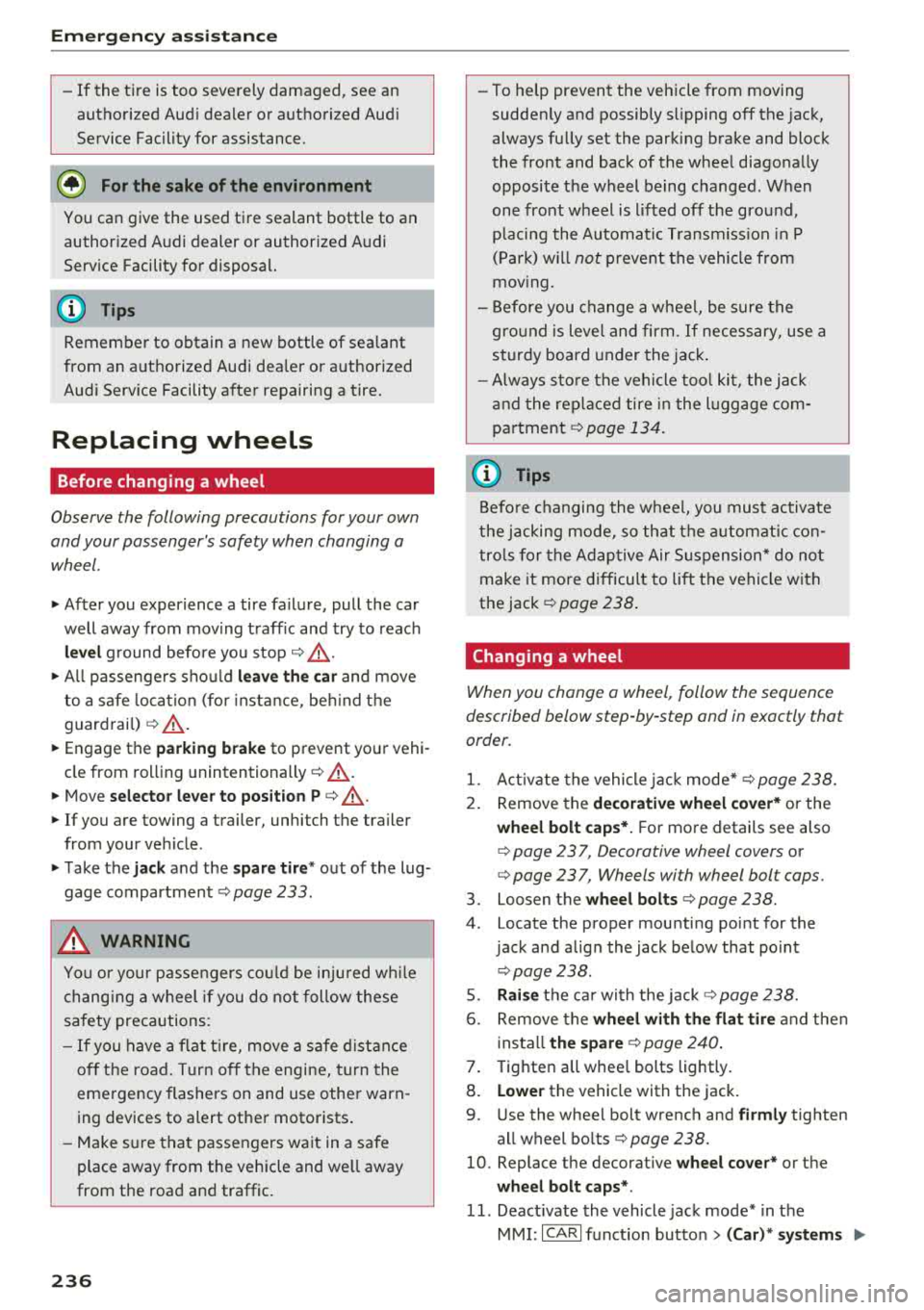
Changing a wheel
When you change a wheel, follow the sequence
described below step-by-step and in exactly that
order .
1. Act ivate the vehicle jack mode* ca> page 238 .
2. Remove the decorative wheel cover* or the
wheel bolt caps*. For more details see also
¢ page 23 7, Decorative wheel covers or
¢ page 237, Wheels with wheel bolt caps.
3. Loosen the wheel bolts ¢ page 238.
4. Locate the proper mounting point for the
jack and alig n the jack below that po int
¢ page 238 .
5. Raise the car with the jack ca> page 238.
6. Remove the wheel with the flat tire and then
install
the spare ca> page 240.
7. T ighten all whee l bolts lightly.
8 .
Lower the vehicle with the jack.
9. Use the wheel bolt wrench and
firmly tighten
all wheel
bolts ¢ page 238.
10. Replace the decorat ive wheel cover* or the
wheel bolt caps*.
11. Deact ivate the vehicle jack mode* in the
MM I:
ICARI function button > (Ca r)* systems .,.
Page 248 of 274

Fuses
Fuse panel© (brown)
No. Equipment
1 I nfota inment system
2 Infotainment system
3
Infota inment, automatic dimming inter ior
rearv iew mir ror
4 Rearview camera/per ipheral cameras
s TV tuner
6 Tank leak detect ion system
7 Sockets
8 Park ing heater
10 Lumbar support (front passenger's seat)
11 Emergency call
12 Infotainment system
Fuse panel @ (black)
No. Equipment
Air suspens ion, adapt ive dampers , sport
1 different ial, elect romechan ical pa rking
brake
2
Clutch pedal position sensor/automat ic
transmission
3 Seats
4 Rear wiper (Avant)
s Side assist
6 Engine sound
7 Infotainment/sound amplifier
8 Gateway
9 Sport differential
10 Climate control system
1 1
T ire pressure monitoring system, parking
heater
12 Sta rt/Stop system
Fuse panel ® (black)
No . Equipment
1 Special purpose vehicles/rear seats
Fuse panel ® (black)
No . Equipment
1 Rear window defogger
246
Page 249 of 274

a co .... N
" N .... 0 00 \.J '
General
This chapter is intended for trained emergency
crews and working personnel who have the nec
essary tools and equipment to perform these
operations.
Starting by pushing or
towing
~ Note
Vehicles with an automatic transmission can
not be started by pushing or towing.
Starting with jumper
cables
If necessary, the engine can be started by con
necting it to the battery of another vehicle .
If the engine should fail to start because of a dis
charged or weak battery, the battery can be con
nected to the battery of
another vehicle, using a
pair of jumper cables to start the engine.
Jumper cables
Use only jumper cables of sufficiently large cross
section
to carry the starter current safely. Refer
to the manufacturer's specifications.
Use only jumper cables with
insulated terminal
clamps which are distinctly marked :
plus(+) cable in most cases colored red
minus(-) cable
in most cases colored black.
A WARNING -
Batteries contain electricity, acid, and gas.
Any of these can cause very serious or fatal in
jury. Follow the instructions below for safe
handling of your vehicle's battery .
-Always shield your eyes and avoid leaning
over the battery whenever possible.
-A dead battery can freeze at temperatures
around 32 °F (0 °C) . If the vehicle battery is
frozen, you must thaw it before connecting
the jump start cables. If you do not, this in-
Emergency situations
creases the risk of an explosion and chemi
cal burns. After jump starting the vehicle,
drive to an authorized Audi dealer or author ized Audi Service Facility immediately to
have the vehicle battery checked.
- Do not allow battery acid to contact eyes or
skin . Flush any contacted area with water
immediately.
- Improper use of a booster battery to start a
vehicle may cause an explosion .
- Vehicle batteries generate explosive gases .
Keep sparks, flame and lighted cigarettes
away from batteries.
- Do not try to jump start any vehicle with a
low acid level in the battery .
- The voltage of the booster battery must also
have a 12-volt rating . The capacity (Ah) of
the booster battery should not be lower
than that of the discharged battery. Use of
batteries of different voltage or substantial
ly different "Ah " rating may cause an explo
sion and personal injury.
- Never charge a frozen battery. Gas trapped
in the ice may cause an explosion.
- Never charge or use a battery that has been
frozen. The battery case may have be weak
ened.
- Use of batteries of different voltage or sub
stantially different capacity (Ah) rating may
cause an explosion and injury. The capacity
(Ah) of the booster battery should not be
lower than that of the discharged battery.
- Before you check anything in the engine
compartment, always read and heed all
WARNINGS
c>page 193.
@ Note
- Applying a higher voltage booster battery
will cause expensive damage to sensitive
electronic components, such as control
units, relays, radio, etc.
- There must be no electrical contact between
the vehicles as otherwise current could al
ready start to flow as soon as the positive
( + ) terminals are connected.
247
Page 250 of 274
Emergency situations
@ Tips
The discharged battery must be properly con
nected to the vehicle's electrical system .
When jump starting or charging the battery,
never connect the negative ground cable to
the battery negative post because the battery
manager system must be able to detect the
battery's state of charge. Always connect the
negat ive g round cable to the negative ground
post of the battery manager control unit.
Use of jumper cables
Make sure to connect the jumper cable clamps in
exactly the order described below!
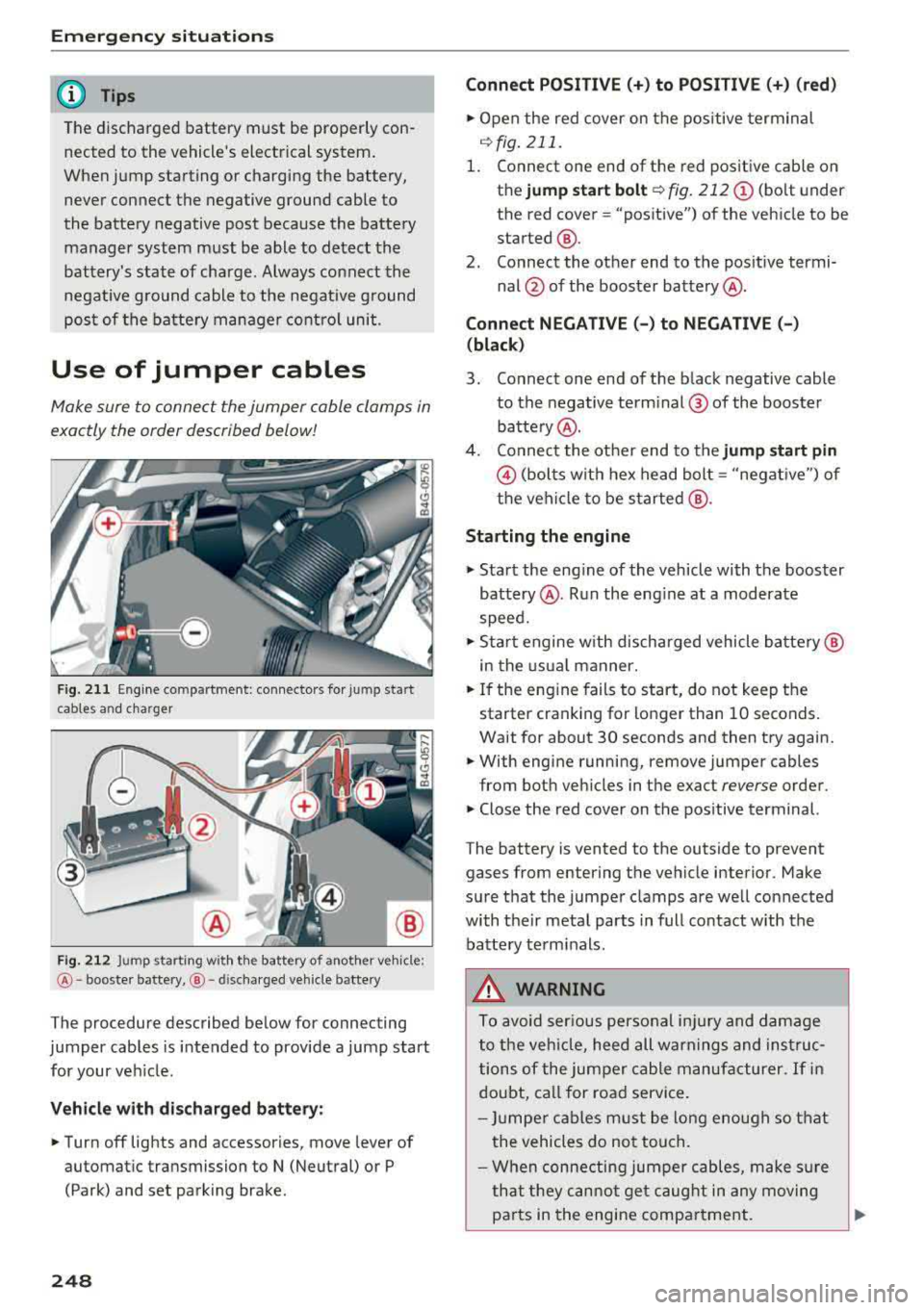
Fig . 211 Engine compartmen t: connecto rs for jump start
cables and charger
@
F ig . 212 Jump starting w it h the battery of anot her vehicle :
@-booster battery, @- discha rged vehicle battery
The procedure described below for connecting
jumper cables is intended to provide a jump start
for your veh icle.
Vehicle with discharged battery:
• Turn off lights and accessories, move lever of
automatic transmission to N (Neutral) or P (Park) and set park ing brake.
248 Connect POSITIVE(+) to POSITIVE(+)
(red)
• Open the red cover on the positive terminal
.:!.>fig. 211.
1. Connect one end of the red positive cable on
the
jump start bolt ~ fig. 212@ (bolt under
the red cover= "positive") of the vehicle to be
started @.
2. Connect the other end to the positive termi-
nal @of the booster battery @.
Connect NEGATIVE(-) to NEGATIVE(-)
(black)
3. Connect one end of the black negative cable
to the negative terminal @ of the booster
battery @.
4. Connec t the other end to the
jump start pin
@ (bolts with hex head bolt= "negative") of
the vehicle to be started @.
Starting the engine
• Start the eng ine of the vehicle with the booster
battery @. Run the eng ine at a moderate
speed.
• Sta rt engine w ith discharged vehicle battery@
in the usual manner.
• If the engine fails to start, do not keep the
starter cranking for longer than 10 seconds.
Wait for about 30 seconds and then try again.
• With engine running, remove jumper cables
from both veh icles in the exact
reverse order.
• Close the red cover on the pos itive terminal.
The battery is vented to the outside to prevent
gases from entering the vehicle interior . Make
sure that the jumper clamps are well connected
with their metal parts in full contact w ith the
battery terminals.
A WARNING
To avoid serious personal injury and damage
to the vehicle, heed all warnings and instruc
tions of the jumper cable manufacturer. If in
doubt, call for road service .
- Jumper cables must be long enough so that
the vehicles do not touch.
- When connecting jumper cables, make sur e
that they cannot get caug ht in any moving
pa rts in the engine compartment.
.,.
Page 251 of 274
-Be fore yo u chec k any thing in the engine
compartment, a lways read and heed a ll
WARNINGS
c:::> page 193 .
(D Note
Impro per hook-u p of jum per cables c an r uin
the gene rato r.
-Always connect P OSITIVE( +) to POS ITIV E
( + ), and NEG ATIVE( -) to NEGATI VE( -)
g round post of t he battery manage r contro l
unit.
- Check that a ll sc rew p lugs on t he battery
ce lls are screwed in f irmly . If not, t ighten
plugs p rior to connecting clamp on negative
b attery termi nal.
- Please note t hat the procedure fo r con nect
i ng a jumper cab le as desc ribed above ap
pli es specifica lly to the case of yo ur vehicle
b eing jump starte d. W hen you are giv ing a
ju mp s ta rt to ano ther vehicle , d o
no t con
ne ct t he negative( -) cable to the neg ative
(-) t ermin al on the disch arged b attery @
c:::> fig . 212 . In stead , securely connec t the
n egative ( -) cable to either a solid metal
com ponent that is firm ly bolted to the e n
gine block or to the engine bloc k itsel f. If
the battery that is be ing charged does not
vent to the outs ide, escap ing battery gas
could ignite and ex plode!
Towing with a tow truck
General hints
Your Audi requires special handling for towing .
The follow ing informa tion is to be used by com
mercia l tow tr uck operators who know how to op
e rate the ir equip men t sa fely.
- Never tow your Audi. Towing will cause dam
age to the engine and transmission .
- Never wrap the safety chains or winch cables
around the brake line s.
- To prevent unnecessary damage, your Audi
must be transported with a flatbed tru ck .
a co -To load the vehicle on to the flatbed , use the ,...,
~ towing loop found in the vehicle tools and at-N ,...,
0 00 <.,;) '
tach to the front or rear anchorage
c:::> pag e 249 and c:::>page 250 .
A WARNING
-
A veh icle bei ng towed is not safe for passen-
gers . N ever allow anyone to ride in a vehicle
being towed, for any reason.
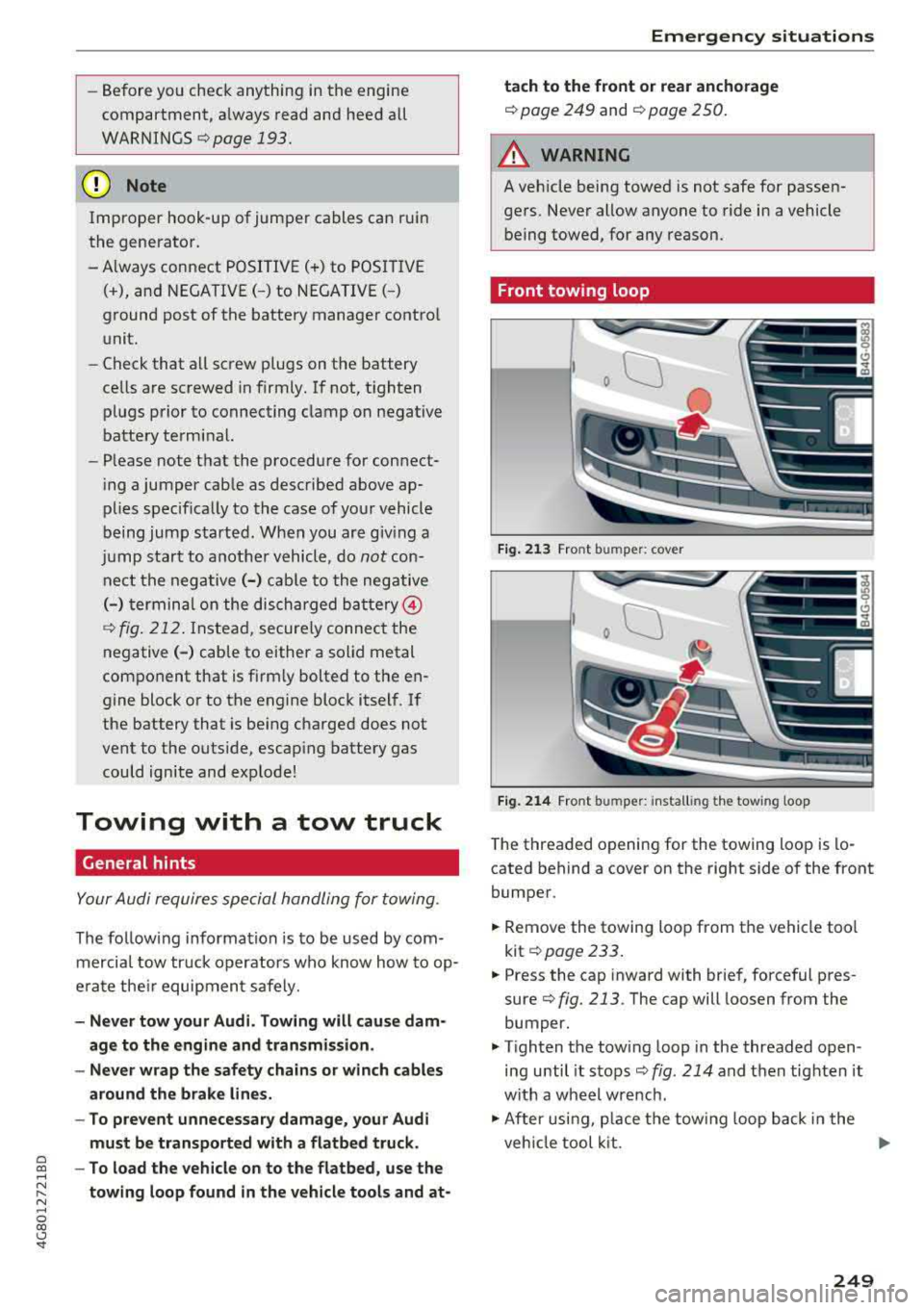
Front towing loop
Fig. 213 Front bu mpe r: co ve r
Fig. 214 Front bu mper: i nst all ing the tow ing loop
T he t hreaded o pen ing for th e towing loop is lo
cated be hind a cover on the r ight side of the front
bumper .
.,. Remove the towing loo p from the vehi cle too l
k it
c:::> page 2 3 3 .
.,. Press the cap inward with brief, force ful p res
su re
c:::> fig. 213 . The cap will loosen from the
bumper.
.,. T ighten the towing loop in the threaded open
ing until it sto ps
c:::> fig . 214 and then tighten it
w ith a wheel w re nch .
.,. After usi ng, p lace the tow ing loop back i n the
veh icle tool kit.
..,.
249
Page 253 of 274
a co ,...,
N
" N ,...,
0 00 <.,;) '
Lifting with workshop hoist and with floor
jack
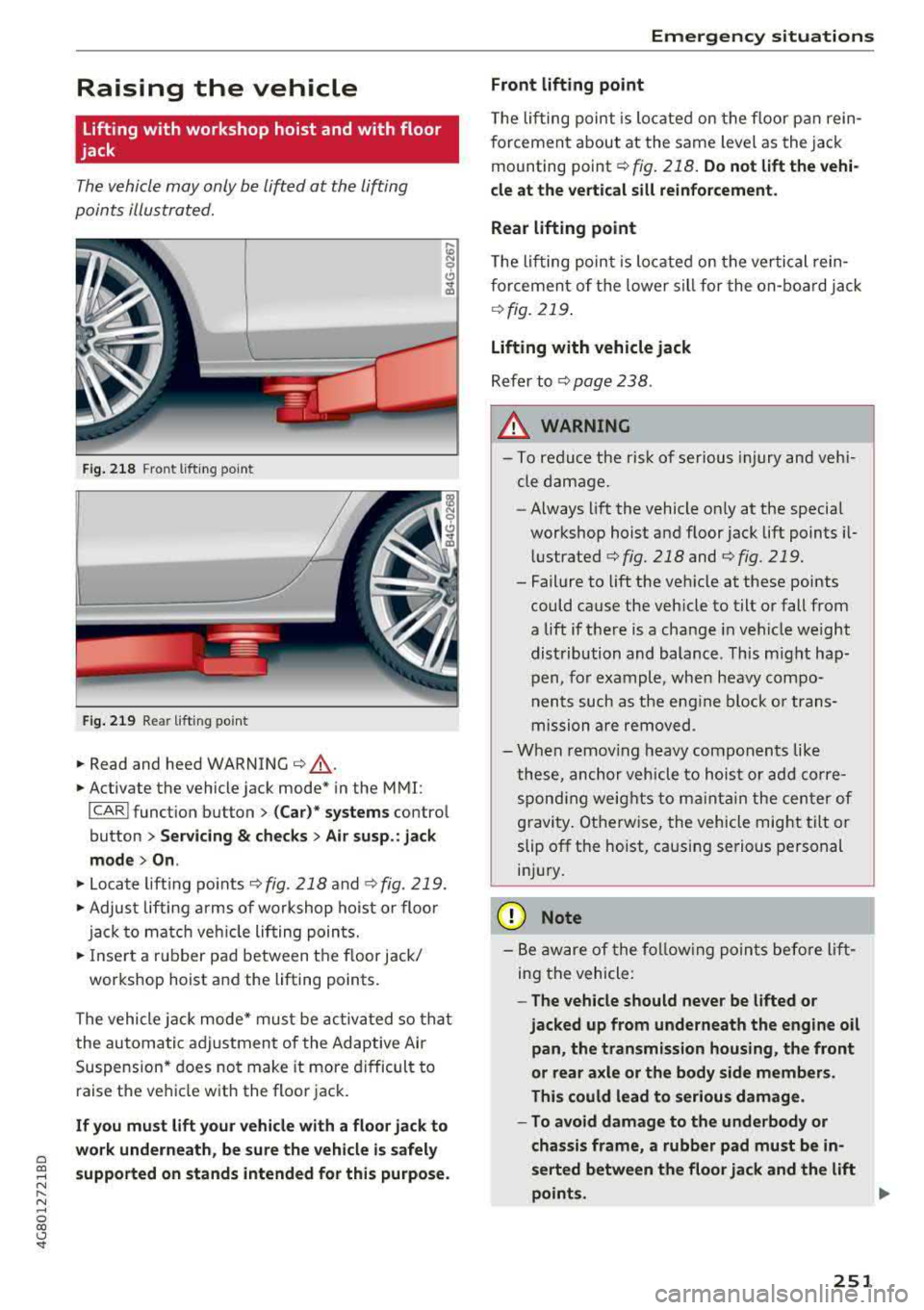
The vehicle may only be lift ed at the lifting
points illus tr at ed.
Fig. 218 Fro nt lift in g poin t
Fig. 219 Re ar lift ing poin t
.,. Read and heed WARNING c::> &, .
.. Activate the veh icle ja ck mode* in the M MI:
I CAR I funct ion button> (Car) * systems contro l
bu tton >
Servicing & checks > Air susp.: jack
mode > On .
.. Loca te lift ing po ints c::> fig . 218 and c::>fig . 219 .
.. Adju st lifting arms of wo rkshop hoist o r floo r
jack t o match vehicle li fting poin ts.
.. In se rt a rubb er pa d between the floor jack/
wor kshop ho ist a nd the lifting points .
T he vehicle ja ck m ode* mus t be activa ted so that
the au tomatic a djustment of the Ad aptive Air
Suspension * does no t make it more difficult to
raise the ve hicle wit h the floor jac k.
If you must lift your vehicle with a floor jack to
work underneath, be sure the vehicle is safely
supported on stands intended for this purpose . Emergency situations
Front lifting point
T he lifting poin t is locate d on the floor p an rein
f o rcement about at the same level as the ja ck
mounting point
c::> fig . 218 . Do not lift the vehi
cle at the vertical sill reinforcement .
Rear lifting point
T he lifting p oin t i s lo cate d on the ve rtic al rei n
f o rceme nt o f th e lower s ill for the on- bo ar d jac k
c::>fig. 219.
Lifting with vehicle jack
Refer to c::> pag e 238 .
A WARNING
- To reduce the r is k of se rious inju ry and veh i
cle dama ge.
-Always lift the vehicle o nly at the specia l
wor kshop h oist a nd f loor jack lift points
il
l ustrated c::> fig. 218 and c::> fig. 219.
-Failure to lift t he ve hicle at these points
could cause t he veh icle to tilt o r fall from
a lift i f th ere is a change in vehicle weight
dist ribution and balance . This might hap
pen, fo r example, when heavy compo
n en ts such as the eng ine block o r trans
missi on a re removed .
- Whe n re mov ing heavy comp onents like
these, an ch or veh icle t o hois t or ad d co rre
spon ding weig hts t o m aintai n the cen ter of
g ravi ty . Ot herw ise, the vehicle mig ht tilt or
slip off t he hoist, caus ing se rio us pe rsonal
i njur y .
(D Note
-Be aw are of the fo llow ing po ints b efor e lift
ing the vehicle:
-The vehicle should never be lifted or
jacked up from underneath the engine oil
pan, the transmission housing, the front
or rear axle or the body side members.
This could lead to serious damage .
-To avoid damage to the underbody or
chassis frame, a rubber pad must be in
serted between the floor jack and the lift
points .
.,.
251