service AUDI A7 2018 Workshop Manual
[x] Cancel search | Manufacturer: AUDI, Model Year: 2018, Model line: A7, Model: AUDI A7 2018Pages: 274, PDF Size: 42.77 MB
Page 223 of 274
a co .... N
" N .... 0 00 \.J '
Reinstall summer tires at the appropriate
time, because they provide better handling
when roads are free of snow and ice. Summer
tires cause less road noise, tire wear and fuel
consumption.
(D Tips
You can also use all season tires instead of
winter tires. Please note that in some coun
tries where winter tires are required, only
winter tires with the
& symbol may be per
mitted .
Snow chains
Snow chains not only improve the driving in win
ter road conditions, but also the braking .
.,. Only install snow chains on the front wheels.
This applies also to vehicles with all wheel
drive*.
.,. Check and correct the seating of the snow
chains after driving a few feet, if necessary. Fol
low the instructions from the manufacturer .
.,. Note the maximum speed of 30 mph (SO km/
h). Note the local regulations.
Use of snow chains is only permitted with certain
rim/tire combinations due to technical reasons.
Check with an authorized Audi dealer or author i zed Audi Service Facility to see if you may use
snow chains.
You must remove the snow chains on roads with
out snow. Otherwise, you could impair driving
ability and damage the tires.
A WARNING
Using incorrect snow chains or installing snow
chains incorrectly can result in loss of vehicle
control, which increases the risk of an acci
dent.
@ Note
- Snow chains can damage the rims/wheel
covers* if the chains come into direct con
tact with them . Remove the wheel covers*
first . Use coated snow chains.
Wheels
- Using snow chains that add more than 0.4
inch (10.5 mm) of height can severely dam
age the wheel housings and other vehicle
components.
- Do not install and use snow chains if there is
a malfunction in the air suspension*, be
cause the vehicle height will be very low. If
you drive with snow chains anyway, the
wheel housings and other vehicle compo
nents can be severely damaged .
(D Tips
When using snow chains, it may be useful to
switch on sport mode
c> page 121.
Low-profile tires
Applies to: vehicles with low-profile tires
Compared to other tire/rim combinations, low
profile tires offer a wider tread surface and a
larger rim diameter with shorter tire sidewalls.
This results in an agile driving style. However, it
may reduce the level of comfort and increase
road noise when driving on roads in poor condi
tion.
Low-profile tires can become damaged more
quickly than standard tires when driving over
large bumps, potholes, manhole covers and
curbs. Therefore, it is particularly important to
maintain the correct tire pressure
c>page 215.
To reduce the risk of damage to the tires and
rims, drive very carefully on poor roads.
Check your wheels regularly every 2,000 mi
(3,000 km) for damage. For example, check for
bulges/cracks on the tires or deformations/
cracks on the rims.
After a heavy impact or damage, have the tires
and rims inspected or replaced immediately by
an authorized Audi dealer or authorized Audi
Service Facility.
Low-profile tires can wear out faster than stand
ard tires.
Uniform tire quality grading
-Tread wear
221
Page 224 of 274
Wheels
- Traction AA A B C
- T emperature ABC
Quality grades can be found where appl icable on
the tire side wall between tread shoulder and
maximum section width
~ page 206, fig. 187.
For example: Tread wear 200, Traction AA, Tem
perature
A .
All passenger car tires must conform to Federal
Safety Requirements in addition to these grades.
Tread wear
The tread wear grade is a comparative rating
based on the wear rate of the tire when tested
under contro lled conditions on a specified gov
ernment test course.
F or examp le, a tire graded
150 would wear one
and one half (1 1/2) times as well on the govern
ment course as a tire graded
100.
The relative performance of tires depends upon
the actua l conditions of their use, however, and
may depart significantly from the norm due to
variations in driving habits, service practices and
d ifferences in road characteristics and climate.
Traction
The traction grades, from highest to lowest, are
AA, A, Band
C. T hose grades represent the tire's
abi lity to stop on wet pavement as measured un
der controlled conditions on specified govern ment test surfaces of asphalt and concrete. A tire
marked C may have poor traction performance
~ .&..
Temperature
The temperature grades are A (the highest), B,
and C, representing the tire's resistance to the
generation of heat and its ability to d iss ipate
heat when tested under controlled conditions on
a specified indoor laboratory test wheel.
Sustained high temperature can cause the mate rial of the tire to degenerate and reduce tire life,
and excess ive temperature can lead to sudden
tire
fa ilure ~.&. .
The grade C corresponds to a level of perform
ance which a ll passenger car tires must meet un-
222
der the Federal Motor Vehicle Safety Standard
No.
109. Grades Band A represent higher levels
of performance on the laboratory test wheel than
the minimum required by law.
A WARNING -
The tract ion grade assigned to this t ire is
based on straight-ahead braking traction
tests, and does not include acceleration, cor
nering, hydroplaning or peak traction charac
teristics .
A WARNING
The temperature grade for this tire is estab
lished for a tire tha t is properly inflated and
not overloaded. Excessive speed, underinfla
tion, or excessive loading, either separately or
in combination, can cause heat buildup and
possible tire failure.
A WARNING
-
-
Temperature grades apply to tires that are
proper ly inflated and not over or underinflat
ed.
Tire pressure monitoring system
ill General notes
Each tire, including the spare (if prov ided),
shou ld be checked monthly when cold and inflat
ed to the inflation pressure recommended by the
vehicle manufacturer on the vehicle placard or
tire inflation pressure label. (If your veh icle has
t ir es of a diffe rent size t han the size ind icated on
the vehicl e placard or tire infl ation press ure la
bel, you sho uld determine the proper tire infla
tion pressure for those tires).
As an added safety featu re, you r vehicle has been
equipped with a tire pressure monitoring system
(TPMS) that illuminates a low tire pressure tell
ta le when one or more of your tires is significant
l y under-inflated. According ly, w hen the low tire
pressure telltale illuminates, you should stop and
check your t ires as soon as possible, and inflate
them to the proper pressure. Dr iving on a
.,..
Page 226 of 274
![AUDI A7 2018 Workshop Manual Wheels
Indicator lights
It]-loss of pressure in at least one tire¢,&. .
Check the tires and replace or repair if necessary.
Check/correct the pressures of all four tires and
st](/img/6/57599/w960_57599-225.png "AUDI A7 2018 Workshop Manual Wheels
Indicator lights
It]-loss of pressure in at least one tire¢,&. .
Check the tires and replace or repair if necessary.
Check/correct the pressures of all four tires and
st")
Wheels
Indicator lights
It]-loss of pressure in at least one tire¢,&. .
Check the tires and replace or repair if necessary.
Check/correct the pressures of all four tires and
store the pressure again in the Infotainment sys
tem
¢ page 224.
[m]) (Tire Pressure Monitoring System) Tire
pressure: System malfunction!.
If[m]J appears
after switching the ignition on or while driving
and the
RI] indicator light in the instrument clus
ter blinks for approximately one minute and then
stays on, there is system malfunction. Try to
store the correct tire
pressures¢ page 224 . If
the indicator light does turn off or turns on again
after a short period of time, drive to an author
ized Audi dealer or authorized Audi Service Facili
ty immediately to have the malfunction correct
ed.
A WARNING
- If the tire pressure indicator appears in the
display, reduce your speed immediately and
avoid any hard steering or braking maneu
vers. Stop as soon as possible and check the
tires and their pressure .
- The driver is responsible for maintaining the
correct tire pressure. You must check the
tire pressure regularly.
- Under certain conditions (such as a sporty
driving style, winter conditions or unpaved
roads), the tire pressure monitoring system
indicator may be delayed.
(D Tips
- The tire pressure monitoring system can al
so stop working when there is an ESC mal
function.
- Using snow chains may result in a system
malfunction.
- The tire pressure monitoring system in your
Audi was calibrated with "Audi Original
Tires"
¢ page 212. Using these tires is rec
ommended .
224
Storing tire pressures
Applies to: vehicles with Tire P ressure Monitoring System in
dicator
If the tire pressure changes or a tire is replaced,
it must be confirmed in the Infotainment sys
tem.
.,. Make sure before storing that the tire pressures
of all four tires meet the specified values and
are adapted to the load
¢page 215.
.,. Switch the ignition on .
.,. Select: the I CARI function button > (Car)* Sys
tems
control button > Service & control > Tire
pressure monitor> Store tire pressure > Yes,
store now.
(D Tips
Do not store the tire pressures if snow chains
are installed.
Tire pressure monitoring
system
ill General notes
Each tire, including the spare (if provided),
should be checked monthly when cold and inflat
ed to the inflation pressure recommended by the
vehicle manufacturer on the vehicle placard or
tire inflation pressure label. (If your vehicle has
tires of a different size than the size indicated on
the vehicle placard or tire inflation pressure la
bel, you should determine the proper tire infla
tion pressure for those tires).
As an added safety feature, your vehicle has been
equipped with a tire pressure monitoring system
(TPMS) that illuminates a low tire pressure tell
tale when one or more of your tires is significant
ly under-inflated. Accordingly, when the low tire
pressure telltale illuminates, you should stop and
check your tires as soon as possible, and inflate
them to the proper pressure. Driving on a signifi
cantly under-inflated tire causes the tire to over
heat and can lead to tire failure. Under-inflation
also reduces fuel efficiency and tire tread life,
and may affect the vehicle's handling and stop-
ping ability.
.,.
Page 227 of 274

a co .... N
" N .... 0 00 \,;J '
proper tire maintenance, and it is the driver's re
sponsibility to maintain correct tire pressure,
even if under-inflation has not reached the level
to trigger illumination of the TPMS low tire pres
sure telltale .
Your vehicle has also been equipped with a TPMS malfunction indicator to indicate when the sys
tem is not operating properly. The TPMS mal
function indicator is combined with the low tire pressure telltale. When the system detects a
malfunction, the telltale will flash for approxi
mately one minute and then remain continuously
illuminated. This sequence will continue upon
subsequent vehicle start-ups as long as the mal
function exists.
When the malfunction indicator is illuminated,
the system may not be able to detect or signal
low tire pressure as intended. TPMS malfunctions
may occur for a variety of reasons, including the
installation of replacement or alternate tires or
wheels on the vehicle that prevent the TPMS
from functioning properly . Always check the
TPMS malfunction telltale after replacing one or
more tires or wheels on your vehicle to ensure
that the replacement or alternate tires and
wheels allow the TPMS to continue to function
properly.
Description
Applies to: vehicles with tire pressure monitor ing system
The tire pressure monitoring system monitors
the pressure in the four tires when driving.
T he system uses sensors that measure the tem
perature and pressure in the tires . The data is
sent from these sensors to the control module by radio frequency.
T he Tire Pressure Monitoring System shows the
current pressures and temperatures of the tires
in the Infotainment system
¢page 226. It also
compares the current tire pressures with the
stored tire pressures and gives a warning in the
driver information system if the tire pressure is
different from what is
stored ¢ page 226 .
Wheels
The system does not detect if the stored tire
pressures match the recommended tire pres
sures. You must store the tire pressures again
¢ page 226:
- every time the tire pressures change, for exam
ple when the load in the vehicle changes,
- after replacing a tire, or
- if wheels with new wheel sensors are used.
_& WARNING
- The tire pressure monitoring system assists
the driver in monitoring tire pressures. The
driver is responsible for having the tires in
flated to the correct pressure.
- Do not change the tire pressure when the
temperature of the tire is extremely high.
This could result in serious damage to the
tire and even cause the tire to burst, in
creasing the risk of an accident.
- A tire with low pressure flexes more. This heats the tire up too much. This could cause
the tread to separate and even cause the
tire to burst, increasing the risk of an acci
dent.
- The tire pressure monitoring system does not warn about damage or defects in the
tire construction that could cause the tire to
burst, for example. Inspect your tires regu
larly.
(D Tips
- If tires are replaced, the sensors/valves do
not need to be removed or replaced . Just re
placed the valve stem and, if necessary, the
valve and the wheel electronics. If you have questions, see an authorized Audi dealer or
authorized Audi Service Facility.
- An incorrect display or a malfunction in the
tire pressure monitoring system can occur
after using the tire mobility kit. Have the
sensors replaced by an authorized Audi
dealer or authori zed Audi Service Facility.
- For an explanation on conformity with the
FCC regulations in the United States and the
Industry Canada regulations, see
¢ page 258.
225
Page 228 of 274

Wheels
Displaying tire pressures/temperatures
Applies to: vehicles with tire pressure monitoring system
Requirement: the ign ition must be switched on.
.,. Select : the ICARI function button > Car systems
> Service & control> Tire pressure monitor>
Display tire pressure .
The current tire pressures are shown in green and
yellow numbers in the Infotainment system:
- Green: the current tire pressure and the speci
fied tire pressure are approximately the same.
- Yellow: the current tire pressure is too low
compared to the specified tire pressure.
The specified tire pressure is the last tire pres
sure that was stored
9 page 226 .
Note that the tire pressure also depends on the
temperature of the tire. The tire pressure in
creases as the engine becomes warmer while
driving.
A WARNING
Read and follow the important information
and notes
q page 225.
@ Tips
The tire pressure or temperature are not dis
played in adaptation mode. Dashes --.-- are
shown in place of the pressure and tempera
ture.
CD Tire pressure loss
App lies to: veh icles with tire pressure mon itoring system
Fig. 192 Display : in dic ato r light with a me ssage
226
-
If the (D] indicator light turns on, the pressure in
at least one tire is too low or new sensors were
not adapted:
RE indicator lights turns on after turning the
ignition on
The tire pressure is too low compared to the
specified pressure.
.,. Check and store the tire pressure(s) the next
time it is possible
9 page 226.
RE indicator light turns on while driving
Wheels with new sensors were not adapted or
the tire pressure has reached a critical level com
pared to the specified pressure.
.,. Avoid unnecessary steering and braking maneu-
vers.
.,. Adapt your driving sty le to the situation.
.,. Stop as soon as possible and check the tire(s).
.,. If it is possible to continue driving, see an au-
thorized Audi dealer or authorized Audi Service
Facility immediately and have your tire(s) re
paired or replaced.
A WARNING
Read and follow the important information
and notes ¢
page 225.
Storing new tire pressures
Applies to: vehicles with tire pressure mon itoring system
Correctly stored tire pressure specifications are
necessary for reliable tire pressure monitoring.
.,. Check the tire pressures in all wheels .
-
.,. Correct the tire pressure if necessary. Refer to
the tire pressure Label for the recommended
tire pressure for your vehicle
c> page 215,
fig . 190 .
Only correct the pressure in tires
whose temperature is approximately the same
as the ambient temperature. If the tempera
ture of the tire is higher than the ambient air
temperature, the tire pressure must be in
creased approximately 3 PSI (0,2 bar) above
the value on the sticker .
.,. Switch the ignition on .
.,. Select: !CAR ! function button > Car systems>
Tire pressure monitoring
> Store tire pressure . ..,.
Page 229 of 274

a co .... N
" N .... 0 00 \.J '
tem measures the current tire pressures and stores them as the new specified pressures.
~ If the changed tire pressures are not displayed
in the Infotainment system, drive the vehicle
for approximately 10 minutes so that the sen
sor signal from the wheels is received again.
During this adaptation phase, --.·· is displayed
for the pressure and temperature and the tire
pressure monitoring system is only partially
available. It only provides a warning if one or
more tir e pressures is below the minimum per
mitted specified pressure. If this is the case, the
IE indicator light appears with a message.
& WARNING
Read and follow the important information
and notes
¢p age 225.
Malfunctions
Applies to: vehicles with tire pressure monitoring syste m
-
If the Tire Pressure Monitoring System is not
avai lable, the
mm indicator light appears in the
driver information system. The
IE indicator light
also blinks for approximately one minutes each
time the ignition is switched on . The tire pressure
monitoring system cannot be selected in the In
fotainment system. The fol lowing are examples
of situat ions that could cause a malfunction:
-If the message appears at the end of the adap
tation phase, the system cannot detect the
wheels installed on the vehicle. This may resu lt
from one or more wheels being installed with
out wheel sensors or with incompatible wheel
sensors.
-A wheel sensor or another component has
failed.
-Using snow cha ins can affect the function of
the system because of the shield ing effect of
the chains .
-The tire pressure monitoring system is not
available due to a malfunction.
-T ransmitters with the same frequency, such as
headphones or remote-control led dev ices, may
cause a temporary system malfunction due to
the strong electromagnetic field.
Wheels
T he m;i indicator light turns off once the Tire
Pressure Monitoring System is available again. If
you cannot correct the ma lfunction and the
m;i
indicator light stays on, drive immediately to an
authorized Audi dealer or authorized Audi Service
Facility to have the malfunction repaired.
227
Page 230 of 274

Care and cleaning
Care and cleaning
General information
Regular, proper care helps to maintain your vehi
cle's value. It can also be a requirement when
submitting warranty claims for corrosion damage
and paint defects on the body.
The necessary care products can be obtained
from an authorized Audi dea ler or authorized
Audi Service Facility. Read and follow the instruc
tions for use on the packaging.
A WARNING
-Using cleaning and care products incorrectly
can be dangerous to your health.
- Always store clean ing and care products out
of reach of children to reduce the r isk of poi
sonin g.
@ For the sake of the environment
- Preferab ly purchase environmenta lly-friend
l y cleaning products.
- Do not dispose of leftover cleaning and care
products with household trash.
Car washes
The longer that deposits remain on the vehicle,
the more the surface may be damaged. High
temperatures such as those caused by sunlight increase the damaging effect .
Before washing, rinse
off heavy deposits with
p lenty of water.
Stubborn deposits such as bird droppings or tree
sap are best removed with plenty of water and a
microfiber cloth.
A lso, wash the underside of yo ur vehicle once
road sa lt stops being used for the season.
Pressure washers
When washing your veh icle w ith a pressure wash
er, always follow the operating instructions pro
vided with the press ure washer. This is espec ially
impor tant in r egard to the pressure and spraying
distance. Do not aim the spray directly at the
sea ls on the side windows, doors, lids or the sun-
228
roof* or at tires, rubber hoses, insulating materi
a l, sensors* or camera lenses* . Keep a distance of
at least 16 in (40 cm) .
Do not remove snow and ice with a pressure
washe r.
Never use cone nozzles o r high pressu re nozzles.
The water temperature must not be above 140 °F
(60 °().
Automatic car washes
Spray off the vehicle before washing .
Make sur e that the windows and roof* are closed
and the windshie ld wipers are
off. Follow instruc
tions from the car wash operator, especially if
there are accessories attached to your vehicle .
If possible, use car washes that do not have
brushes.
Applies to : RS models: only use car washes where
the vehicl e remai ns stationary and the washing
equipment moves around the vehicl e when wash
ing and drying. Car washes that move the vehicle
through the car wash using a chain are not rec
ommended.
Washing by hand
Clean the vehicl e starting from the top and work
ing down using a soft sponge or cleaning brush.
Use solvent -free cleaning products.
Washing vehicles with matte finish paint by
hand
To avoid damaging the paint when washing, first
remove dust and large particles from your vehi
cle. Insects, grease spots and fingerprints are
best removed with a special cleaner for matte
finish paint.
Apply t he product using a microfiber cloth. To
avoid damaging the paint surface, do not use too
much pressure.
Rinse t he ve hicle thoroughly with water. Then
clean using a neutra l shampoo and a so ft micro
fiber clot h.
R inse the vehicl e thoroughly again and let it air
dry. Remove any water residue using a chamois.
..,..
Page 232 of 274
Care and cl eaning
Component Situation Solution
De cora tiv e p arts/
Deposits Mild soap so lution al, a cleaning solution suitable for stain-
t rim less stee l, if necessary
Paint Paint damage Refer to the paint numbe r on the vehicle data label, repair
with touch up pa int
9 page 253
Spilled fuel Rinse with water immediately
Surface rust Rust remover, then protect
with hard wax; for questions,
consult an authorized Audi dealer or authorized Audi Serv-
ice Facility .
Corros ion Have it removed by an authorized Aud i dea ler or author-
i zed Audi Service Fac il ity.
Water no longer Protect with hard wax (at least twice per year)
beads on the surface
of clean paint
No shine even though Treat with
suitable polish; then apply paint protectant if
paint has been pro- the polish that was used does not contain any protectant
tected/paint looks
poor
Deposits such as in- Dampen w ith wate r immediately and remove wit h a m icro -
sects, bird dropp ings, fiber cloth
tree sap and road salt
Grease -based con- Remove immediately with a m ild soap solution
a) and a
taminants such as soft cloth
cosmetics or sunb lock
Car bon parts Deposits clean the same way as painted parts 9page 228
al Mild soap so lut ion : m axim um tw o tab lespoo ns o f neu tra l soap i n 1 qua rt (1 lite r) of water
Int erior cl ea ni ng
Component Situation Solution
Wind ows
Deposits Glass cleaner, then wipe dry
Deco rat ive p art s/ Deposits Mild
soap solution a)
t rim
Pla stic parts
Deposits Damp cloth
Heavier deposits Mild soap solution al, detergent-free plastic cleaning solu -
tion, if necessary
Di spla ys Deposits Soft cloth with LCD cleaner
C ontrol s Deposits Soft brush, then a soft cloth with a mild soap solutiona>
Safet y belts Deposits Mi
ld soap so lution al, allow to dry befo re letting them re -
tract
230
Page 234 of 274
Care and cl eaning
avoid scratches, move the scraper on ly in
one direction and not back and forth.
- Never remove snow o r ice from door win
dows and mirrors using warm or hot water
because this could cause cracks to form .
- To avoid damage to the rear w indow de
fogger , do not apply any stickers on the
heating wires on the inside of the window .
-Deco rati ve parts /trim
- Never use chrome care or cleaning prod-
ucts .
-Paint
-To red uce the risk of scratches, the vehicle
must be free of dirt and dus t before pol
ishing or waxing .
- To prevent pa int damage, do not pol ish or
w ax the veh icle in dire ct sunlight.
- To red uce the risk of pa int damage, do not
polish away rust spots .
- Remove cosmetics and sunscreen immedi
a tely
-these could damage the p aint.
- Displays
- To avoid scratches, do not use dry cleaning
methods on displays .
-Controls
- Make sure that no fluids enter the con-
trols, because this could ca use damage.
- Safety belts
- Do not remove the safety belts to clean
them.
- Never clean safe ty belts o r their compo
nents chemically or with corrosive fl uids
or so lvents and neve r al low sha rp o bje cts
t o come in to con ta ct w ith the sa fe ty belts .
Th is could cause damage to the belt web
bing .
- I f there is damage to the webbing, the
connections, the retractors or the b uckles,
have them replaced by an authorized Audi
dealer or author ized Audi Service Facility.
- Te xtiles /artificial leather/ Alcantara
- Never treat artificia l leather/ Alcantara
w ith leather care p roducts, solvents, floo r
polish, shoe polish, spot remove or similar
prod ucts.
- Have a specialis t remove st ubborn s tains
to prevent damage.
232
- Neve r use steam cleaners, brushes, hard
sponges, etc . when cleaning .
- D o not turn on the seat heating* to dry the
seat.
- Ob jects w ith sharp edges, such as zippe rs
or rive ts on clothing or belts, can cause
damage to the surface .
- Open hook and loop fastene rs, for exam
p le on clothing, can damage seat covers .
Make sure hook and loop fasteners a re
closed.
- Natural leather
- Never treat leather with solvents, floor
polish, shoe polish, spot remover or sim i
lar p roducts.
- Objects w ith sharp edges, such as zippe rs
or rivets on clothing or belts, can cause
damage to the surface.
- Never use steam cleaners, brushes, hard
sponges, etc. when cleaning.
- Do not turn on the seat heating * to dry the
seat .
- To he lp prevent the leather from fad ing,
do not leave the vehicle in d irec t sun light
for long periods of time. If leav ing the ve
h icl e parked fo r long pe riods of time, you
should cove r th e le athe r to pro te ct it from
dir ect sun light.
(D Tips
- I nsects are easier to remove from paint that
ha s bee n freshly waxe d.
- Regular waxing can prevent rust spots from
forming.
Placing your vehicle out
of service
I f you wo uld like to take your vehi cle out of serv
ice for a longer period of time, contact an author
i zed Audi dealer or author ized A udi Se rvice Facili
ty. They will adv ise you of important measures,
suc h as corrosion protect ion, serv ice and storage
procedures. A lso fo llow the information about
the ve hicle
battery ~ page 201.
Page 236 of 274
Emergency assistance
Tire mobility kit
Preparation
Applies to: vehicles with tire mob ility k it
• Read and follow the important safety precau
tions ¢ page 233, General information.
• Select the P selector lever position .
• Check if a repair with the tire mobility kit is pos
sible
¢ page 234.
Using the tire mobility kit
Applies to : ve hicles w ith tire mob ility k it
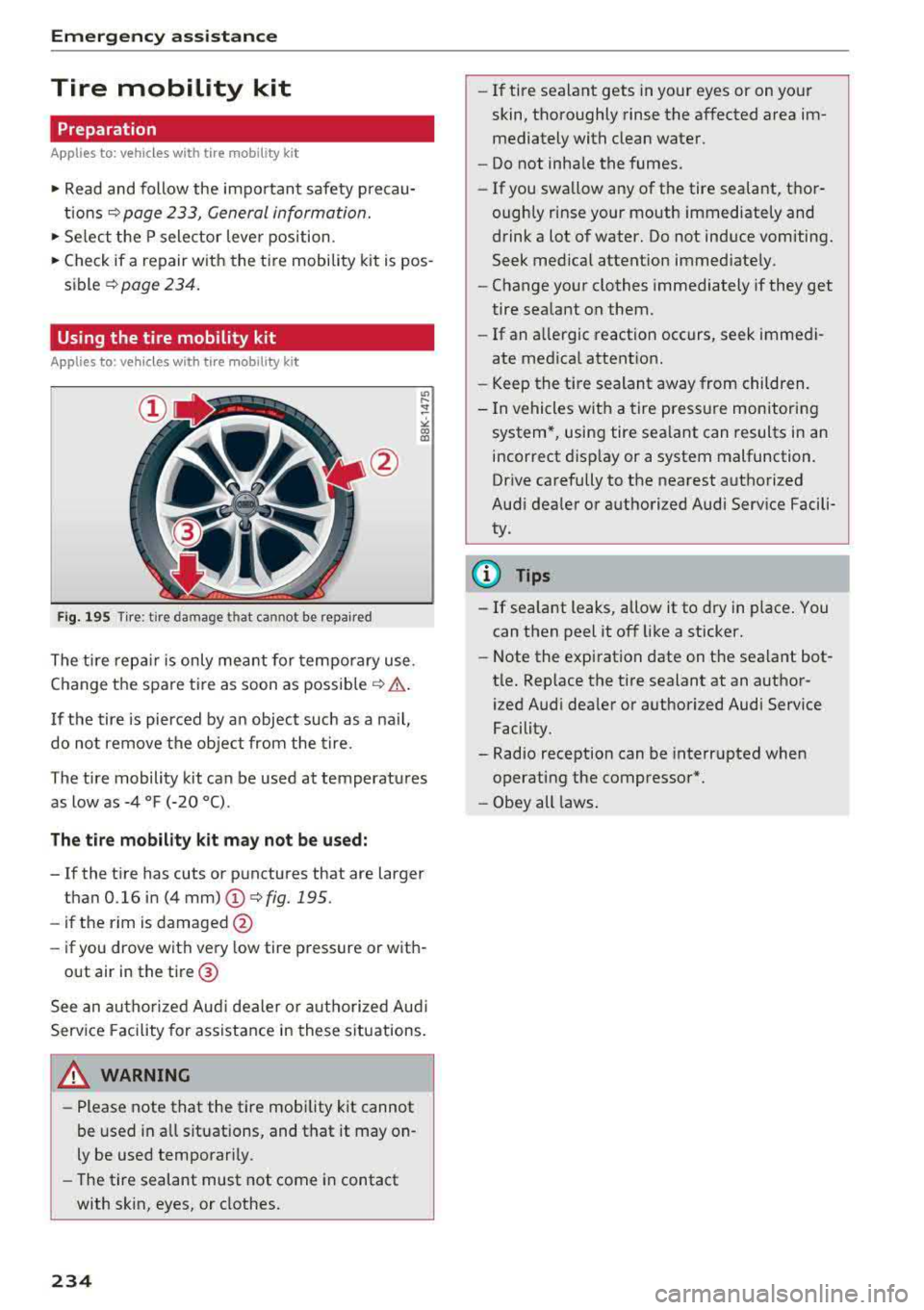
F ig. 195 Tir e: t ire da mage that ca nnot be repaired
The tire repair is only meant for temporary use.
Change the spare tire as soon as
possible ¢& .
If the tire is pierced by an object such as a na il,
do not remove the object from the tire.
The tire mobility kit can be used at temperatures as low as
-4 °F (-20 °C) .
The tire mobility kit may not be used:
-If the tire has cuts or punctures that are larger
than 0 .16 in (4
mm) © ¢fig. 195.
-if the rim is damaged @
- if you drove with very low tire pressure or with-
out air in the tire @
See an autho rized Aud i dealer or authorized Aud i
Service Facility for assistance in these situations.
A WARNING
-Please note that the tire mobility kit cannot
be used in all situations, and that it may on
ly be used temporarily.
- The tire sealant must not come in contact
with skin, eyes, or clothes.
234
- If tire sealant gets in your eyes or on your
skin, thoroughly rinse the affected area im
mediately with clean water .
- Do not inha le the fumes.
- If you swa llow any of the tire sealant, thor-
oughly rinse your mouth immediately and
drink a tot of water. Do not induce vomiting.
Seek medical attention immediately.
- Change your clothes immediately if they get
tire sealant on them.
- If an allergic reaction occurs, seek immedi
ate medical attention.
- Keep the tire sealant away from children.
- In vehicles with a tire pressure monitoring
system*, using tire sea lant can results in an
incorrect display or a system malfunction. Drive carefully to the nearest authorized
Audi dealer or authorized Audi Service Facili ty.
(D Tips
- If sealant leaks, allow it to dry in place. You
can then peel it off like a sticker.
- Note the expiration date on the sea lant bot
tle. Replace the tire sealant at an author ized Audi dealer or authori zed Audi Service
Facility.
- Radio reception can be interrupted when
operating the compressor*.
- Obey all laws.