cruise control AUDI A8 2011 User Guide
[x] Cancel search | Manufacturer: AUDI, Model Year: 2011, Model line: A8, Model: AUDI A8 2011Pages: 302, PDF Size: 76.07 MB
Page 90 of 302

88 Adaptive cruise control and braking guard
The adaptive cruise control system on ly reacts
to objects that are moving or that the system
has already detected and reg istered as mov
ing.
Adaptive cruise control
Description
Ap plies to vehicles: with a daptive cruise co ntrol
Fi g. 88 Detect io n ra nge
What c an adaptive cruise control do?
The adaptive cruise control system uses video,
radar and ultrasound. Mov ing vehicle ahead
can be recognized up to about 650 feet (200 m) away .
On open roads w ith no traffic, adaptive cruise
control wo rks like a regu la r cruise control sys
tem. The stored speed is maintained. When
ap proaching a moving vehicle de tected up
a head, t he adapt ive cr uise control system au
tomatically s lows dow n to ma tch that vehi
cle's spee d and then ma in tain s th e d istance
that the driver previo usly s to red. As soon as
the system does not de tect a vehicle up
ahead, adaptive c ruise control acce lerates
bac k up to the stored speed.
I n stop-and-go t raffic, ada ptive cr uise con tro l
can brake unt il t he vehicle stops i f th is is pos
sib le w ith in the systems' limits and capabili
ties. ACC will not make an emergency stop.
Pull the lever <=>
page 88, fig. 89 towards
you into position @to reactivate ACC, the ve
h icle w ill move forward when t he vehicle in
fro nt o f you s tarts moving aga in . You can also
depr ess the accelerator to move forwa rd
again <=>
page 89.
Which functions can be controlled?
When yo u swi tc h a dap ti ve cr uise control on,
yo u c an set the c urrent speed as the "cont ro l
s p eed " <=>
page 88, Switching on and off.
When dr iving, yo u ca n stop cru ise co ntrol
¢ p age 90 or ch ange t he spee d ¢ page 90
at any time .
You can also se t the dis tance to t he object
ahead and set the ad apt ive cr uise con tro l d riv
ing progr am
¢page 91.
Switching on and off
Applies to vehicles: wi th adaptive c ruise contro l
Fig. 89 Ope rati ng lever: swit c hin g on/off
Fig . 90 Instrument clus te r: adap tive cruise control
You can set any speed between 20 mp h and
95 mp h (30 and 150 km/h) .
Switching adaptive cruise control on
... Pull the lever toward you into position (D
¢ fig. 89. ACC standby appears in t he in
strument cluste r display.
Setting the speed and activating
regulation
... To set the c urrent speed, press the ISETI but
ton ¢
fig. 89. The set speed is shown in the
tachometer @and in the display¢
fig . 90 . ..,_
Page 91 of 302

Adaptive cru ise co ntrol and b rakin g guar d 89
You must also press the b rake pedal when
the vehicle is stopped.
Sw itching adapti ve cruis e co ntrol off
~ Push the lever away from you into position
@ until it clic ks into p lace. The message
A CC off appears.
I ndicator lamps and messages in the instru
ment cluster display inform you about the c ur
rent system status and settings.
@ Indic ator light s
fl-adaptive cruise control is sw itched on . No
veh icles are detected up ahead . The stored
speed is ma inta ined.
I -A moving vehicle is detected up ahead .
The adaptive cruise control system regulates
the speed and distance to the moving veh icle
ahead and accelerates/brakes automat ically.
f:i -adaptive cru ise control is switched on. A
mov ing vehicle up ahead was detected. Your
veh icle remains stopped and will not start
driving automatically.
I -When automat ic braking is not able to
keep enough distance to a previously detected
mov ing vehicle up ahead, you must take con
trol and brake¢
page 90, Prompt for driver
intervention.
© Di splay
If adaptive cruise control is not shown in the
d isplay, you can call it up with the multifunc
tion steering wheel buttons
¢ page 23 .
Based on the symbols in the display, you can
determine if the system is maintaining a dis
tance to the vehicle ahead and what that d is
tance is .
No v ehicle -No vehicle ahead was detected.
White vehicle -A vehicle ahead was detected .
Red ve hicl e -Prompt for the d river to take ac
tion
¢ page 90.
Both arr ow s on the scal e© indicate the dis
tance to the vehicle ahead . No ar row appears
when the vehicle is on an open road and there is no object ahead.
If an object is detected
ahead, the arrow moves on the scale .
T he green zone on the sca le shows the stored
distance. For informat ion on changing the
stored distance ¢
page 91. If the distance
selected is too close or may soon become too
close, the arrows move into the red zone on
the scale .
A WARNING
Improper use of the adaptive cruise con
trol can cause collisions, other accidents
and serious personal injur ies .
- Pressing the
!SET ! button when driv ing at
speeds below
20 mph (30 km/h), w ill au
tomatically accelerate the vehicle to
20
mph (30 km/h), wh ich is the minimum
speed that can be set .
(D Tips
- If you switch the ignit ion or the adaptive
cruise control off, the set speed is e rased
from the system memory.
- You cannot switch the Electron ic Stabili
zation Program (ESP) to the SPORT mode
when adaptive c ruise control is sw itched
on.
Driving in stop-and-go traffic
Appl ies to vehicles: wi th adap tive c ruise control
T he adaptive cru ise contro l system also as
sists yo u in stop-and-go traffic. If a previous
detected vehicle ahead stops, your vehicle wi ll
brake to a stop, within the limits of the sys
tem.
~ To resume driving with adaptive cruise con
trol, tap the acce lerator pedal or
~ Pull the lever toward you into position @
¢ page 88, fig. 89.
(D Tips
- If adaptive cruise control is act ive and
your vehicle does not start driving as ex pected after pu lling the lever once, you
can start out again by tapping the acce l-
erator peda l. ..,.
Page 92 of 302

90 Adapti ve crui se control and braking gu ard
- If an obstacle is detected when your ve
hicle starts driving, the system will
prompt you to take over~
page 90.
Your vehicle w ill drive more slow ly when
starting . This may also happe n in some
situations when there no obstacle is ap
parent .
Interrupting cruise control
Applies to vehicles: with adaptive cruise control
Requi rement : adaptive cruise control must be
switched on.
Overriding cruise control
... To accelerate manually, pull the lever to
ward you into position@~
page 88, fig. 89
and hold it there . The message ACC ove rri de
appears. Or
... press the accelerator peda l.
... To resume cruise control, release the leve r
o r take your foot off the acce le rator pedal.
Canc eling cruise control while driving
... Move the lever into posit ion @. The mes
sage
ACC standb y appears . Or
... press the brake peda l.
... To resume the stored speed, move the lever
into position @.
Canceling cruise control when stopped
... Push the lever away from you into position
@ . The message
ACC standb y appears .
... To resume cruise control, press the brake
peda l and pull the lever toward you into po
sition @.
A WARNING
Improper use of the adaptive cruise con
trol can cause collis ions, other acc idents
and ser io us personal injuries.
- Never resume the stored speed if the
speed is too high for preva iling road,
traffic or weather conditions .
-
Prompt for driver intervention
Applies to vehicles: with adaptive cruise contro l
Fig. 91 Inst ru m en t cl ust er : req ues t fo r dr ive r in te rv en
ti on
In certa in situations, the system will p rompt
you to take action . Fo r example , braking by
the adaptive cr uise control system is not
enough to maintain enough distance to the
vehicle ahead .
T he ind ic a tor light
I and the symbol in the
display will warn you abo ut the s ituation
r::!> fig. 91 . You wi ll also hear an acoustic signal.
- Press the brake pedal to slow your vehicle
down.
Changing the speed
Applies to vehicles: with adaptive cruise control
0
f
• 0
Fig. 92 Operating leve r: c ha ngi ng the speed
... To increase or reduce the speed in incre
ments,
tap the lever up or down .
... To increase or reduce the speed quick ly,
h o ld
the lever up o r down un til the red LED@
reaches the desired speed
r::!> page 88,
fig. 90.
Page 93 of 302

Adaptive cruise control and braking guard 91
Setting the distance and driving
program
Applies to vehicles: with adaptive cruise co ntrol
Fig. 93 Operating leve r: sett ing the distance
The distance at which the adaptive cruise con
trol follows a vehicle in front is determined by
time interva ls. A time interval to a vehicle in
front is estab lished and maintained. This pro
duces a speed-dependent inte rval. The higher
the speed, the greater the safety interval in
yards (meters)¢ ,&.
Setting the distance
~ Tap the switch to d isplay the current set dis
tance
¢fig. 93.
~ To increase or reduce the distance by incre
ments, tap the switch again to the left or
right. The distance between the two vehicles
will change in the instrument cluster dis
play.
Setting the driving program
~ Select in the MMI: !CAR ! function button >
Car Systems control button > Driver assist >
adaptive cruise control > Driving program .
Setting the distance
When approaching a movi ng veh icle up ahead,
the adaptive cruise contro l system automati
cally brakes to match that object's speed and
then maintains the stored distance. When this happens, the actual distance may briefly be
less than the stored distance. If the veh icle
ahead accelerates, adaptive cruise control will
also accelerate up to the stored speed.
The higher the speed, the greater the distance
in yards (meters) ¢&. . The
Distance 3 setting
is recommended. The distances
provided are specified va lues.
Depending on the driving situation and the
how the vehicle ahead is driving, the actual
distance may be more or less than these tar
get distances.
,;:::::;, _c::::, ___ Distance 1: This setting corre-
sponds to a distance of 92 feet/28 meters
when traveling at 62 mph (100 km/h), or a
time interval of 1 second.
,;:::::;, __ c::::, __ Distance 2: This setting corre
sponds to a distance of 118 feet/36 meters
when traveling at 62 mph (100 km/h), or a
t ime interval of 1.3 seconds.
,;:::::;, ___ ,;:::::;,_ Distance 3: This setting corre-
sponds to a distance of 164 feet/SO meters
when traveling at 62 mph (100 km/h), or a
time interval of 1.8 seconds.
,;:::::;, ____ c::::, Distance 4: This setting corre-
sponds to a distance of 210 feet/64 meters
when traveling at 62 mph (100 km/h), or a
t ime interval of 2.3 seconds.
Setting the driving program
You can select Dynamic, Standard or Comfort
driving programs. Depending on the selected
driving program and distance, driving behav
ior when accelerating will vary from dynamic
to comfortable.
.&_ WARNING
Following other vehicles too closely in
creases the risk of coll is ions and ser ious
personal injury.
- Sett ing short d istances to the traffic
ahead reduces the time and distance
availab le to bring your vehicle to a safe
stop and makes it even more necessary
to pay close attention to traffic.
-
-Always obey applicable traffic laws, use
good judgment, and select a safe follow
ing d istance for the traff ic, road and
weather conditions .
(0 Tips
-Distance 3 is set automat ically ea ch time
you switch the ignition on. ..,.
Page 94 of 302

92 Adaptive cruise control and braking guard
-Your standard settings are automatically
stored and assigned to the remote con
trol key being used .
Audi braking guard
Description
Applies to vehicles: wit h adapt ive c ru ise control
Fig. 94 Instrument cluster: approach warn ing
Audi brak ing guard uses radar sensors and a
video camera . It is active at speeds above
about 6.2 mph (10 km/h) and also works
within system limits when adaptive cruise control is switched off.
On vehicles with aAdaptive cruise control and
Audi side assist (Audi pre sense plus), system
functions also engage when a co llision is im
minent
¢page 188.
What can Audi braking guard do?
When detected in time, the system can assess
situations when a vehicle ahead brakes sud
denly or if your own veh icle is traveling at a
h igh speed and approaching a vehicle up
ahead that is moving more slowly. Audi brak
ing guard does not react if it cannot detect
the situation.
The system advises you of various kinds situa tions :
- The
distance warning is given if you are too
close to the vehicle ahead for a long time. If
the vehicle ahead brakes sharply, you will not be able to avoid a coll is ion. The ind icator
light
I i n the d isplay comes on. Take imme
diate action to avoid the coll is ion and in
crease the distance to the vehicle up ahead. -
The
approach warning is given when a de
tected vehicle up ahead in your lane is mov
ing much more slowly that you are or if it
brakes sharp ly. When this warning is given,
it may only be possible to avoid a collision
by swerving or braking sharp ly . The indicator
light
I and the symbol in the disp lay will
warn you about the danger
c:> fig. 94 . You
w ill also hear an acoustic signal.
If you do not react fast enough or do not react
at all to the situation, Aud i braking guard w ill
intervene by braking and the message
braking
guard intervention
w ill appear.
- If a coll is ion is imminent, the system will
first provide an
acute warning by brak ing
sharply .
- If you do not react to the acute warning, Au
di braking guard will brake w ith increased
force in severa l stages to reduce the speed
in a possible collisio n. On ve hicles w ith
adaptive cruise contro l and Audi side assist
(Audi pre sense plus), the system can brake
with increasing force up to maximum decel
eration shortly before a sensed collision
¢ page 188.
- If
the Audi braking g uard senses that you
are not braking hard enough when a colli
sion is imminent, it can increase the braking
force.
Audi braking guard takes the driver's reaction
time into consideration in order to provide
timely warnings. The system reaction time de creases automatically in some situations, for
example when it detects accelerator pedal use
or steering input . The Audi braking guard in
tervent ion stops in certa in situations, for ex
amp le if you press the accelerato r pedal to
pass the vehicle moving ahead of you in your
lane.
Which functions can be controlled?
You can switch Audi braking guard and the
distance/approach warning on or off in the
M M I c:> page 93, Settings in the MMI.
Page 96 of 302

94 Adaptive cruise control and braking guard
The road exceeds the maxim um possible an
gle for proper adaptive cruise contro l opera
tion. Adaptive cruise control is sw itched off .
ACC: only selector lever positions D, S or M
available
Select the D, Sor M selector lever position.
ACC: unavailable at this time. Parking brake
set
The adaptive cruise control system switches
off automatically if the parking brake is set .
ACC: unavailable at this time. ESP interven
tion
This message appears if the Electronic Stabili
zation Program (ESP) is working to he lp stabi
lize the vehicle. In this case, adaptive cruise
control switches off automatically.
ACC : Please take over
This message appears when adapt ive cr uise
control can not set the parking brake. Press
the brake pedal to prevent the vehicle from
r olling .
•••
Three wh ite dots appear if a setting cannot be
selected with the operat ing lever . For exam
ple, this happens if adaptive cru ise control
cannot resume driving in stop-and-go traffic
because one of the conditions required for
ACC to wor k is not prese nt.
Door open
The adaptive cruise control system cannot
switch on when a door is open.
Stationary object ahead
This message appears if you wou ld like to
switch adaptive cruise control on and there is
a stationary veh icle or obstacle directly ahead
of your vehicle.
Page 190 of 302
188 Audi pre sense
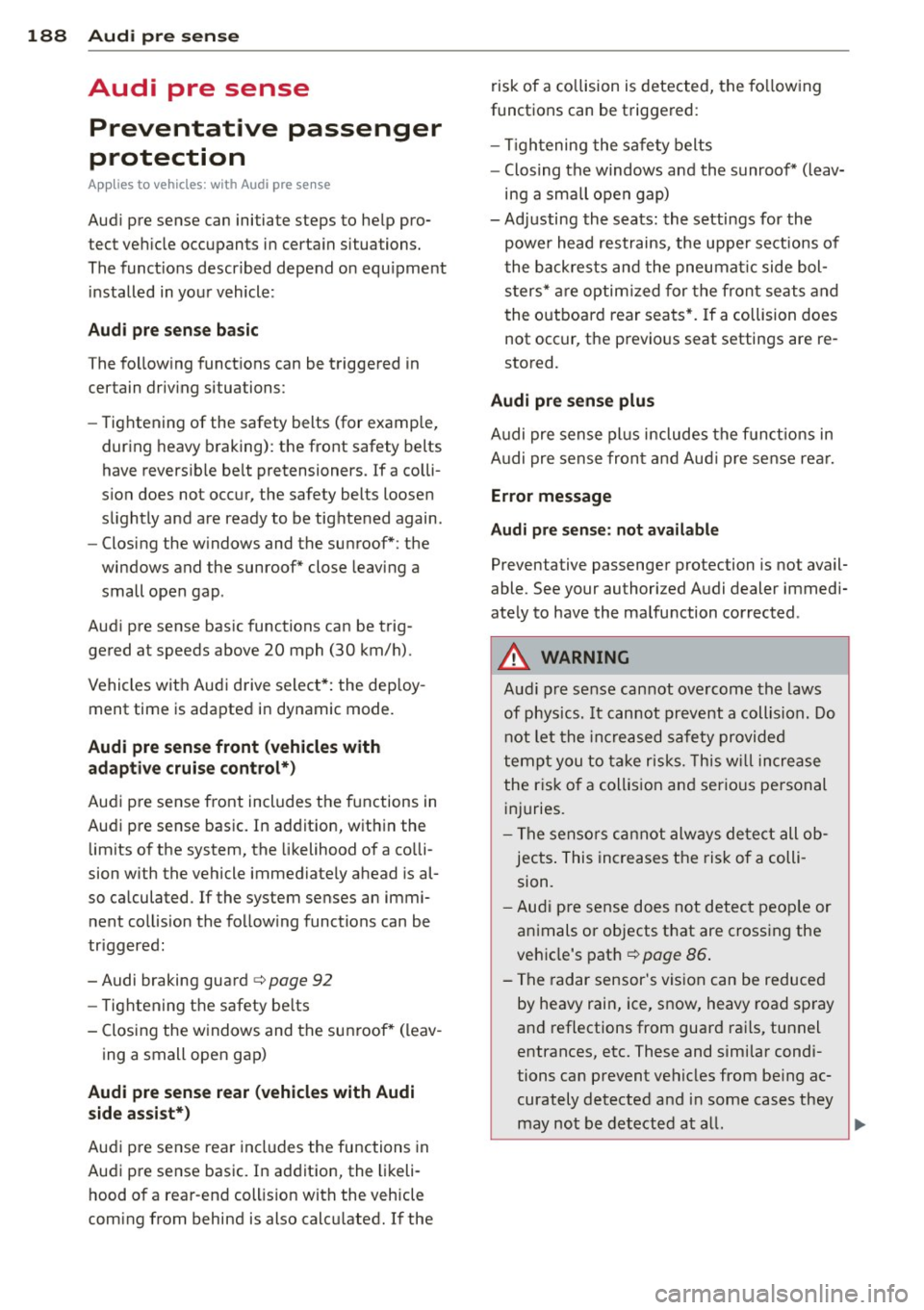
Audi pre sense
Preventative passenger
protection
A pp lies to veh icles: with Audi pre se nse
Aud i pre sense can ini tia te steps to help pro
t ect veh icle occupants in certain situa tions.
The funct ions described depend on equ ipment
installed in your vehicle:
Audi pre sense basic
The following functions can be triggered in
certain driv ing situations :
- Tightening of the safety belts (for examp le,
during heavy braking) : the front safety belts
have reversible belt pretensioners. If a colli
sion does not occur, the safety belts loosen
s lightly and are ready to be tightened again .
- Closing the w indows and the sunroof* : the
windows and the sunroof* close leaving a
small open gap .
Audi pre sense basic functions can be trig
gered at speeds above 20 mph (30 km/h).
Vehicles with Aud i drive select*: the dep loy
ment time is adapted in dynamic mode.
Audi pre sense front (vehicles with
adaptive cruise control*)
Audi pre sense front includes the functions in
Audi pre sense basic. In addition, within the
limits of the system, the likelihood of a colli
sion with the vehicle immediately ahead is al
so ca lculated . If the system senses an immi
nent collision the follow ing functions can be
tr iggered :
-Audi braking guard
c::> page 92
- Tightening the safety be lts
- Closing the windows and the sunroof* (leav -
ing a small open gap)
Audi pre sense rear (vehicles with Audi
side assist*)
Audi p re sense rear includes the functions in
Audi pre sense basic. In addition, the likeli
hood of a rear -end collis ion with the vehicle
coming from behind is also calc ulated.
If the risk
of a co llision is detected, the following
functions can be triggered :
- Tig htening the safety belts
- Closing the windows and the sunroof* (leav-
ing a small open gap)
- Adjusting the seats : the settings for the
power head restrains, the upper sections of
t he backrests and the pneumatic side bol
s ters* are optim ized for the front seats and
the outboard rea r seats*. If a collision does
not occur, the previo us seat settings are re
stored.
Audi pre sense plus
Audi pre sense plus includes the funct ions in
A udi pre sense front and Audi pre sense rea r.
Error message
Audi pre sense: not available
Preventative passenger protection is not avail
able. See your authorized Audi dealer immedi
ately to have the malfunction corrected .
A WARNING
-Audi pre sense cannot overcome the laws
of physics.
It cannot prevent a collision. Do
not let the increased safety provided
tempt you to take risks. This will increase
the r isk o f a coll is ion and serio us personal
injuries.
- The sensors cannot always detect all ob
jects . This increases the risk of a colli
sion.
- Aud i p re sense does not detect peop le or
animals or objects that are crossing the
vehicle's path
c::> page 86.
-The radar sensor's vis ion can be reduced
by heavy rain, ice, snow, heavy road spray
and reflections from guard rails, tunnel
entrances, etc. These and similar condi
tions can prevent vehicles from be ing ac
curately detected and in some cases they
may not be detected at all.
Ill>
Page 193 of 302
ESP includes and/or works together with the
anti-lock brake assist system (ABS), brake as
sist system, anti -slip regulation (ASR), elec
tronic differential lock (EDL), dynamic steer
ing* and electronic interaxle differential lock*.
ESP is switched on all the t ime . In certa in sit
uations when you need less traction, you can
sw itch
off ASR by pressing the button above
the selector lever. Be sure to switch ASR on
again when you no longer need less traction.
Anti-lock braking system (ABS)
ABS prevents the wheels from locking up
when braking. The vehicle can still be steered even during hard braking . Apply steady pres
sure to the brake pedal. Do not pump the ped
al. A puls ing in the brake pedal indicates that
the system is he lping you to brake the vehicle.
Brake assist system
The brake assist system can decrease brak ing
distance.
It increases braking power when the
driver presses the brake pedal quickly in emer
gency situations. You must press and hold the
brake pedal until the situation is over. In vehi
cles with adaptive cruise control*, the brake
assist system is more sensitive if the distance
detected to the vehicle ahead is too small.
Anti-slip regulation (ASR)
ASR reduces engine power when the drive
wheels begin to spin and adapts the force to
the road conditions. This makes it easier to
start, accelerate and drive up hills .
Electronic differential lock (EDL)
The EDL brakes wheels that are spinning and
transfers the drive power to the other drive
wheel or whee ls if the vehicle is equipped with
a ll whee l drive *. This function is available up
to about 75 mph (120 km/h).
I n extreme cases, EDL automatically switches
off to help keep the brake on the braked wheel
from overheating . EDL will switch on again au
tomatically when conditions have returned to
normal.
Intelligent technology 191
Dynamic steering*
On vehicles with dynamic steering, ESP helps
stabilize the steering in certain situations.
Electronic interaxle differential lock
function*
T he electronic interaxle differential lock func
tion activates when driving th ro ug h curves.
Braking is targeted toward the wheels on the
inside of the curve as needed. This he lps to
minimize front whee l skid, improves traction
and allows for more precise driving through
curves .
A WARNING
- ESP, ABS, ASR, EDL, dynamic steering*
a nd the electronic interaxle differential
loc k fu nction* cannot overcome the laws
of physics. This is especially impo rtant
on slippery or wet roads.
If the systems
begin acting to stabilize your vehicle, you
should immediately change yo ur speed
to match the road and traffic conditions .
Do not let the increased safety provided
by these systems tempt you to take risks.
Doing so will increase the risk of a loss of
veh icle contro l, collision and ser ious per
sonal injur ies.
- Always adapt your speed to road, traffic
and weather conditions. The risk of los
ing con trol of the vehicle increases when
driving too fast, espe cially through
curves and on slippery or wet roads, and
when dr iving too close to vehicles up
ahead. ESP, ABS, the brake assist system,
EDL, ASR, dynam ic steer ing* and the
electronic interaxle differentia l lock func
tion* cannot prevent collisions.
- Always accelerate with special care on
even, smooth surfaces such as those that
are wet or covered with ice and snow.
The drive wheels can spin even with
these assistance systems that cannot al
ways he lp to reduce the risk of loss of ve
hicle contro l.
-
•
•
Page 210 of 302
208 Cleaning and protection
-Never wash your car in bright sunlight.
Drops of water act as magnifying lenses
and may damage your paint.
- When you wash your car in the winter: if
you rinse your vehicle with a hose, be
careful not to aim the stream of water
directly at locks, or at door or hatch
openings - they can freeze shut.
- Never use sponges des igned to remove
i nsects, or any kitchen scouring sponges
or similar products . They can damage
your paint finish .
- Never use a dry cloth or sponge to clean
the headlights. Only use wet cloths or
sponges to prevent scratches .
It is best
to use soapy water.
- You should remove debris (such as in
sects) from the headlight lenses on a
regular basis, fo r example when refuel
ing your vehicle. Never clean the head
lig hts w ith a dry cloth or sponge. Use a
wet cloth or sponge . It is best to use
soapy water.
@ For the sake of the environment
I n the interest of the environment, the ve
hicle should only be washed in special
wash bays.
Washing your vehicle with a power
washer
Cleaning the exterior of your car with a high
pressure power washer is safe as long as you observe a few simple rules.
• Before using the power washer, make sure
you have read and understood the WARN
INGS
c:> A in General information on
page 206 .
• Always follow the operating instructions for
the power washer .
• Make sure that the jet on the spray hose pro
duces a "fan shaped spray".
• Do
not hold the spray nozzle too close to
soft materia ls.
When cleaning the vehicle wit h a power wash
er
always follow the operating instructions. T
his applies particu larly to the
operating
pressure
and the spraying distance. Keep a
distance from soft materials such as rubber
hoses or insulating material as well as sensors
and camera lenses.
Do not use a jet which sprays water in a
di rect
stream
or one that has a rotating jet .
Water temperature should not exceed 140 °F
(60 °().
A WARNING
Never wash tires with a jet that sprays wa
ter in a direct stream . This could cause in
v is ible damage to the t ires and weaken
them, even if the spray is from
a relatively
long distance and for a short time. Dam
aged and weakened tires can fail and cause
accidents and personal injury .
(D Note
To avoid damaging your vehicle, always
make sure that there is suffic ient d istance
between the spray head and soft materials
like rubber hoses, plast ic parts and sound
deadening materials as well as sensors
and camera lenses. Never aim the sp ray
head at the same point for a long time.
This also applies to cleaning headlights
and painted bumpers. Remember: the
closer the nozzle is to the surface of the
mater ia l, the greater the stress on the ma
terial.
Sensors and camera lenses
- Remove snow with a hand brush and remove
ice with a de-icing spray that does not con
tain solvents .
- Clean the sensors (adaptive cruise control*,
pa rking system*) w ith a cleaning so lution
that does not contain so lvents and a soft
cloth.
- The camera lens or the area in front of the
camera lens is normally cleaned by the
w indshie ld w ipers (Audi lane assist*) or
headlight wipers (night vision system*) . If
the lens or the area is exceptionally dirty,
111-
Page 272 of 302
2 70 Fu ses and bulb s
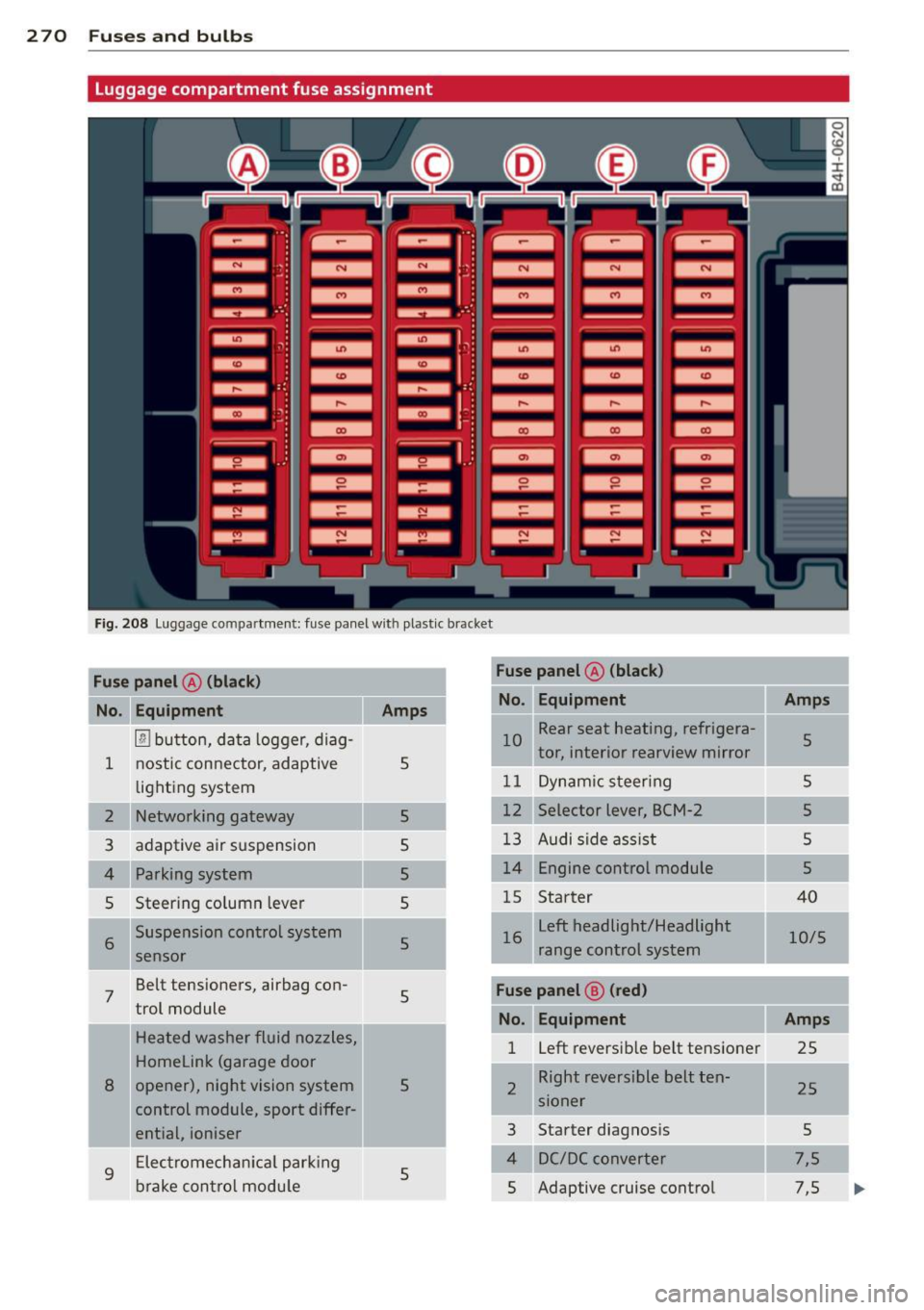
Luggage compartment fuse assignment
Fig. 208 Luggage co mpar tment: fuse panel with plastic b racket
Fu se pan el A (black ) Fuse panel
@ (b lac k)
I
No.
Equ ipment Amps No
. Equipment
Amps .
l!l button, data logger, diag-
1 nostic con
nector, adaptive
5 10
Rear seat heating, refrigera-
5 j tor, interior rearview mirror
lighting system 11 Dynam
ic steer ing 5
2 Networking gateway
5 12
Selector lever, BCM-2
5
3 adaptive air suspension
5 13 Audi side ass
ist 5
4 Parking system 5 14 Engine control module
5
5 Steering column
lever
5 1
5 Starter 40
I 6 Suspension control system
5
sensor left headlight/Headlight
'
16
10/5
range control system
.
7 Belt tensioners, airbag con-
5
trol module Fuse pan el@ (red)
No. Equipment Amps
Heated washer fluid nozzles,
Homelink (garage door
8 opener), night vision system
5
control module, sport differ- 1
left reversib
le be lt tens ioner
25
2 II
R_ight reversible belt ten-
25
s1oner
ential, ioniser 3
Starter diagnos
is
5
9
Electromechan ica l park ing
5
brake con tro l module 4 DC/DC converter
7,5
5 Adaptive cruise control 7,5