heating AUDI A8 2011 User Guide
[x] Cancel search | Manufacturer: AUDI, Model Year: 2011, Model line: A8, Model: AUDI A8 2011Pages: 302, PDF Size: 76.07 MB
Page 198 of 302
196 Intelligent technology
What you should know
The highest priority is given to maintaining
starting capability.
The battery is severely taxed in short-distance
driving, in city traffic and during the cold time
of year. Abundant electr ical energy is re
qu ired, but only a little is generated. It is also
cr itical if the e ngine is not run ning and elect ri
cal components a re turned on. In th is in
stance energy is being consumed but none is be ing generated .
I t is in precisely these situations that you w ill
notice energy managemen t actively regulat
ing the distrib ution of energy.
Vehicle stands for an ext ended period
If you do not drive your vehicle over a period
of severa l days or weeks, elect rical compo
nents are grad ually cu t back o r switched off .
This reduces energy co nsu mption and main
tains starting cap abili ty
over a longer period.
Be aware that when you unlock you r vehicle,
some of the conve nience funct ions may not
ope rate, such as the Convenience key , the re
mote cont ro l or the power seat adjustment .
The convenience functions will be availab le
aga in when you switch on the ignition and
start the engine .
With the engine turned off
If yo u lis ten to the radio, for example, with
the eng ine turned off or use othe r MM I fu nc
tions, the battery is being discharged .
I f sta rting capability is jeopa rdized due to e n
e rgy consumpt ion, the fo llow ing warning ap
pears in the MMI disp lay :
Please start th e engine soon or th e syst em
will be turned off .
The warning ind icates that the system will be
turned off automatically after 3 m inu tes .
If
you wish to cont inu e us ing the functions , you
have to start the engine.
With the engine running
Although e lec trical energy is generated when
the vehicle is being driven, the battery can be
come discharged. This happens mostly when
li ttle energy is being generated and a g reat
deal consumed and the battery's state of
charge is not optimal.
To b ring the energy ba lance back into equili
brium, consumers which req uire especially
l arge amounts of energy are temporar ily cut
back or sw itched off. Heat ing systems i n par
ticular require a great deal of energy. If you
notice , for example, that the heated seats* o r
the heated rear window are not heating, they have been temporarily cut back or sw itched
off . These systems w ill be available again as
soon as the ene rgy balance has been restored.
You w ill also notice that engi ne idle speed has
been increased slightly . Thi s is normal and not
a cause for con ce rn. By inc reas ing eng ine id le
speed the addi tional energy requ ired is gener
ated and the battery is charged.
Page 200 of 302
198 Driving and en vi ro nment
Catalytic converter
It is very important that your emission con
trol system (catalytic converter) is function
ing properly to ensure that your vehicle is run
ning in an environmentally sound manner .
.. Always use lead-free gasoline¢ page 218,
Fuel supply.
.. Never run the tank down all the way to emp-
ty .
.. Never put too much motor oil in your engine
¢ page 22 7, Adding engine oil 't=r. .
• Never try to push- or tow-star t your veh icle.
The catalytic converter is an eff ic ient "clean
up" device built into the exhaust system of
the vehicle. The catalytic converter burns many of the pollutants in the exhaust gas be
fore they are released into the atmosphere.
The exclusive use of unleaded fuel is critically
important for the l ife of the cata lytic conve rt
e r and proper functioning of the engine.
& WARNING
-
- Do not park o r operate the vehicle in
areas where the hot exhaust system may
come in contact with dry grass, brush,
fuel spill or other material which can cause a fire.
- Do not apply additional undercoating or
rustproofing on or near the exhaust
man ifold, exhaust p ipes, catalytic con
verter or heat shie lds . During driving, the
substance used for undercoating could
overheat and caus e a fire .
@ Note
-Be aware that just one tank filling with
leaded fuel will already seriously de
grade the perfo rmance of the catalytic
conve rter .
- Do not exceed the correct engine oil leve l
¢page 227.
-Do not drive until the fuel tank becomes
completely empty. The eng ine could mis
fire . Un burned f uel could a lso get into the exhaust system and th
is co uld cause
the cata lytic converter to overheat .
- Do not switch
off the ignition while the
vehicle is moving .
- Do not continue to ope rate your veh icle
under these conditions, as otherwise fuel
can reach the catalytic converter. This
cou ld result in overheating of the con
verter, requir ing its replacement .
- To assure efficient operation of the Emis
sion Control System:
- H ave you r vehicle maintained properly
and in accordance w it h the service rec
ommendat ions in your Warranty &
M ain tenance boo klet.
- L ack of prope r maintenance as we ll as
improper use of the vehi cle will impair
the function of the em ission contro l
system and could lead to damage .
@ For the sake of the environment
Even when the Emiss ion Control Sys tem is
operat ing proper ly, the exha ust gas can
have a sul fur -li ke ex haust gas smell under
some operating states . This depends on
the sulfur content of the fuel being used .
Using a different brand of fue l may help,
or f il li ng the tank with lead-free super
grade gasoline .
Avoid damaging the
vehicle
When you are d rivi ng on poor roads, or over
c u rbs, steep ramps, etc., ma ke certai n that
low- ly ing parts s uch as spoilers and exha ust
system parts do not bottom o ut and get dam
aged.
T his is es peci ally true for ve hicles with low
s lung chassis (spor ts chassis)* and fully load
ed vehicles .
Page 202 of 302

200 Driving and en vi ro nm ent
Avoid full throttle
Driving at moderate speeds saves fuel and
improves your mileage .
"'Try and keep well below your car 's maximum
speed.
Accelerating gently reduces fuel consump
tion, engine wear, and does not disturb the
environment. F ue l consumption, exhaust em issions and en
gine noise increase disproportionately at high
speeds. If you drive at approximately three
quarters of top speed, fue l consumption will
be reduced by one half. Never drive faster
than the posted speed limit and weather con
d itions permit .
Reducing unnecessary idling
Even when your car is just idling it burns up
fuel.
"'Shut the engine off when you are not driving
the vehicle .
"'Do not warm up the veh icle by letting the
engine run at idle .
It makes sense to shut
off the e ngine in traff ic
jams, when waiting for trains to pass at ra il
road crossings , or at traff ic lights that have
long wa its on red. Turning the engine
off fo r
just
30-40 seconds saves more fue l than is
burned s tarting the eng ine again .
It takes a long time for the engine to warm up
fully when it is running at idle . Howeve r, wear
and noxious em issions are especially high
when the engine is warming up. So you should
drive away as soon as you start the engine and
avoid running at high rpms while the engine is
still warming up .
([) Note
Do not leave engine idling unattended af
ter starting . If warning lights should come
on to indicate improper operation, they
wou ld go unheeded. Extended idling also
produces heat, which cou ld result in over- heating or other damage to the vehicle or
other property .
Regular maintenance
A badly tuned engine unnecessarily wastes a
lot of fuel.
"' Have your ve hicle serviced at reg ular inter -
vals.
By having your veh icle regu larly serviced by an
Audi dealer he lps to ensure that it runs p rop
erly and economically. The condition of your
vehicle not only affects its sa fety and ability to
hold its value, it also affects
fuel c onsump
tion .
Check your oil e ach time you fill your t ank .
The amount of oil used is related to engine
load and speed .
It is normal for the oil consumption of a new
engine to reach its lowest value after a certa in
mileage has been driven.
You must drive your veh icle about 3,000 m iles
(5,000 kilometers) before you can properly
assess oil consumpt ion.
This also app lies to fue l consumption and en
gine output.
(D Note
- Have your vehicle maintained proper ly
and in accordance with the service rec
ommendations in your Warranty
& Main
tenance booklet. Lack of proper ma inte
nance as well as improper use of the ve
hicle will impair the function of the
em iss ion contro l system and cou ld lead
to damage.
- Do not alter or remove any component of
the Emission Control Sys tem unless ap
proved by the manufacture r.
- Do not alte r or remove any device, such
as heat sh ie lds, switches, ign it ion w ires,
valves, which are designed to protec t
your vehicle's Emission Control System
and other impo rtant vehicle compo
nents .
Page 231 of 302
Engine cooling system
Coolant
The engine coolant performs two functions: it
keeps the engine from overheating and it pro
te cts the engine from freezing in the winter .
The cooling system is sealed and generally re
qu ires little attention .
The cooling system has been filled at the fac
tory with a permanent coolant which does not need to be changed. The coolant consists of a
mixture of water and the manufacturer's gly
col-based coolan t additive G12++ ant ifreeze
with a nticorrosion add itives (50% fo r USA
models; 60% for Canad ian models). This mix
ture bot h assu res the ne ces sary frost protec
tion and protects metal components in the
engine's cooling system from corrosion and
scaling. It also raises the bo ili ng po int of t he
coolant.
D o not red uce the concentration of the coo l
ant in the summe r by adding plain water .
The
proportion of coolant addit ive must be at
least 50% but not mo re than 60 %
to main
tain antifree ze protection and cooling efficien
cy. If the coolant frost protect ion is too low,
the coolant could freeze and damage the veh i
cle heating and eng ine cooling system .
For year-round driving, antifree ze is added at
the factory for temperatures down to:
- -3 1°F (-35°C)USA
- -4 0 ° F ( - 4 0 °C) Canada.
You can mix t he G12 ++ cool ant ad ditive with
o ther addit ives (G1 2+ or G1 2). Alway s check
w ith your author ized Audi dealer.
& WARNING
Before yo u check any thing in the engine
compartment, always read and hee d all
W AR NIN GS
Q .&. in Working in the engine
compartment on page 222.
(D Note
- Before win ter se ts in , have the coolan t
checked to see if the coolant addit ive i n
Checkin g and fillin g 229
your vehicle is sufficient to meet the cli
mate conditions . This is especia lly impor
tant if you live in a reg ion where t he win
ter is extreme ly co ld. If necessary, in
crease t he p ropo rtion of coo lant add itive
t o 60% .
- Whe n add ing coolant additive to your
cooling system , remember :
- W e re co mme nd usin g only cool ant ad
dit ive G 12++ (check t he labe l) for your
vehi cle. This coolan t addi tive is ava ila
b le at a uthorized Audi dea le rs . Othe r
types of ant ifreeze can significant ly re
d uce co rrosi on protection. The res ult
i n g corrosion can ca use a loss of co ol
ant and ser io us eng ine damage .
- Do not add any type of rad iator leak seal
ant to you r vehicle's eng ine c oolant .
Add ing radiator repair fl uid may adverse
ly affect t he f unction and performance of
yo ur cooling sys tem and co uld resu lt i n
damage not covered by yo ur New Ve hicle
Li mi ted Warran ty.
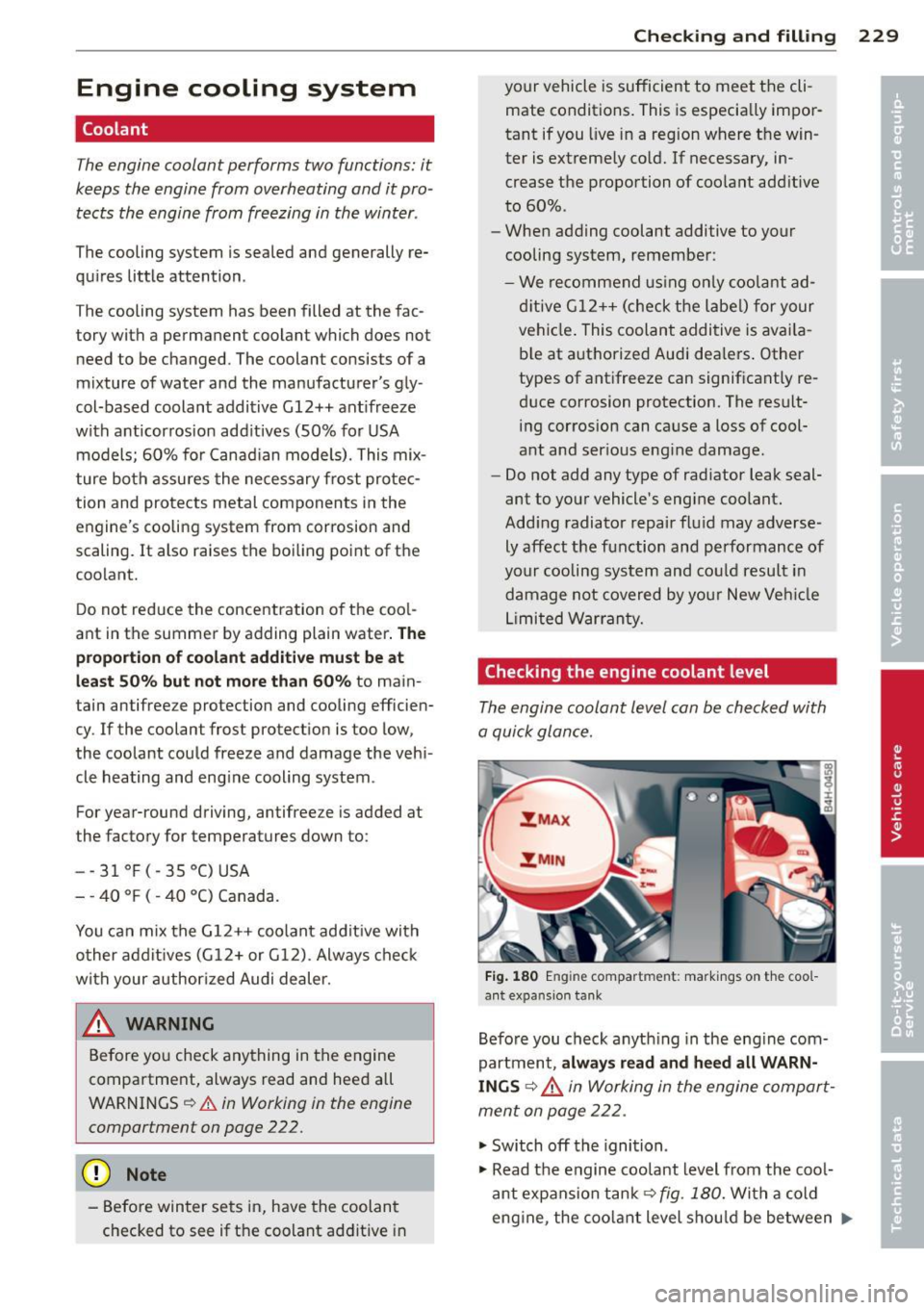
Checking the engine coolant level
The engine coolant level can be chec ked with
a quick glan ce.
:!, MAX
% MIN
Fig. 180 En gin e compar tment: mark ings on t he coo l
a n t expa nsion tank
Befo re you check a nyth ing in the eng ine com
partment,
always read and heed all WARN
INGS ¢.&, in Working in the engine compart
men t on page
222 .
"' Switch off the ignition .
"' Read the engine coo lant level from the coo l
ant expa nsion tank
Qfig . 180. Wit h a co ld
eng ine , the coo lant level s hou ld be between
1JJ>-
Page 271 of 302
Fuse panel@ (brown)
No. Equ ipment
1 H eadlight contro l switch
I 2
Ignition lock (key identifica-
tion)
3
Rear door control mod ule
(driver's side)
5 Horn
6 Interior lights (head liner)
Steering column lever, mul-
8
tifunction steering wheel
controls, steering wheel
heating
10
Power steering column ad-
j ustment
11 Driver door control module
12
D iagnostic co nnector, light/
rain sensor
Power steering column ad-
justment
15
P ower stee ring, A/C com-
pr esso r
16 Brake booster (VS FSI)
Fuse panel © (black )
No. Equipment
1 F ront seat heating
2 Windshield wiper
3 Fr ont exterior lighting
4 Sun roof
5 Dr iver power window
6 Driver seat (pneumatic)
7 Panoramic sunroof
8 Dynamic steering
9 Fr
ont exterior lighting
I 10
Windshield/headlight *
washe r system
11
Rear power w indow (driver's
side)
12 Panoramic sunroof
Amp s
5
5
7,5 15
7,5
10/5
5
7,5 10
25
20
15
Amps
30 30
30
20
30
15
20 35
30
35
30
4 0
Fu se s and bulb s 269
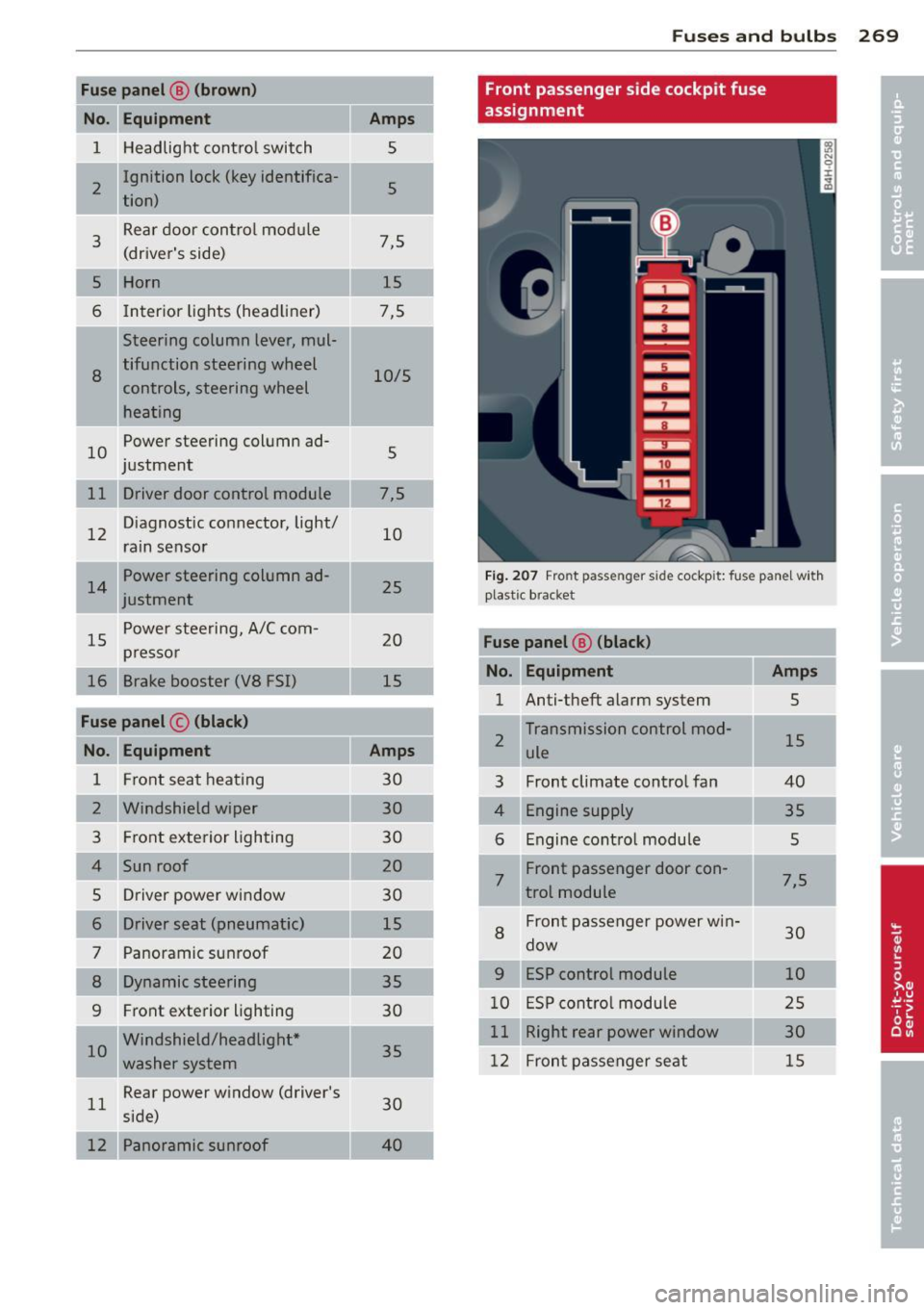
Front passenger side cockpit fuse
assignment
Fi g. 2 07 Fro nt passe nger s id e co ckpit: f use pa nel w it h
plast ic brac ket
Fuse panel ® (black)
No . Equipment Amps
1 Anti-theft alarm system 5
2
Transmission control mod-
15 ule
3 Front climate control fan 40
4
Engine supply 35
6
Engine cont ro l module 5
7
Front passenger door con-7,5
t rot module
8
Fron t passe nger power w in-
30 dow
9 ESP control module 10
1 0
E S P cont ro l modu le 2 5
11
Right rear power window 30
12
Fron t passe nger seat 15
Page 272 of 302
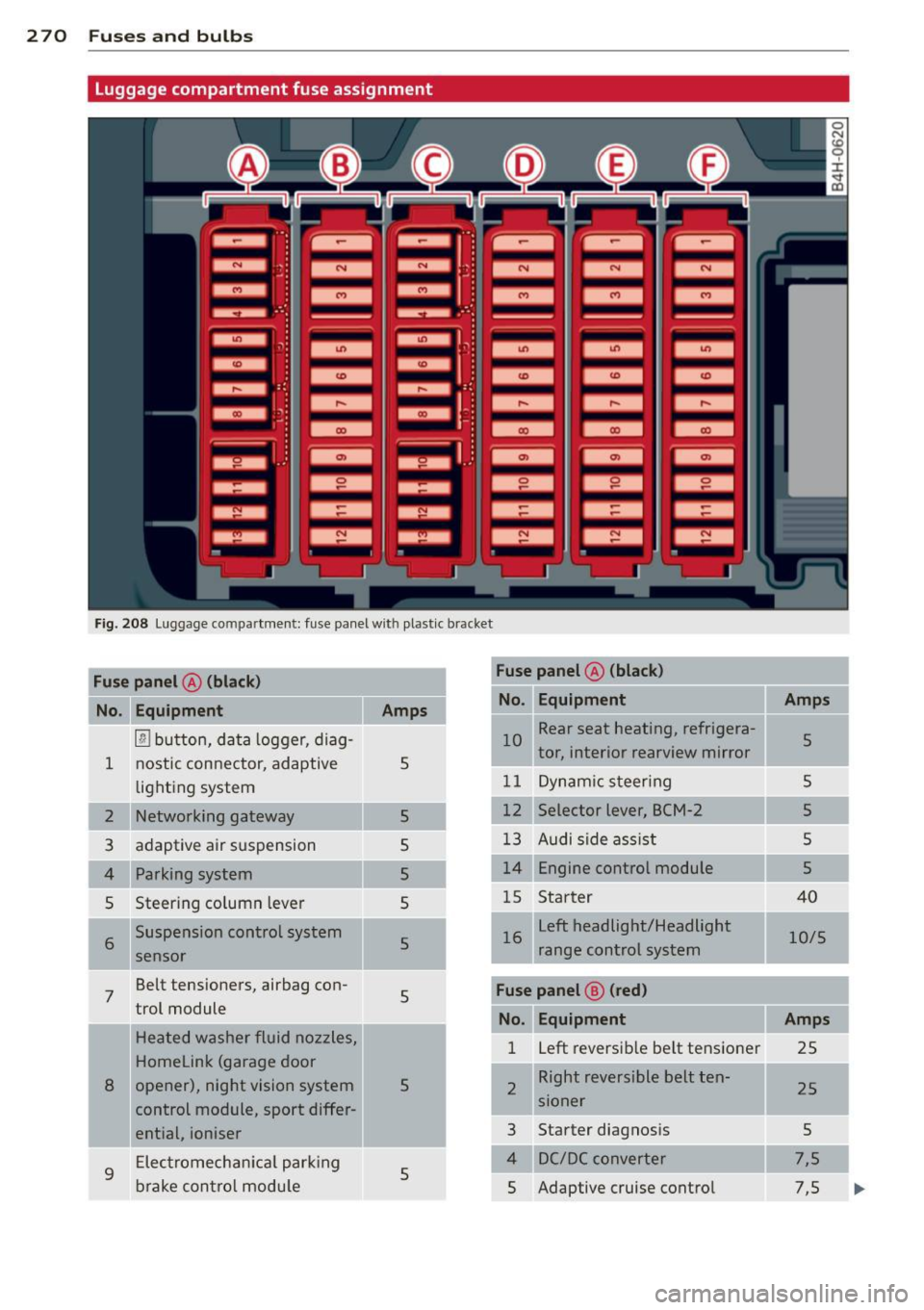
2 70 Fu ses and bulb s
Luggage compartment fuse assignment
Fig. 208 Luggage co mpar tment: fuse panel with plastic b racket
Fu se pan el A (black ) Fuse panel
@ (b lac k)
I
No.
Equ ipment Amps No
. Equipment
Amps .
l!l button, data logger, diag-
1 nostic con
nector, adaptive
5 10
Rear seat heating, refrigera-
5 j tor, interior rearview mirror
lighting system 11 Dynam
ic steer ing 5
2 Networking gateway
5 12
Selector lever, BCM-2
5
3 adaptive air suspension
5 13 Audi side ass
ist 5
4 Parking system 5 14 Engine control module
5
5 Steering column
lever
5 1
5 Starter 40
I 6 Suspension control system
5
sensor left headlight/Headlight
'
16
10/5
range control system
.
7 Belt tensioners, airbag con-
5
trol module Fuse pan el@ (red)
No. Equipment Amps
Heated washer fluid nozzles,
Homelink (garage door
8 opener), night vision system
5
control module, sport differ- 1
left reversib
le be lt tens ioner
25
2 II
R_ight reversible belt ten-
25
s1oner
ential, ioniser 3
Starter diagnos
is
5
9
Electromechan ica l park ing
5
brake con tro l module 4 DC/DC converter
7,5
5 Adaptive cruise control 7,5
Page 273 of 302

Fuse panel@ (red)
No. Equipment
= '
I 6 Right headlight (headlight
with adaptive light)
I
7 ESP control module
8
9 Adaptive cruise control
Transmission control mod-
10 ule
11 Climate control system sen
sors
Fuse panel @ (brown)
No
. II Equipment
Electromechan ical parking
1 brake
2 Suspension control system
sensor
Right rear door control mod-
3 ule
4 Smart-Modul Tank
5 Front climate control system
controls
6 Rear climate control system
controls
7 Networking gateway
8 Refrigerator
Interface for spec ial func-
9 tions
12 Selector lever
13 Ambient lighting
14 Rear exterior lighting
15 Fuel pump
16 Electromechanical parking
brake
Fuse panel @ (black)
Equipment
3 Rear sockets*
5 adaptive air suspension
6 115-V socket
7 Electromechanical parking
brake
II
Amps
10
s
5
10
5
5
Amps
5
5
7,5 5
15
10 5
15
5
10
10
20
25
30
Amps
20
15
25
30
=
Fuses and bulbs 271
Fuse panel @ (black)
No. Equipment
8 Rear seat heating
9 Rear exterior lighting
10 Rear
climate control system
blower
Rear sun shade, closing aid,
11 luggage compartment lock,
keyless
go/entry, fuel filler
door
12 luggage compartment lid
control module
Fuse panel E (red)
No. Equipment
1 Rear
seat adjustment but-
tons
3 Left rear seat
(pneumatics)
5 Trailer hitch control modu le*
6 Left rear seat
7 Right rear seat
8 Trailer hitch control module*
9 Trailer hitch control module*
10 Right rear seat (pneumatics)
Fuse panel ® (brown)
No. Equipment
1 Radio receiver/sound ampli-
fier
Sound amplifier, Bang&
2 Olufsen Advanced Sound
System
Rear Seat Enterta inment, ra-
3 dio receiver/sound amplifier
Automatic dimming interior
5 rearview mirror, rearview
camera (parking aid)
6 DVD changer
7 TV tuner
8 MMI unit/drives
9
Instrument cluster, analog
clock
10 MMI Display
Amps
25
20
20
20
30
Amps
s
7,5
20
30
30
20
15
7,5
30
30 10
5
5
5
7,5
5
5
•
•
....
Page 296 of 302

294 Index
Panoramic sunroof ........... .. .... .. 41
Sun shade . . . . . . . . . . . . . . . . . . . . . . . . . 42
Parking . .. .... ........... ........ .. 82
Valet park ing ............ .. .. .. .. .. 40
Park ing brake ... . ...... ... .. .. .. .. .. 81
also refer to Electromechanical park ing
brake .. .. .. ................ ... ... . 81
Parking lights ............. .... .... .. 43
Parking system
C leaning camera lens ............... 208
Parking system advanced
Adjust ing the display .......... .. .. . 122
Adjust ing the warning tones .. .. .. ... 122
Rear view camera -parking mode 1 .. . 121
Rear view camera -parking mode 2 . .. 121
Safety precautions ................ . 118
Switching on and off ....... .... ... . 120
Parts replacement ......... .... .... . 285
Pass-through with ski sack . . . . . . . . . . . . . 66
PASSENGER AIR BAG OFF light .... ... . 1S6
Passenger protection ........ ..... .. . 188
Passive safety system ......... .. .... . 127
Pedals .. .. .. ............. .. .. .. .. . 132
Physical principles of a frontal collision . 138
Polishing .... ................ ..... . 209
Pollutant filter (automatic A/C system) . . 7 4
Power locking system . . . . . . . . . . . . . . . . . 31
Locking/unlocking the vehicle from in-
side . .. .. .. ................ ... ... . 34
Rear lid .. .. ... .... ...... .. .. .. .. .. 35
Selective unlock feature . .. .. .. .. .. . . 32
Settings . . . . . . . . . . . . . . . . . . . . . . . . . . 32
Unlock ing and locking vehicle ... .. .. . . 32
Power seat adjustment Front seats . . . . . . . . . . . . . . . . . . . . . . . . S5
Rear seats .. ................ ... ... . S7
Power steering (servotronic) . .. .. .. .. . 194
Power windows . . . . . . . . . . . . . . . . . . . . . . 39
malfunction . . . . . . . . . . . . . . . . . . . . . . . 39
Pregnant women
Special considerations when wearing a
safety belt . . . . . . . . . . . . . . . . . . . . . . . 142
pre sense .. .. ... .. ..... ... .... .. .. . 188
Preventative passenger protection . . . . . 188
Programming the Homelink ® universal re-
mote control .............. .. .. .. .. . 124 Proper
occupant seating positions ... .. 128
Proper safety belt position ............ 141
Proper seating position Front passenger .. ............. .... 129
Occupants . .. .. .. .. .. ... ..... ... .. 128
Rear passengers .. ..... ........... . 130
Q
quattro ®
refer to All Wheel Drive . . . . . . . . . . . . . 194
Question What happens to unbelted occupants? 138
Why safety belts? ............. .... 137
R
Radiator fan ...... ................ . 231
Radio clock ... .. .. ............. .. .. . 26
Rain/light senso r
Headlights .. ...... ... ..... ... .. .. . 43
Intermittent (w indshield wipers) ...... 48
Sensor defective . . . . . . . . . . . . . . . . . . . . 21
Range (fuel level) . . . . . . . . . . . . . . . . . . . . 24
Reading lights ... .. ............. .. .. . 46
Rear fog lights .. .. ....... ...... .. .. . 43
Rear lid Automatic operation .............. .. 36
Emergency release ............... .. . 37
Escape handle . .. ............. .... 259
Opening and closing ..... ...... .. .. . 35
Rear light Defective . . . . . . . . . . . . . . . . . . . . . . . . . 21
Rear seats Adjusting individual seats ....... .... . 57
Entry assistance . . . . . . . . . . . . . . . . . . . . 60
Front passenger seat adjustment . . . . . . 60
Reclining rear seat ................ .. 59
Rear view camera
Reverse Parking .. ............. .. .. 121
Rear view mirror ... ....... ...... .. .. . 51
Rear window heating ................. 76
Recirculation mode (automat ic climate
control) .... .... ................... . 7S
Reclining rear seat . ... .. ....... ... .. . 59
Refrigerator
refer to Cooler . . . . . . . . . . . . . . . . . . . . 216
Refuelling .... .. .. .. ... ............ 220
Page 297 of 302
Remote control Garag e door open er (Homelink ®) .. .. . 124
Massage funct ion . . . . . . . . . . . . . . . . . . . 60
Unlock ing and locking ........... .. .. 32
Remote rear lid release ............... 35
Repair manuals ................... .. 283
Repairs Airbag system .................... 158
Replacing Fu ses . ..... .. .. ... ..... ... .. .. ... 268
Light bulbs ... ... ..... ... .. .. .. ... 272
Tires and whee ls . ..... ... .. .. .. .. . 250
Windshield wiper blades ... .. .. .. .. .. 50
Report ing Safety Defects .......... .. . 135
Reset button . . . . . . . . . . . . . . . . . . . . . . . . 26
Retractor . . . . . . . . . . . . . . . . . . . . . . . . . . 140
Reverse . .. .. ........ ......... .. .. . 112
R ims (cleaning) ..................... 211
Roof rack .... .... ...... ... .. .. .. .... 67
L oading .... .. .... .... ... .. .. .. .... 68
Roof weight . . . . . . . . . . . . . . . . . . . . . . . 68
s
SAFE . .. .. .. ... .. .. ..... ... .. .. .... 26
Safe driving hab its ...... ... .. .. .. .. . 127
Safety belt position ........ .. .. .. .. . 141
Safety belts worn by pregnant women . 142
Safety belt pretens ioner . . . . . . . . . . . . . . 143
Service and disposal . . . . . . . . . . . . . . . 1 44
Safety belt pretens ioners
P re sense . . . . . . . . . . . . . . . . . . . . . . . . 188
Safety belts . . . . . . . . . . . . . . . . . . . . . . . . 140
Adjusting .. .. .. ............ ... .. . 142
cleaning ......................... 216
D anger to passengers who do not wea r a
safety be lt . .. .. ......... .. .. .. .. . 138
F asten ing .. ............. .... .. ... 1 40
I mproperly wor n .................. 14 3
N ot wo rn . .... .. ..... ... .. .. .. ... 138
Safety belt position .... ... .. .. .. .. . 14 1
Safety instructions ..... ... .. .. .. .. . 140
Secur ing child safety seats . .. .. .. .. . 178
Special considerations for pregnant
women .. ... ............. ... ... .. 142
Unfasten ing .... ............ ... ... 142
War ning/ indicato r light .. .. .. .. .. .. . 137
Inde x 295
Warning light . ...... .. .. ..... ... .. . 16
Why YOU MUST wea r them ...... .. .. 137
Worn properly ... .. . .. ..... ... .. .. 139
Safety be lt tens ioner
drive selec t .. .. .. ................. 106
Safety be lt warning light ............ . 137
Safety compliance sticker ..... ... .. .. 279
Safe ty eq uipme nt .. ............. .... 12 7
Safety features for occupant restraint and
protection . . . . . . . . . . . . . . . . . . . . . . . . . 12 7
Safety gui delines
Seat adjustment . . . . . . . . . . . . . . . . . . . . 54
Safety instr uctions
E ngine compar tment ........... .... 2 22
f or side cu rtain airbags . ..... ... .. .. 167
for using child safety seats ... ... .. .. 172
for using safety belts . . . . . . . . . . . . . . . 140
Monito ring the Advanced Airbag Sys-
tem ............................. 158
Safety sys tems
Warning/ind icator lights ..... ... .. .. . 18
Seat adjustment Co ntrols (front seats) . . . . . . . . . . . . . . . . 55
C o ntrols (re ar seats) ........... .. .. . 57
Drive r's sea t . . . . . . . . . . . . . . . . . . . . . . . 54
F ront passenger's seat . . . . . . . . . . . . . . . 55
Front seats . . . . . . . . . . . . . . . . . . . . . . . . 54
Head restraints . . . . . . . . . . . . . . . 61, 131
Reclining rear seat .... ............. . 58
Safety gu idelines . ... ... .... ... .. .. . 54
Seat belts Why YOU MUST wea r them ... ... .. .. 137
Seat heating/ventila tion . . . . . . . . . . . . . . 76
Seating position Driver ....... .... ........... ..... 128
Front passenger ... ........... .... . 129
How to ad just the front seats ........ 129
Incor re ct sea t position .......... .. .. 131
Oc cupan ts . .. .. .. .. . .. .......... .. 128
Rear passengers .. .. .. ...... ... .. .. 130
Seat memory . . . . . . . . . . . . . . . . . . . . . . . 62
Seats (n umber) . ... .. .. ... ..... ... .. 137
Se lective unlo ck feature . . . . . . . . . . . . . . . 32
Se lector lever . . . . . . . . . . . . . . . . . . . . . . 112
Service and disposa l
Safety be lt pretensioner . . . . . . . . . . . . 144
Se rv ice interval display .. ......... .. .. . 26
•
•
Page 298 of 302
296 Index
Servotronic (power steering system) ... . 194
Shiftpaddles . ... ... ...... ... .. .. .. . 115
Ship (transporting your vehicle) . .. ..... 277
Side airbags
Description ............... ... .... . 163
How they work ............ ... .... . 164
Side assist Activating and deactivating . . . . . . . . . . . 98
C leaning sensors ....... .... .. .. .. . 208
Description ............... ... .... .. 98
Informational and alert stage signals . 100
Messages in instrument cluster display 104
MMI settings ................ ..... 103
Operation . . . . . . . . . . . . . . . . . . . . . . . . . 99
Safety tips ................ .. .. .. . 104
Sensor detection area . . . . . . . . . . . . . . . 99
Side curtain airbags ................. 166
Descript ion ................ .. .... . 166
How they work ........... .... ..... 167
Safety instructions ........ .... .... . 167
Ski sack
refer to Pass-through with ski sack ... .. 66
Sliding/tilting sunroof Emergency closing .......... .. .. .. .. 41
Emergency operation ...... .... .. .. .. 42
Opening and closing ....... ... .. ... . 40
Panoramic sunroof ............ .... .. 41
Snow chains ... ........... .. .. .. .. . 254
Sockets . . . . . . . . . . . . . . . . . . . . . . . . 63, 69
Solar operation (automatic climate con-
trol) . . . . . . . . . . . . . . . . . . . . . . . . . . . . . . . 77
Sources of information about child re-
straints and their use ......... .. .... . 187
Space-saving spare tire ........ .. .... . 261
Spare wheel ............... ... .... . 262
Speedometer . . . . . . . . . . . . . . . . . . . . . . . 26
Speed rating letter code ....... .. .... . 250
Speed warn ing system ...... .. .. ...... 83
Sport differential . .......... ... .. .. . 106
Ind icator light . . . . . . . . . . . . . . . . . . . . . 22
START ENGINE STOP button ....... .. .. 79
Starting from rest . . . . . . . . . . . . . . . . . . . . 82
Starting off with a trailer .. .. .... .. .. . . 82
Starting the engine .................. 79 Steering wheel
Adjusting steering column ....... ... . 78
Easy entry feature . . . . . . . . . . . . . . . . . . 78
Indicator light . . . . . . . . . . . . . . . . . 17, 22
Shift paddles .... ............. .... llS
Steering wheel heating ............ .. 77
Steps for determining correct load limit . 247
Stopping the eng ine ... .......... .. .. . 80
Storage .. .. .. .. .. ............. .. .. . 70
Sunroof ........ .. .. .............. .. 40
Sun shades Emergency closing (roof) ......... ... . 42
Panoramic sunroof ............. .. .. . 42
Rear window ... .. ... .......... .. .. . 47
Side doors ..... .. .. .............. .. 47
Sun visors .. .. .. .. .. ..... ...... .. .. . 47
Symbols
refer to Warning/Indicator lights . .. .. . 11
T
Tachometer ..... .. .. ............ 11, 23
Technical modifications .......... .. .. 286
Temperature di splay .................. 23
T ether anchors .... ................ . 18S
Tether strap .. .. .. .. ..... ...... .. .. 185
The first 1,000 miles (1,500 km) and after-
wards ...... .. .. .. .. ........... .... 197
Tie-downs . . . . . . . . . . . . . . . . . . . . . 65, 134
Tips for the environment Sav ing fuel .. .. .. .. ... ....... ... .. . 68
tiptronic (automatic transmission) . .... 112
T ire pressure .... .. ............. .... 244
Tire pressure monitoring system ....... 256
Loss of air pressure ............. ... 25 7
Malfunction ..... ................ . 257
Resetting tire pressures ......... .. .. 258
Tires ..... .. .. .. .. .. ............. .. 238
Serv ice life . . . . . . . . . . . . . . . . . . . . . . . 248
speed rating letter code ......... ... 250
Tire manufacturing date ......... ... 250
T ire specifications ... .......... .. .. 250
T read depth . .. .. ............. .. .. 248
Uniform tire quality grading ......... 252
Winter tires ..... ................ . 253
Tires and veh icle load limits ........... 246