oil AUDI A8 2011 User Guide
[x] Cancel search | Manufacturer: AUDI, Model Year: 2011, Model line: A8, Model: AUDI A8 2011Pages: 302, PDF Size: 76.07 MB
Page 101 of 302
-The radar sensor's vision can be reduced
or entirely blocked by rain, snow, and
heavy spray . This can result in side assist
not adequately detecting vehicles or, in
some cases, not detecting them at all.
Always keep an eye on the d irection you
are traveling and the relevant area
around the vehicle.
- Please note that side assist indicates
there are approaching vehicles, o r vehi
cles in your blind spot, only after your ve
hicle has reached a driving speed of at
least 19 mph (30 km/h).
- Side ass ist signal does not work around
tight corners (turning radius less than
328 feet or 100 m).
- Side assist is no replacement for the driv
er's full attention . The driver alone is re
sponsible for lane changes and similar
driving maneuvers. A lways keep an eye
on the direction you are traveling and the
relevant area around the vehicle.
(D Note
- To ensure that you do not adversely af
fect side assist, do not block the area on
the rear bumper where the radar sensors
are located with foreign objec ts (such as
stickers or bicycle racks).
- Make sure that the signal light on the
outside m irror is not blocked by st ickers
or other items .
@ Tips
-Side assist automatically deactivates if it
detects that the radar sensors are
blocked ~
page 104. The indicator light
on the button goes out .
- The area on the bumper where the radar
senso rs are located must consistently re
main free of snow, ice, and heavy soiling
so that side assist can function properly.
Follow the additional notes on
.:!>page 104 .
-Additional tinting on the front side win
dows can make it harder to see and cor
rectly understand the signa l light on the
outside mirror.
Aud i side assist 99
-For Declaration of Compliance to United
States FCC and Industry Canada regula
tions ¢
page 286.
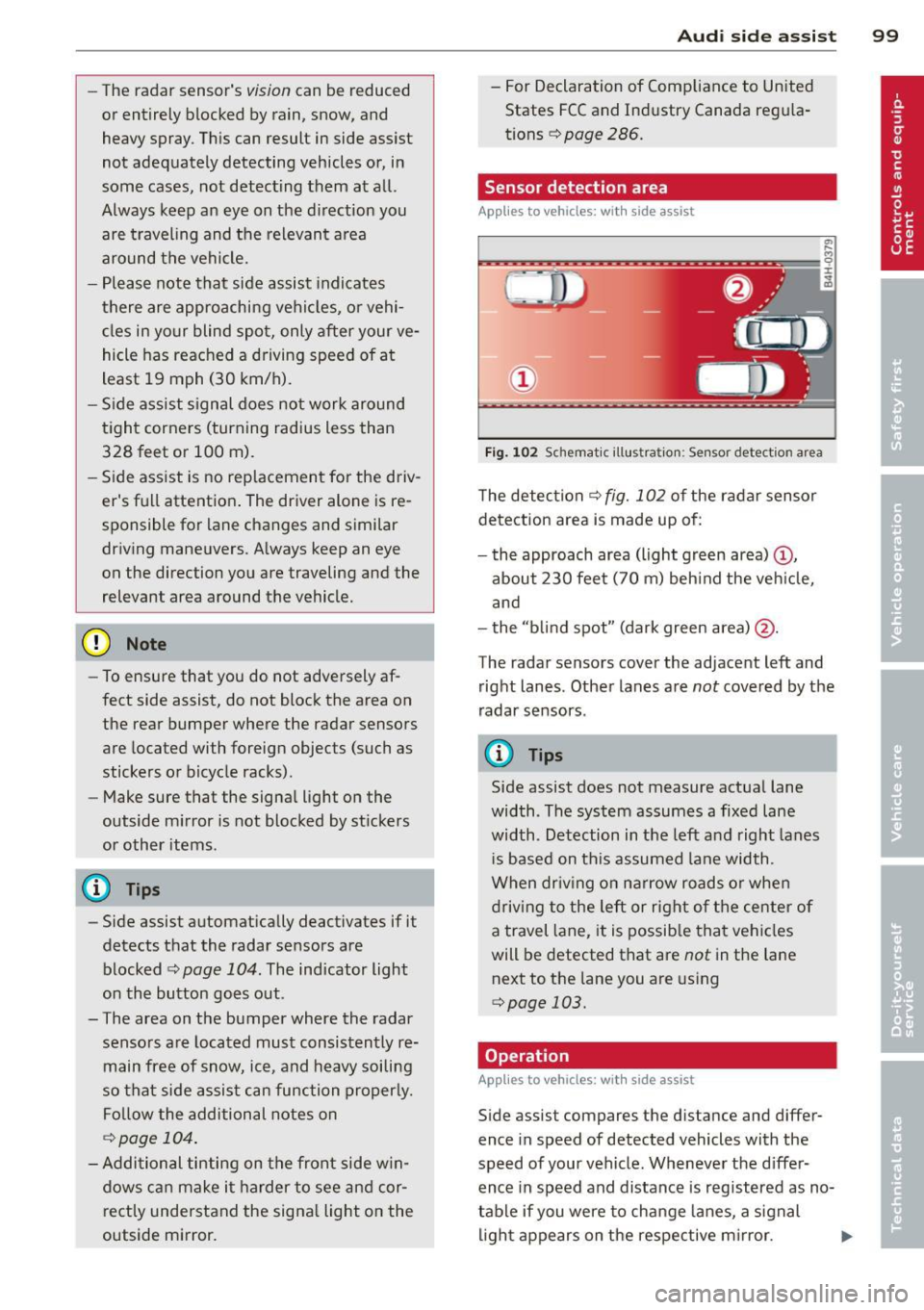
Sensor detection area
Applies to vehicles: with side assist
t
Fig. 102 Sc hemat ic illu st ration : Sen sor detect io n area
The detection ¢ fig. 102 of the radar sensor
detection area is made up of:
- the approach area (light green area)@,
about 230 feet (70 m) beh ind the veh icle,
and
- the "b lind spot" (dark green area) @.
The radar sensors cover the adjacent left and right lanes. Other lanes are
not covered by the
radar sensors .
(D Tips
Side assist does not measure actual lane
width. The system assumes a fixed lane
width . Detection in the left and right lanes
i s based on this assumed lane width .
When dr iv ing on narrow roads or when
driving to the left or right of the center of
a travel lane, it is possib le that vehicles
will be detected that are
not in the lane
next to the lane you are using
.:!> page 103.
Operation
App lies to vehicles: with side assist
Side assist compares the distance and differ
ence in speed of detected vehicles with the
speed of your vehicle . Whenever the d iffer
ence in speed and distance is registered as no
table if you were to change lanes, a signal
light appears on the respective m irror. ..,.
Page 185 of 302
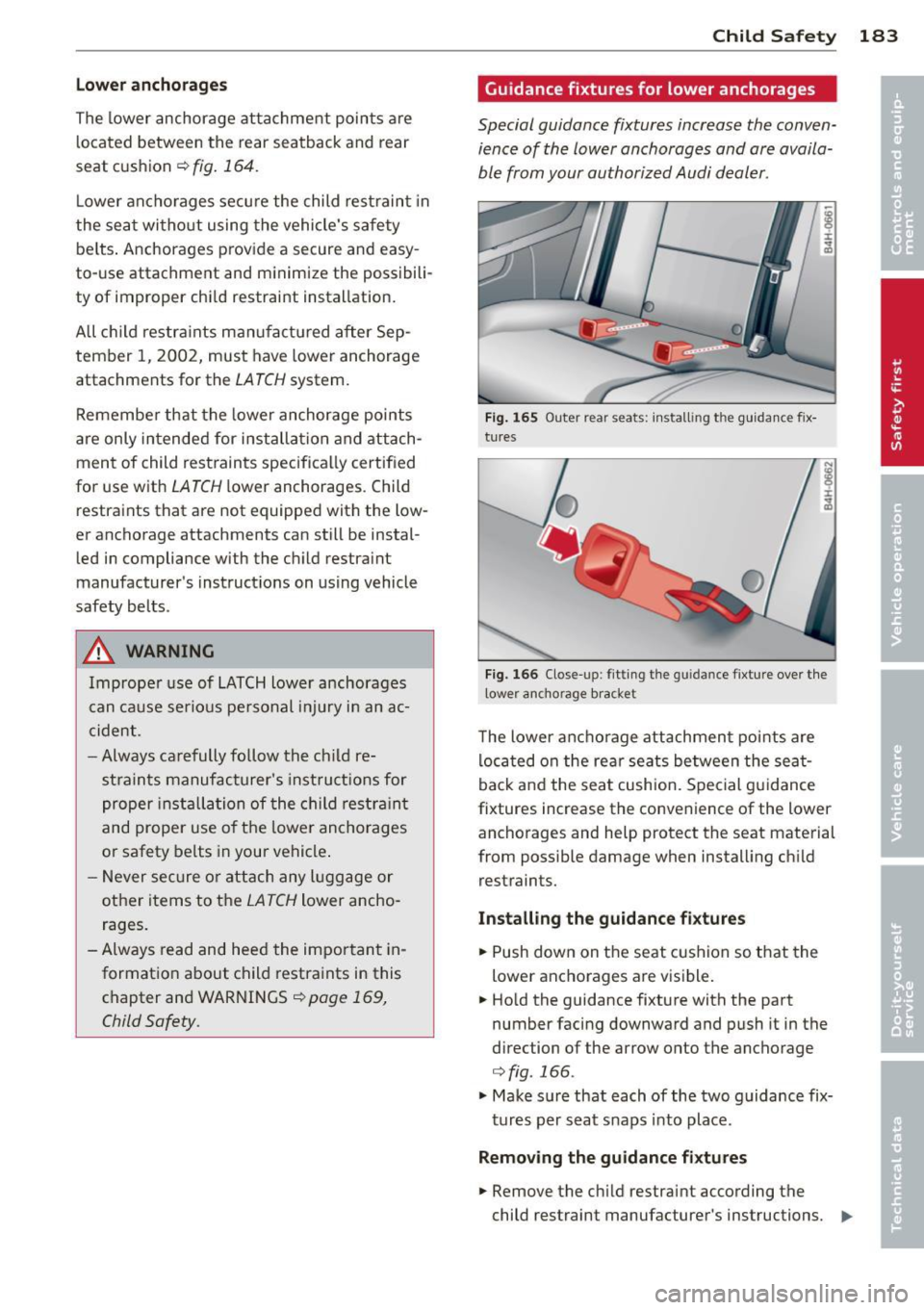
Lower ancho rag es
The lower anchorage attachment points are
located between the rear seatback and rear
seat c ushion
¢ fig. 164.
Lower anchorages secure the child restraint in
the seat witho ut using the vehicle 's safety
be lts . Anchorages provide a secure and easy
to- use attachment and minimize the possibili
ty of improper chi ld restraint installation.
All ch ild restra ints man ufact ured after Sep
tember 1, 2002, must have lower anchorage
attachments for the
LATCH system.
Remembe r that the lowe r anchorage points
are only intended for i nstallation and attach
ment of child restraints specifical ly certified
for use with
LATCH l ower anchorages . Child
restra ints that are not equipped with the low
er anchorage attachments can still be instal led in compliance with the c hild restra int
manufacturer's instruct ions on using vehicle
safety belts .
_&, WARNING
Improper use of LATCH lower anchorages
can cause serious personal i njury in an ac
cident .
- Always carefully fo llow the ch ild re
straints manufacturer's inst ruct ions for
proper installation of the child restra in t
and proper use of the lower anchorages
or safety belts in your vehicle .
- Never secure o r attach any l uggage or
other items to the
LATCH lower ancho
rages.
- Always read and heed the important in
formation about child restra ints in this
chapter and WARNINGS
¢ page 169,
Child Safety .
Child Safety 183
Guidance fixtures for lower anchorages
Special guidance fixtures increase the conven
ience of the lower anchorages and ore ovoilo
ble from your authorized Audi dealer .
Fig . 1 65 Outer r ear seats : inst alling the gu idanc e fix
t u res
8 ± ... a,
Fig . 1 66 Close-up: fitt ing t he g uida nce fixture over the
l ower ancho rage bracket
T he lower ancho rage attachment poi nts are
located on the rear seats between the seat
back and the seat cushion. Special guidance
fixtures increase the convenience of the lower
anchorages and help protect the seat material
from possible damage when install ing ch ild
restraints.
Installing the guidanc e fixture s
.,. Push down on the seat cushion so that the
lower anchorages are visible .
.,. Ho ld the guidance fixture with the part
number facing downward and push it in the
direction of the arrow onto the anchorage
¢ fig . 166 .
.,. Make su re that each of the two guidance fix
tures per seat snaps into place .
Removing the gu idance fixtures
.,. Remove the ch ild restraint according the
child restraint manufacturer's instructions. .,..
Page 195 of 302

road and the brakes are not used. Here too,
you shou ld clean off accumu lated salt coating
from brake discs and pads with a few carefu l
applications of the brake
c> ,&. .
Cor rosion
There may be a tendency for dirt to build up
on the brake pads and corrosion to form on
the discs if the car is not driven regularly or
only for short trips with little use of the brakes.
If the brakes are not used frequently, or if cor rosion has formed on the discs, it is advisable
to clean off the pads and discs by brak ing
f irmly a few times from a moderately high
speed
c> &, .
Fau lts in th e bra ke s ystem
If you should notice a sudden increase in
brake peda l travel, then one of the two brake
ci rcu its may have failed
c> ,&. .
Low brak e fluid l evel
Malfunct ions can occur in the brake system if
the brake fluid level is too low. The brake fluid
leve l is monitored electronically.
Brake lining w ear statu s
Brake lining wear may be checked by visual in
spection of the condition of the brake pads
through the openings in the whee l. If neces
sary, the wheel may be removed for this in
spection
c> page 262, Changing a wheel .
8_ WARNING
-You should perform braking maneuvers
for the purpose of clean ing the brake
system on ly if road condit ions permit.
Other road users must not be put at r isk -
you may cause an acc ident!
- Before descending a steep grade, reduce
speed and shift transmiss ion into a lower
gear or lower driving range . Do not ride
the brakes or hold the pedal down too lo ng or too often. This cou ld cause the
brakes to get hot and dimin ish b raking
effi ciency.
Int ellig ent technolog y 193
-Do not "ride the brakes" by resting your
foot on the pedal when you do not intend
to brake. This may cause the brakes to
overheat, premature wear and increased
stopping distance .
- Under certain cl imatic and operat ing
conditions such as passing through wa
ter, dr iv ing in heavy rain or after washing
the vehicle, the effectiveness of the
b rakes can be reduced. In winte r, ice can
accumulate on the brake pads , lin ings,
discs and drums . Carefu lly app ly brakes
for a test . Brakes will dry and ice coat
ings wi ll be cleaned off after a few care
fu l brake applications.
- Driving for an extended period of time on
salt-covered roads without using your
brakes can a lso affect braking efficiency.
Clean off accumu lated salt coating from
brake discs and pads with a few careful
brake applications .
- If you damage the front spoiler, or if you
install a different spoiler, be sure the air
f low to the front brakes is not obstruct
ed. Otherw ise the brake system could
overheat reduc ing the effectiveness of
the entire brake system.
- Failure of one b rake circuit will impai r
the braking capab ility result ing in an in
creased stopping distance. Avoid driving
the vehicle and have it towed to the near
est A udi dealer or qualified workshop .
Brake booster
The brake booster adds extra braking power.
The brake booster works with vacuum pres
su re which is created only whe n the engine is
runn ing
c> &, .
A WARNING
-Never let the vehicle roll to a stop with
the engine shut off.
-
- If the b rake booster is no t working, for
examp le when towing you r vehicle, or
because the brake booster has somehow
Ill>
•
•
Page 200 of 302
198 Driving and en vi ro nment
Catalytic converter
It is very important that your emission con
trol system (catalytic converter) is function
ing properly to ensure that your vehicle is run
ning in an environmentally sound manner .
.. Always use lead-free gasoline¢ page 218,
Fuel supply.
.. Never run the tank down all the way to emp-
ty .
.. Never put too much motor oil in your engine
¢ page 22 7, Adding engine oil 't=r. .
• Never try to push- or tow-star t your veh icle.
The catalytic converter is an eff ic ient "clean
up" device built into the exhaust system of
the vehicle. The catalytic converter burns many of the pollutants in the exhaust gas be
fore they are released into the atmosphere.
The exclusive use of unleaded fuel is critically
important for the l ife of the cata lytic conve rt
e r and proper functioning of the engine.
& WARNING
-
- Do not park o r operate the vehicle in
areas where the hot exhaust system may
come in contact with dry grass, brush,
fuel spill or other material which can cause a fire.
- Do not apply additional undercoating or
rustproofing on or near the exhaust
man ifold, exhaust p ipes, catalytic con
verter or heat shie lds . During driving, the
substance used for undercoating could
overheat and caus e a fire .
@ Note
-Be aware that just one tank filling with
leaded fuel will already seriously de
grade the perfo rmance of the catalytic
conve rter .
- Do not exceed the correct engine oil leve l
¢page 227.
-Do not drive until the fuel tank becomes
completely empty. The eng ine could mis
fire . Un burned f uel could a lso get into the exhaust system and th
is co uld cause
the cata lytic converter to overheat .
- Do not switch
off the ignition while the
vehicle is moving .
- Do not continue to ope rate your veh icle
under these conditions, as otherwise fuel
can reach the catalytic converter. This
cou ld result in overheating of the con
verter, requir ing its replacement .
- To assure efficient operation of the Emis
sion Control System:
- H ave you r vehicle maintained properly
and in accordance w it h the service rec
ommendat ions in your Warranty &
M ain tenance boo klet.
- L ack of prope r maintenance as we ll as
improper use of the vehi cle will impair
the function of the em ission contro l
system and could lead to damage .
@ For the sake of the environment
Even when the Emiss ion Control Sys tem is
operat ing proper ly, the exha ust gas can
have a sul fur -li ke ex haust gas smell under
some operating states . This depends on
the sulfur content of the fuel being used .
Using a different brand of fue l may help,
or f il li ng the tank with lead-free super
grade gasoline .
Avoid damaging the
vehicle
When you are d rivi ng on poor roads, or over
c u rbs, steep ramps, etc., ma ke certai n that
low- ly ing parts s uch as spoilers and exha ust
system parts do not bottom o ut and get dam
aged.
T his is es peci ally true for ve hicles with low
s lung chassis (spor ts chassis)* and fully load
ed vehicles .
Page 202 of 302

200 Driving and en vi ro nm ent
Avoid full throttle
Driving at moderate speeds saves fuel and
improves your mileage .
"'Try and keep well below your car 's maximum
speed.
Accelerating gently reduces fuel consump
tion, engine wear, and does not disturb the
environment. F ue l consumption, exhaust em issions and en
gine noise increase disproportionately at high
speeds. If you drive at approximately three
quarters of top speed, fue l consumption will
be reduced by one half. Never drive faster
than the posted speed limit and weather con
d itions permit .
Reducing unnecessary idling
Even when your car is just idling it burns up
fuel.
"'Shut the engine off when you are not driving
the vehicle .
"'Do not warm up the veh icle by letting the
engine run at idle .
It makes sense to shut
off the e ngine in traff ic
jams, when waiting for trains to pass at ra il
road crossings , or at traff ic lights that have
long wa its on red. Turning the engine
off fo r
just
30-40 seconds saves more fue l than is
burned s tarting the eng ine again .
It takes a long time for the engine to warm up
fully when it is running at idle . Howeve r, wear
and noxious em issions are especially high
when the engine is warming up. So you should
drive away as soon as you start the engine and
avoid running at high rpms while the engine is
still warming up .
([) Note
Do not leave engine idling unattended af
ter starting . If warning lights should come
on to indicate improper operation, they
wou ld go unheeded. Extended idling also
produces heat, which cou ld result in over- heating or other damage to the vehicle or
other property .
Regular maintenance
A badly tuned engine unnecessarily wastes a
lot of fuel.
"' Have your ve hicle serviced at reg ular inter -
vals.
By having your veh icle regu larly serviced by an
Audi dealer he lps to ensure that it runs p rop
erly and economically. The condition of your
vehicle not only affects its sa fety and ability to
hold its value, it also affects
fuel c onsump
tion .
Check your oil e ach time you fill your t ank .
The amount of oil used is related to engine
load and speed .
It is normal for the oil consumption of a new
engine to reach its lowest value after a certa in
mileage has been driven.
You must drive your veh icle about 3,000 m iles
(5,000 kilometers) before you can properly
assess oil consumpt ion.
This also app lies to fue l consumption and en
gine output.
(D Note
- Have your vehicle maintained proper ly
and in accordance with the service rec
ommendations in your Warranty
& Main
tenance booklet. Lack of proper ma inte
nance as well as improper use of the ve
hicle will impair the function of the
em iss ion contro l system and cou ld lead
to damage.
- Do not alter or remove any component of
the Emission Control Sys tem unless ap
proved by the manufacture r.
- Do not alte r or remove any device, such
as heat sh ie lds, switches, ign it ion w ires,
valves, which are designed to protec t
your vehicle's Emission Control System
and other impo rtant vehicle compo
nents .
Page 209 of 302
Automatic car wash
The vehicl e can b e washed in almost any
modern automatic car wash .
The vehicle paint is so durable that t he vehicle
can n ormally be washed without p roblems in
a n automatic car wash . H owever, the effect on
the paint depends to a large extent on the de
sig n of the fac ility, the filte ring of the wash
water, the type of wash and care mater ial , etc.
If the pa int h as a dull appearance afte r go ing
through the car wash or is scratched, bring
this to the attention of the operator immedi
ately. If necessary, use a different car wash.
Before going through a ca r wash, be s ure to
take the usual precautions such as clos ing the
windows and power roof. Factor y installed an
tennas m ust not be removed.
If yo u have installed additional accessor ies on
the vehicle -such as spoilers, roof rack, etc. -
it is best to ask the car was h operator if these
should be removed .
When driv ing through an automatic ca r wash,
firs t se lect the
N posit ion and then sw itch the
engine off. If you switch the eng ine off when
N is engaged, the transmission remains in N
for approximate ly 30 m inutes and then Pis
engaged.
F u rther information for automatic gearboxes
~ page 112.
A WARNING
Always read and heed a ll WARNINGS and
other information
¢ page 206.
(D Note
- Fo ld the exterior mir ro rs -flat the re is a
r isk of damaging the exterio r mirrors .
Power folding exterior mirrors must not
be fo lded in or out by hand. Use the pow
er function!
- Compare the track of your vehicle w it h
the distance between the guide ra ils of
the facility- there is a risk of damage to
t h e wheels and tires .
-
Cleaning and protec tion 207
- Compa re the height and w idth of your
vehicle with t he height and width of the
t u nnel at the facility .
Washing the vehicle by hand
A lot of water is needed when washing a vehi
cle by hand.
.,. Before yo u start washing, make s ure you
have read and unders tood the WARNINGS
¢ .&. in General information an page 206.
.,. First soak a ll dried d irt unt il it is soft, then
r inse it off.
.,. As you clean yo ur vehicle, start wit h the roof
and work your way down to t he bottom, us
ing a sponge, a sponge glove or a clean
brush .
.,. Rinse the sponge o r th e sponge g love often,
flushi ng it cl ean ea ch time.
.,. Use spec ial car shampoo only fo r very persis
tent di rt.
.,. Rinse the ca r thorough ly w ith water.
.,. Use a chamo is leather to gently w ipe the ex-
ter ior dry.
Use a separate sponge for cleaning the
whee ls , door sills and othe r regions exposed
to road dirt. In this way, yo u wi ll not scratch
the pa int with coarse particles imbedded in
the sponge the next time you wash the car.
A WARNING
- Do not clean the unde rside of the chas
sis, fenders, wheel covers, or oth er ha rd
to rea ch parts witho ut p rotect ing you r
hands a nd ar ms . You may cut you rsel f on
sha rp-edge d meta l pa rts.
- Always read a nd heed a ll WA RNIN GS and
o ther info rmation
¢ page 206.
@ Note
- Never try to remove dirt, mud or dust if
th e su rface of the ve hicle is dry. Never
use a d ry cloth o r sponge, s in ce th is
co uld scra tch you r vehi cle's pain t or win -
-
dows. .,..
•
•
Page 212 of 302
210 Cleaning and protection
Plastic and vinyl
Plastic needs special care .
Use a clean, damp cloth or sponge to remove
dust and light surface dirt. For other soil, use
a lukewarm all-purpose clean ing solution or a
mild saddle soap for vinyl trim. Remove water
spots and traces of soap w ith a clean, damp
clot h or sponge. Use a clean, soft clot h to rub
dry.
Grease, tar or o il stains can be removed w ith a
clean cloth or sponge soaked w ith all-purpose
cleane r or with a solvent designed especially
to clea n viny l.
Occasionally apply a colorless vinyl or leather preservat ive to retain the material's luster
and pliability.
.&_ WARNING
Always read and heed all WARNINGS and
other information ¢ page 206.
Aluminum trim
Use only neutral-pH produc ts to remove spots
and deposits from aluminum surfaces.
C hr ome care products and alkaline cleaners
will attack aluminum surfaces and can dam
age them over time.
.&_ WARNING
, -
Always read and heed all WARNINGS and
other information ¢ page 206.
Touch-up paint
Minor paint damages should be touched up
immediately.
.. Use either a touch-up paint stick or spray
paint to cover minor scratches and nicks .
Your Audi dea ler has touch-up paint for minor
scratches and stone chips. Scratches s hou ld
be touched up soon after they occur to pre
vent corrosion.
If a spot starts to rust, however, a simple
touch-up job will not be enough. The affected
surface must be sanded smooth and coated
with an anti-rust primer before the painted
finish can be restored.
The number for the original vehicle paint can
be fo und on the vehicle identification label
¢ page
279.
.&_ WARNING
Always read and heed all WARNINGS and
other information¢ page 206.
Windows '
Clear vision to all sides .
Clean all windows regularly to remove road
film and car wash wax buildup .
.. Remove snow from w indows using a brush.
.. Use a plastic ice scraper to remove ice from
windows and mirrors .
.. Remove other residue on the windows with
a spray •on glass cleaner.
.. Wipe the w indows dry with a clean piece of
cloth or kitchen paper towel.
T he best way to remove snow from windows
and mirrors is to use a brush. Use a non-abra
sive
plastic ice scraper -better still, a spray
deicer - to remove
ice from windows and mir
rors.
Oil, grease or s ilicone residue can be removed
with
glass cleaner or silicone remover . How
ever, wax res idue requires the use of a spec ial
ly formulated solvent. Please contact your Au
di dealer for adv ice on safe products for wax
removal.
Windows should also be cleaned on the inside at regular intervals .
Never dry windows with the same chamo is
that you use to dry painted surfaces. Wax resi
due on the chamois can impair vis ion through
the windows . ..,_
Page 216 of 302
214 Cleaning and protection
leathe r, whi ch has a smooth surface and
comes in various co lors .
The intensity of the color determines the v is u
a l charac ter istics and appearance. If the sur
face of the leather has a typical natu ral look,
then the leather is a nappa leather that has been left in a relatively natural cond ition. This
leather offers particularly good comfort and
breathes well. F ine veins, closed grains, insect
b ites, skin folds , and subtle var iations in co lor
remain visible . These c haracteristics demon
strate that the mater ia l is natural.
Natural nappa leather is not covered by a col
or fi nish . It is therefore more sensitive to soil
i ng and wear, w hich is something you need to
consider if ch ild ren , an ima ls or othe r factors
might prove to be particular ly hard on the
l eathe r.
By contrast, leat her types that are covered by
a co lored finish layer a re mor e durable . This
has a posit ive effect o n the leather's resist
a nce to wear and soil ing in daily use. On the
o ther hand , the typical characteris tics of na tu
ra l leather a re barely or not apparent. Howev
e r, this does not mean that the leather itself
is of infer ior quality.
Care and handling
Because of the exclusive na ture of the types of
l eather that Audi uses and the ir unique prop
erties (such as sensitivity to oils, grease, soi l
ing, etc.), you will need to be somewhat care
fu l w ith these leathers, and a ce rtain type of
care is required. For examp le, dark clot hing
materials can d iscolor leather sea ts (especial
ly if such clot hing is damp and was not dyed
correctly) . Dust and d irt part icles in po res,
folds , and seams can have a n ab ras ive effect
and can damage the leathe r sur face as well as
weaken seams.
The leather should be cleaned regula rly as
needed. After havi ng been used for a re lative ly
l ong time, yo ur leather sea ts will acqui re a
ri ch aged finish. This is a charac ter istic of n at
u ra l lea ther and a sign o f true quality . In order to maintain the val
ue of this nat ural
product over the life of your vehicle, you
sho uld follow the recommendat ions be low :
(D Note
- To keep your leather from b leaching o ut,
do not allow it to be exposed to b right
sunlight for long periods of time . If you
have to leave the ve hicle parked outside
for long per iods, cover the leather to
protect it from direct exposure to sun
light .
- Sharp objects on cloth ing, such as zip
pers, rivets or sharp pieces on belts can
leave permane nt sc ratches or sc rape
ma rks on the su rface of the leather.
(0 Tips
- After each time you clean the leather and
at regular intervals, use a leathe r preser
vative c reme that contains UV-b locke rs
and tha t works into the leat he r. Thi s
c reme will nour ish a nd moistu rize the
leather, helping it to breathe and stay
supple. It a lso helps to build up a p rotec
tive coating on the surface.
- Clean the leat her every 2 -3 months,
and clean any a reas that get soi led .
- Remove fresh ma rks made by ballpo int
pe ns, ink, lipstick, shoe polish, etc. as
soon as poss ible.
- P reserve the color o f the leather as need
ed by using a specia l co lore d leathe r care
creme to touch up areas of uneven color .
Cleaning and caring for leather
upholstery and trim
Applies to vehicles: with natural leather
Natural lea ther requires special care and at
tention .
Normal cleaning
.. Clean soiled areas with a slightly moistened
cotton or woolen cloth . .,.
Page 217 of 302
More stubborn dirt
"' More stubborn dirt can be removed using a
cloth saturated with a mi ld soap so lution (2
tablespoons mi ld liquid soap).
"'N ever allow the soap so lution to saturate
the leather, and make certa in that no water
soaks into the seams .
"' Wipe
off the soap solution with a soft, dry
cloth .
Cleaning spots
"' Remove fresh water-based spots (such as
coffee, tea, juices, blood) w ith an absorbent
cloth or paper towel.
"' Remove fresh
grease or oil -based spots
(such as butter, mayonnaise, chocolate) with
an absorbent cloth or paper towel, or use
t h e cleane r from the leathe r care kit if the
spot has not yet penetrated into the surface
of the leather.
"'U se an oil/grease dissolving spray, if
oil/
grease spots have d ried on.
"' Remove spec ific kinds of spots (ballpoint
pen, felt marker, fingernail polish , water
based paint, shoe polish, etc.) with a spot
remover specifically formulated for leather .
Leather care
"'Every half year use an approved leather care
product (available from your Audi dealer) to
care for the leather.
"' Apply the product very sparingly.
"' Wipe it
off with a damp cloth .
If you have any questions abo ut cleaning and
caring for the leather in your vehicle, it is best
to contact your author ized Audi dealer, who
will be glad to help you and tell you about our
fu ll range of leather care products, suc h as:
- Leather cleaning and care k it
- Creams to care for colored leather
- Spot removers for ballpoint pens, shoe pol-
ish, etc.
- Oil/grease dissolving spray
- New and upcoming prod ucts.
Cleaning and protection 215
A WARNING
Always read and heed all WARNINGS and
other information
¢ page 206.
(D Note
-Never use chemica l so lvents (e.g. lighter
fluid, turpentine), waxes, shoe polish or
similar products on the leather surfaces
in your Audi.
- To avoid damage, have stubborn sta ins
removed by a commercial clean ing spe
cialist.
Cleaning Alcantara ® (synthetic suede)
App lies to veh icles: w it h Alca nta ra upho lstery
Removing dust and dirt
"' Moisten a cloth, squeeze out excess water
and wipe down the seat surfaces.
Removing stains
"' Moisten a cloth with lukewarm water or
w ith diluted
ethyl (rubbing) alcohol.
"' Dab at the stain . Start at the outside and
work inwards .
"' Once the stain is no longer visible, use a soft
d ry cloth or tissue to soak up the moisture .
Do not use leather cleaning products on A l
cantara .
You may use a suitable shampoo for remov ing
dust and dirt.
Dust and grit in the pores and seams can
scratch and damage the surface.
If the car is
left stand ing in the sun for long per iods, the
Alcantara covers should be protected aga inst
direct sunlight to prevent it from fad ing .
Slight color variations will develop in normal
use and are not an indication of mate rial dete
rioration .
(D Note
-Never use chemical so lvents (e .g. lighter
fluid, turpentine), waxes, shoe polish or
similar products on Alcantara ® surfaces. .,.. •
•
Page 218 of 302

216 Cleaning and protecti on
- To avoid damage, have stubborn stains
removed by a commercial cleaning spe
cialist.
- Do not use br ushes, stiff sponges or sim
ilarly abrasive cleaning aids.
Safety belts
Only well-maintained safety belts work relia
bly when needed .
> Keep belts clean.
> For cleaning, use a mild soap and wate r sol
ution . Let be lts dry thoroughly and away
from direct sunlight .
> Do not allow inertia reel safety be lts to re
tract before they are completely dry.
> Check the condition of your safety belts reg
ularly .
Heavily soiled safety belts may not retract
properly.
.&_ WARNING
Damaged safety belts can break in a crash.
- Anything that might damage your safety
belts could mean that you and your pas
sengers would not be adequately pro
tected in an acc ident.
- Safety belt performance depends on cor
rect installation. Never remove belts
from the vehicle to clean them.
- Do not use chemical cleani ng agents,
bleach or dyes. They have corrosive prop
ert ies which weaken the webbi ng.
- When cleani ng your safety belts, inspect
them for damage.
If you discove r dam
age, see you r A udi dealer.
- Always read and heed all WARNI NGS and
other information
c:> page 206.
Cooler
A ppl ies to vehicles: with cooler
A layer of ice or frost in the cooler interferes
with its cooling performance .
Clean ing
The refr igerator sho uld be cleaned reg ularly.
> Wash the coo ler with lukewarm wate r and a
mild cleaning solution, if necessary.
> Then wipe the cooler dry.
> Dust and d irt will accumulate near the venti
lation openings in the luggage compart
ment due to normal cooler usage. This
should be cleaned regularly.
D ef rosting
> Switch the coo ler off c:> page 72.
> Remove any food or beverages and allow the
coo ler to defrost with the door open.
> W ipe the inside of the cooler dry and clea n
the cooler, if necessary .
Defrost the cooler if you will not be us ing it
for extended periods of time .
(D Note
- Do not try to speed up the defrosting
process by apply ing heat.
- To reduce the risk of persona l injury or
damage to the refr igerator,
- do not use any abrasive cleaners, sol
vents, wax, agg ress ive clean ing solu
tions, solut io ns w it h strong frag rances,
etc.,
- d o no t clean the co oler w ith cleaning
tools su ch as s teel woo l.
Engine compartment
Be especially careful when cleaning the en
gine comportment.
Alway s switch off the ignit ion b efor e cle an
ing the engine
c:> ,&. .
Plenum panel
Remove leaves from the plenum panel in front
of the w indshield under the eng ine compart
ment . This prevents the wate r drain holes
from becom ing b locked, and it preve nts de
br is from entering the vehicle inte rior through
the heat ing and ven tilat ion duc ts.
Corrosion protection
The eng ine compartment and transmission
have been corrosion-protected at the factory .
ll-