transmission AUDI A8 2011 User Guide
[x] Cancel search | Manufacturer: AUDI, Model Year: 2011, Model line: A8, Model: AUDI A8 2011Pages: 302, PDF Size: 76.07 MB
Page 119 of 302
of the slits on the cover and pry the cover
off.
~ Pull the band @ in the direction of the ar
row until the release lever locks in place
¢fig . 122.
~ Fold the upper section of the release lever
down into the recess .
Resetting the parking lock
~ Press the button @ and the release lever at
the same time. You can now push the lever
back into its original position . Make sure the
lever locks in place
¢fig. 123 .
~ Install the cover .
The indicator light
[O] and the N position indi
cator in the instrument cluster turn on when
the park ing lock is released using the emer
gency re lease . The message
Risk of rolling! P
not possible. Please set the parking brake
al
so appears.
_& WARNING
If you release the parking lock using the
emergency release, secure your vehicle
with the parking brake or the brake pedal
if the parking brake is not working. The ve
hicle can roll away if it is not secured and
cause a crash.
-
Automatic Transmission 11 7
Page 199 of 302
Driving and
environment
The first 1
1000
miles
(11500 km) and
afterwards
New engine
The engine needs to be run-in during the first
1,000 miles (1 ,500 km) .
For the fir st 600 mile s (1,000
kilometers ):
.,. Do not use full throttle.
.,. Do not drive at engine speeds that are more
than 2/3 of the max imum permitted RPM .
.. Avoid high engine speeds .
From 600 to 1,000 miles (1 ,000 to
1,500 kilometers):
.. Speeds can gradually be increased to the
maximum pe rm iss ib le road or eng ine speed .
During and after break-in per iod
.,. Do not rev the engine up to high speeds
when it is cold. This applies whether the
transmission is i n N (Neutra l) or in gear.
After the break- in peri od
.. Do not exceed maximum engine speed un
der any circumstances.
.,. Upshift into the next higher gear before
reaching the red area at the end of the tach
ometer scale c:.>page 10.
During the first few hours of driving, the en
g ine's interna l friction is higher than later
when all the moving parts have been broken
i n. How well this break-in p rocess is done de
pends to a considerable extent on the way the
ve hicl e is driven du ring the first 1,000 miles
(1,500 ki lome ters).
(D Note
Extremely h igh engine speeds are auto
mat ica lly reduced. However, t hese rpm
lim its are progr amme d for an eng ine well
r u n- in, not a new engine .
Driving and environment 197
@) For the sake of the environment
Do not drive with unnecessarily high en
g ine speeds -upshifting ear ly saves f uel,
reduces noise and protects the environ
ment.
New tires
If your vehicle is running on new tires, drive
particularly caref ul for the first 350 miles
(500 kilomete rs) afte r fitt ing.
.&, WARNING
N ew tires tend to be sl ippery and mus t al
so be "b roken -in" . Be sure to remember
this dur ing the f irst 350 m iles (500 kilo
meters) . Brake gently . Avoid fo llowing
closely behind other vehicles or other sit
uations that m ight require sudden, hard
b raking .
New brake pads
Remember that new brake pads do not have a
full brak ing effect dur ing the first 250 m iles
(400 ki lomete rs) afte r they a re installed.
New brake pads have to be "burnished in" be
fore they have optima l grab¢ .&, .
D uring the brea k-in period, yo u should avo id
putting severe loads on the brakes. Severe
l oads include , for example, sudden hard brak
i ng, in particular at very h igh speeds or, for
example, on mounta in passes .
.&, WARNING
New b rake pads don't have the best stop
p ing power and mu st be "broke n-i n" dur
ing the initi al 100 to 150 miles (150 to
2 00 kilometers) o f no rma l ci ty driving . You
can compensate for this by pressing the b rake peda l more fi rm ly . This also applies
later when new pads are installed.
•
•
Page 207 of 302
Parking on a slope
Do not pork on a slope with a trailer. If it can
not be avoided, do so only ofter doing the fol
lowing:
When parking:
.. Apply the foot brake .
.,. Have someone place chocks under both the
vehicle and the trailer wheels .
.,. With chocks in place, slowly release the
brakes until the whee l chocks absorb the
load .
.. Turn the wheels towa rds the curb .
.. Apply the parking brake .
.. Se lect the
P se lector lever position.
When restarting after parking:
.. Apply the foot brake .
.,. Start the engine .
.. Select the
D se lector lever position .
.. Release the parking brake and slowly pull
out and away from the wheel chocks .
.. Stop and have someone retrieve the wheel
chocks.
If you move the selector lever of the auto
matic transmission to
P before applying
the parking brake and before blocking the
wheels, you may have to use more force
later to move the lever out of the
P posi
tion .
Trailer towing 205
•
•
Page 209 of 302
Automatic car wash
The vehicl e can b e washed in almost any
modern automatic car wash .
The vehicle paint is so durable that t he vehicle
can n ormally be washed without p roblems in
a n automatic car wash . H owever, the effect on
the paint depends to a large extent on the de
sig n of the fac ility, the filte ring of the wash
water, the type of wash and care mater ial , etc.
If the pa int h as a dull appearance afte r go ing
through the car wash or is scratched, bring
this to the attention of the operator immedi
ately. If necessary, use a different car wash.
Before going through a ca r wash, be s ure to
take the usual precautions such as clos ing the
windows and power roof. Factor y installed an
tennas m ust not be removed.
If yo u have installed additional accessor ies on
the vehicle -such as spoilers, roof rack, etc. -
it is best to ask the car was h operator if these
should be removed .
When driv ing through an automatic ca r wash,
firs t se lect the
N posit ion and then sw itch the
engine off. If you switch the eng ine off when
N is engaged, the transmission remains in N
for approximate ly 30 m inutes and then Pis
engaged.
F u rther information for automatic gearboxes
~ page 112.
A WARNING
Always read and heed a ll WARNINGS and
other information
¢ page 206.
(D Note
- Fo ld the exterior mir ro rs -flat the re is a
r isk of damaging the exterio r mirrors .
Power folding exterior mirrors must not
be fo lded in or out by hand. Use the pow
er function!
- Compare the track of your vehicle w it h
the distance between the guide ra ils of
the facility- there is a risk of damage to
t h e wheels and tires .
-
Cleaning and protec tion 207
- Compa re the height and w idth of your
vehicle with t he height and width of the
t u nnel at the facility .
Washing the vehicle by hand
A lot of water is needed when washing a vehi
cle by hand.
.,. Before yo u start washing, make s ure you
have read and unders tood the WARNINGS
¢ .&. in General information an page 206.
.,. First soak a ll dried d irt unt il it is soft, then
r inse it off.
.,. As you clean yo ur vehicle, start wit h the roof
and work your way down to t he bottom, us
ing a sponge, a sponge glove or a clean
brush .
.,. Rinse the sponge o r th e sponge g love often,
flushi ng it cl ean ea ch time.
.,. Use spec ial car shampoo only fo r very persis
tent di rt.
.,. Rinse the ca r thorough ly w ith water.
.,. Use a chamo is leather to gently w ipe the ex-
ter ior dry.
Use a separate sponge for cleaning the
whee ls , door sills and othe r regions exposed
to road dirt. In this way, yo u wi ll not scratch
the pa int with coarse particles imbedded in
the sponge the next time you wash the car.
A WARNING
- Do not clean the unde rside of the chas
sis, fenders, wheel covers, or oth er ha rd
to rea ch parts witho ut p rotect ing you r
hands a nd ar ms . You may cut you rsel f on
sha rp-edge d meta l pa rts.
- Always read a nd heed a ll WA RNIN GS and
o ther info rmation
¢ page 206.
@ Note
- Never try to remove dirt, mud or dust if
th e su rface of the ve hicle is dry. Never
use a d ry cloth o r sponge, s in ce th is
co uld scra tch you r vehi cle's pain t or win -
-
dows. .,..
•
•
Page 218 of 302

216 Cleaning and protecti on
- To avoid damage, have stubborn stains
removed by a commercial cleaning spe
cialist.
- Do not use br ushes, stiff sponges or sim
ilarly abrasive cleaning aids.
Safety belts
Only well-maintained safety belts work relia
bly when needed .
> Keep belts clean.
> For cleaning, use a mild soap and wate r sol
ution . Let be lts dry thoroughly and away
from direct sunlight .
> Do not allow inertia reel safety be lts to re
tract before they are completely dry.
> Check the condition of your safety belts reg
ularly .
Heavily soiled safety belts may not retract
properly.
.&_ WARNING
Damaged safety belts can break in a crash.
- Anything that might damage your safety
belts could mean that you and your pas
sengers would not be adequately pro
tected in an acc ident.
- Safety belt performance depends on cor
rect installation. Never remove belts
from the vehicle to clean them.
- Do not use chemical cleani ng agents,
bleach or dyes. They have corrosive prop
ert ies which weaken the webbi ng.
- When cleani ng your safety belts, inspect
them for damage.
If you discove r dam
age, see you r A udi dealer.
- Always read and heed all WARNI NGS and
other information
c:> page 206.
Cooler
A ppl ies to vehicles: with cooler
A layer of ice or frost in the cooler interferes
with its cooling performance .
Clean ing
The refr igerator sho uld be cleaned reg ularly.
> Wash the coo ler with lukewarm wate r and a
mild cleaning solution, if necessary.
> Then wipe the cooler dry.
> Dust and d irt will accumulate near the venti
lation openings in the luggage compart
ment due to normal cooler usage. This
should be cleaned regularly.
D ef rosting
> Switch the coo ler off c:> page 72.
> Remove any food or beverages and allow the
coo ler to defrost with the door open.
> W ipe the inside of the cooler dry and clea n
the cooler, if necessary .
Defrost the cooler if you will not be us ing it
for extended periods of time .
(D Note
- Do not try to speed up the defrosting
process by apply ing heat.
- To reduce the risk of persona l injury or
damage to the refr igerator,
- do not use any abrasive cleaners, sol
vents, wax, agg ress ive clean ing solu
tions, solut io ns w it h strong frag rances,
etc.,
- d o no t clean the co oler w ith cleaning
tools su ch as s teel woo l.
Engine compartment
Be especially careful when cleaning the en
gine comportment.
Alway s switch off the ignit ion b efor e cle an
ing the engine
c:> ,&. .
Plenum panel
Remove leaves from the plenum panel in front
of the w indshield under the eng ine compart
ment . This prevents the wate r drain holes
from becom ing b locked, and it preve nts de
br is from entering the vehicle inte rior through
the heat ing and ven tilat ion duc ts.
Corrosion protection
The eng ine compartment and transmission
have been corrosion-protected at the factory .
ll-
Page 265 of 302
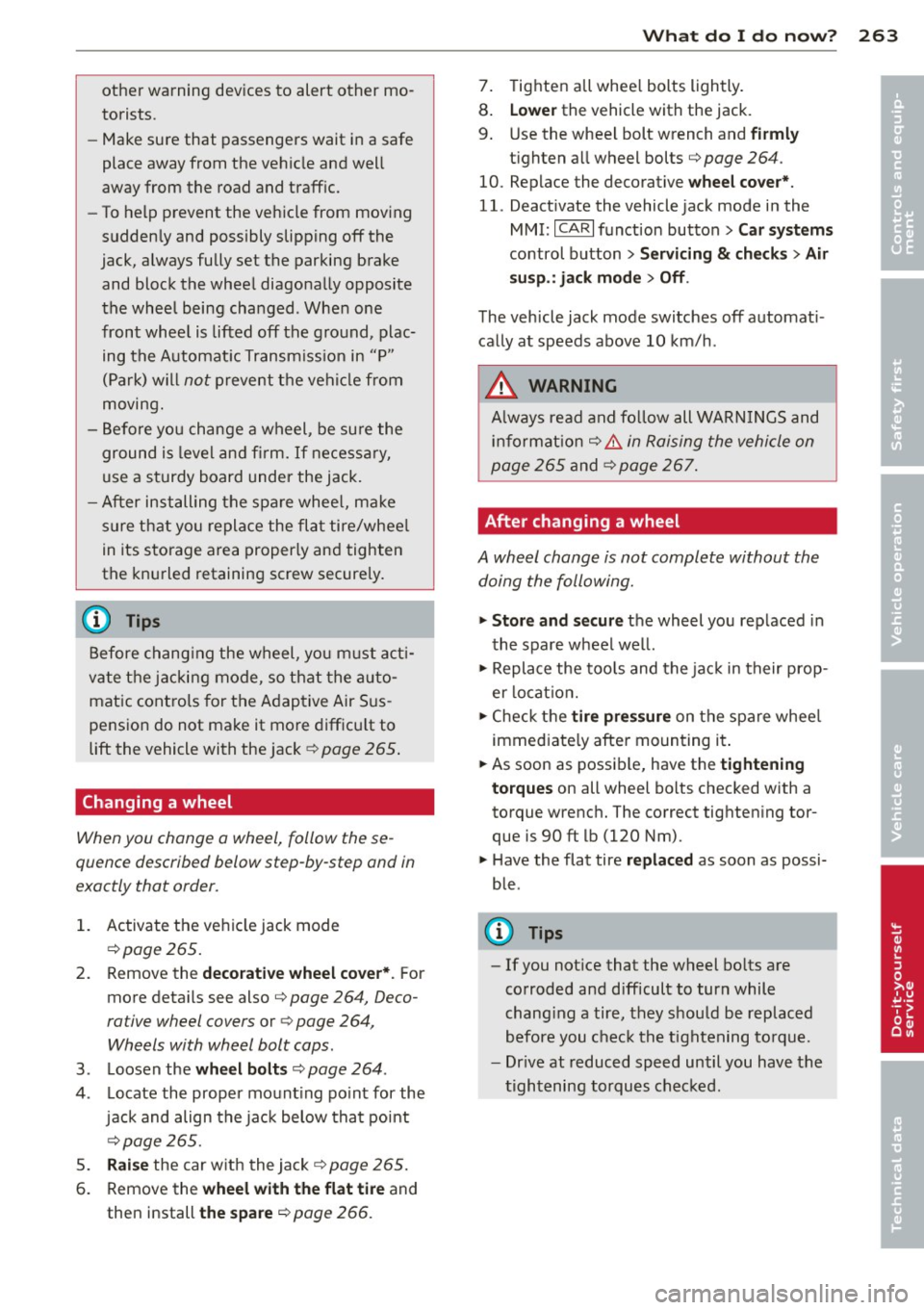
other warning devices to alert other mo
torists.
- Make sure that passengers wait in a safe
place away from the vehicle and well
away from the road and traffic.
- To help prevent the vehicle from moving
suddenly and possibly slipping off the
jack, always fully set the parking brake
and block the wheel diagonally opposite
the wheel being changed. When one
front wheel is lifted off the ground, plac
ing the Automatic Transmission in "P"
(Park) will
not prevent the vehicle from
moving.
- Before you change a wheel, be sure the
ground is level and firm. If necessary,
use a sturdy board under the jack.
- After installing the spare wheel, make
sure that you replace the flat tire/wheel
in its storage area properly and tighten
the knurled retaining screw securely.
@ Tips
Before changing the wheel, you must acti·
vate the jacking mode, so that the auto
matic controls for the Adaptive Air Sus
pension do not make it more difficult to
lift the vehicle with the jack ¢
page 265.
Changing a wheel
When you change a wheel, follow these
quence described below step-by-step and in
exactly that order.
1. Activate the vehicle jack mode
¢ page 265.
2. Remove the decorative wheel cover*. For
more details see also¢
page 264, Deco
rative wheel covers
or ¢ page 264,
Wheels with wheel bolt caps.
3 . Loosen the wheel bolts¢ page 264 .
4. Locate the proper mounting point for the
jack and align the jack below that point
¢page 265.
5. Raise the car with the jack¢ page 265.
6. Remove the wheel with the flat tire and
then install
the spare ¢ page 266.
What do I do now? 263
7. Tighten all wheel bolts lightly.
8.
Lower the vehicle with the jack.
9. Use the wheel bolt wrench and
firmly
tighten all wheel bolts¢ page 264.
10. Replace the decorative wheel cover*.
11. Deactivate the vehicle jack mode in the
MMI:
ICARI function button > Car systems
control button > Servicing & checks> Air
susp.: jack mode> Off .
The vehicle jack mode switches off automati
cally at speeds above 10 km/h .
A WARNING
Always read and follow all WARNINGS and
information¢ .&
in Raising the vehicle on
page 265
and ¢ page 267.
After changing a wheel
A wheel change is not complete without the
doing the following.
.. Store and secure the wheel you replaced in
the spare wheel well.
.. Replace the tools and the jack in their prop
er location.
.. Check the
tire pressure on the spare wheel
immediately after mounting it.
.. As soon as possible, have the
tightening
torques
on all wheel bolts checked with a
torque wrench. The correct tightening tor
que is 90
ft lb (120 Nm).
.. Have the flat tire
replaced as soon as possi
ble .
(D Tips
-If you notice that the wheel bolts a re
corroded and difficult to turn while
changing a tire, they should be replaced
before you check the tightening torque.
- Drive at reduced speed until you have the
tightening torques checked.
•
•
Page 271 of 302
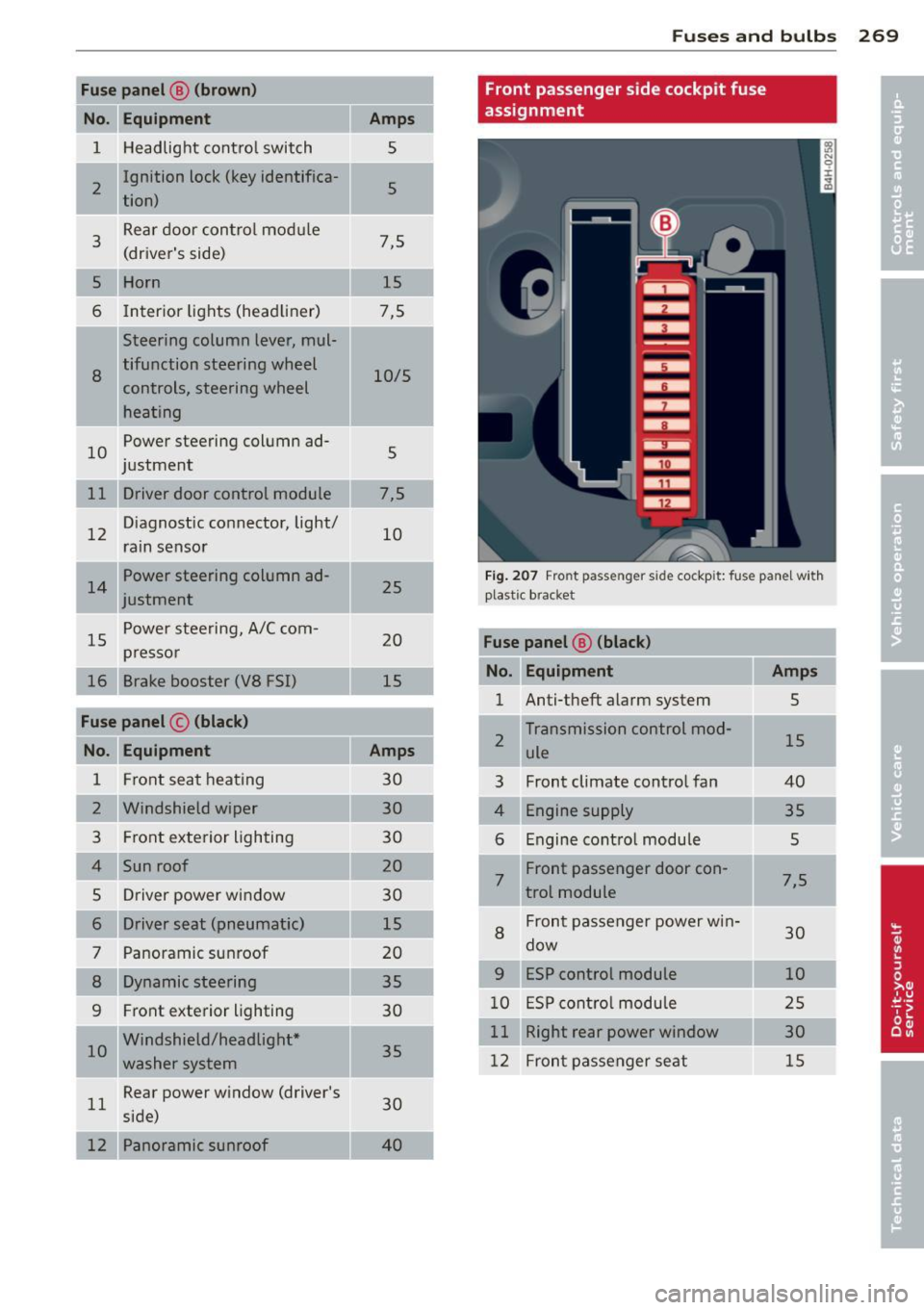
Fuse panel@ (brown)
No. Equ ipment
1 H eadlight contro l switch
I 2
Ignition lock (key identifica-
tion)
3
Rear door control mod ule
(driver's side)
5 Horn
6 Interior lights (head liner)
Steering column lever, mul-
8
tifunction steering wheel
controls, steering wheel
heating
10
Power steering column ad-
j ustment
11 Driver door control module
12
D iagnostic co nnector, light/
rain sensor
Power steering column ad-
justment
15
P ower stee ring, A/C com-
pr esso r
16 Brake booster (VS FSI)
Fuse panel © (black )
No. Equipment
1 F ront seat heating
2 Windshield wiper
3 Fr ont exterior lighting
4 Sun roof
5 Dr iver power window
6 Driver seat (pneumatic)
7 Panoramic sunroof
8 Dynamic steering
9 Fr
ont exterior lighting
I 10
Windshield/headlight *
washe r system
11
Rear power w indow (driver's
side)
12 Panoramic sunroof
Amp s
5
5
7,5 15
7,5
10/5
5
7,5 10
25
20
15
Amps
30 30
30
20
30
15
20 35
30
35
30
4 0
Fu se s and bulb s 269
Front passenger side cockpit fuse
assignment
Fi g. 2 07 Fro nt passe nger s id e co ckpit: f use pa nel w it h
plast ic brac ket
Fuse panel ® (black)
No . Equipment Amps
1 Anti-theft alarm system 5
2
Transmission control mod-
15 ule
3 Front climate control fan 40
4
Engine supply 35
6
Engine cont ro l module 5
7
Front passenger door con-7,5
t rot module
8
Fron t passe nger power w in-
30 dow
9 ESP control module 10
1 0
E S P cont ro l modu le 2 5
11
Right rear power window 30
12
Fron t passe nger seat 15
Page 273 of 302

Fuse panel@ (red)
No. Equipment
= '
I 6 Right headlight (headlight
with adaptive light)
I
7 ESP control module
8
9 Adaptive cruise control
Transmission control mod-
10 ule
11 Climate control system sen
sors
Fuse panel @ (brown)
No
. II Equipment
Electromechan ical parking
1 brake
2 Suspension control system
sensor
Right rear door control mod-
3 ule
4 Smart-Modul Tank
5 Front climate control system
controls
6 Rear climate control system
controls
7 Networking gateway
8 Refrigerator
Interface for spec ial func-
9 tions
12 Selector lever
13 Ambient lighting
14 Rear exterior lighting
15 Fuel pump
16 Electromechanical parking
brake
Fuse panel @ (black)
Equipment
3 Rear sockets*
5 adaptive air suspension
6 115-V socket
7 Electromechanical parking
brake
II
Amps
10
s
5
10
5
5
Amps
5
5
7,5 5
15
10 5
15
5
10
10
20
25
30
Amps
20
15
25
30
=
Fuses and bulbs 271
Fuse panel @ (black)
No. Equipment
8 Rear seat heating
9 Rear exterior lighting
10 Rear
climate control system
blower
Rear sun shade, closing aid,
11 luggage compartment lock,
keyless
go/entry, fuel filler
door
12 luggage compartment lid
control module
Fuse panel E (red)
No. Equipment
1 Rear
seat adjustment but-
tons
3 Left rear seat
(pneumatics)
5 Trailer hitch control modu le*
6 Left rear seat
7 Right rear seat
8 Trailer hitch control module*
9 Trailer hitch control module*
10 Right rear seat (pneumatics)
Fuse panel ® (brown)
No. Equipment
1 Radio receiver/sound ampli-
fier
Sound amplifier, Bang&
2 Olufsen Advanced Sound
System
Rear Seat Enterta inment, ra-
3 dio receiver/sound amplifier
Automatic dimming interior
5 rearview mirror, rearview
camera (parking aid)
6 DVD changer
7 TV tuner
8 MMI unit/drives
9
Instrument cluster, analog
clock
10 MMI Display
Amps
25
20
20
20
30
Amps
s
7,5
20
30
30
20
15
7,5
30
30 10
5
5
5
7,5
5
5
•
•
....
Page 276 of 302
2 7 4 Emergency situations
@ Tips
-The discharged battery must be properly
connected to the vehicle's electrical sys
tem. When jump starting or charging the
battery, never connect the negative
ground cable to the battery negative
post because the battery manager sys
tem must be able to detect the battery 's
state of charge. Always connect the neg
ative g round cable to the negative
ground post of the battery manager con
trol unit .
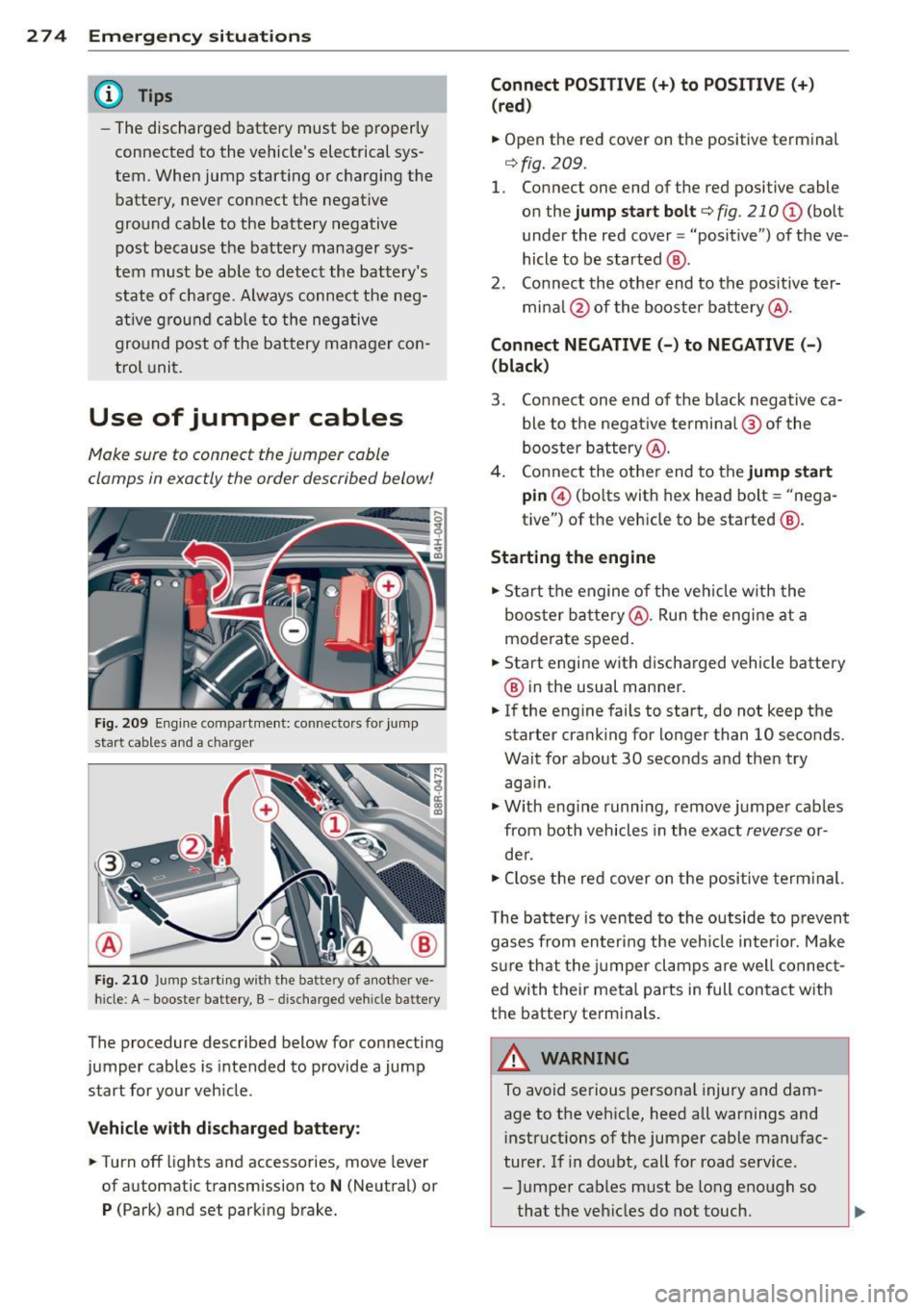
Use of jumper cables
Make sure to connect the jumper coble
clomps in exactly the order described below!
Fig . 209 Engine compartme nt: connecto rs for jump
start cab les and a charger
Fig. 210 Jump starting w ith the battery of another ve
h icle: A - boos ter battery, B - discharged veh icle battery
The procedure described below for connecting
jumper cables is intended to provide a jump
start for your veh icle.
Vehicle with discharged battery :
.. Turn off lights and accessories, move lever
of automatic transmission to
N (Neutral) or
P (Park) and set parking brake.
Connect POSITIVE(+) to POSITIVE(+)
(red)
.. Open the red cover on the positive terminal
¢fig. 209 .
1. Connect one end of the red positive cable
on the
jump start bolt ¢ fig. 210@ (bolt
under the red cover = "positive") of the ve
hicle to be started @.
2 . Connect the other end to the positive ter-
mi nal @of the booster battery@.
Connect NEGATIVE (-) to NEGATIVE (-)
(black)
3. Connect one end of the black negative ca
ble to the negat ive terminal @ of the
booster battery @.
4. Connect the other end to the
jump start
pin © (bolts with hex head bolt= "nega
tive") of the vehicle to be started @.
Starting the engine
.. Start the engine of the veh icle w ith the
booster battery @. Ru n the engine at a
moderate speed .
.. Start engine with discharged vehicle battery
@ in the usual manner .
.. If the engine fails to start, do not keep the
starter crank ing for longer than 10 seconds.
Wait for about 30 seconds and then try aga in .
.,. With engine running, remove jumper cables
from both vehicles in the exact
reverse or
de r .
.. Close the red cover on the positive term inal.
T he battery is vented to the outside to prevent
gases from entering the vehicle inter ior. Make
s ur e that the jumper clamps are well connect
ed with their meta l parts in full contact with
the battery terminals.
_& WARNING
To avoid se rious personal injury and dam
age to the vehicle, heed all warnings and
in structions of the jumper cable manufac
turer. If in doubt, call for road service .
- Jumper cables must be long enough so
that the veh icles do not touch.
-
Page 280 of 302

2 78 Emergency situations
-When removing heavy components like
these, ancho r vehicle to ho ist o r add cor
responding weig hts to ma inta in the cen
ter of g ravity. Othe rwise, the vehicle
m ight tilt o r slip off t he hoist, causi ng
serious p erson al inju ry .
@ Note
- Be awa re of the following points befo re
li fting the vehicle:
- The vehicle should never be lifted or
jacked up from underneath the engine
oil pan, the transmission housing , the
front or rear axle or the body side membe rs. This could lead to serious
damage.
- To avoid damage to the underbody or
chassis frame, a rubber pad must be
inserted between the floor jack and
the lift points.
- Before driving over a workshop hoist,
check that the vehicle we ight does not
exceed the permissible lifting capacity
of the hoist .
-Before driving over a workshop hoist,
ensure that there is sufficient clear
ance between the hoist and low parts
of the vehicle.