ECU AUDI A8 2011 Owner's Manual
[x] Cancel search | Manufacturer: AUDI, Model Year: 2011, Model line: A8, Model: AUDI A8 2011Pages: 302, PDF Size: 76.07 MB
Page 181 of 302
-Always make sure that the safety belt re
tractor is locked when installing a child
safety seat. An unlocked safety belt re
tractor cannot hold the child safety seat
in place during normal driving or in a
crash .
- Always buckle the child safety seat firmly
in place even if a child is not sitting in it.
A loose child safety seat can fly around
during a sudden stop or in a collision.
- Always make sure that the rear seat
backrest to which the center rear safety
belt is attached is securely latched when
ever the rear center safety belt is being
used to secure a child restraint.
- If the backrest is not securely latched,
the child and the child restraint will be
thrown forward together with the back
rest and will strike parts of the vehicle
interior. The child can be seriously in
jured or killed.
- Never install rear-facing child safety
seats or infant carriers on the front pas
senger seat. A child will be seriously in
jured and can be killed when the passen ger airbag inflates .
- The inflating airbag will hit the child
safety seat or infant carrier with great
force and will smash the child safety seat
and child against the backrest, center
armrest, door or roof.
- Always install rear-facing child safety
seats or infant carriers on the rear seat.
- Forward-facing child safety seats or in
fant carriers installed on the front pas
senger's seat may interfere with the de
ployment of the airbag and cause serious
injury to the child.
- It is safer to install a forward-facing
child safety seat on the rear seat.
- Always read and heed all WARNINGS
whenever using a child restrained in ave
hicle is being used
¢page 169. Special
precautions apply when installing a child
safety seat on the front passenger seat
¢ page 147, Child restraints on the front
seat -some important things to know.
Child Safety 1 79
A WARNING
-
Always take special precautions if you
must install a forward or rearward -facing
child restraint on the front passenger's
seat in exceptional situations:
- Whenever a forward or rearward -facing
child restraint is installed on the front
passenger seat, the
PASSENGER AIR
BAG OFF
light must come on and stay on
whenever the ignition is switched on.
- If the
PASSENGER AIR BAG OFF light
does not come on and stay on, perform
the checks described
¢page 156, Moni
toring the Advanced Airbag System.
- Take the child restraint off the front pas
senger seat and install it properly at one
of the rear seat positions if the
PASSEN
GER AIR BAG OFF
light does not stay on
whenever the ignition is switched on.
- Improper installation of child restraints
can reduce their effectiveness or even
prevent them from providing any protec
tion.
- An improperly installed child restraint
can interfere with the airbag as it de
ploys and seriously injure or even kill the
child .
- Always carefully follow the manufactur
er's instructions provided with the child
safety seat or carrier .
- Never place additional items on the seat
that can increase the total weight regis
tered by the weight-sensing mat and can
cause injury in a crash.
A WARNING
Forward-facing child restraints:
- Always make sure the forward-facing
seat has been designed and certified by
its manufacturer for use on a front seat
with a passenger front and side airbag.
- Never put the forward-facing child re
straint up, against or very near the in
strument panel.
- Always move the passenger seat into its
rearmost position in the seat's fore and
aft adjustment range, as far away from •
•
Page 183 of 302
-Always buckle the child safety seat firmly
in place even if a child is not sitting in it.
A loose child safety seat can fly around during a sudden stop or in a crash.
- Always make sure the seat backrest to
which the child restraint is installed is in
an upright position and securely latched
into place and cannot fold forward. Oth
erwise, the seatback with the child safety
seat attached to it could fly forward in
the event of an accident or other emer gency situation.
- Always read and heed all WARNINGS
whenever using a child restrained in ave
hicle is being used
Q page 169. Special
precautions apply when installing a child
safety seat on the front passenger seat
Q page 147, Child restraints on the front
seat -some important things to know.
Deactivating the convertible locking
retractor
The convertible locking retractor for child re
straints will be deactivated automatically when the belt is wound all the way back into
the retractor .
.. Press the red button on the safety belt buck
le . The belt tongue will pop out of the buck
le.
.. Guide the safety belt all the way back into
its stowed position.
Always let the safety belt retract completely into its stowed position. The safety belt can
now be used as an ordinary safety belt with
out the convertible locking retractor for child
restraints.
If the convertible locking retractor should be
activated inadvertently, the safety belt must
be unfastened and guided completely back in
to its stowed position to deactivate this fea
ture. If the convertible locking retractor is not
deactivated, the safety belt will gradually be
come tighter and uncomfortable to wear.
Child Safety 181
A WARNING
Improperly installed child safety seats in
crease the risk of serious personal injury
and death in a collision.
- Never unfasten the safety belt to deacti
vate the convertible locking retractor for
child restraints while the vehicle is mov ing. You would not be restrained and
could be seriously injured in an accident.
- Always read and heed all WARNINGS
whenever using a child restrained in ave
hicle is being used¢
page 169. Special
precautions apply when installing a child
safety seat on the front passenger seat
¢ page 147, Child restraints on the front
seat -some important things to know.
LATCH Lower
anchorages and tethers
for children
Child Restraint System anchors and how
are they related to child safety
To provide a simpler and more practicable way
to attach the child restraint on the vehicle
seat, Federal regulations require special lower
anchorages in vehicles and devices on new
child restraints to attach to the vehicle ancho
rages .
The combination of the tether anchorages and
the lower anchorages is now generally called
the
LATCH system for " Lower Anchorages and
Tethers for Children."
Forward-facing child restraints manufactured
after September 1, 1999, are required by U.S.
federal regulations to comply with new child
head movement performance requirements .
These new performance requirements make a
tether necessary on most new child seats.
Installing a child restraint that requires a top
tether without one can seriously impair the
performance of the child restraint and its abil
ity to protect the child in a collision. Installing
a child restraint that requires a top tether ..,. •
•
Page 185 of 302
Lower ancho rag es
The lower anchorage attachment points are
located between the rear seatback and rear
seat c ushion
¢ fig. 164.
Lower anchorages secure the child restraint in
the seat witho ut using the vehicle 's safety
be lts . Anchorages provide a secure and easy
to- use attachment and minimize the possibili
ty of improper chi ld restraint installation.
All ch ild restra ints man ufact ured after Sep
tember 1, 2002, must have lower anchorage
attachments for the
LATCH system.
Remembe r that the lowe r anchorage points
are only intended for i nstallation and attach
ment of child restraints specifical ly certified
for use with
LATCH l ower anchorages . Child
restra ints that are not equipped with the low
er anchorage attachments can still be instal led in compliance with the c hild restra int
manufacturer's instruct ions on using vehicle
safety belts .
_&, WARNING
Improper use of LATCH lower anchorages
can cause serious personal i njury in an ac
cident .
- Always carefully fo llow the ch ild re
straints manufacturer's inst ruct ions for
proper installation of the child restra in t
and proper use of the lower anchorages
or safety belts in your vehicle .
- Never secure o r attach any l uggage or
other items to the
LATCH lower ancho
rages.
- Always read and heed the important in
formation about child restra ints in this
chapter and WARNINGS
¢ page 169,
Child Safety .
Child Safety 183
Guidance fixtures for lower anchorages
Special guidance fixtures increase the conven
ience of the lower anchorages and ore ovoilo
ble from your authorized Audi dealer .
Fig . 1 65 Outer r ear seats : inst alling the gu idanc e fix
t u res
8 ± ... a,
Fig . 1 66 Close-up: fitt ing t he g uida nce fixture over the
l ower ancho rage bracket
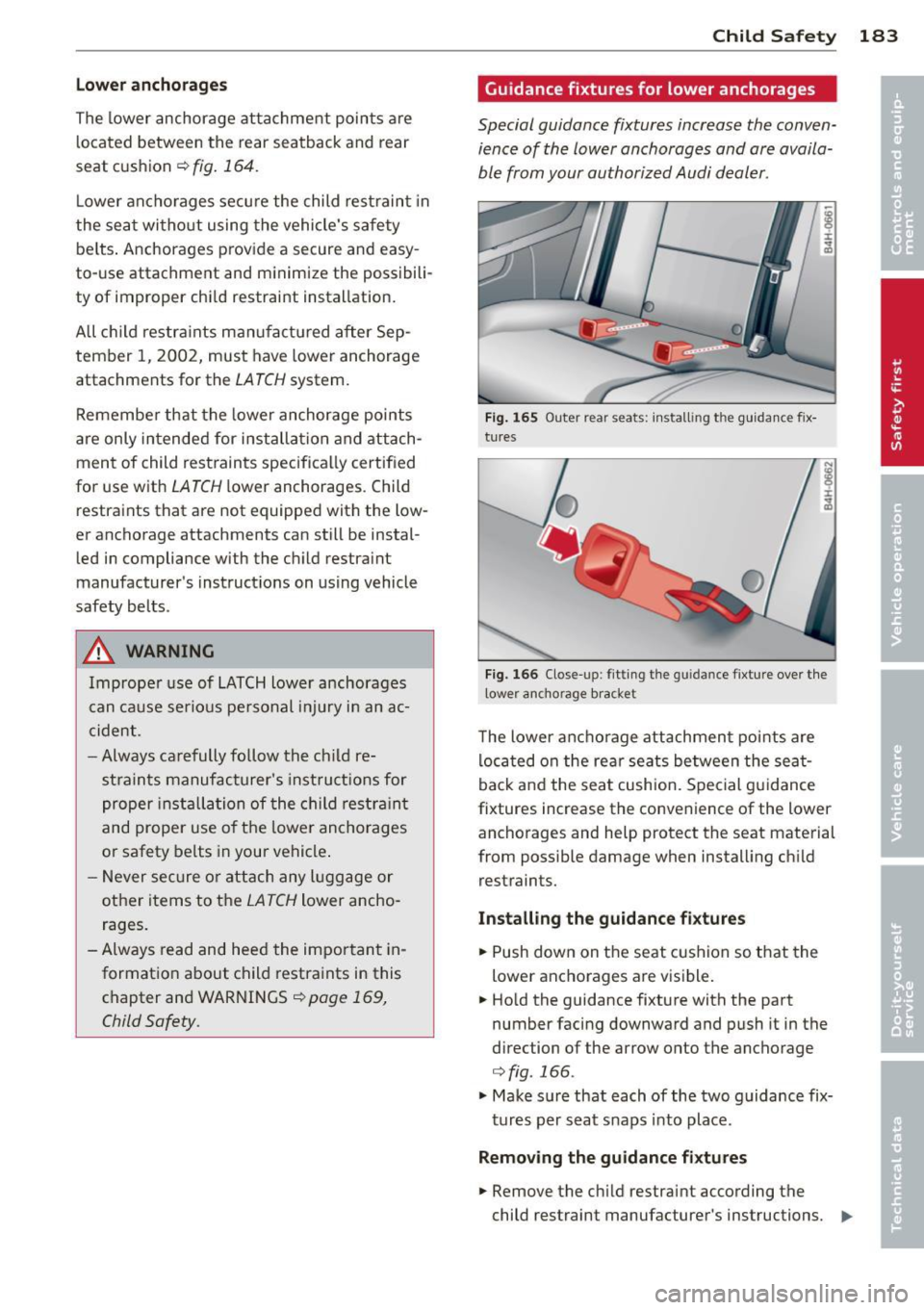
T he lower ancho rage attachment poi nts are
located on the rear seats between the seat
back and the seat cushion. Special guidance
fixtures increase the convenience of the lower
anchorages and help protect the seat material
from possible damage when install ing ch ild
restraints.
Installing the guidanc e fixture s
.,. Push down on the seat cushion so that the
lower anchorages are visible .
.,. Ho ld the guidance fixture with the part
number facing downward and push it in the
direction of the arrow onto the anchorage
¢ fig . 166 .
.,. Make su re that each of the two guidance fix
tures per seat snaps into place .
Removing the gu idance fixtures
.,. Remove the ch ild restraint according the
child restraint manufacturer's instructions. .,..
Page 186 of 302
184 Child Safet y
• Push down on the seat cushion so that the
lower anchorages are visib le.
• Pull
off the guidance fixtures from the lower
anchorages.
• Always remove the guidance fixtures and
keep them in a safe place when not in use.
You may find it easier to install child re
straints equipped with hooks attached to
straps without the guidance fixtures in place.
If this is the case, remove the guidance fix
tures by pull ing them
off the anchorages .
H oweve r, the guidance fixtu res can he lp you
to locate the
LATCH ancho rages.
.&_ WARNING
Imprope r use of tether anchorages or low
er anchorages ca n cause serious persona l
injury in a crash .
- Always carefully fo llow the child re
straint manufacturer 's instructions for
proper insta llation and use of child re
straint systems .
- Never use the
LATCH or tethe r anchorag
es to attach safety belts or other kinds of
occupant restraints.
- Child restraint tether attachments and
lower attachments are only des igned to
secure a child restraint t hat has been
equipped to use these anchorages.
- Tether anchorages and lower anchorages
are designed to withstand only those
loads imposed by correctly fitted ch ild
restraints. Under no circumsta nces can
they be used safely for adu lt or chi ld
safety belts o r harnesses.
- Never mou nt more than one ch ild re
stra in t to a sing le tether or to a low er an
c ho rage poin t. Attac hing two chi ld re
st rain ts to a sing le anchor age poi nt can
cause the anchorage to fail and cause se
rious persona l injury in a crash .
0 Note
- Remove the guidan ce fixt ures before
fo ld ing t he rear sea tba ck t o preven t
dam aging the seat c ushion . -
To attach the ch ild restraint sec urely, the
seat must be moved to the farthest rear
posit ion, the seat height set to the low
est position and t he head restraint must
be adjusted to the vertical position
¢page 57.
-If you leave the guidance f ixtures instal
led for several days , they could leave a
mark on the upholstery on the seat cush
ion and back rest in the area that the
guidance fixtures were installed . T he up
holste ry wou ld al so be pe rmanen tly
stretched aro und the gui dance fix tures.
Th is ap plies especia lly to lea ther seats .
Installing a child restraint with LATCH
lower anchorages
Whenever you install a child restraint always
follow the child restraint manufacturer's in
structions.
F ig. 167 Lowe r a nchorages: proper mount ing
Mounting
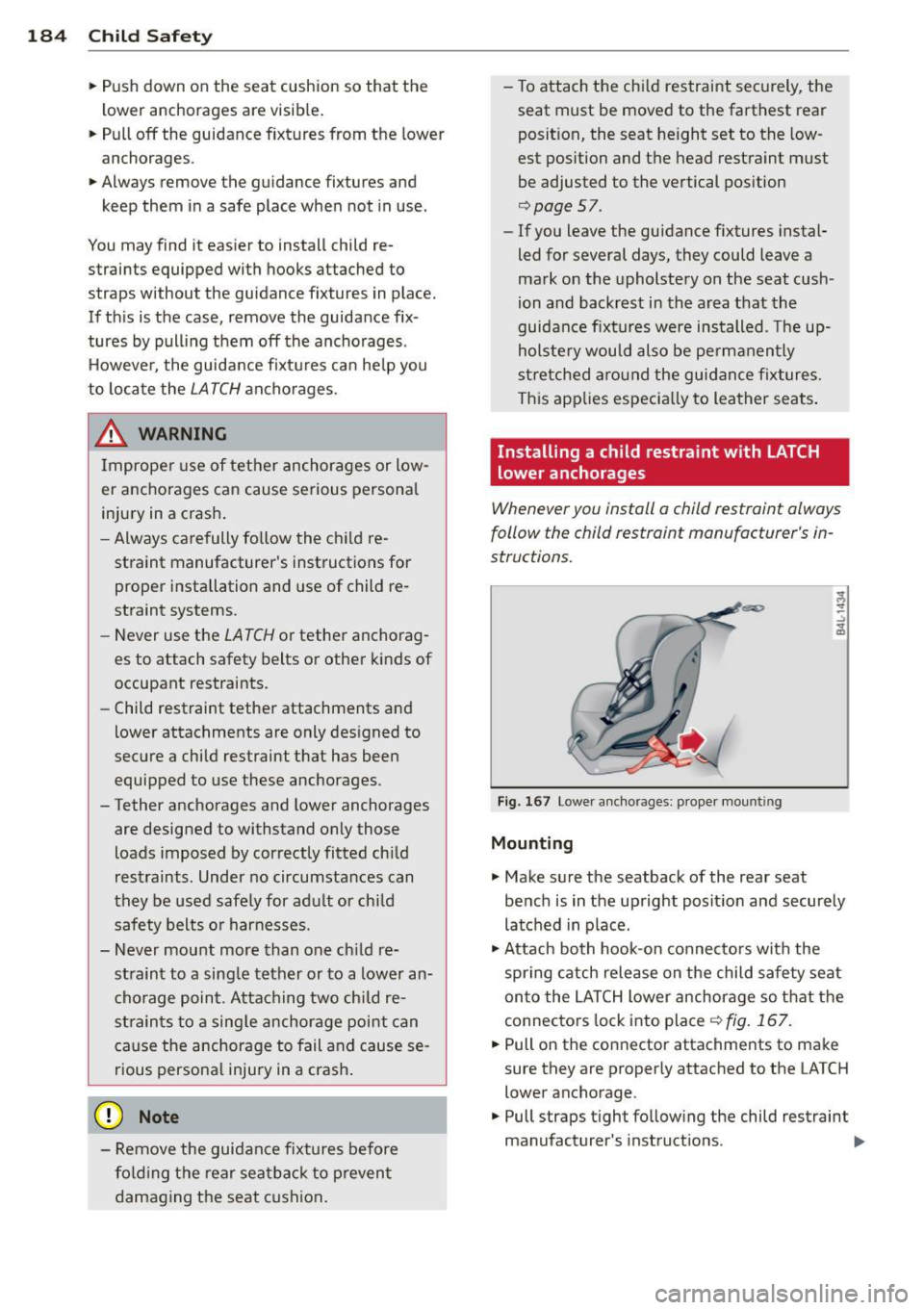
• Make sure the seatback of the rear seat
bench is in the upright posit ion and securely
latched in place .
• Attach bo th hook-on connectors with the
spring catch release on the child safety seat
on to the LATCH lower anchorage so that the
connecto rs lock into place
¢ fig. 167.
•Pullon the connector attachments to make
sure they are proper ly attached to the LATCH
lower anchorage .
• Pull straps tight following the child restraint
manufacturer's instruct io ns. .,,.
Page 187 of 302
Releasin g
• Loosen the tension on the straps following
the chi ld restraint manufacturer's instruc
tions .
• Depress the spring catches to release the
anchorage hooks from the lower anchorag
es.
Remember: Use tether straps to help keep the
child restraint firmly in p lace.
A WARNING
Improper use of the LATCH system can in
crease the risk of serious personal injury
and death in an acc ident.
- These anchors were developed only for
child safety seats us ing the "LATCH" sys
tem .
- Never attach other child safety seats,
belts or other objects to these anchors .
- Always make sure that you hear a click
when latching the seat in place. If you do
not hear a click the seat is not secure and
cou ld fly forward and h it the interior of
the vehicle, or be ejected from the vehi cl e.
A WARNING
Imprope r insta llation of chi ld restr aint s
w ill increase the risk of inju ry in an acc i
dent.
- Always fol low the child rest raint sys tem
man ufacturer's instr uctions for proper
installation of the child restraint system
and proper use of tethe r straps as we ll as
the lower anchorages or safety belts in
your vehicle.
- Always read and heed the important in
format ion and WARNINGS about child
safety and the installation of child re
straint systems
q page 169, Child Safe
ty .
(D Note
On veh icles with power adjustable rear
seats* some criter ia must be observed
Child S afety 185
when attaching the ch ild restraint using
the
LATCH system:
- T o attach the chi ld restraint securely, the
seat must be moved to the farthest rear
position, the seat height set to the low
est position and the head restraint must
be adjusted to the vertical pos ition
9page57.
- If a child safety seat is attached to one of
the rear seats, this seat must not be ad
justed using the power controls under
any c ircumstances. The
Entry assistanc e
for this seat must also be deactivated in
the MM I
9 page 60. The child safe ty seat
as well as the rear seat can be damage d
by t he a dju stmen t process.
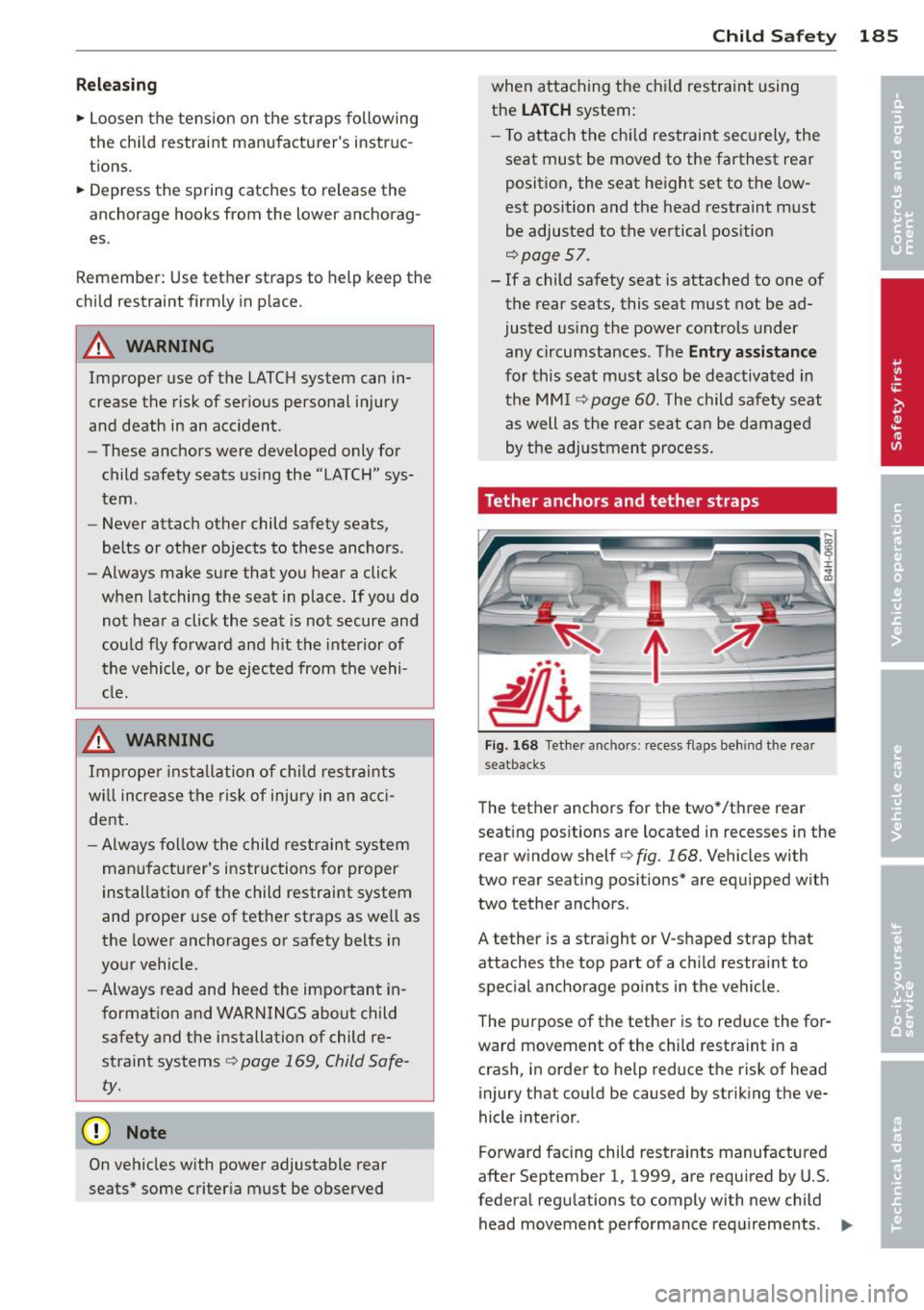
Tether anchors and tether straps
Fig. 168 Tet her anc hor s: recess flaps beh ind t he rea r
seatbacks
The tether anchors for the two * /t hree rear
seat ing pos itions are located in recesses in the
rear window shelf
q fig . 168. Vehicles with
two rear seating positions* are equipped w ith
two tether anchors .
A tether is a stra ight or V-s haped strap that
attaches the top part of a ch ild restraint to
special anchorage points in the vehicle.
The purpose of the tether is to reduce the for
ward movement of the child restraint in a
crash , in order to help reduce the risk of head
injury that could be caused by striking the ve
hicle interior .
Forward facing child restraints manufactured
after September 1, 1999, are requ ired by U.S.
federal regulations to comply with new child head movement performa nce requ irements .
II-
Page 188 of 302
186 Child Safet y
These new performance requirements make a
tether necessary on most new child safety
seats.
.&_ WARNING
Improper insta llation of child restraints
wi ll increase the risk of injury and death in
a crash.
- Always follow the instructions prov ided
by the manufacturer of the ch ild re
straint you intend to install in your Audi .
- Improper use of child restra int anchors
(including tether anchors) can lead to in
jury in a collision. The anchors are de
signed to withstand on ly those loads im
posed by cor rect ly fitted ch ild restraints.
- Never mou nt two ch ild restraint systems
on one LA T CH lower ancho r po int.
- Never attach two child restraint systems
to one tethe r strap or tether anchorage.
- Never attach a tether strap to a tie-down hook in the luggage compartment.
- Never use c hild restraint tether ancho
rages to secure safety belts o r other
k inds of occ upant restra ints.
- Never secure or attach any luggage or other items to the LATC H lowe r ancho
rages or to the tethe r anchors.
- If a tether or othe r strap is used to at
tac h a child rest raint to the front passen
ger seat, make sure that it is not so
t ight, that it causes the we ight-sensi ng
mat to measure more weight than is ac
t u a lly on t he seat.
- T he heav ier we ight reg iste red can make
t he Advanced Airbag Sys tem work as
though an adult were on the seat and de
ploy the Advanced Airbag when it must
be s uppressed causing serious or even
fatal injury to the child.
- If you must install a rearward facing
child safety seat on the front passenger
seat beca use of exceptional circ umstan
ces and the
PASSENGER AIR BAG OFF
light does no t come on and stay on, im
med iately install the rea r-facing child
safety seat in a rear seating position a nd
-
have the airbag system inspected by your
Aud i dea ler.
Installing the upper tether strap on the
anchorage
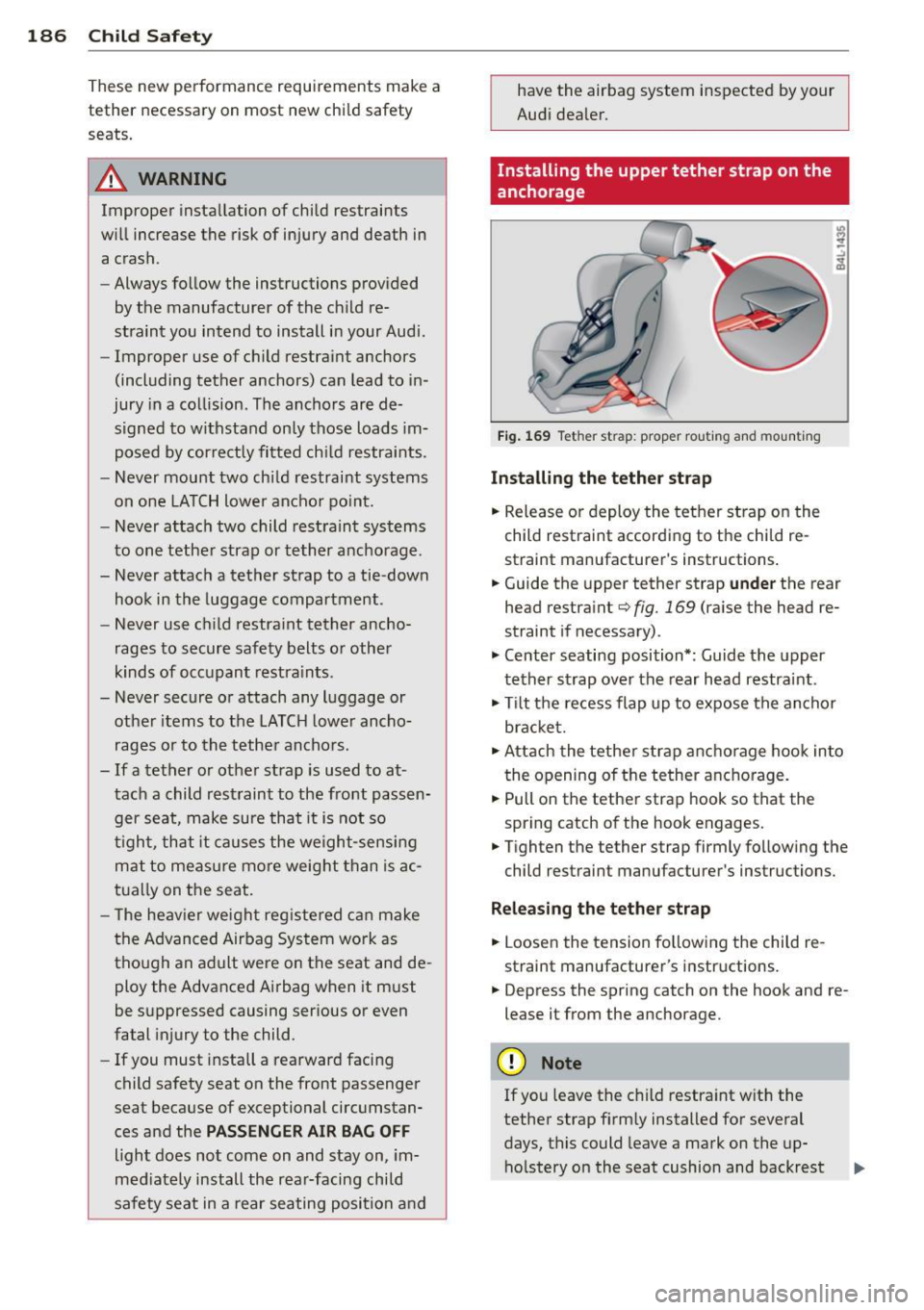
F ig . 1 69 Tether strap: proper ro uting and mount ing
Installing the tether strap
"' Release or deploy the tether st rap on the
child restraint according to the child re
straint manufacturer's instructions .
"' Guide the upper tether strap
under the rear
head restra int¢
fig. 169 (ra ise the head re
straint if necessary) .
"' Center seating position*: Guide the upper
tether strap over the rear head restra int.
"' Tilt the recess flap up to expose the an chor
b racket.
"' Att ach the tether strap ancho rage hook in to
the opening of the tethe r ancho rage.
"' Pull on the tether strap hook so that the
spring catch o f the hook engages.
"' Tighten the tether strap firmly fo llow ing the
child restraint manufacturer's instructions.
Releasing the tether strap
"'Loosen the tension fo llow ing the child re
straint manufacture r's in str uctions.
"' Depress the spring catch on the hook and re
lease it from the anchorage.
(D Note
If yo u leave the c hild restra int w it h the
tether strap firm ly installed for seve ral
days, this could leave a mark on the up
ho lstery on the seat cushion and backrest
Page 204 of 302
202 Trailer towing
Trailer towing
Driving with a trailer
General information
Your Audi was designed primarily for passen
ger transportation .
If you plan to tow a trai ler, please remember
that the additional load will affect durability,
economy and performance .
Trailer towing not on ly places more stress on
the vehicle, it also calls for more concentra
tion from the driver.
For this reason, always fo llow the operating
and driving instructions provided and use
common sense.
(D Note
If you are going to tow a trai ler, you must
activate the trailer operation mode
i::> page 202, Operating instructions .
Technical requirements
Trailer hitch
Use a weight-carrying hitch conforming to the
gross trailer weight. The hitch must be suita ble for your vehicle and trailer and must be
mounted securely on the veh icle's chassis at a
technically sound location. Use only a trailer
hitch with a removable ball mount. Always
check with the trailer hitch manufacturer to
make sure that you are using the correct
hitch.
Do not use a bumper hitch.
The hitch must be installed in such a way that
it does not interfere with the impact-absorb
ing bumper system. No modifications should
be made to the vehicle exhaust and brake sys
tems. From time to time, check that all hitch
mounting bolts remain securely fastened.
When you are not towing a trailer, remove the
trailer hitch ball mount. This prevents the
hitch from causing damage should your vehi
cle be struck from behind~ &.
Trailer brakes
If your trailer is equipped with a brak ing sys
tem, check to be sure that it conforms to all
regulations.
T he trailer hydraulic brake system must not be
direc tly connected to the vehicle's hydraulic
brake system .
Safety chains
Always use safety chains between your veh icle
and the tra iler.
Trailer lights
Trailer lights must meet all regulations. Be
sure to check with your Audi dealer for correct
wiring, switches and relays.
Mirrors
If you are unable to see the traffic behind you
using the regular outside mirrors, then you
must install extended mirrors. It is important
that you
always have clear v is io n to the rear .
A WARNING ,~ -
After removing the trailer hitch, do not
store it in your vehicle. In case of sudden
braking, the hitch could fly forward and in
jure you or your passengers.
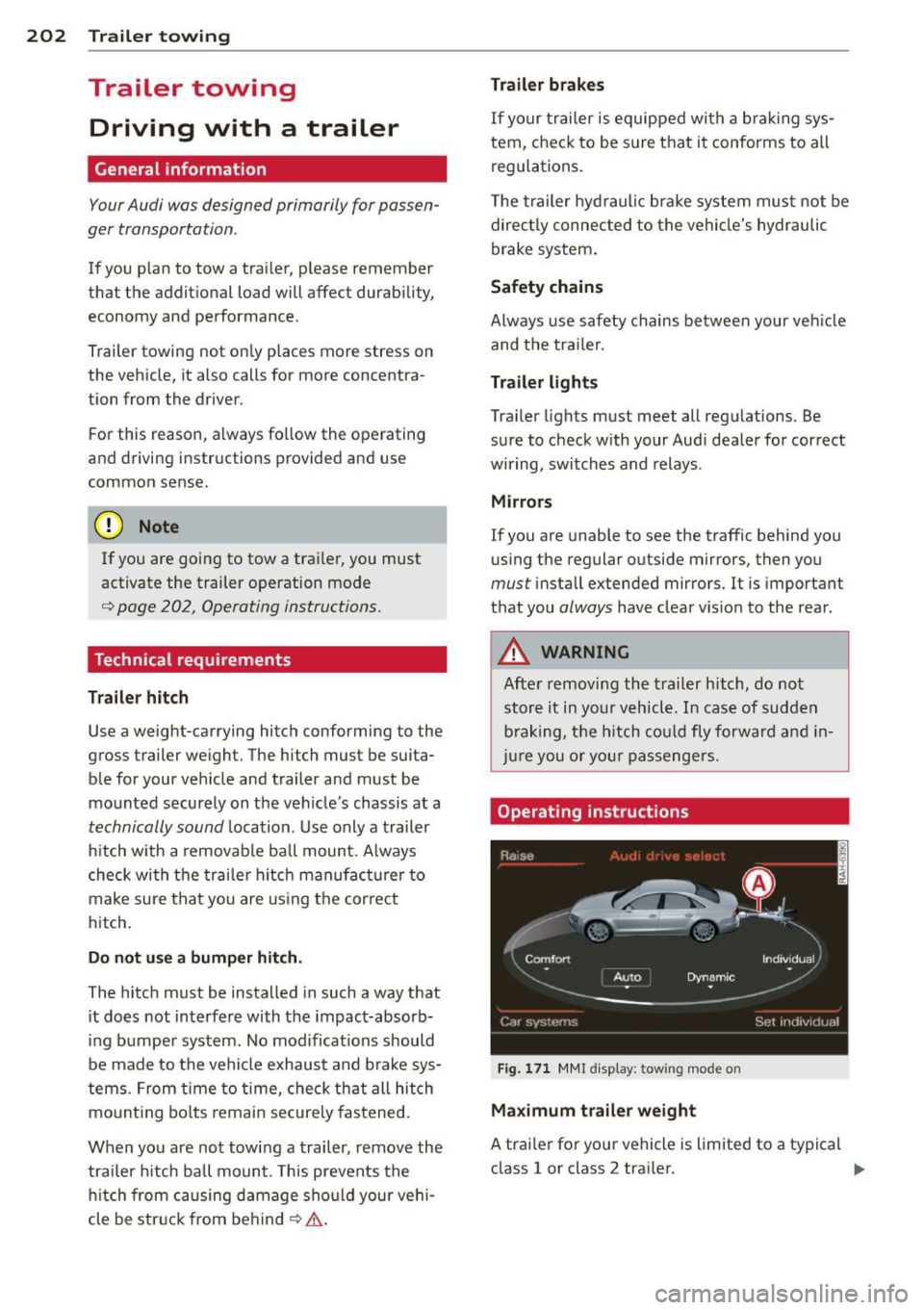
Operating instructions
Fig. 171 MMI display : tow ing mode on
Maximum trailer weight
A trailer for your vehicle is limited to a typical
class 1 or class 2 trailer. .,.
Page 205 of 302
Trailer lo ad di stri bu tion
Be s ure the load in the trai ler is held securely
in place to prevent it from shifting forward,
backward or sideways.
N eve r allow a p assenger to rid e in a tr ailer
,=:, .&. in Driving instructions on page 204.
Engine cooling s ystem
Towing a tra iler makes the eng ine work hard
er . It is important that the cooling system's
pe rformance is up to the addit ional load .
Make sure that the cooling system has enough
fluid.
Tire p res sure
When tow ing a trailer, inflate the t ires of your
vehicle to the co ld tire pressure listed under
" Full load " on the label located on the dr iver's
side B-pillar (v is ible when the door is open).
I nflate trailer tires to tra iler and t ire manufac
turers' specifications.
Lights
Check to make sure both veh icle and trailer
lights are working properly .
Safety chain s
Be sure trailer safety cha ins are properly con
nected from the trailer to the hitch on the ve
h icle . Leave enough slack in the chains to per
mit turn ing corners . When you install safety
cha ins, make sure they w ill not drag on the
r oad when yo u are driving.
The chains should cross under the trailer
tongue to prevent it from dropping in case of
sepa rat ion from the hitch .
Adjusting the air su spens ion an d damping
s y stem
Ensure the follow ing b efore coupling the trai l
e r and
b efo re adjusting the tongue weight on
the trailer:
- For the veh icle to be at the normal level, the
A uto or Comfort driv ing mode must be se
lected
,=:, page 10 7, Selecting the driving
mode. The vehicle must a lso not be raised
,=:, page 108 .
Trailer to win g 203
-If the trailer was detected automatically, a
trailer hitch wi ll appear on the veh icl e@ in
the
Aud i dr ive se lect menu (MMI > ICARI
function button)
,=:, fig. 171. If this does no t
happen , turn the towing mode on in the
MMI. Select: I CAR I funct ion button>
C ar
sys tem s
control button > Vehicle setting s >
Air su sp en sion: t owing > O n.
- Turn towing mode off if you secure a carrier
system such as a bicycle rack on the trailer
hitch. Se lect in the M MI: ICAR !function but
ton >
Car syste m s control button > Vehi cle
se tting s
> Air su spen sion : towin g > Off.
If you must drive under poor road conditions,
you can raise the vehicle
aft er coupling the
tra iler or
aft er adjust ing the tongue we ight
,=:, page 108.
(D Note
If you a re going to tow a t railer, you must
activate the tra iler operation mode .
Driving instructions
Driving with a trailer always requires extra
care and consideration .
To obtain the best possible handling of vehicle and trailer, please note the follow ing :
.,. Do not tow a loaded trailer when your car it
self is no t loaded.
.,. Be especially careful when passing other ve
hicles .
.,. Obse rve speed limits .
.,. Do not dr ive at the max imum permissib le
speed.
.,. Always app ly brakes early .
.,. Monitor the temperature gauge.
Weight distribution
Towing a loaded t railer with an empty car re
s ul ts in a highly unstable distribution of
weight. If this cannot be avoided, dr ive at very
low speeds on ly to avoid the risk of losing
steering contro l.
A "balanced " rig is easier to operate and con
trol. This means tha t the tow vehicle should
be loaded to the extent possible and
IJI>
•
•
Page 225 of 302

-Never smoke or work near heate rs or
open flames. Fluids in the engine com
partment could start a fire.
- Keep an approved fire extinguisher im
mediately ava ilable.
- To avoid elect rical shock and persona l in
jury while the engine is running or be ing
started, never touch:
- I gnition cables
- Othe r components of the high voltage
e lectronic ignition system.
- If you must pe rform a check or repair
with the engine running:
- F irst, fully apply the pa rking brake,
move selector lever to "P" (Park) .
- Always use extreme caution to prevent
clothing, jewelry, or long hai r from get
ting caught in the radiator fan, V-belts
or other moving parts, or from contact ing hot parts. T ie back hair before
starting, and do not wear cloth ing that
will ha ng or droop into the eng ine.
- Min imize exposure to emission and
c h emical hazards
c:> &,.
A WARNING
California Propos ition 65 Warning:
- Engine exhaust, some of its constituents,
and certai n veh icle components co nta in
or em it chemicals known to the State of
Californ ia to cause cancer a nd b irth d e
fects a nd rep roduct ive ha rm. In addi tion,
c e rta in fluids cont ained in vehicle s and
c ertain p rod ucts of component wear con
tain or emit chemicals known to the
State of Ca lifo rnia to cause cancer and
birth defects or other reproductive harm.
- Battery posts, terminals and related ac
cessories contain lead and lead com-
Checkin g and fillin g 223
poun ds, c hemicals known to the State of
California to cause cancer and reproduc
tive harms. Wash hands after handling.
([) Note
When adding fluids, always make su re that
they are poured into the p roper conta iner
or fi ller opening, otherwise serious dam
age to vehicle systems w ill occur .
@ For the sake of the environment
To detect lea ks in time, inspect the vehicle
floor pan from underneath regular ly. If
you see spots from oil or other veh icle flu
i ds, have you r vehicle inspected by an au
thorized Audi dea ler.
Closing the engine hood
.. Pull the hood down until the pressure from
t he st ruts is reduced.
.. Let the hood
drop down a nd l atc h in pla ce.
Do not try to push it shut; it may fail to en
gage ~ A_.
A WARNING
-
A hood that is not completely latched
could fly up and block your view while dr iv
i ng.
- When you close the engine hood, chec k it
to make sure t he safety catch has prope r
ly engaged. The hood shou ld be flush
with the surround ing vehicle body parts .
- If you notice while driv ing that the hood
is not secured prope rly, stop at once and
close it. •
•
Page 248 of 302
246 Tires and wheels
valve stem caps on all wheels are secure ly
mounted on the valve .
@ For the sake of the environment
Underinflated tires will also increase the
fue l consumption.
Tires and vehicle load limits
There are limits to the amount of load or
weight that any vehicle and any tire can carry.
A vehicle that is overloaded will not handle
well and is more difficult to stop. Overloading
can not only lead to loss of vehicle control, but can also damage important parts of the
vehicle and can lead to sudden tire failure, in
cluding a blowout and sudden deflation that
can cause the vehicle to crash.
Your safety and that of your passengers also
depends on making sure that load limits are
not exceeded. Vehicle load includes everybody
and everyth ing in and on the vehicle. These
l oad limits are techn ica lly referred to as the
vehicle's
Gross Vehicle Weight Rating
("GVWR").
The "GVWR" includes the we ight of the basic
vehicle, all factory installed accessories, a full
tank of fuel , oil, coo lant and other fluids plus
maximum load. The maximum load includes
the number of passengers that the vehicle is
intended to carry ("seating capacity") with an
assumed weight of 150 lbs (68 kg) for each
passenger at a des ignated seat ing pos ition
and the tota l we ight of any luggage in the ve
hicle. If you tow a trailer, the weight of the
trailer hitch and the tongue weight of the
l oaded trailer must be included as part of the
vehicle load.
The
Gross Axle Weight Rating ("GAWR") is
the maximum load that can be applied at each
of the vehicle's two axles.
The G ross Vehicle Weight Rating and the
Gross Axle Weight Rating are listed on the
safety compliance sticker labe l located on the
driver's side B-p illar. You r A udi has 5 seat ing
positions, 2 in the front and 3 in the rear for
total seating capacity of 5. Vehicles with pow- er individual rear seats* have
4 seating posi
tions,
2 in the front and 2 in the rear for total
seat ing capac ity of
4. Each seating position
has a safety belt¢
page 137, Safety belts.
The fact that there is an upper limit to your
vehicle's Gross Vehicle Weight Rating means
that the total weight of whatever is being car
ried in the vehicle (including the weight of a
trailer hitch and the tongue weight of the
loaded trailer) is lim ited . The more passen
gers in the vehicle or passengers who are
heavier than the standard we ights assumed
mean that less we ight can be carried as lug
gage.
The tire pressure label on your Audi also lists
the max imum combined weight of a ll of the
occupants and luggage or other cargo that
the vehicle can carry. For the location of the
label¢
page 242, fig. 184.
A WARNING ,___
Overloading a vehicle can cause loss of ve
h icl e contro l, a crash or other accident, se
rious personal injury, and even death.
- Carrying more weight than your vehicle
was designed to carry will prevent the
vehicle from handling properly and in
crease the risk of the loss of vehicle con
trol.
- The brakes on a vehicle that has been
overloaded may not be able to stop the
veh icle with in a safe distance.
- Tires on a vehicle that has been overload
ed can fail suddenly, including a blowout
and sudden deflation, causing loss of
control and a crash.
- Always make sure that the total load be
ing transported -including the weight of
a trailer hitch and the tongue we ight of a
loaded trailer -does not make the vehi
cle heavier than the vehicle's G ross Vehi
cle Weight Rating.