brakes AUDI A8 2011 Owner's Manual
[x] Cancel search | Manufacturer: AUDI, Model Year: 2011, Model line: A8, Model: AUDI A8 2011Pages: 302, PDF Size: 76.07 MB
Page 206 of 302
204 Trailer towing
pe rmissible, while keep ing the trailer as light
as possible under the circumstances. Whenev
er possib le, transfer some cargo to the lug
gage compartment of the tow veh icle while
observing tongue load requirements and vehi
cle load ing considerations.
Spee d
The higher the speed, the more difficult it be
comes for the dr iver to control the rig . Do not
drive at the maximum permissible speed . Re
duce your speed even more if load, weather or
wind condit ions are unfavorable -part icu larly
when going downhill.
Reduce vehicle speed
immediately if the trail
er shows the slightest sig n of swaying.
Do not
try to stop the swaying by acc eler ating .
Observe speed limits. In some areas, speeds
for vehicles towing trailers are lower than for regular vehicles.
A lways apply brakes ear ly . When driving
downhill, shift into a lower gear to use the en
g ine braking effect to slow the vehicle. Use of
the brakes alone can cause them to overheat
and fail.
Coolant t emperatu re
The coolant temperature gauge¢ page 10
must be observed carefully. The coo lant tem
perature can increase if you drive on long in
clines in a low gear at high engine speeds . Re
duce your speed immed iate ly if the LEDs in
the top pa rt of the display turn o n.
For more informat ion about indicator lights,
refer to. ¢
page 15.
A WARNING
Anyone not p roperly restrained in a mov
ing veh icle is at a much greater risk in an
accident. Never let anyone r ide in your car
who is no t prope rly wear ing the restra ints
provided by Aud i.
-
Trailer towing tips
Important to know
You r ve hicle handles d ifferently when towing
a trai le r be cause of the additional weig ht and
differen t weigh t distr ib ution. Sa fety, per fo rm
ance and economy will great ly depend on how
carefully you load your trai ler and operate
your rig.
Be fore you act ua lly tow yo ur tra iler, p ract ice
tu rning, s topping and backing up in an area
away from t raffic . Keep practicing unti l yo u
have become completely familiar wit h the way
yo ur vehicle-tra ile r combination behaves and
responds.
Backing up is diffic ult and requires practice .
Bac king up w ith a trailer gene rally req uires
stee ring action opposite to that when backing
up your vehicle without a tra iler.
Maintain a greater d istance between your ve
hicle and the one in front of you . You wi ll need
more room to stop. To compensate for the
trailer, you w ill need a larger than normal
turning rad ius .
When passing, remember that you cannot ac ce lerate as fast as you norma lly would be
cause of the added load. Make sure you have
enough room to pass. After passing, a llow
plen ty of room for your t railer before cha ng
i ng lanes again .
Avoid jerky starts, sharp turns o r rapid lane
changes .
(D Tips
- Do not tow a trailer during the break-in
period of your vehicle.
- If you tow a trailer, your Audi may re
quire more frequent maintenance due to
the extra load ¢
page 283.
Page 207 of 302
Parking on a slope
Do not pork on a slope with a trailer. If it can
not be avoided, do so only ofter doing the fol
lowing:
When parking:
.. Apply the foot brake .
.,. Have someone place chocks under both the
vehicle and the trailer wheels .
.,. With chocks in place, slowly release the
brakes until the whee l chocks absorb the
load .
.. Turn the wheels towa rds the curb .
.. Apply the parking brake .
.. Se lect the
P se lector lever position.
When restarting after parking:
.. Apply the foot brake .
.,. Start the engine .
.. Select the
D se lector lever position .
.. Release the parking brake and slowly pull
out and away from the wheel chocks .
.. Stop and have someone retrieve the wheel
chocks.
If you move the selector lever of the auto
matic transmission to
P before applying
the parking brake and before blocking the
wheels, you may have to use more force
later to move the lever out of the
P posi
tion .
Trailer towing 205
•
•
Page 208 of 302
206 Cleaning and protection
Cleaning and protect ion
General information
Regular care preserves vehicle value.
Any automobile is exposed to industrial
fumes, corrosive road salt, etc. A well cared
for Audi can look like new many years after
purchase . Regular and correct care w ill con
tr ibute to maintaining the beauty and value of
your Aud i.
Furthermore, good care may be a condition
for substantiating a warranty claim should
corrosion damage or paint defects occur.
Your author ized Audi dealer has a variety of
dedicated vehicle-care products and can ad
vise which ones to use for cleaning the exter i
or and interior of your vehicle .
Whether you use products recommended by
Aud i or other commercially available clean ing
agents, please make sure you apply them cor
rectly .
A WARNING
-Cleaning agents may be poisonous. Keep
them out of the reach of children.
- Heed all caution labels.
- Always read directions on the container
before using any product. Follow the di
rect ions carefu lly.
- Most chemical cleaners are concentrated
and have to be diluted.
- Use spot removing fluids only in well
ventilated areas.
- Do not use gasoline, kerosene, d iesel
fuel, nail pol ish remover or other volatile
fluids. They may be toxic, flammab le or
hazardous in other ways. Do not wash,
wax or dry the vehicle with the ignit ion
on or the engine running.
- Do not clean the undersides of chassis,
fenders, wheel covers, etc. without pro
tecting your hands and arms. You may cut yourself on sharp-edged metal parts. -
Moisture and ice on brakes may impair
brak ing eff ic iency
c::> page 192 , General
information.
Test the brakes carefully
each time you wash the vehicle.
@ For the sake of the environment
Select on ly environ mentally friendly clean
i ng products. Leftover cleaning products
should not disposed of in the household
waste.
Care of exterior
Washing
Frequent washing protects the vehicle.
The best p rotection against environmental in
fluences is
frequent washing and waxing. How
often this is required depends on:
- How much the veh icle is used
- Where the vehicle is parked (garage, in the
open under trees, etc.)
- The seasona l and weather conditions
- Environmental influences
T he longer b ird droppings, insects, tree resin,
road and industria l gr ime, tar, soot, road salt
and other materials remain on the vehicle
body, the more lasting their destructive ef
fects will be . High temperatures caused by ex
posure to intense sunlight intensify the corro
sive effect, particularly when humidity is high as well.
Under certain circumstances,
weekly washing
may be necessary. Under other conditions, a
monthly washing and waxing may be ade
quate .
After the winter, the underside of the vehicle
should be thoroughly washed, preferably in a
professional car wash.
A WARNING
-Always read and heed all WARNINGS and
other information
c::> page 206.
Page 213 of 302
A WARNING ,~
- Always read and heed all WAR NINGS and
other information
c:> pag e 206.
- The w indshield must not be treated with
water -repe llent materials. They can in
creas e glare under poor visibility condi
t ions such as wetness, darkness, or when
the sun is low on the horizon. In addi
ti on, they can cause the windshield wip
ers to cha tter.
(D Note
- Never use warm or hot water to remove
snow and ice from windows and m irrors.
This cou ld cause the g lass to c rack.
- To prevent damage to the wires of the
r ear defogger, do not place a ny ad hesive
stickers on the inside of the rear wi ndow
ove r the wires .
- To he lp prevent di rt from sc ratching the
window, always scr ape in a forw ard d i
rection - p ush ing the scraper away from
you - never back and fo rth.
Weatherstrips
Complete car care includes the weatherstrips
as well .
.,. Apply a suitab le rubber condi tioner to the
weathe rstrips from time to time.
To be able seal p roperly, the weatherstr ips
a round the hood, doors, rear lid, e tc. m ust re
main pliable . Spray the weatherstrips w ith sil
i cone or coat them with talcum powder or
g lycerine to retain the flexibility of the rubber
and to protect them against freezing in the
winter .
A WARNING
Always read and heed all WARNINGS and other information
c:> page 206.
Keep s ilicone sprays off the windsh ield to
avoid wiper smear in ra in.
Cleaning and protec tion
Cast (light) alloy wheels
Cast (light) alloy wheels require special care.
.,. Wash the wheels with a sponge or hose
brush every other week.
.,. For deep clean ing afterwards, use o nly a
ded icated acid-fr ee cast alloy wheel cleaner .
.,. Rub a coat of liquid wax onto the rims every
three month. Be sure to reach and treat all
pa rts of the rim.
To preserve the decorative appearance of the cast alloy wheels, som e special care is neces
sa ry. In addi tion to road d irt and salt, brake
dust is a lso co rrosive . If left on fo r too long,
brake d ust can cause pitt ing.
Use only spec ia l
acid-free cleaners formulated
fo r alloy r ims. Safe produc ts are ava ilab le at
yo ur Audi dealer. Never leave the cleane r on
the rims longer than specified on the label. If
not rinsed off prompt ly, the acid con tained in
some cleaners can attack the threads on the
whee l bolts .
Never use abrasive o r metal po lis hi ng clean
ing agents .
If the protective coating has been
c h ipped, e.g . by kicked up road dirt, to uch it
u p as soon as possible .
A WARNING
--Moisture and ice o n brakes may affect
brak ing eff ic iency
c:> page 192, General
information.
Test the brakes ca refully
each time you wash the vehicle.
- Always read and heed a ll WARNINGS and
other info rmation
¢ page 206.
Body cavity sealing
The body cavity sealing does not need to be
checked.
A ll body cavities which could be affected by
corros ion have been thorough ly protected at
the factory.
T his sealing does not require any inspection or
additional treatment. If any wax should seep
o ut of the cavity when the ambient
Iii>-
21 1
•
•
Page 234 of 302
232 Checking and filling
Brake fluid
Checking brake fluid level
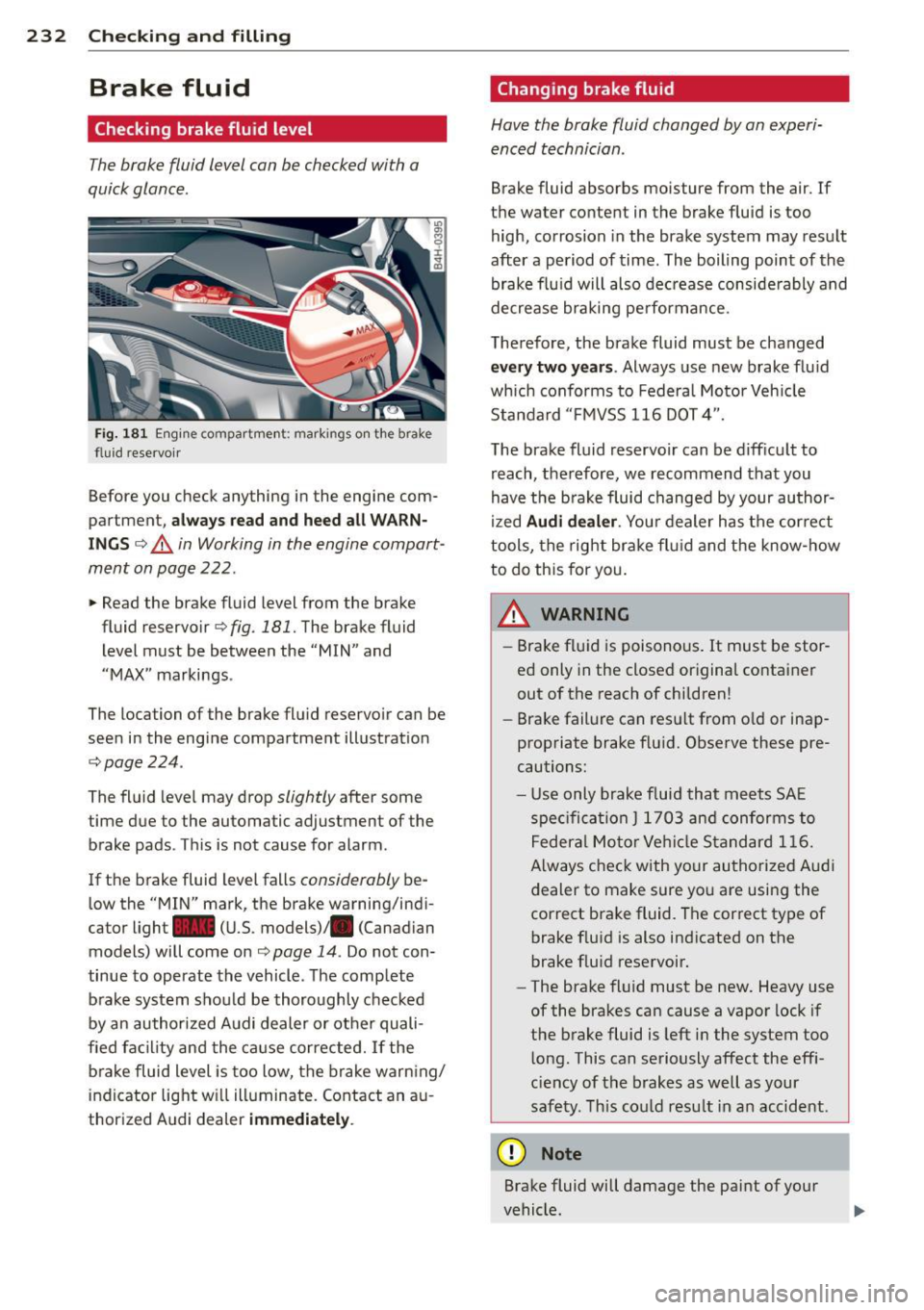
The brake fluid level can be checked with a
quick glance .
Fig. 181 Engine compartme nt: markings on the brake
flu id reservoir
Before you check anything in the engine com
partment,
always read and heed all WARN
INGS ¢ .&._ in Working in the engine compart
ment on page 222.
.. Read the brake fluid level from the brake
fluid reservoir ¢
fig. 181. The brake fluid
level must be between the "MIN" and
" MAX " markings .
The location of the brake fluid reservoir can be
seen in the engine compartment illustration
c:::,page224 .
The fluid level may drop slightly after some
time due to the automatic adjustment of the
brake pads . T hi s is not cause for alarm.
If the brake fluid level falls
considerably be
low the "MIN" mark, the brake warning/indi
cator light. (U.S. models)/ . (Canadian
models) will come on ¢
page 14. Do not con
tinue to operate the vehicle . The complete
brake system should be thoroughly checked
by an authorized Audi dealer or other quali
fied facility and the cause corrected.
If the
brake fluid level is too low, the brake warning/
indicator light will illuminate. Contact an au
thorized Audi dealer
immediately .
Changing brake fluid
Have the brake fluid changed by an experi
enced technician .
Brake fluid absorbs moisture from the air. If
t he water content in the brake fluid is too
high, corrosion in the brake system may result
after a period of time . The boiling point of the
brake fluid will also decrease considerably and
decrease braking performance.
Therefore, the brake fluid must be changed
every two years . Always use new brake fluid
which conforms to Federal Motor Vehicle
Standard "FMVSS 116 DOT 4".
The brake fluid reservoir can be difficult to reach, therefore, we recommend that you
have the brake fluid changed by your author
ized
Audi dealer. Your dealer has the correct
tools, the right brake fluid and the know-how
to do this for you .
A WARNING
-Brake fluid is poisonous. It must be stor
ed only in the closed original container
out of the reach of children!
- Brake failure can result from old or inap
propriate brake fluid. Observe these pre
cautions:
- Use only brake fluid that meets SAE
specification
J 1703 and conforms to
Federal Motor Vehicle Standard 116.
Always check with your authorized Audi
dealer to make sure you are using the
correct brake fluid. The correct type of brake fluid is also indicated on the
brake fluid reservoir.
- The brake fluid must be new. Heavy use
of the brakes can cause a vapor lock if
the brake fluid is left in the system too
long . This can seriously affect the effi
ciency of the brakes as well as your
safety. This could result in an accident.
(D Note
Brake fluid will damage the paint of your
vehicle.
Page 242 of 302
240 Tires and wheels
Maximum loaded vehicle weight
means t he sum of:
(a) Curb weight
(b) Accessory weight
(c) Vehicle capacity we ight, and
(d) P rod uction options weight
Maximum (permissible) inflation pressure
me ans t he max imum co ld inflation pressu re
to which a tire may be in flate d. Also called
"maxim um inflation p ress ure."
Normal occupant weight
means 150 lbs. (68 kilog rams) times the
nu mbe r of o ccupants seated in t he vehicle up
to the tota l sea ting capaci ty of yo ur vehicle .
Occupant distribution means dist ribution of occupants in a veh icle .
Outer diameter means t he overa ll diameter of a n in flated new
tire.
Overall width
means t he linear dis tan ce between the ex ter i
ors o f th e sidewalls of an inflated tire, in cl ud
ing e levations due to labeling, decorations, or
p rotective bands o r ribs.
Ply
means a laye r of r ubber-co ate d parall el c ords.
Production options weight
means t he comb ined we ight of those installed
regular produc tion options weigh ing ove r 5
l bs . (2 .3 kg) in excess of t hose standard items
which they repla ce, no t previously considered
in cur b weight o r acc essory weig ht, incl uding
h eavy duty brakes, r ide leve le rs, roof ra ck,
h eavy duty ba tte ry, a nd specia l trim .
Radial ply tire
means a pneumatic t ire in which the p ly co rds
t ha t ex tend to the beads are laid a t sub stan
ti ally 9 0 degrees to the ce nt erline o f the
trea d. Recommended inflation pressure
see
<=>
page 239, C old tire infl atio n pressure.
Reinforced tire
means a tire design to operate a t higher loads
and at h igher inflation pressures than t he cor
r espondi ng stan da rd tire. Reinforced tires
may be identifie d as "X L", "xl" , "EX TRA LOAD",
o r "RF " on t he sidewa ll.
Rim
means a metal su ppo rt for a tire or a t ire and
tube assembly upon which the tire beads are
seated.
Rim diameter
means nom inal d iameter of the bead seat. If
you change your wheel s ize, you w ill have to
purchase new tires to match th e new r im di
ameter .
Rim size designation
means r im diameter and width.
Rim width
means nom inal dista nce between rim flan ges .
Sidewall
means tha t port ion of a t ire betw ee n t he
t read a nd bead.
Speed rating (letter code)
means the speed at which a tire is designed to
be driven for extended periods of time. The
r a ti ngs range from 93 mph ( 150 km/h) to
186 mph (298 km/h)
~ page 250. Yo u may
not fi nd this information o n all ti res because
it is no t re quir ed by law.
T he speed rating letter code, wh ere applica
ble , is molde d on the tire sidewall a nd indi
c ates the max imum pe rmissibl e road speeds
<=> A in Winter tire s on page 2 54.
Tire pressure monitoring system*
mea ns a system that detects when o ne or
more of a veh icle 's tires are unde rinf lated an d
ill uminat es a low tir e pr es sure wa rning t ell
t a le.
Page 246 of 302
24 4 T ir es and whe els
- The brakes on a vehicle that has been
overloaded may not be able to stop the
vehicle within a safe distance.
- Tires on a vehicle that has been overload
ed can fail suddenly causing loss of con
trol and a crash.
- Always make sure that the tota l load be
ing transported -including the we ight of
a trailer hitch and the tongue weight of a
loaded trailer - does not make the veh i
cle heav ier than the veh icle's Gross Vehi
cle Weight Rating.
A WARNING
- Incorrect tire pressures and/or underin
flation can lead to a serious or fatal acci
dent.
- Incorrect tire pressures and/or underin
flation cause increased tire wear and can affect the handling of the vehicle .
- Incorrect tire pressures and/or underin
flation can also lead to sudden tire fa il
ure, including a blowo ut and sudden de
flation, causing loss of vehicle control.
Checking tire pressure
.
The correct tire pressure for the tires original
ly installed on your vehicle is listed on the tire
pressure label located on driver's side 8-pil
lar.
The recommended t ire pressures are on the
tire pressure labe l and in the tab le
r::;, page 242, Cold tire inflation pressure.This
means that the pressure must be checked and
adjusted when the tire has not been driven for
more than a couple of m iles (kilometers) at
low speeds during the previous three hours .
A ir in the tires expands when the tire heats up
as a result of internal fr iction as it flexes in
use. The ti re p ressu re is higher w hen the tire
has warmed up than when it is "cold ."
It is the inflat ion pressure in a "cold" tire that
counts. Therefo re, you shou ld never let air out
of a warm t ire to match "Cold tire inflation
p ressure" recommendations
¢page 242. T he tires wou
ld then be unde rinf lated and co uld
fail suddenly.
T he tire pressure label on your Audi lists the
re commended co ld tire inflation pressures at
maximum capacity for the new, original
equipment tires that were on your vehicle at
t h e time it was man ufactured. For the loca
t ion of the labe l
r::;, page 242, fig. 184 .
Most tires lose air natura lly over time. They
can a lso lose some air if you drive over a pot
ho le or hit a curb while park ing. It is usually
not possible to see whether the rad ia l tires
used today are underinflated just by looking
at them .
Therefore, be sure to check t ire press ures at
l east once a month and a lways before going
on a long trip. Make sure to take the number
of peop le and the amount of luggage into ac
count when adjust ing tire pressure for a trip -
even one that you wo uld not consider to be
"long." See
r::;, page 246, Tires and vehicle
load limits
for more important information .
Always use an accurate ti re pressu re gauge
when checking and ad justing inflat ion pres
su res. Check all of the tires and be sure not to
forget the spare tire.
If the pressure in any t ire
is too high when the ti re is "cold," let air o ut
of the ti re s low ly with the edge o f the tire
gauge and keep checking the pressure until
you reach the pressure that is correct for the load (passengers and luggage) and k ind of
driv ing you plan to do.
If the pressure in any tire is too low, note the
difference between the pressure in the co ld
tire and the pressure you need and add the air
that you need to reach the correct pressure for
the ve hicle load (passengers and luggage) for
the tires on your vehicle as listed on the o n
your vehicle and in th is manual and the kind
of d riving you plan to do .
Never e xce ed the max imum inflation pres
sure list ed on the tire sidewall for any rea
s on .
Page 248 of 302
246 Tires and wheels
valve stem caps on all wheels are secure ly
mounted on the valve .
@ For the sake of the environment
Underinflated tires will also increase the
fue l consumption.
Tires and vehicle load limits
There are limits to the amount of load or
weight that any vehicle and any tire can carry.
A vehicle that is overloaded will not handle
well and is more difficult to stop. Overloading
can not only lead to loss of vehicle control, but can also damage important parts of the
vehicle and can lead to sudden tire failure, in
cluding a blowout and sudden deflation that
can cause the vehicle to crash.
Your safety and that of your passengers also
depends on making sure that load limits are
not exceeded. Vehicle load includes everybody
and everyth ing in and on the vehicle. These
l oad limits are techn ica lly referred to as the
vehicle's
Gross Vehicle Weight Rating
("GVWR").
The "GVWR" includes the we ight of the basic
vehicle, all factory installed accessories, a full
tank of fuel , oil, coo lant and other fluids plus
maximum load. The maximum load includes
the number of passengers that the vehicle is
intended to carry ("seating capacity") with an
assumed weight of 150 lbs (68 kg) for each
passenger at a des ignated seat ing pos ition
and the tota l we ight of any luggage in the ve
hicle. If you tow a trailer, the weight of the
trailer hitch and the tongue weight of the
l oaded trailer must be included as part of the
vehicle load.
The
Gross Axle Weight Rating ("GAWR") is
the maximum load that can be applied at each
of the vehicle's two axles.
The G ross Vehicle Weight Rating and the
Gross Axle Weight Rating are listed on the
safety compliance sticker labe l located on the
driver's side B-p illar. You r A udi has 5 seat ing
positions, 2 in the front and 3 in the rear for
total seating capacity of 5. Vehicles with pow- er individual rear seats* have
4 seating posi
tions,
2 in the front and 2 in the rear for total
seat ing capac ity of
4. Each seating position
has a safety belt¢
page 137, Safety belts.
The fact that there is an upper limit to your
vehicle's Gross Vehicle Weight Rating means
that the total weight of whatever is being car
ried in the vehicle (including the weight of a
trailer hitch and the tongue weight of the
loaded trailer) is lim ited . The more passen
gers in the vehicle or passengers who are
heavier than the standard we ights assumed
mean that less we ight can be carried as lug
gage.
The tire pressure label on your Audi also lists
the max imum combined weight of a ll of the
occupants and luggage or other cargo that
the vehicle can carry. For the location of the
label¢
page 242, fig. 184.
A WARNING ,___
Overloading a vehicle can cause loss of ve
h icl e contro l, a crash or other accident, se
rious personal injury, and even death.
- Carrying more weight than your vehicle
was designed to carry will prevent the
vehicle from handling properly and in
crease the risk of the loss of vehicle con
trol.
- The brakes on a vehicle that has been
overloaded may not be able to stop the
veh icle with in a safe distance.
- Tires on a vehicle that has been overload
ed can fail suddenly, including a blowout
and sudden deflation, causing loss of
control and a crash.
- Always make sure that the total load be
ing transported -including the weight of
a trailer hitch and the tongue we ight of a
loaded trailer -does not make the vehi
cle heavier than the vehicle's G ross Vehi
cle Weight Rating.
Page 254 of 302
252 Tir es and whe els
Driving with different tires reduces vehi
cle handling and can lead to a loss of
control.
- If the spare tire is not the same as the
tires that are mounted on the veh icle -
for example with winter tires - only use
the spare tire for a short period of time
and dr ive with extra care . Refit the nor
ma l road wheel as soon as safely possi
ble.
- Never drive faster than the maximum
speed for which the tires on your veh icle
are rated because ti res that a re driven
faster than their rated speed can fail
sudden ly .
- Overloading t ires cause heat build- up,
sudden tire failure, including a blowout
and sudden deflation and loss of control.
- T emperature grades app ly to tires that
are properly inflated and not over o r un
derinflated .
- For technical reasons it is not a lways
possible to use wheels from other vehi
cles -in some cases not even whee ls
from the same vehicle model.
- If you install wheel trim discs on the ve
hicle whee ls, make sure that the air f low
to the brakes is not blocked. Reduced air
flow to the brakes can them to overheat, increasing stopping distances and caus
ing a collision .
- Run flat t ires may only be used on vehi
cles that were equipped with them at the
factory . The vehicle must have a chassis
designed for run flat tires . Incorrect use
of run flat tires can lead to vehicle dam
age or acc idents. Check with an a uthor
ized Audi dea le r or tire specialist to see if
yo ur vehicle can be equipped with run
flat tires. If run f lat tires are used, they
must be insta lled on all four wheels. Mix
ing t ire types is not permitted .
- Fo r technical reasons , it is not genera lly
possib le to use the whee l rims from oth
er vehicles. This can ho ld true for wheels
of the same veh icle type. - If the spare tire is different from the
tires that yo u have mounted on your ve
hicle (for example winter tires or wide
profile tires), then use the spare tire for a
short period of time only and drive w ith
extra care. Replace the flat tire w ith the
tire matching the others on your vehicle
as soon as possib le .
- Never drive without the valve stern cap .
The valves cou ld get damaged .
@) For the sake of the environment
Dispose of o ld tires in accordance with the
local requirements .
Uniform tire quality grading
-Tread wear
- Traction AA AB C
- Tempe ra tu re ABC
Quality grades can be found whe re applicab le
on the tire sid e wall betw een tr ead shou ld er
a nd maximum section width
c> page 249,
fig. 188 .
For ex ample: Tread wear 200 , Tract ion AA ,
Temperatur e A.
All passenger car t ires must conform to Feder
al Safety Requirements in add ition to these
grades.
Tread wear
T he tread wear grade is a comparative rating
based on the wear rate of the t ire when tes ted
u nder contro lled cond itions on a specified
government test course .
For example, a tire graded 150 would wear
one and one ha lf (11/2) times as well on the
government course as a tire graded 100.
T he relative performance of tires depends
upon the actual conditions of thei r use, how
ever, and may depa rt s ignificantly from the
norm due to va riations in driving hab its, se rv
ice practices and differences in road character -
istics and cl imat e. ..,.
Page 290 of 302

288 Index
Average consumption ........ ... .... .. 24
Average speed . . . . . . . . . . . . . . . . . . . . . . . 24
Avoid damaging the vehicle .. .. .. .. .. . 198
B
Battery 233
Charging ................... ..... . 235
Important warnings ...... .. .. .. .. . 233
Location . ................. .. .... . 233
low . .. .... .......... ...... ... .. . 195
Replacing the battery ...... ..... .. . 236
State of charge ............... .. ... 195
W inter operation ....... .. .. .. .. .. . 233
Working on the battery .... .. .. .... . 233
Before driving .. ... .... .... .. .. .. .. . 127
Blended gasoline .................. . 218
Blower (automatic climate control) . . . . . . 76
Body cavity sealing ......... .. .. .... . 211
Booster seats
Brake fluid 177
Changing the brake fluid ....... .. .. . 232
Check ing the brake fluid level . .. .. .. . 232
What is the cor rect brake flu id level? . . 232
What should I do if the brake fluid warn-
ing light comes on?
........ .... ... . 232
Brake system Anti-lock braking system . . . . . . . . . . . . . 19
Brake assist system ....... .. .. .... . 190
Brake booster ............ .. .. .. .. . 193
Brake fluid ............... ... .... . 232
Brake fluid specifications for refill and re-
placement ............... ... .... . 232
Brake light defective ...... .. .. .. .. .. 21
Brake pads ... ........... .. .. .... . 197
Electromechanical park ing brake .. .. . . 81
Fluid reservoir ............... .. ... 232
H ow does moisture or road salt affect the
brakes? .. ............... .. .. .... . 192
Warn ing/ indicator lights ... .. .. .... . . 14
Worn brake pads symbol ... .. .. .. .. . . 19
braking guard Messages
Sett ings
. .. ... .......... .. .. .. .. ..
86
93
93
Break-in period . ........... .. .. .... . 197
Brake pads . ... ....... ... .. .. .. .. . 197
Tires 197
Bulbs ..... .. ................ ..... . 272
C
California Proposition 65 Warning ... .. 223
Battery specific . ................. . 235
Capacities .. .. .. .. .... ...... ... .. . .
Engine oil ... .. . .. ............ .. . .
Car care .... .... .................. . 282
224
206
Exterior ....... .. .......... ...... . 206
Interior ..... .. .. ....... ...... .. .. 212
Car carrier Transporting your vehicle ....... .. .. 277
Catalytic converter .............. ... . 198
Center armrest Cockpit ....... .. ..... ........... .. 57
Rear . .. .. .. .. .. ............. .. .. . 63
Central locking . . . . . . . . . . . . . . . . . . . . . . 31
Emergency locking ............. .... . 35
Certification . . . . . . . . . . . . . . . . . . . . . . . 286
Changing a wheel .. ................ . 262
Changing engine oil ............. .... 228
Chassis (undercoat ing) ........... .. . .
Check ing
Engine coolant level ...... ...... .. . -
Tire pressure . .. .. ............. .. . .
Child restraints Danger of using child restraints in the
front seat ..... .. .......... ...... .
Where can I get additional information
about child restraints and their use? ..
Child restraint system anchors .... .. . .
Child safety ... .. .. ................ .
Convertible locking retractor ........ .
Guidance fixtures for lower anchorages
I mportant safety instructions for using
child safety seats .............. ... .
Important things to know when driving
with children . ... ....... .... --. - . - 212
229
244
14
7
187
181
169
178
183
172
169
Tether anchors . .. .......... ...... . 185
Tether straps .. .. ... .. ..... ... .. .. 185
Child safety lock Rear doors (mechanical) ........ .... . 38
Rear doors (power) ...... ...... .. . - - 38
Child safety seats . . . . . . . . . . . . . . . . . . . 17 4
Booster seats . . . . . . . . . . . . . . . . . . . . . 177
Convertible child seats ......... .... 175
Convertible locking retractor ..... .... 178