lock AUDI A8 2011 Workshop Manual
[x] Cancel search | Manufacturer: AUDI, Model Year: 2011, Model line: A8, Model: AUDI A8 2011Pages: 302, PDF Size: 76.07 MB
Page 179 of 302
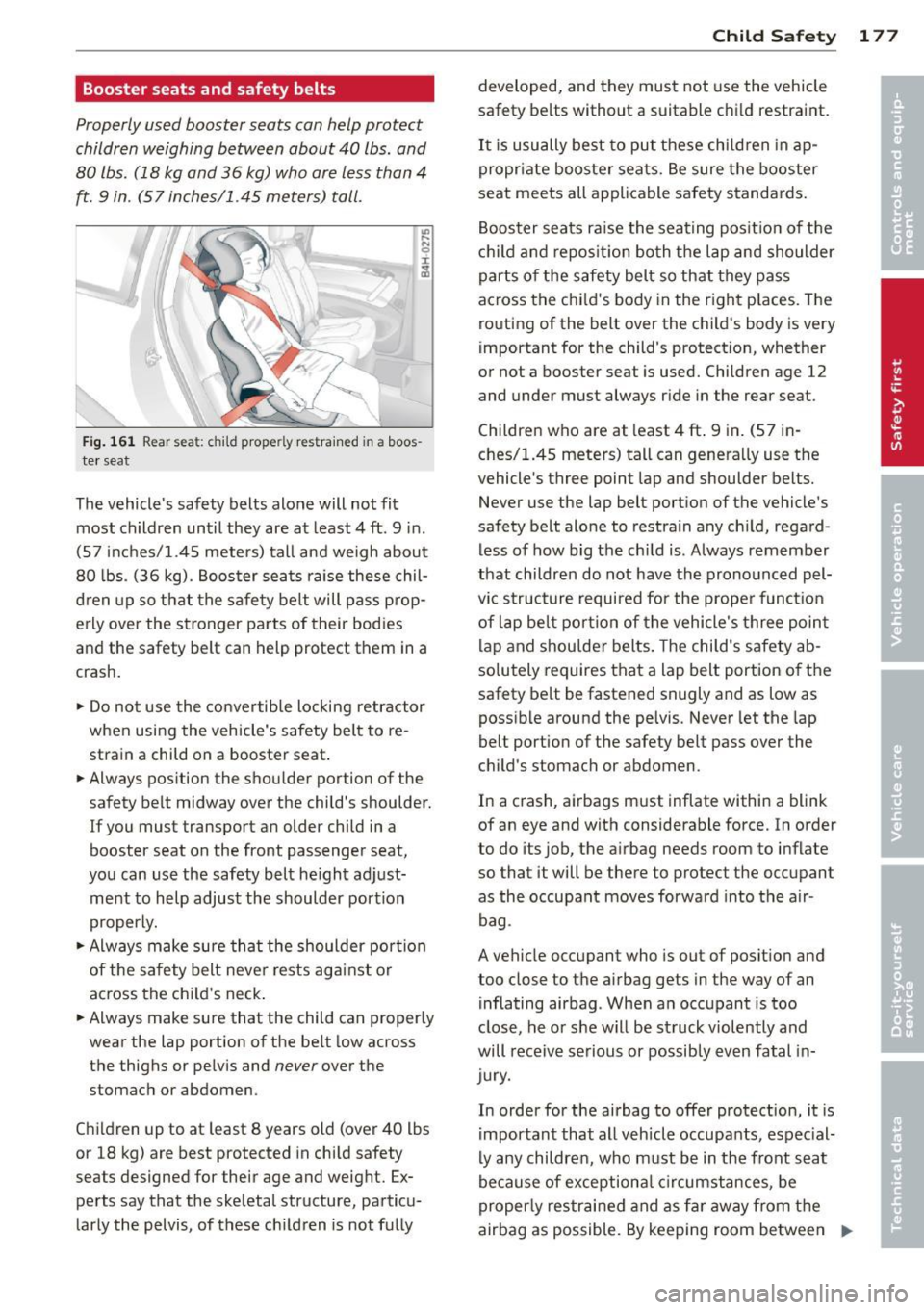
Booster seats and safety belts
Properly used booster seats can help protect
children weighing between about 40 lbs. and
80 lbs. (18 kg and 36 kg) who are less than 4
ft. 9 in. (57 inches/1 .45 meters) tall.
Fig. 161 Rear seat: child prope rly restrained in a boos
ter seat
The vehicle's safety belts alone will not fit
most children until they are at least 4
ft. 9 in .
(57 inches/1.45 meters) tall and weigh about
80 lbs. (36 kg). Booster seats raise these chil
dren up so that the safety belt will pass prop
erly over the stronger parts of their bodies
and the safety belt can help protect them in a
crash.
.,. Do not use the convertible locking retractor
when using the vehicle's safety belt to re
strain a child on a booster seat .
.. Always position the shou lder portion of the
safety belt midway over the child's shoulder.
If you must transport an older child in a
booster seat on the front passenger seat,
you can use the safety belt he ight adjust
ment to help adjust the shoulder portion
properly .
.. Always make sure that the shoulder portion
of the safety belt never rests against or
across the child's neck .
.. Always make sure that the child can properly
wear the lap portion of the be lt low across
the thighs or pelvis and
never over the
stomach or abdomen.
Children up to at least 8 years old (over 40 lbs
or 18 kg) are best protected in chi ld safety
seats designed for their age and weight. Ex pe rts say that the ske letal structure, particu
larly the pelvis, of these ch ildren is not fully
Child Safety 17 7
developed, and they must not use the vehicle
safety belts without a suitable child restraint.
It is usually best to put these child ren in ap
propriate booster seats. Be sure the booster
seat meets all applicable safety standa rds.
Booster seats raise the seat ing posit ion of the
child and reposition both the lap and shoulder
parts of the safety belt so that they pass
across the child's body in the right p laces. The
routing of the belt over the child's body is very
important for the child's protect ion, whether
or not a booster seat is used. Children age 12
and under must always ride in the rear seat.
Children who are at least 4
ft. 9 in. (57 in
ches/1.45 meters) tall can generally use the
vehicle 's three point lap and shoulder belts.
Never use the lap belt portion of the vehicle's
safety belt alone to restrain any child, regard
less of how big the ch ild is. Always remember
that children do not have the pronounced pel
vic structure required for the pro per function
of lap belt portion of the vehicle's three point
lap and shoulde r belts. The child's safety ab
solutely requires that a lap belt portion o f the
safety belt be fastened snugly and as low as
possible around the pelvis. Never let the lap
belt portion of the safety belt pass over the
child's stomach or abdomen .
In a crash, airbags must inflate within a blink
of an eye and with considerable force. In order
to do its job, the a irbag needs room to inflate
so that it will be there to protect the occupant
as the occupant moves forward into the air
bag.
A vehicle occupant who is out of position and
too close to the a irbag gets in the way of an
inflating airbag. When an occupant is too
close, he or she will be st ruck violently and
will receive serious or possibly even fatal in
Jury.
In order for the airbag to offer protection, it is
im portant that all veh icle occupants, espec ial-
ly any children, who must be in the front seat
be cause of exceptiona l circumstances, be
properly restrained and as far away from the
airbag as possible. By keeping room between ..,_
Page 180 of 302
178 Child Safety
the child's body and the front of the passen
ger compartment, the airbag can inflate comp lete ly and provide supp lemental protection
in certain fronta l collisions .
A WARNING
Not using a booster seat, us ing the boos
ter seat improperly, incorrect ly install ing a
booster seat or using the vehicle safety
belt improperly increases the risk of seri
ous personal injury and death in a col lision
or other eme rgency s ituation. To help re
duce the risk of ser ious persona l injury
and/or death:
- Always make su re to position the should
er portion of the three -point belt over
the midd le of child's sho ulder.
- Never le t the shoulder port ion of the belt
rest against or across the neck, face,
chin, or throat of the child.
- Always make su re the lap belt portion of
the three-po int be lt is worn sn ug and
passes as low as possib le across the
child's pelvis. Never let the belt pass over
the soft abdomen.
- Failure to properly route safety belts
over a ch ild's body will cause severe inju
ries in an acc ident or other emergency
situation
c;,page 137.
-Children on the front seat of any car,
even w ith Advanced A irbags, can be seri
ous ly injured or even killed when an a ir
bag inflates.
- Never let a child stand or knee l on any
seat, for example the front seat.
- Never let a child ride in the cargo area of
your vehicle.
- Always remember that a ch ild lean ing
forward, sitt ing s ideways or out of posi
t ion i n any way during an acc ident can be
struck by a deploying airbag . This will re
sult in serious personal injury o r death.
- If you must install a booster seat on the
front passenger seat because of excep
tional circumstances the
PASSENGER
AIR BAG OFF
light must come on and
stay on, whenever the ignition is sw itch
ed on .
-
-If the PASSENGER AIR BAG OF F light
does not come on and stay on, perform
the checks described
c;, page 156, Moni
toring the Advanced Airbag System.
- Take the child restraint off the front pas
senger seat and install it properly at one
of the rear seat positions if the
PA SSEN
GER AIR BAG OFF
light does not stay on
whenever the ignit ion is switched on.
- Always read and heed all WARNINGS
whenever us ing a child restrained in ave
hicle is being used
¢ page 137, Safety
belts,
c;, page 145, Airbag system and
c;, page 169, Important things to know.
Installing a child safety
seat
· Securing a child safety seat using a
safety belt
Safety belts for the rear seats and the front
passenger can be locked with the convertible locking retractor to properly secure child
safety seats.
The safety belts emergency locking retractors
for the rear seats safety belts and for the
front passenger's seat safety be lt have a con
vertib le locking retractor for child restraints .
The safety belt must be locked so that be lt
webbing cannot unreel. The retractor can be
activated to lock the safety belt and prevent
the safety belt webbing from loosening up
during normal dr iving . A child safety seat can
o n ly be properly instal led when the safety belt
is locked so that the chi ld and child safety
seat w ill stay in place .
Always remember : Even though your vehicle is
equipped with an Advanced Airbag system, all
child ren, especially those 12 years and young
er, shou ld always r ide in the back seat prope r
ly restrained for the ir age and size.
A WARNING
Improperly installed chi ld safety seats in
crease the risk of serious personal injury
and death in a co llision. -
Page 181 of 302
-Always make sure that the safety belt re
tractor is locked when installing a child
safety seat. An unlocked safety belt re
tractor cannot hold the child safety seat
in place during normal driving or in a
crash .
- Always buckle the child safety seat firmly
in place even if a child is not sitting in it.
A loose child safety seat can fly around
during a sudden stop or in a collision.
- Always make sure that the rear seat
backrest to which the center rear safety
belt is attached is securely latched when
ever the rear center safety belt is being
used to secure a child restraint.
- If the backrest is not securely latched,
the child and the child restraint will be
thrown forward together with the back
rest and will strike parts of the vehicle
interior. The child can be seriously in
jured or killed.
- Never install rear-facing child safety
seats or infant carriers on the front pas
senger seat. A child will be seriously in
jured and can be killed when the passen ger airbag inflates .
- The inflating airbag will hit the child
safety seat or infant carrier with great
force and will smash the child safety seat
and child against the backrest, center
armrest, door or roof.
- Always install rear-facing child safety
seats or infant carriers on the rear seat.
- Forward-facing child safety seats or in
fant carriers installed on the front pas
senger's seat may interfere with the de
ployment of the airbag and cause serious
injury to the child.
- It is safer to install a forward-facing
child safety seat on the rear seat.
- Always read and heed all WARNINGS
whenever using a child restrained in ave
hicle is being used
¢page 169. Special
precautions apply when installing a child
safety seat on the front passenger seat
¢ page 147, Child restraints on the front
seat -some important things to know.
Child Safety 1 79
A WARNING
-
Always take special precautions if you
must install a forward or rearward -facing
child restraint on the front passenger's
seat in exceptional situations:
- Whenever a forward or rearward -facing
child restraint is installed on the front
passenger seat, the
PASSENGER AIR
BAG OFF
light must come on and stay on
whenever the ignition is switched on.
- If the
PASSENGER AIR BAG OFF light
does not come on and stay on, perform
the checks described
¢page 156, Moni
toring the Advanced Airbag System.
- Take the child restraint off the front pas
senger seat and install it properly at one
of the rear seat positions if the
PASSEN
GER AIR BAG OFF
light does not stay on
whenever the ignition is switched on.
- Improper installation of child restraints
can reduce their effectiveness or even
prevent them from providing any protec
tion.
- An improperly installed child restraint
can interfere with the airbag as it de
ploys and seriously injure or even kill the
child .
- Always carefully follow the manufactur
er's instructions provided with the child
safety seat or carrier .
- Never place additional items on the seat
that can increase the total weight regis
tered by the weight-sensing mat and can
cause injury in a crash.
A WARNING
Forward-facing child restraints:
- Always make sure the forward-facing
seat has been designed and certified by
its manufacturer for use on a front seat
with a passenger front and side airbag.
- Never put the forward-facing child re
straint up, against or very near the in
strument panel.
- Always move the passenger seat into its
rearmost position in the seat's fore and
aft adjustment range, as far away from •
•
Page 182 of 302
180 Child Safety
the airbag as possible before installing
the forward-facing child restraint. The backrest must be adjusted to an upr ight
posit ion.
- Make sure that the
PAS SENGER AIR BAG
OFF
light comes on and stays on all the
t ime whenever the ignition is switched
on.
A WARNING , _
Rearward-fac ing ch ild restra ints:
- A ch ild in a rearward-facing child safety
seat installed on the front passenge r
seat will be ser iously injured and can be
killed if the front airbag inflates -even
with an Advanced Airbag System.
- T he inflating a irbag will hit the child
safety seat or infant carrier with g reat
force and w ill smash the ch ild safety seat
and child against the backrest, center
armrest, door or roof .
- Always be especially caref ul if you must
install a rearward facing child safety seat
on the front passenge r seat in exception ·
al circumstances .
- A tight tether strap on a rearward-facing
child restraint attached to the front pas
senger seat can put too much pressure
on the weight-mat in the seat and reg is
ter a heavier weight in the Advanced A ir
bag System. The heav ier we ight regis
tered can make the system work as
though an adult were on the seat and de ploy the Advanced Airbag when it must
be s uppressed causing ser ious or even
fatal injury to the child.
- Make sure that the
PASSENGER AIR BA G
OFF
light comes on and stays on all the
time whenever the ignition is switched on.
- If the
PA SSENGER AIR BAG OFF light
does not come on and stay on, immedi
ately install the rea r-facing chi ld safety
seat in a rear seating position and have
the a irbag system inspected by your Audi
dealer.
Act ivating the convertible locking
retractor
Use the convertible locking retractor to se
cure a child restraint.
Always heed the ch ild safety seat manufactur
er's instructions when installing a child re
st ra int in your vehicle. To activate the conve r
t ible lock ing ret ractor:
.,. Place the ch ild restraint on a seat, prefera
bly on the rear seat .
.,. Slowly pu ll the belt
all the wa y out .
.,. Route it around or through the child re
straint belt path
¢ _& .
.,. Push the chi ld safety seat down with yo ur
full weight to get the safety be lt really tight.
.. Insert the belt tongue into the buck le for
that seating position.
.,. Guide the safety belt back into the retractor
until t he belt lies flat and snug on the child
safety seat.
.,. You should hear a "clicking" noise as the
be lt winds back into the inertia ree l. Test the
convert ible lock ing retractor by pulling on
the belt . You shou ld no longer be able to
pull the be lt out of the retractor. The con
vertible locking retractor is now activated .
.. Make sure that the red release button is fac
ing away from the child restraint so that it
can be unbuckled quickly.
.,. Pull on the belt to make sure the safety belt
is properly tight and fastened so that the
seat cannot move forward or sideways mo re
than one inch (2.5 cm).
A WARNING
-
Using the wrong child restraint or an im
p roperly installed chi ld restraint can cause
serious personal injury or death in a crash.
- Always ma ke sure that the safety belt re-
tractor is locked when insta lling a child
safety seat . An un locked safety belt re
tractor cannot hold the child safety seat in place dur ing norma l dr iving or in a
crash.
Page 183 of 302
-Always buckle the child safety seat firmly
in place even if a child is not sitting in it.
A loose child safety seat can fly around during a sudden stop or in a crash.
- Always make sure the seat backrest to
which the child restraint is installed is in
an upright position and securely latched
into place and cannot fold forward. Oth
erwise, the seatback with the child safety
seat attached to it could fly forward in
the event of an accident or other emer gency situation.
- Always read and heed all WARNINGS
whenever using a child restrained in ave
hicle is being used
Q page 169. Special
precautions apply when installing a child
safety seat on the front passenger seat
Q page 147, Child restraints on the front
seat -some important things to know.
Deactivating the convertible locking
retractor
The convertible locking retractor for child re
straints will be deactivated automatically when the belt is wound all the way back into
the retractor .
.. Press the red button on the safety belt buck
le . The belt tongue will pop out of the buck
le.
.. Guide the safety belt all the way back into
its stowed position.
Always let the safety belt retract completely into its stowed position. The safety belt can
now be used as an ordinary safety belt with
out the convertible locking retractor for child
restraints.
If the convertible locking retractor should be
activated inadvertently, the safety belt must
be unfastened and guided completely back in
to its stowed position to deactivate this fea
ture. If the convertible locking retractor is not
deactivated, the safety belt will gradually be
come tighter and uncomfortable to wear.
Child Safety 181
A WARNING
Improperly installed child safety seats in
crease the risk of serious personal injury
and death in a collision.
- Never unfasten the safety belt to deacti
vate the convertible locking retractor for
child restraints while the vehicle is mov ing. You would not be restrained and
could be seriously injured in an accident.
- Always read and heed all WARNINGS
whenever using a child restrained in ave
hicle is being used¢
page 169. Special
precautions apply when installing a child
safety seat on the front passenger seat
¢ page 147, Child restraints on the front
seat -some important things to know.
LATCH Lower
anchorages and tethers
for children
Child Restraint System anchors and how
are they related to child safety
To provide a simpler and more practicable way
to attach the child restraint on the vehicle
seat, Federal regulations require special lower
anchorages in vehicles and devices on new
child restraints to attach to the vehicle ancho
rages .
The combination of the tether anchorages and
the lower anchorages is now generally called
the
LATCH system for " Lower Anchorages and
Tethers for Children."
Forward-facing child restraints manufactured
after September 1, 1999, are required by U.S.
federal regulations to comply with new child
head movement performance requirements .
These new performance requirements make a
tether necessary on most new child seats.
Installing a child restraint that requires a top
tether without one can seriously impair the
performance of the child restraint and its abil
ity to protect the child in a collision. Installing
a child restraint that requires a top tether ..,. •
•
Page 186 of 302
184 Child Safet y
• Push down on the seat cushion so that the
lower anchorages are visib le.
• Pull
off the guidance fixtures from the lower
anchorages.
• Always remove the guidance fixtures and
keep them in a safe place when not in use.
You may find it easier to install child re
straints equipped with hooks attached to
straps without the guidance fixtures in place.
If this is the case, remove the guidance fix
tures by pull ing them
off the anchorages .
H oweve r, the guidance fixtu res can he lp you
to locate the
LATCH ancho rages.
.&_ WARNING
Imprope r use of tether anchorages or low
er anchorages ca n cause serious persona l
injury in a crash .
- Always carefully fo llow the child re
straint manufacturer 's instructions for
proper insta llation and use of child re
straint systems .
- Never use the
LATCH or tethe r anchorag
es to attach safety belts or other kinds of
occupant restraints.
- Child restraint tether attachments and
lower attachments are only des igned to
secure a child restraint t hat has been
equipped to use these anchorages.
- Tether anchorages and lower anchorages
are designed to withstand only those
loads imposed by correctly fitted ch ild
restraints. Under no circumsta nces can
they be used safely for adu lt or chi ld
safety belts o r harnesses.
- Never mou nt more than one ch ild re
stra in t to a sing le tether or to a low er an
c ho rage poin t. Attac hing two chi ld re
st rain ts to a sing le anchor age poi nt can
cause the anchorage to fail and cause se
rious persona l injury in a crash .
0 Note
- Remove the guidan ce fixt ures before
fo ld ing t he rear sea tba ck t o preven t
dam aging the seat c ushion . -
To attach the ch ild restraint sec urely, the
seat must be moved to the farthest rear
posit ion, the seat height set to the low
est position and t he head restraint must
be adjusted to the vertical position
¢page 57.
-If you leave the guidance f ixtures instal
led for several days , they could leave a
mark on the upholstery on the seat cush
ion and back rest in the area that the
guidance fixtures were installed . T he up
holste ry wou ld al so be pe rmanen tly
stretched aro und the gui dance fix tures.
Th is ap plies especia lly to lea ther seats .
Installing a child restraint with LATCH
lower anchorages
Whenever you install a child restraint always
follow the child restraint manufacturer's in
structions.
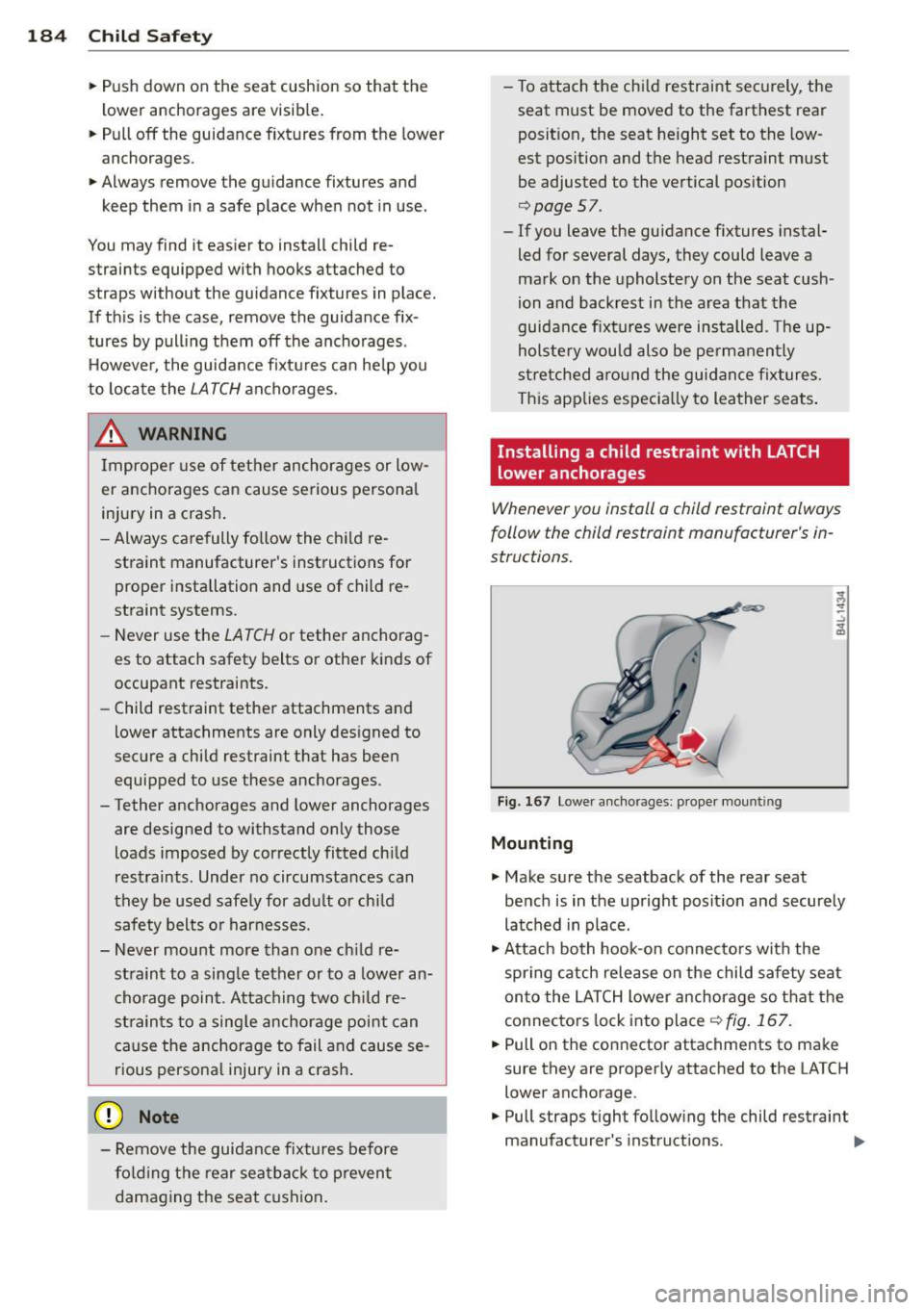
F ig. 167 Lowe r a nchorages: proper mount ing
Mounting
• Make sure the seatback of the rear seat
bench is in the upright posit ion and securely
latched in place .
• Attach bo th hook-on connectors with the
spring catch release on the child safety seat
on to the LATCH lower anchorage so that the
connecto rs lock into place
¢ fig. 167.
•Pullon the connector attachments to make
sure they are proper ly attached to the LATCH
lower anchorage .
• Pull straps tight following the child restraint
manufacturer's instruct io ns. .,,.
Page 193 of 302
ESP includes and/or works together with the
anti-lock brake assist system (ABS), brake as
sist system, anti -slip regulation (ASR), elec
tronic differential lock (EDL), dynamic steer
ing* and electronic interaxle differential lock*.
ESP is switched on all the t ime . In certa in sit
uations when you need less traction, you can
sw itch
off ASR by pressing the button above
the selector lever. Be sure to switch ASR on
again when you no longer need less traction.
Anti-lock braking system (ABS)
ABS prevents the wheels from locking up
when braking. The vehicle can still be steered even during hard braking . Apply steady pres
sure to the brake pedal. Do not pump the ped
al. A puls ing in the brake pedal indicates that
the system is he lping you to brake the vehicle.
Brake assist system
The brake assist system can decrease brak ing
distance.
It increases braking power when the
driver presses the brake pedal quickly in emer
gency situations. You must press and hold the
brake pedal until the situation is over. In vehi
cles with adaptive cruise control*, the brake
assist system is more sensitive if the distance
detected to the vehicle ahead is too small.
Anti-slip regulation (ASR)
ASR reduces engine power when the drive
wheels begin to spin and adapts the force to
the road conditions. This makes it easier to
start, accelerate and drive up hills .
Electronic differential lock (EDL)
The EDL brakes wheels that are spinning and
transfers the drive power to the other drive
wheel or whee ls if the vehicle is equipped with
a ll whee l drive *. This function is available up
to about 75 mph (120 km/h).
I n extreme cases, EDL automatically switches
off to help keep the brake on the braked wheel
from overheating . EDL will switch on again au
tomatically when conditions have returned to
normal.
Intelligent technology 191
Dynamic steering*
On vehicles with dynamic steering, ESP helps
stabilize the steering in certain situations.
Electronic interaxle differential lock
function*
T he electronic interaxle differential lock func
tion activates when driving th ro ug h curves.
Braking is targeted toward the wheels on the
inside of the curve as needed. This he lps to
minimize front whee l skid, improves traction
and allows for more precise driving through
curves .
A WARNING
- ESP, ABS, ASR, EDL, dynamic steering*
a nd the electronic interaxle differential
loc k fu nction* cannot overcome the laws
of physics. This is especially impo rtant
on slippery or wet roads.
If the systems
begin acting to stabilize your vehicle, you
should immediately change yo ur speed
to match the road and traffic conditions .
Do not let the increased safety provided
by these systems tempt you to take risks.
Doing so will increase the risk of a loss of
veh icle contro l, collision and ser ious per
sonal injur ies.
- Always adapt your speed to road, traffic
and weather conditions. The risk of los
ing con trol of the vehicle increases when
driving too fast, espe cially through
curves and on slippery or wet roads, and
when dr iving too close to vehicles up
ahead. ESP, ABS, the brake assist system,
EDL, ASR, dynam ic steer ing* and the
electronic interaxle differentia l lock func
tion* cannot prevent collisions.
- Always accelerate with special care on
even, smooth surfaces such as those that
are wet or covered with ice and snow.
The drive wheels can spin even with
these assistance systems that cannot al
ways he lp to reduce the risk of loss of ve
hicle contro l.
-
•
•
Page 198 of 302
196 Intelligent technology
What you should know
The highest priority is given to maintaining
starting capability.
The battery is severely taxed in short-distance
driving, in city traffic and during the cold time
of year. Abundant electr ical energy is re
qu ired, but only a little is generated. It is also
cr itical if the e ngine is not run ning and elect ri
cal components a re turned on. In th is in
stance energy is being consumed but none is be ing generated .
I t is in precisely these situations that you w ill
notice energy managemen t actively regulat
ing the distrib ution of energy.
Vehicle stands for an ext ended period
If you do not drive your vehicle over a period
of severa l days or weeks, elect rical compo
nents are grad ually cu t back o r switched off .
This reduces energy co nsu mption and main
tains starting cap abili ty
over a longer period.
Be aware that when you unlock you r vehicle,
some of the conve nience funct ions may not
ope rate, such as the Convenience key , the re
mote cont ro l or the power seat adjustment .
The convenience functions will be availab le
aga in when you switch on the ignition and
start the engine .
With the engine turned off
If yo u lis ten to the radio, for example, with
the eng ine turned off or use othe r MM I fu nc
tions, the battery is being discharged .
I f sta rting capability is jeopa rdized due to e n
e rgy consumpt ion, the fo llow ing warning ap
pears in the MMI disp lay :
Please start th e engine soon or th e syst em
will be turned off .
The warning ind icates that the system will be
turned off automatically after 3 m inu tes .
If
you wish to cont inu e us ing the functions , you
have to start the engine.
With the engine running
Although e lec trical energy is generated when
the vehicle is being driven, the battery can be
come discharged. This happens mostly when
li ttle energy is being generated and a g reat
deal consumed and the battery's state of
charge is not optimal.
To b ring the energy ba lance back into equili
brium, consumers which req uire especially
l arge amounts of energy are temporar ily cut
back or sw itched off. Heat ing systems i n par
ticular require a great deal of energy. If you
notice , for example, that the heated seats* o r
the heated rear window are not heating, they have been temporarily cut back or sw itched
off . These systems w ill be available again as
soon as the ene rgy balance has been restored.
You w ill also notice that engi ne idle speed has
been increased slightly . Thi s is normal and not
a cause for con ce rn. By inc reas ing eng ine id le
speed the addi tional energy requ ired is gener
ated and the battery is charged.
Page 207 of 302
Parking on a slope
Do not pork on a slope with a trailer. If it can
not be avoided, do so only ofter doing the fol
lowing:
When parking:
.. Apply the foot brake .
.,. Have someone place chocks under both the
vehicle and the trailer wheels .
.,. With chocks in place, slowly release the
brakes until the whee l chocks absorb the
load .
.. Turn the wheels towa rds the curb .
.. Apply the parking brake .
.. Se lect the
P se lector lever position.
When restarting after parking:
.. Apply the foot brake .
.,. Start the engine .
.. Select the
D se lector lever position .
.. Release the parking brake and slowly pull
out and away from the wheel chocks .
.. Stop and have someone retrieve the wheel
chocks.
If you move the selector lever of the auto
matic transmission to
P before applying
the parking brake and before blocking the
wheels, you may have to use more force
later to move the lever out of the
P posi
tion .
Trailer towing 205
•
•
Page 210 of 302
208 Cleaning and protection
-Never wash your car in bright sunlight.
Drops of water act as magnifying lenses
and may damage your paint.
- When you wash your car in the winter: if
you rinse your vehicle with a hose, be
careful not to aim the stream of water
directly at locks, or at door or hatch
openings - they can freeze shut.
- Never use sponges des igned to remove
i nsects, or any kitchen scouring sponges
or similar products . They can damage
your paint finish .
- Never use a dry cloth or sponge to clean
the headlights. Only use wet cloths or
sponges to prevent scratches .
It is best
to use soapy water.
- You should remove debris (such as in
sects) from the headlight lenses on a
regular basis, fo r example when refuel
ing your vehicle. Never clean the head
lig hts w ith a dry cloth or sponge. Use a
wet cloth or sponge . It is best to use
soapy water.
@ For the sake of the environment
I n the interest of the environment, the ve
hicle should only be washed in special
wash bays.
Washing your vehicle with a power
washer
Cleaning the exterior of your car with a high
pressure power washer is safe as long as you observe a few simple rules.
• Before using the power washer, make sure
you have read and understood the WARN
INGS
c:> A in General information on
page 206 .
• Always follow the operating instructions for
the power washer .
• Make sure that the jet on the spray hose pro
duces a "fan shaped spray".
• Do
not hold the spray nozzle too close to
soft materia ls.
When cleaning the vehicle wit h a power wash
er
always follow the operating instructions. T
his applies particu larly to the
operating
pressure
and the spraying distance. Keep a
distance from soft materials such as rubber
hoses or insulating material as well as sensors
and camera lenses.
Do not use a jet which sprays water in a
di rect
stream
or one that has a rotating jet .
Water temperature should not exceed 140 °F
(60 °().
A WARNING
Never wash tires with a jet that sprays wa
ter in a direct stream . This could cause in
v is ible damage to the t ires and weaken
them, even if the spray is from
a relatively
long distance and for a short time. Dam
aged and weakened tires can fail and cause
accidents and personal injury .
(D Note
To avoid damaging your vehicle, always
make sure that there is suffic ient d istance
between the spray head and soft materials
like rubber hoses, plast ic parts and sound
deadening materials as well as sensors
and camera lenses. Never aim the sp ray
head at the same point for a long time.
This also applies to cleaning headlights
and painted bumpers. Remember: the
closer the nozzle is to the surface of the
mater ia l, the greater the stress on the ma
terial.
Sensors and camera lenses
- Remove snow with a hand brush and remove
ice with a de-icing spray that does not con
tain solvents .
- Clean the sensors (adaptive cruise control*,
pa rking system*) w ith a cleaning so lution
that does not contain so lvents and a soft
cloth.
- The camera lens or the area in front of the
camera lens is normally cleaned by the
w indshie ld w ipers (Audi lane assist*) or
headlight wipers (night vision system*) . If
the lens or the area is exceptionally dirty,
111-