ABS AUDI A8 2012 User Guide
[x] Cancel search | Manufacturer: AUDI, Model Year: 2012, Model line: A8, Model: AUDI A8 2012Pages: 300, PDF Size: 75.06 MB
Page 137 of 300
-Failure to pay attention to the warning
light that come on, could lead to person
al injury.
Why safety belts?
Frontal collisions and the law of physics
Frontal crashes create very strong forces for
people riding in vehicles .
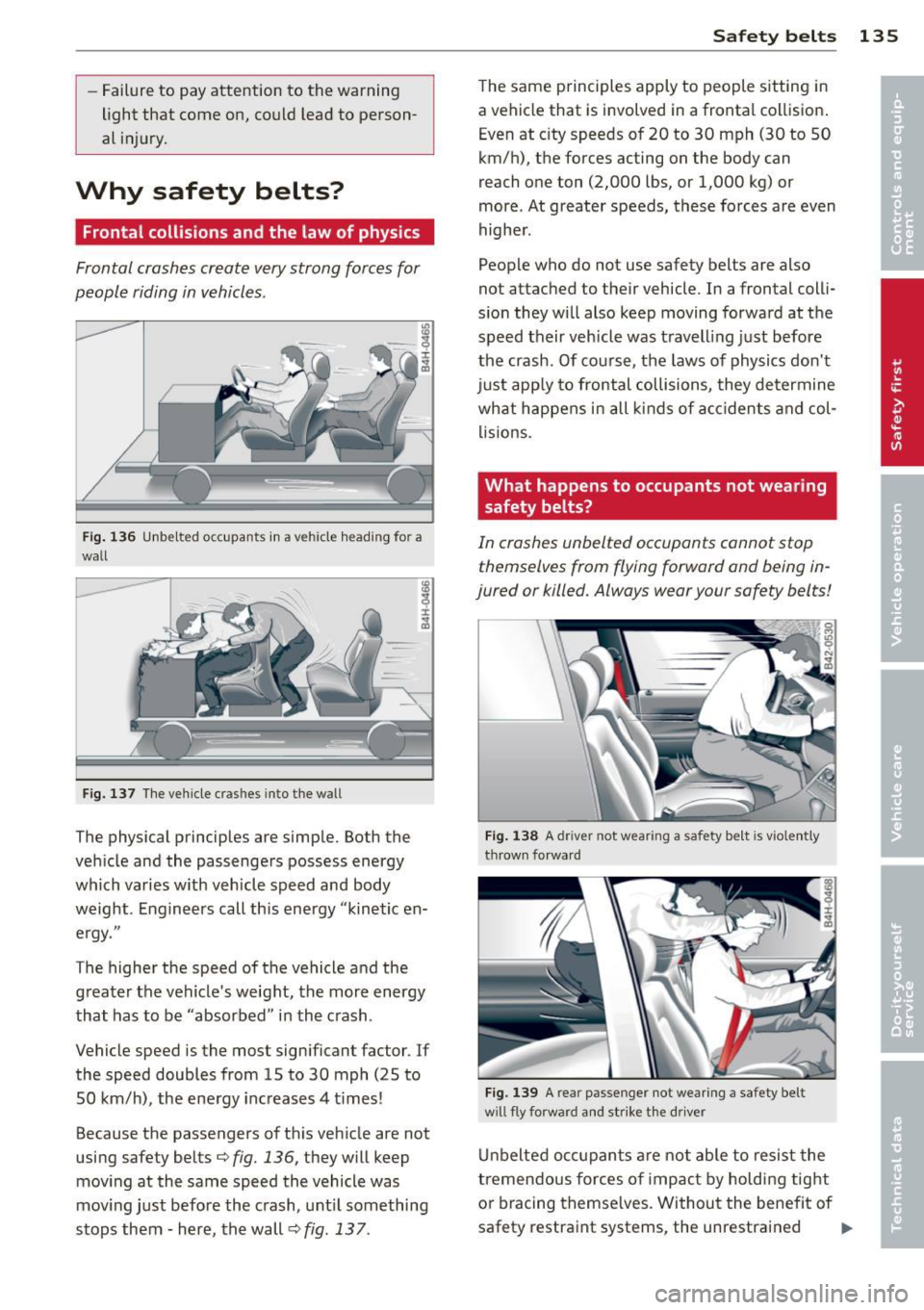
Fig. 1 36 Unbe lted occupants in a ve hicle head ing for a
wall
Fig. 137 T he vehicle cras hes into the wall
The physical principles are simple. Both the
veh icle and the passengers possess energy
which varies w ith veh icle speed and body
weight . Engineers call this energy "kinetic en
e rgy."
The higher the speed of the vehicle and the
greater the vehicle's weight, the more energy
that has to be "absorbed" in the crash .
Vehicle speed is the most significant factor . If
the speed doubles from 15 to 30 mph (25 to
50 km/h), the ene rgy increases 4 t imes!
Because the passengers of th is veh icle are not
using safety belts¢
fig. 136, they will keep
mov ing at the same speed the vehicle was
mov ing just befo re the crash, unt il something
stops them - here, the wall ¢
fig. 137.
Safety belts 135
The same principles apply to people s itting in
a vehicle that is involved in a frontal coll ision .
Even at c ity speeds of 20 to 30 mph (30 to 50
km/h), the forces acting on the body can
reach one ton (2,000 lbs, or 1,000 kg) or
more . At greater speeds, these fo rces are even
highe r.
Peop le who do not use safety belts are also
not attached to their vehicle . In a frontal colli
s ion they will also keep moving forward at the
speed their veh icle was travel ling just before
the crash . Of co urse, the laws of physics don't
just app ly to frontal collisions, they determine
what happens i n all k inds of a cc ident s and col
li s ions.
What happens to occupants not wearing
safety belts?
In crashes unbelted occupants cannot stop
themselves from flying forward and being in
jured or killed. Always wear your safety belts!
F ig . 1 38 A driver not wea ring a safety be lt is vio lently
th row n forwa rd
F ig. 139 A rear passenger not wearing a sa fety belt
w ill fly forward a nd strike the d river
Un belted oc cupants a re not able to resist the
tremendous forces o f impact by hold ing tight
o r bracing themse lves. Without the benefit of
safety restraint systems, the unrestra ined .,..
Page 138 of 300
136 Safety belts
occupant will slam violently into the steering
wheel, instrument panel, windshield, or what
ever else is in the way
c::> fig. 138. This impact
with the vehicle interior has all the energy
t hey had just before the crash.
Never rely on a irbags alone for protection.
Even when they deploy, airbags provide only
additional protection. Airbags are not sup
posed to deploy in all kinds of accidents. Al
though your Audi is equipped with airbags, all
vehicle occupants, including the driver , must
wear safety belts correctly in order to mini
mize the risk of severe injury or death in a
crash.
Remember too, that airbags will deploy only
once and that your safety belts are always
there to offer protection in those accidents in
which airbags are not supposed to deploy or
when they have already deployed . Unbelted
occupants can also be thrown out of the vehi
cle where even more severe or fatal injuries
can occur.
It is also important for the rear passengers to
wear safety belts correctly. Unbelted passen
gers in the rear seats endanger not only them
selves but also the driver and othe r passen
gers ~
fig. 139. In a frontal collision they will
be thrown forward violently, where they can
hit and injure the driver and/or front seat pas
senger .
Safety belts protect
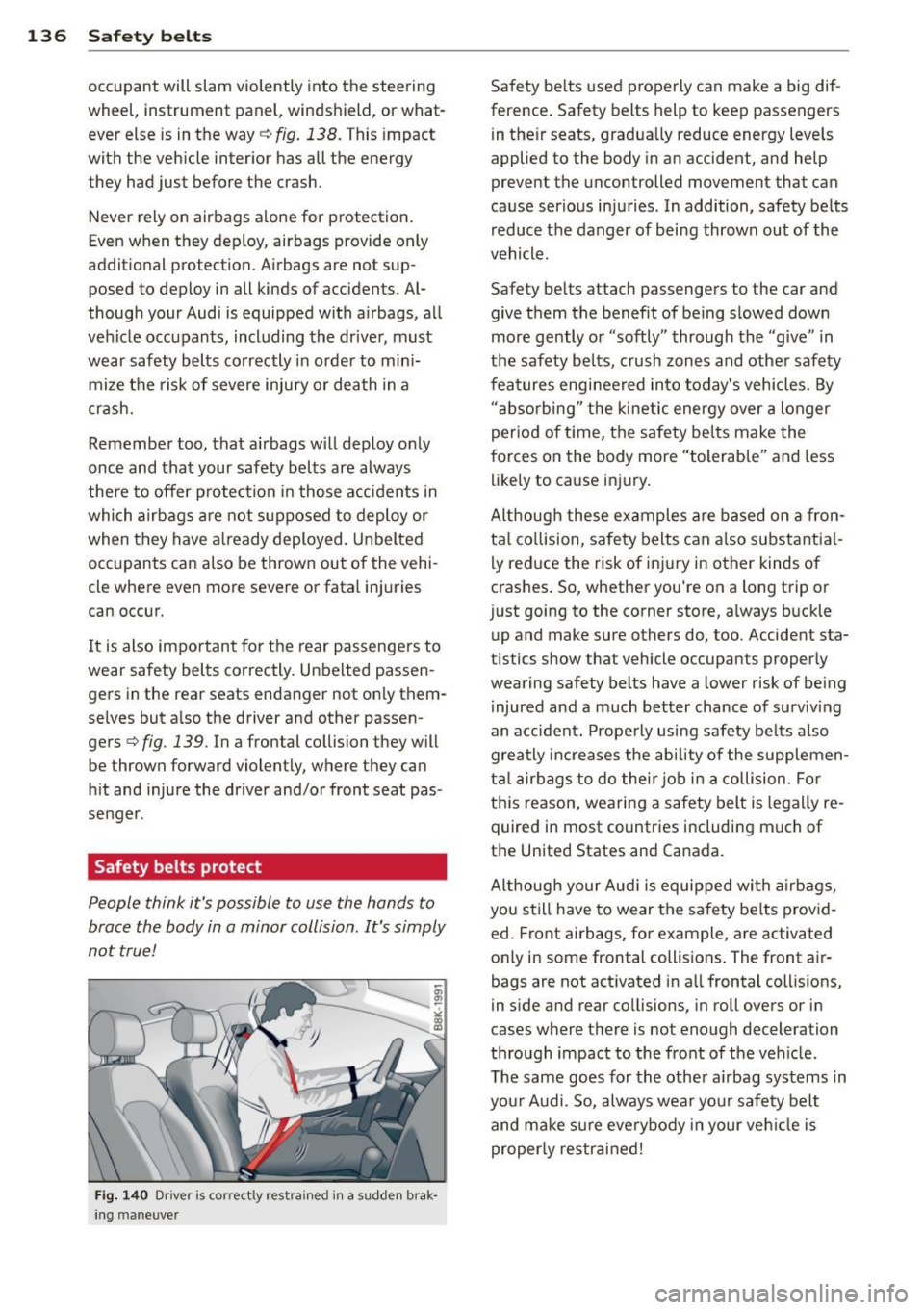
People think it's possible to use the hands to
brace the body in a minor collision . It's simply
not true !
Fig. 140 Driver is co rr ect ly re strain ed in a sudd en brak
ing maneuve r
Safety belts used properly can make a big dif
ference. Safety belts help to keep passengers
in their seats, gradually reduce energy levels
applied to the body in an accident, and help
prevent the uncontrolled movement tha t can
cause serious injuries . In addition, safety belts
reduce the danger of being thrown out of the
vehicle .
Safety belts attach passengers to the car and
give them the benefit of being slowed down
more gently or "softly" through the "give" in
the safety belts, crush zones and other safety
features engineered into today's vehicles. By
"absorbing " the kinetic energy over a longer
period of ti me, the safety belts make the
forces on the body more "tolerable" and less
likely to cause injury.
Although these examples are based on a fron
tal collision, safety belts can also substantial
ly reduce the r isk of injury in other kinds of
crashes. So, whether you're on a long trip or
just going to the corner store, always buckle up and make sure others do, too. Accident sta
tistics show that vehicle occupants properly
wearing safety belts have a lower risk of being
injured and a much better chance of surviving
an accident. Properly using safety belts also
greatly increases the ability of the supplemen
tal airbags to do their job in a collision . For
this reason, wearing a safety belt is legally re
quired in most countries including much of
the United States and Canada.
Although your Audi is equipped with airbags,
you still have to wear the safety belts provid
ed. Front airbags , for example, are activated
only in some frontal collisions. The front air
bags are not activated in all frontal collisions,
in side and rear collisions, in roll overs or in
cases where there is no t enough decelera tion
through impact to the front of the vehicle .
The same goes for the other airbag systems in
your Audi . So, always wear your safety belt
and make sure everybody in your vehicle is
properly restrained!
Page 148 of 300
146 Airbag system
-An improperly installed child restraint
can interfere with the airbag as it de
ploys and seriously injure or even kill the
child -even with an Advanced Airbag
System .
- Always carefully follow the manufactur
er's instructions provided with the child
seat or carrier .
- Never place additional items on the seat
that can increase the total weight regis tered by the weight-sensing mat and can
cause injury in a crash .
Front airbags
Description of front airbags
The airbag system con provide supplemental
protect ion to properly restrained front seat
occupants.
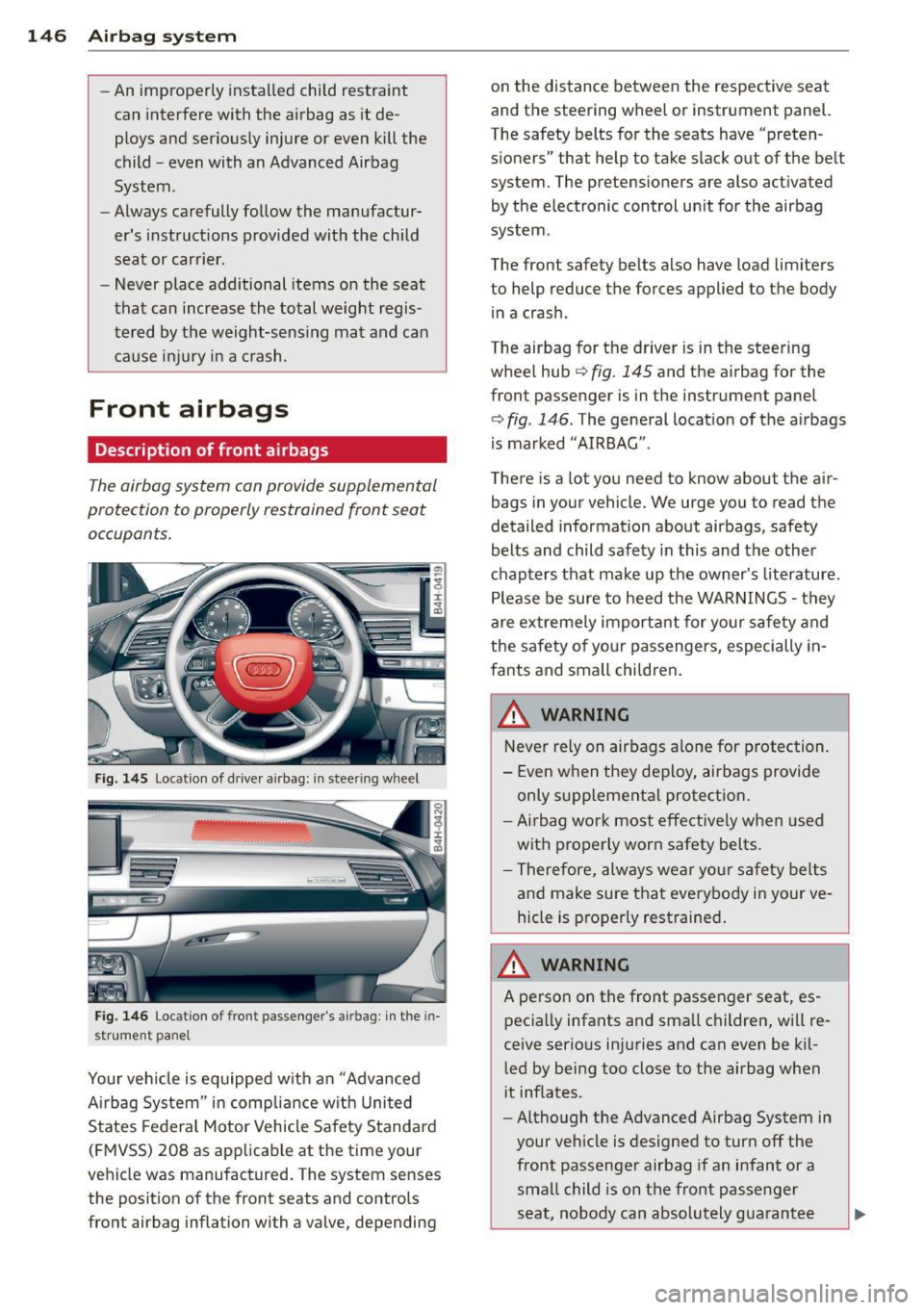
Fig. 145 Location of dr iver airbag: in stee ring wheel
Fig. 146 Locat ion of front passenger's airbag: in the in
s trument panel
Your vehicle is equipped with an "Advanced
A irbag System" in compliance with United
States Federal Motor Vehicle Safety Standard
(FMVSS) 208 as applicable at the time you r
vehicle was manufactured. The system senses
the position of the front seats and controls
front airbag inflation with a valve, depending on
the distance between the respective seat
and the steering wheel or instrument panel.
The safety belts for the seats have "preten sioners" that help to take slack out of the belt
system. The pretensioners are also activated by the electronic control unit for the airbag
system.
The front safety belts also have load limiters
to help reduce the forces applied to the body in a crash .
The airbag for the driver is in the steering
wheel hub
c::;, fig. 145 and the airbag for the
front passenge r is in the instrument panel
c::;, fig . 146 . The general location of the airbags
is marked "AIRBAG".
There is a lot you need to know about the air
bags in your vehicle. We urge you to read the
detailed information about airbags, safety
belts and child safety in this and the other
chapters that make up the owner's literature .
Please be sure to heed the WARNINGS -they
are extremely important for your safety and
the safety of you r passengers, especially in
fants and small children.
A WARNING
Never rely on airbags alone for protection.
- Even when they deploy, airbags provide
only supplementa l protection .
-Airbag work most effectively when used
with properly worn safety belts.
- Therefore, always wear your safety belts
and make sure that everybody in your ve
hicle is properly restrained .
A WARNING
A person on the front passenger seat , es
pecially infants and sma ll children, will re
ceive serious injuries and can even be kil
led by being too close to the airbag when
it inflates .
- Although the Advanced Airbag System in
your vehicle is designed to turn off the
front passenger airbag if an infant or a
small child is on the front passenger
seat, nobody can absolutely guarantee ..,.
Page 150 of 300

148 Airbag sys tem
an impact that meets the conditions stored in
its memory .
I f the tota l weight on the front passenger
seat is more than that of a typical 1 year-o ld,
but less than the weight of a small adu lt, the
front airbag on the passenger side may deploy (the
PASSENGER AIR BAG OFF light does not
come on).
For e xample , the a irbag may depl oy if :
- a small child that is heavier than a typical 1
year-o ld child is on the front p assenger seat
(regardless of whe ther the child is in one of
the chi ld seats listed
¢ page 168),
- a ch ild who h as o utg rown child rest raints is
on the front passenger seat.
If the front passenger airbag is turned off, the
PASSENGER AIR BAG OFF l ight in the cente r
of the inst rument panel w ill come on and stay
on.
The front a irbag on the passeng er side may
not dep loy (the PAS SENGER AIR BAG OFF
light does not ill umin ate and stay lit) if:
- a small adult or teenager is o n the front pas
senger seat
- a passenger who is not sitt ing upright wit h
their back against a non-reclined backrest
with their feet on the veh icle floo r in front
of the seat is on the front passenge r seat.
If the front passenger airbag deploys, the Federal Standard requires the a irbag to meet
the " low risk" deployment criteria to help re
d uce the risk of inj ury through inter action
with the airbag. " Low r isk" deployment occurs
in those crashes that take place at lower de
celerations as defined in the e lectronic control
un it
¢ page 153.
Alwa ys remember : Even though yo ur vehicle
is equipped with Advanced Airbags, the safest
p lace for children is properly restrained on the
bac k seat . Please be sure to read the impor
tant information in the sect ions that follow
and be sure to heed a ll of the WARNINGS.
A WARNING
To reduce the risk of injury when an a irbag
i nflates, always wear safety be lts properly.
- If you are unrestra ined, leaning forward,
sitt ing s ideways or out of pos ition in any
way, your risk of injury is much h igher.
- You will a lso receive serious injuries and
could even be killed if you are up aga inst
the airbag or too close to it when it in
flates -even w ith an Advanced A irbag
¢ page 142.
A WARNING
A child in a rearward-fac ing ch ild seat in
stalled on the front pa ssenger se at will be
se riously in jured and can be killed if the
front airbag inflates -even with an Ad
vanced Airbag System.
- Al tho ugh the Advan ced Airbag Sys tem in
your veh icle is designe d to turn off the
front airbag when a rearward-facing
child restraint has been installed on the
front passenger seat, nobody can abso
lutely g uarantee that dep loyment is im
possible in all conceivable situations that
may happen dur ing the usefu l life of your
veh icle.
- The inflating airbag will h it the ch ild seat
or infant car rier with g reat force and will
smash the child seat and child against
the backrest, center armrest, door, or
roof.
- Always inst all rearward-fa cing ch ild re
s traints on the rear seat.
- I f you must ins tall a rearwa rd fa cing
child sea t on the fron t passenger seat
because of exceptional circumstan ces
an d the
PASSENGER AIR BAG OFF light
does not come on and stay on, imme di
ately insta ll the rear-facing child seat in a
rear seat ing pos ition and have the airbag
system inspected by your Audi dealer.
A WARNING
If, in except ional circumstances, you must
i nstall a forward-facing child restraint on
the front passenge r's seat:
-
Page 159 of 300
regulations must be observed. Your au
thorized Audi dealer is familiar with these requirements and we recommend that you
have your dealer perform this service for
you.
Other things that can affect Advanced
Airbag performance
Changing the vehicle's suspension system can
change the way that the Advanced Airbag Sys
tem performs in a crash. For example, using
tire-rim combinations not approved by Audi, lower ing the vehicle, changing the stiffness of
the suspension, including the springs, suspen sion struts, shock absorbers etc. can change
the forces that are measured by the airbag
sensors and sent to the electronic control
un it . Some suspension changes can, for exam
ple, increase the force levels measured by the
sensors and make the airbag system deploy in
crashes in which it would not dep loy if the
changes had not been made. Other kinds of
changes may reduce the force Levels meas
ured by the sensors and prevent the airbag
from deploying when it should.
The sensors in the safety belt buckle for the
driver and front passenger seat tell the elec
tronic control module if the safety belt is
latched or not. If the safety belt is being used,
the front airbag will deploy at a slightly high
er rate of vehicle deceleration than if the safe
ty belt is not being used. Therefore, in a par
ticular collision, it is poss ible that an airbag
will not deploy at a seating position where the
safety belt is being used but will inflate at the
position where the safety belt is not being
used. It is important that nothing interfere
with the safety belt buckles so that the sen
sors can send the correct information about
safety belt use to the electronic control unit.
A WARNING
Changing the vehicle's suspension includ
ing use of unapproved tire-rim combina
tions can change Advanced Airbag per
formance and increase the risk of serious personal injury in a crash.
Airbag system 157
-Never install suspension components
that do not have the same performance
characteristics as the components origi
nally installed on your vehicle .
- Never use tire-rim combinations that
have not been approved by Audi.
A WARNING
-
Items stored between the safety belt
buckle and the center console can cause
the sensors in the buckle to send the
wrong information to the electronic con
trol module and prevent the Advanced Air
bag System from working properly.
- Always make sure that nothing can inter
fere with the safety belt buckles and that they are not obstructed.
Knee airbags
Description of knee airbags
The knee airbag system con provide supple
mental protection to properly restrained
front seat occupants.
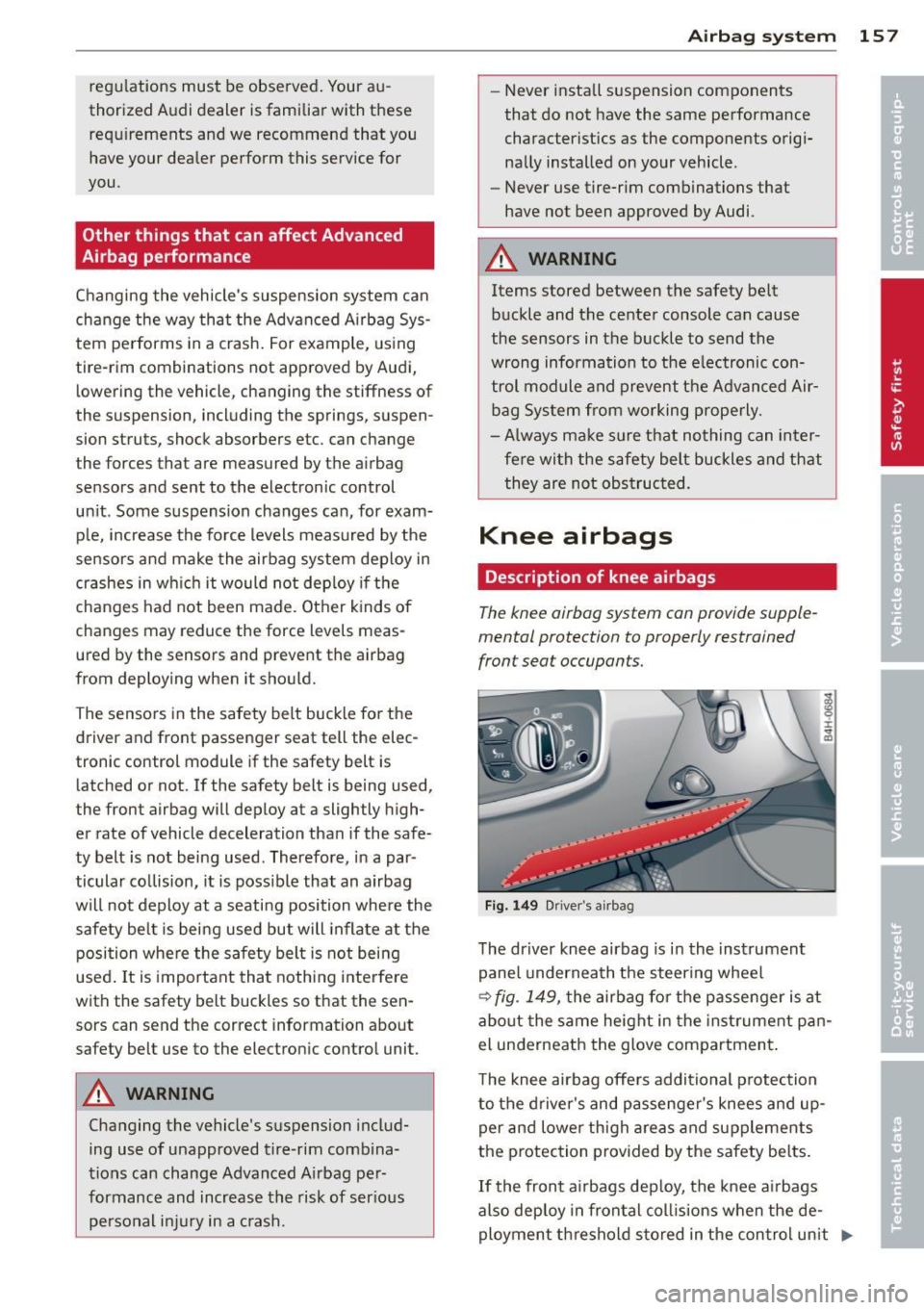
Fig. 149 Driver 's airbag
The driver knee airbag is in the instrument
panel underneath the steering wheel
¢ fig . 149, the airbag for the passenger is at
about the same height in the instrument pan
el underneath the glove compartment.
The knee airbag offers additional protection
to the driver's and passenger's knees and up
per and Lower thigh areas and supplements
the protection provided by the safety belts.
If the front airbags deploy, the knee airbags
also deploy in frontal col lisions when the de
ployment threshold stored in the control unit .,,.
Page 190 of 300
188 Intelligent technology
ESC includes and/or works together with the
anti-lock braking system (ABS), brake assist
system, anti-s lip regulat ion (ASR), e lectronic
d ifferential lock ( EDL), dynamic steering* and
e lectronic interaxle differentia l lock*. ESC is
switched on all the time. I n certa in s ituations
when you need less tract io n, you ca n sw itch
off ASR by pressi ng the button above
~ page 189, fig. 167 the se lector lever. Be
sure to sw itch ASR on ag ain when you no lon
ger need less trac tion.
Anti -lock braking system (ABS)
ABS prevents t he wheels from locking up
when braking. The veh icle can still be st eered
even d uring ha rd b rak ing . Apply steady p res
sure to the br ake ped al. Do no t pu mp the ped
a l. A puls ing in t he bra ke peda l ind icates that
the system is he lping yo u to b rake the vehicle .
Brake assist system
The brake assist system can decrease b ra kin g
d ista nce. It increases braking powe r w hen the
d river p resses the brake pedal quickl y in eme r
gency situa tions . You mus t press and ho ld the
b rake peda l until the situation is over. In vehi
cles with adaptive cruise control*, the brake
assist system is more sensitive i f the d istance
detected to the vehicle ahead is t oo smal l.
Anti-slip regulation (ASR)
ASR reduces engine power w hen the drive
wheels begin to spin and adapts the fo rce to
the road condit ions. This makes it eas ier to
start, accelerate and drive up hills.
Electronic differential lock (EDL )
The E DL brakes wheels that are spinn ing and
transfers the drive powe r to the o ther d rive
wheel o r whee ls if the vehic le is equipped with
a ll whee l drive*. This funct ion is available up
to about 7S mph (120 km/h).
I n extreme cases , EDL automatica lly swit ches
off to help keep the brake on the braked whee l
from overheating. ED L wi ll switch on again au
tomatically when conditions have returned to normal.
Dynamic steering*
On vehicles wi th dynam ic s teeri ng, ES C helps
stab ilize the steer ing in cer tain sit uations.
Electronic interaxle differential lock
function*
T he ele ctronic i nte raxle di fferentia l lock f unc
tion ac tiva tes when dr iving t hrough curves.
B ra king is targeted towar d the whee ls on the
inside of the curve as needed . This helps to
min imi ze front whee l skid, improves traction
and allows for more precise driving throug h
cu rves .
A WARNING
- ESC, ABS, ASR , EDL, dynamic steering*
and the elect ronic interaxle differential
loc k function* cannot ove rcome t he laws
of physics . This is espe cially im po rtant
on slippery o r we t road s.
If the sys tems
begin actin g to stabilize your veh icle, you
should immediately change yo ur speed
to match the road and t raffic conditions .
Do not let the increased safety provided
by these systems tempt you to take risks. Doing so will increase the risk of a loss of
veh icle cont ro l, collision and ser io us per
sonal injur ies .
-Always ada pt your speed to road , traffic
and wea ther conditions. The risk of los
ing contr ol of the vehicle i ncreases wh en
d riving too fast, espe cially through
curve s and on slippe ry or wet roads, and
when dr iv ing too close to vehicles up
ahead. ESC, ABS, the brake ass ist sys
tem, EDL, ASR, dynam ic steering * and
the elect ron ic interaxle differential lock
function * cannot prevent co llisions.
- Always accelerate with s pecial care on
even, smooth s urfaces such as those that
are wet or covered with ice and snow.
The drive wheels can spin even w ith
these assistance sys tems that cannot al
ways he lp to red uce the risk of loss of ve
h icle co nt ro l.
-
Page 191 of 300
@ Tips
-ABS and ASR on ly work correctly when
all four wheels are equ ipped with identi
cal t ires. Different tire s iz es can lead to a
reduct ion in eng ine power.
- You may hear noises when the systems
described are working.
- If the indicator light
D] or m (USA
models) ;£1 (Canada models) appears,
there may be a malfunction¢
page 19,
c> page
18 .
Switching on and off
ESC
turn s on au tomatically when you s tart
the engine .
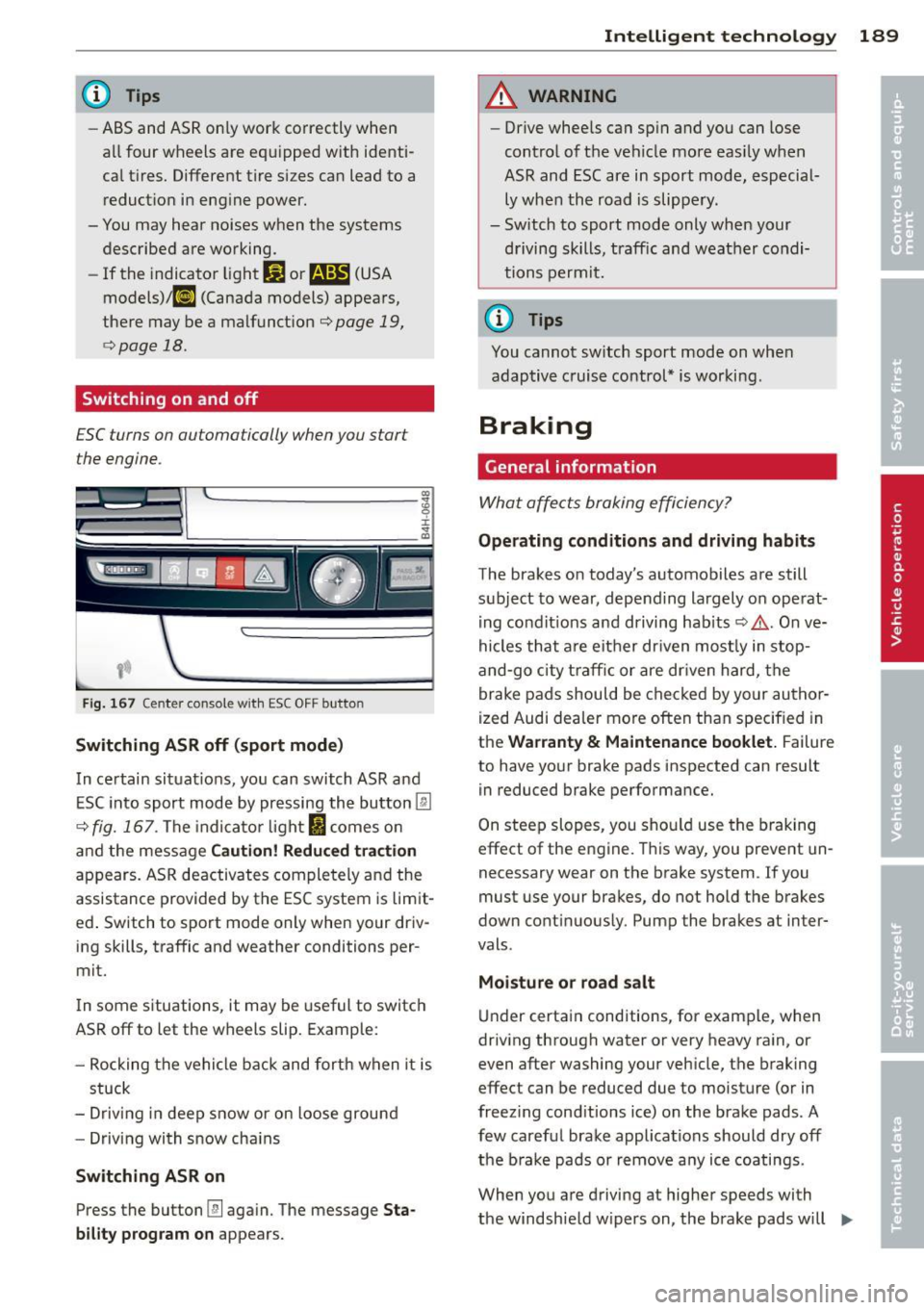
Fig. 167 Cen te r con sol e wit h ES C OF F but ton
Switching ASR off (sport mode )
In certain sit uat ions, you can switch ASR and
ESC in to sport mode by pressing the bu tton
[ru
c> fig. 167 . The indicator light I comes o n
and the message
Cauti on! R edu ced t ra cti on
appears. ASR deactivates completely and the
assistance provided by the ESC system is lim it
ed . Switch to sport mode only when your driv
ing skills, traffic and weathe r conditions per
mi t.
I n some s ituations, it may be useful to switc h
ASR off to let the wheels slip. Example:
- Rocking the vehicle back and forth when it is
stuck
- Driv ing in deep snow or on loose ground
- Driving with snow cha ins
Switching ASR on
Press the button [fil again. The message Sta
bility program on
appears.
Intelligen t technolog y 189
A WARNING
-Drive whee ls can sp in and you can lose
control of the vehicle more eas ily when
ASR and ESC are in sport mode, especial
ly whe n the road is slippe ry .
- Sw itch to sport mode only when your
driving skills, traff ic and weather condi
tions permit.
(D Tips
You cannot sw itch sport mode on whe n
adaptive cruise control* is working .
Braking
General information
What affects braking efficiency?
Operating cond itions and driving h abits
The brakes o n today's automobiles are still
subject to wear, depend ing largely on operat
i ng condit ions and driving habits ¢&, . On ve
hicles that a re either dr iven most ly in stop
and-go c ity t raff ic or are dr iven hard, the
brake pad s should be checked by yo ur author
i zed Audi dealer more often than specified in
the
Warranty & Maintenance booklet. Failure
to have your brake pads inspected can result in reduced brake performance.
On steep slopes, you sho uld use the braking
effect of the eng ine . T his way, you prevent un
necessary wear on the brake system . If you
must use your brakes, do not hold the br akes
down cont inuous ly . Pump the brakes a t in ter
vals .
Moisture o r ro ad sa lt
Under certa in conditions, for example, when
driv ing through water or very heavy ra in, or
even after washing your veh icle, the braking
effec t can be reduced due to moisture (or in
freez ing cond itions ice) on the brake pads . A
few carefu l brake applications should dry off
the b ra ke pads or remove a ny ice coatings.
When you are driving a t higher speeds with
the windsh ie ld w ipers on , the brake pads will
IJJJ,
Page 201 of 300

Trailer towing Driving with a trailer
General information
Your Audi was designed primarily for passen
ger transportation .
If you plan to tow a trai ler, p lease remember
that the addit ional load will affect durab ility,
economy and performance .
Trailer towing not on ly places more stress on
the vehicle, it also calls for more concentra
tion from the driver.
F or this reason, a lways fo llow the operating
and d riving instr uctions provided and use
common sense.
(D Note
If you are going to tow a trai ler, you must
activate the trailer operat ion mode
~ page 199, Operating instructions.
Technical requirements
Trailer hitch
Use a weight-carrying hitc h co nforming to the
gross trailer we ight. The hitch must be suita
b le for your veh icle and trailer and must be
mounted secure ly on the veh icle's chassis at a
technically sound location . Use only a trailer
hi tch wit h a removab le ball moun t. A lways
check with t he trail er hitch ma nufactur er to
make sure tha t you are using the corre ct
hi tch.
Do not use a bumper hitch.
The hitc h must be installed in such a way that
i t does not interfere with the impac t-absorb
i ng bumpe r sys tem. No mod ifica tio ns should
be made to the vehicle exh aust a nd brake sys
tems . From time to time, check that a ll hitch
mo unt ing bolts remain securely fastened.
W hen you are not towing a trail er, remove the
traile r hitch ball mount. Th is prevents the
hi tch from causing damage sho uld your ve hi
cle be str uck from behind ¢& .
Trailer towin g 199
Trailer brakes
If your trailer is equippe d wi th a br akin g sys
tem, check to be s ure that i t conforms to all
r egulations .
T he trailer hy draul ic brak e sys tem mus t not be
direc tly connec ted to the vehi cle' s h ydraulic
brake system .
Safety chains
Always use safety chains between your veh icle
and the tra ile r.
Trailer lights
Trai ler lights must meet all regu lations. Be
su re to check with your Audi dealer for cor rect
wir ing, swi tches and relays .
Mirrors
If you are unable to see the traffic behind you
us ing the reg ular o utside mirrors, then you
must insta ll extended mirrors. It is imp ortant
that you
always have clea r v is ion to the rear.
A WARNING ...__ -
Afte r removing the trailer hitch, do not
stor e it i n yo ur v ehicl e. In cas e o f sudden
b ra king, the hitch co uld fly forwar d and in
ju re you or your p ass en ger s.
Operating instructions
Fi g. 168 MM I dis pl ay: tow ing mode on
Ma ximum trailer weight
A trai ler fo r you r vehicle is limited to a typical
class 1 or class 2 tra iler.
ll>
Page 203 of 300

drive at the maximum permissible speed. Re
duce your speed even more if load, weather or
wind condit ions are unfavorable -part icularly
when going downhill.
Reduce vehicle speed
immediately if the trail
er shows the slightest sign of swaying .
Do not
try to stop the swaying by accelerating.
Observe speed limits . In some areas, speeds
for vehicles towing trailers are lower than for
regular vehicles .
A lways apply brakes early. When driving
downhill, shift into a lower gear to use the en
gine braking effect to slow the vehicle . Use of
the brakes a lone can cause them to overheat
and fail.
Coolant temperature
The coolant temperature gauge c:> page 10
must be observed carefully. The coo lant tem
perature can increase if you drive on long in
clines in a low gear at high engine speeds. Re
duce your speed immed iate ly if the L EDs in
the top part of the display turn on.
F or more information about indicator lights,
refer to.
i::> page 15.
A WARNING
Anyone not properly restrained in a mov
ing vehicle is at a much greater risk in an
accident . Never let anyone r ide in your car
who is not properly wear ing the restra ints
provided by Aud i.
Trailer towing tips
Important to know
Your veh icle hand les different ly when tow ing
-
a trailer because of the addit ional weight and
d ifferent weight distribution . Safety, perform
ance and economy will greatly depend on how
carefully you load your trailer and operate
your ng .
Before you actually tow your trailer, practice
turning, stopp ing and back ing up in an area
away from traffic. Keep practicing until you
Trailer towing 201
have become completely familiar with the way
your vehicle-trai ler combination behaves and
responds .
Backing up is difficult and requires practice .
Backing up with a t railer generally requires
steering action opposite to that when backing
up your vehicle without a tra iler.
Maintain a greater distance between your ve
hicle and the one in front of you . You wi ll need
more room to stop. To compensate for the
trailer, you w ill need a larger than normal
turning rad ius.
When passing, remembe r that you cannot ac
ce lerate as fast as you norma lly would be
cause of the added load. Make sure you have
enough room to pass. After passing, allow plenty of room for your trailer before chang
ing lanes again.
Avoid jerky starts, sharp turns or rapid lane changes.
(D Tips
- Do not tow a trailer during the break-in
period of your vehicle.
- If you tow a trailer, your Audi may re
quire more frequent maintenance due to
the extra load
c:> page 280.
Parking on a slope
Do not park on a slope with a trailer. If it can
not be avoided, do so only a~er doing the fol
lowing:
When parking:
.,. App ly the foot brake.
.,. Have someone p lace chocks under both the
vehicle and the trailer wheels .
.,. With chocks in place, slowly release the
brakes until the wheel chocks absorb the
load.
.,. Turn the wheels towards the curb .
.,. Apply the parking brake .
.,. Select the P selector lever posit ion .
When restarting after parking:
.,. Apply the foot brake.
•
•
Page 208 of 300

206 Cleaning and protec tio n
durch den Scheibenwischer und beim Nacht
sichtassistent* durch die Scheinwerferreini
gungsan lage gereinigt. Bei starker Versch
mut zung ki::innen Sie den Bere ich mit Glas
reiniger und einem weichen trockenen Tuch
reinigen .
@ Note
- Wenn Sie Ihr Fahrzeug mit e inem Hoch
druckrein iger waschen,
- halten Sie geni.igend groBen Abstand
zu den Sensoren, die s ich im vorderen
oder hinte ren StoBfanger befinden.
- rein igen S ie Kameralinsen und den Be
reich um diese nicht mit dem Hoch
druckre iniger .
- Entferne n Sie niemals Schnee und Eis
von de r Kameralinse m it warmem oder
heiBem Wasser -Gefahr einer Rissbi l
dung in der Linse!
- Verwenden S ie bei der Re inigung der Ka
meralinse niemals Pflegemittel mit
Schleifwirk ung.
Waxing and Polishing
Wa xing
A good wax coating protects t he vehicle paint
to a large extent aga inst the environmental
factors listed under ¢page 203, Washing and
even against slight scratches .
You can use a liquid car wax to protect your
pa int as soon as one week after your veh icle
has been delivered.
Even if you regularly use a
w ax ing process in
automatic car washes, we recommend that
you manua lly app ly a coat of wax to give the
pa int extra protection, particular ly if water no
longer beads o n the clean paint .
Protect p lastic body parts with car wax in the
same way as the vehicle body.
During warm weather dead insects tend to
collect on the front bumper and on the for
ward area of the hood. They are much easier
to remove from paint that is waxed often.
Polishing
Polish yo ur vehicle only if the paint has lost its
shine and the gloss cannot be brought back
with wax .
If the pol ish used does not conta in p reserva
t ive compounds, the pain t must be waxed a f
te rwards.
A WARNING ~
A lways read and heed all WARNINGS and
other info rmation
¢ page 203.
(D Note
Do not use car wax on
- matte o r anodized meta l trim
- rubber or rubber-like t rim.
Trim strips
Metal trim needs special care .
For environmental reasons, Audi fabricates
the bright trim strips and trim p ieces from
pure chromium-free aluminum.
Dirt and ma rks on the trim st rips sho uld be
removed with a
pH -balanced cleaning agent
(do not use a chrome cleaner). Audi dealers
carry clea ning products which have been tes t
ed fo r use on your vehicle and are not harmful
to the environment.
To avoid corrosion on the exter ior trim strips,
only a pH-ba lanced solution should be used
for the windsh ield washer .
A WARNING
-Always read and heed all WARNINGS and
other i nformation
¢ page 203.
Plastic and vinyl
Plastic needs special care .
U se a clean, damp cloth or sponge to remove
dust and light surface dir t. For other soil, use
a lukewa rm all-purpose cleaning so lution or a
mild saddle soap for v inyl tr im . Remove water
spots and traces of soap with a clean, damp ..,.