change wheel AUDI A8 2012 User Guide
[x] Cancel search | Manufacturer: AUDI, Model Year: 2012, Model line: A8, Model: AUDI A8 2012Pages: 300, PDF Size: 75.06 MB
Page 239 of 300
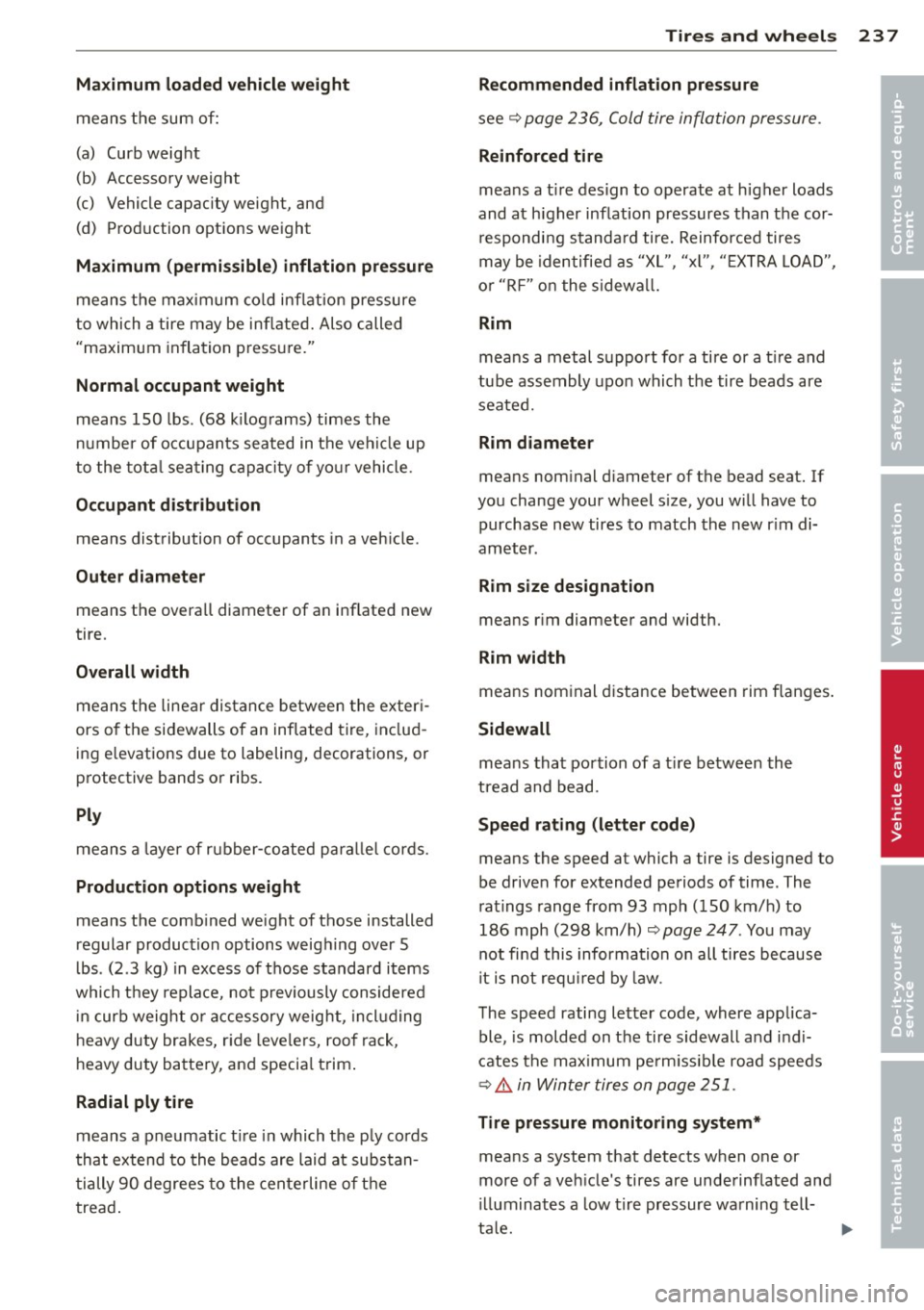
Maximum loaded vehicle weight
means the sum of:
(a) Curb weight
(b) Accessory weight
(c) Vehicle capacity weight, and
(d) Production options weight
Maximum (permissible) inflation pressure
means the maximum cold inflation pressure
to which a tire may be inflated. Also called
"maximum inflation pressu re."
Normal occupant weight
means 150 lbs. (68 k ilograms) times the
number of occupants seated in the vehicle up
to the total seating capacity of your vehicle.
Occupant distribution
means distribution of occupants in a vehicle .
Outer diameter means the overall diameter of an inflated new
tire.
Overall width
means the linear distance between the exteri
ors of the sidewalls of an inflated tire, includ
ing e levations due to labeling, decorations, or
protective bands or ribs.
Ply
means a layer of rubber-coated para llel cords.
Production options weight
means the comb ined weight of those installed
regular production options weighing over 5
lbs . (2 .3 kg) in excess of those standard items
which they replace, not previously considered
in curb weight or accessory weight, including
heavy duty brakes, r ide leve lers, roof rack,
heavy duty battery, and specia l trim .
Radial ply tire
means a pneumatic t ire in which the p ly cords
that extend to the beads are laid at substan
tially 90 degrees to the centerline of the
tread.
Tires and wheels 237
Recommended inflation pressure
see~
page 236, Cold tire inflation pressure.
Reinforced tire
means a t ire design to operate at higher loads
and at higher inflation pressures than the cor
responding standard tire. Reinforced tires
may be identified as "XL ", "x l", "E XTRA LOAD",
o r "R F" on the sidewall.
Rim
means a metal support for a tire or a t ire and
tube assembly upon which the tire beads are
seated.
Rim diameter
means nom inal d iameter of the bead seat. If
you change your wheel s ize, you w ill have to
purchase new tires to match the new r im di
ameter.
Rim size designation
means r im diameter and width.
Rim width
means nom inal distance between rim fla nges.
Sidewall
means that portion of a tire between the
tread and bead.
Speed rating (letter code)
means the speed at which a tire is designed to
be driven for extended periods of time. The
ratings range from 93 mph (150 km/h) to
186 mph (298 km/h)
~ page 247 . You may
not find this information on all tires because
it is not requ ired by law.
The speed rating letter code, where applica
ble, is molded on the tire sidewall and indi
cates the max imum pe rm issib le road speeds
~ .&. in Winter tires on page 251.
Tire pressure monitoring system*
means a system that detects when one or
more of a veh icle's tires are underinflated and
illuminates a low tire pressure warning tell
tale.
•
•
Page 242 of 300
240 Tires and wheels
change. In the event of discrepancies, the tire
pressure labe l is located on the driver's side B
p ill ar a lways takes precedence.
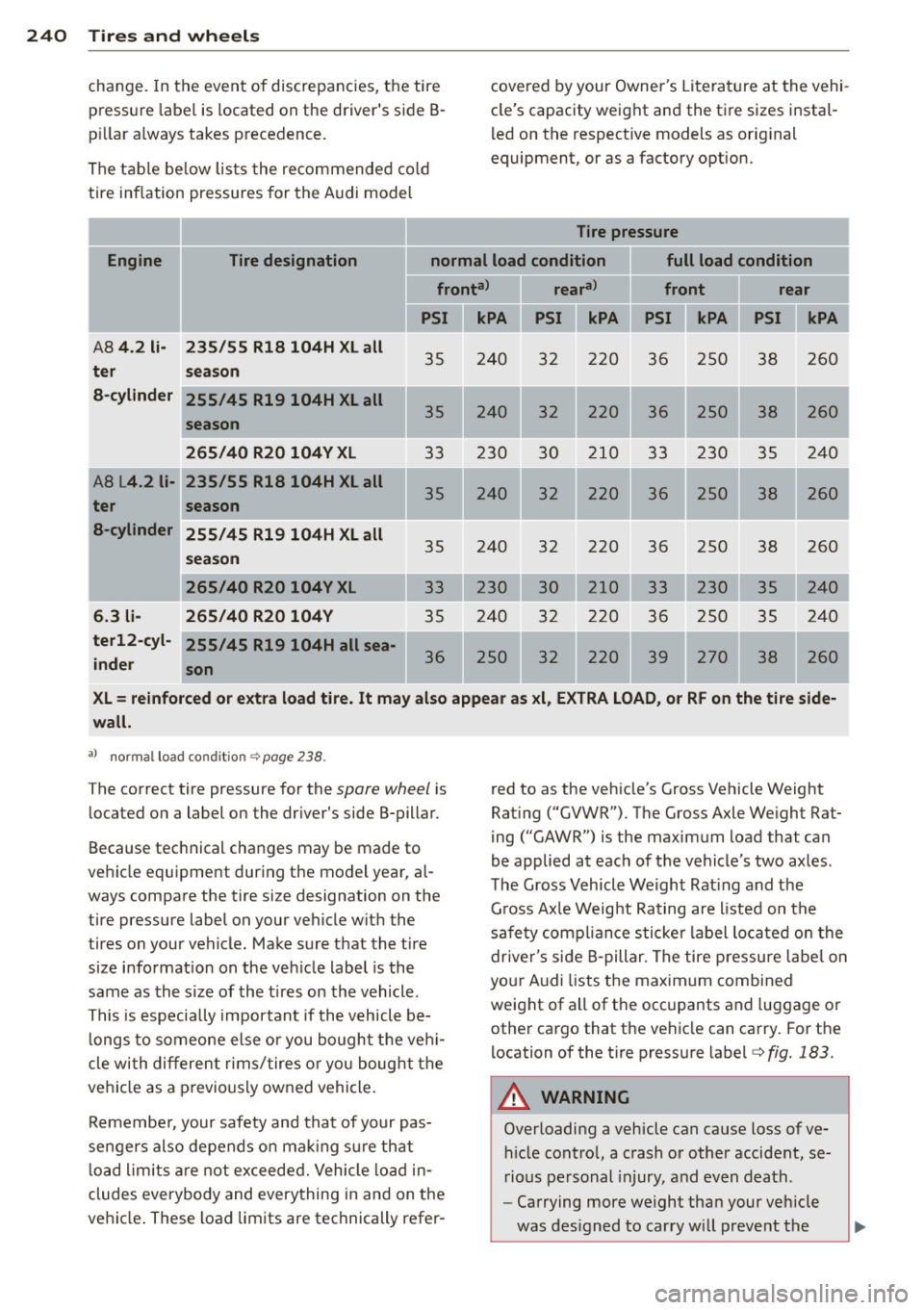
The table below lis ts the recommended cold
tire inflation pressures for the Audi model covered
by your Owner's Literature at the vehi
cle's capacity weight and the tire sizes instal
l ed on the respective models as orig inal
equipment, or as a factory option.
Tire pressure
Engine Tire designation normal load condition full load condition
fronta> reara>
front rear
AS 4.2 Ii-235/55 Rla 104H XL all
ter season
a -cylinder 255/45 R19 104H XL all
season
265/40 R20 104V XL
IA8 L4.2 Ii-235/55 Rla 104H XL all
ter season
a-cylinder 255/45 R19 104H XL all
season
6.3 li
ter12-cyl
inder 265
/40 R20 104V XL
265/40 R20 104V
255/45 R19 104H all sea-
son PSI
35
35
33
35
35
35
36
kPA
240
240
230
240
240
240
250
PSI
32
32
30
32
32
32
32
kPA
220
220
210
220
220
220
220
PSI kPA
36
250
36 250
33 230
36 250
36 250
36 250
39 270
PSI
38
38
35
38
38
35
38
kPA
260
260
240
260
260
240
240
260
I
I
I
XL= reinforced or extra load tire. It may also appear as xl, EXTRA LOAD, or RF on the tire side
wall.
a l nor mal load co nd it io n"'> page 238 .
The correct tire pressure for the spare wheel is
located on a label on the driver's side B-pillar.
Because technical changes may be made to
vehicle equipment during the model year, a l
ways compare the tire size designation on the
tire pressure label on your vehicle with the
tires on your vehicle. Make sure that the tire
size information on the veh icle label is the
same as the size of the tires on the vehicle.
This is especially important if the vehicle be
l ongs to someone else or you bought the veh i
cle with different rims/tires or you bought the
vehicle as a previously owned vehicle .
Remember, your safety and that of your pas
sengers also depends on mak ing su re that
l oad limits are not exceeded. Vehicle load in
cludes everybody and everything in and on the
vehicle . These load limits are technically refer- red to as the veh
icle's Gross Vehicle Weight
Rat ing ("GVWR"). The Gross Axle Weight Rat
ing ("GAWR") is the maximum load that can
be applied at each of the vehicle's two axles .
The Gross Vehicle Weight Rating and the
Gross Axle Weight Rating are listed on the
safety compl iance sticke r label located on the
driver's side B-pillar. The tire pressu re labe l on
your Audi lists the maximum combined
weight of all of the occupants and luggage or
other cargo that the vehicle can carry. For the
location of the tire pressure label
¢ fig. 183.
A WARNING
Overloading a vehicle can cause loss of ve
hicle contro l, a crash or other accident, se
rious personal injury, and even death.
- Carrying more we ight than your veh icle
was designed to carry will prevent the
Page 244 of 300
24 2 T ire s and wheel s
Remember that the vehicle manufacturer, not
the tire manufacturer, determines the correct
tire pressure for the t ires on your vehicle.
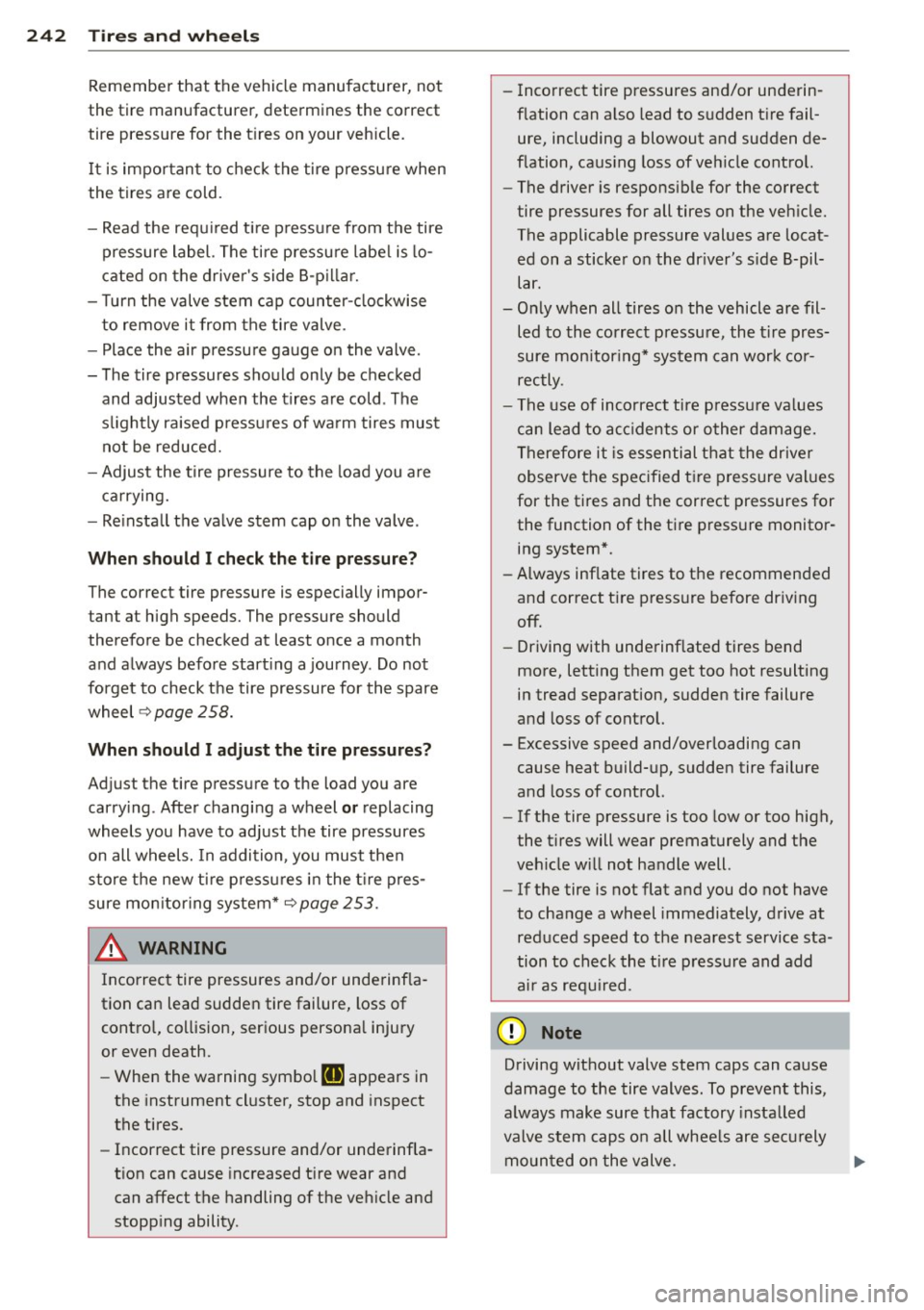
I t is important to check the tire pressu re when
the tires a re cold.
- Read the requ ired t ire pressure from the tire
pressure label. The tire pressure labe l is lo
cated on the drive r's side 8-p illar.
- T urn the valve stem cap counter-clockwise
to remove it from the tire valve.
- Place the air pressu re gauge on the valve.
- The tire pressures should only be checked
and adjusted when the tires are cold. The
sl igh tly ra ised p ressu res of warm tires must
not be reduced.
- Adjust the tire pressure to the load you are
carrying.
- Re insta ll the va lve stem cap on the valve .
When should I check the ti re pres sure ?
The correct tire pressure is especially impor
tant at high speeds. The pressure should
therefore be checked at least once a month
and always before start ing a jou rney. Do not
fo rget to check the tire pressure for the spare
wheel
i::!> page 258.
When should I adju st the tire p re ss ure s?
Adjust the tire pressure to the load you are
carry ing . After changing a wheel
or replacing
wheels you have to adjust the tire pressures
on all wheels. In addition, you must then
sto re t he new ti re press ures in the t ire pres
sure mon itor ing system*
i::?> page 253.
_8 WARNING
Incorrect tire pressures and/or underinf la
tion can lead sudden tire failure, loss of
contro l, co llision, ser ious persona l injury
or even death.
- When the warning symbo l
RI] appears in
the instrument cluster, stop and inspect
the tires.
- Incorrect tire pressure and/or underinfla
t ion can cause increased t ire wear and
can affect the handling of the veh icle and
stopp ing ability. -
Incorrect tire pressures and/or underin
f lation can a lso lead to s udden t ire fail
ure, including a blowout and sudden de
flation, caus ing loss of veh icle control.
- The driver is responsible for the correct
tire pressures for all tires on the veh icle.
The applicable pressure values are locat ed on a sticke r on the dr iver's s ide 8-pil
lar.
- Only when all tires on the vehicle are fil led to the correct pressure, the t ire pres
sure mon itor ing* system can work cor
rectly.
- The use of incorrect t ire p ressure va lues
can lead to acc idents or other damage.
Therefore it is essential t hat the drive r
observe the spec ified tire pressure values
for the tires and the correct pressures for
the function of the t i re press ure monitor
ing system*.
- Always inflate tires to the recommended
and correct ti re press ure before driving
off.
- Driving with underinflated tires bend
more, letting them get too hot resulting
in tread separation, sudden tire failure
and loss of control.
- Excessive speed and/overloading can
cause heat build-up, sudden tire failure
and loss of control.
- If the tire pressure is too low or too high,
the t ires will wear prematurely and the
veh icle w ill not handle well.
- If the tire is not flat and you do not have
to change a wheel immediately, drive at
reduced speed to the nearest service sta
tion to check the t ire p ress ure and add
a ir as req uired.
Q) Note
Driving w ithout valve stem caps can cause
damage to the tire valves. To prevent this,
always make sure that factory insta lled
valve stem caps o n all whee ls are sec urely
mounted on the valve.
Page 256 of 300

254 Tires and wheels
remain continuously illuminated. This se
quence will continue upon subsequent vehicle
start-ups as long as the malfunction exists.
When the malfunction indicator is illuminat
ed, the system may not be able to detect or
signal low tire pressure as intended. TPMS
malfunctions may occur for a variety of rea
sons, including the installation of replace
ment or alternate tires or wheels on the vehi
cle that prevent the TPMS from functioning
properly. Always check the TPMS malfunction
tellta le after replacing one or more tires or
wheels on your veh icle to ensure that the re
placement or alternate tires and wheels allow
the TPMS to continue to function properly.
Tire pressure indicator appears
Appl ies to vehicles: with tire pressure monitoring sys te m
The tire pressure indicator in the instrument
cluster informs you if the tire pressure is too
low or if there is a system malfunction.
Fig. 188 Display: underinflation warning
Fig. 189 Display: System malfu nction
Using the ABS sensors, the tire pressure moni
toring system compares the tire tread circum
ference and vibration characteristics of the in
dividual tires. If the pressure decreases in one
or more tires, this is indicated in the instru- ment
cluster with a warning symbol
[I] and a
message
r=> fig. 188.
The tire pressure monitoring system must be
reset via MMI each time the pressures are ad
justed (e.g. when switching between partial
and full load pressure) or after changing or re
plac ing a tire on your vehicle
r=> page 255. You
can find the recommended tire pressures for
your vehicle on the Label on driver's side 8-pil lar
¢ page 239.
Tire tread circumference and vibration charac
teristics can change and cause a tire pressure
warning if:
- the tire pressure in one or more tires is too
low,
- the tire has structural damage,
- the tire pressure was changed, wheels rotat -
ed or replaced but the TPMS was not reset
r=> page 255.
Warning symbols
[I] Loss of pressu re in at least one tir e ¢ ,&. .
Check the tire or tires and replace or repa ir if
necessary. The indicator light
[I] in the instru
ment cluster also illuminates
¢page 11 .
Check/correct the pressures of all four tires
and reset TPMS via MMI.
IIQllfl (Tir e Pressure Monitoring System) Tire
pressure! System malfunction .
If IIQIS, appears after switching the ignition
on or while driving¢
fig. 189 and the indica
tor light
[I] in the instrument cluster blinks
f or approximately one minute and then stays
on, there is a system malfunction . See your
authorized Audi dealer as soon as possible.
A WARNING
-- If the tire pressure indicator appears in
the instrument cluster display, one or more of your tires is significant ly under
inflated. Reduce you r speed immediately
and avoid any hard steering or braking
maneuvers. Stop as soon as possible and
check the tires and their pressures. In
flate the tire pressure to the proper pres-
sure as indicated on the vehicle's tire .,..
Page 257 of 300

pressure label¢ page 239. Driving on a
significantly under-inflated tire causes
the tire to overheat and can lead to tire
failure. Under-inflation also is likely to
impair the vehicle's handling and stop
ping ability .
- The driver is responsible for maintaining the correct tire pressures. You must check the tire pressures regularly.
- Under certain conditions (such as a spor ty driving style, winter conditions or unpaved roads), the pressure monitor indi
cator may be delayed.
-Ask your authorized Audi dealer if run
flat tires may be used on your vehicle.
Your vehicle registration becomes invalid if you use these tires when not permit
ted. Damage to your vehicle or accidents
could also result.
@ Tips
- The tire pressure monitoring system
stops working when there is an ESC/ABS
malfunction.
- Using snow chains may result in a system
malfunction.
- To ensure a proper TPMS function use
AUDI Original Tires which are marked
with "AO" or "RO" on the tire sidewall.
¢page 246.
- The tire pressure monitoring system on
your Audi was syntonized using tires with
the "AO" or "RO" identification. We rec
ommend using these tires.
Reset tire pressure monitoring system
App lies to vehicles: with tire pressure monitoring syste m
If the tire pressure is adjusted , wheels are ro
tated or changed, the TPMS must be reset via
MMI.
~ Switch on the ignition.
~ Select in the MMI: !CAR !function button>
Car systems control button > Servicing &
checks > Tire pressure monitoring > Store
tire pressures> Yes, store now .
Tires and wheels 255
(D Tips
Before resetting the TPMS, the current
pressures of all four tires must correspond
to the specified values. Adjust the tire
pressure and reset the pressure in the tire
pressure monitoring system according to
the load you are carrying ¢
page 239.
-Do not store the tire pressures if you are
driving with snow chains. Otherwise, a
system malfunction may occur .
•
•
Page 261 of 300

Spare wheel
Applies to vehicles: with spare wheel
The spare wheel is stored in the wheel well
underneath the floor panel in the luggage
compartment.
F ig. 1 95 Luggag e compartment: spare wheel
Taking out the sp are whee l
• Lift the cargo floor by the plast ic handle
c:> fig . 195.
• Hook the hand le into the luggage compart
ment weather strip .
• Turn the large screw
c:> fig. 195 counter
clockwise.
• Take out the spare tire.
• Always store the vehicle tool kit, the jack*
and the replaced tire i n the luggage com
partment
c:> page 130 .
• Unhook the ca rgo floor before closing the
rear lid.
& WARNING
Loose items in the passenger compa rt
ment can cause serious pe rsonal in jury
during hard braking or in an accident.
- Never store the spare wheel or jack and
tools in the passenger compartment.
@ Tips
Check the inflat io n press ure of the spare
tire periodically to keep the tire ready for
use.
-
What do I d o now ? 259
Changing a wheel
Before changing a wheel
Observe the following precautions for your
own and your passenger's safety when chang
ing a wheel.
• After you experience a tire failure, pull the
car well away from mov ing traffic and try to
reach
le vel ground before you stop c:> ,&.
• All passengers should leave the car and
move to a safe location (for ins tance, behind
t he guardra il)
c:> ,& .
• Engage the parking brak e to prevent your
vehicle from rolling unintentionally
c:> ,& .
• Move sele ctor lever to po sit ion Pc:> &_ .
• If you are towing a trailer, unhitch the trail
er from your vehicle.
• Take the
jack and the spare tire out of the
luggage compartment
c:> page 257,
c:> page258 .
& WARNING
You or you r passengers could be i njured
while changing a wheel if you do not fo l
low these safe ty pre caut ions :
-I f you have a flat tire, move a safe d is
tance off the road. Turn off the e ngine,
turn the emergency flashers on and use
other warning devices to a lert other mo
torists .
- Make sure that passengers wait in a safe
place away from the vehicle and well
away from the road and traffic.
- To help prevent the vehicle from moving
suddenly and possib ly slipping off the
jack, always full y set the parking brake
a nd b lock the wheel d iagonally opposite
the wheel be ing changed. When one
front wheel is lifted off the ground, plac ing the Au tomatic Transmission in "P"
( P ar k) will
not prevent the vehicle from
mov ing .
- Before you chang e a whee l, be s ure the
g round is level and firm. If necessary,
use a sturdy board un der the jac k.
- After insta lling the spare wheel , make
sure that you replace t he f lat t ire/wheel
-
Page 262 of 300
260 What do I do now ?
in its storage area properly and tighten
the knurled retaining screw securely.
@ Tips
Before changing the wheel, you m ust acti
vate t he jacking mode , so that the auto
matic controls for the Adaptive Air Sus
pension do not make it more diff icu lt to
lift the vehicle with the jack
q page 262.
Changing a wheel
When you change a wheel, follow these
quence de scribed below s tep-by-s tep and in
exac tly tha t order.
1. Act ivat e the vehicle jack mod e
¢page 262.
2. Remove the de corat ive wh eel co ver* . For
more details see also¢
page 260, Deco
rative wheel covers
or ¢ page 261 ,
Wheels with wheel bolt cops.
3 . Loosen the wheel bolts¢ page 261 .
4. Locate the proper mo unt ing po int for the
jack and align the jac k below that point
¢ pag e 262.
5. R ais e the car with the jack¢ page 262.
6. Remove the wheel with the fl at tire and
then in stall
the spare ¢ page 263 .
7. Tigh ten all wheel bol ts ligh tly.
8 .
Lo wer the veh icle with the jack .
9 . Use the whee l bolt wrench and
firml y
tighte n all whee l bolts ¢ page 261.
10. Replace the decorative wheel c over*.
11. De activate the veh icle jack mode in the
MMI:
! CARI function button> Ca r syst em s
control button > Se rv icing & chec ks > Air
sus p.: jack mode > Off.
The vehicle jac k mode sw itches off automati
cally at speeds above 10 km/h.
A WARNING
Always read and follow all WARNINGS and
information
¢ &. in Raising the vehicle on
page 262
and ¢ page 264.
After changing a wheel
A wheel change is not complete without the
doing the following .
.,. Alw ays store the vehicle tool kit, the jack*
and the repl aced tire in the luggage com
pa rtment
¢ page 130.
... Check the tir e pres su re on the spare wheel
immed iate ly afte r mounting it.
.,. As soon as possib le, have the
tight ening
torque s
on all whee l bolts checked with a
torque wrench . The correc t tightening tor
que is 90 ft lb (120 Nm).
... Hav e the flat tire
repl aced as soon as possi
ble .
@ Tips
-If you notice that the wheel bo lts are
corroded and difficult to turn while
changing a tire, they should be rep laced
before you check the tightening torque.
- Dr ive at reduced speed until you have the
tightening torques checked.
- After changing a whee l, the t ire press ure
in all four tires must be checked/correct
ed and the tire pressure monitoring ind i
cator must be stored in the MMI
¢ page 255.
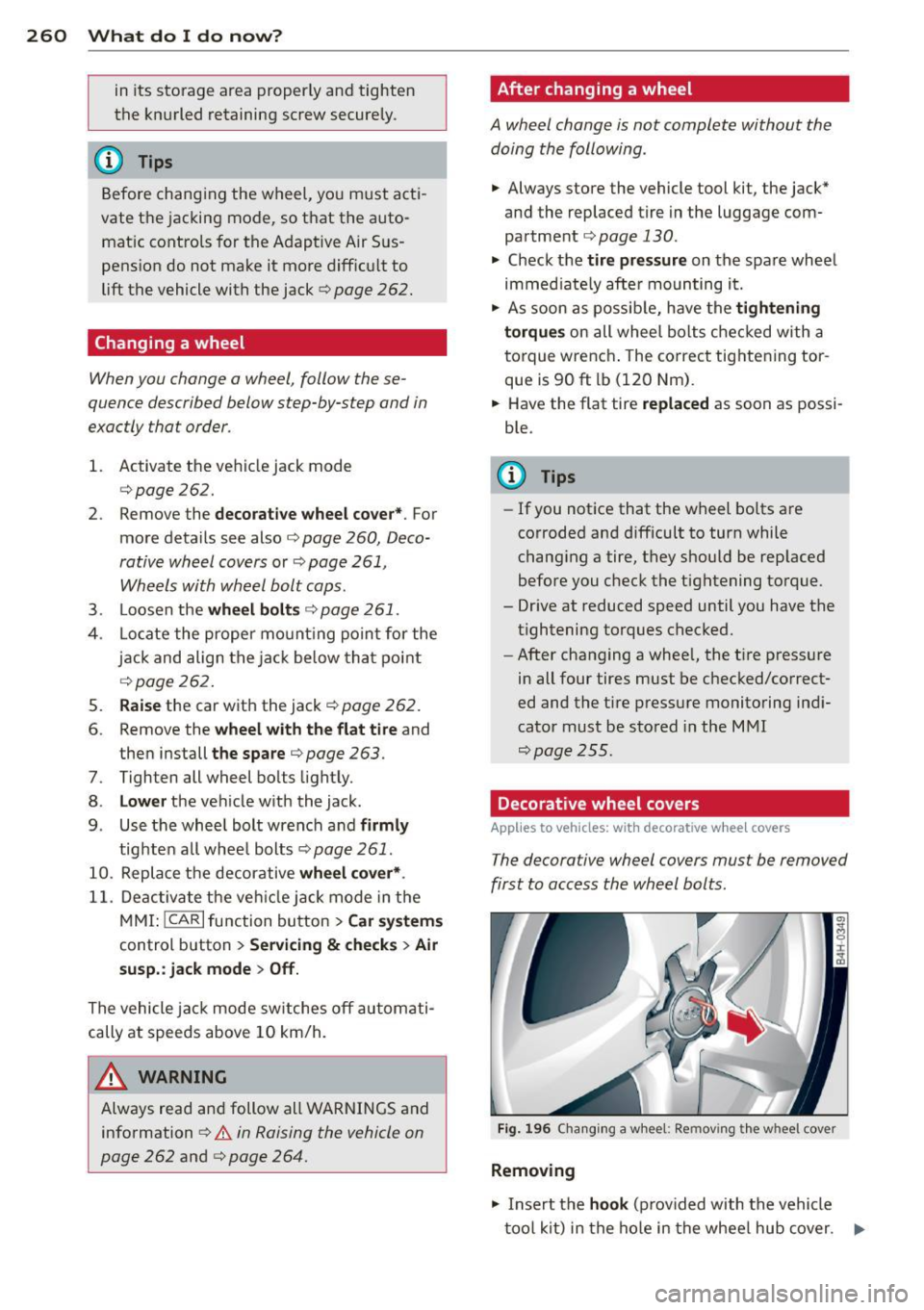
' Decorative wheel covers
Applies to vehicles: w ith decorative whee l covers
The decora tive wheel covers mus t be removed
first to access the wheel bolts.
Fi g. 1 96 Chang ing a whee l: Re mov ing th e w hee l cov er
Removing
.,. Insert the hook (prov ided with the vehicle
too l kit) in the ho le in the whee l hub cover . .,..
Page 264 of 300

262 What do I do now ?
ho ld on to the car to keep your ba lance
and take care not to slip .
Raising the vehicle
The vehicle must be lifted with the jack first
before the wheel can be removed .
Fig. 199 Sill panels: markings
Fig. 200 Sill: posit ion ing t he veh icle jack
.. Activate the vehicle jack mode in the MMI:
I CAR ! function button > Ca r sys te m s control
button>
S ervic ing & c h ecks > Air susp .:
jack mod e > On .
.. Engage the par king brake to prevent your
vehicle from ro lling u ninten tionally.
.. Move the
se lector l ever to po siti on P .
.. Find the marking (imprint) on the sill that
is nearest the wheel that will be changed
o fig. 199 . Behind the marking, there is a
lifting point on the s ill for the vehicle jack .
.. Turn the
ve hicle jack located under the lift
ing point on the si ll to raise the jack until its
arm @
o fig. 200 is located under the des
i gnated plastic mount
o ,& o0.
.. Align the jack so that its arm @ o fig. 200
engages in the designated lifting po int in
the door sill and the movable base @ lies
flat on the ground. The base @ must be
ver
tical
under the lifting point @. ..
Wind the jack up fu rther until the f lat tire
comes off the ground
o .&, .
Position t he vehicle jack o nly under the desig
nated lifting points on the si ll
¢fig. 199.
There is exactly one location for each wheel.
The jack must not be positioned at any other location
c:> .&, c:>Q).
An un sta ble surf ace under the jack ca n cause
the vehicle to slip off the jack . Always provide
a firm base for the jack on the ground . If nec
essary place a sturdy board or similar support
under the jack. On
hard, sl ipp ery su rfaces
(such as tiles) use a rubbe r mat or similar to
prevent the jack from slipping
c:> .&, .
A WARNING ~
-You or your passengers could be injured
while changing a wheel if you do not fo l
low these safety preca utio ns:
- Position the vehicle jack on ly at the
designated lifting points and align the
jack. Otherwise, the vehicle jack could slip and cause an injury if it does not
have sufficient hold on the vehicle.
- A soft or unstable surface under the
jack may cause the vehicle to slip off
the jack . Always provide a firm base for
the jack on the ground. If necessa ry,
use a stu rdy board under the jack.
- On hard, s lippery surface (such as t iles)
use a rubber mat or simi lar to prevent
the jack from slipping.
- To help prevent injury to yourself and
your passe ngers:
- Do not raise the vehicle until you are
sure the jack is securely engaged.
- Passengers must not remain in the ve
hicle when it is jacked up.
- Make sure that passengers wait in a
safe place away from the vehicle and
well away from the road and traffic .
- Make sure jack pos ition is correct, ad
just as necessary and then continue to raise the jack.
- Changes in temperature or load can af
fect the height of the vehicle.
Page 280 of 300
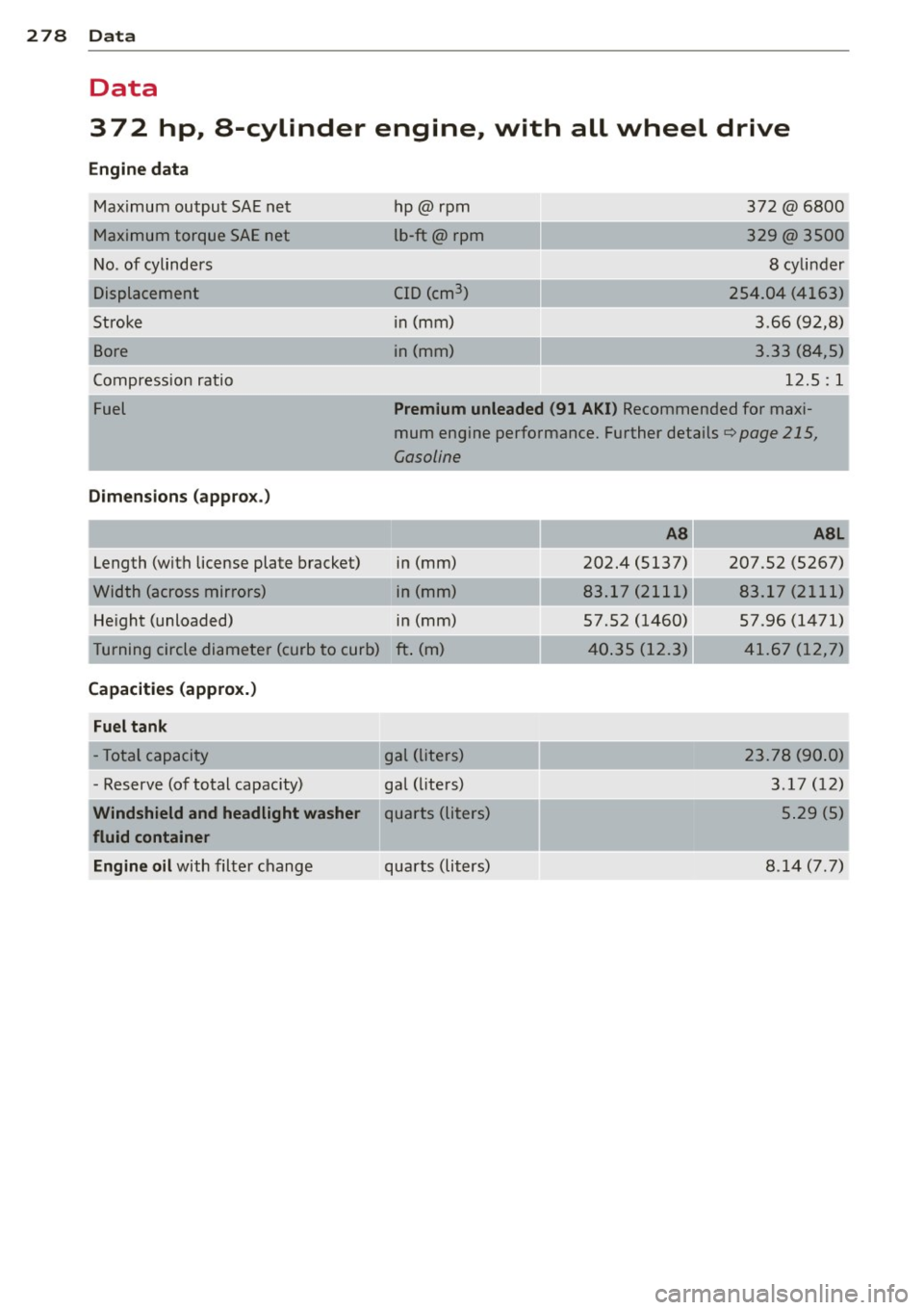
278 Data
Data
372 hp, a-cylinder engine, with all wheel drive
Engine data
Maximum output SAE net
Maximum torque SAE net
No. of cylinders
Displacement
Stroke
Bore
Compression ratio hp@rpm
l
b-ft@ rpm
CID (cm
3 )
in (mm)
i n (mm)
372 @6800
329@3500
8 cylinder
254.04 (4163)
3.66 (92,8)
3.33 (84,5)
12.5 : 1
Fuel Premium unleaded (91 AKI) Recommended for maxi
mum engine performance. Further details¢
page 215,
Gasoline
Dimens ions (appro x.)
Length (with license plate bracket) in (mm)
Width (across mirrors) ____ in (mm)
He ight (unloaded) in (mm)
Turning circle diameter (curb to curb) ft . (m)
Capacities (approx.)
Fuel tank
- Total capacity gal (liters)
- Reserve (of total capacity) gal (liters)
Windshield and headlight washer quarts (liters)
fluid container
Engine oil
with filter change quarts (liters)
AS ASL
202.4 (5137) 207.52 (5267) _,, __
83.17 (2111) 83.17 (2111)
57 .52 (1460) 57.96 (1471)
4 0.35 (12.3) 41.67 (12,7)
23. 78 (90 .0)
3.17 (12)
5.29 (5)
8 .14 (7 .7)
Page 281 of 300
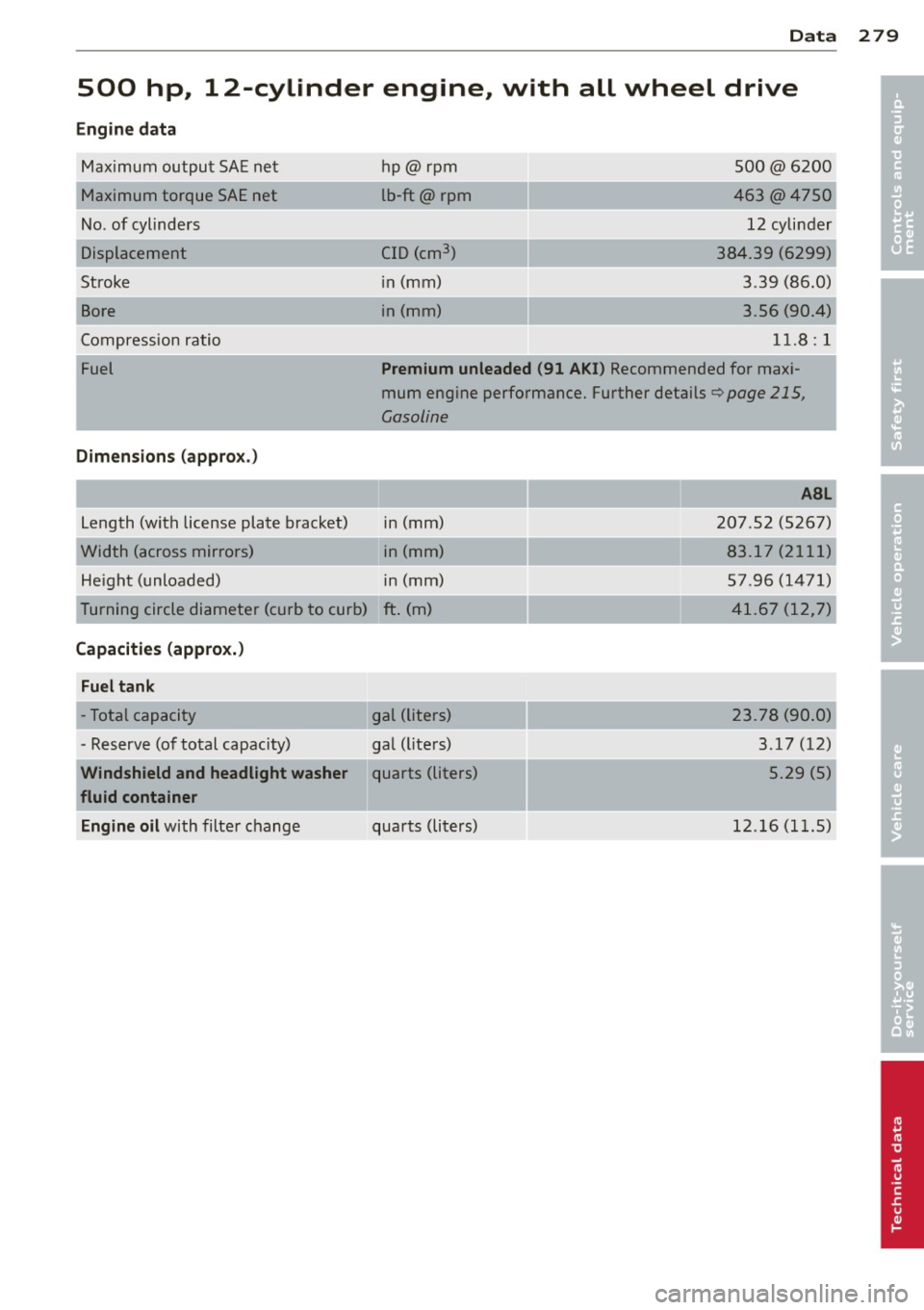
Data
500 hp, 12-cylinder engine, with all wheel drive
Engine data
Maximum output SAE net
Maximum torque SAE net
No. of cylinders
Displacement
Stroke
Bore
Compression ratio hp@rpm
lb-ft@ rpm
CID (cm
3 )
in (mm)
in (mm) 500@6200
463@4750 12 cylinder
384.39 (6299)
3.39 (86.0)
3 .56 (90.4)
11. 8:1
Fuel
Premium unleaded (91 AKI) Recommended for maxi
mum engine performance. Further details¢
page 215,
Gasoline
Dimension s (approx .)
Length (with license plate bracket)
Width (across mirrors)
He ight (unloaded) in (mm)
in (mm)
in (mm)
T urning circle diameter (curb to curb) ft . (m)
Capacities (approx.)
Fuel tank
- Total capacity gal (liters)
- Reserve (of total capacity) gal (l iters)
Windshield and headlight washer quarts (liters)
fluid container
Engine oil
with filte r change quarts (liters)
ASL
207 .52 (5267)
83.17 (211 1)
57 .96 (1471)
41.67 (12,7)
23.78 (90 .0)
3.17 (12)
5.29 (5)
12 .16 (11.5)
279
•
•