heating AUDI A8 2012 User Guide
[x] Cancel search | Manufacturer: AUDI, Model Year: 2012, Model line: A8, Model: AUDI A8 2012Pages: 300, PDF Size: 75.06 MB
Page 190 of 300
188 Intelligent technology
ESC includes and/or works together with the
anti-lock braking system (ABS), brake assist
system, anti-s lip regulat ion (ASR), e lectronic
d ifferential lock ( EDL), dynamic steering* and
e lectronic interaxle differentia l lock*. ESC is
switched on all the time. I n certa in s ituations
when you need less tract io n, you ca n sw itch
off ASR by pressi ng the button above
~ page 189, fig. 167 the se lector lever. Be
sure to sw itch ASR on ag ain when you no lon
ger need less trac tion.
Anti -lock braking system (ABS)
ABS prevents t he wheels from locking up
when braking. The veh icle can still be st eered
even d uring ha rd b rak ing . Apply steady p res
sure to the br ake ped al. Do no t pu mp the ped
a l. A puls ing in t he bra ke peda l ind icates that
the system is he lping yo u to b rake the vehicle .
Brake assist system
The brake assist system can decrease b ra kin g
d ista nce. It increases braking powe r w hen the
d river p resses the brake pedal quickl y in eme r
gency situa tions . You mus t press and ho ld the
b rake peda l until the situation is over. In vehi
cles with adaptive cruise control*, the brake
assist system is more sensitive i f the d istance
detected to the vehicle ahead is t oo smal l.
Anti-slip regulation (ASR)
ASR reduces engine power w hen the drive
wheels begin to spin and adapts the fo rce to
the road condit ions. This makes it eas ier to
start, accelerate and drive up hills.
Electronic differential lock (EDL )
The E DL brakes wheels that are spinn ing and
transfers the drive powe r to the o ther d rive
wheel o r whee ls if the vehic le is equipped with
a ll whee l drive*. This funct ion is available up
to about 7S mph (120 km/h).
I n extreme cases , EDL automatica lly swit ches
off to help keep the brake on the braked whee l
from overheating. ED L wi ll switch on again au
tomatically when conditions have returned to normal.
Dynamic steering*
On vehicles wi th dynam ic s teeri ng, ES C helps
stab ilize the steer ing in cer tain sit uations.
Electronic interaxle differential lock
function*
T he ele ctronic i nte raxle di fferentia l lock f unc
tion ac tiva tes when dr iving t hrough curves.
B ra king is targeted towar d the whee ls on the
inside of the curve as needed . This helps to
min imi ze front whee l skid, improves traction
and allows for more precise driving throug h
cu rves .
A WARNING
- ESC, ABS, ASR , EDL, dynamic steering*
and the elect ronic interaxle differential
loc k function* cannot ove rcome t he laws
of physics . This is espe cially im po rtant
on slippery o r we t road s.
If the sys tems
begin actin g to stabilize your veh icle, you
should immediately change yo ur speed
to match the road and t raffic conditions .
Do not let the increased safety provided
by these systems tempt you to take risks. Doing so will increase the risk of a loss of
veh icle cont ro l, collision and ser io us per
sonal injur ies .
-Always ada pt your speed to road , traffic
and wea ther conditions. The risk of los
ing contr ol of the vehicle i ncreases wh en
d riving too fast, espe cially through
curve s and on slippe ry or wet roads, and
when dr iv ing too close to vehicles up
ahead. ESC, ABS, the brake ass ist sys
tem, EDL, ASR, dynam ic steering * and
the elect ron ic interaxle differential lock
function * cannot prevent co llisions.
- Always accelerate with s pecial care on
even, smooth s urfaces such as those that
are wet or covered with ice and snow.
The drive wheels can spin even w ith
these assistance sys tems that cannot al
ways he lp to red uce the risk of loss of ve
h icle co nt ro l.
-
Page 195 of 300

than is being generated and ensures an optimal state of charge for the battery.
@ Tips
- But even energy management cannot
negate the limits o f physics. Consider
that the power and life of a battery are
li mited.
- If starting ab ility is threatened, the indi
cator light
(•i appears ~ page 16, 0
Battery.
What you should know
The highest priority is given to maintaining
starting capability.
The battery is severely taxed in short-dis tance
d riving, in city traffic and during the co ld time
of year . Abundant e lectrica l energy is re
q ui red, but only a litt le is generated. It is also
cr itical if the engine is not runn ing and electri
cal components are turned on. In th is in
stance energy is being consumed but none is
be ing generated .
It is in precisely these situations that you w ill
notice energy management actively regulat
i ng the distribution of energy.
Vehicle sta nds for an ext ended p eriod
If you do not drive you r vehicle over a period
of several days or weeks, electrical compo nents are grad ually cut back or switched
off .
This reduces energy consumption and main
tains sta rting capab ility over a longer per iod.
Some of the conven ience f unctions may not
ope rate, such as the inter ior lig hts or the
power sea t adjustment. The conven ien ce
f u nctions w ill be ava ilable again when you
switch on the ignit ion and start the engine .
With the engine turned off
If you listen to the radio, for example, with
the engine turned
off or use other MMI func
tions, the battery is being discharged .
If starting capability is jeopa rdized due to en
ergy consumpt ion, the fo ll ow ing warning ap
pears in the MMI display :
Intellig ent technolog y 193
Plea se start the engine soon or the sy stem
will be turned off .
The wa rni ng ind ic ates that the system wi ll be
tu rned
off automatically a fter 3 minu tes. If
you w ish to continue using the funct ions, yo u
have to start the engine.
With the engine running
Althoug h elec trical energy is generated when
t h e ve hicl e is being driven, t he battery can be
come d ischarged. This happe ns mostly when
little energy is being generated and a great
deal consumed and the battery's state of
charge is not opt imal.
T o b ring the energy ba lance back in to equili
brium, consumers which require especially
l a rge amounts of energy a re temporari ly cut
back or sw itched
off. Heat ing systems in par
ticular require a great deal of energy. If you notice, for example, that the heated seats* or
the heated rear window are not heating, they
have been temporarily cut back or switched
off . These systems w ill be available again as
soon as the ene rgy balance has been restored.
You w ill also notice that engine id le speed has
been increased slightly . Thi s is normal and not
a cause for concern. By inc reasing engi ne id le
speed the additional e nergy requi red is gene r
ated and the b attery is charged.
•
•
Page 197 of 300
Catalytic converter
It is very important that your emission control system (catalytic converter) is function
ing properly to ensure that your vehicle is run
ning in an environmentally sound manner .
.. Always use lead-free gasoline¢ page 215,
Fuel supply.
.,. Never run the tank down all the way to
empty.
.,. Never put too much motor oil in your en-
gine
¢ page 225, Adding engine oil~-
.,. Never try to push- or tow-start your veh icle.
The catalytic converter is an eff icient "clean
up" device built into the exhaust system of
the vehicle . The catalytic converter burns
many of the pollutants in the exhaust gas be
fore they are released into the atmosphere.
The exclusive use of unleaded fuel is critically
importa nt for the life of the cata lytic convert
e r and proper functioning of the engine.
A WARNING
-
- Do not park or operate the vehicle in
areas where the hot exhaust system may
come in contact with dry grass, brush,
fuel spill or other material which can cause a fire.
- Do not apply additional undercoating or
rustproofing on or near the exhaust
man ifold, exhaust pipes, catalytic con
verter or heat shields. During driving, the
substance used for undercoating cou ld
overheat and cause a fire.
0 Note
- Be aware that just one tank filling with
leaded fuel will already seriously de
grade the performance of the catalytic
converter.
- Do not exceed the correct engine oil level
¢ page 225.
-Do not drive until the fuel tank becomes
completely empty. The eng ine could mis
fire . U nburned fuel could a lso get i nto
Dri vin g and en vironm ent 195
the exhaust system and this cou ld cause
the catalytic converter to overheat .
- Do not switch off the ignit ion while the
vehicle is mov ing.
- Do not continue to ope rate your veh icle
unde r these conditions, as othe rwise fuel
can reach the catalytic converter. This
co uld result in overheating of the con
verter, requir ing its replacement .
- To assure efficient operation of the Emis
sion Control System:
- H ave your vehicle maintained prope rly
and in accordance w ith the se rv ice rec
ommendat ions in you r Warranty &
M aintenance boo klet.
- L ack of prope r maintenance as we ll as
improper use of the vehi cle w il l impair
the function of the em ission contro l
system and could lead to damage .
@ For the sake of the environment
Even when the Emiss ion Control System is
operat ing properly, the exha ust gas can
have a sul fur -li ke exhaust gas smell under
some operating states . This depends on
the sulfur content of the fuel being used .
Using a different brand of fue l may help,
or filling the tank with lead-free super
grade gasoline .
Avoid damaging the
vehicle
When you are drivi ng on poo r roads, or over
c ur bs, s teep ramps, etc., ma ke certai n that
low -lying parts s uch as spoilers and exhaust
system pa rts do not bottom o ut and get dam
aged.
T h is is espec ially true for veh icles w ith low
s lung chassis (spor ts chassis)* and fully load
ed vehicles. •
•
Page 199 of 300
Avoid full throttle
Driving at moderate speeds saves fuel and
improves your mileage.
"" Try and keep well below your car's maxi-
mum speed.
Accelerating gently reduces fuel consump tion, engine wear, and does not disturb the
environment.
F ue l consumption, exhaust emissions and en
g ine noise increase disproportionately at high
speeds. If you drive at approximately three
quarters of top speed, fuel consumption will be reduced by one half. Never drive faster
than the posted speed limit and weather con
d itions permit .
Reducing unnecessary idling
Even when your car is just idling it burns up
fuel.
"" Shut the engine off when you are not driv
ing the vehicle.
"" Do not warm up the veh icle by letting the
engine run at idle .
It makes sense to shut
off the engine in traff ic
jams, when waiting for trains to pass at ra il
road crossings, or at traffic lights that have
l ong wa its on red. Turning the engine
off fo r
just
30-40 seconds saves more fue l than is
bu rned starting the eng ine again .
It takes a long time for the engine to warm up
fu lly when it is running at idle. However, wear
and nox ious em issions are especially high
when the engine is warming up. So you should
drive away as soon as you start the engine and
avoid running at high rpms while the engine is
still warming up .
(D Note
Do not leave engine idling unattended af
ter starting . If warning lights should come
on to indicate improper operation, they
wou ld go unheeded. Extended idling also
produces heat, which cou ld result in over-
Dri vin g and en vironm ent 197
'
heating o r othe r damage to the veh icle or
other p roperty .
Regular maintenance
A badly tuned engine unnecessarily wastes a
lot of fuel.
"" Have your veh icle serviced at reg ular i nter-
vals.
By having your veh icle regu la rly serviced by an
Audi dealer he lps to ensu re that it runs prop
erly and economically. The condition of your
vehicle not only affects its sa fety and ability to
hold its value, it a lso affects
fuel con sump
tion .
Check your oil e ach t ime you fill your tank .
The amount of o il used is re lated to eng ine
load and speed .
It is normal for the oil consumption of a new
engine to reach its lowest value after a certa in
mileage has been driven .
You must drive your veh icle about 3,000 m iles
(5,000 kilometers) before you can properly
assess oil consumpt ion.
This also app lies to fue l consumption and en
gine output.
(U) Note
- Have your vehicle maintained properly
and in accordance with the service rec
ommendations in your Warranty
& Ma in
tenance booklet . Lack of proper mainte
nance as well as improper use of the ve
hicle will impair the function of the
em iss io n cont ro l system and cou ld lead
to damage.
- Do not alter or remove any component of
the Emission Control Sys tem unless ap
proved by the manufacture r.
- Do not alter or remove any device, such
as heat shie lds, swit ches, ign it ion w ires,
valves, which are designed to p rotec t
your vehicle's Emission Control System
and other important vehicle compo
nents .
•
•
Page 229 of 300
Engine cooling system
Coolant
The engine coolant performs two functions: it
keeps the engine from overheating and it pro
te cts the engine from freezing in the winter .
The cooling system is sealed and generally re
qu ires little attention .
The cooling system has been filled at the fac
tory with a permanent coolant which does not need to be changed. The coolant consists of a
mixture of water and the manufacturer's gly
col-based coolant additive G13 ant ifreeze
w ith anticorrosion add itives (SO% fo r USA
models; 60% for Canad ian models). This mix
ture bot h assu res the ne cessary frost protec
tion and protects metal components in the
engine's coo ling system from corrosion and
scaling. It also raises the boili ng po int of t he
coolant.
D o not red uce the concentration o f the coo l
ant in the summer by adding plain water .
The
proportion of coolant addit ive must be at
least 50% but not mo re than 60 %
to main
tain antifree ze protection and cooling efficien
cy. If the coolant frost protection is too low,
the coolant cou ld freeze and damage the veh i
cle heating and eng ine cooling system .
For year-round driving, antifree ze is added at
the factory for temperatures down to:
- -3 1°F (-3S°C)USA
- -40 ° F ( - 4 0 °C) Canada.
A WARNING
Before yo u check anything in the engine
compartment , always read and heed a ll
WARNINGS ¢
& in Working in the engine
compartment on page 219.
(D Note
- Befo re winter sets i n, have the coolant
chec ked to see i f th e coo lant ad dit ive i n
you r vehicle is suffic ient to meet the cli
mate cond itions . T hi s is especially impor
ta nt if yo u live in a regi on whe re the w in-
-
Checkin g and fillin g 22 7
ter is ex treme ly co ld. If necessary, i n
crease t he p ro po rtion of coo lant additive
to 60%.
- W hen a dding coolant additive to yo ur
cooling system , remembe r:
- We recommend us ing on ly coo la nt ad
di tive G 12++ or G 13 for your v ehicle .
T his co olan t ad ditive is av ailab le at au
t hor ized A udi dealers . O ther types of
an tifree ze can signi fican tly reduce cor
r osion pro te ction . The resulti ng cor ro
sion can ca use a loss of coolant a nd se
rious engine damage.
- Do not add any ty pe of rad iator leak seal
ant to you r vehicle's engine coo lant .
Add ing radiator repair flu id may adverse
ly affect t he fu nction and performance of
your cooling system and cou ld result in
damage not covered by yo ur New Ve hicle
L imited Warranty .
Checking the engine coolant level
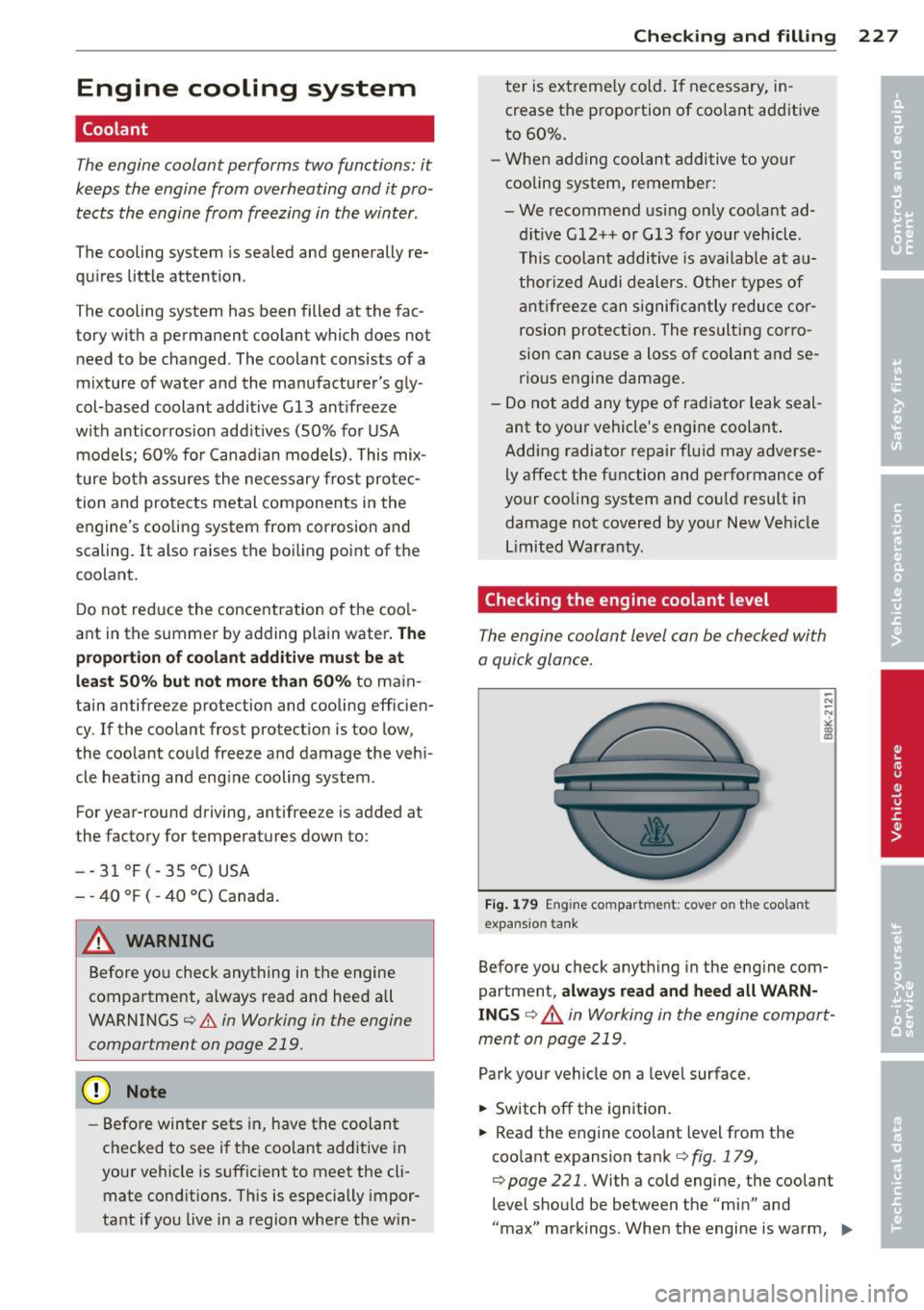
The engine coolant level can be checked with
a quick glance.
Fig. 179 En gine co mpart ment: cover on t he coo la nt
expansio n ta nk
Before you check a nyth ing in the eng ine com
partment,
always read and heed all WARN
INGS <=>&.
in Working in the engine compart
ment on page 219 .
Park your vehicle on a level surface.
.., Switch off t he ignition.
.., Read t he engine coolant level from the
coo lant expansion tank¢
fig. 179,
¢ page 221 . With a cold engine, the coolant
level shou ld be between the "min" and
"ma x" markings . When the engi ne is warm, ..,.
Page 230 of 300

228 Checking and filling
the level may be slightly above the "max"
marking.
The location of the coolant expansion tank
can be seen in the engine compartment illus
tration
¢ page 221.
To obtain an accurate reading, the engine
must be switched off.
The expansion tank in your vehicle is equipped
with an electric coolant level sensor.
When the coolant level is too low, the warning light in the Auto-Check System¢
page 15 will
illuminate until you add coolant and the level
has been restored to normal. Even though
there is an electric coolant level sensor , we
still recommend you check the coolant level
from time to time.
Coolant loss
Coolant loss may indicate a leak in the cooling
system. In the event of coolant loss, the cool
ing system should be inspected immediately
by your authorized Audi dealer.
It is not
enough merely to add coolant.
In a
sealed system, losses can occur only if
the boiling point of the coolant is exceeded as
a result of overheating.
_& WARNING
The cooling system is under pressure and
can get very hot. Reduce the risk of scald
ing from hot coolant by following these
steps. -
- Turn off the engine and allow it to cool
down.
- Protect your face, hands and arms from
escaping fluid and steam by covering the
cap with a large, thick rag.
- Turn the cap slowly and very carefully in
a counter-clockwise direction while ap
plying light, downward pressure on the
top of the cap .
- To avoid being burned, do not spill anti freeze or coolant on the exhaust system
or hot engine parts. Under certain condi
tions, the ethylene glycol in engine cool
ant can catch fire .
(D Note
Do not add any type of radiator leak seal
ant to your vehicle's engine coolant. Add
ing radiator repair fluid may adversely af
fect the function and performance of your
cooling system and could result in damage not covered by your New Vehicle Limited
Warranty .
Adding coolant
Be very careful when adding engine coolant.
Before you check anything in the engine com
partment,
always read and heed all WARN
INGS ¢&. in Working in the engine compart
ment on page 219.
.. Turn off the engine .
.. Let the engine cool down.
.. Place a thick rag over the coolant expansion
tank
¢ page 227, fig . 179 and carefully
twist the cap counter-clockwise ¢,&. .
.,. Add coolant.
.. Twist the cap on again
tightly.
Replacement engine coolant must conform to
exact specifications
¢ page 22 7, Coolant. We
recommend using only coolant additive G12+
+, G3 or in an emergency G12+ . Do
not use a
different additive. In an emergency use plain
water until you can get the correct additive
and can restore the correct ratio. This should
be done as soon as possible .
If you have lost a considerable amount of
coolant , then you should add cold antifreeze
and cold water only when the engine is cold.
Always use
new engine coolant when refilling.
Do not fill coolant above the
"MAX" mark . Ex
cess coolant will be forced out through the
pressure relief valve in the cap when the en
gine becomes hot.
_& WARNING
-= -- The cooling system is under pressure and
can get very hot. Reduce the risk of ..,_
Page 268 of 300

266 Fuses and bulbs
Fuse panel @ (brown)
No. Equipment
1 Headlight control switch
2 Emergency start coil (key
identification)
3 Rear door
control module
(driver's side)
5 Horn
6 Interior lights
(headliner)
Steering column lever, mul-
8
tifunction steering wheel
controls, steering wheel
I heating
10 Power steering column ad-
justment
11 Driver door control module
12 Diagnost
ic connector, light/
rain sensor
14 Power steering column ad-
justment
15 Power
steering, AC compres-
sor
16 Brake booster
Fuse panel © (black)
No. Equipment
1 Front seat heating
2 Windshield wiper
3 Front exterior lighting
4 Sun roof
5 Driver power window
6 Driver seat (pneumatic)
7 Panoramic
sunroof
8 Dynamic steering
9 Front exterior lighting
10 Windshield/headlight
wash-
er system
11 Rear power window (driver's
side)
Panoramic sunroof
Amps
5
5
7,5 15
7,5
10/5
5
7,5 10
25
20 15
Amps
30
30
30 20
30 15
20
35
30
35
30
40
Front passenger side cockpit fuse
assignment
Fig. 206 Front passe nger side cockpit: fuse pane l with
plastic bracket
Fuse panel ® (black)
No. Equipment Amps
1 Anti-theft alarm system
5
2 T
ransmission control mod-
15
ule
3 Front climate control fan 40
4 Engine supply 35
6 Engine
control module
5
7 Front passenger door con-
7,5
trol module
8 Front passenger
power win-
30
dow
9 ESC control module 10
10 E5C control modu le 25
11 Right rear power window
30
12 Front
passenger seat (pneu -
15
matics)
Page 269 of 300

Fuse s and bulb s 267
Luggage compartment fuse assignment
Fig. 207 Luggage compartment: fuse pa nel with plastic bracket
Fuse panel @ (black ) Fuse panel @ (b la ck)
No . Equi pment Amps No. Equipment Amps
[ru button, data logger, diag-
11 Dynamic
steering
5
l nostic connector, BCM -1,
5
Selector lever, BCM-2 5
adaptive light ing system
Audi side assist
5
2 Networking gateway 5
Engine control module 5
3 adaptive air suspension
5
Starter 40
4 Parking system 5
Left headlight/Headlight
16 10/5
5 Steer
ing column lever
5
range control system
Suspension control system
6 5 Fuse panel @ (red ) sensor
Belt tensioners, airbag con-
No. Equipment Amps
7
trol module 5 1 Left
reversible be lt tens ione r
25
Heated washer fluid nozzles, 2 Right reversible belt ten-
25
Homelink (garage door sioner
8 opener), night vision system
5 3 Starter diagnosis 5
control module, sport differ- 4 DC/DC converter
7,5
ential, ioni zer
5 Adaptive cruise contro l 7,5
9
Electromechan ica l parking
5 Right headlight (headlight
brake contro l modu le
6 with adaptive light) 10 -
10 Rear seat heating, cooler, in-
5 7 ESC co ntrol modu le 5 ... terior rearview mirror
Page 270 of 300

268 Fuses and bulbs
Fuse panel
® (red)
No. Equipment
=
I a
Sound actuator, AEM control module
9 Adaptive cruise control
Transmission control mod-
10 ule
---11 Climate control system sen-
sors
Fuse panel © (brown)
No. Equipment
1 Electromechanical parking
brake
2 Suspension control system
sensor
3 Right rear door control mod-
ule
4 Smart modul tank
5 Front cl
imate control system
controls
6
Rear climate control system
controls
-
7 Networking gateway
8 Cooler
9
Interface for specia l func-
tions
10 Cell phone adapter, Blue-
tooth handset
11 AEM contro l module
12 Selector lever
13 Ambient
lighting
14 Rear exterior lighting
15 Fue
l pump
1 16 Electromechanical
parking
brake
Fuse panel @ (black )
Equipment
3 Rear sockets adaptive air suspension
115-V socket
Amps
s
10
s
s
=
Amps
5
s
7,5
s
15
10
5
15
5
5
15
10
10
20
25
-
30
Amps
20 15
25
Fuse panel @ (black)
No. Equipment
7
Electromechanical parking
brake
8 Rear seat heating
9 Rear exterior lighting
10 Rear climate control system
blower
Rear sun shade, closing aid,
11 luggage compartment lock,
keyless go/entry, fuel filler
door
12 Luggage compartment
lid
control module
Fuse panel © (red)
No. Equipment
1 Rear seat adjustment but-
tons
3 Left rear seat (pneumatics)
5 Tra
iler hitch control module*
6 Left rear seat
7 Right rear seat
8 Trailer hitch control module *
9 Tra iler hitch control module*
10 Right rear seat (pneumatics)
Fuse panel
® (brown)
No. Equipment
1 Radio
receiver/sound ampli-
fier
2 Sound amplifier
3 Rear Seat
Entertainment, ra -
dio receiver/sound amplifier
Automatic dimming interior
s rearview mirror
6 DVD changer
T V tuner
MMI unit/drives
Instrument cluster, analog
9 clock
10 MMI Display
Amps
30
25
20
20
20
30
Amps
5
7,5
20
30
30
20 15
7,5
Amps
30
30
10
5
s
5
7,5 5
5
Page 291 of 300
Pressure malfunction ............ .. .. 17
Recommended oil check int ervals .. .. . 224
Sensor defective . . . . . . . . . . . . . . . . . . . . 20
Specification and viscosity .. .. .. .. .. . 222
Engine speed limitation ....... .. .. .. .. 20
Engine start system (indicator lights) .. .. 17
Entry assistance . . . . . . . . . . . . . . . . . . . . . 60
Environment Break-in period ........... .... .. .. . 194
Catalytic converter ................. 195
Disposing of your vehicle battery . ... . 234
Driving at high speeds ........ ... .. . 197
Driving to minimize pollution and noise 196
Fuel . .... .. .. .. ........... .. .. ... 217
Fuel economy ............ .... .. .. . 196
Leaks under your vehicle ........ .... 219
Letting the vehicle stand and warm up . 197
Proper disposal of drained brake fluid . 230
Proper disposal of drained engine coo l-
ant . .. .. .. .... ............. .. .. . 228
Proper disposal of drained engine
oil . . . . . . . . . . . . . . . . . . . . . . . . . 225, 226
Recycling used engine oil ............ 225
Unleaded fuel ............ .... .. ... 215
What should I do with an old battery? . 234
ESC (Electronic Stability Control)
Warning/indicator lights ............. 18
Event Data Recorder (EDR) ........ .... 187
Exhaust tail pipes .......... .... .. .. . 209
Expansion tank .............. .. .. .. . 227
Exterior lighting ................. ... . 43
Exterior mirrors Adjusting .. .. ........... .. .. .. .... 51
Dimming . .. ............. .... .. .... 51
Heating .. .. ... ... .... ... .. .. .. .. .. 51
Exterior temperature display ....... .. .. 23
F
Fa stening
Booster seats .................. .. . 174
Convertible child safety seats . . . . . . . . 172
Infant seats . ............... ... ... 171
Floor mats . .. ............. .... .. .. . 130
Folding table . . . . . . . . . . . . . . . . . . . . . . . . 65
Foot pedals . ... .............. ... ... 129
Index 289
For the sake of the environment
Gasoline fumes and the environment .. 217
Reduc ing engine noise by early upshift-
ing ......... .. .. .................. 10
Refueling . .. .. .. .... ............. 217
Saving fuel by early upshifting ........ 10
Four zone automatic climate control ... .. 76
Front airbags Description . . . . . . . . . . . . . . . . . . . . . . . 146
How they work . .. .. . .......... .... 151
Frontal collisions and the laws of physics 135
Front passenger seat adjustment . . . . . . . 60
Front seats . . . . . . . . . . . . . . . . . . . . . . . . . 54
Adjust ing . .. .. .. .. .. ........... .. 126
Child restraints in the front seat ..... . 144
Fuel Additives ........ .. ............... 215
Blended gasoline . ................. 215
Current consumption ........... .. .. . 24
Fuel filler flap emergency release ... .. 218
Fuel filler neck ... .. .............. . 216
Fuel gauge . . . . . . . . . . . . . . . . . . . . . . . . 11
Gasoline .. .. .. .. .. ............... 215
Gasoline additives .... ......... .. .. 216
Low fuel level symbol . . . . . . . . . . . . . . . 21
Octane rating .. ... ...... ......... . 215
Recommendation ... . .. .... ........ 215
Refuelling ....... .. ............... 217
Reserve ... .. .. .. .... ............. . 11
Tank capac ity . . . . . . . . . . . . . . . . . 11,278
Fuses Assignment . .. .. .. ... ....... .... . 265
Replacing ....... .. ............... 265
G
Garage door opener (Homelink ®) .. ... . 121
Garment hooks . . . . . . . . . . . . . . . . . . . . . . 72
Gas discharge lamps ................. 269
Gauges Engine coolant temperature . . . . . . . . . . 10
Fuel gauge . . . . . . . . . . . . . . . . . . . . . . . . 11
Speedometer .. .. .. . .. .... ........ . 25
Tachometer . . . . . . . . . . . . . . . . . . . . . . . 11
Trip odometer . .. .................. 25
General illustration . . . . . . . . . . . . . . . . . . . 8
Generator (warning/indicator lights) .... 16
G lossary of tire and loading terminology 236
•
•