height AUDI A8 2012 User Guide
[x] Cancel search | Manufacturer: AUDI, Model Year: 2012, Model line: A8, Model: AUDI A8 2012Pages: 300, PDF Size: 75.06 MB
Page 142 of 300
140 Safety belts
The s houl der belt should lie as close to the
center of the collar bone as possib le and
should fit well on the body¢
A in Safety belt
position on page 138.
P ower safety belt h eight adju stment *
You can ad just the height of the safety belts
using the mu ltifunction button on the driver
or front passenge r seat ¢
page 56.
A WARNING
Always read and heed all WARNINGS and
other important informat ion
¢page 137.
You can also adjust the height of the front
seats to change the position of the safety
be lts.
Improperly worn safety belts
Incorrectly positioned safety belts can cause
severe injuries.
Wear ing safety be lts imprope rly can cause se
rio us inj ury or death. Safety be lts can on ly
wo rk when they are correct ly positioned on
the body. Improper seating positions reduce
the effect iveness of safety belts and will even
increase the r isk of injury and death by mov
ing the safety belt to cr itical areas of the
body. Imprope r seat ing pos it ions also in
crease the risk of serio us in jury and death
when an air bag deploys and str ikes a n occu
pant who is not in the correct seating posi
tion . A d river is responsib le for the sa fety of
all vehicle occupants and especially for chi l
dren. Therefore:
~ Never permit anyone to ass ume an incorrect
sitting position in the veh icle w hile traveling
¢&_ .
A WARNING
Imprope rly worn safety belts increase the
r isk of serious personal injury and death
whenever a veh icle is being used. -
Always make sure that all vehicle occu
pants are co rrectly restrained and stay in
a correct seating position whenever the
veh icle is being used .
- Always read and heed all WAR NINGS and
other important information
¢ page 137.
Safety belt preten
sioners
How safety belt pretensioners work
In front, side and rear -end collisions above a
particular severity and in a rollover , safety
belts are tensioned automatically.
Reversible safety belt tensioners
T he safety belts on the fro nt sea ts ar e e qui p
ped with powe r reversib le tensioners . The fo l
lowing functions a re ava ila bl e when the driv
er's/front passenger's safety belts are fas
tened :
- Automatic tens ioners : at the star t of a drive,
the safety belts automat ica lly adjust to the
passe nger afte r a certain time period or ve
hicle speed. To switch the automatic ten
sioners off, select the following in the MMI:
! CARI function button> Car systems > Vehi
cle settings > Seats > Driver's seat or Pas
s enger's seat
> Automatic belt t ensioner >
Off .
-In certain dr iv ing s ituations, the safety belts
may tighten w ith a revers ible tens ion ing
fu nction
¢ page 185.
-The safety be lts may a lso t ighten with th is
reve rsible tensioning function in minor co lli
sion s.
Pyrotechnic safety belt pretensioners
The safety belts are equ ipped with safety belt
pre tensioners . The system is act ivated by se n
sors i n front, s ide and rear-end co llisions of
great severity and in a rollover. This tig htens
t h e belt and t akes up belt slack¢.&.
in Service
and disposal of safety belt pretensi oner on
page 141.
Taking up the slack helps to reduce 1111>
Page 159 of 300
regulations must be observed. Your au
thorized Audi dealer is familiar with these requirements and we recommend that you
have your dealer perform this service for
you.
Other things that can affect Advanced
Airbag performance
Changing the vehicle's suspension system can
change the way that the Advanced Airbag Sys
tem performs in a crash. For example, using
tire-rim combinations not approved by Audi, lower ing the vehicle, changing the stiffness of
the suspension, including the springs, suspen sion struts, shock absorbers etc. can change
the forces that are measured by the airbag
sensors and sent to the electronic control
un it . Some suspension changes can, for exam
ple, increase the force levels measured by the
sensors and make the airbag system deploy in
crashes in which it would not dep loy if the
changes had not been made. Other kinds of
changes may reduce the force Levels meas
ured by the sensors and prevent the airbag
from deploying when it should.
The sensors in the safety belt buckle for the
driver and front passenger seat tell the elec
tronic control module if the safety belt is
latched or not. If the safety belt is being used,
the front airbag will deploy at a slightly high
er rate of vehicle deceleration than if the safe
ty belt is not being used. Therefore, in a par
ticular collision, it is poss ible that an airbag
will not deploy at a seating position where the
safety belt is being used but will inflate at the
position where the safety belt is not being
used. It is important that nothing interfere
with the safety belt buckles so that the sen
sors can send the correct information about
safety belt use to the electronic control unit.
A WARNING
Changing the vehicle's suspension includ
ing use of unapproved tire-rim combina
tions can change Advanced Airbag per
formance and increase the risk of serious personal injury in a crash.
Airbag system 157
-Never install suspension components
that do not have the same performance
characteristics as the components origi
nally installed on your vehicle .
- Never use tire-rim combinations that
have not been approved by Audi.
A WARNING
-
Items stored between the safety belt
buckle and the center console can cause
the sensors in the buckle to send the
wrong information to the electronic con
trol module and prevent the Advanced Air
bag System from working properly.
- Always make sure that nothing can inter
fere with the safety belt buckles and that they are not obstructed.
Knee airbags
Description of knee airbags
The knee airbag system con provide supple
mental protection to properly restrained
front seat occupants.
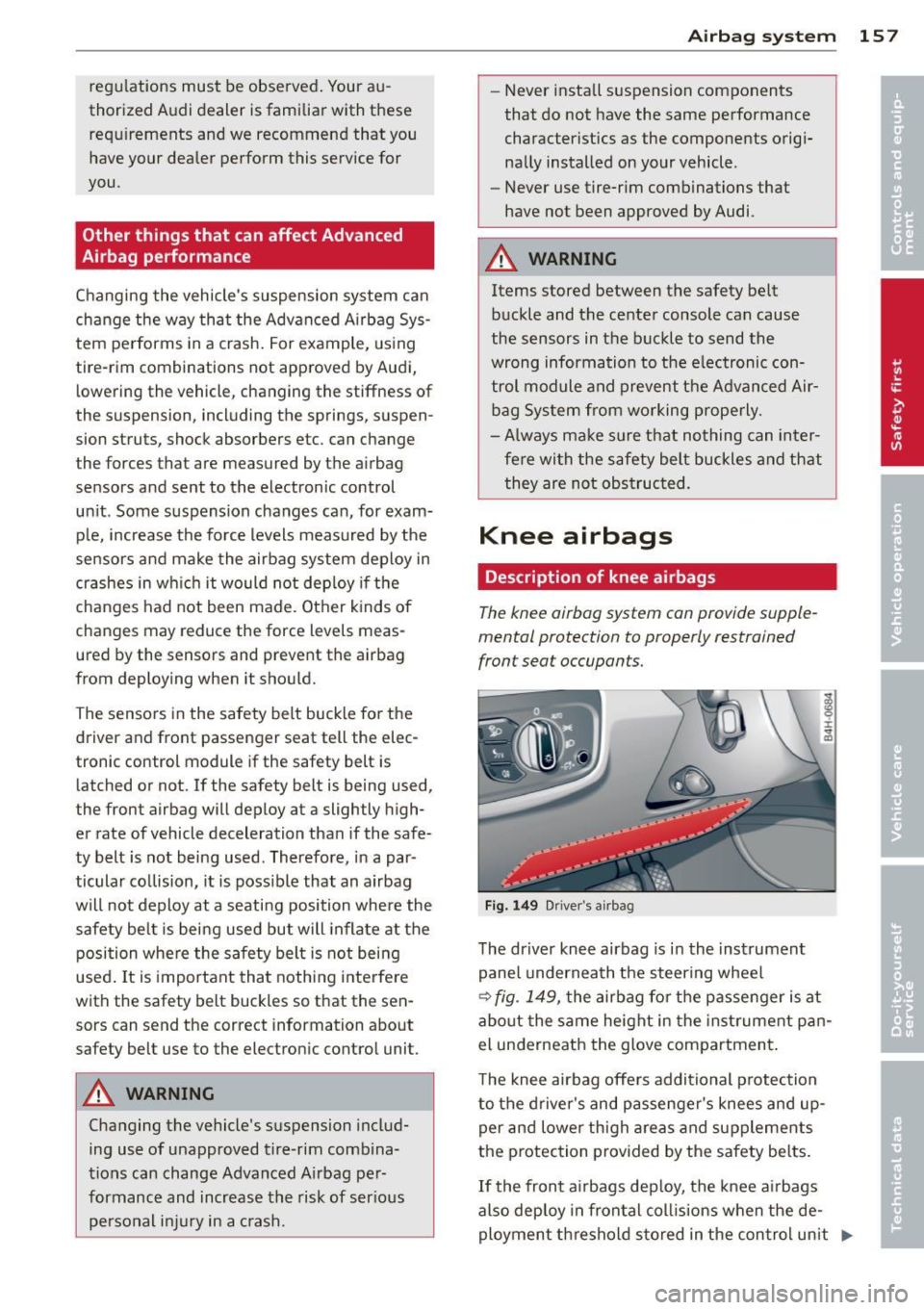
Fig. 149 Driver 's airbag
The driver knee airbag is in the instrument
panel underneath the steering wheel
¢ fig . 149, the airbag for the passenger is at
about the same height in the instrument pan
el underneath the glove compartment.
The knee airbag offers additional protection
to the driver's and passenger's knees and up
per and Lower thigh areas and supplements
the protection provided by the safety belts.
If the front airbags deploy, the knee airbags
also deploy in frontal col lisions when the de
ployment threshold stored in the control unit .,,.
Page 176 of 300
174 Child Safety
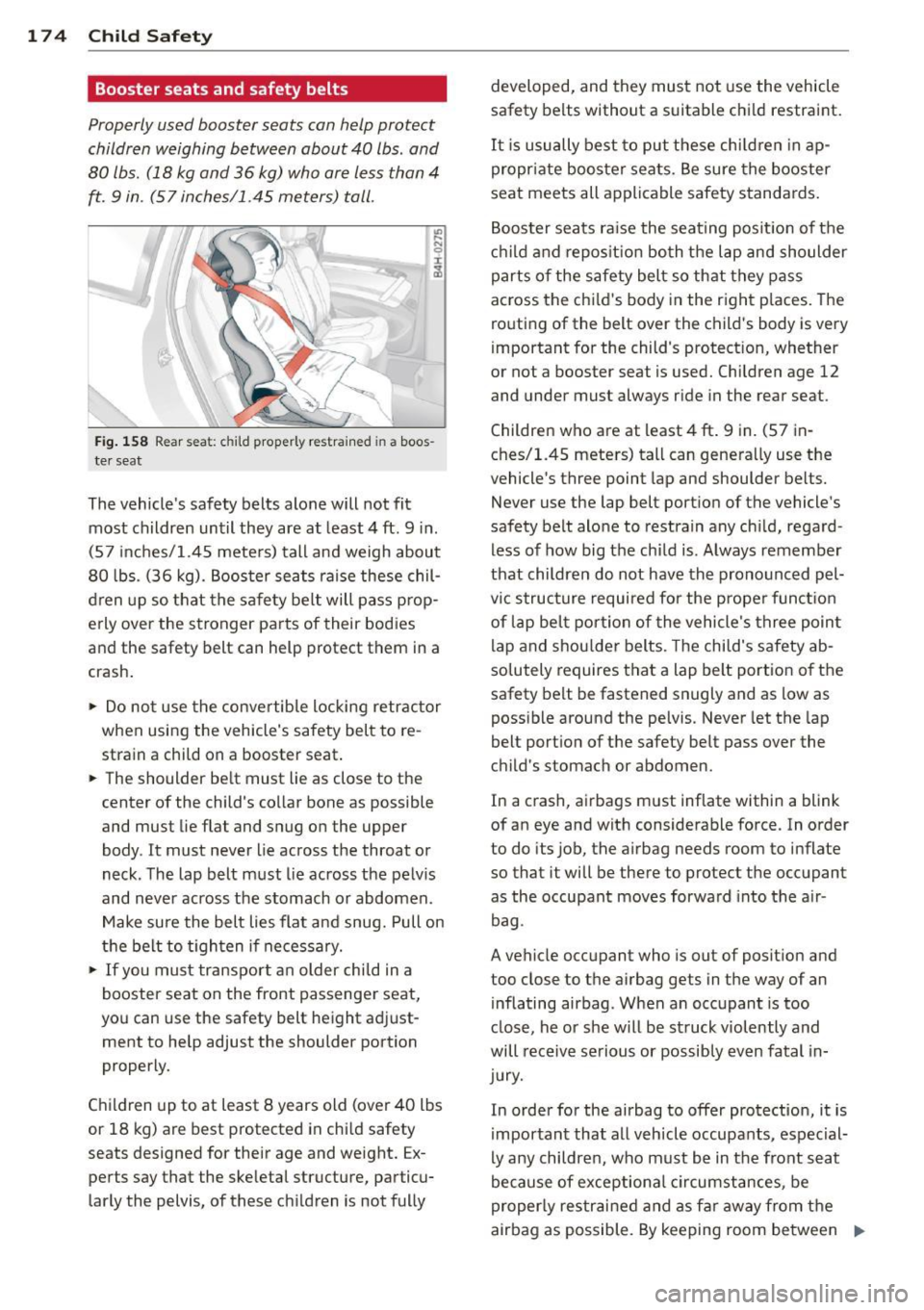
Booster seats and safety belts
Properly used booster seats can help protect
children weighing between about 40 lbs. and
80 lbs. (18 kg and 36 kg) who are less than 4
ft. 9 in. (57 inches/1.45 meters) tall.
Fig. 158 Rear seat: child properly restrained in a boos
ter seat
The vehicle's safety belts alone will not fit
most children until they are at least 4
ft. 9 in.
(57 inches/1.45 meters) tall and weigh about
80 lbs. (36 kg). Booster seats raise these chil
dren up so that the safety belt will pass prop
erly over the stronger parts of their bodies
and the safety belt can help protect them in a
crash.
.. Do not use the convertible locking retractor
when using the vehicle's safety belt to re
strain a child on a booster seat.
.. The shoulder belt must lie as close to the
center of the child's collar bone as possible
and must lie flat and snug on the upper
body.
It must never lie across the throat or
neck . The lap belt must lie across the pelvis
and never across the stomach or abdomen.
Make sure the belt lies flat and snug. Pull on
the belt to tighten if necessary.
.. If you must transport an older child in a
booster seat on the front passenger seat,
you can use the safety belt height adjust
ment to help adjust the shoulder portion
properly.
Children up to at least 8 years old (over 40 lbs
or 18 kg) are best protected in child safety
seats designed for their age and weight. Ex
perts say that the skeletal structure, particu
larly the pelvis, of these children is not fully developed, and they must not
use the vehicle
safety belts without a suitable child restraint.
It is usually best to put these children in ap
propriate booster seats. Be sure the booster
seat meets all applicable safety standards.
Booster seats raise the seating position of the
child and reposition both the lap and shoulder
parts of the safety belt so that they pass
across the child's body in the right places. The
routing of the belt over the child's body is very
important for the child's protection, whether
or not a booster seat is used. Children age 12
and under must always ride in the rear seat.
Children who are at least 4
ft. 9 in. (57 in
ches/1.45 meters) tall can generally use the
vehicle's three point lap and shoulder belts.
Never use the lap belt portion of the vehicle's
safety belt alone to restrain any child, regard
less of how big the child is. Always remember
that children do not have the pronounced pel
vic structure required for the proper function
of lap belt portion of the vehicle's three point
lap and shoulder belts. The child's safety ab
solutely requires that a lap belt portion of the
safety belt be fastened snugly and as low as
possible around the pelvis. Never let the lap
belt portion of the safety belt pass over the
child's stomach or abdomen .
In a crash, airbags must inflate within a blink
of an eye and with considerable force. In order
to do its job, the airbag needs room to inflate
so that it will be there to protect the occupant
as the occupant moves forward into the air
bag.
A vehicle occupant who is out of position and
too close to the airbag gets in the way of an inflating airbag . When an occupant is too
close, he or she will be struck violently and
will receive serious or possibly even fatal in
Jury.
In order for the airbag to offer protection, it is
important that all vehicle occupants, especial-
ly any children, who must be in the front seat
because of exceptional circumstances, be
properly restrained and as far away from the
airbag as possible. By keeping room between ..,_
Page 202 of 300
200 Trailer towing
Trail er load dis tr ibut ion
Be sure the load in the trai ler is held securely
in place to prevent it from shifting forward,
backward or sideways.
N eve r all ow a p assenger to rid e in a trailer
~ .&. in Driving instructions on page 201.
Engine cooling sy stem
Towing a tra iler makes the eng ine work hard
er . It is important that the cooling system's
performance is up to the addit ional load .
Make sure that the cooling system has eno ugh
flu id.
Tir e pressure
When tow ing a tra iler, inflate the t ires of your
vehicle to the co ld tire pressure listed under
" Full load" on the label loca ted o n the dr iver's
side B-pillar (v is ible when the door is open).
I nflate trailer tires to tra iler and tire manufac
turers' specifications.
Lights
Check to make sure both veh icle and trailer
l ights are wor king p roperly.
Safe ty chain s
Be sure tra iler safety cha ins are properly con
nected from the trailer to the hitch on the ve
h icle . Leave enough slack in the chains to per
mit turning corners. When you install safety
cha ins, make sure they w ill not drag on the
road when yo u are driving.
The chains shou ld cross under the tra iler
tongue to prevent it from dropping in case of
separat ion from the hitch .
Adjusting the Audi drive select
Make sure the vehicle is on a level surface be
for e
hitching up the tra iler and b efor e adjust
ing the tongue weight . The vehicle must be i n
auto or comfort driving mode and not raised
~ page 103, ~CD .
Make sure that the vehicle is lowered . In Info
tainment, select:
I CARI function button> Lo w
e r
control button . If you must drive under poor road conditions,
you can raise the vehicle
afte r coupling the
trailer or
a fter adjust ing the tongue we ight
~ page 105.
(D Note
-Changes in temperature or load can af
fect the height of the vehicle .
- Always select auto or comfort mode .
Otherwise, the tongue load specified for
your vehicle will no longer be applicable.
Driving instructions
Driving with a trailer always requires extra
core and consideration.
T o obtain the best possible hand ling of vehicle
and trailer, please note the fo llowing:
.. Do not tow a loaded t railer when you r ca r it
self is not loaded .
.. Be especially carefu l when passing other ve
hicles .
.. Observe speed limits.
.. Do not drive at the maximum permissible
speed .
.. Always apply brakes early .
.. Monitor the temperature gauge .
Weight distribut ion
T owing a loaded trailer with an empty car re
s ul ts in a highly unstable distribution of
weight. If this cannot be avoided, drive at very
low speeds only to avoid the risk of losing
steering control.
A "balanced" rig is easier to operate and con
trol. This means that the tow vehicle should
be loaded to the extent possible and permissi
ble , while keep ing the trailer as light as possi
ble under the ci rcumstances. Whenever poss i
ble, transfer some cargo to the luggage com
partment of the tow vehicle while obse rv ing
tong ue load requi rements and vehicle load ing
considerations .
Speed
The higher the speed, the more d ifficu lt it be
comes for the driver to control the rig. Do not
1111>
Page 206 of 300
204 Cleaning and protec tio n
Automatic car wash
The vehicle can be washed in almost any
modern automatic car wash .
The vehicle paint is so durable that the vehicle
can normally be washed without problems in
an automatic car wash. However, the effect on
the paint depends to a large extent on the de
sign of the facility, the filte ring of the wash
water, the type of wash and care mater ial , etc.
I f the pa int has a dull appearance afte r going
through the car wash or is scratched, bring
this to the attention of the operator immedi
ately. If necessary, use a different car wash.
Before going through a car wash, be sure to
take the usual precautions such as closing the
windows and power roof . Factory installed an
tennas must not be removed.
I f you have installed additional accessor ies on
the vehicle - such as spoilers, roof rack, etc. -
it is best to ask the car wash operator if these
should be removed .
When driving through an automatic car wash,
fi rst se lect the N position and then switch the
engine off. If you switch the engine off when N is engaged, the transmission remains in N
for approximately 30 m inutes and then Pis
engaged.
Further information for automatic gearboxes
~ page 109.
A WARNING
Always read and heed all WARNINGS and
other information
r:::;, page 203.
- Fo ld the exterior mirrors - flat there is a
risk of damaging the exterior mirrors .
Power folding exterior m irrors must not
be folded in or out by hand. Use the pow
er function!
- Compare the track of your vehicle with
the d istance between the guide rails of
the facility - there is a risk of damage to
the wheels and tires . - Compa
re the height and width of your
vehicle with the height and width of the t u nnel at the facility .
· Washing the vehicle by hand
A lot of water is needed when washing a vehi
cle by hand.
.,. Before yo u start wash ing, make su re you
have read and understood the WARNINGS
r:::;, A in General information on page 203.
.,. First soak a ll dried dirt unt il it is soft , then
rinse it off.
.,. As you clean your vehicle, start with the
roof and work your way down to the bottom,
using a sponge, a sponge glove or a clean brush .
.,. Rinse the sponge or the sponge g love often,
flushing it clean eac h time.
.,. Use spec ial car shampoo only for very per
sistent di rt.
.,. Rinse the car thoroughly w ith water.
.,. Use a chamois leather to gently w ipe the ex-
terior dry.
Use a separate sponge for cleaning the
whee ls , door si lls and other regions exposed
to road dirt. In this way, you will not scratch
the pa int with coarse particles imbedded in
the sponge the next time you wash the car.
A WARNING
- Do not clean the underside of the chas
sis, fenders, wheel covers, or other hard
to reach parts without protect ing you r
hands and arms. You may cut yourself on
sha rp-edged metal parts .
- Always read and heed all WARNINGS and
other info rmation
c;, page 203.
(D Note
- Never try to remove dirt, mud or dust if
the surface of the veh icle is dry. Never
use a d ry cloth or sponge, s in ce this
co uld scratch your vehicle's paint or win -
-
dows. .,.
Page 248 of 300

246 Tires and wheels
& WARNING
Sudden tire failure can lead to loss of con
trol, a crash and serious personal injury!
- Never drive a vehicle when the tread on
any tire is worn down to the wear indica
tors.
- Worn tires are a safety hazard, they do
not grip well on wet roads and increase
your risk of "hydroplaning" and loss of control.
- Always keep chemicals that can cause tire damage, such as grease, oil, gasoline
and brake fluid away from tires.
- Tires age even if they are not be ing used
and can fail suddenly, especially at high
speeds. Tires that are more than 6 years
old can only be used in an emergency
and then with special care and at lower
speeds.
- Never mount used tires on your vehicle if
you are not sure of their "previous histo
ry." Old used tires may have been dam
aged even though the damage cannot be
seen that can lead to sudden tire failure
and loss of vehicle control.
New tires and replacing tires and wheels
New tires and wheels have to be broken in .
Fig. 187 Tir e specificat ion codes on the s idewall of a
t ire
No. Description
(!) Passenger car tire (where applicable)
@ Nominal width of t ire in millimeters
@ Ratio of height to width (aspect ratio)
© Rad ial
® Rim diameter code
@ L oad index and speed rating
(J) U.S. DOT tire identification number
@ Audi Original tire
@ Sever snow conditions
@ T ire ply composition and materials
used
Maximum load rating
Treadwear, traction and temperature
grades
Maximum permissible inflation pres
sure
T he tires and rims are essential parts of the
vehicle 's design . The tires and rims approved
by Audi are spec ially matched to the charac
teristics of the vehicle and can make a major .,..
Page 249 of 300

contribution to good road holding and safe
handling when in good condition and properly
inflated
¢ .&. .
We recommend that all work on t ires and
wheels be performed by an authorized A udi
dealer. They are familiar with recommended
procedures and have the necessary spec ial
too ls and spare parts as we ll as the proper fa
cilities for dispos ing of the old tires .
Authorized Audi dealers have the necessary information about techn ica l requ irements for
installing or changing tires and r ims.
R eplacing t ires and wheel s
Tires shou ld be rep laced at least in pairs and
not individua lly (for example both front tires
or both rear tires together).
Be s ure to read and heed the information to
the tire pressure monitoring system*
¢page 253.
Always buy rep lacement radial tires that have
the same specifications as the t ires approved
for your ve hicle by Audi. Replacement tires
must always have the same load rating speci
fication as the original equipment or approved
optional tires listed in the table
¢ page 239.
Audi-approved specification tires are specially
matched to your vehicle and its load limits,
and can contribute to the important road hold
ing, driving character istics, and safety of the
veh icle. The table
(¢page 239) lists spec ifica
tions of the tir es approved for the Audi mod
e ls covered by your Owner's Literature .
The tire pressure labe l located on dr iver's side
B-pillar (
¢ page 239, fig. 184) lists the speci
fications of the orig inal equipment tires in
stalled on your veh icle at the time it was man
ufactured .
Federal law requires t ire manufacturers to
p lace standard ized information on the s ide
wall of all tires¢
fig. 187 . This information
i dent ifies and desc ribes the fundamental
characterist ics, the quality grade of the tire
and a lso provides a tire ide ntificat io n number
Tire s an d wheel s 24 7
for sa fety standard certification and in case of
a reca ll.
Tire specifications
Knowledge of tire specifications makes it eas
ier to choose the co rrec t tires . Radial ti res
have the tire specifications marked on the
sidewa ll, for examp le:
255 /45 R 19 104 H
This co nta ins the following information:
P Indicates the tire is for passenger cars
(where app licab le)
255 Nom inal tire width i n mm of the tire
from sidewall edge to sidewall edge. In
general, the larger the number, the wider
the tire
45 Height/w idth ratio in percent (aspect ra -
t io)
R Tire construct ion: Radial
1 9 Rim diameter code (i n inches)
104 Load ra ting code
H Speed ra ting letter code
XL (or "xl", "EXTRA LOAD" or "RF") Indicates
t h at the t ire is a "Reinfo rced" or an " Ext ra
Load " tir e
M+S (or "M/S") Indicates that the ti re has
some mud and snow capab ility
The tires could also have the informat ion of
direction of rotation ¢
page 235 .
Tire manufacturing d ate
The manufact uring date is also indicated on
the tire sidewall (possibly only on the
inner
s ide of the wheel):
"DOT ... 2211 .. . " means, for example, the tire
was produced in the 22nd week of 2011.
Speed rating (letter code )
The speed rating le tter code on the whee ls in
dicates the maximum permiss ible road speeds
¢ .&. in Winter tires on page 251.
P up to 93 mp h (150 km/h)
Q up to 99 mph (158 km/h)
R up to 106 mph (170 km/h)
S up to 110 mph (180 km/h)
•
•
Page 254 of 300
252 Tire s and wheel s
chains because the vehicle will be ex
tremely low. If you do drive with snow
chains on while the vehicle is at this lev
el, the snow chains might severe ly dam
age the wheelhouse and other parts of
the veh icle.
(D} Tips
Where snow chains are mandatory oncer
tain roads, this normally also applies to vehicles with All Wheel Drive.
Wheel bolts
Wheel bolts must always be tightened to the
correct torque .
The design of whee l bolts is matched to the
factory installed r ims. If different rims
are fit
ted, the correct wheel bolts with the right length and correctly shaped bolt heads must
be used. This ensures that wheels are fitted
secure ly and that the brake system functions
correctly .
In certain circumstances, you may not use
wheel bolts from a different vehicle -even if it
is the same mode l
¢page 282.
_& WARNING
Imprope rly tig htened o r maintained whee l
bolts can be come loose ca using loss of
contro l, a co llision and serious persona l in
jury.
- Always keep the wheel bol ts an d the
threads in the wheel hubs clea n so the
wheel bolts can tu rn easily and be prop
er ly tightened .
- Never grease or oil the wheel bo lts and
the threads in the wheel h ubs. They can
become loose w hile driving if greased or
oiled, even if tightened to the specif ied
torque.
- Only use wheel bolts that belong to the rim being installed.
- Never use different whee ls bolts on your
vehicle.
- Always maintain the correct tighten ing
torq ue for the wheel bo lts to reduce the risk of a whee
l loss. If the tightening tor
que of the wheel bolts is too low, they
can loosen and come out when the vehi
cle is mov ing. If the tighte ning torque is
too high, the wheel bolts a nd threads
can be damaged and the whee l can be
come loose.
([) Note
The specified torque for the whee l bolts is
90 ft lb (120 Nm) with a tolerance of± 7,4
ft lb(± 10 Nm). Torque whee l bolts diago
nally. Afte r changing a whee l, the torque
must be checked as soon as possible wi th a
torque wrench -pre ferably by an au thor
ized Audi dealer or qualified workshop .
Low aspect ratio tires
Your Audi is factory-equipped with low aspect
ratio tires. These tires have been thoro ughly
tested and been se lected specifically for your
model for their superb performance, road fee l
and hand ling u nder a var iety of d riv ing condi
t ions . As k your author ized Audi dealer for
more details.
The low aspect ratio of these tires is ind icated
by a numeral of
55 or less in the tire's s ize
designation . The numeral rep resents the ratio
of the t ire's s idewa ll height in relation to its
t read width ex pressed in percentage. Conven
tiona l tires have a he igh t/w idth rat io of 60 or
more.
The performanc e of low -a sp ec t-ratio tires i s
pa rticularly sensitive to improper inflation
pre ssure . It is therefore important that low
a spect ratio tires are inflated to the specified
pre ssure and that the inflation pressure i s
regularly checked and maintained. Tire pre s
sures should be checked at least once a month and always befo re a long trip
¢ page 241, Checking tire pressure .
What you can do to avoid tire and rim
damage
Low aspect ratio tires can be damaged more
easily by impact w ith potholes, curbs, gull ies .,..
Page 264 of 300

262 What do I do now ?
ho ld on to the car to keep your ba lance
and take care not to slip .
Raising the vehicle
The vehicle must be lifted with the jack first
before the wheel can be removed .
Fig. 199 Sill panels: markings
Fig. 200 Sill: posit ion ing t he veh icle jack
.. Activate the vehicle jack mode in the MMI:
I CAR ! function button > Ca r sys te m s control
button>
S ervic ing & c h ecks > Air susp .:
jack mod e > On .
.. Engage the par king brake to prevent your
vehicle from ro lling u ninten tionally.
.. Move the
se lector l ever to po siti on P .
.. Find the marking (imprint) on the sill that
is nearest the wheel that will be changed
o fig. 199 . Behind the marking, there is a
lifting point on the s ill for the vehicle jack .
.. Turn the
ve hicle jack located under the lift
ing point on the si ll to raise the jack until its
arm @
o fig. 200 is located under the des
i gnated plastic mount
o ,& o0.
.. Align the jack so that its arm @ o fig. 200
engages in the designated lifting po int in
the door sill and the movable base @ lies
flat on the ground. The base @ must be
ver
tical
under the lifting point @. ..
Wind the jack up fu rther until the f lat tire
comes off the ground
o .&, .
Position t he vehicle jack o nly under the desig
nated lifting points on the si ll
¢fig. 199.
There is exactly one location for each wheel.
The jack must not be positioned at any other location
c:> .&, c:>Q).
An un sta ble surf ace under the jack ca n cause
the vehicle to slip off the jack . Always provide
a firm base for the jack on the ground . If nec
essary place a sturdy board or similar support
under the jack. On
hard, sl ipp ery su rfaces
(such as tiles) use a rubbe r mat or similar to
prevent the jack from slipping
c:> .&, .
A WARNING ~
-You or your passengers could be injured
while changing a wheel if you do not fo l
low these safety preca utio ns:
- Position the vehicle jack on ly at the
designated lifting points and align the
jack. Otherwise, the vehicle jack could slip and cause an injury if it does not
have sufficient hold on the vehicle.
- A soft or unstable surface under the
jack may cause the vehicle to slip off
the jack . Always provide a firm base for
the jack on the ground. If necessa ry,
use a stu rdy board under the jack.
- On hard, s lippery surface (such as t iles)
use a rubber mat or simi lar to prevent
the jack from slipping.
- To help prevent injury to yourself and
your passe ngers:
- Do not raise the vehicle until you are
sure the jack is securely engaged.
- Passengers must not remain in the ve
hicle when it is jacked up.
- Make sure that passengers wait in a
safe place away from the vehicle and
well away from the road and traffic .
- Make sure jack pos ition is correct, ad
just as necessary and then continue to raise the jack.
- Changes in temperature or load can af
fect the height of the vehicle.