window AUDI A8 2012 User Guide
[x] Cancel search | Manufacturer: AUDI, Model Year: 2012, Model line: A8, Model: AUDI A8 2012Pages: 300, PDF Size: 75.06 MB
Page 77 of 300
Warm and cold Climate controls
Description
The climate control system warms, cools and
adds humidity to the a ir in the veh icle inter io r.
It is the most effect ive when the windows and
sunroof* are closed. If the temperature inside
the parked vehicle becomes very warm, open
ing the window briefly will speed up the cool
ing process.
I n all heating mode functions except
defrost,
the blower on ly switches to a higher speed
once the engine coolant has r eached a certain
temperature.
Condensation from the cooling system can
drip and form a puddle of water under the vehicle. This is normal and does not mean there
is a leak.
Pollut ant filter
The po llutant filte r removes pollutants s uch
as dust and pollen from the air.
The air pollutants filte r must be changed at
the intervals spec ified in you r Wa rra nty
&
Maintenance book let, so that the air condi
tioner can properly work.
I f you drive you r vehicle in an area with h igh
ai r po llution , the fi lter may need to be
changed more freq uent ly than specified in
your Aud i Warranty
& Ma intenance booklet. If
i n doubt, ask your authorized Audi Service Ad
visor for advice .
K ey coded settings
The climate con trol settings are a utomat ica lly
stored and assigned to the remote contro l key
that is in use .
& WARNING
Reduced visibility is dangero us and can
cause accidents . -
Warm and cold 75
- For safe driving it is very important that
all windows be free of ice, snow and con
densat ion.
- Comp letely fam iliarize yourse lf with the
proper use and funct ion of the heat ing
and ve nti lation system and especially
how to defog and defrost the w indows.
- Never use the windshield wiper/washer
system in freez ing weather unt il you
have warmed the w indshield first, using
the heating and ventilation system . The
washer solution may free ze o n the wind
shie ld and red uce visib ility.
(D Note
- If you suspect that the air conditioner has been damaged, switch the system
off to avoid furt her damage and have it
i n spected by a q ua lified dea lership.
- Repairs to the Audi air conditioner re
quire specia l techni cal know ledge and
special tools. Contact an autho rized Aud i
dealer fo r ass istance.
@ For the sake of the environment
By reduci ng the amou nt of f uel you use,
you also red uce the amount of pollutan ts
emitted into the air .
(D Tips
- Keep the air intake s lots ( in fro nt of the
w indshield) free from ice, snow and de
br is in order to maintain the proper f unc
tion of the climate control system.
- T he energy management system may
switch the seat heating* or rear window
defroster off temporar i Ly . These systems
are available again as soon as the energy
balance has been restored .
- Air escapes through vents under the rear
window. When placing items of clothing
on the luggage compartment cover, en
sure that the openings are not covered.
Page 78 of 300

76 Warm and cold
Operation
We recommend pressing the IAU TOI button and setting the temperature to 72 °F (22 °C) .
Fig. 77 Cockp it co ntrols
F ig . 78 fou r zone automat ic cl imate co ntrol: rea r con
trols
Press the buttons to t urn the f unctions on or
off . Use the d ials to adjust the temperature,
the blower speed and the air distribution . The
LED in a button will light up when the func
tion is sw itched on. The settings are show n in
the cl imate co ntrol d isplay a nd are also shown
in the MMI display for a few seconds . The driv
er and front passenger settings ca n be ad just
ing separately.
You can a lso adjust the rear left and r ight
sides in the fo ur zone automat ic climate co n
trol* ~
fig. 78.
IO FF ! Switching the clim ate control
system on/off
The IO FFI b utton switches the climate control
system on or off . It a lso switches on when you
turn the dia l or press any b utton . Airf low from outside is blocked when the c
limate control
system is switched off .
You can a ctivate the residual hea t fu nction
when the ignition is off by p ressing and hold
i ng the ~ button . The residua l heat from the
coolant is used to heat the vehicle interior.
The residua l heat function switches off a uto
matically after about 30 minutes.
IACI Switching cooling mode on /off
T he air is not coo led and h umidity is not re
moved when cooling mode is switched off.
T his can ca use fog on the windows. Cooling
mode switches off automatically when the
outside temperature is below zero.
1 -1 Switching reci rculation mode on /off
In recircu lation mode, the air inside the vehi
cle is c irculated and f iltered. This prevents the
u nfiltered air outs ide the vehicle from enter
ing the vehicle interior . We recommend
switching recircu lation mode on when driving
t h rough a tunne l or when s itting in traff ic
q &_ .
The !AU TO I button or~ button switches reci r
cu lation mode off.
IAU TOI Switching automatic mode on
A utomat ic mode maintains a cons tant tem
perature inside the vehicle. A ir temperature,
IJli>
Page 79 of 300
airflow and air distribution are controlled au
tomatically.
Adjusting the temperature
Temperatu res between 60 °F (+16 °() and
84 °F (+28 °C) can be set. O uts ide of this
range,
lo or hi will appear in the climate con
trol system disp lay. At both of these settings,
the climate control system runs continuously
at maximum coo ling or heating power. There
is no temperature regulation.
[!] Adjusting the airflow
You can ad just the airf low manually to suit
your needs . To have the airflow regulated au
tomatically, press the
! AUTO ! button.
~ Adjusting the air distribution
You can manually se lect the vents where the
air will flow. To have the air distribution regu
l ated automatically, press the
!AUTOI button.
~ I lil* Adjusting Seat heating/
ventilation*
Pressing the button switches the seat heat
ing/ventilation on at the highest setting ( level
3). The LEDs indicate the temperature leve l.
To reduce the temperature, press the button
again . To switch the seat heating/ventilation
off, press the button repeatedly until the LED
turns off.
After 10 minutes, the seat heating/ventilation
automatically switches from level 3 to level 2.
I n vehicles without the four zone automat ic
climate contro l*, buttons in the rear center
console control the seat heating for both out
er rear seats*.
~ Switch the defroster on/off
The windsh ield and sid e windows are defrost
ed or cleared o f condensation as quickly as
possible. The maximum amount of air flows
mainly from the vents be low the windshield.
Recirculation mode switches off . The tempera
ture is controlled automatically.
The
IAU TOI button switches the defroster off.
Warm and cold 77
~ Switching rear window heater on/off
The rear window heater only operates when
the engine is running. It switches off auto
matically after 10 to 20 minutes, depending
on the outside temperature.
T o p revent the rear window heater from
switching off automatically, press and hold
the ~ button for more than 2 seconds . This
remains stored until the ignition is switched
off .
I SYNC I Synchronization*
When synchronization is switched on, the set
tings for the driver's side are applied to the
front passenger's side (except for seat heat
i ng/venti lation*) . The rear seat is also
synchronized in vehicles with the 4-zone de
luxe automatic climate control system* . Syn
chronization switches off if the sett ings are
adjusted on the front passenger's side or in
the rear* .
You can synchronize the settings in a row by
pressing and holding a knob. For example, to
apply the settings for the front passenger's s ide to the driver's side, press and hold the
knob on the front passenger's s ide.
Air vents
You can open or close the center and rear
vents in the cockpit and the vents in the rear
center console and door pillars us ing the
ridged thumbwheels. The levers adjust the di
rection of the airflow from the vents.
,&. WARNING
-Do not use the recirc ulation mode for ex
tended periods of time. The windows
could fog up since no fresh air can enter
the vehicle. If the windows fog up, press
the air recircu lation button again imme
diately to switch off the air recirculation
function or select defrost .
- Individuals w ith reduced sensitivity to
pa in or temperature could deve lop burns
when using the seat heating function . To
reduce the risk of injury, these indiv idu-
als shou ld not use seat heating. ..,.
Page 85 of 300
-If the indicato r light - (USA mod
els)
,111 (Canada models) or I.I turns
on, there may be a malfunction in the
parking brake
¢page 15.
@ Tips
-You can apply the parking brake at any
time - even w ith the ignition switched
off. The ignit ion must be on in order to
release the parking brake.
- Occasiona l noises when the park ing
brake is applied and released are norma l
and are not a cause for concern.
- When the vehicle is parked, the parking
brake goes through a self-test cycle at
regular intervals. Any assoc iated noises
are norma l.
Parking
Various rules apply to prevent the parked ve
hicle from rolling away accidentally.
P a rking
~ Stop the vehicle w ith the foot brake.
~ Pu ll the switch© to apply the parking
brake.
~ Se lect the P selector lever position
¢page 109.
~ Turn the eng ine off ¢,& .
In addition on incline s and grade s
~ Turn the steering wheel so that your vehicle
will roll against the curb in case it should
start to move.
A WARNING
-When you leave your veh icle - even if on
ly b riefly - always take the ignition key
with you. This applies particu la rly when
children remain in the veh icle. Otherw ise
the ch ild ren could sta rt the engine, re
lease the parking brake or operate elec
trical equipment (e .g. power windows).
There is the risk of an accident.
- When the vehicle is locked, no one - par
t icu larly not ch ildren should remain in
the vehicle. Locked doors make it more
On th e ro ad 83
difficult for emergency workers to get in
to the vehicle - putting lives at risk.
Starting from rest
The starting assist function ensures that the
parking broke is released automatically upon
starting.
Stopping and appl ying p arking brake
~ Pull the switch(®) to apply the pa rking
brake.
Sta rting and automaticall y releasing the
parking brak e
~ When you start to drive as us ual, the pa rk
ing brake is automatically released and your
veh icle begins to move .
When stopp ing at a traffic signal or stopping
in city t raff ic, the parking b rake can be ap
plied. The vehicle does not have to be held
with the footbrake. The parking brake elimi
nates the tendency to creep w ith a dr ive range
engaged. As soon as you drive off as usua l,
the parking brake is released automatically
and the vehicle starts to move.
St arting on slope s
When starting on inclines, the sta rting assist
prevents the vehicle from unintentionally roll
ing back. The braking force of the parking
brake is not re leased until suff ic ient driving
force has been built up at the wheels.
(D Tips
For safety reasons, the parking brake is re
l eased automatically on ly when the driv
er's safety belt is engaged in the buckle.
Starting off with a trailer
To prevent rolling back unintentionally on an
incline, do the following:
~ Keep the switch(®) pulled and depress the
accelerator. The parking brake stays applied
and prevents the vehicle from roll ing back-
ward . ..,.
Page 103 of 300

-Improper reliance on the side assist sys
tem can cause collisions and serious
personal injury:
- Never rely only on side assist when
changing lanes.
- Always check rear view mirrors to make
sure that it is safe to change lanes.
- Side assist cannot detect all vehicles un
der all conditions- danger of accident!
- Please note that side assist indicates
there are approaching vehicles, or vehi cles in your blind spot, only after your ve
hicle has reached a driving speed of at
least 19 mph (30 km/h).
- In certain situations, the system may not
function or its function may be limited.
For example:
- if vehicles are approaching or being left
behind very quickly. The display may
not turn on in time.
- in poor weather conditions such as
heavy rain, snow or heavy mist .
- on very wide lanes, in tight curves or if
there is a rise in the road surface . Vehi
cles in the adjacent lane may not be de
tected because they are outside of the
sensor range.
(D Note
The sensors can be displaced by impacts or
damage to the bumper, wheel housing and
underbody. This can affect the system .
Have your authorized Audi dealer or au
thorized Audi Service Facility check their
function.
(D Tips
- If the window glass in the driver's door
or front passenger's door has been tint
ed, the display in the exterior mirror may be misinterpreted.
- For Declaration of Compliance to United
States FCC and Industry Canada regula
tions
c::>page 283.
Audi side assist 101
Activating and deactivating
Applies to vehicles: m it s ide ass ist
Fig. 105 Driver 's doo r: Side ass ist button
.,. Press the c::> A in General information on
page 100
button to switch the system on/
off . The LED in the button turns on when
side assist is switched on.
Adjusting the display brightness
App lies to vehicles: wit h side assist
The brightness setting can be adjusted via the
MMI.
.,. Select: I CAR I function button > Car systems
control button
> Driver assist > Audi side
assist .
The display brightness adjusts automatically
to the brightness of the surroundings, both in
the information and in the warning stage . In
very dark or very bright surroundings, the dis
play is already set to the minimum or maxi
mum level by the automatic adjustment. In
such cases, you may notice no change when
adjusting the brightness, or the change may
only be noticeable once the surroundings
change.
Adjust the brightness to a level where the dis
play in the information stage will not disrupt
your view forward.
If you change the bright
ness, the display in the exterior mirror will
briefly show the brightness leve l in the infor
mation stage. The brightness of the warning
stage is linked to the brightness in the infor
mation stage and is adjusted along with the
information stage adjustment .
Page 126 of 300
124 Driving Safel y
Driving Safely
General notes
Safe driving habits
Please remember -safety first!
This chapter contains important information,
tips, instructions and warnings that you need
to read and observe for your own safety, the
safety of your passengers and others . We have
summarized here what you need to know
about safety belts, a irbags, ch ild restra ints as
well as child safety. Your safety is for us
priori
ty number 1.
Always observe the info rmat ion
and warn ings in th is sect ion -fo r yo ur own
safety as well as that of your passengers .
The information in this se ction app lies to all
model ve rsions of your veh icle . Some of the
feat ures desc ribed in this sec tions may be
standard equipment on some models, or may
be optional equipment on others . If you are
not sure, ask your authorized Aud i dealer.
A WARNING
- Always make sure that you follow the in
struct ions and heed the WARNINGS in
this Manual. It is in your interest and in
the inte rest of you r passengers.
- Always keep the complete Owner's Liter
ature in your Audi when you lend or sell
yo ur vehicle so that this important info r
mation will always be ava ilable to the
dr iver and passengers.
- Always keep the Owner's literature handy
so that you can find i t eas ily if you have
ques tions.
Safety equipment
The safety features are part of the occupant
restraint system and work together to help
redu ce the risk of injury in a wide variety of
accident situations.
Your safety and the safety of your passenge rs
should not be left to chance. Advances in
technology have made a varie ty o f fea tures
avai la bl e to he lp re duce the risk of inj ury in an accident
. The following is a list of just a few of
the safety features in your Audi:
- sophis tic ated s afety be lts for d rive r and a ll
passenger sea ting pos it ions,
- s afety belt prete nsio ners ,
- safety belt force lim ite rs fo r the front seats,
- safety belt he ight ad justment systems for
the front seats ,
- front airbags,
- knee airbags for the front seats
- side airbags in the front seats a nd outer rear
seats,
- side c urtai n airbags ,
- specia l LATCH anchorages for child re-
straints,
- he ad restr aints for each sea ting pos ition,
- ad justab le s teer ing colum n.
These ind iv idual safety features, can work to
ge ther as a system to help protect you and
you r passengers in a wide range of accidents .
T hese features canno t wo rk as a system if
they are not always cor re ct ly adjusted and co r
rect ly used.
Safety is ev erybody' s responsibility!
Important things to do before driving
Safety is everybody 's job! Vehicle and occu
pant safety always depends on the informed and careful driver .
For your safety and the safety of your passen
gers,
befor e driv ing always:
.. Make s ure that all lig hts and signa ls are op
erating correctly.
.. Make sure that the tire pressure is correct .
.. Mak e sur e that all windows are clean and
afford good v is ibility to the outside .
.. Se cu re a ll luggage a nd o ther items carefu lly
q page 6 6, ¢ page 71 .
.. Ma ke s ure that noth ing can interfere wi th
the peda ls .
.. Adjust front seat, head restraint and mir
rors correctly for your height.
.. Instruct passengers to adjust the head re-
straints according to the ir height . .,..
Page 131 of 300
The following bulletins list only some sample positions that will increase the risk of serious
in ju ry and death . Our hope is that these exam
p les will make you more aware of seating po
sitions that are dangerous.
The refore, wh en ev er th e vehicl e is
mov ing:
- never stand up in the vehicle
-never stand on the seats
- never knee l on the seats
- never ride with the seatbac k reclined
- never lie down on the rear seat
- never lean up against the instrument panel
- never sit on the edge of the seat
- never sit s ideways
- never lean out the window
- never put yo ur feet out the window
- never put yo ur feet on the ins trument panel
- never rest your feet on the seat cushion o r
back of the seat
- never r ide in the footwe ll
- never ride in the cargo area
A WARNING
Imprope r seat ing positions increase the
r isk of se rious personal injury and death
whenever a veh icle is being used.
- Always make sure that all vehicle occu
pants stay in a p ro per seating pos it ion
and are properly restr ained whenever the
vehicle is be ing used.
Driver and passenger
side footwell
Important safety instructions
A WARNING
Always make sure that the knee a irbag can
inf late without interference. Objects be
tween yourse lf and the airbag can increase
the risk of injury in an acc ident by interfer
ing w it h the way the a irbag deploys or by
being p ushed into you as the airbag de
ploys.
-
Dr iving S afel y 129
-No persons (children) or animals sho uld
ride in the footwell in front of the pas
senger seat. If the airbag dep loys, this
can result in ser ious or fatal injuries.
- No objects of any kind should be carried
in the footwell area in front of the driv
er 's or passenger's seat. Bulky objects
(shopping bags, fo r example) can ham
pe r o r prevent proper deployment of the
airbag. Small obje cts can be thrown
through the vehicle if the airbag deploys
an d inju re you or your passenge rs .
Pedal area
Pedals
The pedals must always be free to move and
must never be interfered with by a floor mat
or any other object.
Make sure that a ll peda ls move free ly without
interference and that nothing prevents them
from return ing to their orig inal positions.
Only use floor mats t hat leave the pedal area
free and can be secured with floor mat fasten
ers.
If a brake circ uit fai ls, inc reased brake pedal
trave l is required to b ring the vehicle to a f ull
stop .
A WARNING
-Pedals that cannot move free ly can cause
loss of vehicle control and increase the risk
of ser ious injury.
- Never p lace any objects in the drive r's
footwell. An ob ject cou ld get into the
pedal area and interfere with pedal func
tion. In case of sudde n brak ing o r an ac
cident, yo u wou ld not be able to b rake or
accelerate!
- Always ma ke sure that nothing can fall
or move into the driver's footwel l. •
•
Page 133 of 300
-Always distribute the load as evenly as
possible.
- Place heavy objects as far forward in
the luggage compartment as possible.
- Never exceed the Gross Axle Weight Rat
ing or the Gross Vehicle Weight Rating
specified on the safety compliance stick
er on the left door jamb. Exceeding per
missible weight standards can cause the
vehicle to slide and handle differently .
- Please observe information on safe driv
ing
o page 124 .
A WARNING
-
To help prevent poisonous exhaust gas
from being drawn into the vehicle, always
keep the rear lid closed while driving .
- Never transport objects larger than those fitting completely into the luggage
area because the rear lid cannot be fully
closed.
- If you absolutely must drive with the rear
lid open, observe the following notes to
reduce the risk of poisoning:
-Close all windows,
- Close the power roof,
- Open all air outlets in the instrument
panel,
- Switch off the air recirculation,
- Set the fresh air fan to the highest
speed.
A WARNING
Always make sure that the doors, all win dows, the power roof and the rear lid are
securely closed and locked to reduce the
risk of injury when the vehicle is not being
used .
- After closing the rear lid, always make
sure that it is properly closed and locked.
- Never leave your vehicle unattended es pecially with the rear lid left open. A
child could crawl into the vehicle through
the luggage compartment and close the
rear lid becoming trapped and unable to
get out . Being trapped in a vehicle can
lead to serious personal injury .
-
Driving Safely 131
-Never let children play in or around the
vehicle.
- Never let passengers ride in the luggage
compartment. Vehicle occupants must
always be properly restrained in one of
the vehicle's seating positions .
(D Tips
-Air circulation helps to reduce window
fogging. Stale air escapes to the outside
through vents in the trim panel, on the
left side of the luggage compartment. Be sure to keep these slots free and
open .
- The tire pressure must correspond to the
load . The tire pressure is shown on the
tire pressure label. The tire pressure la
bel is located on the driver's side B-pillar.
The tire pressure label lists the recom
mended cold tire inflation pressures for
the vehicle at its maximum capacity
weight and the tires that were on your
vehicle at the time it was manufactured.
For recommended tire pressures for nor
mal load conditions, please see chapter
opage 239.
Tie-downs
The luggage compartmen t is equipped with
four tie-downs to secure luggage and o ther
items .
Use the tie-downs to secure your cargo prop
erly
o page 130, Loading the luggage com
partment .
In a collision , the laws of physics mean that
even smaller items that are loose in the vehi
cle will become heavy missiles that can cause
serious injury. Items in the vehicle posses s en
ergy which vary with vehicle speed and the
weight of the item. Vehicle speed is the most
significant factor.
For example, in a frontal collision at a speed
of 30 mph (48 km/h), the forces acting on a
10-lb (4 .5 kg) object are about 20 times the
normal weight of the item . This means that
the weight of the item would suddenly be
•
•
Page 139 of 300
Important safety instructions about
safety belts
Safety belts must always be correctly posi
tioned across the strongest bones of your
body.
~ Always wear safety belts as illustrated and
described in this chapter.
~ Make sure that your safety belts are always
ready for use and are not damaged.
A WARNING
Not wearing safety belts or wearing them
improperly increases the risk of serious
personal injury and death. Safety belts can
work only when used correctly .
- Always fasten your safety be lts correctly
before driving off and make sure all pas
sengers are correc tly restrained.
- For maximum protection, safety belts must always be positioned properly on
the body .
- Never strap more than one person, in
cluding small children, into any belt.
- Never place a safety belt over a child sit
ting on your lap.
- Always keep feet in the footwell in front
of the seat while the vehicle is being d riv
en .
- Never let any person ride with their feet on the instrument panel or sticking out
the window or on the seat.
- Never remove a safety belt while the ve
hicle is moving. Doing so will increase
your risk of be ing injured or killed.
- Never wear belts twisted.
- Never wear belts over rigid or breakable
objects in or on your clothing, such as
eye glasses, pens, keys, etc., as these may cause injury.
- Never allow safety belts to become dam
aged by being caught in door or seat
hardware .
- Do not wear the shoulder part of the belt
under your arm or otherwise out of posi
tion . Safety belts
13 7
- Several layers of heavy clothing may in
terfere with correct positioning of belts and reduce the overall effectiveness of
the system .
- Always keep belt buckles free of anything
tha t may prevent the buckle from latch
ing securely .
- Never use comfort clips or devices that
create slack in the shoulder belt . Howev
er, special clips may be requ ired for the
proper use of some child restraint sys
tems .
- Torn or frayed safety belts can tear, and
damaged belt hardware can break in an
accident. Inspect belts regularly.
If web
bing , bindings, buckles , or retractors are
damaged, have belts replaced by an au
thorized Audi dealer or qualified work shop.
- Safety belts that have been worn and
loaded in an accident must be replaced
with the correct replacement safety belt
by an authorized Audi dealer . Replace
ment may be necessary even if damage
cannot be clearly seen . Anchorages that
were loaded must also be inspected.
- Never remove, modify, disassemble, or
try to repair the safety belts yourself.
- Always keep the bel ts clean. Dirty belts
may not work properly and can impair
the function of the inertia reel
c::> page 212, Safety belts .
Safety belts
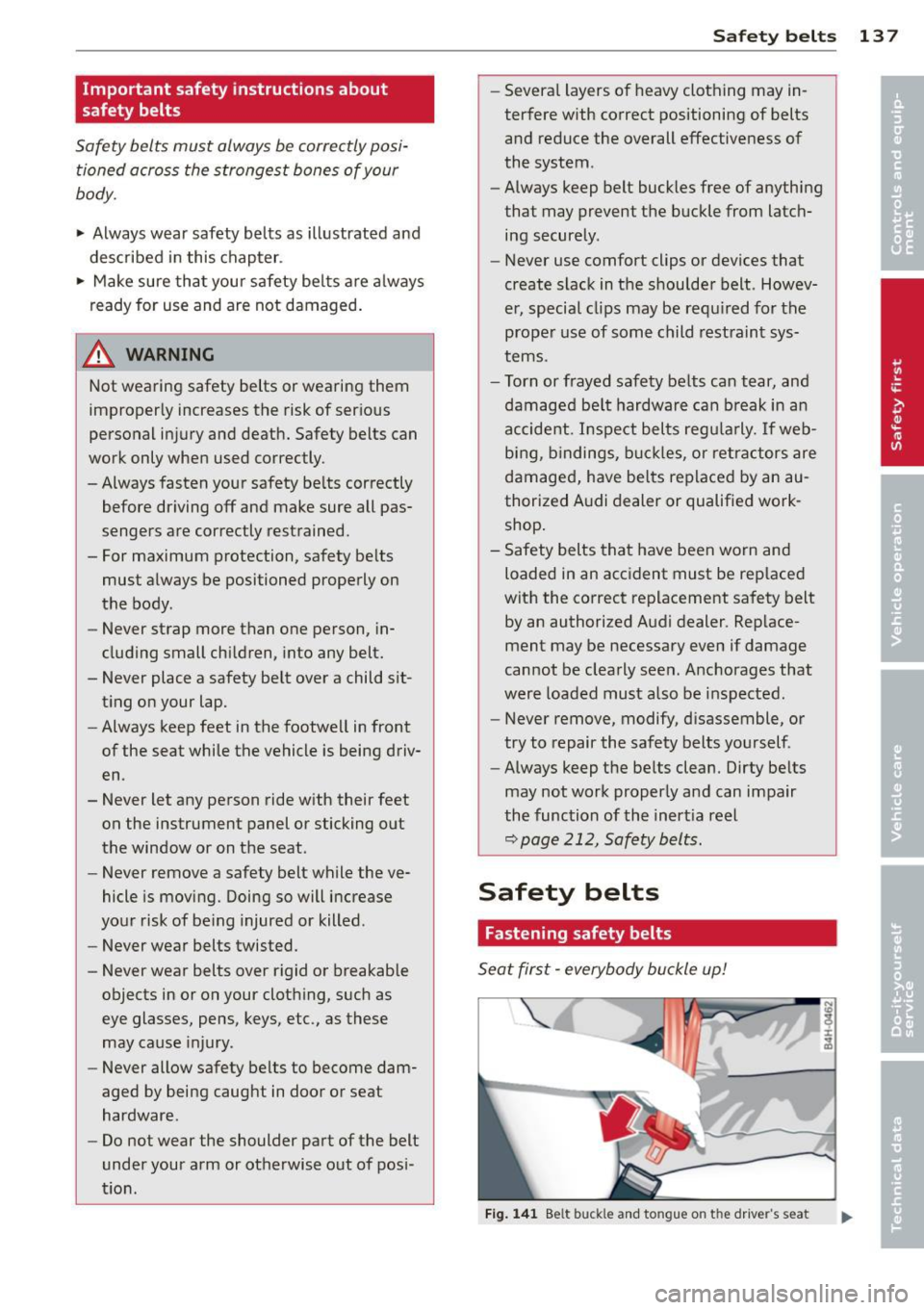
Fastening safety belts
Seat first -everybody buckle up!
Fig. 141 Bel t b uckle and to ngue on the driver's seat
Page 154 of 300
152 Airbag sys te m
electronic contro l uni t (the PAS SENGER AIR
BAG OFF
light comes on and stays on) .
A WARNING
Sitting in the wrong position can increase
the risk of serious injury in crashes.
- To reduce the risk of injury when the air
bags inflate, the driver and passengers
must always sit in an upright position,
must not lean against or place any part
of the ir body too close to the area where
the a irbags are located .
- Occupants who are unbelted, out of posi
t ion or too close to the airbag can be se
riously injured by an airbag as it unfolds
with great force in the blink of an eye
<=?page 144.
A WARNING
-
A child in a rearward -facing child sea t in
stalled on the front passenger seat will be
seriously injured and can be killed if the
front airbag inflates -even with an Ad
vanced Airbag System.
-The inflating ai rbag will hit the child seat
or infant carrier with great force and will
smash the ch ild seat and child against
the backrest , center armrest, door or
roof .
- Always install rear-facing child seats on
the rear seat.
- If you must install a rearward facing child seat on the front passenger seat
because of except iona l circumstances
and the
PASSENGER AIR BAG OFF light
does not come on and stay on, immedi
ately i nstall the rea r-facing chi ld seat in a
rear seating position and have the ai rbag
system inspected by your Au di dealer.
A WARNING
Objects be tween you and the a irbag will
increase the risk of in jury in a c rash by in
terfering with the way the airbag unfolds
or by being pushed into yo u as the a irbag
inf lates. -
Never hold things in you r hands o r on
your lap when the veh icle is in use.
- Never transpo rt items on or in t he a rea
of the front passenger seat. Objects
could move into the area of the front air
bags during braking or other sudden ma
neuvers and become dangero us projec
tiles that can cause ser ious personal in
jury if the a irbags inf late .
- Never p lace or attach accesso ries o r oth
er objects (such as cup hold ers, te le
phone b ra ck ets, large, heavy or bulky ob
jects) on the doors, ove r o r ne ar the are a
marked "AIRBAG" on the s teer ing whee l,
instr ument panel, sea t bac krests o r be
tween those areas and yourself. These
objects could ca use in jury in a crash, es
pecially when the airbags inflate.
- Never recline the front passenger 's seat
to transport objects. Items can a lso
move into the area of the s ide airbag or
the front a irbag during braki ng or in a
sudden maneuve r. Objects near the air
bags can become projectiles and cause
in jur y, partic ularly when the seat is re
clined.
A WARNING
The fine dus t create d when air bags deploy
c a n cause breathing p rob lems fo r people
wi th a history of as thma or other breath
i ng cond itions.
- T o reduce the risk of breath ing pro blems,
those with asthma or other respiratory
conditions s hou ld get fresh air right
away by getting o ut o f the veh icle or
open ing windows or doors .
- If you are in a collision in which airbags
deploy, wash your hands and face with
mild soap and water before eating.
- Be careful not to get the dust into your
eyes, or into any c uts or scratches.
- If the res id ue should get into your eyes,
f lush them w ith water.